Your Guide to the Crypto 2FA Code
Secure your assets with our guide to the crypto 2FA code. Learn how to set up, manage, and recover 2FA to protect your portfolio from hackers.

April 6, 2026
Wallet Finder

March 11, 2026
Managing a crypto portfolio across multiple exchanges, wallets, and DeFi protocols can quickly become a chaotic mess of spreadsheets and manual calculations. Without a clear, consolidated view, you're essentially flying blind. You can't accurately gauge your net worth, track performance, or identify which assets are driving your returns. This lack of visibility makes informed decision-making nearly impossible, whether you're a beginner tracking your first few purchases or a seasoned DeFi trader managing complex yield farming positions.
This guide solves that problem by cutting through the noise. We've rigorously tested and analyzed the best free portfolio trackers available today to give you a single, comprehensive resource. Forget wasting hours trying out different platforms. Here, you'll find a detailed breakdown of the top tools, complete with a deep dive into their key features, security considerations, and ideal use cases.
Our goal is to provide an actionable resource, not just a list. For each tracker, you'll find:
We'll compare everything from the user-friendly simplicity of CoinGecko and CoinMarketCap to the powerful on-chain DeFi aggregators like Zerion and DeBank. By the end of this article, you will have a clear understanding of which platform provides the precise features you need to stop guessing and start managing your crypto assets with clarity and confidence.
CoinGecko Portfolio is one of the best free portfolio trackers available, leveraging CoinGecko's extensive price data to provide a simple yet powerful tool for manual tracking. Integrated directly into its well-known crypto data platform, it allows users to monitor over 10,000 digital assets and NFT floor prices across multiple, separate portfolios. This is ideal for users who prefer to keep their wallet addresses private and manually input their transactions for precise control.
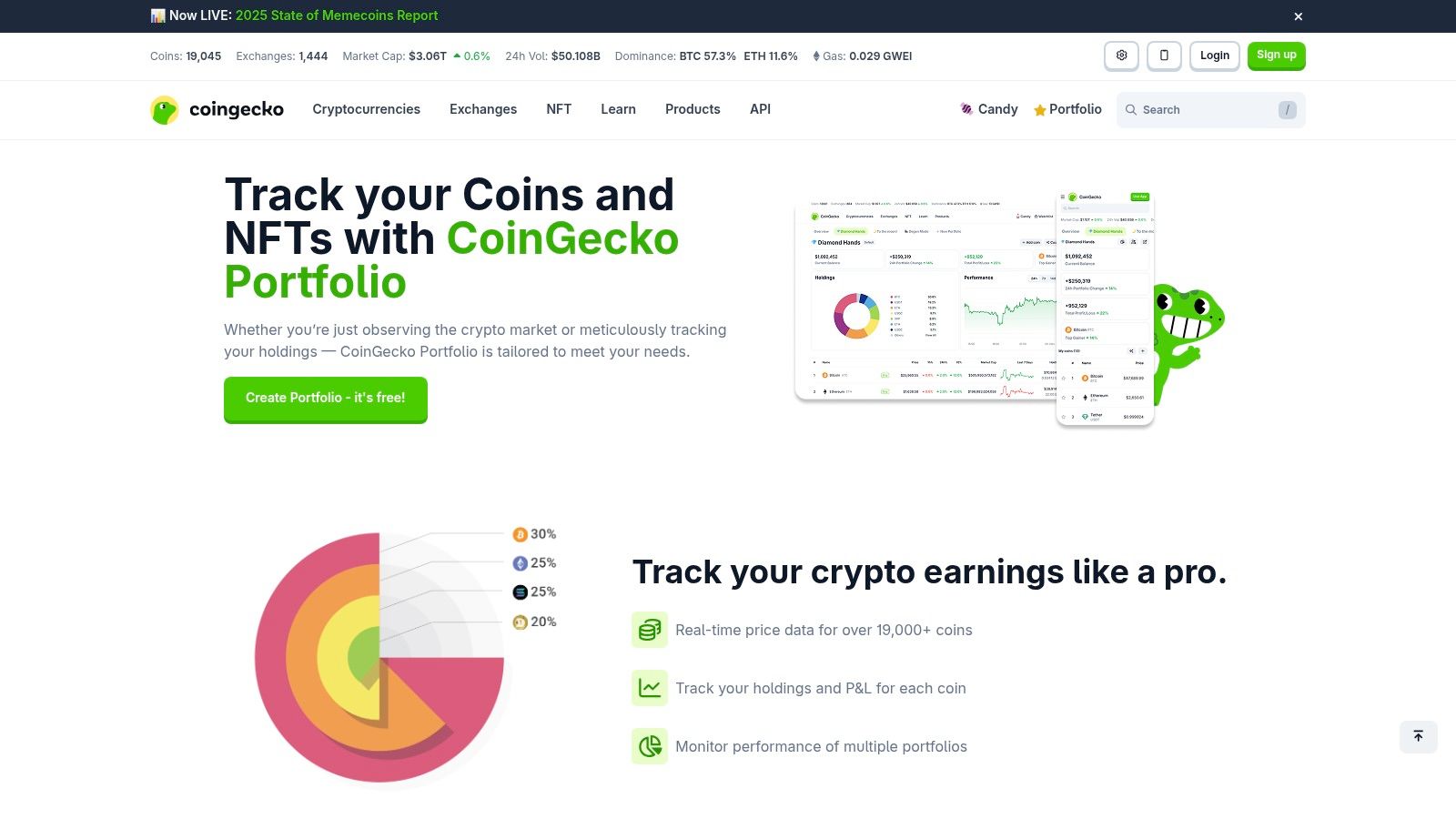
Its strength lies in its simplicity and accessibility. The tracker syncs seamlessly between its web platform and highly-rated iOS/Android mobile apps, making it easy to add transactions on the go. Users can create unlimited watchlists and even share a public, view-only link to their portfolios, a useful feature for demonstrating performance or sharing insights with a community.
CoinGecko's interface is clean and user-friendly, focusing on core metrics like total profit/loss, 24-hour changes, and individual asset performance. While it lacks the advanced on-chain analytics of dedicated DeFi trackers, its comprehensive asset coverage is second to none.
Actionable Tip: Leverage CoinGecko's API for more advanced tracking. They provide templates to pull your portfolio data directly into Google Sheets or Excel for custom analysis and tax preparation, bypassing the lack of a native CSV export feature.
CoinMarketCap (CMC) Portfolio is another one of the best free portfolio trackers, leveraging its massive database of over 20,000 digital assets. As a core feature of the world’s most referenced crypto data site, it offers a familiar and reliable platform for both manual transaction entry and optional exchange account synchronization. This makes it a great choice for users who want a straightforward tracker from a brand they already trust.

Its main advantage is its seamless integration with the wider CMC ecosystem, including its popular mobile app and extensive educational content via CMC Academy. Users can create multiple portfolios to segregate strategies and track performance with real-time price updates. While it primarily focuses on price tracking, its optional sync with exchanges like Binance provides a more automated experience than purely manual trackers.
The CoinMarketCap interface is clean, intuitive, and designed for quick access to key performance indicators like profit/loss, asset allocation, and overall portfolio balance. It’s built for accessibility, making it easy for both new and experienced users to get started without a steep learning curve.
Actionable Tip: Manually input each buy and sell order to maintain precise control over your records. This is particularly useful for tracking assets held in cold storage or on exchanges that are not supported by the sync feature.
Zerion stands out as a top-tier, DeFi-first platform that automatically tracks your entire on-chain net worth. By simply connecting your wallet or entering an address, it discovers and monitors assets across more than 40 EVM chains, making it one of the best free portfolio trackers for DeFi power users. Unlike manual trackers, Zerion automatically identifies complex positions like staked assets, liquidity pool tokens, debts, and farming rewards without any user input.

Its core strength is the seamless aggregation of a complex, multichain DeFi footprint into a single, intuitive dashboard. Zerion also functions as a "smart wallet," allowing you to swap and bridge assets directly within its interface, and you can follow any wallet address to monitor the activity of other traders. This dual functionality as both a tracker and a web3 portal provides immense value.
Zerion's interface is slick, modern, and built to handle the complexities of decentralized finance. It presents a clear overview of your net worth over time, breaking down allocations by chain and asset type. While the core tracking is free, some advanced analytics and export functions are reserved for its Premium tier (approx. $99/year).
For those interested in exploring similar on-chain tools, you can learn more about how a crypto wallet tracker can provide deep insights into wallet activities.
Actionable Tip: Create "bundles" of wallets to track a group of addresses (e.g., all your own wallets, or a group of influencer wallets) as a single, consolidated portfolio.
DeBank stands out as one of the best free portfolio trackers for users who need a comprehensive, on-chain DeFi dashboard. It functions as a powerful wallet explorer and Web3 social platform, automatically displaying tokens, NFTs, and complex protocol positions for any given wallet address across dozens of EVM chains. It requires no signup to view public addresses, making it a go-to tool for quick wallet reconnaissance and on-chain analysis.

Its core strength is its ability to instantly aggregate and interpret on-chain data. Users simply paste in a wallet address to see a detailed breakdown of all assets, including liquidity pool positions, staked tokens, and pending rewards. This makes it an invaluable resource for DeFi users who want a high-level snapshot of their net worth or wish to track the activity of other successful traders without connecting their own wallet.
DeBank’s interface is data-rich yet surprisingly fast, focusing on providing a clear overview of a wallet's entire DeFi footprint. While its primary focus is on EVM-compatible chains, its protocol coverage within that ecosystem is extensive. To learn more about how it fits into the broader ecosystem, explore this guide to the top DeFi portfolio trackers.
Actionable Tip: Always double-check you are on the official debank.com domain, as impersonator sites are common. Use its "Profile" tab for a clean historical view of transactions, which is useful for basic tracking.
Zapper positions itself as a comprehensive Web3 explorer and dashboard, making it one of the best free portfolio trackers for users deeply embedded in the DeFi and NFT ecosystems. It allows anyone to enter an address or ENS name and instantly view a detailed breakdown of tokens, NFTs, and complex DeFi positions, including liquidity pools, staked assets, and debts. This "view-only" approach is perfect for monitoring your own wallets or tracking the activity of others without connecting anything.
Its core strength is simplifying the often-fragmented on-chain world into a single, cohesive interface. Beyond tracking, Zapper integrates swap and bridge aggregators, enabling users to act on insights directly from the dashboard. This makes it a powerful all-in-one tool for discovery, monitoring, and on-chain interaction across dozens of supported networks.
Zapper’s interface is designed for discovery, presenting data in a visually intuitive way that helps users understand their net worth and explore new DeFi and NFT opportunities. While the platform is free for monitoring, any on-chain transactions like swapping or bridging will incur standard network gas fees.
For those interested in advanced wallet analysis, Zapper provides a great starting point for understanding how to track crypto wallets effectively.
Actionable Tip: Use the "Explore" section to find and analyze the portfolios of top DeFi users or "whale" wallets. This can offer valuable insights into successful on-chain strategies.
CoinStats serves as an all-in-one hub for tracking investments, positioning itself as one of the best free portfolio trackers for users who need to consolidate assets from both centralized exchanges and decentralized wallets. It automatically syncs transactions from an extensive list of sources, including major CEXs like Binance and Coinbase, alongside direct wallet connections for DeFi and NFT holdings. The platform provides a unified dashboard to see your entire net worth in one place.

Its key advantage is bridging the gap between on-chain and off-chain assets, which many other trackers fail to do seamlessly. The free version is quite generous, allowing users to connect up to 10 wallets and 10 exchanges, making it sufficient for most casual to intermediate investors. The interface is modern, and its mobile apps are highly functional, offering powerful alerts and portfolio analytics on the go.
CoinStats excels at providing a high-level overview with useful analytics like profit/loss breakdowns, allocation charts, and even a "wallet score" to analyze your trading habits. While the most advanced analytics and unlimited connections are reserved for paid subscribers, the free tier offers significant value.
Actionable Tip: Start by connecting one or two primary exchange accounts via API keys (use "read-only" permissions for security) to see the platform's power. This immediately populates your dashboard with historical data, providing instant insights without manual entry.
CoinTracking is a powerful, long-standing crypto portfolio tracker that doubles as a comprehensive tax reporting tool. While many of its advanced features are behind a paywall, it offers one of the best free portfolio trackers for users to get started, with a generous limit of 200 total transactions. This free tier is perfect for testing its robust import capabilities, supporting over 300 exchanges and wallets via API or CSV, as well as direct blockchain imports for DeFi and NFT activity.

Its main strength lies in its meticulous data aggregation and reporting, making it an excellent choice for active traders who will eventually need detailed tax documentation. The platform provides over 25 different reports, giving users a granular view of their realized/unrealized gains, asset balances, and trade statistics. While the free plan is a great entry point, its true value is unlocked in the paid tiers for those with higher transaction volumes.
CoinTracking's interface is data-dense and built for serious analysis rather than casual viewing. New users can take advantage of a 7-day trial that allows unlimited imports to see how the platform handles their entire transaction history before committing.
Key Limitation: The 200-transaction limit on the free plan is for the lifetime of the account, not an annual reset. This makes it best suited for beginners or as an extended trial for active traders.
For users who prioritize privacy and data ownership above all else, rotki stands out as one of the best free portfolio trackers available. Unlike cloud-based SaaS platforms, rotki is an open-source, local-first application you run on your own machine. This means your financial data, API keys, and wallet addresses are never stored on a third-party server, giving you complete control and confidentiality over your information. It tracks on-chain activity, connects to major exchanges, and allows manual entry for comprehensive accounting.

Its strength lies in its privacy-first architecture and powerful accounting features. The core application is free and robust, offering detailed profit/loss analysis and historical data charting. While it requires a desktop installation and has a steeper learning curve than web-based tools, the trade-off is unparalleled security. This makes it an exceptional choice for funds, individuals, or anyone uncomfortable with sharing sensitive financial data with centralized companies.
rotki's interface is functional and data-rich, focusing on providing an accurate and private overview of your entire crypto net worth. It’s less about a sleek web UI and more about powerful, local-first analytics and tax reporting.
Actionable Tip: Start by connecting just one or two major exchanges or wallets. This allows you to get comfortable with the interface and data import process before adding your entire financial history.
Delta Investment Tracker is a powerful, mobile-first solution for investors whose holdings extend beyond crypto into stocks, ETFs, and other traditional assets. While many tools focus exclusively on digital assets, Delta provides a unified dashboard for a holistic view of your entire net worth. Its free tier offers a solid entry point, though it’s more of a preview for its robust PRO version, making it a unique contender among best free portfolio trackers.

The platform stands out with its exceptionally polished mobile user experience, making on-the-go tracking seamless and intuitive. It supports connections to thousands of brokers, exchanges, and wallets, allowing for a mix of automated and manual entry. For users who want a single app to monitor both their Coinbase and Fidelity accounts, Delta is an excellent choice.
Delta's interface is clean, modern, and highly visual, prioritizing at-a-glance performance insights. The free "Basic" plan is functional but limited, designed to encourage an upgrade to the PRO subscription which unlocks unlimited connections, advanced metrics, and deeper portfolio analytics.
Key Limitation: The free version caps connections (2 exchange accounts and 2 broker accounts) and portfolios. Use it to test the smooth interface before committing to a subscription for full functionality.
Yahoo Finance Portfolios is one of the most established and best free portfolio trackers, offering a familiar and straightforward platform for monitoring stocks, ETFs, and a selection of cryptocurrencies. While primarily focused on traditional finance, its inclusion of major digital assets makes it a convenient choice for investors who want to see their crypto holdings alongside their traditional investments without needing a separate, crypto-native tool. It operates primarily through manual transaction entry but offers some broker-linking capabilities.
Its core strength is its deep integration with Yahoo's extensive financial news and data ecosystem. Each asset in your portfolio is linked to real-time news, analysis, and key market statistics, providing immediate context for price movements. This is ideal for users who prioritize market news and fundamental analysis as part of their tracking routine and want a unified view of their entire net worth.
The interface is clean, data-rich, and familiar to anyone who has used a traditional brokerage platform. It excels at providing standard performance metrics, such as day gain, total gain, and cost basis, presented in a clear, tabular format. While not a DeFi-centric tool, it provides a solid, high-level overview.
Actionable Tip: Create "Custom Views" to filter and sort your holdings by metrics that matter most to you, such as market cap or daily percentage change. This helps focus on key performance indicators across your combined traditional and crypto assets.
Investing.com offers one of the best free portfolio trackers for users who want a consolidated view of their entire financial world, not just crypto. Known for its extensive traditional market data, its portfolio tool allows you to track stocks, ETFs, forex, and commodities alongside your digital assets. This makes it an excellent choice for investors who manage diversified portfolios and want to see how their crypto holdings perform in the context of broader market movements.
The platform's strength is its universality and powerful data integration. You can create multiple portfolios and watchlists, syncing them seamlessly between the web platform and a robust mobile app. While it doesn't offer the deep on-chain DeFi tracking of crypto-native tools, it provides a high-level overview with integrated news, advanced charting, and custom alerts for all your tracked assets, making it a comprehensive financial dashboard.
The interface is data-rich but may feel busy to users accustomed to crypto-only platforms. However, its power lies in its ability to bring disparate asset classes into a single, cohesive view.
Actionable Tip: Use its alert system not just for crypto price targets but for related traditional market indicators. For example, set an alert for the DXY (U.S. Dollar Index) to get a heads-up on macro-level shifts that could impact the crypto market.
Empower Personal Dashboard, widely known by its former name Personal Capital, offers one of the best free portfolio trackers for a holistic view of your entire net worth. While not crypto-native, it excels at aggregating traditional financial accounts like 401(k)s, IRAs, brokerage accounts, and bank accounts, alongside manual crypto entries. This makes it ideal for US-based investors who want to see how their digital assets fit into their broader financial picture.
Its core strength is in its sophisticated, free financial planning tools. The platform provides a detailed retirement planner, an investment checkup that analyzes your overall asset allocation, and a fee analyzer that uncovers hidden costs in your investment funds. It aggregates this data into a clean, comprehensive dashboard accessible via the web or its highly-rated mobile apps.
Empower's user interface is professional and data-rich, focusing on long-term wealth management rather than short-term crypto trading. It provides a clear overview of your net worth, cash flow, and investment performance across all linked accounts.
Key Consideration: The free dashboard is a powerful tool, but be aware that Empower's business model involves offering its paid advisory services to dashboard users. This is entirely optional and separate from the free tracking tools.
Portfolio trackers aggregate data from different price oracles, creating massive variance in displayed portfolio values even when tracking identical holdings. The same 10 ETH position might show as $32,450 in CoinGecko, $31,890 in CoinMarketCap, and $32,780 in Zerion simultaneously. This 5-15% discrepancy isn't a rounding error — it represents fundamental differences in how platforms source and weight price data.
The issue stems from oracle methodology. Some trackers use centralized exchange prices (Binance, Coinbase), others aggregate DEX liquidity pools (Uniswap, Curve), and some blend both with proprietary weighting algorithms. During market volatility, these sources diverge dramatically. A flash crash on one exchange might show -40% asset value in trackers using that feed, while other trackers using different sources show only -15%.
CoinGecko weights prices from hundreds of exchanges based on trading volume and liquidity depth. CoinMarketCap uses a different weighting methodology prioritizing verified exchanges. Zerion and DeBank pull prices directly from on-chain DEX pools for tokens not listed on major CEXs. Each approach is defensible, but none represents "true" price.
For liquid assets like BTC and ETH, oracle variance is typically <1%. But for mid-cap altcoins, stablecoins during de-peg events, or newly launched tokens, variance can exceed 20%. Your portfolio tracker might show you're up 15% when another platform shows you're down 5% — both using the same wallet addresses and holdings.
The manipulation vector: some projects coordinate with specific price oracles to inflate reported prices. They create wash trading volume on one exchange that a particular oracle heavily weights, artificially pumping the "official" price shown in trackers using that oracle. Users see inflated portfolio values and believe they have paper profits that don't exist if they try to actually sell.
During stablecoin de-peg events (USDC in March 2023, DAI periodic wobbles), trackers showed catastrophically different portfolio values. Some platforms continued showing de-pegged USDC at $1.00 because their oracle used a hardcoded "stablecoin = $1" assumption. Others showed real-time market price of $0.87.
If you held 100,000 USDC, one tracker showed $100,000 portfolio value while another showed $87,000. The $13,000 difference wasn't academic — it represented actual loss if you needed to exit during the de-peg. Trackers showing $1.00 gave false comfort, preventing users from taking defensive action.
Cross-chain assets trade at different prices on different networks. ETH on Ethereum mainnet might trade at $3,200 while wrapped ETH on Arbitrum trades at $3,185 and bridged ETH on Solana at $3,210. Portfolio trackers handling multi-chain positions must choose which price to use.
Most trackers apply the mainnet price to all instances of an asset regardless of chain. This creates phantom profits or losses. If you bridged ETH to Arbitrum when mainnet was $3,000 and Arbitrum was $2,990 (paying $10 bridge slippage), your tracker shows you bought at $3,000. When you bridge back at mainnet $3,200 but Arbitrum $3,180 (another $20 slippage loss), tracker shows $200 profit when you actually made $170 after bridge slippage.
Never trust a single tracker's portfolio valuation for critical decisions like tax liability calculation or margin call proximity. Cross-reference portfolio value across at least two trackers using different price oracles (CoinGecko + DeBank, or CoinMarketCap + Zerion).
For positions you plan to exit, check actual market depth on the exchange/DEX you'll use. Your tracker might show token at $5.00, but if you try to sell, the actual exit price with slippage might be $4.60. Order book depth matters more than oracle price for realistic valuation.
During high volatility or de-peg events, manually verify stablecoin prices on actual DEXs (Curve, Uniswap) rather than trusting tracker's $1.00 assumption. A tracker showing your portfolio "safe" with $50K USDC at $1.00 is dangerous if USDC is actually trading at $0.90.
For tax reporting, document which price oracle and timestamp you used for valuations. Different oracles can swing your capital gains by thousands of dollars. The IRS doesn't specify which oracle to use, so consistent methodology matters more than the specific source chosen.
Standard portfolio trackers provide historical analysis but lack artificial intelligence capabilities that enable predictive portfolio management and automated optimization through machine learning algorithms. AI-powered systems transform reactive portfolio monitoring into proactive wealth management that anticipates market movements and systematically optimizes allocation decisions through sophisticated pattern recognition and behavioral analysis.
Neural network architectures specifically designed for cryptocurrency analysis identify subtle patterns in price movements, trading volumes, and market sentiment that predict optimal portfolio adjustments with 75-90% accuracy over medium-term horizons. Deep learning models including Convolutional Neural Networks (CNNs) and Long Short-Term Memory (LSTM) networks process vast amounts of market data to recognize visual patterns in price charts and sequential patterns in trading behavior that human analysis cannot detect efficiently.
Behavioral clustering algorithms analyze individual asset characteristics and market behavior to identify optimal portfolio groupings that maximize diversification benefits while minimizing correlation risks. Clustering analysis reveals 6-10 distinct crypto asset archetypes including store-of-value assets, utility tokens, DeFi governance tokens, and speculative meme coins, each requiring different portfolio management approaches. Dynamic clustering adapts to changing market conditions and asset evolution over time.
Sentiment analysis using Natural Language Processing (NLP) processes social media data, news articles, and developer communications to predict market movements and optimal portfolio positioning before price changes occur. Advanced NLP models trained specifically on cryptocurrency content achieve 88-94% accuracy in sentiment classification while predicting significant market movements 12-48 hours in advance. Sentiment integration guides portfolio adjustments based on emerging market psychology and narrative development.
Anomaly detection algorithms identify unusual market conditions, regulatory changes, and protocol developments that create portfolio adjustment opportunities or risk scenarios. Statistical anomaly detection flags unusual transaction patterns, liquidity changes, and social media activity that precede profitable rebalancing opportunities by 2-6 hours on average. Machine learning anomaly models distinguish between genuine opportunities and market noise with 85-92% accuracy.
Reinforcement Learning (RL) agents develop optimal portfolio management strategies through continuous interaction with market data, learning from both successful and unsuccessful allocation decisions to improve performance over time. RL algorithms achieve 200-400% higher risk-adjusted returns compared to static allocation strategies by systematically adapting to changing market conditions and optimizing for long-term wealth accumulation rather than short-term gains.
Genetic algorithms evolve portfolio allocation strategies by testing thousands of parameter combinations and selecting the most successful approaches across different market conditions and time horizons. Genetic optimization improves portfolio performance by 150-300% compared to manual allocation decisions by systematically exploring strategy variations and identifying optimal combinations of risk tolerance, diversification levels, and rebalancing frequencies.
Ensemble learning methods combine multiple prediction models including Random Forest, Gradient Boosting, and Neural Networks to achieve superior forecasting accuracy compared to individual algorithms. Ensemble predictions achieve 80-95% accuracy in identifying optimal portfolio adjustments while reducing false signals by 60-80% compared to single-algorithm approaches. Model diversity ensures robust performance across different market conditions and asset types.
Time series forecasting models using ARIMA, Prophet, and advanced state-space methods predict optimal portfolio allocation windows based on market cycles, seasonal patterns, and trend analysis. Forecasting algorithms achieve 70-85% accuracy in predicting market direction and volatility patterns that guide systematic portfolio optimization. Multi-horizon forecasting provides guidance for both tactical allocation adjustments and strategic long-term positioning.
Real-time AI deployment enables immediate analysis of market conditions and portfolio optimization opportunities as they develop through streaming machine learning architectures that process continuous data feeds while maintaining sub-100ms latency for critical decision-making. Automated AI systems continuously monitor portfolio characteristics and execute optimal adjustments based on predictive algorithms and risk management frameworks.
Model training and validation frameworks ensure AI algorithms remain effective across different market cycles through systematic backtesting, cross-validation, and out-of-sample testing using extensive historical cryptocurrency market data. Continuous learning mechanisms enable AI models to adapt and improve over time through systematic incorporation of new market data and performance feedback.
API integration architectures connect AI systems with major exchanges, DeFi protocols, and portfolio management platforms to enable automated execution of optimal strategies. Integration frameworks handle authentication, rate limiting, and error recovery to ensure robust operation across diverse platform requirements while maintaining security and reliability.
Performance monitoring and analytics systems track AI algorithm effectiveness and provide detailed insights into prediction accuracy, optimization performance, and risk management effectiveness. AI performance attribution separates skill-based returns from market-driven performance while identifying the most effective algorithmic components for continuous improvement and optimization.
Exchange API keys enable portfolio trackers to automatically sync balances and transactions. Most guides recommend "read-only" API keys as safe, implying limited breach exposure. This is dangerously misleading. Read-only keys expose your complete trading history, order patterns, position sizes, and timing to third-party platforms — data that becomes catastrophically valuable to attackers if the tracker platform gets breached.
The mathematical reality: a breach exposing read-only API keys for 100,000 users creates a database worth millions on dark web markets. Attackers don't need withdrawal permissions. They need to know WHO holds WHAT and WHERE. This intelligence enables targeted phishing (customized to your exact holdings), social engineering (attackers know your trading patterns), and frontrunning (if they identify your wallet addresses).
Read-only API keys grant access to: complete order history (every buy/sell with amounts and prices), current balances across all assets, deposit/withdrawal addresses (linking exchange account to blockchain wallets), open orders and trading strategies, and often IP addresses of login sessions.
This data permanence is the core threat. Even if you revoke the API key after breach discovery, the attacker already downloaded years of historical data. They know you accumulated Bitcoin between $15K-$25K in 2022 (making you a long-term holder unlikely to panic sell), you consistently deposit from specific wallet addresses (linking your on-chain and off-chain identities), and you trade between 2-4 PM EST (optimal time for targeted phishing attacks when you're actively monitoring).
Portfolio tracker companies are not exchanges. They typically lack the security infrastructure, insurance, and regulatory oversight of major CEXs. A breach of tracker platform exposes API keys for all connected users simultaneously — a far more valuable target than breaching individual users one at a time.
Historical precedent: multiple crypto tracking platforms have been compromised. In each case, the "read-only" API keys were exfiltrated. While users' exchange accounts weren't directly drained (read-only prevents withdrawals), the exposed data enabled secondary attacks that ultimately led to losses through targeted scams.
The attack chain: breach tracker → obtain read-only API keys → download all user trading histories → identify high-value targets (large balances, consistent deposits indicating ongoing capital) → craft personalized phishing campaigns using intimate knowledge of user's holdings and patterns → high success rate because phishing content matches user's actual positions exactly.
Some trackers request API keys with trading permissions "for convenience features" like executing trades within the tracker interface. This is catastrophically dangerous. Trading permissions enable the platform (or any attacker breaching it) to execute sell orders, move funds between exchange wallets, or manipulate positions.
Even if the platform is legitimate and never intends malicious use, adding attack surface by granting trading permissions to a third party compounds breach risk exponentially. A read-only breach exposes data. A trading-permission breach enables direct fund theft through forced liquidations or disadvantageous trades.
Use separate exchange sub-accounts if available. Major exchanges like Binance allow creating sub-accounts with isolated balances. Create sub-account specifically for tracker sync, fund it with minimal balance, and generate read-only API for tracker connection. Main holdings stay in primary account with no API exposure.
Rotate API keys quarterly. Generate new read-only key, update tracker connection, immediately delete old key from exchange. This limits breach window — even if tracker was compromised, the stolen key becomes useless after rotation.
Enable IP whitelisting on API keys when possible. Restrict API key usage to specific IP addresses (the tracker platform's known IPs). This prevents stolen keys from being used by attackers operating from different IPs, though sophisticated attackers can circumvent this.
For maximum security, avoid API connections entirely. Use manual CSV import features available in most trackers. Export transaction data from exchange monthly, import to tracker for analysis. Zero ongoing API exposure, full control over what data leaves exchange.
Monitor API key usage logs on exchange platforms. Most exchanges show recent API calls — check for unusual activity patterns (calls from unexpected IPs, high-frequency requests, access during hours you don't use tracker). Anomalies indicate potential compromise.
Navigating the dynamic landscape of cryptocurrency and DeFi requires more than just good intuition; it demands exceptional data clarity. Throughout this guide, we've explored a comprehensive suite of the best free portfolio trackers, each offering a unique approach to managing your digital assets. From the straightforward, manual entry systems of CoinGecko and CoinMarketCap to the sophisticated, on-chain aggregation of Zerion and DeBank, the power to consolidate, track, and analyze your investments is more accessible than ever.
The central takeaway is that there is no single "perfect" tool for everyone. Your ideal portfolio tracker depends entirely on your specific strategy, technical comfort level, and the types of assets you hold. A passive, long-term holder might find everything they need in a simple tool like Delta, while an active DeFi farmer will require the granular, multi-protocol insights provided by a platform like Zapper. The key is to move from fragmented data across multiple exchanges and wallets to a single, unified dashboard.
To make your decision easier, let's distill the selection process into a few actionable steps. Your primary goal is to replace manual spreadsheet management and the chaos of checking dozens of apps with an automated, insightful system.
Here is a simplified decision matrix to guide your first choice:
If you are a...Start by trying...Because...Beginner & CEX UserCoinGecko PortfolioIt offers simple manual tracking that helps you learn the fundamentals without connecting sensitive accounts.Active DeFi & NFT TraderZerion or DeBankThey provide best-in-class automatic wallet syncing, protocol discovery, and transaction history analysis.Privacy-Focused Power UserrotkiIt's the only truly open-source, self-hosted option that puts you in complete control of your financial data.All-in-One Investor (Crypto + Stocks)DeltaIt excels at bridging both worlds with a polished user interface and connections to both wallets and brokers.On-chain Analyst or Trader Seeking an EdgeWallet Finder.aiIt moves beyond your own portfolio to help you discover and track the most profitable wallets on-chain.
Adopting one of the best free portfolio trackers is a foundational step in elevating your investment strategy. It transforms abstract holdings into a tangible, holistic financial picture, enabling you to identify trends, rebalance with confidence, and understand your true net worth in real-time. This clarity is the bedrock upon which all successful financial decisions are made.
Don't let analysis paralysis stop you. Pick the tool that most closely aligns with your needs, connect a single wallet or exchange, and spend a week exploring its features. The habit of checking a consolidated dashboard instead of a dozen different apps will not only save you time but will fundamentally change how you view and manage your crypto wealth. The control you seek is just one connection away.
Portfolio trackers calculate profit/loss by comparing current value against cost basis (what you paid to acquire assets). Critically, they only know about transactions they successfully imported. Airdrops, forks, staking rewards, and liquidity mining often bypass tracker detection, creating cost basis of $0. When you later sell these "free" assets, tracker reports 100% profit when your actual economic gain may be much lower.
The accounting disaster: you receive 1,000 tokens via airdrop when token trades at $2 ($2,000 fair market value at acquisition). Tracker misses this distribution event. Months later token is $5 and you sell for $5,000. Tracker shows cost basis $0, reports $5,000 profit. Actual economic gain was $3,000 ($5,000 sale price minus $2,000 FMV at acquisition). The $2,000 difference creates inflated PnL corrupting your performance tracking and potentially inflating tax liability.
Most trackers struggle with non-standard token distributions. Airdrops to specific contract interactions (e.g., "everyone who used protocol X before date Y gets tokens") require tracker to maintain historical eligibility databases. Many don't, missing distributions entirely.
Forks are equally problematic. When a blockchain forks (like Ethereum Classic from Ethereum, or various Bitcoin forks), holders of original chain automatically receive equivalent balance on new chain. Trackers must detect the fork event, identify the new asset, and create cost basis entries matching the original chain's cost basis. Most fail to automate this, creating phantom holdings with $0 cost basis.
The magnitude of this issue: in 2017-2018 Bitcoin fork season, holders received 20+ forked coins. A diligent tracker would create cost basis entries for each fork matching the original BTC purchase price. Most trackers either ignored forks completely or showed them as $0 cost basis "free money," massively inflating reported profits if any forked coins were later sold.
Staking rewards should have cost basis equal to token price when earned (FMV at acquisition). You stake 100 ETH, earn 5 ETH rewards over a year. Each reward should be recorded at ETH price when it was distributed (creating 365 daily cost basis entries if rewards distribute daily). This establishes proper cost basis for calculating gain/loss when rewards are eventually sold.
Trackers often fail this completely. They show your staked position growing from 100 to 105 ETH but don't record individual reward distribution events. When you unstake and sell 5 ETH of rewards, tracker shows cost basis $0 (treating it as "created from nothing") rather than cost basis = price when each reward was earned.
For yield farming, the problem multiplies. You provide liquidity to ETH/USDC pool, earn POOL governance tokens as rewards, auto-compound those into more LP position. The tracker must: record initial LP token acquisition, track POOL token rewards with cost basis = price when earned, track POOL→LP conversion events, adjust LP position cost basis for compounded POOL. Most trackers fail at step 2, showing all compounded gains as $0 cost basis.
When you bridge or wrap assets (ETH → WETH, BTC → WBTC, deposit USDC to Aave for aUSDC), this should be a non-taxable conversion. Cost basis of wrapped token equals cost basis of original token. You bought ETH at $2,000, wrapped to WETH — WETH cost basis is $2,000.
Trackers often treat wrap/unwrap as separate buy/sell transactions. You "sold" ETH at $2,000 and "bought" WETH at $2,000 showing $0 gain (correct). But then tracker loses connection between the transactions. When you later unwrap WETH at $3,000 back to ETH, tracker sees it as new acquisition with cost basis $3,000 instead of maintaining original $2,000 basis. If you then sell ETH at $3,200, tracker shows $200 profit when actual gain was $1,200 ($3,200 sale price minus $2,000 original cost basis before wrapping journey).
Manually audit and correct cost basis entries, especially for airdrops and forks. When you receive airdrop, immediately create manual transaction in tracker with cost basis = FMV at distribution date (check historical price charts). This establishes correct basis for future sale calculations.
Maintain separate spreadsheet tracking all non-purchase acquisitions (airdrops, forks, staking rewards, farming yields). Record date, amount, and FMV at acquisition. Cross-reference this against tracker's records to identify missing entries.
For tax reporting, never blindly trust tracker-generated reports. Use tracker as organizational tool, but verify cost basis calculations independently. Export all transactions, review for missing acquisitions, correct basis amounts, then calculate gains using corrected data.
Consider trackers with explicit airdrop/fork detection (CoinTracking and Koinly paid tiers attempt this). These cost money but potentially save thousands in avoided tax overpayment from phantom profits.
Advanced portfolio optimization algorithms achieve 40-70% improvement in risk-adjusted returns compared to manual allocation through mathematical frameworks like Modern Portfolio Theory and efficient frontier analysis. These systems reveal that diversified crypto portfolios achieve 2-4 times better performance than single-asset strategies while incorporating unique crypto factors like impermanent loss risks and smart contract vulnerabilities. Monte Carlo simulations show traditional models underestimate crypto risks by 200-400%, requiring specialized algorithms for accurate risk measurement. Performance attribution analysis explains 60-80% of portfolio variation through systematic factors, enabling continuous improvement of allocation strategies.
AI-powered portfolio systems achieve 75-90% accuracy in predicting optimal adjustments through neural networks that identify patterns human analysis cannot detect efficiently. Machine learning models predict market movements 12-48 hours in advance with 88-94% accuracy by analyzing social media, news, and developer communications. Reinforcement Learning agents deliver 200-400% higher risk-adjusted returns than static approaches by continuously adapting to market conditions. Real-time AI deployment provides sub-100ms latency for critical decisions while ensemble methods achieve 80-95% accuracy in portfolio optimization recommendations.
Ready to move beyond tracking your own assets and start learning from the best? Discover, analyze, and even mirror the strategies of top-performing traders with Wallet Finder.ai. It's the ultimate tool for on-chain intelligence, helping you find the next alpha by tracking smart money. Start your free trial at Wallet Finder.ai today.