Recovery Factor Calculation for Smart Traders
Master the recovery factor calculation to measure a strategy's resilience. Learn the formula, see DeFi examples, and find top wallets with Wallet Finder.ai.

June 20, 2026


Wallet Finder
February 8, 2026
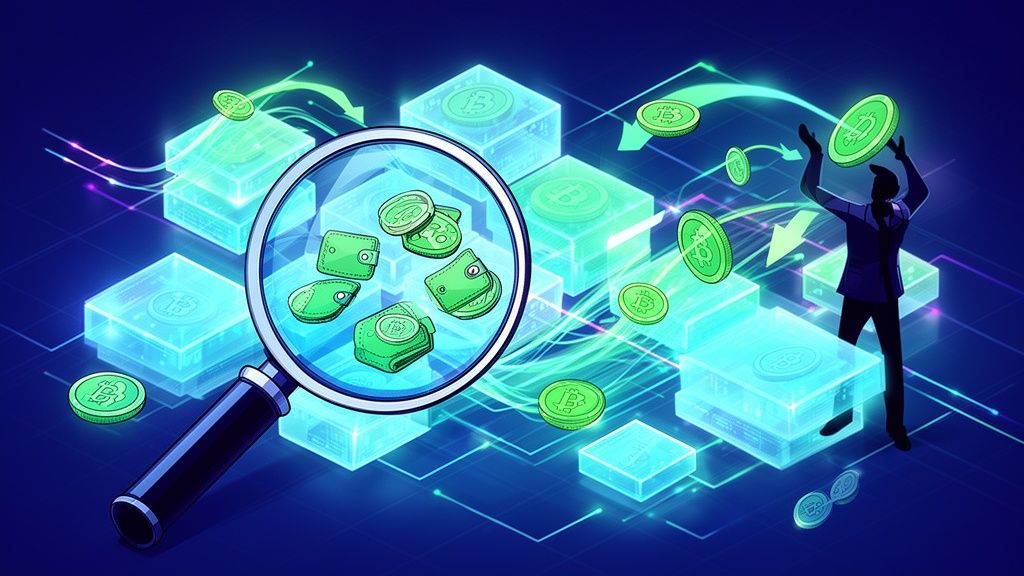
Block chain analytics is the process of digging through public blockchain data to find actionable intelligence. For a DeFi trader, this isn't just data—it's the secret sauce that reveals the "why" behind market moves, turning guesswork into sharp, data-driven decisions.
Picture the blockchain as a giant, transparent public library. Every transaction is recorded in a permanent, unchangeable book. Anyone can read these books, but the sheer volume of information is staggering. It's information overload.
Block chain analytics is the skill of knowing which books to read and how to interpret them for a real edge.
Instead of just reacting to price charts and news, you start seeing the hidden forces that drive those prices. This deeper insight is what separates successful traders from the rest. You stop reacting and start anticipating.
On-chain data provides a crystal-clear view of market behavior that traditional financial analysis can't offer. It helps you answer critical questions that lead to smarter, more profitable strategies.
Here’s what it unlocks:
By mastering block chain analytics, you transition from being a market spectator to a market detective. You learn to piece together clues from wallet movements and transaction patterns to build a solid picture of what’s really happening.
Ultimately, the goal is simple: make better, more profitable decisions. It’s like a business analyzing sales data to understand customer behavior, but you're applying that same logic to the entire crypto market.
Tools like blockchain explorers are your starting point. To understand them better, check out our guide on what is a blockchain explorer and how it works. Mastering this fundamental knowledge is the first step to unlocking the powerful insights block chain analytics has to offer.
To profit from on-chain data, you must learn its language. The blockchain communicates through transactions, wallet addresses, and token flows. The real skill is turning that raw information into a clear trading signal. Mastering a few core block chain analytics techniques is what separates the noise from the alpha.
Think of each technique as a different tool in a detective's kit. You wouldn't solve a case with just one piece of evidence. By combining these on-chain methods, you can build a complete picture of what the smartest traders are doing and, more importantly, why.
This concept map shows how everything starts with the public ledger. From there, block chain analytics branches out to help us track smart money and spot market-moving trends before they happen.
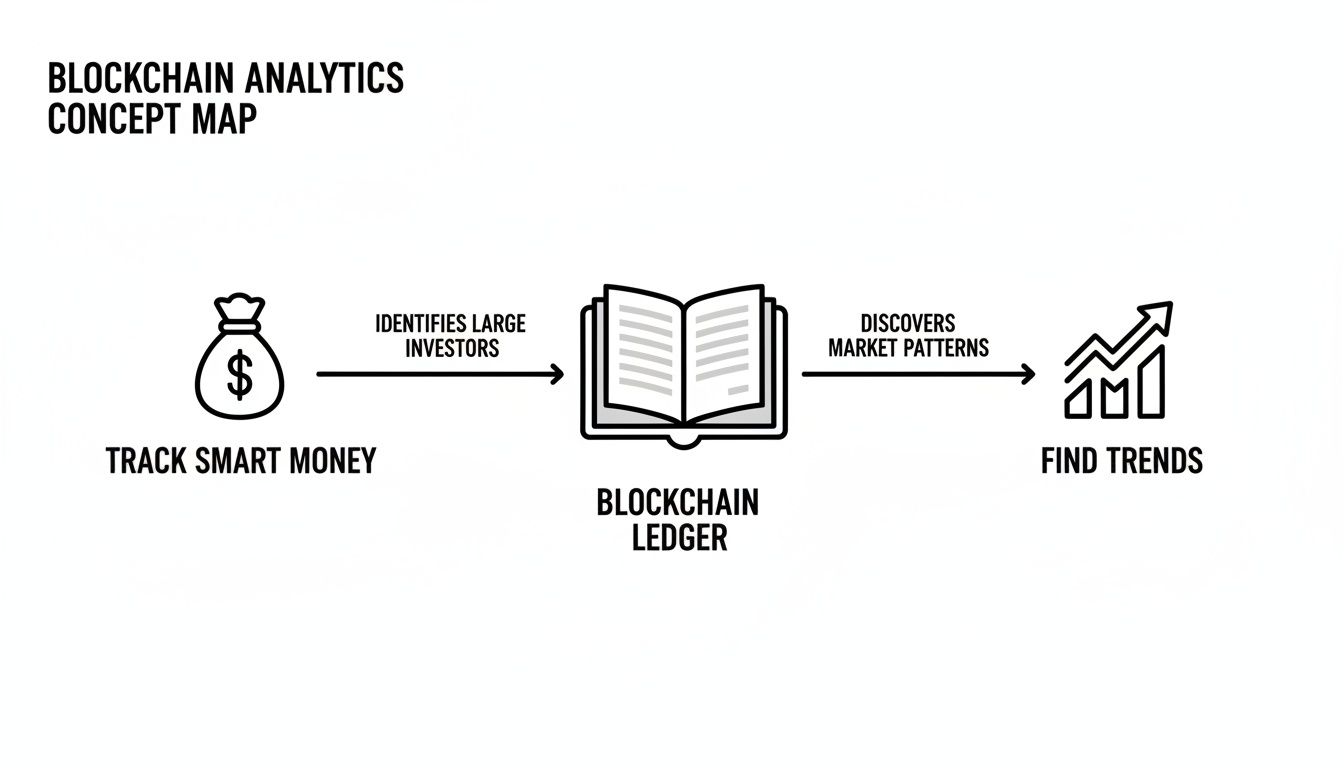
The entire point is to use the ledger's transparency to find an edge. Let’s break down the essential techniques you'll need.
Transaction tracing is financial detective work for the crypto age. It’s about following funds as they move between wallets to reveal their source, path, and destination. This is how you understand the story behind market movements.
For example, a large sum of stablecoins moving from a dormant wallet to a major exchange often precedes a big buy. Conversely, a whale shifting a massive token position from DeFi to a centralized exchange wallet could be a major red flag that they’re about to sell.
Transaction tracing isn't just watching numbers; it's about understanding the intent behind the movement. It’s the closest you can get to reading the minds of major players based on their actions.
This technique helps you answer critical questions:
Blockchain anonymity is largely a myth. While wallet addresses seem random, wallet clustering groups multiple addresses likely controlled by the same entity. It’s like discovering that a trader’s five different brokerage accounts all belong to the same person.
Top traders often spread capital across dozens of wallets to hide their size and strategy. Clustering algorithms analyze transaction patterns—like simultaneous funding from a single source or coordinated trades—to link them together. This provides a true picture of a trader's net worth, portfolio, and strategic footprint. Without it, you’re only seeing a small piece of the puzzle.
Profit and Loss (PnL) analysis is the ultimate report card for any wallet. It calculates realized and unrealized gains for every asset a wallet has ever touched, giving you an unfiltered look at its performance. This is one of the most powerful tools in block chain analytics.
PnL cuts through social media hype. A trader might brag about one huge win, but a PnL check could reveal a history of losses.
A solid PnL analysis reveals:
This is non-negotiable for determining if a "smart money" wallet is genuinely skilled or just got lucky once.
Liquidity flow analysis is like tracking capital tides in the DeFi ocean. It shows where money is flowing in aggregate—which tokens, protocols, or ecosystems are attracting capital and which are bleeding assets.
When you see billions in liquidity rushing into a specific DeFi protocol, it signals massive market conviction. When that capital flees, it signals risk or fading interest. This macro view helps you identify broad market trends and position yourself ahead of the herd.
This table breaks down these core on-chain techniques with a simple analogy and the key question each one helps you answer.
Each of these methods provides a unique layer of insight. When you learn to use them together, you can finally decode the language of the blockchain and make decisions based on hard evidence, not hype.
Knowing the theory of block chain analytics is one thing, but using it to make profitable trades is another. The real edge comes from a repeatable system—a workflow that turns raw on-chain data into confident trading decisions. This isn't about chasing one signal; it's about a disciplined process for finding, vetting, and acting on opportunities.
This four-step framework will take you from spotting a high-potential wallet to deciding whether to copy its strategy, adapt it, or move on.
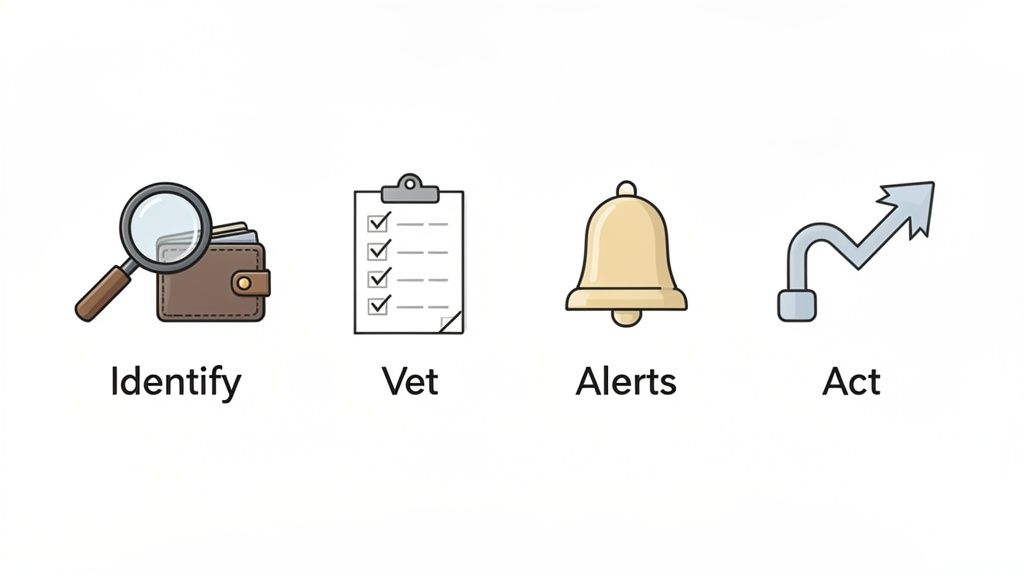
Stick to these steps to trade with a plan, not on a whim.
First, you have to find the needles in the haystack. The blockchain has millions of active wallets, but only a tiny fraction are consistently profitable. Your job is to pinpoint the "smart money" wallets worth your time.
A modern analytics platform is your best friend here. With a tool like Wallet Finder.ai, you can apply specific filters to do the heavy lifting. Instead of manually digging through Etherscan, you set criteria for what a "good" wallet looks like.
Start with these key filters:
This initial screen ensures you only analyze wallets with a proven track record.
Now that you have a shortlist, the real detective work begins. A big PnL number is great, but you must understand how they got it. Vetting means diving into a wallet's transaction history to figure out its trading style, risk tolerance, and token preferences.
During this phase, answer these critical questions:
This deep dive separates skilled traders from lucky ones. You want to follow a repeatable process, not a lottery ticket.
The crypto market moves at lightning speed. By the time you manually check a wallet's activity, an opportunity could be gone. Real-time alerts are non-negotiable.
Timeliness is everything in DeFi. An alert that arrives five minutes after a smart money move is infinitely more valuable than discovering that trade five hours later.
Most advanced block chain analytics platforms let you create custom notifications for wallets you follow. Get alerts via Telegram, push notifications, or email the second a tracked wallet makes a move.
Configure alerts for:
These alerts transform your analysis from reactive to proactive, allowing you to act on opportunities as they unfold.
This is the final, most important step: making the call. Blend the on-chain data with your own judgment and risk management. Blindly copying every trade is a recipe for disaster. Treat alerts as high-quality signals that require further investigation.
Here is a simple decision-making checklist for when an alert fires:
This disciplined approach keeps you in control, using smart money moves as a source of ideas, not as a blind instruction manual.
Not all on-chain activity is created equal. The blockchain is transparent but also incredibly noisy. It’s filled with retail hype, manipulation, and traps designed to fool the average trader. Block chain analytics is your shield, helping you separate real signals from all that background noise.
Understanding these advanced patterns is crucial. It’s the difference between following a skilled investor and getting suckered into a pump-and-dump scheme. When you learn to spot the subtle red flags and green lights, you start seeing what most of the market misses.
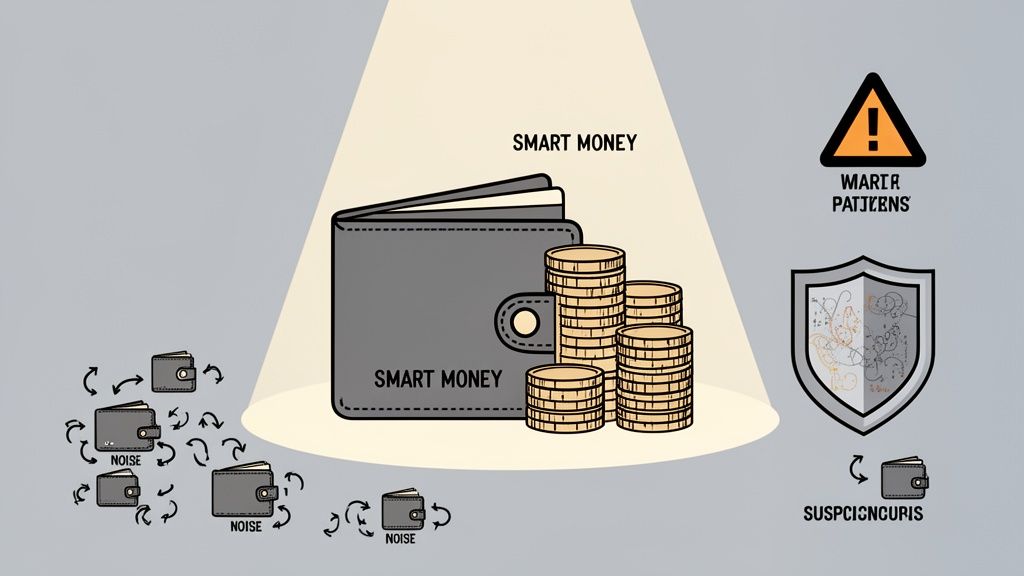
Let's break down key signals that expose market manipulation and highlight genuine smart money moves.
The smartest traders rarely broadcast their intentions. Instead of placing a single, massive buy order that would spike prices, they engage in stealth accumulation. This means methodically building a large position over days or weeks through smaller, less obvious transactions, often across multiple wallets. The goal is to fly under the radar and avoid inflating their entry price.
What to look for:
When you find a stealth accumulation pattern, it's a powerful signal that an institution or expert is interested. It suggests someone with deep knowledge expects a big price move and is positioning themselves before the news breaks. You can learn more in our guide on using a smart money tracker.
Wash trading is a classic manipulation tactic. It's when an entity trades a token back and forth with itself to create the illusion of high volume and liquidity. This fake hype is designed to lure retail traders who see the activity and assume they've found the next big thing. This is common with new token launches and NFTs to get the asset trending on tracking sites.
How to spot it:
Maximal Extractable Value (MEV) is the profit extracted by reordering, inserting, or blocking transactions within a block. Its presence is a giveaway of advanced bot activity, which can create dangerous situations for manual traders.
A prime example is a sandwich attack: a bot spots a large pending trade, buys the same asset right before it (front-running), lets the trade execute and push the price up, and then immediately sells for a quick profit. The original trader gets a much worse price.
Learning to recognize wallets that consistently perform these moves is key. While you may not want to copy them, their activity can confirm an asset has enough liquidity to attract sophisticated bots—a double-edged sword signaling both opportunity and risk. This highlights why advanced block chain analytics is essential for survival.
Knowing the theory is one thing, but putting it to work is how you make money. A powerful tool can turn all the complex block chain analytics we've discussed into a few simple clicks. Wallet Finder.ai bridges the gap between finding a solid strategy and executing it, making top-tier on-chain analysis accessible to any trader.
The platform is built to make spotting and vetting smart money as straightforward as possible, doing the heavy lifting so you can focus on making good decisions.
First, you need to find the right wallets to follow. With the 'Discover Wallets' feature, you can apply razor-sharp filters to instantly surface the most profitable and consistent traders.
You can filter by crucial metrics like:
This feature slices through the noise, handing you a curated list of high-potential wallets in seconds. It’s your launchpad for building a watchlist of genuine alpha.
The dashboard below gives you a glimpse of how this works. You get a clean list of top wallets, sorted by their profitability and other key stats.
This view provides an immediate snapshot of top performers, making it easy to spot which wallets are worth a closer look.
Once a promising wallet catches your eye, a single click reveals its entire trading history. This is where you vet the strategy. You can see a full PnL breakdown, their biggest wins and losses, and the exact entry and exit points for every trade.
This helps you understand the how and why behind their success. You’ll quickly see if they specialize in a certain ecosystem, like Solana or Base, or if they just have a knack for sniffing out trending tokens early.
This granular view is crucial. It’s not about blindly copying trades; it’s about deconstructing a successful strategy so you can learn from it, adapt its principles, and sharpen your own trading style.
The final piece is execution. With Wallet Finder.ai, you can set up instant Telegram alerts for any wallet you track. The second a monitored wallet makes a move—buying, selling, or swapping—you get a notification.
This ensures you never miss a critical trade. The speed of these alerts gives you the chance to analyze the move and act while the opportunity is still hot. In a 24/7 market, this is non-negotiable. Global adoption is accelerating, with Asia-Pacific projected for a 63.4% CAGR through 2031. This means opportunities arise at all hours, making a tool that watches the market for you indispensable. You can explore detailed market analysis on MordorIntelligence.com to see how fast things are moving.
By combining discovery, deep analysis, and real-time alerts, you can build and execute a potent on-chain trading strategy. You can discover how Wallet Finder.ai simplifies this process and start turning data into actionable insights today.
The blockchain might be an open book, but that transparency creates a deafening amount of noise. Your real edge in DeFi comes from knowing how to pull clear, actionable signals out of that chaos. This is where block chain analytics comes in, turning raw data into a serious advantage.
We've walked through core techniques: tracing transactions, digging into wallet performance, and following the money. We even pulled back the curtain on advanced signals, like stealth accumulation or predatory MEV bots. These aren't just buzzwords; they are the tools you use to build a trading strategy that’s always one step ahead.
When you apply these methods, a fundamental shift occurs. You stop reacting to market news and start anticipating where things are headed. You’re no longer chasing pumps after they’ve happened. Instead, you're positioning yourself before them, learning directly from the best on-chain traders in real time.
This proactive approach is built on three pillars:
The ultimate goal is to turn the blockchain’s ledger from a simple record of the past into a playbook for the future. You start to see where capital is likely to move next, giving you a massive head start.
By combining the right analytical mindset with a powerful platform, you can filter out market chatter. It lets you focus on one thing: the high-conviction moves being made by the smartest players. At that point, you're not just participating in the market—you're decoding it.
Jumping into block chain analytics can feel like trying to read the Matrix at first. As you start digging into this powerful field, it's normal for questions to pop up. Let's tackle some of the most common ones we hear from traders new to on-chain analysis.
This is about providing straight, practical answers to help you get past the initial learning curve and start building a real edge.
Not anymore. It used to require serious technical skills to trace transactions or cluster wallets. But modern tools have changed the game, taking complex data and presenting it on clean, intuitive dashboards.
The real skill for a beginner isn't data science; it's learning to read and interpret these visual reports. While understanding core concepts is important, the barrier to entry is much lower. You can now pull powerful insights without writing any code, making block chain analytics accessible to anyone.
Absolutely not. Using on-chain analysis to mirror top traders is a great way to generate ideas, but it's not a magic money printer. The market is unpredictable, and even the best traders have losses.
Think of a smart money move as a high-quality signal, not a command. Always do your own research on any token or trade you're considering.
The most important thing is to run every decision through your own risk management framework. Blindly aping another trader without considering your portfolio size, risk tolerance, and goals is just gambling. Use their trades as inspiration, not as an instruction manual.
This is a huge misconception. On-chain analysis isn't a crystal ball that predicts a token will hit $5.32 next Tuesday. Its power lies in showing you the behavior of the market's biggest players, which is often a leading indicator of where the price is headed.
For example, on-chain data can show you:
These insights give you a probabilistic edge, not a guarantee. They help you see the forces likely to move the market, letting you get positioned before everyone else.
The best chain to analyze is the one where the action is happening for your strategy. Don't try to watch everything at once. Focus your energy on the ecosystems where your target opportunities live.
Here’s a quick guide:
The key is simple: follow the money. By focusing your block chain analytics on the chains with the most volume and active smart money, you drastically increase your odds of finding a winning trade.
Ready to turn these insights into action? Wallet Finder.ai simplifies complex on-chain data, providing the tools you need to discover profitable traders, track their every move, and act on opportunities in real time. Start your 7-day trial today at https://www.walletfinder.ai.

A premier DeFi analytics platform empowering traders to discover and analyze profitable blockchain wallets, trades and tokens.