Guide to Crypto Funding Rates

Wallet Finder

Blank calendar icon with grid of squares representing days.

January 17, 2026

Crypto funding rates are periodic payments between traders in perpetual futures markets. Their purpose is to keep the contract's price anchored to the asset's spot price.

Think of it as the invisible force ensuring a derivative—which never expires—faithfully tracks the real-time value of the crypto it represents. It's the balancing act that keeps the entire system in equilibrium.

The Core Idea Behind Crypto Funding Rates
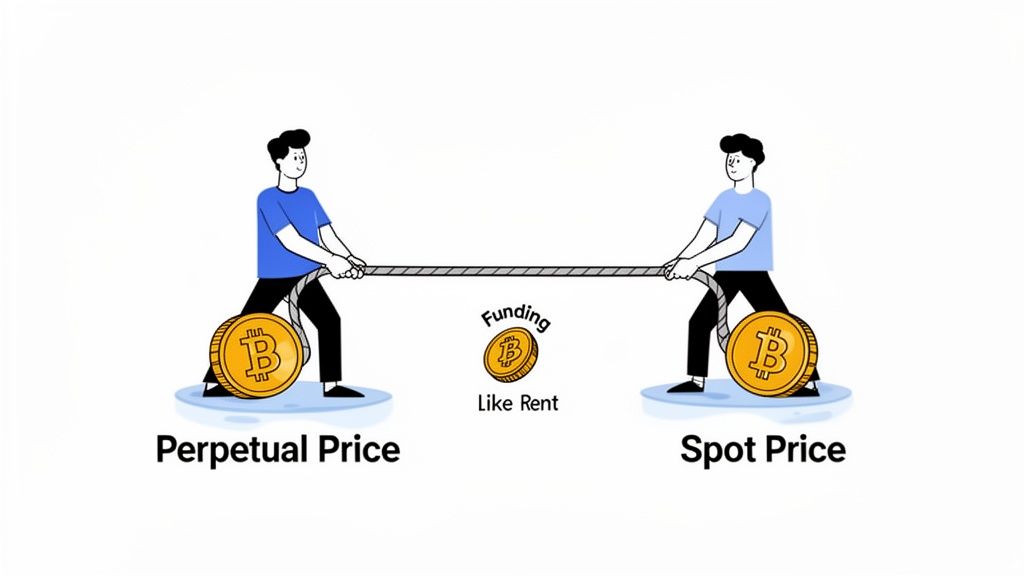
Two people in a tug-of-war with Bitcoin coins, representing perpetual and spot prices balanced by funding like rent.

Picture a tug-of-war. On one end is the price of a Bitcoin perpetual futures contract. On the other is the spot price of Bitcoin. The goal is to keep the rope centered. Funding rates are the constant, tiny adjustments—the gentle tugs—that stop one side from overpowering the other.

This balancing act happens through small payments exchanged directly between traders, not fees paid to the exchange. It's a peer-to-peer settlement. A simple way to think about it is paying a little 'rent' to hold a position that's more popular than the other side of the trade.

How Funding Payments Work

The direction of payments depends entirely on market demand. The system is designed to incentivize traders to take the less popular side of a trade, which naturally nudges the contract price back toward the spot price.

It boils down to two scenarios:

  • Positive Funding Rate: When the perpetual contract trades higher than the spot price, it indicates bullish sentiment. In this situation, traders holding long (buy) positions pay a fee to those holding short (sell) positions.
  • Negative Funding Rate: Conversely, when the contract price dips below the spot price, it signals bearish sentiment. Now, the tables are turned: traders with short positions pay those with long positions.

The core function of funding rates is to create equilibrium. By making it more expensive to hold the majority's position, the market discourages overcrowding and maintains the crucial price peg between the derivative and its underlying asset.

Why Funding Rates Are a Critical Signal

For any serious trader, funding rates are more than a cost; they're a powerful, real-time gauge of market sentiment, revealing where collective leverage is building up.

For instance, a consistently high positive rate shows the market is overwhelmingly long. This creates the perfect conditions for a "long squeeze" if the price suddenly reverses, forcing leveraged longs to liquidate.

These rates are a direct reflection of trader positioning, with costs varying across exchanges based on liquidity and volatility. To compare rates, a good resource is CoinMarketCap's funding rate data.

Understanding this dynamic is the first step toward building sophisticated trading strategies. By monitoring funding, you get a clearer picture of market psychology, helping you sidestep crowded trades and spot potential reversals.

How Funding Rates Are Calculated

To understand what crypto funding rates are telling you, you need to look under the hood. The calculation is a specific formula designed to keep the perpetual futures market tethered to reality. It all boils down to two key parts: the Interest Rate and the Premium.

The funding rate is simply these two components added together. While exchanges might have slight tweaks in their formulas, this fundamental structure is universal.

The Interest Rate Component

The first piece is the Interest Rate. Think of this as the basic cost of keeping your position open. In a swap like BTC/USDT, you’re dealing with two currencies. This component reflects the difference in borrowing costs between them.

For example, the formula looks at whether it costs more to borrow USDT or BTC. Exchanges typically set a fixed daily interest rate to account for this. A common rate is 0.03% per day, which works out to 0.01% for each 8-hour funding window. This part of the calculation is usually stable and predictable.

The Premium Component

The second, more dynamic component is the Premium. This is where market sentiment comes into play. The premium is the gap between the perpetual contract's price and the asset's spot price. Funding rates exist to close this gap.

The gap's size depends on buying and selling pressure in the perpetuals market:

  • Positive Premium: A wave of buying pushes the perpetual contract price above the spot price, creating a positive premium. This indicates bullish sentiment.
  • Negative Premium: Heavy selling drives the contract price below the spot price, flipping the premium negative and signaling a bearish mood.

This component makes funding rates a powerful real-time indicator of what traders are thinking.

A volatile premium is the market's way of shouting its intentions. When the premium spikes, it shows a rush of demand for leverage on one side of the trade, forcing the funding rate to adjust and restore balance.

To make this crystal clear, here’s a breakdown of the components.

Funding Rate Calculation Components

ComponentWhat It MeasuresHow It Influences the Rate
Interest RateThe cost difference of borrowing the base and quote currencies.Provides a stable, baseline cost for holding a position.
PremiumThe price gap between the perpetual contract and the spot market.Creates dynamic shifts based on bullish or bearish market sentiment.

By combining the steady Interest Rate with the ever-changing Premium, the final funding rate provides a complete picture of both the fundamental cost of capital and immediate, sentiment-driven market pressures.

Reading the Market with Funding Rates

Funding rates are one of the purest, real-time gauges of market psychology available. They’re more than a fee; they’re a live reading of the collective greed and fear driving the derivatives market. Learning to read them is like learning to read the room—it gives you a massive edge.

This real-time feedback comes from the two parts of the funding rate: a stable interest rate and a volatile premium. The premium directly reflects the tug-of-war between buyers and sellers fighting for leverage.

This graphic breaks down the simple but powerful calculation.

A clear flowchart illustrates the crypto funding rate process, showing interest rate plus premium equals funding rate.

The steady interest rate provides a baseline, but it's the premium—driven by raw market sentiment—that really tells the story.

Decoding Bullish Sentiment

When the market is euphoric, traders pile into long positions. This buying frenzy pushes the perpetual contract price above the spot price, creating a positive premium and a positive funding rate. In this environment, longs pay shorts to keep their positions open.

Consistently high positive funding rates are a red flag. It means the market is top-heavy with bullish leverage, creating a fragile situation. This is the perfect setup for a "long squeeze," where a small price dip can trigger a domino effect of forced liquidations, causing a sharp crash.

Interpreting Bearish Sentiment

When fear takes over, traders rush to short the market. This selling pressure pushes the perpetual contract's price below the spot price, resulting in a negative funding rate. Now, shorts have to pay longs.

Deeply negative rates are a powerful sign of widespread panic. As grim as it sounds, this is often the fuel a massive rally needs. This is where you get a "short squeeze," where a small move up forces shorts to buy back their positions, triggering an explosive chain reaction that sends prices soaring. Historically, major market bottoms have occurred during times of extreme negative funding.

Funding rates act as a contrarian's best friend. Extreme greed (high positive rates) often signals a local top, while extreme fear (deep negative rates) frequently points to a local bottom.

Using Funding Rates with On-Chain Data

Funding rate analysis is powerful, but it becomes a superpower when paired with other data, like insights from the blockchain. Learning to interpret crypto on-chain data provides a complete picture.

Imagine seeing high positive funding rates (greed). If you then see on-chain data showing a huge flow of coins to exchanges from long-term holders, the alarm bells should ring. This suggests smart money is preparing to sell into retail-driven hype. The combination of signals is far more reliable than either one alone.

Here’s how you can layer these two data sources for smarter trades:

  • Confirming a Top: High positive funding rates + Large exchange inflows = Higher probability of a market top.
  • Spotting a Bottom: Deep negative funding rates + On-chain data showing whale accumulation = Stronger chance of a market bottom.
  • Gauging Trend Strength: Neutral funding rates + Steady on-chain accumulation = A healthy, sustainable uptrend.

By cross-referencing derivatives sentiment with actual on-chain behavior, you can make far more confident decisions and identify high-conviction opportunities.

Actionable Trading Strategies Using Funding Rates

Illustrations of three crypto trading strategies: funding rate arbitrage, contrarian reversal, and trend confirmation.

Understanding crypto funding rates is one thing; turning that knowledge into profitable trades is another. By spotting specific patterns, you can build clear, rules-based strategies that give you an edge.

Let's break down three powerful, actionable strategies you can use today.

Strategy 1: Funding Rate Arbitrage

Often called a "carry trade," this strategy is market-neutral. You aren’t betting on price direction; you’re simply aiming to profit from the funding payments. It's a popular way to generate a relatively steady income from the derivatives market.

The idea is simple: find a perpetual contract with a high positive funding rate, short it, and then buy the same amount of the underlying asset on the spot market. This creates a hedged position. Now you collect funding payments from over-leveraged longs, while your spot holding protects you if the price rises.

Execution Checklist

  1. Hunt for High Rates: Scan exchanges for assets with consistently high positive funding rates (ideally above 0.05% per 8 hours).
  2. Short the Perpetual: Open a short position on the perpetual futures contract.
  3. Buy the Spot: Immediately buy the exact same amount of the asset on the spot market.
  4. Collect Payments: Hold the position and let the funding payments roll in.
  5. Exit Cleanly: Close both positions simultaneously when the funding rate drops and is no longer profitable.

This strategy thrives on market greed. When bullish hype pushes funding rates to extreme levels, arbitrage traders provide liquidity and collect a premium for taking the less popular side of the trade.

Risk Management for ArbitrageYour biggest risk isn't a price crash—it's basis risk. This is the danger that the gap between the perpetual and spot price changes against you, potentially wiping out your funding profits. Always monitor the price difference between the two markets.

Strategy 2: Contrarian Reversal Trading

This strategy is for traders who hunt for major market tops and bottoms. The premise is that extreme market sentiment, reflected in funding rates, often precedes a sharp reversal.

When rates are extremely high and positive, it’s a sign of extreme greed and a potential market top. When rates are deeply negative, it signals widespread fear and a potential market bottom.

Entry and Exit Signals

  • To Short a Top: Look for consistently high positive funding rates paired with other signs of exhaustion, like bearish price action. Enter a short and place your stop-loss just above recent highs.
  • To Long a Bottom: Find deeply negative funding rates that signal peak fear. Combine this with technical signs of a bottom, like a bullish divergence. Enter a long with a stop-loss just below recent lows.

Before executing a contrarian play, it's crucial to see how it would have performed historically. You can learn more about how to backtest trading strategies to validate your approach.

Strategy 3: Trend Confirmation

Sometimes, the most valuable signal simply tells you to stay in a winning trade. That’s where funding rates become a powerful tool for trend confirmation.

A healthy, sustainable uptrend is usually marked by neutral or slightly positive funding rates. This indicates that while there’s bullish interest, the market isn't dangerously over-leveraged. Similarly, a strong downtrend often has slightly negative funding rates, showing persistent but not panicked bearish sentiment.

How to Use Funding for Confirmation

  • In an Uptrend: If you're long, stable and slightly positive funding is a green light to hold. If rates suddenly spike, the trend might be overheating, and it could be smart to take some profits.
  • In a Downtrend: If you're short, slightly negative rates confirm the trend. If rates plunge into deeply negative territory, it could signal capitulation and an impending short squeeze. That's your cue to lock in profits.

Common Mistakes and Risks to Avoid

It’s tempting to view funding rates as a crystal ball, but relying on them without understanding their limits is a recipe for disaster. These numbers reflect past and present sentiment, not a guaranteed future outcome.

Treating funding rates as a standalone, predictive tool is one of the most common and costly mistakes. A nuanced approach, blending their signals with a broader market view, is essential.

The Lagging Indicator Trap

Here’s the most important takeaway: funding rates are a lagging, not a leading, indicator. They tell you how the market is positioned now, reflecting the collective sentiment that has already built up.

A market can stay "overheated" with high positive funding rates for a surprisingly long time during a powerful uptrend. Shorting too early based on a high rate alone can lead to significant losses.

Never assume a high funding rate guarantees an immediate price correction. It only signals that the conditions for a reversal are in place, but it doesn't tell you when or if that reversal will happen.

This is why context is everything. Combine funding rate data with technical analysis, order book flow, and on-chain metrics to build a complete picture.

Misinterpreting Neutral Rates

While extreme funding rates get all the attention, neutral rates are just as revealing. A rate hovering around the 0.01% baseline can mean several things:

  • A Healthy Trend: A steady rally not fueled by risky leverage.
  • Consolidation: The market is coiling up for its next big move.
  • Balanced Positioning: Longs and shorts are in equilibrium.

Dismissing a neutral rate as "boring" is a mistake. You might miss a quiet accumulation phase or fail to recognize the stability in an ongoing trend.

Ignoring the Bigger Picture

No market indicator lives in a bubble. Major economic news, regulatory shifts, or changes in global risk appetite can override any signal from funding rates.

For instance, a deeply negative funding rate might scream "short squeeze," but if it happens during a global market crash, that bullish reversal probably isn't coming. Macro fear will almost always overpower localized sentiment in the derivatives market.

A Practical Checklist for Risk Management

Use this simple checklist to ensure you're using funding rates as a tool, not a trap.

DoDon't
Use rates as a confirmation tool alongside other analyses.Rely on funding rates as a standalone signal for entries or exits.
Look for extremes as a sign of a crowded trade.Assume a high rate means an immediate top or a low rate means a guaranteed bottom.
Pay attention to neutral rates to gauge trend health.Ignore the broader market context and macroeconomic news.
Understand an asset's typical funding rate behavior.Chase high yields in arbitrage trades without managing basis risk.

Best Tools for Monitoring Funding Rates

To use funding rates effectively, you need solid, real-time data. The right tool can turn complex market sentiment into a clear, actionable signal.

Dedicated platforms are essential for monitoring and analysis, allowing you to spot arbitrage opportunities, see crowded trades, and get a feel for the market without hopping between ten different browser tabs.

Leading Data Aggregators

For a bird’s-eye view, data aggregators are indispensable. Two platforms dominate this space:

  • Coinglass: The industry standard, Coinglass offers massive historical and real-time data on funding rates, open interest, and liquidations. Its dashboard makes it easy to compare rates across exchanges.
  • Velo Data: With its clean design, Velo Data excels at visualizing data trends over time, which is perfect for understanding how sentiment for a specific coin is shifting.

Here’s a look at the Coinglass dashboard. Green indicates positive rates (longs pay shorts), while red means the opposite.

From a quick glance, a trader can immediately identify assets with extreme funding rates, flagging potential contrarian plays or arbitrage chances.

Native Exchange Dashboards

While aggregators are great for market-wide analysis, don't overlook the tools built into the exchanges themselves. Major platforms like Binance and Bybit display funding rate data directly on their trading interfaces.

The main advantage here is convenience and pinpoint accuracy for that specific platform. When executing a trade, you want the exact funding rate for the venue you're using.

For developers, most exchanges also provide this data through public endpoints. To pull this info programmatically, you'll need to learn more about finding the right API for crypto prices and funding data.

Top Tools for Tracking Crypto Funding Rates

Choosing the right tool depends on your goal. This table breaks down the best options available.

Tool/PlatformKey FeaturesBest ForCost
CoinglassHistorical data, liquidation maps, open interest chartsAll-around market analysis and spotting arbitrage.Free, with a paid tier for advanced features.
Velo DataClean UI, excellent data visualization, asset-specific trendsTraders who prioritize visual analysis and sentiment tracking.Free
Exchange DashboardsReal-time data, direct integration with trading interfaceTraders who need the most accurate, platform-specific data.Free

Ultimately, a combination of these tools often works best. Use an aggregator like Coinglass to find opportunities, then switch to your exchange's native dashboard to execute with precision.

Frequently Asked Questions

Here are quick, clear answers to the most common questions traders ask about crypto funding rates.

How Often Do Funding Rates Change?

Funding rates are constantly recalculated to keep the perpetual contract price anchored to the spot price. On most major exchanges like Binance, Bybit, and OKX, this happens every 8 hours.

However, this isn't a universal rule. During extreme volatility, some platforms might increase the frequency to as often as once per hour. When the funding time hits, payments are settled directly between traders.

Can You Lose Money on an Arbitrage Trade?

Yes, absolutely. A funding rate arbitrage trade is designed to be market-neutral, but it is not risk-free. The biggest risk is basis risk.

Basis risk occurs when the gap between the perpetual contract price and the spot price widens against your position. Losses from this price move can easily wipe out any profits you've made from collecting funding payments. This is why these trades require active monitoring.

Are High Positive Funding Rates Always a Sell Signal?

Not always. While sky-high positive rates often indicate an over-leveraged market ripe for a correction, a powerful bull run can sustain high rates for a long time.

It's better to view a high rate as a yellow warning light, not a red stop sign. It signals that conditions for a long squeeze are building, but it doesn't tell you when it will happen. Smart traders use funding rates as a confirmation tool alongside other analysis, never in isolation.

Why Do Funding Rates Differ Between Exchanges?

It's normal for funding rates to vary across exchanges for the same asset. This is typically due to:

  • Liquidity Differences: Exchanges with larger order books can absorb significant buying or selling pressure more easily, leading to more stable rates.
  • Market Composition: An exchange dominated by retail speculators will have different sentiment and funding rates than one favored by institutions.
  • Leverage Limits: Platforms offering higher leverage (e.g., 100x) attract risk-takers, which can push funding rates to more extreme levels.

Ready to stop guessing and start tracking what the smartest traders are doing? Wallet Finder.ai gives you the on-chain intelligence to discover top-performing wallets and mirror their strategies in real time. Find your edge and act on market-moving signals before anyone else by visiting https://www.walletfinder.ai today.