Your Guide to Crypto Liquidity Pools

Wallet Finder

Blank calendar icon with grid of squares representing days.

January 18, 2026

A crypto liquidity pool is a collective stash of digital currency locked in a smart contract. It's the core engine for decentralized exchanges (DEXs), enabling users to trade crypto without needing a direct buyer or seller. This system is the backbone of decentralized finance (DeFi), making everything from instant token swaps to advanced yield farming strategies a reality.

What Are Crypto Liquidity Pools and Why Do They Matter

Imagine a currency exchange booth at an airport needing to swap US dollars for Euros. It must keep a supply of both. A crypto liquidity pool follows the same principle but is automated and community-run.

Instead of a single entity, users called Liquidity Providers (LPs) contribute their assets. For example, an LP might deposit an equal value of Ethereum (ETH) and a stablecoin like USDC into a shared pool. In return for supplying these funds, they earn a portion of the trading fees each time someone uses that pool. This innovative model allows DEXs to operate 24/7, bypassing the traditional order books of centralized exchanges.

The Two Key Players

Every liquidity pool relies on two essential groups, each with distinct motivations:

  • Liquidity Providers (LPs): Individuals who deposit their crypto to "make a market." Their primary goal is to generate passive income from the fees produced by trades.
  • Traders: Users who come to the pool to swap one token for another. They pay a small fee for the convenience of an instant, automated trade, which is distributed to the LPs.

This creates a symbiotic relationship. Without LPs, there would be no assets for traders. Without traders, LPs would have no incentive to provide liquidity, as no fees would be generated.

At its core, a crypto liquidity pool replaces the traditional financial middleman with code. It’s a move away from a centralized order book managed by a single company to a decentralized, autonomous market powered by its own users.

The Foundation of Decentralized Trading

Before liquidity pools, early DEXs were inefficient. They mimicked the traditional order-book model, which was slow and struggled with low liquidity, leading to poor pricing and frequent failed trades.

The crypto liquidity pool solved this problem by creating a ready-to-go stockpile of assets, ensuring liquidity is always available for smooth and reliable token swaps. This innovation unlocked DeFi's potential, paving the way for the multi-billion dollar ecosystem of automated financial services we see today. Understanding this concept is the first step to mastering DeFi.

How Automated Market Makers Drive Pool Mechanics

A crypto liquidity pool operates on an engine called the Automated Market Maker (AMM). This smart contract replaces the old-school order book with a mathematical formula, allowing you to trade directly with the pool itself.

This core innovation enables the instant, permissionless trading that defines DeFi. The AMM's algorithm automatically adjusts token prices based on the balance of assets in the pool after each swap, ensuring a market is always available.

The diagram below illustrates how the pool serves as the central hub connecting all participants.
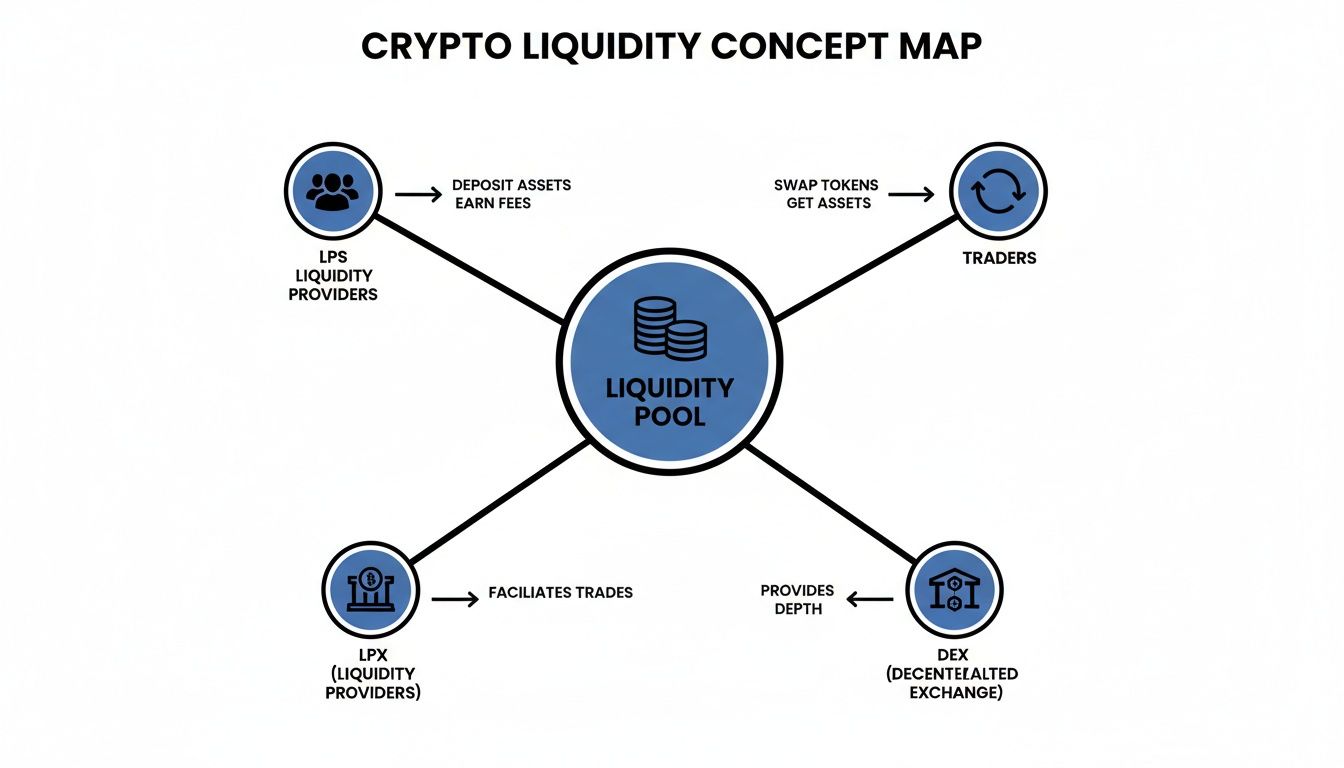
Concept map illustrating the crypto liquidity ecosystem, detailing roles of providers, traders, and decentralized exchanges with a central liquidity pool.

As you can see, liquidity providers (LPs) supply the tokens, traders drive the action by swapping them, and the DEX offers the playground—all revolving around that central pool governed by its AMM.

The Constant Product Formula Explained

The original algorithm, popularized by Uniswap, is the constant product formula: x * y = k.

Here’s a breakdown:

  • x: The amount of Token A in the pool.
  • y: The amount of Token B in the pool.
  • k: The "constant product," a value that must remain the same before and after a trade.

Let's use an ETH/USDC pool as an example. Assume the pool holds 10 ETH (x) and 40,000 USDC (y). This implies an ETH price of $4,000 (40,000 / 10).

The constant product k is:
10 (ETH) * 40,000 (USDC) = 400,000

Now, a trader wants to buy 1 ETH. To keep k constant at 400,000, the AMM calculates the required USDC. The trader's payment increases y, so x must decrease to maintain the product.

You can think of the constant product formula as the pool's autonomous bookkeeper. It ensures that as one asset becomes scarcer, its price increases exponentially relative to the other, creating a self-regulating market.

This mathematical relationship determines the price. The more ETH is bought, the less remains in the pool, and the more expensive it becomes. This happens instantly and automatically with every trade.

Evolving Beyond the Basics

While x * y = k was a breakthrough, DeFi innovation has produced more advanced AMMs for better capital efficiency.

Here are two key upgrades:

AMM InnovationDescriptionKey Benefit
Concentrated Liquidity (Uniswap V3)Allows LPs to provide liquidity within a specific price range instead of from zero to infinity.Maximizes fee earnings by focusing capital where most trading occurs.
Weighted Pools (Balancer)Supports pools with up to eight different tokens, each with a custom weight (e.g., 50% WBTC, 25% ETH, 25% DAI).Enables the creation of automated, self-rebalancing crypto index funds.

These advancements provide LPs with more sophisticated tools to manage their assets and optimize their returns.

What Do Liquidity Pools Actually Do in DeFi?

A crypto liquidity pool is more than just a trading venue; it's a fundamental building block for the entire DeFi ecosystem. These user-supplied capital pools power a wide range of financial activities, making them accessible to anyone with an internet connection.

Without liquidity pools, DeFi would cease to exist. They provide the essential infrastructure for three core functions: automated trading, lending and borrowing, and high-reward yield farming. Understanding these roles is crucial to grasping DeFi's true power.

Powering Instant Token Swaps

The most common use for a crypto liquidity pool is facilitating trades on platforms like Uniswap and SushiSwap. They offer a seamless experience for swapping tokens instantly without needing a direct counterparty.

This is a significant improvement over the slow, clunky order-book models of early DEXs.

  • For Traders: It guarantees 24/7 access to liquidity for fast and reliable trades.
  • For LPs: It creates a direct income stream from the small fee generated by every swap.

This mechanism underpins a massive portion of all on-chain activity, with top DEXs processing billions of dollars in daily volume.

Fueling Lending and Borrowing Protocols

Beyond swaps, liquidity pools form the capital foundation for DeFi's lending markets. Protocols like Aave and Compound act as decentralized banks, using massive liquidity pools instead of vaults.

Users deposit assets into these pools to earn interest, becoming lenders. This collected capital is then available for others to borrow, creating a robust and open financial market.

Liquidity pools are the reservoirs of capital that allow DeFi lending to function. When you deposit assets into a lending protocol, you are contributing to a liquidity pool that earns yield from borrowers, turning idle crypto into a productive asset.

The system is highly efficient. Interest rates are determined by an algorithm based on supply and demand. As demand for an asset increases, its interest rate rises, incentivizing more lenders to deposit it.

Enabling Advanced Yield Farming Strategies

The final and most lucrative role of a crypto liquidity pool is enabling yield farming. This advanced strategy allows LPs to earn multiple layers of rewards on their deposited capital.

Yield farming combines standard fees with bonus rewards, typically paid in the protocol's native governance token. This "liquidity mining" bootstraps growth by incentivizing early capital providers.

For example, a yield farmer might earn:

  1. Trading Fees: The standard 0.3% on all swaps.
  2. Protocol Tokens: Additional rewards (e.g., UNI, CRV, CAKE) distributed daily.

Stacking these rewards can lead to high annual percentage yields (APYs), but it also comes with increased risks.

Primary DeFi Use Cases for Liquidity Pools

This table outlines the three main functions of liquidity pools in the DeFi ecosystem.

Use CaseCore FunctionPrimary Benefit for UsersExample Protocols
Token SwapsFacilitating automated trading via AMMsInstant, permissionless asset exchangeUniswap, SushiSwap
LendingSupplying capital for loansEarning interest on deposited assetsAave, Compound
Yield FarmingEarning layered rewards on liquidityMaximizing returns through fees + token incentivesCurve Finance, Balancer

Ultimately, whether you're swapping a token, taking a loan, or chasing high yields, you are interacting with a crypto liquidity pool. They are the versatile and indispensable pillars supporting the entire DeFi structure.

Key Metrics for Evaluating Liquidity Pools

Not all crypto liquidity pools are created equal. Some are deep, bustling markets, while others are shallow and risky. To distinguish a golden opportunity from a money pit, you must look beyond flashy APYs and analyze the on-chain data.

Think of these metrics as your due diligence checklist. Learning to read them is what separates strategic DeFi investing from pure gambling.

Four icons illustrate key crypto liquidity pool metrics: TVL, Volume, Slippage, and LP token.

Total Value Locked as a Trust Signal

Your first stop should always be Total Value Locked (TVL). This metric shows the total dollar value of all assets deposited into a pool. A high TVL acts as a powerful vote of confidence from the market.

A pool with $100 million in TVL is far more trustworthy than one with just $50,000. It signals that many others have trusted the protocol with their capital.

A high TVL doesn't just signal trust; it's a direct measure of a pool's depth. Deeper pools can absorb larger trades without sending prices haywire, which creates a much more stable and reliable environment for everyone.

However, TVL is only one piece of the puzzle. You must consider it alongside other metrics.

Trading Volume as a Fee Predictor

While TVL shows how much money is in the pool, Trading Volume reveals how hard that money is working. This metric tracks the total value of swaps over a 24-hour period. For LPs, volume is paramount—it's how you get paid.

High volume means more trades, which means more fees for you. A pool with a high TVL but low volume is not capital-efficient. Look for a high volume-to-TVL ratio, as it indicates strong returns for LPs.

Understanding this relationship is critical. For a closer look, check our guide on the top metrics for liquidity pool performance.

Understanding Slippage and Pool Depth

Slippage is the difference between the expected price of a trade and the price at which it's executed. It's a direct result of a pool's depth. In a shallow pool with low TVL, even a medium-sized trade can cause significant price impact.

Imagine buying 10 ETH:

  • Deep Pool ($50M TVL): Your trade causes a tiny ripple. Slippage might be less than 0.1%.
  • Shallow Pool ($100k TVL): Your trade is a cannonball in a bathtub. Slippage could exceed 5%, costing you a significant amount.

As an LP, you want to be in deep pools because they attract serious traders who drive up volume and, consequently, your fee income.

Decoding Liquidity Provider Tokens

When you deposit crypto into a pool, you receive Liquidity Provider (LP) tokens. These tokens are your receipt, representing your exact share of the pool.

Think of them as a claim check. To exit, you redeem your LP tokens to reclaim your original assets plus any accrued trading fees.

The value of your LP tokens changes based on two factors:

  1. Accrued Trading Fees: As fees are added to the pool, the total value increases, raising the value of your share.
  2. Impermanent Loss: As token prices fluctuate, the ratio of assets in the pool changes, which can affect the final value of your withdrawal compared to just holding the assets.

Your LP tokens are a direct reflection of your investment's performance in a dynamic, constantly shifting pool.

Navigating the Murky Waters of Liquidity Pool Risks

The high rewards in DeFi don't come for free. Providing liquidity is a game of calculated risk. Before depositing a single token, you must understand the potential downsides. You are exposing your capital to unique dangers, from market mechanics to outright theft.

Illustrations comparing HODL (piggy bank with Bitcoin) and LP (smart contract, impermanent loss, two Bitcoin coins).

The Shadow of Impermanent Loss

The most significant and misunderstood risk for an LP is impermanent loss (IL). It's not a direct loss of funds but an opportunity cost.

IL occurs when the prices of the tokens in your pool diverge. In an ETH/USDC pool, if ETH's price skyrockets, arbitrage bots buy the cheaper ETH from your pool, rebalancing your holdings to be heavier on USDC. When you withdraw, the total value might be less than if you had simply held your original ETH and USDC. That difference is your impermanent loss.

Impermanent loss is the value gap between HODLing your assets and providing liquidity with them. The wilder the price swings between your two tokens, the bigger your potential IL.

While trading fees can offset IL, in a volatile market, the loss can easily exceed your earnings.

Smart Contract Exploits and Bugs

Every liquidity pool runs on a smart contract. If that code has a flaw, hackers can exploit it and drain the pool, leading to a 100% loss of your capital.

Even established protocols are vulnerable. In 2020, a flash loan attack on Harvest Finance resulted in a $33.8 million loss for its users. Only provide liquidity to protocols with multiple, rigorous security audits. For a deeper dive, read our guide on smart contract security risks in liquidity pools.

Malicious Actors and Rug Pulls

In the Wild West of DeFi, watch out for the rug pull. This is a straightforward scam where a developer creates a new token, pairs it with a valuable asset like ETH, and attracts investors. Once enough liquidity is provided, they withdraw all the valuable ETH, leaving LPs with a worthless token.

Be wary of these red flags:

  • Anonymous Team: Founders with no public history.
  • Unlocked Liquidity: The team can withdraw their liquidity at any time.
  • Insane APYs: Returns that seem too good to be true are likely bait.

The AnubisDAO rug pull in 2021, which cost investors $60 million, is a stark reminder of this risk.

The Impact of Major Token Unlocks

Savvy LPs track scheduled token unlocks. These are pre-planned dates when a large number of tokens, previously locked for team members or VCs, are released. This flood of new supply can cause chaos in a liquidity pool.

Studies show that 90% of unlocks create negative price pressure. With projections of over $600 million in tokens unlocking weekly by 2026, this is a major force. For instance, ApeCoin's team unlock in March 2023 caused 15-20% price drops each time. Learn more about these market-moving token unlock findings and why they matter.

How to Track Smart Money with Wallet Finder

Analyzing metrics is a great start, but the real edge comes from knowing what the most profitable players are doing right now. Instead of guessing which crypto liquidity pool might perform well, you can follow the on-chain footprints of proven winners. This approach shifts you from passive analysis to an active, data-driven strategy.

Tools like Wallet Finder.ai are designed for this purpose, turning the public blockchain ledger into a stream of actionable signals. It helps you pinpoint top-performing wallets that consistently profit from liquidity provisioning and other DeFi activities.

Identifying Profitable Liquidity Providers

The first step is to find wallets with a solid track record. Wallet Finder.ai lets you filter wallets by their realized Profit and Loss (PnL), win rates, and other performance metrics to identify consistently successful addresses.

Once you find a promising wallet, you can dive into its transaction history to reverse-engineer its strategy:

  • Pool Selection: See the exact crypto liquidity pool pairs they use.
  • Entry and Exit Timing: Identify when they add and remove liquidity.
  • Position Sizing: Analyze their capital allocation to understand their risk management.

This level of detail moves you beyond theory and shows you how successful strategies are executed in real time. For a detailed walkthrough, check our guide on setting up a smart money tracker.

The Wallet Finder.ai dashboard provides a clean, organized view of top-performing wallets. This snapshot instantly gives you a list of high-performers to start analyzing.

Mirroring Smart Money Moves

The real power lies in acting on current events. Set up real-time alerts for the "smart money" wallets you've flagged. With Wallet Finder.ai, you can create custom watchlists and receive instant notifications via Telegram or push alerts.

This means you'll know the moment a top LP adds or removes liquidity from a pool. Complex strategies become transparent. For example, you can spot whales using Curve's veCRV locking model to boost yields and mirror strategies that compound returns. You can find more insights on these advanced crypto liquidity pool strategies.

By setting up alerts, you transform your strategy from reactive to proactive. You're no longer just analyzing historical data; you're equipped to mirror the moves of DeFi's most profitable participants as they happen.

This direct, signal-based approach gives you a significant advantage, allowing you to piggyback on the research and timing of expert players to inform your own decisions.

Common Questions About Liquidity Pools

As you venture into DeFi, a few practical questions often arise. Here are answers to some of the most common ones.

How Do You Actually Make Money from a Liquidity Pool?

Profit from liquidity pools comes from two main sources:

  1. Trading Fees: You earn a share of the fees from every swap made in the pool, proportional to your contribution. If you provide 1% of the liquidity, you get 1% of the fees.
  2. Yield Farming Incentives: Many protocols offer extra rewards, often in their native governance token (like UNI or CRV), to incentivize liquidity providers.

The key is to ensure your combined earnings from fees and rewards outweigh the risks, especially impermanent loss.

What Is the Biggest Risk in a Crypto Liquidity Pool?

While smart contract bugs are a serious concern, the most unique and persistent risk for LPs is impermanent loss (IL). It's an opportunity cost that occurs when the prices of the two tokens you deposited diverge.

For example, if you deposit ETH and USDC and ETH's price moons, the pool's algorithm sells some of your ETH for USDC to maintain balance. When you withdraw, the total dollar value of your assets could be less than if you had just held the original tokens. In volatile markets, IL can easily erase your fee earnings.

Impermanent loss represents the financial gap between providing liquidity and simply holding the assets. The greater the price divergence between the two tokens in a pool, the more significant this "loss" becomes.

What Is the Difference Between Uniswap and Curve Pools?

While both facilitate token swaps, Uniswap and Curve are designed for different purposes and use different algorithms.

DEX PlatformPrimary Use CaseKey Features
UniswapGeneral-purpose swaps for any token pair, especially volatile ones (e.g., ETH/WBTC).Flexible and widely used, but susceptible to significant impermanent loss for LPs.
Curve FinanceSwaps between "like-kind" assets with minimal price differences (e.g., stablecoins like USDC/DAI).Optimized for extremely low slippage and minimal impermanent loss, ideal for conservative strategies.

Stop guessing which pools are profitable and start tracking the experts. With Wallet Finder.ai, you can discover top-performing wallets, analyze their strategies in real-time, and set up alerts to mirror their moves. Find your edge in DeFi today.