Cumulative Volume Delta Guide

Wallet Finder

Blank calendar icon with grid of squares representing days.

November 30, 2025

Traditional volume bars are a bit one-dimensional. They tell you how much was traded, but they leave out the most exciting part of the story: who won the fight between buyers and sellers?

That's where Cumulative Volume Delta (CVD) comes in. Think of it as your inside look at the real-time battle for control, tracking the net difference between aggressive buying and selling pressure. It’s a powerful way to look ‘under the hood’ of the market.

Going Beyond Price with Cumulative Volume Delta

Price charts are great, but they only show you the final score, not how the game was played. They show the outcome of market action but hide the forces that drove the price there in the first place.

Imagine watching a tug-of-war. The price chart just shows you where the center flag is at any given moment. CVD, on the other hand, tells you how much force each team is pulling with. This is why CVD has become an essential tool for any serious modern trader.

CVD separates the rookies from the pros by distinguishing between aggressive market participants. It keeps a running tally of whether more volume is hitting the ask price (a sign of aggressive buying) or the bid price (a sign of aggressive selling). This gives you a clear lens into the market's true intent.

What Makes CVD a Better Tool

Standard volume indicators just lump all transactions together. CVD gives you directional insight. That difference is huge because it helps you answer the critical questions that price charts can't answer on their own:

  • Is this trend for real? If the price is climbing and CVD is also rising sharply, it confirms that aggressive buyers are truly in charge.
  • Is this rally losing gas? A new price high without a matching new high in CVD is a classic warning sign that buying pressure is fading, often right before a reversal.
  • Who is actually in control right now? CVD cuts through the noise to show you the net result of buying versus selling over any period you choose.

To understand why this is such a leap forward, let's compare CVD directly to the volume indicators most traders are used to.

CVD vs Traditional Volume Indicators

FeatureTraditional VolumeCumulative Volume Delta (CVD)
Primary InsightShows how much activity occurred (transaction quantity).Shows who is driving the activity (buyer vs. seller aggression).
DirectionalityNon-directional; simply shows the total volume traded.Directional; a rising CVD indicates net buying, a falling CVD indicates net selling.
Trend ConfirmationLimited; high volume can occur in both uptrends and downtrends.Strong; confirms trend strength when CVD moves in the same direction as price.
Divergence SignalsNot applicable, as it lacks a directional component.Excellent at spotting divergences, which often precede market reversals.
Market PsychologyShows general interest or lack thereof.Reveals conviction and momentum by measuring aggressive participation.

As you can see, CVD provides a much deeper narrative about what's happening behind the price movements.

Cumulative Volume Delta is a running total of the net difference between buying and selling volume. For example, if buying volume outpaces selling volume by 500 contracts today, the CVD is +500. If tomorrow, selling volume is higher by 300 contracts, the CVD adjusts to +200, always showing the cumulative pressure over time. For more examples, check out this in-depth CVD guide at luxalgo.com.

This layer of information is especially critical in the crypto markets, where momentum and flow are everything. Integrating CVD gives you a serious advantage over traders who are only reacting to price changes.

For an even bigger edge, you can pair this analysis with on-chain data to see what the smart money is doing. We cover this advanced technique in our guide on how to use on-chain analysis effectively. With this foundational understanding of market intent, we can now dive into actionable trading strategies.

Decoding the Math Behind Market Pressure

If you want to trust an indicator, you have to know how it’s built from the ground up. Cumulative Volume Delta (CVD) might sound complicated, but it's really just a running score that tells a powerful story about market aggression. And it all starts with a single trade.

Every transaction is an agreement, a handshake between a buyer and a seller. But one side is always more impatient, more aggressive. The entire calculation for CVD hinges on identifying which side forced the trade through.

The Core Concept: Volume Delta

Think of the market as a constant tug-of-war. The Volume Delta is simply the score after a single pull, usually measured within one price candle. It doesn't care about the total volume; it only cares about the net difference between the aggressive players on each side.

Here’s how we figure out who won that round:

  • Aggressive Buyers: These are the traders who can't wait. They blast market orders to buy whatever is available at the current ask price. All of this volume gets a plus sign (+).
  • Aggressive Sellers: On the other side, you have traders hitting the bids. They use market orders to sell immediately at the current bid price. This volume is marked with a minus sign (-).

Volume Delta is just the buying volume minus the selling volume for that period. If more volume came from buyers hitting the ask, the delta is positive. If sellers dumped more on the bid, the delta is negative. It's that simple.

This quick diagram shows how basic price and volume data are transformed into the much more insightful CVD indicator.
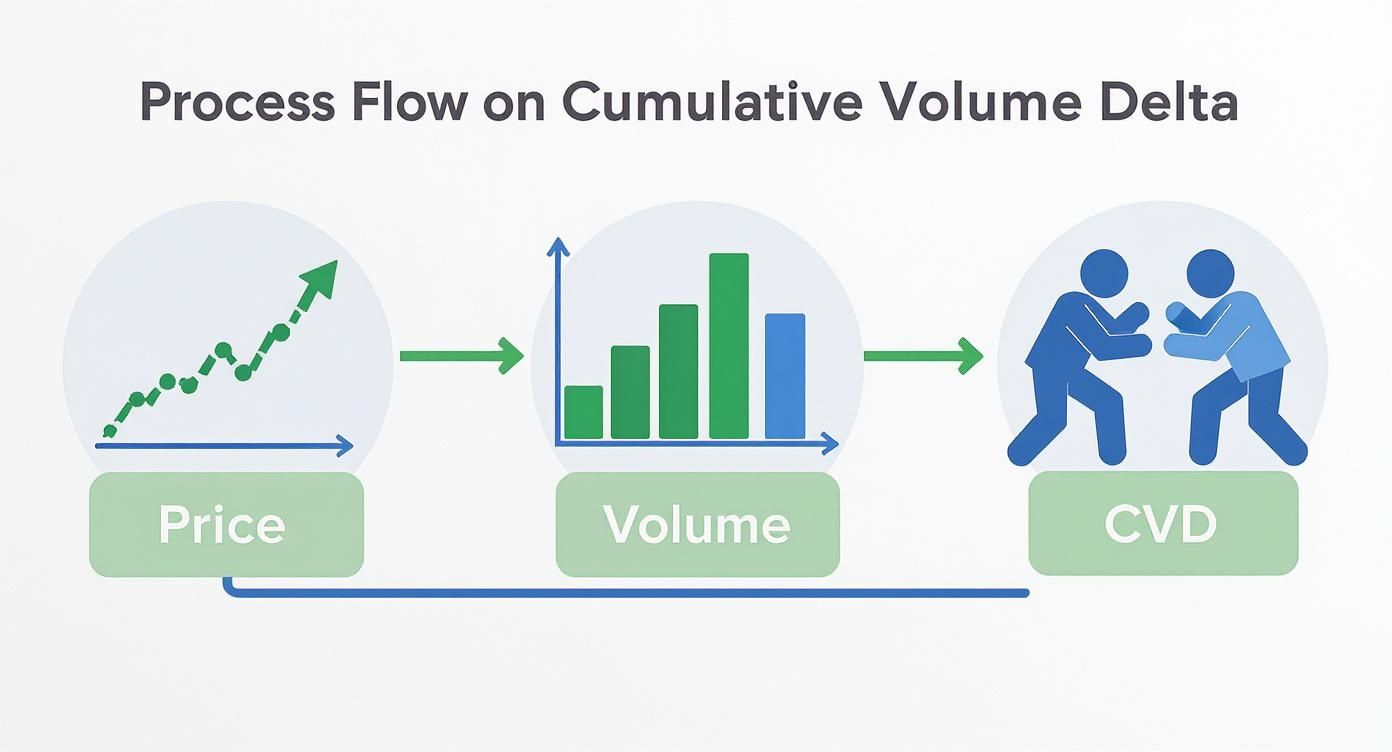
A diagram illustrating the process flow of price and volume leading to Cumulative Volume Delta (CVD) analysis.

As you can see, price and volume are just the starting point. CVD adds a crucial layer by showing the net force of that buyer-versus-seller tug-of-war over time.

The Cumulative Calculation: A Running Tally

The "cumulative" part is what makes this indicator so powerful. Instead of hitting reset on every new candle, the delta from the current candle is just added to the total from all the previous ones.

This running total creates the continuous CVD line you see on your chart. It’s not just showing who is winning now; it’s showing the cumulative score of the entire match since the session began.

This gives you a clear view of the flow of aggression over time, revealing whether buying or selling pressure is building up, starting to fade, or simply being absorbed by the other side.

A Step-by-Step Numerical Example

Let's make this crystal clear. Imagine we're watching a stock for five straight one-minute candles. Here’s how the math plays out.

CandleBuy Volume (at Ask)Sell Volume (at Bid)Volume Delta (Buy - Sell)Cumulative Volume Delta (CVD)
11,000700+300300
2800900-100200
31,200600+600800
45001,100-600200
5900400+500700

Let's break down what happened:

  1. Candle 1: Buyers came out swinging with a positive delta of +300. The CVD begins at 300.
  2. Candle 2: Sellers pushed back, creating a negative delta of -100. The CVD drops to 200 (300 - 100).
  3. Candle 3: A huge wave of buying returns with a +600 delta. This sends the CVD soaring to 800 (200 + 600).
  4. Candle 4: Sellers answer with overwhelming force, resulting in a -600 delta. The CVD gets knocked back down to 200 (800 - 600).
  5. Candle 5: Buyers regain control with a +500 delta, and the CVD finishes at 700 (200 + 500).

See? The calculation itself is completely straightforward. Once you understand the simple logic behind it, you can start trusting the signals it generates, knowing that every tick up or down on the CVD line represents a real, measurable shift in market aggression.

How to Read CVD Signals and Divergences

Knowing how Cumulative Volume Delta is calculated is one thing. Actually using it to read the market’s mind on a live chart? That’s where the real magic happens. This is the moment we turn theory into a practical edge, transforming the CVD line from just another indicator into a powerful lens for seeing what other traders miss.

By watching how the CVD line dances with price, you can uncover the hidden story of buying and selling pressure. The three most important signals you need to master are confirmation, absorption, and the all-powerful divergence.

A candlestick chart illustrating a bullish divergence pattern, marked with text and an arrow, followed by an uptrend.

Confirmation: A Healthy Trend Signal

The most fundamental signal CVD gives is confirmation. Think of it as the market being in perfect harmony—price and volume pressure are singing the same tune. When they move together, it confirms the trend is healthy and has legs.

  • In a strong uptrend: Price makes higher highs and higher lows. You want to see the CVD line climbing right alongside it. This shows that aggressive buyers are consistently stepping up to the plate.
  • In a strong downtrend: Price carves out lower lows and lower highs. The CVD should be falling in lockstep, telling you that aggressive sellers are firmly in the driver's seat.

This alignment is your green light. It says the market's actions (price) are backed by real intent (aggressive volume). Seeing this harmony is often a good reason to stick with the trend.

Absorption: Spotting Hidden Walls of Liquidity

Now for something a bit more subtle. Absorption is what happens when aggressive traders run headfirst into a brick wall of hidden, passive orders. This is where the plot thickens, as it’s often the quiet prelude to a violent reversal.

Picture this: aggressive buyers are going wild, pushing the CVD line higher and higher. But the price itself just isn't budging. It’s hitting an invisible ceiling. This is a massive clue that a huge seller is sitting there, quietly absorbing every single buy order with a giant wall of limit sells.

Think of absorption as effort versus result. If the CVD shows one side is putting in a ton of effort, but the price chart shows they’re getting nowhere, it’s a huge red flag. The trend is likely running on fumes.

This is a classic footprint left by institutions. Big players use passive orders to build or dump positions without spooking the market, and absorption is how you can spot their game.

Divergence: The Ultimate Reversal Warning

Divergence is arguably the most powerful tool in the cumulative volume delta toolkit. It’s a glaring disagreement between price and CVD, and it often screams that a major market turn is just around the corner. You need to learn how to spot both types.

Bullish CVD Divergence

A bullish divergence is a powerful sign that selling pressure is drying up and a bottom could be forming. Here’s the setup:

  1. Price Action: The price makes a new low or a lower low. On the surface, it looks like the downtrend is still in control.
  2. CVD Action: The CVD fails to make a new low. Instead, it forms a higher low, showing that aggressive sellers are losing their nerve on this latest dip.

This disconnect is critical. It tells you that even though price was pushed down, the aggressive force needed to keep it there is fading fast. This creates a vacuum, making it easy for buyers to step in and trigger a rally.

Bearish CVD Divergence

On the flip side, a bearish divergence warns that buying pressure is weakening and a top may be close.

  1. Price Action: The price pushes to a new high or a higher high. It looks like bulls are celebrating another victory.
  2. CVD Action: The CVD fails to confirm the new high. It makes a lower high, revealing that fewer aggressive buyers showed up to this party.

This is a massive warning. That new price high is weak, built on shaky ground without the support of aggressive buying. This makes the price extremely vulnerable to a sharp drop.

These signals aren't just chart voodoo; they have a track record. Backtesting reports from major futures markets show that persistent CVD divergence often precedes a price reversal or trend exhaustion 65-75% of the time. For example, studies on S&P 500 E-mini futures revealed that these signals came before roughly 70% of major intraday pullbacks. You can review professional analysis of CVD trading strategies on bookmap.com to dig deeper into the data.

Understanding these momentum shifts is especially vital in volatile markets like meme tokens, where getting in or out early is everything. For more on that, check out our guide on how to track meme token volume trends.

Actionable CVD Trading Setups and Strategies

Knowing what Cumulative Volume Delta signals mean is one thing. Turning that knowledge into a profitable, rule-based strategy is what separates the consistently successful traders from everyone else. This section gives you concrete, actionable trading setups you can start testing right away. We'll break down each strategy with clear entry triggers, logical stop-loss placements, and defined take-profit targets.

Each of these frameworks is a complete trading plan. It's time to move from just watching the charts to executing with confidence. Let's turn theory into trade ideas.

Three mobile app screens display trading strategies including entry, stop loss, and taking profit with candlestick charts.

Trend Continuation Trading

One of the most reliable ways to use CVD is to confirm the strength of an existing trend or breakout. This strategy is all about avoiding fakeouts and having the confidence to hold your trades when real momentum is on your side. The goal is simple: only enter a trade when the price action and aggressive order flow are singing the same tune.

Imagine a token breaking out above a key resistance level. On its own, the price action looks bullish. But is it a genuine move or a trap set to trick you? This is where CVD steps in to give you that final piece of the puzzle.

Here’s a step-by-step framework for a bullish trend continuation setup:

  1. Identify the Breakout: The price closes decisively above a well-defined resistance level or a key moving average. No ambiguity here.
  2. Confirm with CVD: Now, look at the cumulative volume delta line. A real breakout should have a sharp, rising CVD right alongside it, proving that aggressive buyers are fueling the move. If CVD is flat or, worse, falling, that breakout is weak and likely to fail.
  3. Entry Trigger: Enter a long position on the first pullback after the breakout, but only if the CVD stays strong and doesn't make a new low during the dip.
  4. Stop-Loss Placement: Your stop-loss goes just below the breakout level, which should now be acting as support.
  5. Take-Profit Target: Aim for the next major resistance level, or use a trailing stop to ride the trend until CVD starts showing signs of weakness (like a bearish divergence).

This method acts as a filter, weeding out low-conviction breakouts and making sure you only put your capital to work when the market's internals back up the move.

High-Probability Reversal Trading

Catching reversals can feel like catching a falling knife, but CVD divergences give you a massive edge. They signal when a trend is running out of gas before it's obvious on the price chart. This strategy is all about spotting these divergences at major support or resistance levels for high-probability setups.

The core idea is simple: when the price makes a new high or low, but CVD refuses to follow, it’s a huge red flag. It tells you the aggressive traders who drove the trend are exhausted. This creates the perfect setup for a reversal.

Let’s walk through a bearish reversal strategy using CVD divergence:

  • Step 1: Identify Key Resistance: First, mark a significant resistance area on your chart—a place where the price has previously stalled or reversed.
  • Step 2: Spot the Bearish Divergence: As the price pushes up to test this resistance and makes a new high, keep your eyes glued to the CVD indicator. A bearish divergence happens when CVD makes a lower high, showing that fewer aggressive buyers are showing up for this final push.
  • Step 3: Entry Trigger: Don't just jump in. Wait for a candlestick pattern that confirms weakness at that level, like a bearish engulfing candle or a pin bar. Once you see it, enter your short position.
  • Step 4: Stop-Loss Placement: Place your stop-loss just above the highest point of that price swing. This keeps your risk defined.
  • Step 5: Take-Profit Target: Set your first take-profit target at the nearest support level. You can always take some profits off the table and let the rest of the position run.

This structured approach stops you from blindly shorting every new high. Instead, you wait for the trifecta: a key level, a CVD divergence, and bearish price action. That discipline is what stacks the odds in your favor.

Scalping with Exhaustion and Absorption

For short-term traders and scalpers, CVD is brilliant at pinpointing moments of exhaustion and absorption. These are scenarios where aggressive traders slam into a hidden wall of passive orders, creating quick, predictable price jolts perfect for scalping. Absorption is when you see CVD shooting up aggressively, but the price isn't moving an inch—a sign that a huge seller is soaking up all the buy orders.

This strategy requires sharp focus and quick execution, but the payoff can be huge. You're looking for moments of "effort without result."

The Setup for an Absorption Short-Scalp

  1. Context: The market is trending up but is now approaching a known resistance zone or a big psychological level (like a round number).
  2. Identify Absorption: You see the CVD line making a series of aggressive new highs—buyers are getting frantic. But the price is completely stuck, grinding at the same level. This is the footprint of a large, passive seller.
  3. Entry Trigger: The second you see CVD start to tick down, showing the buyers are finally throwing in the towel, you enter a short position.
  4. Stop-Loss: Place a tight stop-loss just a few ticks above the price level where the absorption was happening.
  5. Target: This is a scalp, not a swing trade. Aim for a quick drop to the nearest short-term support or a key moving average. Get in, and get out.

This strategy is particularly potent in fast-moving markets like meme tokens, where spotting the footprints of large players is everything. You can learn more about this in our overview of the top tools for tracking meme token volume spikes. Once you master these setups, CVD stops being just an indicator and becomes the core of a complete trading system.

Advanced CVD Analysis and Customization

Once you get the hang of Cumulative Volume Delta (CVD), you’re already ahead of the game. But to really make it a core part of your trading system, you need to start tweaking it to fit your style and the specific market you're trading. Stepping away from the default settings is where the real magic happens.

This isn’t about one-size-fits-all. A scalper needs to see market pressure minute by minute, while a swing trader is tracking the flow over days. The out-of-the-box settings are just a starting point; true proficiency comes from bending the indicator to your will.

Choosing Your CVD Reset Point

One of the most powerful adjustments you can make is deciding when your CVD calculation resets to zero. This single choice completely changes the story the indicator tells, so it needs to line up perfectly with how long you hold your trades.

Traders generally stick to one of two camps:

  • Session CVD: This is the go-to for most day traders. Here, the CVD resets at the start of each new trading session (like daily). This is perfect for isolating the order flow for that day alone, helping you pinpoint intraday trends, reversals, and who's in control right now.

  • Continuous CVD (or N-Day Reset): If you're a swing trader or looking at the bigger picture, you'll likely prefer a continuous CVD that doesn't wipe the slate clean every day. This approach lets you see how buying and selling pressure builds up over several days or weeks, revealing the larger capital flows steering the primary trend.

The choice is strategic: Use Session CVD to win the daily battles. Use Continuous CVD to understand who is winning the war.

Multi-Timeframe CVD Analysis

Here’s a technique straight from the pros: multi-timeframe analysis. It’s simple but incredibly effective. You watch the CVD on a higher timeframe to get a feel for the dominant market bias, then you zoom into a lower timeframe to actually place your trades. This keeps your short-term moves aligned with the big money.

For instance, you might spot a strong, rising cumulative volume delta on a 4-hour chart. This tells you that larger players are consistently buying. With that knowledge, you can drop to a 5-minute chart and look for small dips or bullish signals to enter long positions, essentially surfing in the wake of the dominant pressure.

This method keeps you from getting steamrolled by a major trend you didn't see coming. While CVD is often used on intraday charts, its cumulative nature means you can stretch the analysis out. In fact, traders have successfully used CVD data spanning weeks or even months to spot signs of institutional accumulation or distribution. You can find more discussions on how traders apply historical CVD data on the NinjaTrader forum.

Combining CVD with Other Order Flow Tools

CVD is powerful on its own, but it becomes a different beast when you pair it with other tools that provide market context. When you get a confluence of signals—multiple indicators all pointing to the same conclusion—you build a much more robust and three-dimensional view of what's happening.

Here are a couple of essential pairings for your CVD analysis:

Tool CombinationHow It Enhances CVD Analysis
CVD + Volume ProfileVolume Profile shows you where the big fights happened by highlighting key support and resistance zones (High and Low Volume Nodes). If you see a strong CVD divergence right at a major Point of Control (POC), the odds of a reversal just went way up.
CVD + VWAPThe Volume-Weighted Average Price (VWAP) acts as the session's "fair price" benchmark. Watching how CVD reacts as the price interacts with the VWAP is incredibly telling. For example, if you see aggressive selling (falling CVD) get completely absorbed as the price tests the VWAP from above, that's a huge bullish signal.

By layering these tools, you graduate from reading a single indicator to understanding the full story of the market's auction process. This is how you build a trading strategy that can actually stand the test of time.

Common Cumulative Volume Delta Questions

Even after you get the hang of the strategies, a new indicator like Cumulative Volume Delta always brings up some questions. Getting straight answers is the only way to build the confidence you need to actually act on its signals. Let's tackle the most common points of confusion traders run into when they first start with CVD.

The goal here is to cement your understanding and help you sidestep the common traps that trip up even seasoned traders. Think of this as your quick reference for those nagging questions that pop up right in the middle of a live market.

What Is the Best Timeframe for Using CVD?

The right timeframe for cumulative volume delta really comes down to your personal trading style. There's no single "best" answer—only what's best for your strategy. The key is to match the CVD's perspective perfectly with how long you plan to be in a trade.

  • Scalpers and Day Traders: If you're in and out of the market quickly, you need granular data. A 1-minute to 5-minute chart gives you a high-definition view of the intraday order flow, letting you spot fast shifts in momentum and absorption as they happen.
  • Swing Traders: Holding positions for a few days? You'll need a wider lens. Swing traders often gravitate toward a 1-hour or 4-hour chart, and they'll usually reset the CVD calculation daily or weekly. This helps them identify the dominant pressure over a longer stretch while tuning out the minor intraday noise.

Can I Use CVD for Stocks and Crypto?

Absolutely, but the quality and source of your data are everything. CVD is most reliable in centralized markets that offer a clear, consolidated order book, like futures and major stock exchanges (think NYSE or NASDAQ).

For crypto, it works great on large, liquid centralized exchanges like Binance or Coinbase where the bulk of the volume is concentrated. Its reliability can take a hit in decentralized finance (DeFi) or on smaller exchanges, though. On those platforms, volume data gets fragmented across countless pools, making it tough to get a true read on the net aggressive flow.

Crucial Tip: Before you trust CVD for any asset, you must verify that your data provider can accurately separate volume executed at the bid from volume executed at the ask. If it can't do that, the entire calculation is worthless.

Does a Rising CVD Guarantee a Price Increase?

No, and this is probably the most critical lesson to learn. A rising CVD tells you only one side of the story: aggressive buyers are hitting the market hard. It shows powerful intent from buyers, but it completely ignores the other side of the equation—the sellers.

For a price to go up, buyers have to chew through all the sell orders in their way. If a huge, passive seller has a massive wall of limit sell orders at a certain price, they can easily "absorb" all that aggressive buying. You'll see CVD rocket upwards while the price stalls out completely. This situation, known as absorption, is actually a massive warning sign that the rally is about to run out of steam.

Bottom line: Never, ever use CVD in a vacuum. Always pair it with price action and key support and resistance levels.

Should I Use Session-Based or Continuous CVD?

This choice depends entirely on your trading horizon and what you’re trying to figure out.

  • Session-Based CVD is the go-to for day traders. It resets its count to zero at the start of each new trading day, giving you a clean slate. This is perfect for seeing who is winning the battle right from the opening bell and focusing only on the dynamics of the current session.
  • Continuous CVD is for the bigger picture. It doesn't reset, carrying its value over from one day to the next. This creates a long-term running tally of net pressure, making it the preferred method for swing traders who need to track the cumulative force driving a multi-day or multi-week trend.

Ready to stop guessing and start seeing what the smart money is really doing? Wallet Finder.ai turns complex on-chain data into clear, actionable signals. Discover top-performing wallets, get real-time trade alerts, and mirror the strategies of winning traders before the market moves. Start your 7-day trial and gain an unfair advantage.