Recovery Factor Calculation for Smart Traders
Master the recovery factor calculation to measure a strategy's resilience. Learn the formula, see DeFi examples, and find top wallets with Wallet Finder.ai.

June 20, 2026


Wallet Finder
March 27, 2026

If you’ve searched for the JPM Coin price, you can stop now. The straight answer is: JPM Coin doesn’t have a public price because it's not a speculative crypto like Bitcoin. It’s a private token for J.P. Morgan's institutional clients, permanently pegged at $1.00.
The constant search for a "JPM Coin price" stems from misunderstanding its purpose. Unlike public cryptocurrencies driven by supply and demand, JPM Coin is built for stability. Its value is always fixed.
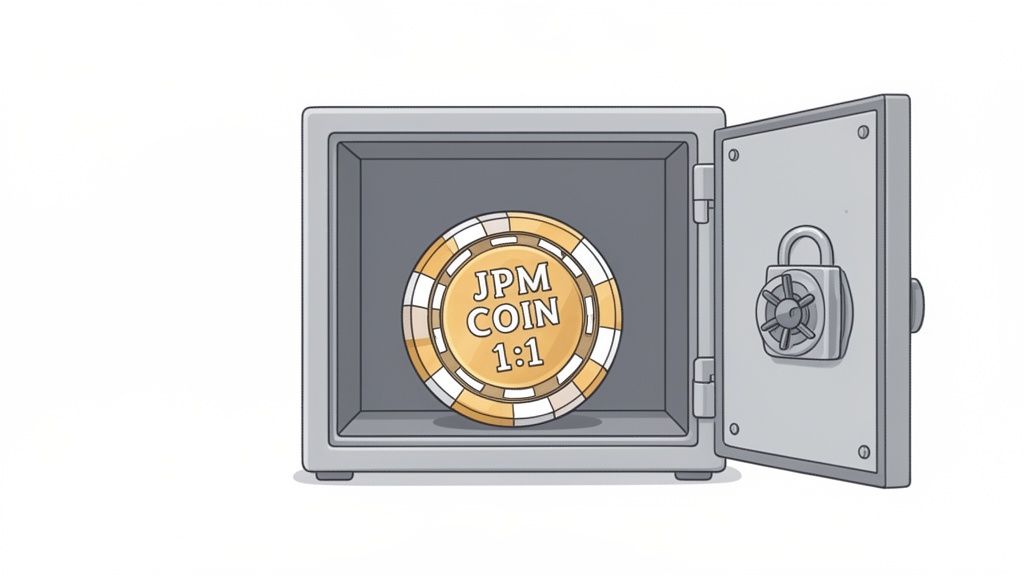
Think of it as a casino chip for J.P. Morgan's private Onyx network. It's always redeemable for exactly one dollar from the bank. You can't trade it elsewhere or sell it for a different value. Its sole function is to enable instant, 24/7 settlements for massive corporate transactions.
This closed-loop system is why you'll never see JPM Coin on Coinbase or Binance. It’s a permissioned token, meaning only approved institutional clients of JPMorgan can use it. This is the opposite of permissionless public cryptocurrencies available to anyone.
JPMorgan already processes billions in daily transaction volume on this network, proving its traction in traditional finance (TradFi). This activity is about moving money efficiently, not speculating on price. Every JPM Coin is backed by a U.S. dollar held in a JPMorgan Chase account, locking its value at a stable 1:1 ratio.
Actionable Takeaway: JPM Coin is a settlement tool, not an investment. Its value is fixed to eliminate the volatility that makes public crypto unsuitable for large-scale institutional payments.
Understanding the distinction is crucial for separating market signals from noise. While both use blockchain, their purpose is worlds apart. For a deeper dive into public crypto pricing, see our guide on finding the true market price of an asset.
| Feature | JPM Coin | Public Cryptocurrency (e.g., Bitcoin) |
|---|---|---|
| Accessibility | Permissioned (Institutions only) | Permissionless (Open to public) |
| Price | Fixed 1:1 to USD | Fluctuates based on market demand |
| Primary Use Case | Institutional Payments & Settlement | Investment, Store of Value, Peer-to-Peer Transactions |
| Network | Private (JPMorgan Onyx) | Public (e.g., Bitcoin, Ethereum networks) |
| Availability | Not on public exchanges | Traded on hundreds of global exchanges |
JPM Coin operates in a different universe from the crypto we trade. It’s a tool for banks, not a token for the masses.
While you can’t trade it, JPM Coin is a fully operational digital token for high-speed payments within JPMorgan's institutional client base. It's designed to grease the wheels of global finance.
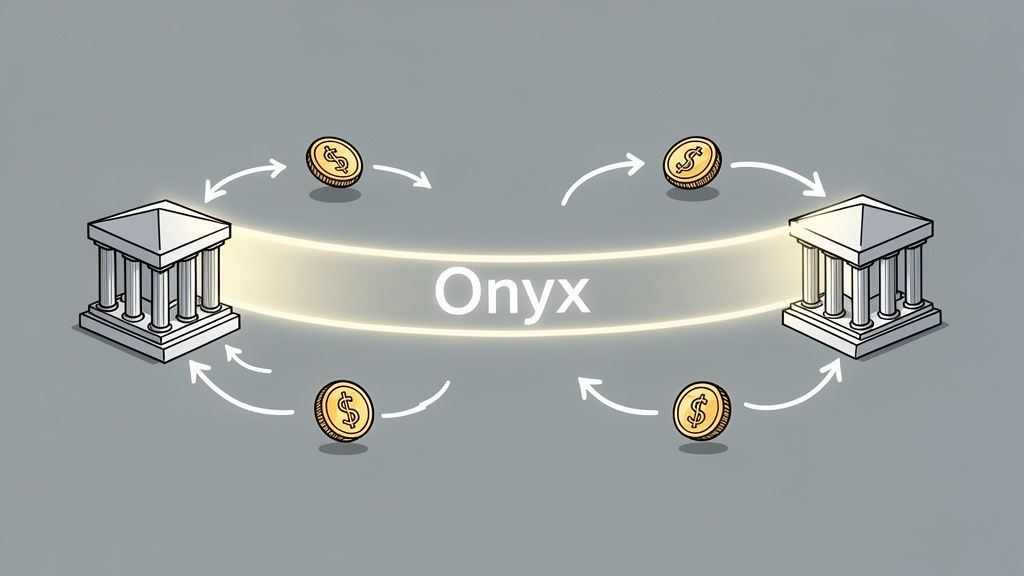
The coin exists on Onyx, JPMorgan’s private blockchain network. Think of Onyx as an exclusive highway for money. On this highway, JPM Coin is the specialized vehicle moving enormous sums between approved corporations, 24/7—a huge leap from traditional banking's 9-to-5 limitations.
The jpm coin price never fluctuates because of its simple pegging mechanism: every JPM Coin is backed 1:1 by a U.S. dollar held in a designated JPMorgan Chase account. No complex algorithms, just a direct link to cash.
Actionable Takeaway: View JPM Coin as a digital dollar deposit. It’s a pure utility token for moving massive amounts of money frictionlessly, not for public trading.
Here’s the process:
JPM Coin is built for massive wholesale transactions that power the global economy. JPMorgan already processes billions of dollars daily with this system, showing how serious TradFi is about this tech.
Key use cases include:
By creating a dependable, always-on settlement network, JPM Coin is building key infrastructure for the future of institutional finance. To learn more about the bank's crypto strategy, see our guide on JP Morgan’s crypto coin. This private activity creates ripples that smart DeFi traders can track.
You can't trade JPM Coin, so why do savvy traders search for its "price"? The search isn't for a number to trade, but for a signal.
They track the flow of institutional capital—‘smart money’—as a powerful market indicator. While JPM Coin is private, its activity on the Onyx network leaves a trail of valuable data.
When billions of dollars in JPM Coin move for settlement, it's a clear sign that major financial players are making significant moves. This activity acts as a proxy for institutional intent, offering a rare glimpse into how large funds and corporations are positioning capital.
The real strategy is connecting this private network activity to its ripple effects on public DeFi markets. Think of the Onyx network as a private airport for corporate jets. You can't get inside, but you can see which jets are landing and taking off.
By observing this activity, you can anticipate where that massive pool of capital might flow next. This off-chain movement often precedes major shifts in the broader crypto ecosystem.
Actionable Takeaway: For a DeFi trader, JPM Coin's internal activity is an external signal. It’s not about the coin's static value; it's about the volume and direction of the funds it represents.
For instance, a spike in JPM Coin settlement volume could signal a fund is preparing to move assets into or out of public blockchains. This could trigger observable on-chain events:
The challenge is spotting these movements on public chains. This requires specialized on-chain analysis tools. Sophisticated analysts use platforms like Wallet Finder.ai to pinpoint the public wallets of these same institutional players.
The process is on-chain detective work: trace a known entity's activity to find its corresponding public wallets. Once found, you can monitor these "smart money" wallets in real-time. This strategy turns JPM Coin's private action into a tradable insight, giving you a front-row seat to institutional interest before the market catches on.
Even though the JPM Coin price is locked at $1, the capital it moves creates ripples across DeFi. The real opportunity is tracing institutional money as it flows from private networks like Onyx onto public blockchains.
Think of it as digital forensics. You’re not looking for JPM Coin on-chain. You’re spotting large, well-funded wallets that suddenly interact with institution-friendly protocols. These wallets are the public face of “smart money,” and following their moves can reveal their investment thesis.
This requires specialized on-chain intelligence tools. Platforms like Wallet Finder.ai are built for this detective work, helping you sift through millions of wallets to find the few that matter.
First, hunt down wallets likely linked to institutional players. This isn’t random searching; it's applying specific filters to isolate the big fish.
Start with the "Discover Wallets" feature in Wallet Finder.ai. Use these key filters:
By layering these filters, you can build a curated list of wallets that behave like smart money.
Once you've tagged promising wallets, shift to active monitoring. Manually checking wallets is inefficient. The key is setting up real-time alerts that notify you the second a tracked wallet makes a move.
Actionable Takeaway: By creating alerts, you transform your analysis from reactive to proactive. You'll be among the first to know when smart money deploys capital, giving you a crucial time advantage.
A tool like Wallet Finder.ai acts as your eyes and ears, sending instant notifications through Telegram or other channels. For a deep dive, check our guide on using a smart money tracker.
The process from private settlement to public signal looks like this:
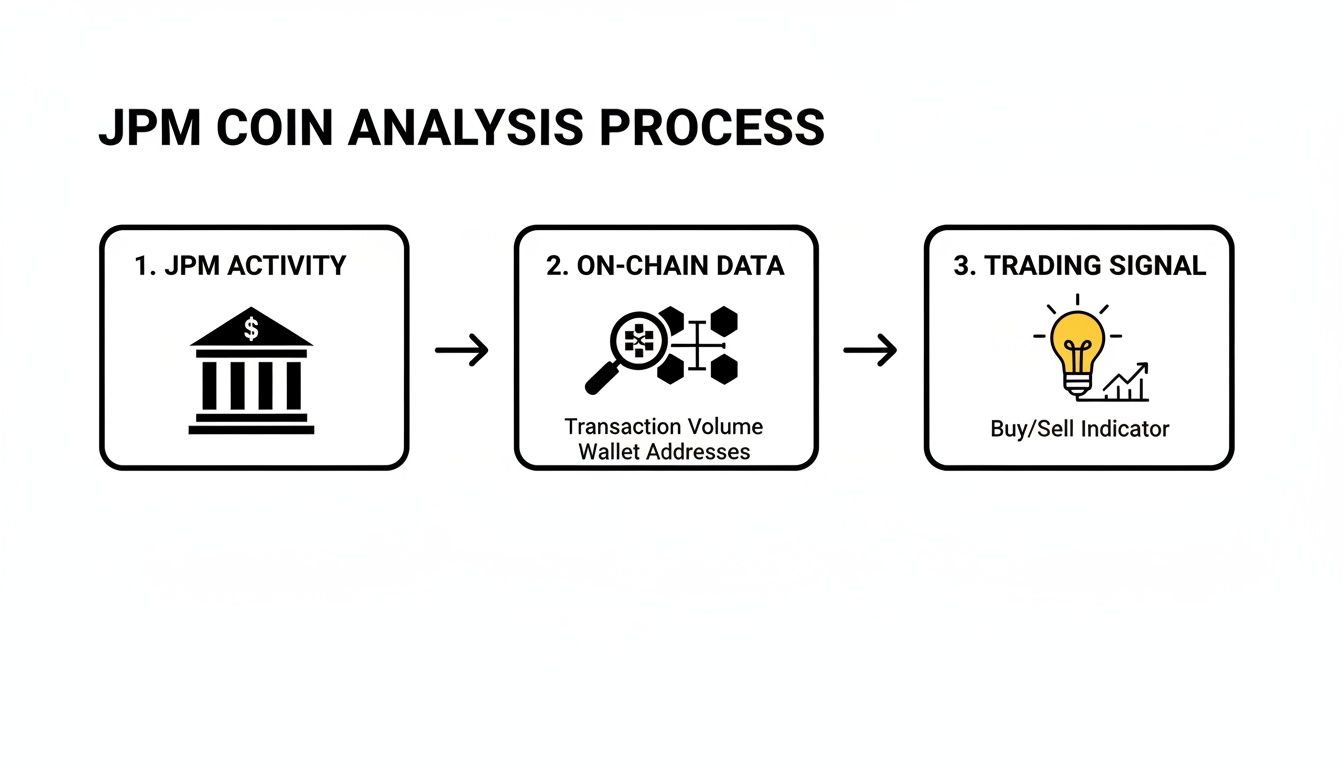
Private institutional activity produces public, on-chain data. That data can then be analyzed to create actionable trading signals.
Let's walk through a scenario. An alert hits your phone: a wallet you’ve flagged as a high-net-worth whale just swapped $5 million in USDC for a relatively new DeFi governance token.
Here’s your playbook:
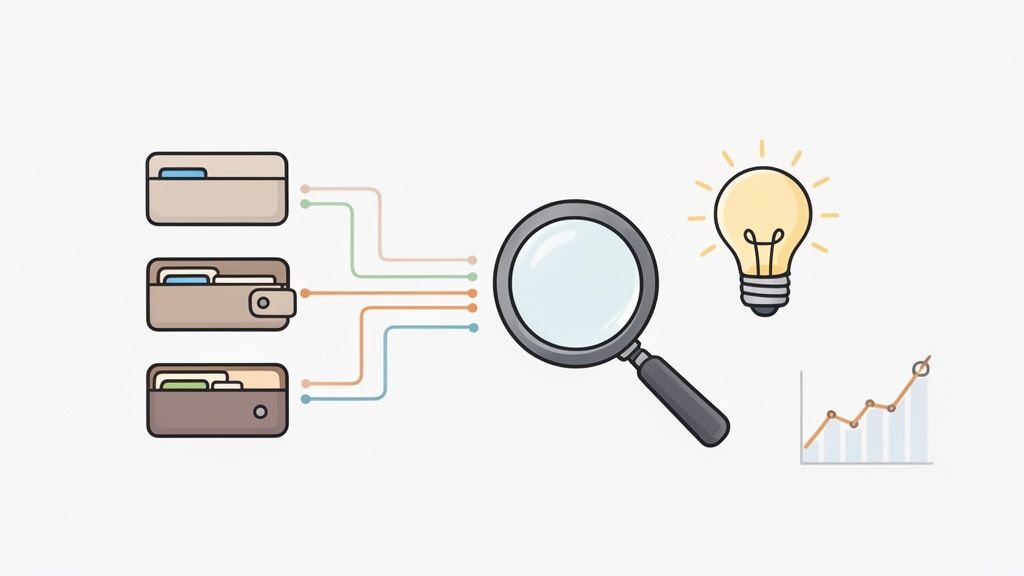
Spotting a smart money wallet is just step one. The real alpha is understanding why they’re moving money and using that to build a trading thesis. It’s about moving past seeing a transaction to understanding the story behind it.
While you can't see private JPM Coin transactions, you can track the footprints when that institutional capital hits public markets. A spike in JPM Coin settlement volume, often mentioned in financial news, is a powerful leading indicator—like hearing thunder before the rain.
When a high-net-worth wallet makes a big move, ask: what's the play? The narrative is as important as the numbers. Here are common scenarios and their potential signals:
| Institutional Action | Potential Signal (Trading Thesis) |
|---|---|
| Large Swap into a New Protocol Token | A high-conviction bet on an early-stage project before mainstream adoption. (Bullish for the token) |
| Providing Liquidity to a DeFi Pool | Farming yield or bootstrapping a new protocol; shows confidence in its long-term stability. (Bullish for the protocol) |
| Moving Assets to a Layer 2 (e.g., Base) | Positioning to interact with specific L2 apps, anticipating growth or seeking lower fees. (Bullish for the L2 ecosystem) |
| De-Risking into Stablecoins (USDC/USDT) | Expecting a market downturn and moving to the sidelines for capital preservation. (Bearish for the market) |
Actionable Takeaway: Build a thesis around what the big players are doing. Are they positioning for a breakout, hunting for yield, or hedging against a crash? Answering this is key to making informed moves.
Building a thesis connects the "what" (the on-chain transaction) with the "why" (the likely motive). You're using smart money's actions as a high-quality data point for your strategy.
Let's walk through a hypothetical example. You notice several institutional wallets bridging millions in USDC to the Base network. JPMorgan reports a jump in JPM Coin activity. Days later, those wallets start buying tokens for a new decentralized social media protocol on Base.
This chain of events creates a compelling narrative:
This approach turns the vague idea of "institutional interest" into a concrete, actionable trading plan. You're no longer guessing about the jpm coin price; you're using its ripple effects to read the market.
Let's clear the air. There's a lot of chatter about JPM Coin, and it's easy to get confused. This section provides actionable answers to common questions from traders.
Absolutely not. JPM Coin is a closed-loop, permissioned token for JPMorgan's institutional clients on their private Onyx network. It will never be listed on a public crypto exchange. If you see a token claiming to be JPM Coin on a public market, it is a scam.
Because it’s a massive signal showing where "smart money" is heading. While one JPM Coin is always worth $1, the real story is in the volume. Seeing billions move through the network gives you a rare peek into the strategies of major financial players.
Actionable Takeaway: The key isn't the coin's static price but the dynamic flow of value it represents. Monitoring this flow gives you a powerful leading indicator of institutional intent before it plays out in public markets.
Wallet Finder.ai cannot and does not access the private Onyx network. Its power comes from identifying the public crypto wallets (on chains like Ethereum, Solana, and Base) that belong to these institutional heavyweights.
When a firm moves capital from its private JPMorgan system into public DeFi, it leaves an on-chain trail. Wallet Finder.ai is built to spot those movements. It helps you filter for high-value wallets and set real-time alerts to follow their trades. In short, it turns private institutional intent into public, actionable trading signals.
They’re both pegged 1:1 to the US dollar, but that’s where the similarity ends. Their purpose and accessibility are worlds apart. JPM Coin is private; USDC is public.
Here’s a simple breakdown:
| Feature | JPM Coin | Public Stablecoin (e.g., USDC) |
|---|---|---|
| Audience | Vetted Institutions Only | General Public |
| Network | Private (JPMorgan Onyx) | Public (Ethereum, Solana, etc.) |
| Primary Goal | Internal Bank Settlement | Public DeFi & Payments |
| Analogy | A Bank's Internal Ledger | Digital Cash for the Internet |
Think of JPM Coin as a tool for the bank's internal plumbing. USDC is digital cash built for the open crypto economy.
Ready to stop guessing and start tracking the real smart money? Wallet Finder.ai gives you the tools to uncover the most profitable wallets in DeFi and get real-time alerts on their every move. Start your 7-day trial today and turn institutional footprints into your next great trade.

A premier DeFi analytics platform empowering traders to discover and analyze profitable blockchain wallets, trades and tokens.