
10 Best Moonshot Crypto Website Tools for 2026
Discover the top moonshot crypto website tools for 2026. Our guide reviews 10 platforms for finding and vetting low-cap gems before they take off. Read now!
Why do traders keep finding the chart first and asking hard questions later?
That habit is expensive in low-cap trading. A token starts ripping, volume spikes, X fills with screenshots, and entries get chased at the point where upside is thinning out. In a lot of cases, the warning signs were already visible in holder concentration, wallet behavior, or contract risk. The issue is rarely access to information. It is sequence.
Moonshot gave a clear example of how quickly retail attention can flood into one venue after a high-profile token launch, as noted earlier. Fast inflows create opportunity, but they also compress the time you have to verify what you are buying. If your process starts and ends with a trending chart, you are trading someone else’s exit liquidity.
That is why I do not treat a moonshot crypto website as a single destination. I treat it as a workflow.
Start with discovery tools such as DEX Screener, GeckoTerminal, Birdeye, or Pump.fun to catch fresh volume and new pairs early. Then check structure with Bubblemaps and TokenSniffer to see whether supply distribution and contract design introduce obvious risk. After that, confirm behavior with a wallet tracker such as Wallet Finder.ai to see whether profitable wallets are entering, scaling, or already distributing.
Each tool answers a different question.
DEX Screener can tell you what is moving. Bubblemaps can show whether connected wallets control too much supply. Wallet Finder.ai can tell you whether traders with a strong on-chain record are participating. In moonshot trading, this context is valuable since not every fast chart is an independent event.
The edge comes from chaining those checks together before you commit capital. That process cuts out a lot of impulsive entries and gives you a cleaner path from discovery to vetting to action.
1. Wallet Finder.ai
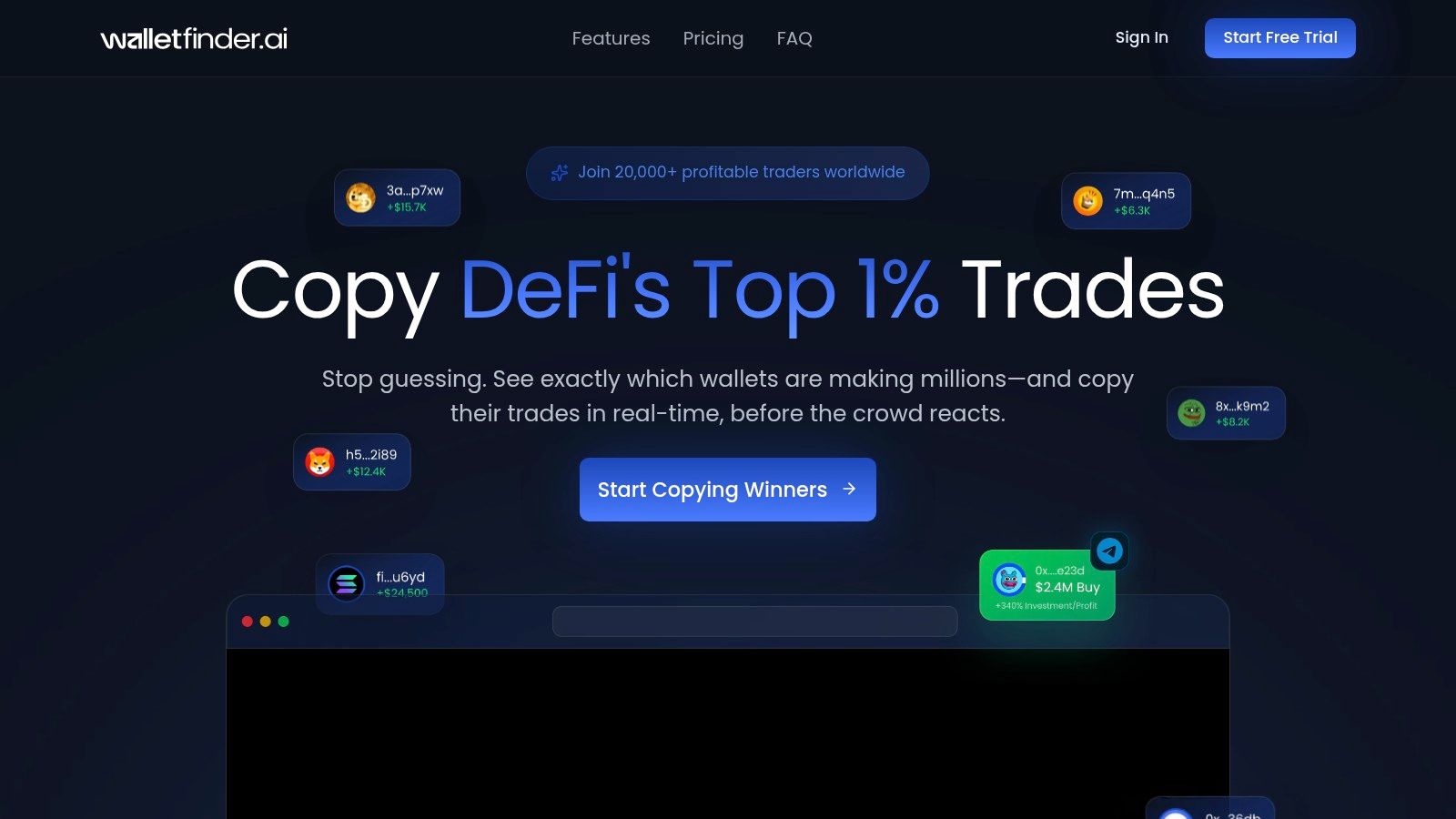
Wallet Finder.ai is the tool I would put at the center of a moonshot crypto website workflow because it answers the question most scanners cannot answer well: who is making money on-chain, and what are they buying right now?
Scanners show activity. Wallet Finder.ai helps you rank the traders behind that activity.
Where it fits in the workflow
If I find a token on DEX Screener, Pump.fun, or Birdeye, I do not want to rely on the chart alone. I want to know whether strong wallets are entering, whether those wallets have a history of good exits, and whether the same cluster tends to chase junk or rotate selectively.
Wallet Finder.ai proves useful here. It surfaces wallet histories, PnL, win streaks, entry and exit timing, position sizing, and recent trades across major chains including Ethereum, Solana, and Base. For moonshot hunting, that matters more than raw hype because wallet behavior usually reveals quality faster than social posts do.
What works well
A few things stand out in day-to-day use:
- Smart money filtering: You can sort for wallets with consistent performance instead of chasing one lucky hit.
- Real-time alerts: Telegram and push alerts matter when a trade setup lasts minutes, not hours.
- Cross-chain research: Many traders stay chain-specific. This is useful if you want one place to watch Solana meme flow and EVM rotation.
- Security context: Holder distribution and scam checks help you avoid treating every fresh buy signal as equally valid.
- Exportable data: Serious traders always end up wanting offline review. Exporting wallet and trade data saves time.
A true edge is not copying a wallet blindly. It is identifying which wallets buy early, size well, and cut losers fast.
The trade-off is obvious. Copy trading is never automatic alpha. A strong wallet may tolerate more volatility than you do. Some trades are not scalable. A late copy on a thin pair can turn a good setup into a bad one.
Practical verdict
Wallet Finder.ai is strongest after discovery but before execution. I would not use it as a pure “find me every new token” feed. I would use it to confirm whether the people who usually win are touching the token you just found.
That is why it leads this list. A moonshot crypto website is only as useful as the decision process around it, and this platform gives that process a performance layer that most traders are missing.
Pros
- Actionable wallet intelligence: Better for validating a trade than relying on token trend pages alone.
- Alert-driven workflow: Good fit for traders who need immediate follow-up after wallet activity.
- Cross-chain coverage: Useful if your strategy is not limited to one ecosystem.
- Research depth: Wallet history and trade context are stronger than simple “top buyers” widgets.
Cons
- Copying is still risky: Good wallets can still lose, rotate late, or run strategies that do not fit your risk profile.
- Lower tiers limit visibility: The full value comes from deeper analytics and more reveals.
Website: Wallet Finder.ai
2. DEX Screener
For early discovery, DEX Screener is still one of the fastest ways to scan the market without overcomplicating the process. It is not the deepest tool on this list, but it is often the first one I open.
The reason is simple. New pairs and trending feeds let you see where liquidity and attention are moving right now.
Best use case
DEX Screener is where I look for fresh pair creation, unusual volume, and fast tape. It works well when you already know what chain you want to trade and want a broad view of what is waking up.
Its weakness is also obvious. It surfaces a lot of junk. That is fine, as long as you treat it as a feed, not a verdict.
If you are trying to understand why newer traders gravitate toward this style of tool before they end up on Moonshot itself, this breakdown of what Moonshot crypto is gives useful context on the behavior around rapid meme token discovery.
What I like and what I do not
- Fast scanning: It is easy to jump between chains, pairs, and charts.
- Good first-pass charting: Enough detail to decide whether a pair deserves deeper review.
- Useful alerts and watchlists: Good for monitoring a shortlist.
The downside is the lack of strong built-in risk analysis. You still need another tool to inspect holder concentration, liquidity quality, and deployer behavior.
DEX Screener is a radar. It is not your risk manager.
That distinction matters because many traders confuse speed with edge. DEX Screener gives speed. Edge comes from what you do after the alert.
Website: DEX Screener
3. GeckoTerminal
GeckoTerminal is the alternative I keep open when I want broad DEX coverage and another angle on new pool discovery. In practice, it complements DEX Screener rather than replacing it.
Where GeckoTerminal stands out is breadth. It is useful when you want to scan beyond the obvious and when launchpad-connected flows matter.
Why I use it
GeckoTerminal’s New Pools view is good for catching tokens close to launch, especially when the market is cycling through meme narratives quickly. It is also useful for category browsing when you are trying to separate random one-off launches from tokens riding a broader theme.
That matters in moonshot trading because not every fast chart is independent. Often the move is narrative-driven, and tools that expose that context help.
Trade-offs
- Strong chain and DEX coverage: Helpful for traders who move between ecosystems.
- Launchpad integrations: Useful when launch sources matter as much as the chart.
- Clean token pages: Fast to review without too much clutter.
The limitation is that early discovery remains high risk no matter how polished the interface is. A new pool feed can help you arrive early, but it cannot tell you whether the token deserves capital. You still need wallet tracking and structure analysis after discovery.
I like GeckoTerminal most when DEX Screener starts feeling too crowded or when I want a second view before deciding whether a pair is real enough to investigate.
Website: GeckoTerminal
4. Birdeye
Birdeye is one of the best Solana-first tools for traders who want discovery, charting, and execution in one place. If your moonshot crypto website stack leans heavily toward Solana meme flow, Birdeye deserves a permanent tab.
Its main advantage is efficiency. You can move from seeing a token to checking its stats to trading it without jumping across too many interfaces.
Where Birdeye earns its place
Solana moves quickly, and Birdeye feels built for that speed. Discovery pages, live charts, watchlists, alerts, and in-page swap functionality reduce friction. That makes a difference when a setup is short-lived.
I also like Birdeye when paired with a stronger wallet-level intelligence layer. If you use a crypto wallet tracker alongside it, the combination is much stronger than treating Birdeye as a standalone decision engine.
What to watch out for
- Excellent for Solana flow: Particularly useful when meme coin attention is rotating fast.
- All-in-one convenience: Less tab switching than many competing setups.
- Alert support: Good for tracking active names without babysitting charts.
The drawback is noise. Solana deal flow is fast, but it is also full of traps. You have to get selective. Birdeye helps you see more opportunities, but seeing more is not the same as finding better ones.
A second practical issue is execution cost awareness. On small positions, routing and fee sensitivity matter more than many traders realize. That is not a Birdeye-only problem, but it shows up quickly when you trade tiny, volatile names.
Website: Birdeye
5. Pump.fun
If you want the earliest possible look at Solana meme launches, Pump.fun is usually where the trail starts. It is not where I decide to invest confidently, but it is where I check origin flow.
This is pure deal flow. New launches, live activity, fast crowd reaction.
Why traders use it anyway
Pump.fun matters because many tokens hit attention here before they matter anywhere else. If your style is extreme early entry, there is no substitute for seeing launches at the source.
That is also why the risk is so high. Early-stage access means thin liquidity, weak filtering, and constant churn. Traders who romanticize “to the moon” setups usually learn here that speed without discipline gets expensive. This explainer on to the moon crypto captures that mindset well.
What it is good for
- Earliest launch visibility: Strong for source-level monitoring.
- Constant opportunity flow: There is always something new to inspect.
- Useful for pattern recognition: Over time you start seeing which launch behavior looks healthier.
What does not work is treating Pump.fun like a normal investing interface. It is not. It is a high-noise launch environment. Most names deserve no capital at all.
I use Pump.fun to monitor, shortlist, and then leave. If something still looks interesting after that, I check whether it graduates cleanly, whether holder structure looks sane, and whether capable wallets are involved. Without that next step, Pump.fun is just an efficient way to meet low-quality tokens faster.
Website: Pump.fun
6. DEXTools
DEXTools remains a solid choice if your moonshot crypto website workflow is more EVM-heavy than Solana-heavy. For Ethereum, BSC, and Base traders, it still does the job well.
I do not use it for everything, but I trust it as an established scanner when I want trending pairs, social context, and basic holder views in one interface.
Best fit
Some traders build their whole meme strategy around Solana, then forget that EVM chains still generate plenty of speculative setups. DEXTools is useful because it speaks that side of the market fluently.
Its pair explorer, trending sections, alerting, and portfolio tools help when you are juggling several EVM names and want a familiar dashboard. It is not the sleekest platform here, but it is functional and battle-tested.
Practical trade-offs
- Strong EVM focus: Good if your setups come from Ethereum-family chains.
- Integrated social and holder widgets: Helpful for quick context.
- Alert and bot support: Useful for active monitoring.
The downside is that some premium functionality sits behind subscriptions or token-gated access. Also, early EVM pairs still need outside verification. A token can look active in DEXTools and still fail basic contract or holder checks. Traders often get lazy in such situations. The familiar dashboard does not do the hard vetting for them. DEXTools should narrow your list, not finish your decision.
Website: DEXTools
7. Solsniper
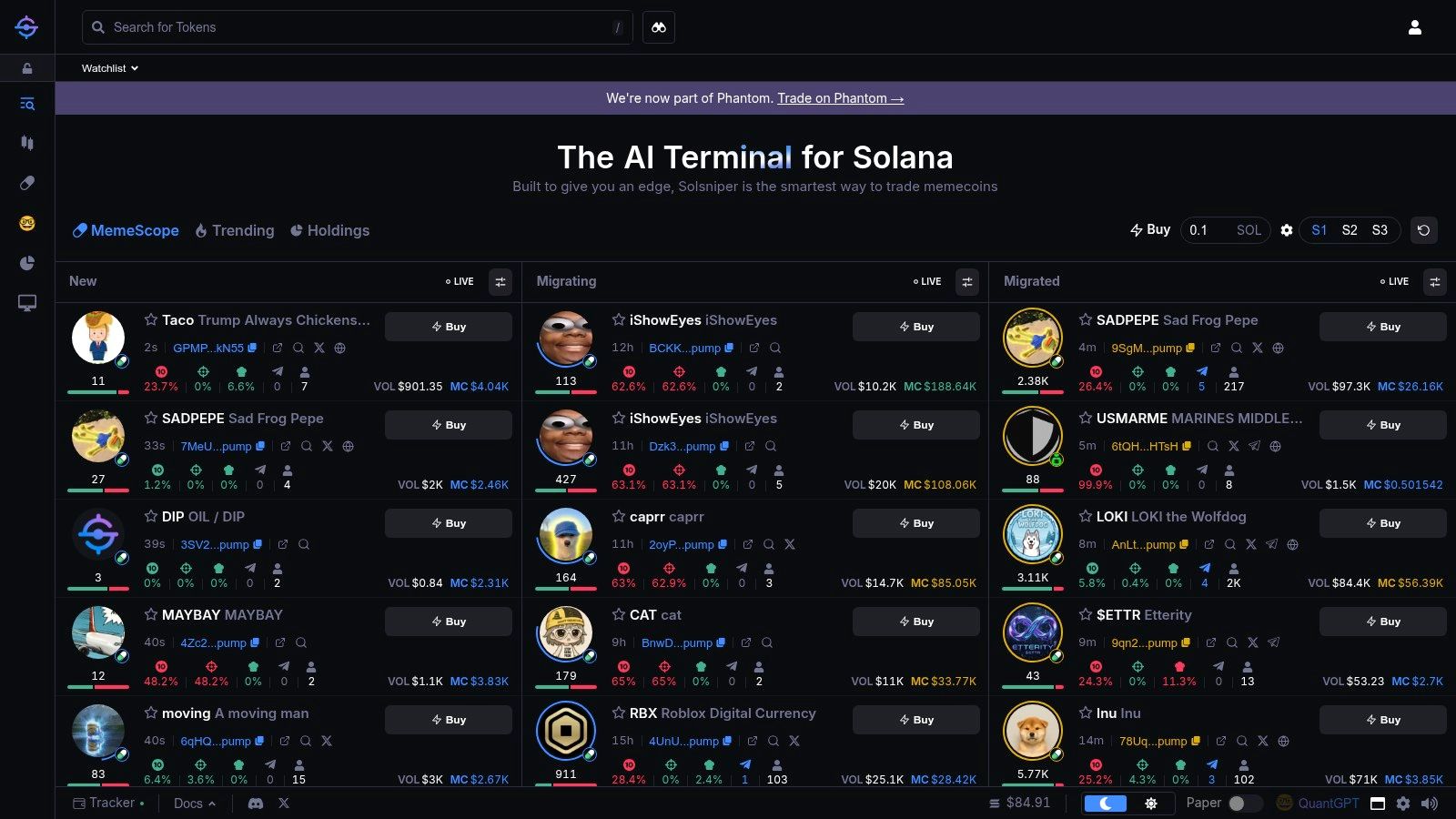
Solsniper is built for traders who want a more terminal-like Solana experience. It feels less like a general scanner and more like an execution-oriented trading workspace.
The feature that makes it useful is lifecycle grouping. Tokens are separated into states such as new, migrating, and migrated, which sounds simple but helps cut some noise.
Why that matters
On Solana, timing is everything. A token at one lifecycle stage behaves very differently from one that has already moved into broader circulation. Solsniper’s categorization gives you a cleaner read on where a token sits in that progression.
That makes it practical for traders who want structure, not just a firehose.
My read on it
- Good native Solana feel: Better suited to fast SOL markets than many generic tools.
- Built-in trading and watchlists: Helpful if you want fewer moving parts.
- Useful lifecycle labeling: Better than one undifferentiated list of chaos.
The trade-off is ecosystem range. Solsniper is mostly for Solana. If you want one tool to cover your full multi-chain routine, this is not it.
I like it as a focused specialist. Open Solsniper when you are actively trading Solana meme flow and need a cleaner operational interface. Close it when your process moves into broader cross-chain validation.
Website: Solsniper
8. GMGN.ai
GMGN.ai is popular with traders who want memecoin discovery and copy-trading features in the same environment. It is fast, feature-rich, and attractive to people who want more than just a scanner.
It is also a tool I would approach carefully.
Where it helps
GMGN.ai is useful when you want smart-money style tracking, first-buyer views, new token alerts, and execution features under one roof. That stack is appealing because it shortens reaction time.
For active Solana traders, that can be enough to justify using it as part of the workflow.
Where I stay cautious
- Fast signal flow: Good for active meme traders.
- Copy-trade options: Helpful if you already know which wallets or styles you trust.
- Contract safety indicators: Useful as a first pass, not a final pass.
The issue is not that the concept is bad. The issue is that copy trading on thin, fast-moving tokens amplifies every execution problem. Delays, slippage, and low-liquidity entries all matter more than people expect.
I also think any platform in this category should be treated as a convenience layer, not a custody shortcut. Verify official links, keep wallet hygiene tight, and never outsource your judgment to a green label on a dashboard.
If you are disciplined, GMGN.ai can speed up your process. If you are impulsive, it can speed up your mistakes.
Website: GMGN.ai
9. Bubblemaps
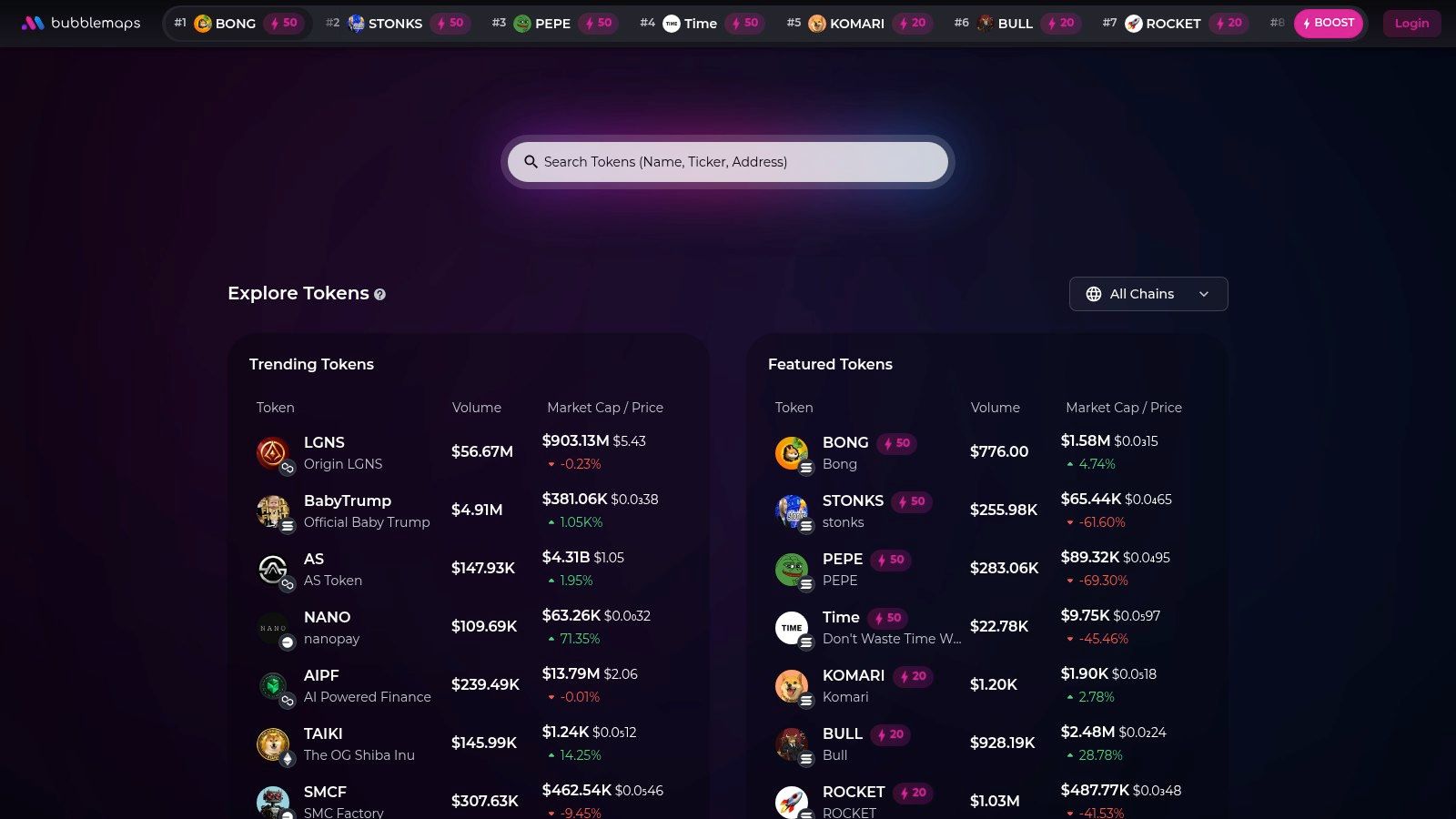
Found a token on a moonshot crypto website that looks ready to run? Bubblemaps is where I check whether the holder structure can ruin the trade before the chart has a chance to prove me right.
This tool earns its place after discovery, not during it. I use DEX Screener, GeckoTerminal, or Birdeye to find momentum. Then I open Bubblemaps to see who holds the supply, whether top wallets connect to each other, and whether the distribution looks organic or staged.
That step matters because price action hides a lot. A clean chart can sit on top of a wallet cluster that is one coordinated exit away from collapse.
What it does best
Bubblemaps turns holder analysis into something you can read quickly. Instead of scrolling through raw addresses, you get a visual map of top holders and wallet links. That makes concentration risk easier to spot in two minutes.
For moonshot crypto website workflows, this is the handoff from discovery to vetting. If a token looks strong on volume and momentum, Bubblemaps helps answer the next question. Is this a broad market bid, or are a few connected wallets controlling the story?
How I use it in practice
- Check top-holder clusters first: Linked wallets near the top of supply deserve immediate caution.
- Compare the map with the chart: If a token pumped fast and the supply still sits in tight clusters, exit risk is higher.
- Use it before copying wallets: If a wallet tracker surfaces buys in a token with bad holder structure, I pass.
One map can save a bad entry.
I do not use Bubblemaps to confirm a trade. I use it to challenge one. If the wallet distribution looks clean, the token moves to the next step in my process. If the map shows insider concentration, recycled wallets, or suspicious clustering, I stop there and move on.
That is its real value. Bubblemaps helps filter the names that looked good on a scanner but fail basic ownership checks.
Website: Bubblemaps
10. TokenSniffer
TokenSniffer is the tool I use for a quick smell test on EVM tokens. It is not perfect, and it should never be the only check, but it is good at one thing: giving you an immediate reason to slow down.
That alone saves trades.
When it earns a place
A lot of moonshot crypto website workflows become messy because traders do too much manual review on names that never deserved that effort. TokenSniffer helps eliminate some of those names by flagging common contract risks and odd token behavior.
For EVM chains, that first-pass filter is useful before you spend more time on holder analysis or wallet tracking.
Limits you should respect
- Good for basic contract checks: Fast way to identify obvious issues.
- Useful alongside scanners: Pairs nicely with DEX Screener, GeckoTerminal, or DEXTools.
- Handy for triage: Helps reduce wasted time.
What does not work is treating the score as absolute truth. False positives happen. False negatives happen. Clever contracts can still pass shallow checks.
I use TokenSniffer to decide whether a token deserves the next ten minutes of my attention. I do not use it to decide whether a token deserves my money. That distinction keeps it in the right role.
Website: TokenSniffer
Top 10 Moonshot Crypto Tools Comparison
| Product | Core features ✨ | UX & quality ★ | Value & price 💰 | Target audience 👥 |
|---|---|---|---|---|
| 🏆 Wallet Finder.ai | Real‑time smart‑money alerts; wallet PnL, win‑streaks, entry/exit & size; cross‑chain Discover views; exportable charts | ★ 4.9/5 (200+ reviews); fast alerts; strong social proof | 💰 7‑day trial; Basic ~$21/mo, Pro ~$34/mo (yrly), Lifetime $1,497 | 👥 Copy traders, quants, funds & active retail traders |
| DEX Screener | New Pairs, Trending, custom alerts, token pages (liquidity/holders) | ★ Fast, intuitive multi‑chain UI | 💰 Free web & mobile; core features unlocked at no cost | 👥 Early token hunters, traders scanning DEXs |
| GeckoTerminal | New Pools, Top Gainers, launchpad integrations, Fast Pass | ★ Broad coverage; rapid updates | 💰 Free core; Fast Pass paid for prioritized updates | 👥 Launchpad/DEX opportunists, team trackers |
| Birdeye | Solana‑first discovery, live charts, in‑page swap, watchlists, PRO alerts | ★ All‑in‑one Solana flow; good UX for memecoins | 💰 Free + Birdeye PRO subscription | 👥 Solana memecoin traders who trade in‑page |
| Pump.fun | Live/new token launches, chat, graduation to DEX, mobile app | ★ Real‑time, high volume (very risky) | 💰 Free access; launch participation costs/slippage | 👥 Earliest launch hunters, Solana degens |
| DEXTools | New/Trending pairs, alerts, social/holder widgets, portfolio tools | ★ Established EVM focus; large user base | 💰 Free + paid tiers; token‑gated perks (DEXT) | 👥 ETH/BSC/Base traders and community analysts |
| Solsniper | MemeScope (New/Migrating/Migrated), built‑in trading, wallet connect | ★ Efficient Solana terminal; now part of Phantom | 💰 Free/core; Pro features possible | 👥 Solana memecoin executors and fast traders |
| GMGN.ai | Smart‑money tracking, copy‑trade tools, pump/launch monitors, contract flags | ★ Fast signals but polarized reviews | 💰 Variable; paid features for automation | 👥 Solana memecoin copy‑traders (use caution) |
| Bubblemaps | Holder bubble maps, cluster tracing, AI "magic nodes", iFrame/API | ★ Strong visual on‑chain analytics; V2 free features | 💰 Free tier; paid for advanced exports/APIs | 👥 Researchers, risk‑averse traders, due‑diligence teams |
| TokenSniffer | Automated contract scanner, honeypot & scam checks, composite risk score, API | ★ Quick first‑pass scanner; accuracy varies | 💰 Free checks; Pro/API for higher volume | 👥 EVM token reviewers and DEX scanner users |
Start tracking smart money today
Join thousands of traders using WalletFinder.ai to find profitable wallets and copy their trades.
Start Free Trial →

