A Developer's Guide to String and Sol

Wallet Finder

Blank calendar icon with grid of squares representing days.

March 28, 2026

When you hear a developer mention a "string and sol" problem, they're not talking about a simple coding error. They’re pointing to one of the most fundamental—and expensive—challenges in blockchain development.

The term refers to handling textual data (string) within either the Solidity programming language (the .sol files that power EVM chains) or on the high-performance Solana blockchain. Getting this right is what separates a functional dApp from one that's actually efficient and scalable enough for real-world use.

Unpacking The String and Sol Challenge

For anyone building on-chain, the "string and sol" dilemma isn't just about syntax—it's a massive issue of cost and performance. Storing text directly on a blockchain is notoriously resource-intensive, no matter which platform you're on.

Think of it this way: writing a string directly to the chain is like trying to mail a solid gold bar. It's incredibly heavy, slow to move, and the shipping costs—calculated for every ounce—are astronomical.

A much smarter approach? Mail a secure, digital certificate of ownership for that gold instead. The certificate is lightweight, transfers instantly, and costs next to nothing to handle, all while providing verifiable proof of your asset. This is the core trade-off.

This diagram helps visualize that flow, showing how raw text is converted into a functional blockchain asset.
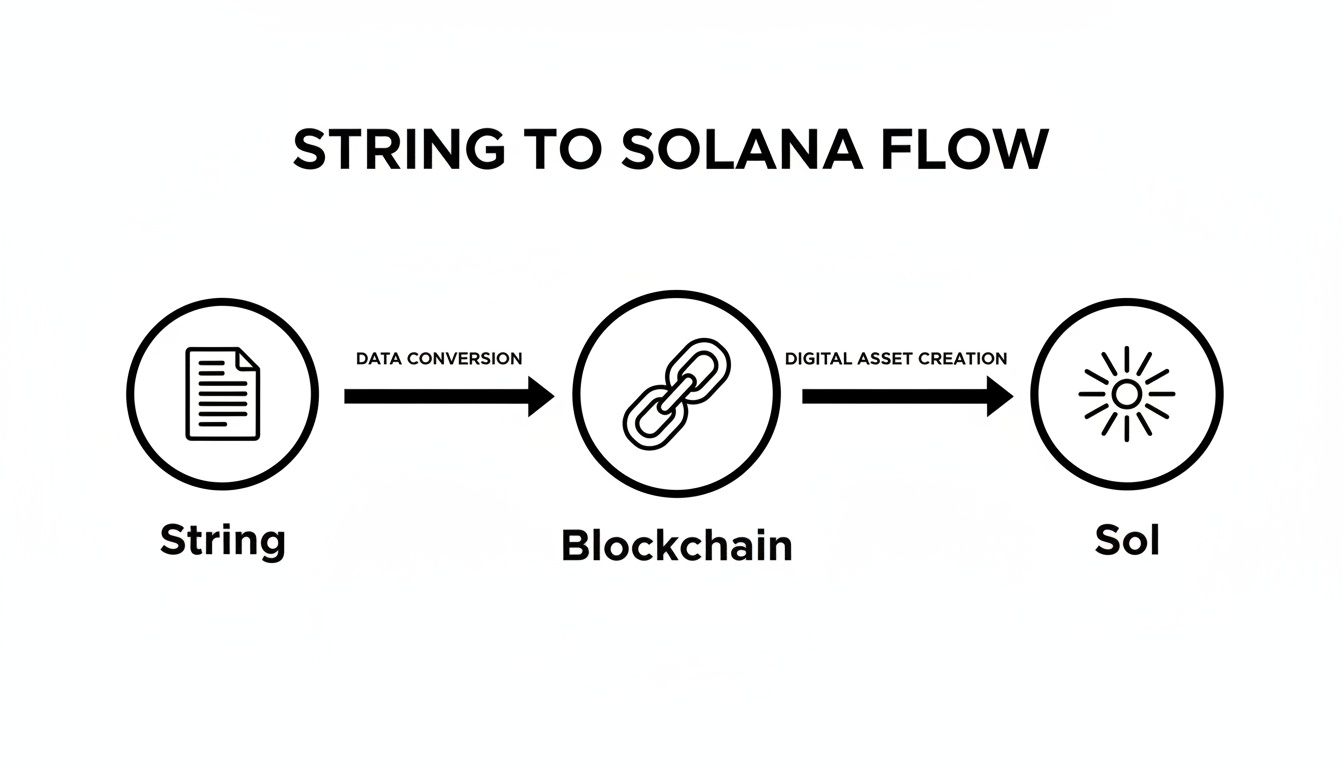
Diagram illustrating the String to Solana flow, showing data conversion to blockchain and digital asset creation to Sol.

Here, we see the conceptual journey from a basic "string" to a processed asset on a chain like Solana, represented by "Sol".

Understanding this difference—storing bulky raw data versus a lightweight reference—is crucial for building effective dApps. Whether you're battling Ethereum's gas fees or managing Solana's compute units, optimizing how you handle strings is what keeps costs down and ensures your application can actually scale.

Key Takeaway: At its heart, the "string and sol" problem is an economic one. Poor string management blows up transaction fees and tanks performance, directly harming your app's viability and user experience.

Of course, the term "sol" itself can pop up in a few different contexts in crypto. To get a full picture of its uses, you can explore our guide on what sol stands for. Mastering these foundational concepts is the first step toward writing smarter, more cost-effective smart contracts on any blockchain.

String Handling At a Glance Ethereum vs Solana

Before we dive deeper, it's helpful to see how the two biggest smart contract ecosystems approach this problem. While both face the same core economic constraints, their architectural differences lead to different developer strategies.

AspectEthereum (Solidity)Solana (Rust)
Primary Data Typestring (dynamic bytes array)String (UTF-8 growable)
On-Chain StorageExtremely expensive; stored in storageExpensive; stored in account data
Typical PatternStore hashes or URIs on-chain; data off-chain (IPFS)Store data in separate accounts; use Program Derived Addresses (PDAs)
Cost ModelGas fees per byteRent for account space + Compute Units for processing
ManipulationLimited native functions; libraries (e.g., Strings.sol) are commonRich native functions in Rust's standard library

This table gives you a quick snapshot of the philosophical differences. Ethereum's model strongly discourages on-chain string storage, while Solana provides more flexibility but requires careful account management to stay efficient. We'll break down what this means in practice in the sections ahead.

Mastering Strings in Solidity for Gas Efficiency

When you're building on Ethereum, understanding how Solidity handles text is absolutely critical for managing your gas costs. A string in Solidity isn't like a simple number—it's actually a dynamically-sized array of bytes (bytes) that uses UTF-8 encoding. And it’s this dynamic, "changeable" nature that makes it so expensive to use.

Illustration comparing an on-chain string (gold bars in a container) with an off-chain reference (document on a smartphone).

Because a string’s length can change, the Ethereum Virtual Machine (EVM) has to do a lot of extra work behind the scenes. That extra work translates directly into higher gas fees for pretty much anything you do with them.

Memory vs. Storage: The Whiteboard and The Stone

To really get why strings are so costly, you have to grasp the difference between memory and storage. It's a fundamental concept in Solidity development.

Think of memory as a temporary whiteboard. It’s cheap and fast, perfect for quick calculations inside a single transaction. But once that transaction is over, everything on the whiteboard is erased.

Storage, on the other hand, is like carving your data into the stone of the blockchain itself. This data is permanent, living on in your smart contract forever. As you can imagine, this kind of permanence comes at a very steep price, since every node on the network has to store it indefinitely.

Storing a string in storage is one of the most expensive operations you can perform in Solidity. Each 32-byte "word" of storage costs thousands of gas, making on-chain storage of even medium-length strings financially insane for most apps.

This cost difference is everything. Working with a string in memory during a function call is relatively cheap. But the second you save that string to a state variable—writing it to storage—your gas costs skyrocket.

The True Cost of String Operations

The gas impact of a string and sol strategy on the EVM can't be overstated. We're not just talking about the initial cost of saving the string; every single update and read costs more gas. Here’s an actionable breakdown of how this eats into your contract's budget.

  • Creation: Writing a new string to storage means you pay for every 32-byte chunk it fills. A 100-character string can easily take up multiple storage slots, costing tens of thousands of gas right out of the gate.
  • Updates: Modifying a string in storage is even worse. Since strings are dynamic, changing their length often forces the EVM to find a whole new spot for the data and update all the pointers, creating a ton of gas overhead.
  • Reading: It's cheaper than writing, but reading strings from storage is still way more expensive than reading fixed-size data types like a uint256 or bytes32.

The table below gives you a simplified idea of the cost differences. While exact gas costs fluctuate with network traffic, the massive difference in scale always holds true. To dive deeper into how these fees work, check out our guide on Ethereum gas fees.

OperationData LocationRelative Gas CostAnalogy
Declaring a StringmemoryLowSketching on a whiteboard
Storing a StringstorageVery HighCarving into a marble slab
Updating a StringstorageExtremely HighRe-carving and polishing the slab
Passing as ArgumentcalldataLowHanding someone a note

This harsh economic reality forces developers to get creative. Storing long strings directly on-chain can easily cripple a contract’s efficiency and make it too expensive for anyone to use. In the next sections, we'll walk through some practical patterns to get around these limitations.

If you’ve spent any time on Ethereum, you know the constant battle developers face with gas fees. Every bit of data you store on-chain costs a fortune. But when we talk about the string and sol problem on Solana, we’re entering a completely different universe. Solana’s architecture throws out the old rulebook, shifting the focus from painful cost-cutting to simply managing data efficiently.

Cartoon illustrating memory as temporary whiteboard notes and storage as permanent stone carving.

The secret sauce is Solana's account model. Instead of stuffing data directly inside a smart contract, Solana treats everything as a separate account—even the contracts themselves, which are called "programs." This lets you store data, like strings, in their own dedicated accounts, which are dramatically cheaper to create and interact with compared to Ethereum's contract storage.

The Account Model Advantage

This design choice changes everything. It makes storing data incredibly efficient and flexible, which is the core reason Solana can handle such massive transaction volumes. The economic hurdles to storing and processing information are almost nonexistent.

Here’s a simple way to think about it: Ethereum is like a single, ridiculously expensive filing cabinet. Every new folder you add costs a premium. Solana, on the other hand, is like an endless warehouse full of cheap, individual file boxes. You can grab as many as you need, organize them however you see fit, and only pay a small, refundable deposit (called rent) for the space you use.

This efficiency is exactly why Solana has become the go-to chain for data-heavy applications.

  • High-Frequency Trading: Traders can run complex strategies with thousands of transactions without getting wrecked by fees.
  • Complex DeFi Protocols: Projects can manage huge amounts of state data—like order books and user positions—at a tiny fraction of the cost.
  • On-Chain Analytics: The low cost makes it possible to do deep, real-time analysis, a critical edge for anyone looking to track profitable wallets on Solana.

Unprecedented Network Activity

This performance edge translates into a mind-boggling amount of on-chain activity. By early 2026, Solana was already processing 15 million daily transactions from automated agents alone, with total daily counts soaring past 150 million. This is the kind of scale that allows platforms like Wallet Finder.ai to mirror winning trades in real time.

For DeFi and memecoin traders, the numbers speak for themselves. Solana saw $117 billion in DEX volume in just two weeks—more than double Ethereum’s during the same period. It’s a clear signal of where the liquidity and opportunity are flowing. You can get more details on Solana's market dominance and growth on Bitcoinke.io.

By separating logic (programs) from state (data accounts), Solana empowers developers to build applications that were simply not economically viable on EVM-based chains. This makes understanding Solana's data handling essential for any modern on-chain analyst or developer.

Practical Patterns for Efficient String Management

Knowing the theory is great, but when it comes to shipping smart contracts, every line of code has a price tag. Whether you're wrestling with Ethereum's notoriously expensive storage or designing for Solana's high-speed account model, how you handle strings isn't a minor detail—it's a critical decision that directly impacts cost and performance.

Let's break down the battle-tested patterns that separate lean, efficient contracts from bloated, expensive ones.

Solidity Patterns for Gas Savings

On Ethereum, the name of the game is minimizing on-chain storage. The high gas cost associated with the string type means that storing long-form text directly in your contract's state is almost always a bad move. Successful protocols treat every byte as precious, using a few core strategies to stay gas-friendly.

Here are three essential, actionable patterns every Solidity developer should use:

  • Use bytes32 for Short, Fixed-Size Text: If you're working with text that you know will be 32 characters or less—like a token symbol, a username, or a status code—always reach for bytes32. It’s a value type that neatly fits into a single storage slot, making it drastically cheaper to store and access than a dynamic string.

  • Emit Events for Logging Data: Instead of saving descriptive text to contract storage, log it with an event. Events are a low-cost logging mechanism built into the EVM. The data gets recorded in the transaction logs, which are cheap to write to and fully accessible to front-ends and indexers, but it doesn't clutter your contract's state. This is perfect for messages, names, or any text that other contracts don't need to read.

  • Store Hashes, Not Raw Data: When you need to verify a piece of information without storing the information itself, use a Keccak256 hash. Hashing any string creates a unique, fixed-size 32-byte fingerprint. You can store this cheap hash on-chain and later prove the original string's authenticity by hashing it off-chain and comparing it to the stored value.

To put this in perspective, take a look at just how much the gas costs can vary for storing a simple 32-character string.

Gas Cost Comparison for Storing Text on Ethereum

This table clearly shows the massive gas savings you can achieve by choosing the right data type or pattern.

Storage MethodExampleApproximate Gas Cost
stringstring public name = "MyDeFiProtocol_Name_Represents_V1";~60,000+ gas
bytes32bytes32 public name = "MyDeFiProtocol_Name_Represents_V1";~22,000 gas
eventevent LogName(string name); emit LogName("...");~2,000 gas
keccak256bytes32 public nameHash = keccak256(abi.encodePacked("..."));~22,000 gas

The numbers don't lie. Simply switching from a string to a bytes32 can slash your gas costs by over 60%. For pure logging, using an event is an absolute game-changer.

The Solana Metadata Pattern

Solana's architecture gives developers more breathing room, but efficiency is still paramount. The solution for the string and sol challenge here isn't just about a data type, but a core design pattern: separating logic from descriptive data.

The dominant pattern in the Solana ecosystem is to store metadata, such as NFT names or token symbols, in separate accounts that are linked to a primary state account.

Here is the actionable flow for this pattern:

  1. Isolate Logic: Keep your main program focused on core functions (e.g., transfers, mints).
  2. Create a Metadata Account: For each on-chain asset, create a separate account (often a PDA) to hold descriptive strings like name, symbol, and uri.
  3. Link and Verify: The metadata account is owned by the program, creating a verifiable link between the asset and its data.
  4. Fetch on Demand: dApps and front-ends can fetch the descriptive data they need from this account without congesting the main program.

This modular design keeps interactions fast, cheap, and efficient—a cornerstone of high-performance development on Solana.

Avoiding Common Security Pitfalls with Strings

Getting on-chain text wrong is more than just a performance headache; it’s a massive security risk. Whether you're dealing with a string and sol implementation on Ethereum or wrangling data on Solana, simple mistakes can open your smart contracts to devastating exploits. Learning to spot these red flags is critical for writing secure code and for safely interacting with other protocols.

Diagram illustrating a data flow from bytes32 to events (log), main state, and metadata account.

One of the most common entry points for an attack is the improper validation of string arguments. If a function blindly accepts a string from an outside source without checking its content or length, an attacker can feed it malicious data. This can be used to hijack contract logic, force unexpected state changes, or even set up complex reentrancy attacks.

Dangers of Unchecked String Inputs

In Solidity, unchecked string inputs are a classic attack vector. A malicious actor can craft a very specific string to cause parsing errors or overflow buffers, assuming the contract’s logic isn’t bulletproof. This is exactly why strict input validation isn't just a "nice-to-have"—it's a non-negotiable part of secure development.

Another huge danger comes from external calls that return string data. If your contract calls another and expects a string back, you absolutely must treat that returned data as untrusted. A malicious contract could send back a deliberately malformed or ridiculously large string, causing an out-of-gas error that stalls or breaks your contract's functions.

Critical Security Insight: Never, ever trust string data from an external source. Always validate the length, sanitize the content, and build in ways to gracefully handle errors. This is how you prevent denial-of-service and logic manipulation attacks.

Security Checklist for Handling Strings

Use this checklist to audit your code and avoid common vulnerabilities:

  • [ ] Input Validation: Does every function that accepts a string check its length and format?
  • [ ] External Call Safety: Are strings returned from external calls treated as untrusted and handled within a try/catch block?
  • [ ] Consistent Encoding: Is the string encoding (e.g., UTF-8) consistent between your contract and off-chain clients?
  • [ ] Safe Deserialization (Solana): Are you using a battle-tested library like Borsh or Anchor to safely deserialize account data, preventing malicious byte payloads?
  • [ ] Avoid Direct On-Chain Comparison: Are you comparing hashes (keccak256) instead of raw strings to save gas and prevent potential denial-of-service vectors?

Failing to tick these boxes can quietly open up security holes, leading to subtle bugs or catastrophic exploits.

Why Understanding On-chain Strings Is a Trader's Secret Weapon

Most traders stick to price charts, but the real alpha is buried deeper. It’s hidden in the raw data of the blockchain itself, specifically within the string data of on-chain transactions.

Getting a handle on these technical details isn't just for developers—it's a trader's secret weapon. When you can read and understand the string data inside transaction inputs, you can see exactly what “smart money” is doing in real time. This is how you spot a whale moving into a new protocol or find a fresh yield farm before it ever hits Twitter.

This edge is especially powerful on a network like Solana. Its capacity for massive transaction volumes at a low cost means every single move, big or small, gets recorded on-chain. All that data is just sitting there, waiting for someone who knows how to read it. If you can master that, you have a serious advantage.

Actionable Trading Strategies Using On-Chain Data

Here is how you can turn this technical knowledge into profitable trades:

  1. Build Smarter Watchlists: Forget just tracking token prices. Start monitoring wallets that are interacting with specific, niche smart contracts. You can identify these contracts by their unique function-call strings in a block explorer.
  2. Set Precision Alerts: Use on-chain monitoring tools to create notifications for when a top wallet calls a new, unknown function. This is often the first signal they’re moving into a brand-new protocol.
  3. Mirror Profitable Strategies: By digging into complete transaction histories (including input data), you can piece together the exact strategies of the most consistently profitable traders and mirror their moves.

Think of it this way: learning to read on-chain string data is like learning to read the market’s source code. It gives you an unfiltered view of what's happening, cutting through all the noise.

This kind of deep-dive analysis is incredibly effective on a resilient, dominant chain like Solana. Even after a major crypto downturn, Solana's market cap found solid ground around $48-50 billion in early 2026, securing its 10% share of the Layer-1 market.

That kind of stability in a $50 billion ecosystem with $7 billion in TVL makes it the perfect hunting ground for DeFi trackers. Tools like Wallet Finder.ai thrive here, allowing users to analyze the PnL and position sizing of top wallets. To get a better sense of the opportunity, you can learn more about Solana's market position and its potential for traders at IndexBox.io.

Common Questions About Strings in Solidity

When you're building on the blockchain, even something as simple as text can get complicated. Here are some quick, practical answers to the questions developers run into all the time when handling strings in their contracts.

When Should I Use Bytes Instead of Strings in Solidity?

Think of it this way: if you know for a fact your text will be short, bytes is your friend. Specifically, if the text is 32 characters or less, always go with a fixed-size bytes array like bytes32.

Why? It's all about gas. bytes32 is a value type that neatly fits into a single, 32-byte storage slot. It's incredibly efficient. A string, on the other hand, is a complex, dynamically-sized type that costs a lot more to store and manipulate.

For any text where you don't know the length, you'll have to use string. But the real pro move is to avoid storing large strings on-chain in the first place. Use events to log them or push them to off-chain storage.

What Is the Cheapest Way to Compare Two Strings On-Chain?

Whatever you do, don't compare two string variables directly in Solidity. It’s a classic rookie mistake that will absolutely burn through your users' gas. The most efficient and secure way is to compare their Keccak256 hashes instead.

Pro Tip: Don't store the full string on-chain. Store its hash. When you need to verify an input string, just hash it on the fly and compare the new hash to the one you have stored. This turns a complex, expensive operation into a simple, cheap comparison of two fixed-size values. It's a standard pattern every serious DeFi developer uses.

How Can I Store Usernames On-Chain Efficiently?

For short usernames—anything up to 32 characters—the answer is always bytes32. It’s the perfect, gas-friendly choice for fixed-length identifiers inside a Solidity contract.

If you have to handle usernames longer than 32 characters, you've got a few smart options that don't involve stuffing expensive strings into storage:

  • Store a hash of the username. This is great for lookups and verification.
  • Log the full username in an event. This makes the data available off-chain without bloating your contract's storage.
  • Use off-chain storage. Put the full username on a service like IPFS and just keep its hash or content identifier (CID) in the smart contract.

Ready to turn on-chain data into your trading advantage? Wallet Finder.ai helps you discover profitable wallets and mirror their strategies in real-time. Start your 7-day free trial on walletfinder.ai and trade smarter.