How to Track Crypto Wallet Activity Like a Pro
Learn to track crypto wallet movements with our expert guide. Discover tools and strategies to find and mirror profitable traders using on-chain analysis.

February 27, 2026
Wallet Finder

February 27, 2026

To get ahead in crypto, you need to follow the money—right on the blockchain. The best strategy is tracking the on-chain moves of proven, profitable traders. This means using a tool like Wallet Finder.ai to pinpoint "smart money" wallets, digging into their track record (PnL, win rate), and setting up alerts to mirror their trades before everyone else catches on.
In the fast-paced crypto market, a real edge comes from seeing what others miss. Tracking crypto wallets has gone from a niche skill to an essential strategy for any serious trader. It’s like getting a front-row seat to market-moving trades before they hit the headlines. This is the core of on-chain analysis—turning raw, public blockchain data into sharp, actionable intelligence.
When you start monitoring the right wallets, you unlock insights that can transform your trading game. Here's what you can achieve:
On-chain data doesn't lie. Every transaction is etched into a public ledger, creating an unchangeable history of every buy, sell, and transfer. Modern tools tap into this goldmine, making it incredibly easy to find and follow top performers. If you want to go deeper, our complete guide to on-chain analysis breaks it all down.
The crypto wallet market itself is exploding. It hit USD 12.20 billion in 2025 and is projected to reach a staggering USD 98.57 billion by 2034, growing at a 26.7% CAGR. This boom highlights why tracking is so vital. With more wallets comes more noise, making tools that cut through it to show PnL, win streaks, and instant alerts absolutely essential. You can dig into the numbers in the full report on crypto wallet market growth.
Here’s a quick look at how a modern dashboard can make sense of this data.
An interface like this transforms messy blockchain data into a clean, intuitive view, spotlighting the metrics that actually matter, like profit and loss.
The best traders aren't just lucky; they follow the data. By tracking wallets, you’re basically looking over the shoulder of the market's sharpest minds, gaining access to strategies that are proven to work.
To cut through the noise, you need to focus on a few key metrics. This table breaks down what to look for and what it tells you about a trader's strategy.
Focusing on these signals helps you separate lucky gamblers from skilled operators, giving you a much clearer path to follow.
With millions of active wallets, the challenge isn’t just tracking activity—it’s finding the signal in the noise. You need to identify wallets that are consistently making smart moves. A systematic approach turns this overwhelming data into a clear, actionable advantage.
The goal is to graduate from a vast ocean of anonymous addresses to a curated watchlist of proven winners. This isn't about getting lucky; it's about applying a disciplined filtering strategy to find patterns of success.
Your journey begins with powerful filters. Instead of manually sifting through transactions, modern wallet discovery tools let you set specific criteria to instantly surface potential gems. Think of it as a specialized search engine for profitable traders.
Here are the non-negotiable filters to build an initial target list:
This initial filtering is all about refining raw data through smart tools to produce actionable insights, just like this flow shows.
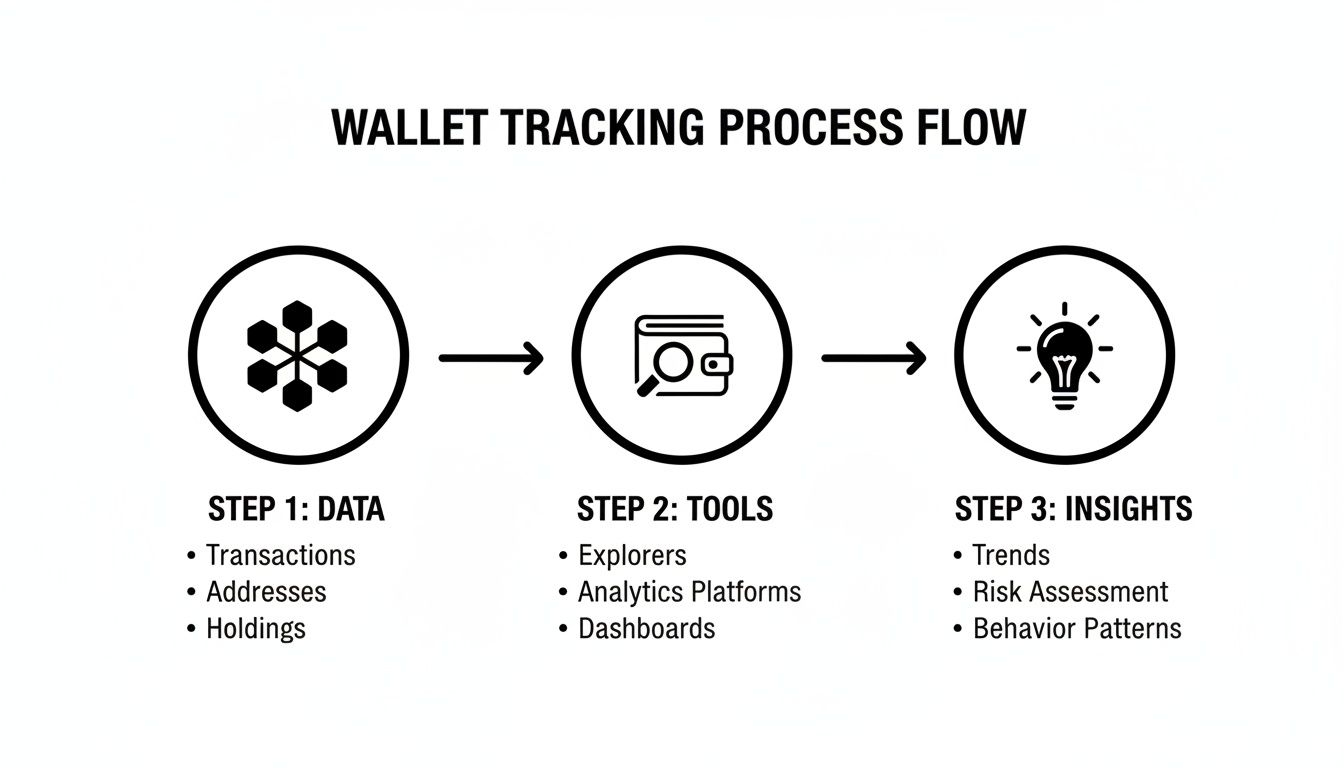
This simple flow—from raw blockchain data, to analytical tools, to actual insights—is the heart of any effective wallet tracking strategy.
The scale of this task can be mind-boggling. There are over 200 million active Bitcoin wallets, with nearly 20,000 holding over 100 BTC. This massive fragmentation is precisely why filtering is so powerful; it helps you zero in on a handful of high-potential targets.
Once you have a shortlist, the real work begins. Go beyond high-level stats and dig into transaction history to understand the story behind the numbers. A massive PnL is great, but how they got it matters more.
Actionable Steps for Vetting a Wallet:
A wallet's transaction history is its resume. Don't just look at the headline PnL; read the work experience to understand their skills, risk appetite, and consistency.
By analyzing these distinct patterns, you’re not just finding profitable traders—you’re identifying specific, repeatable strategies you can learn from. For a deeper dive, check our guide on the key metrics for identifying profitable wallets. This scrutiny separates followers from leaders.
Finding a wallet with a high PnL is just the first step. The real alpha comes from digging into its transaction history to understand the how and why behind its success. Every on-chain move tells a story, and learning to read these signals separates the pros from the crowd.
When you track a crypto wallet, you're searching for repeatable patterns. A wallet's public ledger is a transparent record of every decision, revealing the trader's strategy, risk tolerance, and market conviction. This helps you move beyond blindly copying trades and start making informed decisions.

The most important signals come from how a wallet interacts with tokens on decentralized exchanges (DEXs). These actions form the foundation of any trading strategy.
Here are the key signals to zero in on:
A wallet’s PnL chart tells you if they won, but its transaction history tells you how they played the game. Focus on consistent, repeatable patterns—like early entries into new narratives or disciplined profit-taking—to find strategies worth emulating.
A deeper analysis can reveal a trader's entire playbook. By connecting a few data points, you can understand their unique style and decide if it aligns with your own goals and risk tolerance.
For example, a trader making dozens of small, rapid-fire trades on new memecoins is a "sniper." They live by speed, aiming for quick gains. In contrast, a trader who makes only a few large buys of established DeFi tokens each month is a "swing trader," focused on longer-term trends. Learn more in our guide on how wallet data generates token signals.
Translate raw on-chain data into distinct trader characteristics using this table.
By piecing these signals together, you can construct a detailed profile of any trader. This lets you move beyond just copying moves and start truly understanding their strategy.
Spotting a profitable wallet is a great start, but it's not where the money is made. In crypto, speed is everything. The real edge comes from turning your research into fast, decisive action. This is where a finely-tuned watchlist and a smart alert system become your most critical allies.
Think of a watchlist as your curated feed of high-conviction targets. Instead of a messy list of random wallet addresses, you get a clean dashboard showing every move made by the traders you follow. When you add a wallet to your list on a tool like Wallet Finder.ai, you cut through the market noise.

A watchlist is only as good as the alerts it generates. The goal is to get an instant notification—on Telegram or a push notification—the second a tracked wallet makes a big move. This is how you react in real-time.
But you don't want your phone buzzing for every tiny transaction. The key is to be surgical with your alert settings so you only get pinged for high-signal events.
My Personal Alert Configuration:
Your alert system should be your personal alpha generator, not a source of constant distraction. By setting intelligent triggers based on dollar value and wallet priority, you transform raw transaction data into urgent, actionable trading opportunities.
This customization turns your phone into a trading assistant that feeds you high-priority signals around the clock.
Different platforms offer different features. The best tool for you depends on your goals, the chains you trade on, and how deep you want to go.
Ultimately, whether you choose Wallet Finder.ai for its copy-trading focus or Nansen for deep analytics, the principle is the same. By carefully building your watchlist and configuring precise alerts, you create a system that lets you act with confidence.
Once you’ve mastered the basics, it’s time to move beyond following a single wallet. The real alpha is in understanding the bigger on-chain picture. This means graduating from watching one trader to spotting entire networks moving in coordination.
One of the most powerful ways to do this is through cluster analysis. Look for groups of wallets that move together. Maybe they were all funded from the same source or execute the same trades within seconds of each other. Finding these clusters can tip you off to private trading groups or VC funds building a position before an announcement.
To get this deep, you'll need to go beyond the web dashboard. A huge advantage of platforms like Wallet Finder.ai is the ability to export raw transaction data into a CSV file. This is a game-changer for serious traders.
Once you pull that data into a tool like Excel or Google Sheets, you can:
This is where you find a unique edge. You're no longer just a follower; you're an analyst ready to track crypto wallet networks with new precision.
With all this data, it's easy to get carried away. The single biggest mistake is blindly copying every trade without asking questions. That's a fast track to getting wiped out.
Never forget that when you track a crypto wallet, you're following a stranger's decisions. Always protect your capital by setting strict personal rules and never allocating more than you are willing to lose on any single strategy.
A glowing PnL chart can hide serious dangers:
To navigate this minefield, you need a disciplined game plan. This isn't just about making money; it's about surviving long enough to make it.
By pairing deep analysis with an iron-clad risk framework, you can tap into the incredible power of wallet tracking while keeping your capital safe.
Jumping into on-chain analysis can feel overwhelming. It's normal to have questions. Here are some of the most common ones with straight-to-the-point answers.
Yes, it is 100% legal. All data on public blockchains like Ethereum or Solana is public information by design. Tracking a wallet is like reading a public ledger—you're just using a tool to make it easier to understand.
It’s safe, as long as you’re smart. Reputable platforms will never ask for your private keys or seed phrase. You're an observer watching public addresses from a distance. Just watch out for phishing scams and never connect your personal wallet to a sketchy site.
This is the million-dollar question. Anyone can get lucky on a single memecoin pump. True skill shows up over time and through consistent performance.
Here’s a quick checklist:
It depends on the tool you’re using. Most of the best wallet trackers focus on the big leagues where the action is: Ethereum, Solana, and Base.
Before you sign up for any platform, double-check that it supports the chains you're interested in. While support for smaller chains is improving, the top tools almost always cover the big ones with high trading volume.
The easiest way to lose money copy trading is by turning your brain off. Blindly following is where trouble starts.
The most common pitfalls are:
The best advice? Start small. See how it feels, and always adapt what you see to fit your own strategy and comfort level.
Ready to stop guessing and start tracking the market's smartest money? Wallet Finder.ai gives you the tools to discover profitable traders, analyze their strategies, and get real-time alerts on every move they make. Start your 7-day trial today and turn on-chain data into your unfair advantage. Find winning wallets now at Wallet Finder.ai.