What is a DeFi Wallet? Your Guide to Self-Custody

Wallet Finder

Blank calendar icon with grid of squares representing days.

December 11, 2025

A DeFi wallet isn't just a place to store your crypto. Think of it as your personal digital vault and your all-access pass to the world of decentralized finance. It's a non-custodial wallet, which simply means you—and only you—have complete control over your private keys and digital assets. This setup lets you plug directly into financial apps without needing a bank or any other middleman.

Your Keys to the World of Decentralized Finance
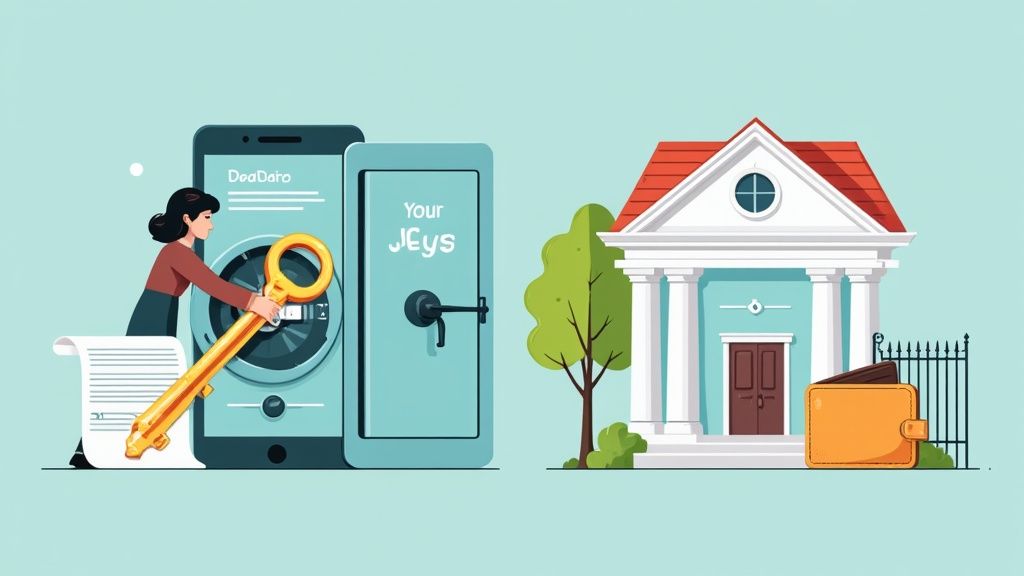
A woman uses a large golden key to unlock a digital safe displayed on a smartphone, next to a bank building and a wallet.

The easiest way to wrap your head around a DeFi wallet is to compare it to something we all know: a traditional bank account. With a bank, you can access your money, but they ultimately hold the reins. The bank holds your funds, approves your transactions, and can even freeze your account if they see fit.

A DeFi wallet completely flips that model on its head.

It’s the difference between owning your house and renting an apartment. When you own the deed, you call the shots. No landlord can lock you out. A DeFi wallet works the same way. You hold the private keys, which are like the cryptographic "deed" to your digital assets.

This principle of self-custody is the absolute bedrock of decentralized finance. It means you are your own bank, with all the freedom—and responsibility—that comes with it. Nobody can access, freeze, or take your funds unless they have your private keys.

This direct ownership is what opens the door to a massive ecosystem of decentralized applications, or dApps. These are the tools built on the blockchain for lending, borrowing, trading, and earning interest, all without an intermediary taking a cut or telling you what you can and can't do.

DeFi Wallet vs. Traditional Bank Account at a Glance

To make this distinction as clear as possible, let's look at a side-by-side comparison. It really highlights the fundamental shift in ownership, access, and control that DeFi wallets bring to the table.

FeatureDeFi WalletTraditional Bank Account
Asset ControlYou have 100% control via private keys.The bank controls your funds and can freeze them.
AccessGlobal, 24/7 access without permission.Limited by bank hours, geography, and policies.
IntermediaryNone; you interact directly with protocols.The bank is a required intermediary for all actions.
SecurityYou are responsible for securing your keys.The bank is responsible for security.
PrivacyPseudonymous; no personal data required.Requires extensive personal identification (KYC).

The table says it all. While a bank offers convenience by managing security for you, it comes at the cost of control. A DeFi wallet puts you firmly in the driver's seat, offering a level of financial sovereignty that was never possible before.

How a DeFi Wallet Actually Works

To really get a handle on DeFi wallets, you have to pop the hood and see what's running the show. It all comes down to a powerful duo of cryptographic keys: a public key and a private key. If you can get your head around this one concept, you're already halfway there.

Think of your wallet’s public key as your bank account number. You can share it freely with anyone who needs to send you money. When someone wants to send you crypto, this is the address they use. It's totally safe to share and doesn't put your funds at risk.

Your private key, on the other hand, is the PIN to your bank card. It's a secret code that absolutely must stay private. This key is the only thing that can authorize sending crypto out of your wallet. If anyone else gets their hands on it, they have complete control of your money.

It's a common mistake to think your wallet "holds" your crypto. In reality, your funds always live on the blockchain. Your wallet is more like a high-tech keychain holding the secret keys that prove you own those funds and give you access to them.

This key system is what makes DeFi wallets the go-to interface for the entire ecosystem. They grant you direct, non-custodial access to protocols like Uniswap or Aave without needing a bank as a middleman. By late 2023, the total value locked (TVL) in DeFi protocols was hovering around $50 billion, which shows you just how big this user-controlled financial world has become. While this gives you incredible freedom, it also means you're 100% in charge of your own security. You can find more data on DeFi user growth over at Statista.

Signing and Broadcasting a Transaction

So, how do these keys team up to send crypto? The process is surprisingly straightforward but incredibly secure.

Let's say you want to send 1 ETH to a friend. Here's a quick look at what your wallet is doing in the background:

  1. You Set Up the Transaction: First, you punch in your friend's public address and the amount, 1 ETH. Your wallet software gets this instruction ready to go.
  2. You Sign with Your Private Key: This is where the real magic happens. Your wallet uses your secret private key to create a unique digital signature for this specific transaction. It's a cryptographic way of proving that you—and only you—gave the green light.
  3. It's Broadcast to the Network: The signed transaction is then fired off to the entire blockchain network for everyone to see.
  4. Miners Verify and Confirm: Computers on the network (nodes or miners) instantly check your digital signature against your public key. If it all matches up, they confirm the transaction is legit and add it to the blockchain. The 1 ETH is now on its way to your friend.

The beauty of it all is that this happens without your private key ever being revealed. It's like signing a check with a special, unforgeable signature that anyone can verify is yours without ever seeing you actually sign it.

Your Ultimate Master Key: The Seed Phrase

But what if you lose your phone or your laptop dies? That's where the seed phrase (also called a secret recovery phrase) saves the day.

When you create a new DeFi wallet, it generates a unique list of 12 to 24 simple words. This is your seed phrase. This phrase is the master key that can be used to regenerate all of your private keys and restore your entire wallet on a new device.

You have to treat this phrase like gold. Seriously.

  • Write it down physically. Use a pen and paper.
  • Store it offline and securely. Think of a safe, a safety deposit box, or another location that isn't connected to the internet.
  • Never, ever share it. No legitimate company, support agent, or dApp will ever ask you for your seed phrase. Ever.

Think of it as the ultimate emergency backup. As long as you have that list of words, you can never truly lose access to your crypto, no matter what happens to your hardware. This is the very essence of self-custody.

Understanding Custodial vs Non-Custodial Wallets

When you first jump into crypto, one of the biggest choices you'll make is between a custodial and a non-custodial wallet. It sounds technical, but it really boils down to one simple question: who actually controls your funds?

Think of a custodial wallet like your bank account. A third party—usually a big crypto exchange—holds your assets for you. They manage the security, and you just log in. Super convenient, right?

A non-custodial DeFi wallet, on the other hand, is like having a vault in your own home. You, and only you, have the keys. This is the entire point of a DeFi wallet—to give you absolute, sovereign control over your own money.

The Power (and Responsibility) of Holding Your Own Keys

Going the non-custodial route unlocks a world of benefits you just can't get with a custodial setup. For starters, your funds are completely censorship-resistant. No company or government can freeze your account or block a transaction. It also gives you a direct, frictionless passport to the entire universe of decentralized applications (dApps).

But with great power comes great responsibility. Being your own bank means security is 100% on you. If you lose your seed phrase—that secret string of words that acts as your master key—there's no "forgot password" link or customer support line to call. Your funds could be gone for good.

This is why understanding the relationship between your seed phrase and your keys is so crucial.

A flowchart illustrating the essential components of a DeFi crypto wallet, from seed phrase to public key.

As the diagram shows, everything starts with that seed phrase. It's the ultimate backup, generating all the private and public keys you need to operate on the blockchain. Guard it with your life.

Custodial wallets, like the ones you get on major exchanges, offer a familiar, comfortable experience. They handle all the complex key management behind the scenes, making it feel just like a regular banking app. The trade-off? You’re trusting that exchange won’t get hacked, go bankrupt, or suddenly decide to restrict your access. The differences are massive, and we dive deeper in our guide on crypto exchange vs wallet.

The core ethos of DeFi is captured in a simple phrase: Not your keys, not your crypto. A non-custodial wallet is the only way to truly own your digital assets, shielding them from third-party risks and control.

To make the choice crystal clear, let's break down the main differences side-by-side.

Custodial vs. Non-Custodial Wallets Key Differences

This table lays out the fundamental trade-offs you're making when you choose one type of wallet over the other.

AttributeCustodial Wallet (e.g., on an exchange)Non-Custodial Wallet (DeFi Wallet)
Private Key ControlA third party holds and manages your keys.You have 100% control and responsibility.
Security ModelYou trust the exchange's security measures.You are solely responsible for your security.
dApp AccessLimited or non-existent; requires moving funds.Direct and seamless interaction with all dApps.
Censorship RiskHigh; your account can be frozen or closed.Extremely low; no one can block your funds.
RecoveryPassword reset via customer support.Requires your secret recovery (seed) phrase.

Ultimately, while custodial wallets are a great, easy starting point, a non-custodial DeFi wallet is the true standard for anyone serious about DeFi. It’s the tool that unlocks genuine financial freedom and lets you engage directly with the future of finance, on your own terms.

Choosing the Right Type of DeFi Wallet

Illustration comparing a hot crypto wallet (phone with fire) and a cold crypto wallet (secure device with lock and snow).

Alright, you've grasped the core idea of a non-custodial wallet—you're the boss. The next choice you'll face is about where that wallet "lives." Not all wallets are built the same, and they generally fall into two camps based on their internet connection: hot wallets and cold wallets.

Think of a hot wallet like your physical wallet. It's the one you carry around every day for quick, easy access. It's a software app on your phone or a browser extension that's always online, making it perfect for frequent, small transactions and daily interactions with DeFi apps (dApps).

A cold wallet, on the other hand, is your personal Fort Knox. It’s a physical hardware device that keeps your private keys completely offline. To sign any transaction, you have to physically approve it on the device itself, creating an "air gap" that shields you from online threats like hackers and phishing scams.

Hot Wallets: Your Gateway to dApps

Hot wallets are the real workhorses of DeFi. They're designed for people who are actively swapping tokens, providing liquidity, or jumping into the latest protocols.

Their main selling point is pure convenience. You can approve transactions with a simple click, which makes for a super smooth experience. Some of the most popular ones you'll run into are:

  • MetaMask: The undisputed king of browser wallets, mainly for Ethereum and other EVM-compatible chains.
  • Trust Wallet: An incredibly versatile mobile wallet that supports a huge variety of blockchains and digital assets.
  • Phantom: A fan favorite in the Solana ecosystem. You can learn more in our detailed guide on what is a Phantom wallet.

Here's the catch: because they're always online, hot wallets are more exposed to cyberattacks. They're fantastic for managing the crypto you plan to actively use, but you wouldn't want to store your life savings in one.

Cold Wallets: The Ultimate Security

When it comes to securing large sums of crypto for the long haul, a cold wallet is an absolute must. These hardware devices are engineered for one purpose and one purpose only: to keep your private keys completely isolated from the internet.

Industry leaders like Ledger and Trezor dominate this space. Even when you plug one into your computer to send crypto, your private key never leaves the secure chip inside the device. The transaction is signed offline, right there on your little gadget.

This process makes them virtually immune to remote hacks. The trade-off, of course, is convenience. They're a bit slower to use and require you to have the physical device on hand for every single transaction.

For most people, the smartest move is a hybrid approach. Use a hot wallet for your "spending cash"—the funds you're actively trading or using in DeFi. Meanwhile, keep the lion's share of your holdings tucked away safely in a cold wallet, moving funds between the two only when necessary. It's the perfect balance of everyday convenience and long-term peace of mind.

Essential Security Practices for Your Wallet

Equation showing a safe, hardware wallet, and a warning against dangerous phishing emails.

In DeFi, the saying "be your own bank" isn't just a cool slogan—it's your new job description. You are the one and only guardian of your assets. Security isn't just another feature; it's everything.

But don't let that scare you. Mastering a few fundamental security habits can turn that responsibility into a source of confidence, not anxiety.

The first, most sacred rule of crypto is to protect your seed phrase. Think of it as the master key to your entire financial world, a key that must be stored completely offline where no hacker can ever reach it.

  • Never type it into a computer, take a screenshot, or save it in a password manager.
  • Always write it down on paper or, even better, etch it into metal.
  • Store multiple copies in secure, separate physical locations (think fireproof safes or safety deposit boxes).

Getting this one practice right is the single most powerful defense you have. Losing your seed phrase is like losing the deed to your house and the keys to your vault at the same time. It's game over.

Managing Your Digital Footprint

Beyond guarding your seed phrase, your daily interactions with dApps demand constant vigilance. Scammers are relentlessly creative, building pixel-perfect fake websites to trick you into connecting your wallet and signing away your funds.

Always triple-check the URL before connecting your wallet to any site. A great habit is to bookmark your most-used dApps to avoid accidentally clicking a malicious link from a Google search or social media.

Another sneaky threat is smart contract approvals. Every time you use a dApp, you grant it permission to access specific tokens in your wallet. These permissions can stick around forever, creating a potential backdoor if that protocol ever gets hacked.

This is a massive issue. Losses from DeFi exploits and fraud run into the billions, and it's not slowing down. Research shows that only about 10.8% of users regularly check and revoke these old approvals, leaving a huge attack surface wide open.

A Proactive Security Checklist

Building a strong security routine isn't optional. It takes a proactive mindset and consistent habits to keep what's yours, yours.

  1. Use a Hardware Wallet: If you're holding any significant amount of crypto, a hardware (cold) wallet is a must. It keeps your private keys completely offline, making it practically impossible for an online attacker to get to them.
  2. Revoke Permissions Regularly: Make it a monthly habit. Use tools like Revoke.cash or Etherscan's Token Approval Checker to review and cancel old or unnecessary permissions you've given to dApps.
  3. Be Skeptical of "Airdrops": Scammers love sending unsolicited tokens to your wallet. If you try to interact with them—like selling or swapping them—you might trigger a malicious contract that drains your real assets. If it looks too good to be true, it always is.

By taking these steps, you build layers of defense around your digital wealth. For a much deeper dive into the specific tactics scammers use, be sure to read our guide to avoiding DeFi wallet scams.

Putting Your DeFi Wallet to Work

Think of your DeFi wallet as more than just a digital safe for your crypto. It's your passport to an entirely new financial system—your key to actually using your assets instead of just holding them.

Owning your keys is the first critical step, but the real magic happens when you connect that wallet to decentralized applications (dApps) and put your crypto to work. This is where the theoretical potential of DeFi becomes a practical reality.

Suddenly, you can perform actions that were once reserved for big banks and financial institutions, all without asking for permission. This direct participation is what makes the space so exciting.

Core DeFi Activities You Can Do Today

Your DeFi wallet is essentially your universal login for the decentralized web. Once you're in, a whole world of possibilities opens up.

Here are a few of the most common things people are doing right now:

  • Swap Tokens on DEXs: Forget centralized exchanges. You can connect to a DEX like Uniswap and instantly trade one crypto for another. It's a pure peer-to-peer swap, with no middleman taking a cut or controlling the order book.

  • Earn Yield Through Lending: You can deposit crypto into a lending protocol like Aave and start earning interest almost immediately. Borrowers take out collateralized loans against your funds, and you get a cut—a direct passive income stream managed right from your wallet.

  • Provide Liquidity and Farm Yield: For those a bit more adventurous, you can supply pairs of assets to liquidity pools on DEXs. By doing this, you're helping other people trade, and in return, you earn a slice of the trading fees. Often, you'll also get extra token rewards in a process known as yield farming.

And people are jumping in fast. The number of active DeFi users has already swelled to around 14.2 million unique wallets. On a good week, transaction volumes can blast past $48 billion. This isn't a niche hobby anymore; it's a bustling on-chain economy, and your wallet is your ticket in. You can dig into more DeFi market statistics from CoinLaw.io.

Advanced Strategies and Tools

Once you get comfortable with the basics, you'll find the ecosystem is packed with more sophisticated opportunities. You can use your tokens to vote on a protocol's future, participating in decentralized governance, or you can dive into the world of NFTs by collecting digital art and other unique assets.

A DeFi wallet transforms you from a passive holder into an active participant. It’s the difference between storing gold in a vault and using it as capital to generate further returns.

The space is also getting smarter. Innovative platforms are popping up that use on-chain data to give you a serious edge. Tools like Wallet Finder.ai let you connect your wallet (in a secure, read-only mode) to see what the most successful traders are doing. By analyzing their moves, you can spot trends early, discover promising new tokens, and even copy their trades, turning the public blockchain into your own source of alpha.

Commonly Asked Questions About DeFi Wallets

Jumping into DeFi wallets always brings up a few key questions. It's totally normal. Getting straight answers is the best way to build the confidence you need to manage your assets securely. Let's tackle some of the most common ones.

Can I Use More Than One DeFi Wallet?

Absolutely, and you probably should. In fact, most seasoned crypto users run multiple wallets for different purposes. It’s a smart security strategy called wallet segmentation, and it’s all about separating your risk.

Think of it like this:

  • You might have a daily trading wallet you use for frequent swaps on decentralized exchanges.
  • Then there's your "burner" wallet, which holds just a tiny amount of funds for testing out new, unproven dApps.
  • Finally, your main savings wallet is a hardware wallet that rarely connects to the internet, keeping your long-term holds safe.

This way, if one of your more active wallets ever gets compromised, the damage is contained. Your most important assets stay completely secure.

What Happens If I Lose My Device?

Don't panic! Your funds are perfectly safe as long as you have your secret recovery phrase (sometimes called a seed phrase). This is a critical concept to understand: your crypto doesn't actually live on your phone or laptop. It lives on the blockchain. Your device just holds the private keys that prove you own it.

If your device is lost, stolen, or just stops working, you simply install your wallet on a new device. Then, you'll use your 12 or 24-word seed phrase to restore full access to all your funds. This is why that phrase is everything. Guard it with your life—it’s the one master key to your entire crypto portfolio.

Are My Transactions Really Anonymous?

Not exactly. DeFi transactions are pseudonymous, which is a fancy way of saying they aren't directly tied to your real name, but they are completely public. Every single transaction is etched into the blockchain's public ledger for anyone to see forever.

Your wallet address is your pseudonym. But if that address is ever linked to your real identity—maybe you sent funds to it from an exchange where you did a KYC (Know Your Customer) verification—then your entire transaction history can be traced back to you. The public nature of the blockchain is great for transparency, but it's not truly anonymous.


Ready to turn on-chain data into your competitive advantage? Wallet Finder.ai helps you discover the strategies of top-performing traders, track their moves in real time, and replicate their success. Start your 7-day trial and see what the smart money is doing at https://www.walletfinder.ai.

Copy Winning Trades Instantly

4.9 Rating based reviews on

Product of the Day Badge

"I've tried the beta version of Walletfinder.ai extensively and I was blown away by how you can filter through the data, and the massive profitable wallets available in the filter presets, unbelievably valuable for any trader or copy trader. This is unfair advantage."

Portrait of a man with short dark hair and beard wearing a dark t-shirt, smiling softly against a plain white background.

Pablo Massa

Experienced DeFi Trader