Your Ultimate Guide to DeFi Wallet Apps

Wallet Finder

Blank calendar icon with grid of squares representing days.

February 8, 2026

A DeFi wallet app is your personal bank vault and all-access pass to the world of decentralized finance. It’s where you truly hold your own assets, connect directly with financial protocols, and make trades without ever needing a middleman. Simply put, it puts you in the driver's seat.

Your Gateway into Decentralized Finance

Think about the regular banking app on your phone. It's useful, sure, but it’s a walled garden. The bank holds your money, sets the rules, and can shut you down at any time. A DeFi wallet app completely flips that idea on its head. It’s less of a simple app and more of a secure, specialized browser that plugs you straight into the open financial system running on blockchains like Ethereum and Solana.

Instead of just being a place to park your cash, a DeFi wallet is an interactive tool. It's the key that unlocks a whole universe of new possibilities, from lending and borrowing to trading and earning interest through decentralized applications (dApps). You're no longer just watching the market from the sidelines; you're an active player with complete ownership.

Why Your Wallet Choice Is Crucial

Picking the right wallet isn't just a minor detail—it's the single most important first step you'll take in DeFi. This isn't about choosing a cool icon for your home screen; it's a decision that impacts your security, functionality, and overall ability to navigate this new financial world.

Your wallet determines which blockchains you can use, how smoothly you can interact with dApps, and how safe your digital assets are from hackers and scammers. A great app makes the experience feel seamless and intuitive, but a bad one can throw up roadblocks and introduce serious security risks.

This decision is the foundation for everything else you do in DeFi, including:

  • True Asset Ownership: You hold the private keys. That means only you can access and move your funds. No one else.
  • Direct dApp Interaction: Connect effortlessly to decentralized exchanges, liquidity pools, NFT marketplaces, and more.
  • Enhanced Security: You’re in charge of your own security protocols instead of trusting a third-party company to do it for you.

The explosive growth of these apps tells the whole story. The crypto wallet market, which is the backbone of DeFi participation, hit a USD 12.20 billion valuation in 2025. It’s projected to rocket to USD 98.57 billion by 2034. This isn't just a niche trend; it shows how vital these wallets are as the main entry point for millions of users. You can dig into more data on this incredible growth at einpresswire.com.

At the end of the day, your DeFi wallet app is more than just a piece of software; it’s your command center for managing your digital wealth. It’s where your journey begins, and choosing the right one is the difference between being a confused spectator and a confident participant. Before we go any further, you can get a more detailed breakdown by reading our guide on what a DeFi wallet is.

Custodial vs Non-Custodial Wallets Explained

When you're ready to jump into DeFi, one of the first decisions you'll make is choosing a wallet app. This choice boils down to a single, critical question: who holds the keys to your crypto?

This isn't just a technical detail; it shapes your entire experience. It's the core difference between a custodial and a non-custodial wallet, and it’s the most important concept to get right from the start.

Think of a custodial wallet as being similar to a bank's safety deposit box. The "bank"—usually a centralized exchange like Coinbase or Binance—holds your assets for you. It's convenient. If you forget your password, they can help you get back into your account. The trade-off is that you're trusting them to keep your funds safe and accessible.

A non-custodial wallet, on the other hand, is like your own personal, high-tech safe. You, and only you, have the combination, which in the crypto world is your "secret recovery phrase" or "private keys." This gives you absolute control over your funds, but it also means you're 100% responsible for keeping that combination safe.

The Trade-Off Between Convenience and Control

You'll often hear the phrase "not your keys, not your crypto" in DeFi circles. It's the movement's unofficial motto, championing the self-ownership that non-custodial wallets offer. With a true DeFi wallet app, you can interact directly with any blockchain protocol without needing permission from a middleman.

Custodial services are often more beginner-friendly. They feel familiar, a lot like the banking and investing apps we're used to, and forgetting a password isn't a disaster. But this convenience comes at a cost. The custodian could freeze your account, get hacked, or even go out of business, putting your assets at risk. This is the main distinction we cover in our guide comparing a crypto exchange vs a wallet.

Non-custodial wallets put you in the driver's seat. No one can stop you from sending a transaction or trying out a new dApp. This freedom is powerful, but it demands a higher level of personal responsibility. If you lose your secret recovery phrase, your funds are gone forever. There is no customer support line to call for a reset.

This chart breaks down the initial steps for getting into DeFi, starting with that all-important decision of picking a wallet.
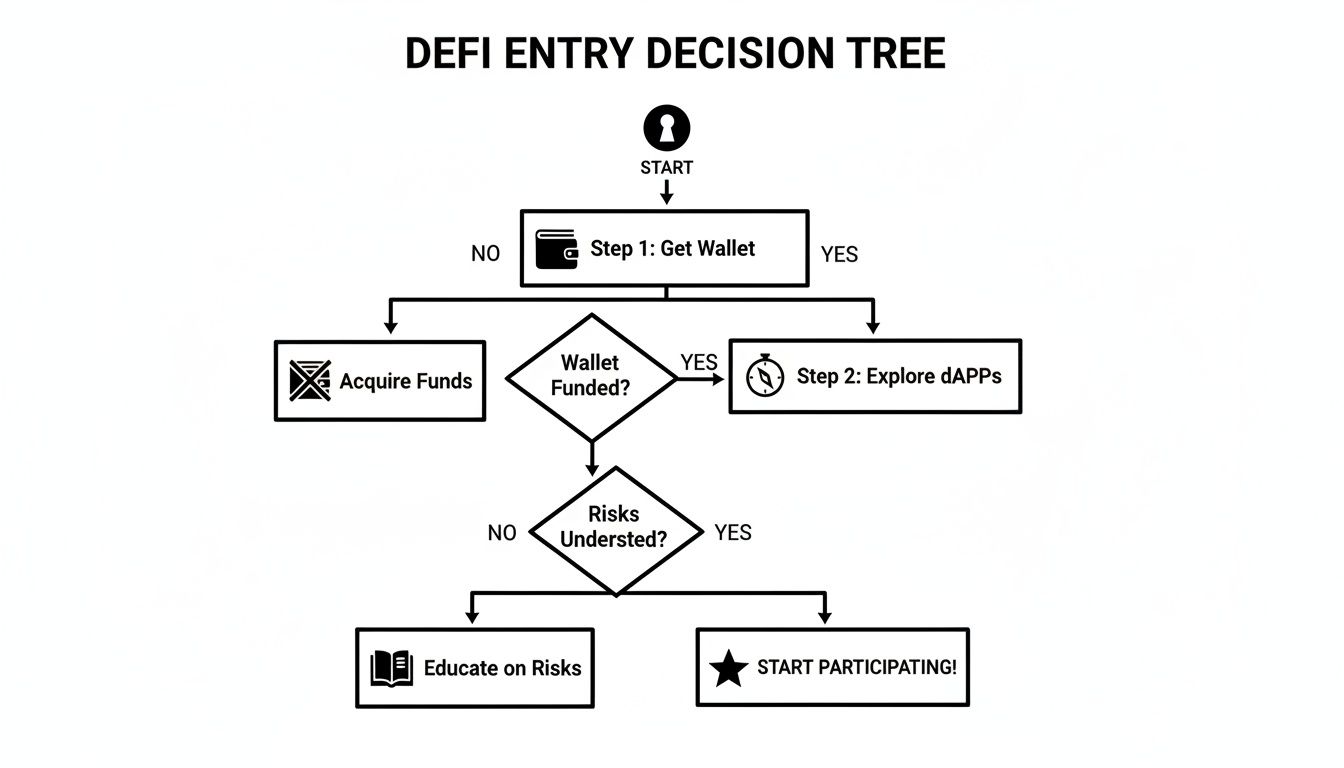
A flowchart illustrating the DeFi entry decision tree, guiding users from starting to participating in decentralized finance.

As you can see, getting a wallet is the foundational first step. It’s the key that unlocks the rest of the DeFi world.

Comparing Your Options Side-by-Side

Seeing the differences laid out clearly can help you decide what’s right for you. It all comes down to your comfort level with technology and how much you value the DeFi ethos of complete self-sovereignty.

The collapse of FTX was a brutal lesson for millions. It hammered home the risks of custodial platforms. When the exchange went under, users learned they weren't the true owners of the assets in their accounts—they were just unsecured creditors. This event triggered a massive shift in mindset, pushing a wave of people toward non-custodial wallets where they truly own their crypto.

To make it even clearer, here’s a table breaking down the key differences.

Custodial vs Non-Custodial Wallets at a Glance

FeatureCustodial Wallet (Like an Exchange)Non-Custodial Wallet (The True DeFi App)
Private Key ControlHeld by a third party (the exchange or service)Held exclusively by the user
Security ResponsibilityYou trust the platform's security measuresYou are 100% responsible for securing your keys
Account RecoveryUsually possible through password resets/customer supportImpossible if you lose your secret recovery phrase
Access to DeFiLimited; may only allow basic swaps or stakingFull, unrestricted access to all dApps and protocols
Censorship RiskHigh; your account can be frozen or transactions blockedVery low; you have complete control over your funds
Best ForBeginners, simple trading, convenient fiat on-rampsTrue DeFi users, long-term holders, full self-sovereignty

Ultimately, the choice depends on your goals. Are you looking for a simple on-ramp to buy and hold a few assets, or are you ready to explore the deep, permissionless world of decentralized finance? Your answer will point you to the right wallet.

Choosing Between Hot Wallets and Cold Storage

Once you’ve sorted out who holds your keys, the next big decision for securing your DeFi wallet app comes down to connectivity. This is all about how your wallet interacts with the internet—ranging from always-on access to being completely offline. Getting this balance right is crucial for keeping your assets safe while still being able to jump into the DeFi action.

A good way to think about it is how you handle your regular cash. A hot wallet is like your checking account. It's always connected to the internet, ready for you to use at a moment's notice. Every DeFi wallet app you use on your phone or browser fits this description. They're built for speed and convenience, making them perfect for everyday activities like swapping tokens on a DEX, staking in a liquidity pool, or minting a new NFT.

On the flip side, a cold storage wallet is your high-security vault. It's a physical device that stays completely disconnected from the internet. You only plug it in when you need to authorize a specific transaction. This is the go-to method for locking down significant amounts of crypto that you don't plan on touching anytime soon.

The Hot Wallet Advantage for DeFi

By their very nature, all DeFi wallet apps are hot wallets. This isn't a design flaw; it’s a core feature. To interact with dApps, sign transactions, and react to a market that never sleeps, you need that real-time internet connection. Without it, you’d be stuck on the sidelines.

This constant connectivity is the engine behind DeFi's incredible growth. Hot wallets captured the largest share of the crypto wallet market in 2025, a trend fueled by DeFi's meteoric rise from USD 44.13 billion in 2025 to a projected USD 951.9 billion by 2033. This part of the market is booming because it allows users to plug directly into the ecosystem with zero delay—a must-have in an industry growing at a projected 46.8% CAGR. You can dive deeper into these numbers in this DeFi market analysis from skyquestt.com.

The Inherent Risk of Being Online

While essential for getting things done, a hot wallet's online status is also its biggest weak spot. Anything connected to the internet is, in theory, exposed to remote hacks, phishing attempts, and malware. It's the classic trade-off: you get instant accessibility but give up maximum security.

This is a risk you have to actively manage, especially as your portfolio grows. For a deeper dive into managing different wallet types, our guide on using multiple crypto wallets effectively has you covered. This is precisely why experienced DeFi users don't just pick one or the other—they use a hybrid strategy to get the best of both worlds.

The Hybrid Strategy: Combining Hot and Cold Wallets

The smartest and most secure setup pairs the smooth user experience of your DeFi wallet app with the ironclad security of a hardware wallet (your cold storage). This powerful duo lets you browse dApps and set up transactions with your app's friendly interface, but requires the final, definitive approval from your offline hardware device.

This approach turns your hot wallet into a secure command center. The transaction is prepared on your app and then sent to your cold wallet for signing. Your private keys never touch the internet or leave the physical device. It’s a lot like using your debit card at an ATM—you use the machine's screen to set up the withdrawal, but it’s the PIN you enter on the secure keypad that actually authorizes it.

Here’s a simple breakdown of how they compare for different uses:

FeatureHot Wallet (DeFi Wallet App)Cold Storage (Hardware Wallet)
ConnectivityAlways onlineCompletely offline until used
Primary Use CaseDaily trading, staking, dApp interactionLong-term holding, high-value storage
Security LevelGood (with precautions)Highest possible
ConvenienceHigh; instant accessLower; requires physical device

By using a hardware wallet to sign off on transactions you start in your mobile DeFi app, you create a system that protects your most valuable assets with an "air gap" while letting you enjoy the fluid, fast-paced experience of DeFi.

Essential Features Every Top DeFi Wallet App Must Have

Smartphone displaying a DeFi wallet app with features like Multi-Chain, dApp Browser, Assets & NFTs, and Hardware Security.

Once you’ve wrestled with the custodial vs. non-custodial debate and know why a hot wallet fits your needs, the real fun begins: digging into the tools that make a wallet truly powerful. Not all DeFi apps are created equal. The difference between a clunky, basic wallet and a powerhouse is all in the features.

Think of it like outfitting a workshop. You wouldn't try to build fine furniture with just a hammer, right? You need a full toolkit. The right features will empower your DeFi journey, not get in your way.

Let’s break down the must-haves that separate the best from the rest.

Seamless Multi-Chain Support

DeFi is no longer an "Ethereum-only" game. Far from it. While Ethereum is still a giant, the most exciting action is often happening on other networks like Solana, Base, and Arbitrum. A top-tier wallet has to live in this multi-chain world.

Multi-chain support is non-negotiable. It means you can manage all your assets and jump between different blockchain ecosystems without juggling a half-dozen different apps. This isn't just about convenience; it’s about staying agile.

With it, you can:

  • Chase Opportunities: Instantly jump on a hot token launch on Base or explore a juicy yield farm on Solana without missing a beat.
  • Dodge High Fees: Move assets to Layer 2 networks to slash your transaction costs, leaving more money in your pocket.
  • See Everything at Once: Get a complete, unified view of your entire portfolio from a single dashboard, no matter which chain your assets are on.

A wallet that traps you in one ecosystem is like having a passport that only works for one country. It’s incredibly limiting.

An Integrated and Secure dApp Browser

The dApp browser is your secure gateway to the entire DeFi universe. It’s what turns your wallet from a simple digital piggy bank into an interactive command center for the decentralized web. Without it, you're just holding crypto. With it, you're actually doing DeFi.

A great dApp browser lets you connect to decentralized exchanges (DEXs), lending platforms, and NFT marketplaces from within the safety of your wallet. It’s a protective layer that ensures your connection is legitimate and secure.

The dApp browser is your bridge to the on-chain world. It should make interacting with protocols like Uniswap or Aave feel as simple as surfing a website, but with the crucial cryptographic security that verifies every single move you make.

This tight integration is fundamental. No more sketchy copy-pasting of wallet addresses or navigating to risky third-party sites. You find a protocol, connect your wallet, and sign the transaction—all from the secure environment of your app.

Advanced Security and Management Features

Beyond the basics, the best wallets offer a suite of modern safety features designed to protect you from common pitfalls and clever scams. These are the tools every serious user should insist on.

Here are the critical security and management features to look for:

  • Transaction Simulations: This is an absolute game-changer for security. Before you hit "approve," the wallet simulates the transaction and shows you exactly what assets will leave your account and what you'll get back. This is your number one defense against wallet "drainer" scams.
  • Clear Asset & NFT Display: A messy interface isn't just ugly; it’s dangerous. Your wallet must have a clean, intuitive layout for all your tokens and NFTs, clearly showing their value and source. Good organization prevents you from sending the wrong thing to the wrong place.
  • Robust Security Options: Look for layered protection. This means biometric support (Face ID or fingerprint), the ability to link a hardware wallet for signing high-value transactions, and prominent warnings for phishing sites or suspicious smart contracts.

These features all work together to give you the confidence to explore DeFi without constantly looking over your shoulder.


DeFi Wallet App Feature Checklist

Choosing a wallet can feel overwhelming, but focusing on the right features makes it much easier. This checklist highlights the essential tools to look for, tailored to what you might need as a trader, staker, or someone just starting out.

FeatureWhy It MattersTop Apps That Excel
Multi-Chain SupportEssential for everyone. Lets you access more opportunities, find lower gas fees, and manage your entire portfolio in one place.MetaMask, Trust Wallet, Phantom
dApp BrowserThe gateway to DeFi. Without it, your wallet is just a storage container. A must-have for interacting with any protocol.Rainbow, Zerion, Phantom
Transaction SimulationYour best defense against scams. It shows you what a transaction will actually do before you sign it. Critical for security.Rabby Wallet, Fire, Pocket Universe (browser extension)
Hardware Wallet SupportThe gold standard for security. Allows you to keep your keys offline while still interacting with dApps.MetaMask, Rabby Wallet, Solflare
Seed Phrase ManagementA good wallet offers secure backup options, including social recovery or cloud backups (with strong encryption).Argent, Safe, Coinbase Wallet
NFT GalleryFor collectors and traders, a clean and visually appealing way to view and manage your NFT collection is crucial.Rainbow, Phantom, Solflare
In-App Swaps/BridgingA huge convenience feature. Lets you trade tokens or move them between chains without leaving the wallet app.MetaMask, Coinbase Wallet, Trust Wallet
Portfolio ViewA clear, comprehensive dashboard that tracks your asset performance over time, including profit/loss.Zerion, Zapper, DeBank

Ultimately, the "perfect" wallet depends on your personal strategy. A trader might prioritize speed and transaction simulation, while an NFT collector will care more about a beautiful gallery view. Use this checklist to weigh what’s most important for your journey into DeFi.

Turning Your Wallet into a Strategic Trading Tool

Think of your DeFi wallet as more than just a digital vault for your crypto. It’s actually the command center for your entire trading operation. When you connect it with a sharp on-chain analytics tool, you flip a switch. It goes from being a passive place to store coins to an active weapon for hunting down profits.

This is a mental shift from just holding assets to actively seeking out market-beating opportunities. The blockchain is a public ledger, meaning every single transaction is out in the open. By digging into that data, you can spot patterns and follow the trades of highly successful investors—the people we call "smart money."

The real trick is translating that messy, raw data into clear, actionable signals. That's exactly where tools like Wallet Finder.ai come in. It acts as an intelligence layer on top of your wallet, so you’re no longer guessing. You're making moves based on the proven strategies of top traders.

The Power of On-Chain Analytics

The explosive growth in DeFi is what fuels the need for smarter wallet apps. The global market is forecasted to hit USD 26.94 billion in 2025 and is on a trajectory to reach an incredible USD 1,417.65 billion by 2033. That's driven by a scorching 68.2% CAGR from 2026 to 2033. You can dig deeper into these numbers in a report from grandviewresearch.com.

For traders using tools like Wallet Finder.ai, this growth means one thing: a mountain of data. By analyzing it, you can pinpoint when the best wallets are buying and selling on networks like Ethereum or Base.

Imagine filtering for wallets with incredible win streaks and getting instant Telegram alerts when they make a move. You're effectively turning on-chain data into copy-trading gold. It’s all about making "alpha"—the industry term for outperforming the market—something anyone can achieve.

This screenshot from Wallet Finder.ai shows a dashboard where you can find top-performing wallets based on live data.

Notice how it lays out key metrics like Profit and Loss (PnL), win rates, and recent trades. This makes it incredibly easy to spot the wallets with a proven track record of success.

A Step-by-Step Guide to Copy Trading

Let's be clear: copy trading in DeFi isn't about blindly following every single transaction. It’s a strategic game. You identify skilled traders, learn their patterns, and then use your own DeFi wallet app to act on those insights—fast. The whole point is to use their research and timing to give your own trades an edge.

Here’s a simple, practical workflow to put this into action.

  1. Identify Smart Money Wallets
    First things first, you need to find the "smart money." These are wallets with a consistent history of high profits. Jump into the Discover Wallets feature in Wallet Finder.ai and start filtering for traders that match what you're looking for. For example, you could search for wallets with:

    • A high PnL (Profit and Loss) over the last 30 days.
    • An impressive win rate, maybe over 70%.
    • A focus on a niche you're into, like memecoins or Real World Assets (RWAs).
    • Recent activity to make sure they’re still active in the market.
  2. Set Up Instant Trade Alerts
    Once you’ve got a list of a few promising wallets, you can't just sit there and watch them 24/7. This is where you let automation do the heavy lifting. Build a custom watchlist and set up real-time alerts for every single move these wallets make.

    By linking Wallet Finder.ai to your Telegram or turning on push notifications, you get pinged the second a wallet you're tracking buys, sells, or swaps a token. This speed is your biggest advantage, letting you get in on a trade before the rest of the market even knows what's happening.

  3. Execute the Trade in Your DeFi Wallet
    An alert hits your phone for a trade that looks good. Now it’s time to move. This is where your DeFi wallet and its built-in dApp browser become critical.

    • Fire up your wallet's dApp browser and head over to a trusted decentralized exchange (DEX) like Uniswap or Orca.
    • Copy the token's contract address directly from your alert. This is crucial for making sure you’re buying the right asset and not a fake one.
    • Execute a similar trade. You don't have to match their exact dollar amount, but you can follow their lead and open a position in the same token.
  4. This simple workflow builds a powerful bridge between on-chain intelligence and real-world trading. It turns your DeFi wallet app from a simple storage device into the engine for a smart, data-driven strategy.

    Best Practices for Securing Your DeFi Wallet

    Visual guide outlining cryptocurrency wallet security practices: keep seed phrase offline, avoid screenshots, and use a dedicated device.

    Let’s get one thing straight about self-custody: you are your own bank. That’s the entire point. But it also means you’re the head of security, the vault manager, and the only person who can fix things when they go wrong.

    This isn’t just about picking a strong password. Protecting your assets in DeFi requires a totally different mindset. Think of the steps below as non-negotiable rules for building a fortress around your funds, because in this world, there’s no "forgot password" link to save you.

    Master Your Seed Phrase Security

    Your secret recovery phrase (or seed phrase) is everything. It's the master key that can unlock your crypto from any device in the world. If someone else gets it, your funds are gone. If you lose it, your funds are gone. It’s that simple, and it's your most critical responsibility.

    Your seed phrase is like the deed to your house and the combination to your safe, all rolled into one. You wouldn't post a picture of your house deed on social media, so don't treat your seed phrase any differently. Never take a screenshot of it, save it in a notes app, or store it in a password manager. Digital storage is a trap.

    The only way to do this right is to keep it completely offline.

    • Write It Down: Grab a pen and paper. Carefully write down each word in the correct order. Double-check it.
    • Store It Securely: Put that piece of paper somewhere safe from fire and water, like a fireproof safe or a bank's safety deposit box.
    • Create Backups: Make two or three physical copies. Store them in different secure locations. This way, a single disaster like a fire or flood can't wipe out your only copy.

    Build a Secure Operating Environment

    How you actually use your DeFi wallet matters just as much as how you store your keys. A malware-infected computer can steal your assets right from under your nose, even if your seed phrase is locked away in a vault. This is all about creating a clean, isolated space for your crypto activity.

    The gold standard here is using a dedicated device. It could be an old laptop or a cheap phone that you’ve wiped clean. Use this device only for crypto transactions and nothing else—no email, no social media, no random downloads. This drastically cuts down your risk of picking up nasty malware.

    If a separate device isn't an option, at least create a dedicated browser profile just for your DeFi adventures. This keeps your cookies, extensions, and browsing history separate, making it much harder for malicious websites to snoop on your crypto activity.

    Recognize and Defend Against Scams

    Scammers are getting smarter every day, constantly coming up with new tricks to get you to sign away your funds. Your best defense is a healthy dose of skepticism and knowing what to look for. The biggest threat by far is phishing, where attackers create fake websites or apps that look exactly like the real thing.

    Stick to these rules like glue:

    1. Triple-Check URLs: Bookmark the dApps you use regularly and only access them through those bookmarks. Never, ever click on links from emails, social media DMs, or random Discord messages. Scammers are experts at creating convincing fakes.
    2. Be Wary of Airdrops: If a random, unknown token suddenly appears in your wallet, just ignore it. Don't try to sell it or interact with it. Doing so can trigger a malicious smart contract designed to drain the rest of your funds.
    3. Use a Wallet with Transaction Simulations: As we mentioned earlier, this feature is a game-changer. It acts as your final line of defense by showing you exactly what a transaction will do before you approve it, helping you spot and avoid those nasty wallet-draining scams.

    Common Questions About DeFi Wallet Apps

    As you dive deeper into the world of DeFi, a few questions always seem to pop up. Getting straight answers is the best way to build confidence and really master your DeFi wallet app, so let's tackle the most common ones we hear.

    What Is the Main Difference Between a DeFi Wallet and an Exchange?

    It all comes down to a single, powerful concept: ownership.

    When you use a non-custodial DeFi wallet, you’re in the driver's seat. You hold the private keys, which are like the deed to your digital property. No one else—not a company, not a government—can freeze your funds, block your transactions, or touch your crypto without those keys. It's all yours, period.

    On a centralized exchange like Coinbase or Binance, it's a different story. The exchange holds your keys for you. While that might feel simpler at first, it means you're trusting them completely with your assets. They have the final say, which is the exact opposite of the self-sovereignty you get with a true DeFi wallet.

    Can I Use One Wallet on Multiple Devices?

    Absolutely. Your secret recovery phrase is the master key to your entire crypto life. You can use it to restore your wallet—every asset, every transaction—on a new phone, a different computer, or a browser extension.

    But a quick word of warning: tread carefully here. For top-tier security, you'll want to keep the number of active devices to a minimum. Every extra phone or laptop with your wallet on it is another potential weak spot for malware or a security breach. It's best to stick to just one or two trusted devices for your daily use.

    Think of your secret recovery phrase as the master blueprint to your vault. You can use it to build a new vault door on another device, but the more copies of that blueprint you have floating around, the higher the risk that one could fall into the wrong hands.

    How Can I Avoid High Gas Fees?

    Ah, gas fees. They can be a real headache, especially when networks like Ethereum get busy. The good news is you don't just have to sit there and take it. There are a few smart ways to keep those costs down.

    One simple trick is timing. Try to make your transactions when the network is quieter, which is often during nights or weekends in major hubs like the US and Europe. Fewer people online means less competition for block space and, usually, lower fees.

    But the real game-changer is using a DeFi wallet app that fully supports Layer 2 networks. These are networks built on top of the main blockchain that make transactions incredibly fast and cheap.

    By shifting your activity to these Layer 2s, you still get the security of the main chain but pay fees that are often just pennies. It makes trading, swapping, and using dApps so much more affordable.


    Ready to stop guessing and start trading with an edge? Wallet Finder.ai gives you the on-chain intelligence to discover top-performing wallets and mirror their strategies in real time. Find your alpha today with a 7-day trial.