Guide to Reading a Buy Sell Indicator
Master trading with this complete buy sell indicator guide. Learn to read signals, combine indicators for better strategies, and avoid costly mistakes.

December 22, 2025
Wallet Finder

December 23, 2025

Relying on a single crypto wallet is like throwing your life savings, your weekly grocery money, and your high-risk stock picks into one big shoebox under your bed. It's a recipe for chaos and a massive security headache. For anyone serious about crypto, adopting a multiple crypto wallet strategy isn't just a good idea—it's absolutely essential.

The days of a "one-wallet-fits-all" approach are long gone. The crypto space has evolved, and so have the risks and opportunities. This shift is mirrored in the market itself; the global cryptocurrency wallet market was valued at $2,722.6 million back in 2021 and is on a trajectory to more than double by 2025.
With over 420 million crypto owners worldwide in 2024, the demand for smarter, more secure asset management has exploded. You can dig into more of these market insights on the growth of crypto wallets on cognitivemarketresearch.com.
This isn't just about more people piling in. It’s about investors getting smarter. They understand that different activities demand different tools and security levels. Funneling every transaction through a single wallet creates one giant bullseye for attackers. If that one wallet gets compromised, you could lose everything.
At its core, a multiple wallet strategy is all about managing risk. By splitting your funds into dedicated wallets, you're essentially building firewalls between your different piles of assets.
Think about it: you've found a new, unaudited DeFi protocol that promises insane yields. Are you really going to connect your main wallet—the one holding your long-term Bitcoin and Ethereum—to that contract? That's a huge, unnecessary gamble.
A seasoned pro would never do that. Instead, they’d use a dedicated "burner" wallet, funded with a small, expendable amount of crypto, just for these kinds of experiments. This simple act of separation shields the bulk of their portfolio from potential smart contract bugs or a clever phishing attack.
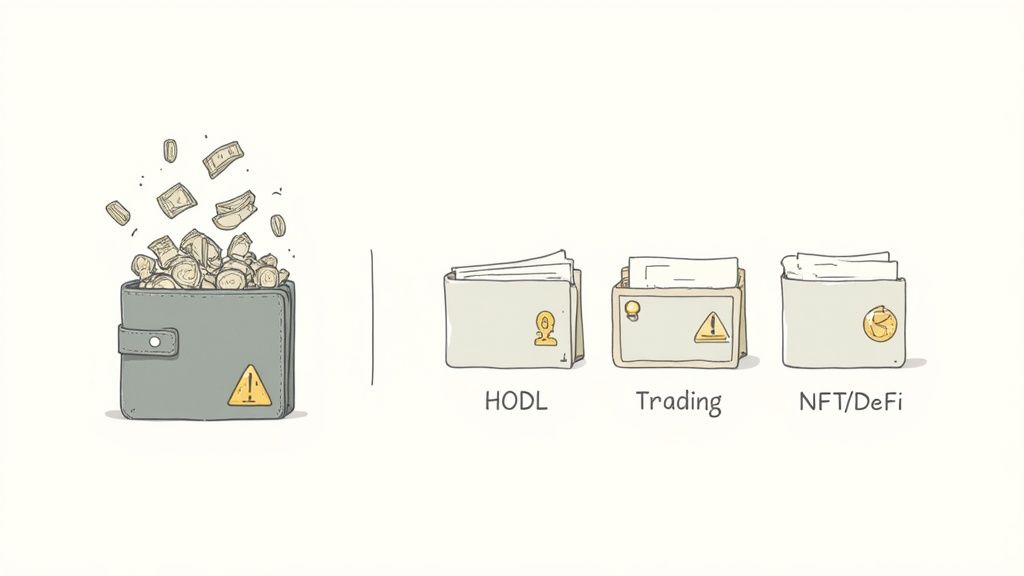
The core principle is simple but incredibly powerful: Isolate your risk. Never let your entire portfolio touch a single high-risk activity. Your HODL stash should live in a completely different universe from your daily degen trading funds.
Beyond the huge security upgrade, using multiple wallets brings much-needed organization to your crypto life. It lets you sort your assets by purpose, which makes tracking performance and making clear-headed decisions way easier. This organized approach is what separates the pros from the amateurs.
To give you a clearer picture, here’s a quick breakdown of why separating your wallets is a game-changer.
Here are some common, actionable setups:
This structure transforms a messy pile of digital assets into a well-oiled portfolio, where every component has a specific job and a defined risk level.
Building a personal wallet ecosystem isn't about becoming a tech wizard. It’s about smart, strategic planning. Think of it like organizing your regular finances—you wouldn't keep your life savings in the same checking account you use for daily coffee runs. The same logic applies here. You’re creating a tiered system to balance rock-solid security with everyday accessibility.
The goal is to separate your crypto assets into distinct buckets based on what you’re doing with them and how much risk you’re taking on. This isn't a rigid framework; it's a flexible model you can tweak for your own strategy. By creating these divisions, you build a resilient system where a screw-up in one area doesn’t sink your entire portfolio.
For most people, a three-tiered structure works best.
This is the bedrock of your setup, built for maximum security. It’s where you stash your core, long-term holdings—the assets you don't plan on touching for months, or even years.
Next up is your 'hot' wallet, designed for accessibility and frequent use. This is usually a software wallet—think a browser extension like MetaMask or a mobile app like Trust Wallet. This wallet should only hold the funds you need for regular trading, interacting with dApps you trust, or making quick payments.
A critical mistake new users make is using a single hot wallet for everything. By adopting a multiple crypto wallet approach, you're not just organizing—you're actively building layers of security that protect you from both hackers and your own simple mistakes.
The final tier is for specific, often higher-risk, activities. This is where you create separate 'burner' wallets for testing out new DeFi protocols, farming airdrops, or minting NFTs. Each of these wallets should be funded with only the amount of crypto you're fully prepared to lose.
This level of compartmentalization is a hallmark of sophisticated crypto management and is becoming standard for many of the 420 million people who owned crypto wallets by 2024. You can dive deeper into this trend in the 2025 Global Adoption Index from chainalysis.com.
A comparison of wallet types to help you select the best option for your security, trading, and specialized asset management needs.
Switching over to a multiple-wallet system is a huge security upgrade, but only if you nail the setup process. One small mistake can bring the whole structure crashing down. Your absolute number one priority is mastering seed phrase management.
Your seed phrase—that list of 12 or 24 words—is the master key to everything in that specific wallet. Let me be blunt: storing this digitally is a catastrophic mistake. A text file, a password manager, or a cloud drive can be compromised. If that happens, your crypto is gone. Forever.
The only truly safe way to store a seed phrase is offline. This means writing it down physically and keeping it safe from both prying eyes and physical damage. Here are actionable methods:
This entire process is about creating a clear flow from your most secure, long-term holdings to your more active, experimental funds.

As you can see, the idea is to have a tiered approach, moving from your heavily protected "Core Assets" out towards more accessible "Active Funds" and finally your high-risk "Experimental" wallets.
Whenever you set up a new wallet, especially a hardware wallet, follow a strict protocol. Never create a wallet or initialize a device on a public Wi-Fi network like a coffee shop or airport. Always use a secure, private connection.
For hardware wallets like a Ledger or Trezor, the device itself is designed to generate your private keys completely offline. You then connect it to a software interface like MetaMask or Phantom to interact with dApps. This setup gives you the best of both worlds: the Fort Knox security of cold storage with the everyday convenience of a hot wallet, because your keys never actually leave the physical device.
Here's a pro-level tip: Use a dedicated, "clean" device—like a cheap laptop or an old phone that's used only for crypto. This creates an isolated environment, massively reducing your exposure to malware you might pick up from daily browsing or opening emails.
By putting these practices into place, you're building a real fortress around your digital assets. For an even deeper dive, run through this comprehensive checklist for assessing wallet risks to make sure all your bases are covered.
Juggling multiple crypto wallets is smart for security, but it creates a new headache: keeping track of everything. Constantly jumping between different wallet apps and blockchain explorers just to get a clear picture of your net worth is exhausting and inefficient.
The solution is to pull everything together into a single, clean dashboard using a portfolio tracker. Just plug in your public wallet addresses, and these tools automatically fetch data from across different blockchains, giving you an instant, real-time snapshot of your entire portfolio.
Powerful platforms can bring order to your multi-wallet chaos. Tools like Zapper, Zerion, and DeBank are fantastic places to start. They connect to dozens of chains and hundreds of protocols, so you can be confident pretty much all of your assets will show up automatically.
The real magic happens when you organize that consolidated view. Here's how to make it actionable:
This level of organization turns a scattered mess of assets into a portfolio that actually makes sense. We’ve put together a detailed walkthrough in our guide on how to track DeFi portfolios across multiple wallets.
While standard portfolio trackers are great for keeping an eye on your own bags, the next-level tools can turn this data into a source of powerful market intelligence. Instead of just looking inward at your own performance, you can start analyzing the moves of other top-performing wallets to find new opportunities.
This is where a platform like Wallet Finder.ai changes the game entirely. It goes beyond simple tracking and dives deep into active discovery and analysis. You can pinpoint highly profitable traders, comb through their entire transaction history, and even get alerts the second they make a move.

The dashboard above shows just how easy it is to filter for wallets with impressive PnL and high win rates, transforming raw on-chain data into signals you can actually use. This shifts you from being a passive observer of your portfolio to an active analyst of the market's smartest players.
By mirroring the strategies of consistently profitable wallets, you can uncover alpha that you would have otherwise missed. It’s like having a team of elite researchers working for you 24/7, with every move transparently recorded on the blockchain.
This approach combines the organizational power of a portfolio tracker with the strategic edge of on-chain intelligence, giving you a complete command center for your entire crypto strategy.
Once you have your wallet system organized, the real fun begins. A multi-wallet system isn't just about defense; it's a launchpad for sophisticated plays that are clunky, or even impossible, with just one address. Each wallet becomes a specialized tool, letting you execute specific strategies with precision.
One of the smartest ways to use multiple wallets is to build a sandbox for your high-risk, high-reward ventures. Think about airdrop farming—it often means interacting with brand-new, unaudited smart contracts. Connecting your main wallet is a risk you shouldn't take.
By spinning up a dedicated "farming" wallet, you effectively quarantine any potential disaster. This same logic is a lifesaver for other degen activities:
Every move you make is etched onto the blockchain forever. Using one address for everything creates a public, easily searchable financial history for anyone to snoop on.
Segregating your activity across different wallets breaks this chain of data. It’s the on-chain equivalent of using different email addresses for different services, making it much harder for observers to connect all your financial dots.
Use one wallet for your CEX withdrawals, another for your DeFi adventures, and a third for private peer-to-peer deals. This simple act shatters your on-chain identity into disconnected pieces, dramatically improving your privacy.
Beyond risk management, a multi-wallet setup unlocks advanced financial maneuvers. A classic example is tax-loss harvesting. By keeping assets for this strategy in their own wallet, you can sell them to realize a loss for tax purposes without messing things up, like accidentally triggering a wash sale by repurchasing the same asset too soon in one of your other wallets.
This strategic separation is becoming more common as the market matures. Projections for the crypto wallet market show staggering growth, with software wallets leading the charge. This trend makes it easier for investors to use multiple wallets for distinct purposes—hot wallets for daily trading, cold storage for long-term holds, and specialized wallets for DeFi. It's just smart risk management.
Ultimately, mastering a multiple crypto wallet system turns you from a passive holder into an active strategist.
Once you start juggling multiple crypto wallets, a few questions are bound to pop up. It's totally normal to wonder about the practical side of things. Let's clear up some of the most common concerns so you can build out your system with confidence.
Yes, without a doubt. It’s significantly safer than putting all your eggs in one basket. Spreading your assets across different wallets is all about walling off risk. If a high-risk dApp drains your "burner" wallet, the damage is contained to that small amount. Your main stash, locked away in a separate hardware wallet, remains completely safe.
By separating your activities, you’re creating firewalls. A breach in one wallet doesn't cascade into a total portfolio wipeout, which is the nightmare scenario for anyone using a single-wallet setup for everything.
There isn't a single magic number, but for most active crypto users, a three-wallet system is the sweet spot. It strikes the perfect balance between security and usability.
Here’s a quick summary of the three-tier setup:
It definitely adds a layer, but modern crypto tax software is built for this situation. Platforms like Koinly or CoinTracker are lifesavers here. You just sync all your public wallet addresses and exchange accounts, and they pull everything together automatically. The software then crunches the numbers to calculate your capital gains and losses across your entire portfolio, saving you a massive headache.
Technically, you can import the same seed phrase into different wallet apps (like using your Ethereum seed in Phantom for Solana). But you absolutely should not. Doing this completely defeats the purpose of having separate wallets in the first place.
If that one seed phrase ever gets compromised, an attacker gets the keys to your entire kingdom. Every single wallet would be vulnerable. The only truly secure practice is to generate a unique, safely-stored seed phrase for each individual wallet you create. This keeps your security layers independent and robust.
Ready to turn on-chain data into actionable intelligence? Wallet Finder.ai helps you discover and mirror the moves of top-performing crypto wallets in real time. Start your 7-day trial and trade smarter by following the pros.
"I've tried the beta version of Walletfinder.ai extensively and I was blown away by how you can filter through the data, and the massive profitable wallets available in the filter presets, unbelievably valuable for any trader or copy trader. This is unfair advantage."
.avif)
Pablo Massa
Experienced DeFi Trader