Your Crypto Allocation Strategy: A Trader's Guide

Wallet Finder

Blank calendar icon with grid of squares representing days.

May 16, 2026

You find a wallet with clean entries, strong exits, and a trade history that looks surgical. You copy it with too much size because you don't want to “miss the move.” Two bad trades later, your account is down hard even though the wallet's longer-term record still looks fine.

The opposite mistake is just as common. You track several strong wallets, spread your capital so thin that none of the winners matter, then watch solid calls produce a weak portfolio result.

That gap is allocation strategy. Not wallet discovery. Not trade selection. Allocation.

In DeFi copy trading, a large majority of participants spend nearly all their energy finding the right wallets and almost none deciding how much capital each wallet should control. That's backwards. A strong wallet with bad sizing can hurt you. An average wallet with disciplined sizing can stay manageable. The traders who last treat allocation like a control system, not an afterthought.

Why Your Allocation Strategy Matters More Than Your Trades

A copied wallet can be right on direction and still lose you money.

A distressed person looking at a smartphone screen showing a red downward trend line indicating financial loss.

That happens all the time in DeFi copy trading. The wallet enters late because gas spikes. You get worse fills on a thinner token. Then the trade pulls back 12%, which is normal for that setup, but you gave that wallet 40% of your book because its last month looked strong. The trade idea may still be fine. Your sizing turned a routine drawdown into a portfolio problem.

That is why allocation deserves more attention than entry quality alone. Wallet selection answers who to follow. Allocation answers how much damage a bad week can do, how much a good week can help, and whether your portfolio can survive normal variance.

The failure pattern is usually easy to spot once you have seen it a few times:

  • A wallet gets promoted from “interesting” to “core” after a short hot streak
  • Capital piles in before you have enough data on its behavior across conditions
  • A rough patch hits, often from liquidity, sector rotation, or plain variance
  • The copied portfolio takes a much larger hit than the underlying edge justified

The direct impact of poor sizing shows up fast:

  1. Drawdowns get deeper than they need to be. A decent wallet can still hurt if it controls too much capital.
  2. Winners do not move the needle. Good calls from smaller allocations barely offset one oversized loser.
  3. Execution gets worse under stress. Traders cut good positions, chase recoveries, or stop following a sound process because the dollar swings are too large.

This is where on-chain signal quality matters. A wallet discovery tool such as Wallet Finder.ai can help surface strong candidates, but the signal is only half the job. Copy-trading results come from matching wallet behavior to position size. A volatile sniper wallet and a steady rotation wallet should not carry the same weight, even if both look profitable on paper.

A simple rule helps. If one wallet can wreck your month, the problem is allocation.

Experienced traders treat each followed wallet like a risk bucket with a job. Some wallets earn larger sizing because they trade liquid markets, size consistently, and stay stable across different conditions. Others belong in a smaller tactical sleeve because their edge is real but narrower. That distinction matters more than many traders expect. In practice, a solid allocation framework often does more for long-term results than finding one more “smart” wallet to copy.

From Portfolio Theory to Wallet Following

Traditional portfolio theory sounds academic until you translate it into trader language. Then it becomes simple. You're building a team, not collecting highlights.
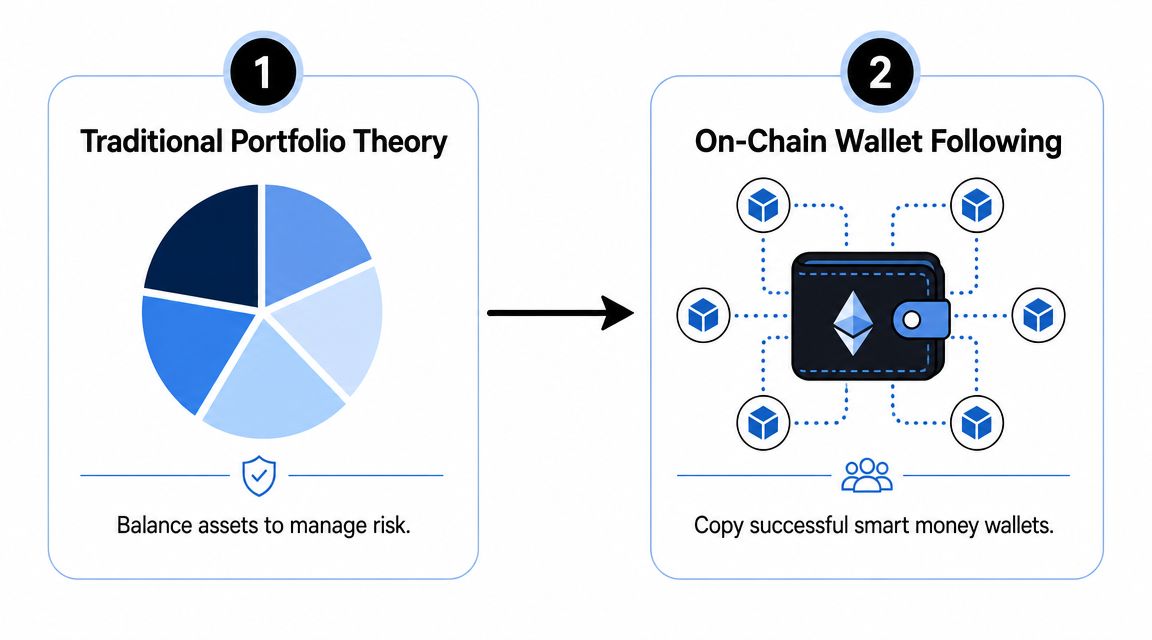
A diagram comparing traditional asset allocation portfolio theory with modern on-chain crypto wallet following strategy.

Strategic and tactical in plain English

Think of your copied wallets like a football squad.

Some players are your starters. They've shown durable skill across different match conditions. In allocation terms, that's your strategic layer. BNP Paribas notes that strategic asset allocation is typically built for a 5 to 10 year horizon, while tactical asset allocation is usually managed over a 6 to 12 month horizon (BNP Paribas on strategic and tactical asset allocation).

In DeFi copy trading, that maps well to:

  • Strategic wallets: wallets you'd keep on the roster because their edge looks durable
  • Tactical wallets: wallets you size up or down based on recent execution, momentum, and market fit

A strategic wallet might be a trader with disciplined entries, repeatable sizing, and evidence of surviving different market conditions. A tactical wallet might be a short-term momentum specialist who shines when meme rotation is active but becomes less useful when liquidity dries up.

Diversification is not copying more wallets

Many traders get sloppy at this stage. They copy five wallets and think they're diversified. If all five are chasing the same narrative, entering the same pools, and reacting to the same catalysts, that's not diversification. That's concentration wearing a disguise.

What matters is correlation of behavior, not the count of wallets.

A more useful wallet mix looks like this:

  • A trend wallet: catches strong continuation moves
  • A mean-reversion wallet: buys panic and exits fast
  • A market-neutral or hedge-aware wallet: reduces directional dependence
  • A selective high-conviction wallet: trades less, sizes harder when conditions fit

A portfolio of different-looking wallets can still be one bet if they all depend on the same market regime.

Risk and return at the wallet level

A wallet that prints high returns but swings wildly may deserve less capital than a steadier wallet with lower upside. That's not conservative for the sake of it. It's practical. The smoother wallet often gives you more staying power, which keeps you in the game long enough for compounding to matter.

The best allocation strategy for wallet following does three things at once:

What you're managingWhat it means in practice
Return potentialBack wallets with repeatable edge
Behavior under stressReduce dependence on one theme or one trader
Execution fitSize according to liquidity, slippage, and your ability to mirror trades

The shift from portfolio theory to wallet following is smaller than it looks. You still build a core. You still add tactical tilts. You still care about diversification. The only difference is that your “assets” are now human strategy streams visible on-chain.

Choosing Your Allocation Model A Side-by-Side Comparison

A DeFi copy-trading portfolio usually fails at the sizing layer, not the wallet-picking layer. Traders find two or three strong wallets, give too much capital to the hottest one, then discover that a good wallet with the wrong allocation can still wreck the month.

That is why the model matters. In wallet following, allocation decides which trader drives returns, which one controls drawdowns, and whether you can keep copying when liquidity gets thin or behavior shifts. If you use Wallet Finder.ai wallet analytics, these models become more than textbook categories. You can tie them to visible on-chain patterns like turnover, concentration, drawdown shape, and how a wallet behaves after a loss.

Below are six models worth knowing. Each solves a different problem.

Crypto Allocation Model Comparison

ModelComplexityData NeedsRisk ProfileBest For
Equal WeightLowBasic wallet shortlistModerateBeginners who want simplicity
Risk ParityMediumVolatility and behavior dataLower concentration riskTraders managing uneven wallet volatility
Return-WeightedMediumHistorical performance dataCan drift aggressiveTraders who trust relative strength
Kelly CriterionHighWin quality and payoff assumptionsAggressive if misusedAdvanced traders with strong data discipline
Fixed FractionalLow to mediumPortfolio risk limitControlled and steadyTraders focused on survival
Top-Wallet MirroringLowOne high-conviction walletHigh single-source riskTraders making a concentrated bet

Equal Weight

Equal weight is the cleanest baseline. Four wallets. Twenty-five percent each.

It works well early because it prevents fake precision. If your sample is short, or you are still learning how a wallet trades through different conditions, equal weight keeps the portfolio honest. It also gives you a benchmark. If a more complex model cannot beat simple equal sizing after costs and slippage, the extra complexity is just noise.

Pros

  • Simple to execute: easy to maintain
  • Harder to overfit: limited room for storytelling
  • Useful benchmark: good reference point for testing upgrades

Cons

  • Ignores risk differences: volatile and stable wallets get the same capital
  • Can overfund mediocre wallets: every wallet gets equal trust
  • Needs manual review: weights stay static unless you rebalance

Risk Parity

Risk parity sizes wallets by how much instability they add, not by how exciting their returns look. A wallet with violent swings gets less capital. A steadier wallet gets more.

For copy trading, this often beats equal weight because wallet behavior is rarely uniform. One wallet may scalp liquid majors with tight sizing. Another may hit thin small caps with sharp bursts of PnL. Giving both the same capital can turn the aggressive wallet into the actual portfolio manager, whether you intended that or not.

The practical version is straightforward. Use observed drawdowns, trade-to-trade variance, concentration, and consistency of position sizing as rough risk inputs.

Pros

  • Reduces hidden concentration: one wild wallet is less likely to dominate
  • Usually improves portfolio stability: especially across mixed styles
  • Fits wallet data well: on-chain history gives enough clues to estimate relative risk

Cons

  • Needs cleaner data: bad volatility estimates produce bad weights
  • Can underfund strong but noisy wallets: some real edge looks messy
  • Requires upkeep: wallet behavior changes faster than many traders expect

Return-Weighted

Return-weighted allocation gives more capital to wallets that have been performing best. The appeal is obvious. Capital follows strength.

The problem is timing. In DeFi, a wallet can look elite because it caught one trend, one narrative, or one pocket of illiquidity that was easy to exploit at small size. If you scale into that wallet after the run, you are often buying the afterglow.

This model works better when recent performance matches a repeatable process you can verify on-chain. It works worse when the gains came from a single token, one unusually good week, or conditions you cannot replicate.

Pros

  • Rewards current leadership
  • Easy to explain and implement
  • Useful for active rotation systems

Cons

  • Chases heat: recent winners often cool off fast
  • Can create concentration fast: one wallet can swell to an unhealthy size
  • Struggles in choppy conditions: leadership flips more often

If you use return-weighting, set a hard cap on any one wallet. Without a cap, the model can drift from disciplined allocation into performance chasing.

Kelly Criterion

Kelly is a sizing formula built around edge and payoff. On paper, it is elegant. In live copy trading, the hard part is not the math. It is estimating the inputs without fooling yourself.

That is why full Kelly is rarely the right answer here. Wallet histories are noisy, strategy drift is common, and your copy results may differ from the source wallet because of slippage, latency, and liquidity. Kelly makes more sense as an upper bound. If your rough estimate says a wallet deserves large size, use that result as a warning to scale down, not as permission to bet big.

Pros

  • Gives a clear sizing framework
  • Useful for advanced traders with strong data hygiene
  • Forces you to quantify edge instead of guessing

Cons

  • Extremely sensitive to assumptions
  • Easy to misuse with weak samples
  • Poor fit for unstable or changing wallet behavior

Fixed Fractional

Fixed fractional is less clever and more durable. You assign a set portion of portfolio risk or capital to each wallet and stay inside that limit.

This approach holds up well in DeFi because it respects uncertainty. You do not need perfect forecasts. You need position sizes that will not cripple the account if one wallet breaks character. Many experienced traders end up here after trying more aggressive models, because fixed fractional keeps them alive through rough stretches.

A practical copy-trading version is simple. Cap each wallet at a predefined share of total capital, then review those caps only on a schedule or after a clear change in behavior.

Top-Wallet Mirroring

Top-wallet mirroring is the concentrated version. Pick one wallet you trust and follow it closely.

Sometimes this produces the highest upside. It also gives you the highest dependence on one trader, one style, and one execution profile. If that wallet shifts into lower-liquidity names, changes holding period, or starts pressing size after a drawdown, your portfolio inherits the change immediately.

This model is a deliberate concentration bet, not a neutral default.

A practical path for most traders

For most copy traders, the strongest path is gradual:

  • Start with equal weight or fixed fractional
  • Add risk parity once you have enough history to judge wallet behavior
  • Use return-weighting only with position caps
  • Treat Kelly as an advanced overlay, not a core model
  • Use top-wallet mirroring only when you have high conviction and strong execution fit

The best allocation model is the one you can run with discipline during both hot streaks and ugly weeks. In DeFi copy trading, a simpler model applied consistently usually beats a clever model built on shaky assumptions.

Putting Your Strategy into Action with Wallet Finder

A good allocation model still fails if the inputs are bad. In DeFi copy trading, that usually happens when a trader picks wallets from screenshots, recent PnL, or social momentum instead of actual on-chain behavior.

A hand using a laptop to view a blockchain network dashboard with asset allocation and status data.

What matters is not just who made money. What matters is how they made it, where they made it, and whether that behavior is still repeatable. That is the missing link in a lot of allocation advice. Traditional portfolio models tell you how to size exposures. For copy trading, you also need a way to convert wallet activity into usable allocation signals.

A platform like Wallet Finder.ai's wallet analytics dashboard helps with that translation. You can review wallets as inputs to a portfolio process instead of treating them like personalities to believe in.

Turn wallet behavior into allocation inputs

Start with observable traits, not heroic assumptions.

For a return-weighted model, check whether profits came from repeated execution or one outsized bet. A wallet that hit one illiquid runner is different from a wallet that keeps finding clean entries across several trades.

For a risk-based model, focus on how the wallet behaves under pressure. Look at trade frequency, sizing consistency, holding period, and the path of wins and losses. Two wallets can post similar returns while carrying very different risk.

For tactical tilts, use recent behavior carefully. A wallet that still enters early, exits in a controlled way, and stays inside its usual niche can earn a modest increase. If it starts chasing, widening size, or drifting into lower-liquidity names, cut it back fast.

Exclusion rules matter too. Some wallets should leave the book before the PnL fully breaks. Style drift usually shows up in the trade pattern first.

A practical workflow

A simple operating sequence works better than a complicated spreadsheet nobody follows:

  1. Build a watchlist with a reason for each wallet
    Pick wallets you can explain in plain language. One might be strong in short-term momentum. Another might trade fewer names with better selectivity. If you cannot describe the edge, you probably should not allocate to it.

  2. Set base weights before looking at this week's leaderboard
    Use equal weight or fixed caps first. This keeps recent winners from taking over your portfolio before they have earned that trust.

  3. Score changes in behavior, not just changes in return
    Increase weight when execution stays consistent and the wallet still fits the role you assigned it. Reduce weight when sizing changes, timing gets worse, or the wallet starts overlapping too much with others you follow.

  4. Pressure-test concentration before adding size
    If two wallets keep landing in the same tokens around the same time, treat them as one risk bucket. If a wallet only works in one corner of the market, size it like a specialist, not a core holding.

Rules that hold up in live trading

Clear if-then rules beat vague conviction every time:

  • If a wallet's gains are dominated by one token, treat the result as concentrated exposure, not broad trading skill.
  • If position size jumps without a long record to justify it, assume the wallet's risk profile changed.
  • If multiple wallets cluster into the same theme, cut combined exposure even if each wallet looks strong on its own.
  • If exits start getting worse while headline PnL still looks fine, reduce weight early.
  • If copying a wallet becomes harder because liquidity thins out, lower size even if the wallet itself still looks sharp.

I have seen traders get the wallet selection right and still lose control of the portfolio because they never converted wallet data into allocation rules. They were following good traders with a bad sizing process.

That is the practical edge here. Use on-chain wallet signals to decide who deserves capital, who only deserves a watchlist slot, and who needs to be cut before the market makes the decision for you.

Managing Risk and When to Rebalance Your Portfolio

You copy three strong wallets, one of them catches a fast run, and two weeks later half your portfolio is riding the same trade through slightly different addresses. That is how allocation risk sneaks up in DeFi copy trading. The problem is rarely one bad entry. It is letting drift, overlap, and slower execution change the portfolio without making an active decision.

Rebalancing keeps that from happening. In practice, it is portfolio maintenance. You are checking whether the book still matches the job each wallet was hired to do.

Rebalancing starts with wallet behavior, not calendar dates

A static plan looks clean in a spreadsheet and breaks fast on-chain. Wallets change pace. They size up. They move into thinner names. They start clustering around the same narrative. A wallet that used to add diversification can end up adding more of the same risk.

That matters more in copy trading than in regular portfolio management because your execution is always one step behind the source wallet. If a wallet shifts into faster rotations or worse liquidity, your expected return changes even if its public PnL still looks strong.

Review the portfolio when any of these show up:

  • One wallet grows into a dominant weight after a strong run
  • Several wallets start buying the same tokens or the same sector
  • A wallet changes its usual holding period or sizing pattern
  • Liquidity gets worse, so your copied entries and exits slip more
  • Your own drawdown changes your risk budget, even if the wallets have not changed

Use tolerance bands so you do not trade your own portfolio to death

Constant rebalancing creates churn. Ignoring drift creates hidden concentration. The practical middle ground is a tolerance band.

Set a target weight for each wallet, then allow it to move within a reasonable range before you act. The exact band depends on volatility, liquidity, and how often you can monitor the book. A core wallet with deep-liquidity trades can get a wider band. A niche wallet trading small caps usually needs a tighter one.

The point is simple. Small drift is normal. Large drift changes what portfolio you own.

A workable framework for DeFi copy traders

Use two review layers.

Review typeWhat triggers itWhat you do
Scheduled reviewA set weekly or biweekly checkReassess wallet weights, overlap, slippage, and whether each wallet still fits its role
Event-based reviewClear change in behavior or market conditionsCut exposure, cap the wallet, move it to a satellite position, or remove it

Scheduled reviews stop neglect. Event-based reviews stop stubbornness.

The event-based side matters most. If Wallet Finder surfaces that your top wallets are converging into the same meme basket, that is not a note for later. Treat it as one crowded risk bucket and cut combined exposure. If a wallet starts trading names you cannot enter cleanly after the signal appears, lower the weight even if the raw wallet stats still look attractive.

For the position-level side of that process, this guide on DeFi position management is worth keeping alongside your allocation rules.

What good rebalancing looks like in practice

Good rebalancing is boring. That is a feature.

You are not trying to predict the next winner. You are keeping one wallet from becoming the whole portfolio, keeping correlated wallets from masquerading as diversification, and adjusting size when copyability gets worse. Traders usually get in trouble at the extremes. They either never touch the weights, or they keep tweaking every small move and bleed performance through noise.

A solid rule set avoids both mistakes. Review on schedule. Intervene on meaningful change. Let wallet signals drive the decision, but size the portfolio based on what you can copy and control.

How to Backtest Your Strategy Before Risking Capital

Before you size real capital, test the allocation logic on history you didn't handpick to flatter the result.

A computer monitor displaying a simulated backtest stock market candlestick chart with a magnifying glass nearby.

Backtesting won't predict the future. It will show you how your model behaves when conditions change, when one wallet dominates, or when several wallets fail together. That's enough to save a lot of pain.

A simple backtesting process

Use a spreadsheet if you have to. You don't need a full quant stack to learn something useful.

  • Choose the wallets first: Don't swap names in and out until the result looks pretty.
  • Export or record trade history: Keep entries, exits, timestamps, and visible sizing if available.
  • Apply one allocation rule: Equal weight, return-weighted, fixed fractional, or whatever you plan to trade live.
  • Set a rebalance rule: Time-based or event-based. Keep it realistic.
  • Track portfolio-level behavior: Focus on combined outcome, not only the top wallet.

What you're looking for isn't the highest historical return. You're looking for whether the strategy stayed coherent when things got messy.

Measure the right things

A backtest should answer questions like:

  • Did one wallet drive most of the outcome?
  • Did the portfolio suffer when similar wallets lost together?
  • Did rebalancing reduce risk or just add churn?
  • Would execution friction have made live copying worse?

If you want a practical framework, this walkthrough on how to backtest trading strategies helps organize the process.

A quick visual explainer helps if you're building your first process:

Don't optimize for a fantasy version of yourself

The common mistake is building a backtest that assumes perfect reactions, perfect fills, and perfect discipline. That's useless.

Use delayed entries if your copying isn't instant. Assume you won't always catch the exact first move. Include the possibility that a wallet becomes less copyable once it gets crowded. The rougher and more honest the test, the more useful it becomes.

Your Allocation Strategy Blueprint

You notice the same problem after a few months of copy trading. The wallets you picked were decent, but the results still feel uneven because capital was scattered without a clear plan. That usually is not a wallet-selection problem. It is an allocation problem.

A usable blueprint gives you rules you can follow when conditions change, wallets drift, or one trader suddenly looks unstoppable for two weeks and then gives it all back. In DeFi copy trading, that matters more than in a static portfolio because your inputs are live wallet behaviors, not quarterly fund reports.

Beginner blueprint

Start simple. Use equal weight across a small group of high-conviction wallets that have distinct styles and clean on-chain histories.

  • Wallet count: keep the list tight
  • Model: equal weight
  • Review habit: scheduled check, no constant changes
  • Risk control: no single wallet gets promoted aggressively after one hot run

This setup buys you clarity. You can see which wallets fit your risk tolerance, how much overlap exists between them, and whether their behavior stays consistent once real money is involved.

Intermediate blueprint

Use a base allocation plus tactical tilt model.

Set a stable core with equal or fixed fractional weights. Then make small adjustments using wallet-level signals that matter in live DeFi conditions: execution quality, consistency of position sizing, reaction speed, and whether the wallet is still trading the same playbook that got your attention in the first place.

That is where on-chain tracking becomes useful in practice. If a wallet still performs well but starts chasing thinner liquidity or holding longer than usual, the issue is not only return. The issue is copyability. A wallet can stay profitable for itself while becoming worse for followers. That wallet deserves less capital, even before the PnL fully rolls over.

Advanced blueprint

Use a dynamic multi-wallet framework.

Split the portfolio by role. Keep one sleeve for durable wallets you trust across multiple conditions. Keep another for shorter-term opportunities driven by fresh on-chain signals, new wallet discoveries, or temporary market regimes. Rebalance based on drift, rising overlap, or clear behavior changes, not because you feel inactive.

Experienced traders often improve by ceasing to treat every wallet as interchangeable alpha and instead assigning jobs. One wallet might be good for trend continuation. Another might be early on rotation trades but too volatile for heavy sizing. Another might only deserve capital during high-momentum weeks. Once you frame wallets this way, allocation becomes portfolio construction instead of blind copying.

The point is to build a model you can run repeatedly. Fancy math does not help if you override it every time one wallet posts a big week.

If you want to base those decisions on actual wallet behavior instead of gut feel, Wallet Finder.ai can help you inspect trade histories, compare wallet patterns, and turn wallet discovery into a repeatable allocation process.