Bank Social Crypto: A Trader's Guide

Wallet Finder

Blank calendar icon with grid of squares representing days.

January 9, 2026

Let's get one thing straight: the old ways of trading crypto are dying. If you're still just staring at charts all day, you're playing a game that's already moved on without you.

Welcome to the new frontier. The sharpest traders on the market aren't just looking at DEX activity anymore. They're watching something much bigger: the powerful collision of institutional finance and social media hype. This isn't about guessing or gambling; it's about seeing the market for what it is—a battlefield where big bank money and viral trends create real, predictable waves.

The New Frontier of Crypto Trading

The game has completely changed. As big banks and institutions dip their toes deeper into crypto, their massive capital flows are laying the foundation for major market moves. At the same time, a single tweet or a fired-up Telegram group can ignite an explosive, short-term rally out of thin air.

The smartest money in the room has already shifted focus. They’ve realized the real action is at the intersection of these two worlds.

Why This Matters for Modern Traders

Learning to read the signals from both bank and social crypto is your biggest strategic advantage right now. It's the difference between spotting a genuine, long-term accumulation trend backed by institutional cash and getting swept up in a fleeting, retail-driven pump-and-dump.

This guide delivers an actionable framework to:

  • Differentiate Signals: Learn to spot the distinct on-chain footprints left by institutional "bank" money versus social hype.
  • Pinpoint Triggers: Identify high-value on-chain events that often precede significant price moves.
  • Leverage Tools: Use a platform like Wallet Finder.ai to cut through the noise and find actionable insights.

As traditional finance and crypto continue to merge, a new "crypto banking" layer is emerging. This means the "smart money" isn't just hiding on DEXs anymore. You can find its trail where bank-level custody solutions and on-chain activity meet, creating a much richer data landscape to follow. You can discover more about the rise of crypto banking and how it’s changing the game.

The ultimate edge today isn’t choosing between bank or social signals—it’s understanding how they work together. One gives you stability and direction; the other brings the volatility and opportunity.

Mastering this trifecta of bank, social, and on-chain crypto data is how you get ahead of the market, not just react to it. It’s how you elevate your entire trading strategy.

Decoding Bank Versus Social Crypto Signals

If you want to understand crypto markets, you need to know who's pulling the strings. On the blockchain, every transaction leaves a footprint, but they're not all the same size or shape. The real skill is learning to tell the difference between the slow, heavy steps of a financial institution and the frantic, scattered sprints of a retail mob.

This is where the idea of "bank social crypto" comes from. It’s a framework for separating the big, institutional players from the hype-driven crowd.
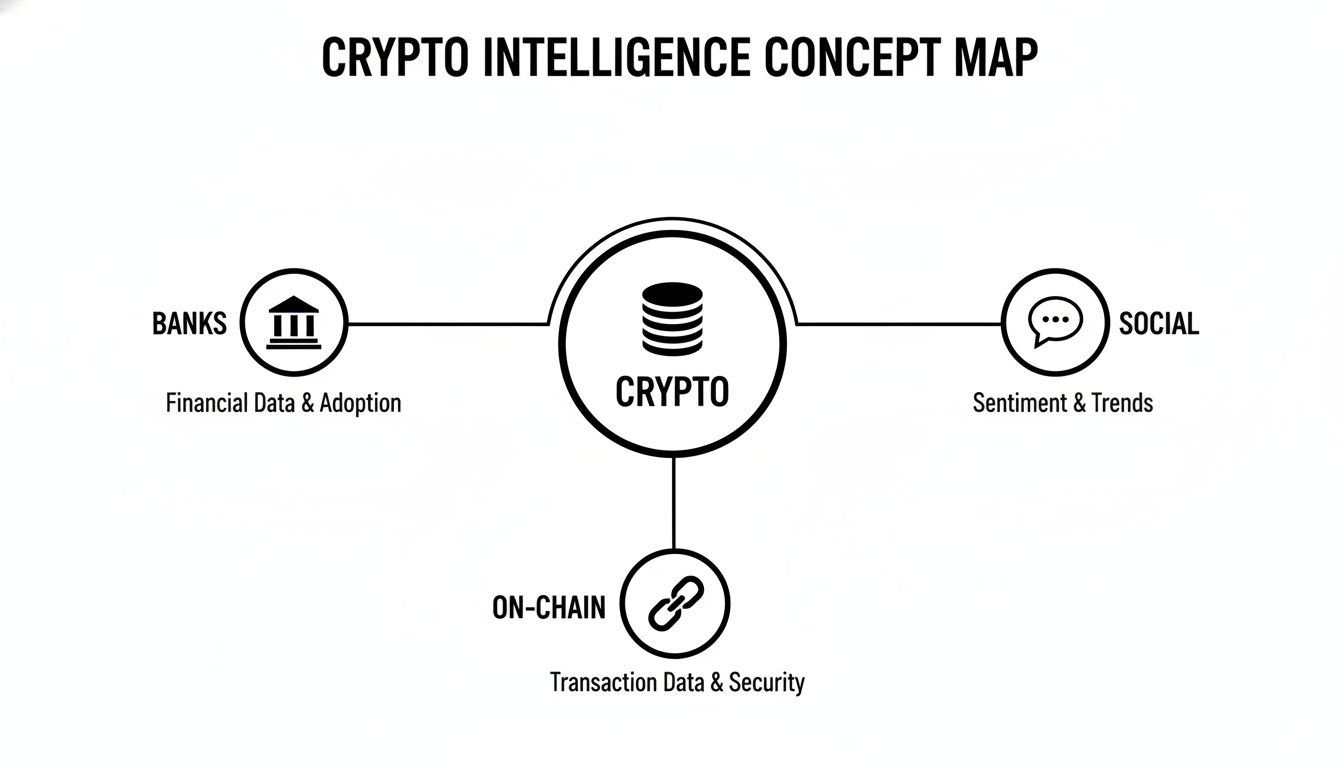
A concept map illustrating crypto intelligence with connections to banks, social media, and on-chain data.

As you can see, these forces don't exist in a vacuum. They're all connected, feeding into a rich data environment where savvy traders can find their edge. But their on-chain behavior couldn't be more different, creating two distinct types of signals you have to learn to read.

The Two Sides of the Crypto Coin

Bank Crypto is the on-chain activity driven by institutions, funds, and other huge financial players. Think of it like a massive cargo ship—it moves slowly, creates big waves, and follows a deliberate, well-planned route. These players aren't chasing 100x gains on the latest memecoin; they are methodically accumulating major assets like Bitcoin and Ethereum.

On the flip side, Social Crypto is the whirlwind of activity fueled by social media narratives, influencer hype, and good old-fashioned retail FOMO. This is more like a fleet of agile speedboats—they're fast, unpredictable, and can change direction on a dime. This corner of the market is all about high-velocity trades in newly launched tokens or coins currently trending on X (formerly Twitter).

By learning to separate these signals, you can tell the difference between a genuine capital rotation led by institutional money and a temporary, retail-driven social frenzy that could collapse at any moment.

This is a fundamental skill for anyone serious about on-chain analysis. Let's break down exactly what to look for.

Bank Crypto vs Social Crypto On-Chain Signals

When you look at wallet activity on-chain, the behavioral patterns of institutional and retail traders are night and day. The table below highlights the key differences in their digital footprints.

Signal CharacteristicBank Crypto FootprintSocial Crypto Footprint
Transaction SizeVery large, often $1M+, executed systematically over hours or days.Small to medium, typically under $10k, executed in rapid succession.
Asset ChoicePrimarily blue-chip assets like BTC, ETH, and major stablecoins.Heavily focused on memecoins, new tokens, and narrative-driven altcoins.
Wallet BehaviorWallets show a long history, steady accumulation, and interaction with custody platforms.New wallets are funded right before a buying spree; high frequency of swaps and sales.
TimingMoves often coincide with traditional market hours or major financial news.Activity spikes 24/7, reacting instantly to Twitter threads or Telegram announcements.
Market ImpactCreates sustained price pressure and establishes long-term support or resistance levels.Generates extreme short-term volatility and sharp, explosive price pumps.

Spotting these patterns in the wild is the first step toward making smarter trading decisions. For instance, a tool like Wallet Finder.ai lets you filter wallets based on metrics that line up with either "Bank" or "Social" behavior. You can isolate wallets based on their net profit, win rate, or even how quickly they trade.

This makes it much easier to zero in on top performers and then dig deeper to see if their strategy looks more like institutional accumulation or nimble social trading.

How Institutional Money Moves Markets

When institutional capital shows up to the crypto party, it doesn't just walk in—it makes waves. A big bank or asset manager doesn’t trade like the rest of us; their financial gravity is so immense it can pull the entire market in a new direction. Unlike the fast, sometimes chaotic energy of social crypto, these moves are calculated, deliberate, and incredibly powerful.

Imagine a major investment fund decides to put just 1% of its assets into Bitcoin. They aren't smashing the “market buy” button. Instead, they roll out a systematic accumulation strategy that might unfold over weeks. On-chain, this looks like a series of large, steady transactions that create sustained buying pressure, often building a brand-new price floor for an asset.

Translating News into On-Chain Signals

The real trick is connecting the dots between a headline and what's actually happening on the blockchain. When you read a report about a bank launching a crypto custody service, that’s not just an announcement—it's a sign that huge amounts of capital are about to start moving on-chain.

Here are three key institutional footprints to watch for on-chain:

  1. Large Stablecoin Movements: Keep an eye on wallets moving tens of millions in USDC or USDT off a centralized exchange and into a private wallet. This is classic "dry powder" preparation before they deploy that capital into assets like ETH or BTC.
  2. Systematic Accumulation: Look for wallets that are making large, periodic purchases of a specific blue-chip crypto without ever selling. This one-way flow is a dead giveaway that an institution is building a long-term position.
  3. Institutional DeFi Interaction: Track significant fund flows into regulated, institutional-grade DeFi protocols. These platforms are built specifically for the big players, so any activity there is a high-confidence signal.

This whole world where banking and crypto meet is getting bigger every day. The global FinTech blockchain market was valued at US$1.3 billion back in 2022 and is expected to hit US$8.7 billion by 2026. This shows just how intertwined traditional finance is becoming with this technology.

As more money flows through these channels, the number of institutional wallets you can track just keeps growing. You can read more about the explosive growth of the FinTech blockchain market to get a sense of the scale we're talking about.

A single institutional wallet methodically buying up an asset tells you more about the market's real direction than a thousand retail wallets chasing the latest trend. Their game is all about methodical growth, not overnight riches.

When you understand these behaviors, you can see what the biggest players are doing, not just what they're saying. Learning to identify these wallets is a core skill in modern on-chain analysis, which we dive into deeper in our guide to the smart money index. By following these slow-moving giants, you can get yourself in position long before the major market shifts happen.

Riding the Wave of Social Momentum

While the big institutional players provide a steady floor for the market, social momentum is the rocket fuel that launches explosive, short-term opportunities. Narratives cooked up on platforms like X and Telegram can generate staggering on-chain volume almost overnight. If you want to capitalize on these moves without getting wrecked, you have to understand their lifecycle.

This social energy creates a distinct, recognizable pattern. It’s a powerful force in the bank social crypto landscape, driven by community hype and a healthy dose of FOMO (fear of missing out).

A social media wave pushing money-filled wallets towards an upward-trending stock market graph.

The 4 Phases of a Social-Driven Trade

These social waves move fast, but they follow a predictable path. Spotting these phases early is everything.

  1. The Whisper Phase: It all starts quietly. A new narrative or token begins bubbling up in small, niche communities or from a handful of low-key influencer wallets. On-chain, this looks like a small cluster of initial buys from wallets known for sniffing out gems early.
  2. The Ignition Phase: Bigger players take notice. Major influencers pick up the narrative, and volume on decentralized exchanges (DEXs) starts to climb. You'll see the number of unique token holders tick up as the first wave of retail traders dives in.
  3. The FOMO Surge: The token starts trending on social media, and the floodgates open. This triggers a massive influx of retail buying. On-chain, you'll see thousands of newly funded wallets making small to medium-sized buys, pushing the price parabolic.
  4. The Profit-Taking Cascade: This is the endgame for early birds. The first buyers and influencers begin selling into the hype, cashing out on the retail-driven pump. This creates immense sell pressure, often leading to a brutal price correction that leaves latecomers holding the bag.

The key isn't just to find a trending token; it's to identify which wallets are consistently getting in during the whisper phase and out before the cascade. These are the "alpha" wallets you want to track.

On-Chain Indicators of a Social Wave

You don’t have to guess based on social media chatter alone. The blockchain gives you clear, data-driven signals that a social wave is building.

Look for a combination of these on-chain events:

  • Sudden Spike in Token Holders: A rapid increase in the number of wallets holding a specific token is a classic sign of growing retail interest.
  • Surging DEX Volume: Monitor for unusually high trading volume on DEXs for a token that was previously quiet.
  • New Wallet Clusters: See a large number of wallets get funded from the same exchange and immediately buy the same token? That often points to a coordinated social push.

Crypto is now a global social and investment phenomenon. By 2024, over 70% of institutional investors reported plans to invest in digital assets. This has created a fascinating market where the real edge is found by identifying the 1-5% of wallets that consistently win in these highly narrative-driven environments. Spotting these wallets is the secret to riding the social wave successfully.

A Practical Guide to Finding Elite Wallets

Theory is great, but action is what pays the bills. Let's turn the idea of bank social crypto into a real-world workflow you can use right now with Wallet Finder.ai. The goal is to build your own custom dashboard to watch both the institutional giants and the fast-moving social traders, giving you a complete picture of the market.

This means we'll be filtering for specific trading behaviors, setting up dedicated watchlists, and creating alerts so you're the first to know when a big move happens. It’s all about turning raw on-chain data into your personal trading edge.

Watchlist interface displaying multiple wallets, with 'Social' filter selected, a magnifying glass, and data analysis charts.

Think of the watchlist view in Wallet Finder.ai as your command center. From here, you can track the exact wallets that fit your strategy, whether that’s the slow-and-steady institutional players or the high-speed social traders.

Identifying Institutional "Bank Crypto" Wallets

First, let's go hunting for the cargo ships of the crypto world—the big, methodical wallets that signal what the institutions are doing. These traders aren’t chasing short-term hype; they’re focused on preserving capital and making steady, calculated gains.

To find them, your filtering strategy should zero in on consistency and size:

  1. High Total Profit (PnL): Start by filtering for wallets that have a proven track record of pulling in massive gains, often in the millions.
  2. Large Average Position Size: Look for wallets that consistently put $100k+ into a single trade. This immediately cuts out the smaller retail crowd.
  3. Focus on Blue-Chip Assets: Dig into a wallet's history. If you see a heavy concentration in assets like ETH, WBTC, and major stablecoins, that's a huge tell for an institutional mindset.
  4. Low Trade Frequency: These wallets aren't day trading. A few well-timed, massive transactions per month is the classic pattern of a big institution.

When you layer these filters, you isolate wallets that operate with a long-term, systematic game plan. They give you clues about where serious money is headed weeks or even months in advance.

Pinpointing Elite "Social Crypto" Traders

Next up, let's find the speedboats—the hyper-active traders who are masters at riding social media waves. These are the wallets you watch for high-risk, high-reward opportunities driven by the latest narrative or community buzz.

The filters here are the polar opposite of what we used for institutions:

  • High Win Rate on New Tokens: Filter for wallets with a win rate over 70%, specifically on tokens that launched in the last 30-60 days. This shows they can pick winners early.
  • High Trade Frequency: Look for wallets that are making multiple trades every day or week. This is a clear sign they are actively jumping on short-term market shifts.
  • Fast Entry and Exit: The best social traders are often the first ones in on a new token and are just as quick to take profits. Their holding periods might be hours or days, not months.
  • "First Mover" Status: Wallet Finder.ai can help you spot wallets that were among the first 100 buyers of a token that later went on a massive run.

These filters help you uncover the alpha hunters who consistently find trends before they hit the mainstream. For a deeper dive, our complete guide on 5 steps for screening profitable wallets can help you refine this process even more.

The real magic happens when you monitor both types of wallets at the same time. An institutional wallet buying up ETH gives you long-term conviction, while a top social trader aping into a new memecoin gives you a shot at a high-risk, high-reward play.

Actionable Steps In Wallet Finder.ai

Once you've found a handful of promising wallets from each category, the last step is to organize them so you can monitor them effectively. This simple workflow inside Wallet Finder.ai gets the job done.

StepAction for Bank Crypto WalletsAction for Social Crypto Wallets
1. Create ListMake a watchlist named something like "Institutional Long-Term."Create a separate list called "Social Alpha Traders."
2. Add WalletsAdd your top 5-10 filtered institutional wallets to this list.Add your top 5-10 filtered social traders here.
3. Configure AlertsSet up real-time alerts for any single transaction over $250,000.Configure instant alerts for any new token purchase, no matter the size.

This setup is designed to give you high-quality signals without all the noise. You’ll know the second an institutional player makes a major allocation or when a proven social trader jumps into a new, potentially explosive token. This is how you go from just watching the market to getting timely, actionable intelligence you can actually use.

Smart Risk Management for Copy Trading

Following elite wallets is an amazing way to generate new trade ideas, but let's be clear: blindly mirroring every single move is a recipe for disaster. Effective copy trading isn't about switching your brain off. It's about using smart money signals as a starting point, then layering on your own solid risk management to keep your capital safe.

If you just copy a trade without any context, you're ignoring the most important parts of the equation—like the trader's total portfolio size, their personal risk tolerance, and the price they actually got in at. You could easily end up buying their bags as they're selling for a profit, which is a classic rookie mistake.

Your 3-Step Pre-Trade Checklist

Before you act on a signal from a wallet you're tracking, run through this critical checklist. This simple step can be the difference between a calculated risk and a reckless gamble.

  1. Check Token Liquidity: Is there enough trading volume to get in and out without causing a massive price swing? Low liquidity is a huge red flag and can trap you in a position.
  2. Analyze the Contract: Look up the smart contract. Is it verified? Does it contain any sketchy functions that could point to a rug pull? Tools like a token scanner can help here.
  3. Understand the Narrative: Why is this specific token moving right now? Is there a real catalyst behind it, or is it just getting pumped by temporary social media hype?

The 3 Core Rules of Risk Management

In this game, protecting your downside is way more important than chasing those massive, high-risk returns. Sticking to a few proven rules will keep you in the market long enough to actually find success.

The goal of a smart trader isn't to win every trade—it's to make sure that no single loss can ever wipe them out. Your survival depends on discipline, not just luck.

Here’s a simple framework you can apply to every single trade you make:

  • Smart Position Sizing: Never go all-in on one trade. A good rule of thumb is to risk no more than 1-2% of your total portfolio on any single position.
  • Set a Stop-Loss: Know your exit point before you even enter a trade. If the price hits that level, you get out automatically. No second-guessing, no emotion.
  • Take Partial Profits: As the trade moves in your favor, sell a piece of your position to lock in gains. This immediately de-risks the trade and lets you ride the rest of your position completely stress-free.

Frequently Asked Questions

When you start digging into the world of bank social crypto signals, especially with real money involved, a lot of questions come up. Here are some clear, straightforward answers to the most common ones we hear from traders.

Is It Legal To Copy Trades From Other Crypto Wallets?

Yes, it’s completely legal. Every transaction on public blockchains like Ethereum is out in the open for anyone to see.

Think of it like this: tools like Wallet Finder.ai are just organizing and making sense of this public information. You aren’t hacking into anything or accessing private data. You're simply making your own investment choices based on publicly available clues, using on-chain analytics to get an edge.

How Can I Distinguish a True Institutional Wallet?

The real trick is to watch their behavior over time. A true institutional wallet usually moves in a more systematic, disciplined way.

A key differentiator is consistency. Institutional players focus on steady accumulation and interact with regulated platforms, whereas a large retail whale might show more erratic behavior chasing hyped narratives.

Wallet Finder.ai helps you cut through the noise. Its filters let you zero in on wallets with a high profit-and-loss (PnL) consistency and a long track record—both classic signs of a serious, sophisticated player.

What Is the Biggest Risk in Following These Signals?

The biggest risk is a mix of bad timing and poor liquidity. You always see a transaction after it’s already happened.

If you rush to copy a massive trade in a token that barely trades, your own buy order can crank the price way up. This is called slippage, and it can be a very expensive mistake.

Worse, you could find yourself stuck, unable to sell when you want to because there's no one to buy from you. That’s why you can’t just blindly copy trades. Always check the token's market depth and manage your risk properly. A good rule of thumb is to start with small test positions to see how the market reacts.


Ready to stop guessing and start tracking the real market movers? Wallet Finder.ai gives you the tools to find elite institutional and social crypto wallets, monitor their every move in real time, and turn on-chain data into your strategic edge. Start your 7-day trial and find your alpha today.