12 Best Crypto Portfolio Tracker Tools for 2025 (Reviewed)

Wallet Finder

Blank calendar icon with grid of squares representing days.

March 6, 2026

Navigating the crypto market without a clear view of your holdings is like trying to sail across an ocean without a compass. As your portfolio expands across different exchanges, wallets, and DeFi protocols, manually tracking your performance, profit and loss (P&L), and tax liabilities becomes not just tedious, but nearly impossible. This is the core problem the best crypto portfolio tracker is designed to solve: aggregating all your disparate crypto activities into a single, cohesive, and actionable dashboard.

This guide dives deep into the top crypto portfolio trackers available today. We move beyond surface-level feature lists to provide a comprehensive analysis tailored to specific user needs. Whether you're a DeFi trader looking to monitor complex yield farming strategies, an on-chain analyst copy-trading whale wallets, or a beginner simply trying to get a handle on your first Bitcoin and Ethereum purchases, this resource will help you find the perfect tool.

We've meticulously reviewed each platform, focusing on practical application, real-world performance, and potential limitations. You will find detailed comparisons, screenshots, and direct links for every tracker. Our goal is to equip you with the insights needed to make an informed decision, saving you hours of research. We'll explore solutions ideal for:

  • DeFi Power Users: Needing granular tracking of liquidity pools, staking, and governance tokens.
  • Tax-Conscious Investors: Requiring detailed and accurate tax reporting features.
  • Multi-Asset Holders: Who need to track not just crypto but also stocks, NFTs, and other investments.
  • Beginners: Looking for a simple, user-friendly interface to get started.

By the end of this article, you will have a clear understanding of which platform aligns best with your investment strategy, technical expertise, and financial goals. Let's find the right tracker for your portfolio.

1. CoinTracker

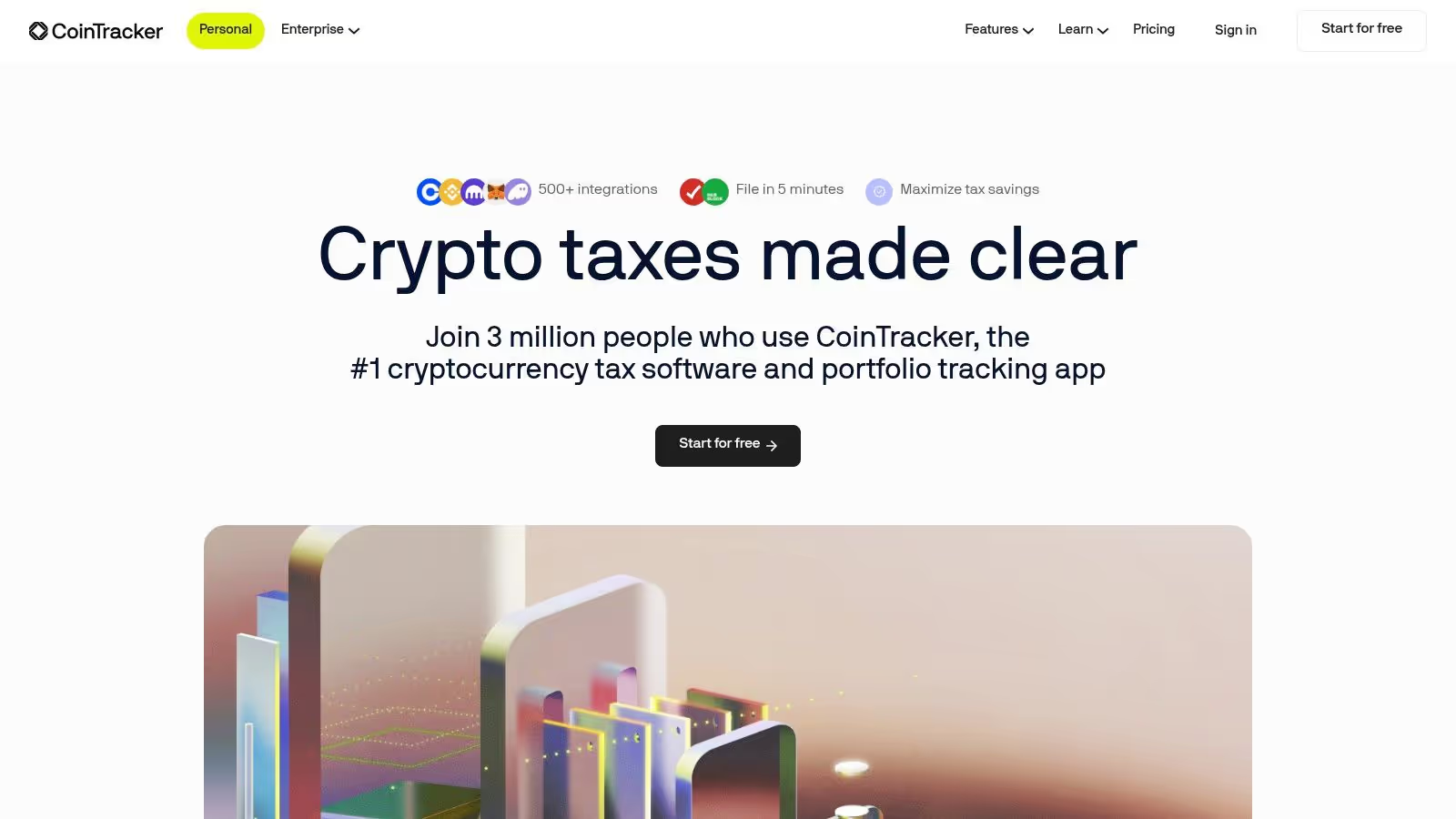
CoinTracker stands out as one of the most established and trusted platforms in the crypto space, excelling as an all-in-one portfolio tracker and tax calculator. Its core strength lies in providing a unified dashboard that not only shows your real-time performance but also simplifies the often-complex process of crypto tax preparation, particularly for users in the US, UK, Canada, and Australia. The platform aggregates data from over 800 exchanges, wallets, and blockchain addresses, giving you a complete financial picture.
CoinTracker

This makes it an excellent choice for investors who want to maintain a single source of truth for both their portfolio’s growth and their tax liabilities throughout the year. The interface is clean and user-friendly, catering well to both beginners and seasoned traders.

Key Features and User Experience

CoinTracker's platform is designed for clarity. Upon connecting your accounts via API or CSV, it automatically syncs transactions, calculates your cost basis, and displays your portfolio allocation and performance over time. While the free plan offers a solid overview, the full power, including downloadable tax reports, is unlocked with paid subscriptions.

Feature HighlightsBest ForIntegrated Tax ReportingUS investors needing compliant tax forms (e.g., Form 8949).Broad ConnectivityUsers with assets scattered across numerous exchanges and wallets.DeFi & NFT SupportInvestors interacting with decentralized applications and holding NFTs.Mobile AppTracking portfolio performance on-the-go with iOS and Android apps.

For a deeper dive into its capabilities, you can find a comprehensive review of CoinTracker in our 2025 roundup.

  • Mature, reliable platform with millions of users.
  • Combines year-round portfolio tracking with tax features in one subscription.
  • Excellent support for a vast number of exchanges and wallets.
  • Advanced tax reporting is a premium, paid feature.
  • Complex DeFi transactions may occasionally require manual categorization.

Website: https://www.cointracker.io

2. Koinly

Koinly is primarily known as a top-tier crypto tax software, but it also functions as a powerful and often free crypto portfolio tracker. Its main advantage is allowing users to fully track their portfolio’s performance, including realized and unrealized gains, without a subscription. You only pay when you need to generate and download official tax reports, making it an excellent "try before you buy" solution for holistic portfolio management.

Koinly

With support for over 900 exchanges, wallets, and blockchains, Koinly automatically imports your transaction history and provides a clear, real-time dashboard. This makes it ideal for investors who want to keep a close eye on their P&L throughout the year and then seamlessly transition to tax preparation when the time comes. For traders looking to measure the effectiveness of their strategies, Crypto Trade Win Rate Estimator provides a practical way to evaluate performance and optimize decisions.

Key Features and User Experience

Koinly’s interface is clean and centered around its dashboard, which gives you a snapshot of your holdings, return on investment, and capital gains. The platform's smart transfer matching automatically reconciles transfers between your own wallets and exchanges, reducing the manual work often required with other trackers. While the portfolio tracking is free, generating tax forms for specific countries is a paid service.

Feature HighlightsBest ForComprehensive Free TrackingUsers who want a full-featured portfolio tracker without an upfront subscription.Robust Tax EngineInvestors in the US, Canada, UK, and other supported regions needing compliant tax forms.DeFi & Margin Trading SupportTraders engaging in complex activities like liquidity pools, staking, and futures.Smart Transfer MatchingAnyone with assets spread across multiple platforms who wants to minimize manual edits.

The platform offers clear guidance and robust support, making it one of the best crypto portfolio tracker options for those who prioritize tax compliance.

  • Generous free plan for portfolio tracking with unlimited transactions.
  • Excellent automation for transaction importing and transfer matching.
  • Strong support for US tax forms, including direct TurboTax exports.
  • Advanced tax features like cost basis optimization are on higher-priced tiers.
  • Users with extremely high transaction volumes might find paid plans costly.

Website: https://koinly.io

3. CoinStats

CoinStats is a highly popular crypto portfolio tracker known for its sleek interface and extensive connectivity across exchanges, wallets, and DeFi protocols. It caters exceptionally well to active retail traders who need real-time data, rich analytics, and customizable alerts to stay ahead of market movements. The platform aggregates all your crypto assets into a single dashboard, offering a holistic view of your performance, allocation, and profit/loss metrics.

CoinStats

Its strength lies in providing a mobile-first experience that doesn’t compromise on features, making it a powerful tool for managing investments on the go. CoinStats has carved out a niche as one of the best crypto portfolio tracker options for users who prioritize deep analytics and frequent feature updates in a user-friendly package.

Key Features and User Experience

CoinStats makes it simple to connect your accounts and automatically sync your transaction history. The platform then generates detailed insights, including your P&L analytics, asset allocation, and even a "wallet analyzer" to explore any public address. While the free version is functional for basic tracking, a subscription unlocks its full potential, including unlimited connections and advanced portfolio analytics.

Feature HighlightsBest ForRich Analytics & AlertsActive traders needing custom notifications for price movements or order fills.All-in-One DashboardUsers wanting a single view of their CEX, wallet, DeFi, and NFT holdings.Web & Mobile AppsInvestors who need to manage and track their portfolio from any device.In-App SwapsUsers looking to trade assets directly within the CoinStats app across multiple liquidity sources.

For users managing a significant volume of transactions, the premium plans offer a robust solution with high connection limits and priority support.

  • Excellent mobile and web apps with a clean, modern user interface.
  • Strong DeFi and NFT tracking capabilities.
  • Offers lifetime plan options for power users and accepts crypto payments.
  • Most advanced analytics and unlimited connections are behind a paywall.
  • Some users in app-store reviews report occasional data synchronization issues.

Website: https://coinstats.app

4. Delta by eToro

Delta, now part of the eToro family, carves out a unique niche by offering a beautifully designed multi-asset tracker that seamlessly integrates cryptocurrencies with traditional investments like stocks and ETFs. Its core strength is its mobile-first approach, providing one of the most polished and intuitive user experiences available for tracking a diverse portfolio on the go. Delta is the ideal choice for investors who want a holistic view of all their assets, not just their crypto holdings, in one centralized dashboard.

Delta by eToro

The platform connects to a vast array of brokers, exchanges, and wallets, ensuring that your financial data is always synced and up-to-date. This makes it a powerful tool for anyone looking to monitor their net worth across different asset classes without juggling multiple apps.

Key Features and User Experience

Delta’s user interface is clean, fast, and highly customizable, with a strong emphasis on powerful alerts and insightful analytics. It allows users to set up notifications for significant price movements or portfolio value changes, keeping them informed of market-critical events. While the free version is robust, the Delta PRO subscription unlocks advanced metrics, unlimited connections, and deeper portfolio insights.

Feature HighlightsBest ForCross-Asset CoverageInvestors holding both crypto and traditional stocks/ETFs.Powerful Mobile ExperienceUsers who primarily manage and track their portfolio from a smartphone.Deep Portfolio AnalyticsAnalyzing overall diversification, gains/losses, and asset allocation.News & Market InsightsStaying updated with personalized news feeds relevant to your holdings.

The app is particularly well-suited for those who appreciate a superior design aesthetic combined with robust functionality, making it one of the best crypto portfolio tracker options for the modern, diversified investor.

  • Polished, intuitive UI/UX with robust and customizable alerts.
  • Excellent for investors managing a mixed portfolio of crypto and traditional assets.
  • Backed by eToro, with a large and active user community.
  • The most advanced analytics are locked behind the Delta PRO subscription.
  • The desktop and web experience is functional but less feature-rich than the mobile apps.

Website: https://delta.app

5. Zerion

Zerion has carved out a niche as a premier, DeFi-first portfolio tracker and smart wallet for self-custody investors. It excels at providing a comprehensive on-chain view, consolidating tokens, liquidity positions, staked assets, and NFTs across more than 40 EVM-compatible networks. Its strength is its deep integration with the decentralized web, making it the best crypto portfolio tracker for users heavily active in DeFi, especially on Ethereum and various Layer-2s.

Zerion

Unlike trackers that focus on centralized exchanges, Zerion is wallet-centric. You simply connect your address to see your entire Web3 footprint in one place, complete with historical profit and loss data. The interface is modern and intuitive, offering built-in trading, bridging, and dApp discovery to create a seamless on-chain experience.

Key Features and User Experience

Zerion's platform is designed for the active DeFi user. It automatically detects and displays complex positions like liquidity pool tokens and staked assets, which many other trackers struggle with. Most of its powerful tracking features are available for free, with a premium subscription unlocking more detailed P&L analysis and other perks. Its mobile apps and browser extension are highly rated, providing a cohesive experience across devices.

Feature HighlightsBest ForDeep DeFi & NFT TrackingUsers with complex positions in LPs, staking, and NFTs across many chains.Wallet-Centric ViewInvestors who primarily use self-custody wallets like Ledger or MetaMask.Built-in Trading & DappsTraders who want to track and act on opportunities from one interface.Multi-Chain EVM SupportUsers active on networks like Arbitrum, Polygon, Optimism, and Base.

Its commitment to self-custody makes it a powerful tool for those who want to manage their on-chain assets without relying on centralized platforms for data.

  • Excellent visibility into complex DeFi and NFT portfolios across 40+ chains.
  • Most core tracking features are completely free to use.
  • Sleek user interface with integrated trading and bridging functions.
  • Not designed for tracking balances on centralized exchanges.
  • Depth of protocol coverage can vary on newer or less popular chains.

Website: https://zerion.io

6. Zapper

Zapper has carved out a niche as the quintessential dashboard for decentralized finance (DeFi) enthusiasts. Instead of trying to be an all-encompassing crypto portfolio tracker that includes centralized exchanges, Zapper focuses exclusively on providing a crystal-clear view of your on-chain activities. It excels at untangling complex DeFi positions, showing your tokens, NFTs, liquidity pool stakes, and yield farming assets across numerous blockchains in a single, elegant interface.

Zapper

This makes it an indispensable tool for anyone deeply involved in web3. You simply paste in a wallet address-yours or one you want to follow-and Zapper instantly populates a detailed dashboard. It's built for action, integrating token swaps and bridging functionalities directly within the platform so you can manage your portfolio without leaving the site.

Key Features and User Experience

Zapper’s user experience is one of its strongest selling points. The platform is entirely non-custodial and requires no personal information, offering a "connect and go" experience. It visualizes your DeFi net worth, including debts and assets, with remarkable clarity. Its discovery tools also help users find new yield farming opportunities and trending NFT collections, adding a layer of utility beyond simple tracking.

Feature HighlightsBest ForDeep DeFi IntegrationUsers actively participating in liquidity pools, staking, and lending.Wallet FollowingOn-chain analysts and traders looking to monitor the moves of other wallets.Actionable DashboardQuickly swapping or bridging assets directly from the tracker interface.NFT VisualizationCollectors who want a clean gallery view of their NFT holdings.

The platform is designed for those who live on-chain and need a powerful, specialized tool for that environment.

  • Completely free to use for all tracking features.
  • Excellent, user-friendly interface for visualizing complex DeFi positions.
  • Non-custodial design prioritizes user privacy and security.
  • Does not support tracking for centralized exchange (CEX) accounts.
  • Lacks the tax reporting features found in more comprehensive trackers.

Website: https://zapper.xyz

7. DeBank

DeBank has carved out a niche as the go-to DeFi-native portfolio tracker, excelling at providing deep, granular insights into on-chain activities across EVM-compatible networks. It is more than just a balance checker; it is a comprehensive wallet analysis tool that allows users to track complex DeFi positions, view detailed transaction histories, and even engage with web3 social features. The platform is particularly powerful for users who want to monitor their own sophisticated DeFi strategies or analyze the on-chain movements of other wallets.

DeBank

Its read-only approach simplifies setup: just paste in a wallet address, and DeBank instantly populates the dashboard with assets, NFTs, and protocol-specific breakdowns. This makes it an invaluable tool for on-chain analysts and traders looking for a quick yet powerful overview of any wallet's holdings and historical performance, solidifying its place as one of the best crypto portfolio tracker options for the DeFi community.

Key Features and User Experience

DeBank’s interface is data-rich but surprisingly intuitive. It focuses on presenting a clear breakdown of assets by chain and by protocol, showing exactly where your funds are allocated. The platform also includes a web3 social layer with features like "Hi" messaging and a "Stream" feed, adding a community dimension to wallet tracking. Its speed and comprehensive DeFi protocol support are major draws.

Feature HighlightsBest ForDeep DeFi Protocol AnalysisUsers with complex positions in liquidity pools, lending, and staking.Multi-Chain EVM CoverageTracking assets across Ethereum, Polygon, Arbitrum, and other EVMs.Wallet Profiling & SocialOn-chain analysts and users wanting to follow or contact top wallets.Instant, Read-Only AccessQuick, secure portfolio checks without connecting a wallet directly.

For those heavily invested in decentralized finance, we've explored how tools like DeBank enhance DeFi portfolio management in our dedicated guide.

  • Completely free to use with no hidden fees.
  • Excellent, detailed breakdowns of DeFi positions and protocol interactions.
  • Fast and secure; requires only a public wallet address.
  • Primarily focused on EVM chains; support for non-EVM chains is limited.
  • NFT and newer protocol data can sometimes be incomplete or delayed.

Website: https://debank.com

8. CoinTracking

CoinTracking is a veteran in the crypto portfolio tracking space, known for its powerful, data-driven approach. It caters especially to serious traders, accountants, and corporate clients who require deep, granular reporting and the ability to handle massive transaction volumes. The platform offers an exhaustive suite of tools for both portfolio analysis and tax calculation, making it one of the most comprehensive solutions for users who need meticulous financial records.

CoinTracking

While its interface is more functional than flashy, its strength lies in the depth of its features. CoinTracking supports imports from over 300 exchanges and wallets and provides more than 25 customizable reports, making it a top-tier choice for professionals who need to perform audits, manage client funds, or prepare detailed tax filings.

Key Features and User Experience

CoinTracking’s platform is built for detail. After connecting your accounts via API or CSV, you gain access to a wealth of data, from realized/unrealized gains to trade statistics and balance charts. The free plan is generous, allowing up to 200 transactions, but the real power is in the paid tiers, which offer automation, higher transaction limits, and access to all tax reports.

Feature HighlightsBest ForDeep Reporting ToolsProfessional traders and accountants needing detailed financial data.High Transaction LimitsPower users and funds with extensive trading histories.Corporate PlansFinancial firms or tax professionals managing multiple client portfolios.Lifetime Plan OptionsLong-term investors looking for a one-time payment solution.

The platform's focus on data integrity makes it an indispensable tool for anyone who considers their crypto activity a serious financial endeavor.

  • Extremely flexible and detailed reporting for audits and tax preparation.
  • Scales exceptionally well to very high transaction volumes.
  • Offers unique multi-year and lifetime pricing models.
  • The interface can feel complex and dated for new users.
  • Full automation and higher transaction limits require a paid subscription.

Website: https://cointracking.info

9. CoinGecko Portfolio

CoinGecko is already a go-to resource for real-time crypto prices and market data, and its integrated portfolio tracker offers a lightweight, free, and incredibly accessible way to monitor your holdings. This tool is perfect for users who primarily want a quick, at-a-glance view of their assets without the complexity of advanced tax features. Its core strength lies in its simplicity and direct integration with CoinGecko's massive database of thousands of coins, providing unmatched market coverage.

CoinGecko Portfolio

Because it's built into a platform that millions of crypto enthusiasts already use daily, the CoinGecko Portfolio is an excellent choice for beginners or investors who prefer manual transaction entry for privacy. It serves as a powerful watchlist and basic performance monitor, all synced seamlessly between its web and highly-rated mobile apps.

Key Features and User Experience

The user experience is straightforward: you create a portfolio and manually add transactions (buy, sell, or transfer) for each asset you hold. The platform then tracks your overall profit and loss, individual asset performance, and portfolio allocation using real-time price data. While it lacks automatic API syncs with exchanges, this manual approach gives users complete control and is a solid free option for basic tracking.

Feature HighlightsBest ForCompletely Free to UseCost-conscious users needing simple, effective portfolio monitoring.Massive Coin DatabaseInvestors holding obscure altcoins or newly launched tokens.Mobile & Web SyncUsers who want to check their portfolio on both desktop and mobile.Shareable PortfoliosTraders who want to share their portfolio performance with a community.

This tool is a standout for those who need a reliable and free crypto portfolio tracker without the overhead of more feature-rich, subscription-based platforms.

  • Entirely free with no hidden costs.
  • Leverages CoinGecko's extensive database of thousands of cryptocurrencies.
  • Simple, clean interface that is very easy to use.
  • Requires manual entry of all transactions; no automatic exchange sync.
  • Does not include any tax reporting features.
  • Lacks support for advanced DeFi or NFT tracking.

Website: https://www.coingecko.com/portfolio

10. CoinMarketCap Portfolio

As one of the most visited websites in the crypto industry, CoinMarketCap offers a free and surprisingly capable portfolio tracker integrated directly into its platform. Its primary advantage is convenience, allowing the millions of users who already rely on CMC for market data to track their holdings without leaving the site. The tool is perfect for beginners or casual investors who want a straightforward way to monitor their assets' performance in real-time.

This tracker leverages CoinMarketCap’s massive database of cryptocurrencies, ensuring you can add virtually any coin or token to your portfolio. While it started as a manual-entry tool, it now supports syncing with a Binance account and tracking on-chain wallet addresses, making it a more versatile and automated solution for basic tracking needs.

Key Features and User Experience

The CoinMarketCap Portfolio is designed for simplicity and ease of use. You can create multiple portfolios and add transactions manually or connect your accounts to see your holdings update automatically. The interface provides a clear overview of your total balance, profit/loss, and asset allocation, all displayed alongside the familiar market data that CMC is known for.

Feature HighlightsBest ForIntegrated Market DataUsers who want their portfolio synced with CMC's live price feeds.Free to UseInvestors looking for a no-cost, basic crypto portfolio tracker.Simple ConnectivityBinance users and those wanting to track public on-chain addresses.Watchlists & Price AlertsMonitoring specific assets of interest alongside your main portfolio.

For those just starting their investment journey, this tool is an excellent entry point into the world of portfolio management without the complexity of paid, feature-heavy platforms.

  • Completely free and integrated into a widely trusted platform.
  • Unmatched coverage of thousands of cryptocurrencies and tokens.
  • Simple setup, especially for manual tracking or Binance users.
  • Lacks advanced analytics, DeFi protocol integrations, and tax features.
  • Limited exchange and wallet connections compared to dedicated trackers.

Website: https://coinmarketcap.com/portfolio

11. Kubera

Kubera positions itself not just as a crypto portfolio tracker, but as a comprehensive, privacy-focused net worth dashboard for the modern investor. Its unique value proposition is its ability to elegantly consolidate both your crypto holdings and traditional financial assets, including bank accounts, real estate, and brokerage investments, into a single, unified view. This makes it an ideal choice for high-net-worth individuals or families who need to see their crypto assets within the context of their entire wealth portfolio.

Kubera

The platform is strictly subscription-based, meaning it doesn't sell user data or display ads, a crucial point for privacy-conscious users. Its clean, minimalist interface focuses on providing a clear financial snapshot without the clutter common in other tools, making it one of the best crypto portfolio tracker options for holistic wealth management.

Key Features and User Experience

Kubera excels in its "all-in-one" approach. You can connect crypto exchanges and wallets alongside traditional accounts, or manually add assets like art, vehicles, or private equity. The platform automatically pulls market data for stocks and crypto, giving you a real-time net worth calculation. Its interface is intuitive, designed more for high-level oversight than for granular, day-to-day trading analysis.

Feature HighlightsBest ForTotal Wealth TrackingIndividuals wanting a complete view of crypto, DeFi, and traditional assets.Privacy-First ModelUsers who prioritize data security and an ad-free experience.Estate PlanningFamilies needing a "dead man's switch" to securely share portfolio access.Multi-Currency SupportGlobal investors managing assets in various fiat currencies.

The platform's strength lies in its simplicity and breadth, rather than deep, crypto-specific analytics. It’s a tool for seeing the big picture, not for dissecting individual DeFi protocol performance.

  • Excellent for a holistic, total-wealth view that includes crypto.
  • Strong privacy stance with a subscription-funded, ad-free model.
  • Unique estate planning and beneficiary management features.
  • Premium pricing compared to crypto-only trackers.
  • Not a dedicated tax solution; lacks integrated tax reporting tools.
  • DeFi support is functional but less in-depth than specialized tools.

Website: https://www.kubera.com

12. Shrimpy

Shrimpy moves beyond simple tracking by integrating powerful trading automation and rebalancing tools directly into its platform. Its core value is for investors who want to not only monitor their portfolio but also execute hands-on strategies across multiple centralized exchanges (CEXs). By connecting exchange accounts, users can automate actions like periodic rebalancing to maintain a target asset allocation or set up dollar-cost averaging (DCA) strategies effortlessly.

Shrimpy

This makes it an exceptional tool for those looking to implement and backtest specific trading strategies without needing to code. The platform also includes social features, allowing users to follow and copy the strategies of top traders, making it one of the best crypto portfolio tracker options for automated strategy management.

Key Features and User Experience

Shrimpy's interface is clean and centered around its automation capabilities. Once exchanges are connected, you can build a custom index, set rebalancing rules, and let the platform do the work. While its strength is CEX automation, its on-chain tracking is less comprehensive. If your focus is primarily on-chain assets, you can discover more about how to track DeFi portfolios across multiple wallets with specialized tools.

Feature HighlightsBest ForAutomated RebalancingInvestors wanting to maintain a specific portfolio allocation automatically.Strategy BacktestingTraders who want to test portfolio strategies against historical data.Social Copy TradingUsers looking to follow and replicate the portfolios of successful traders.Unified Exchange DashboardManaging and trading across multiple centralized exchanges from one place.

  • Combines portfolio tracking with powerful automation and rebalancing.
  • Clear, tiered plans including a free 'Zero' plan for basic tracking.
  • Excellent for backtesting and implementing index-like strategies.
  • Best suited for CEX-connected traders; pure on-chain coverage is limited.
  • Advanced automation and copy-trading features require paid subscriptions.

Website: https://www.shrimpy.io

How to Choose the Best Crypto Portfolio Tracker for Your DeFi Strategy

Selecting the best crypto portfolio tracker is not simply a matter of picking the most feature-rich platform. It requires matching the tool's architecture to your specific DeFi activity patterns, because the technical requirements of a high-frequency on-chain trader are genuinely different from those of a long-term holder managing a diversified mix of centralized and decentralized assets. The twelve platforms reviewed in this guide each serve a different user profile, and the most productive selection process starts by identifying which of three fundamental tracker architectures best aligns with how you actually use the crypto market: on-chain native trackers that read directly from blockchain data, exchange-connected trackers that pull data through API keys, and hybrid wealth trackers that consolidate crypto alongside traditional financial assets.

Understanding which architecture matches your activity eliminates the most common source of dissatisfaction with portfolio tracking tools, which is choosing a platform optimized for a different use case than your own. A trader who primarily operates through self-custody wallets on Ethereum and Solana will find exchange-connected trackers like Shrimpy genuinely limited in their ability to reflect the full picture of DeFi positions, staked assets, and liquidity pool exposure that makes up the majority of the portfolio's economic activity. Equally, a long-term holder who manages assets across five centralized exchanges and wants integrated tax reporting will find DeFi-native trackers like Zapper and DeBank elegant but structurally unsuitable for their needs, because these platforms deliberately exclude centralized exchange connectivity in favor of deep on-chain protocol coverage.

Evaluating Portfolio Tracker Data Accuracy for Complex DeFi Positions

One of the most critical and least discussed dimensions for evaluating the best crypto portfolio tracker for DeFi-active users is data accuracy for complex on-chain positions. A tracker that correctly displays a simple token balance is not necessarily capable of accurately representing the economic value of a liquidity pool position, a staked asset with accruing rewards, a lending protocol deposit earning interest, or a governance token position with locked voting weight. Each of these position types requires protocol-specific integration logic that translates the raw blockchain data into an economically meaningful value representation, and the quality of this integration varies substantially across the platforms in this guide.

Zerion and Zapper have invested heavily in building and maintaining protocol-specific integration libraries that correctly parse and value these complex position types across dozens of protocols and chains, which is why they appear most frequently in recommendations for active DeFi users despite not offering the exchange connectivity or tax reporting that many other platforms provide. DeBank's on-chain social and analysis layer complements this deep protocol support with granular breakdown of individual protocol interactions, making it particularly useful for users who need to understand not just the current value of their positions but the full history of how each position was entered, accumulated, and exited. For users whose DeFi activity spans protocols on both EVM and non-EVM chains simultaneously — including Solana and Base alongside Ethereum mainnet and its Layer-2 ecosystem — the coverage gap between EVM-focused trackers and genuinely multi-chain platforms becomes the decisive differentiator, and identifying whether a specific tracker's claimed multi-chain support includes the specific chains and protocols you use is the most important verification to perform before committing to a platform.

Portfolio Tracker Security Practices and Data Privacy Considerations

Every crypto portfolio tracker that connects to your exchange accounts through API keys or stores your wallet addresses and transaction history introduces a data security consideration that deserves explicit evaluation alongside the platform's feature set. The best crypto portfolio tracker for any user is one that provides the required features while handling the associated data in a way that meets the user's risk tolerance, because the data held by a portfolio tracking platform about your holdings, entry prices, and total wealth is sensitive financial information whose compromise could expose you to targeted theft, social engineering, or regulatory risk depending on your jurisdiction.

Read-only API key security is the baseline standard that all reputable exchange-connected trackers implement, restricting the platform's access to viewing and exporting transaction data without the ability to execute trades or withdrawals on your behalf. All twelve platforms in this guide follow this standard for exchange connections, but the differences in how they store, process, and protect the data accessed through those read-only keys are less uniformly disclosed. Platforms with explicit privacy-first positioning — most notably Kubera with its subscription-funded, no-advertising model — make the data handling commitment a central part of their value proposition rather than an afterthought. On-chain native trackers like Zerion, Zapper, and DeBank that require only a public wallet address for read access represent the lowest data exposure of all tracker architectures, because reading publicly visible blockchain data requires no credentials and exposes no private information beyond the fact that you are monitoring a specific address.

Wallet address privacy for on-chain trackers is a separate consideration from credential security, because the association of a wallet address with your identity can be sensitive even when the blockchain data itself is public. Monitoring your own addresses through a tracker platform that logs which addresses are being monitored, and connecting that monitoring activity to account information, creates a data linkage between your identity and your blockchain addresses that may not be apparent from the tracker's interface. For users who prioritize wallet address privacy, trackers that allow address monitoring without account creation — or that allow multiple separate accounts without identity verification — provide a stronger privacy posture than platforms that require registration before viewing portfolio data.

Beyond Portfolio Tracking: How On-Chain Wallet Analytics Transforms Portfolio Tracker Data Into Alpha

Every platform reviewed in this guide answers the same fundamental question: what does your current crypto portfolio look like and how has it performed? This is an essential starting point for any serious crypto investor, and the twelve trackers in this guide represent the best available tools for answering it across different user profiles and activity types. There is, however, a more powerful question that standard portfolio tracking cannot answer: what are the most consistently profitable traders in the market currently doing with their capital, and how can you use that intelligence to inform your own portfolio decisions? This is the question that on-chain wallet analytics is designed to answer, and it represents the analytical layer that converts portfolio tracking from a backward-looking performance record into a forward-looking strategy input.

Standard portfolio trackers, including all twelve platforms reviewed in this guide, are inherently self-referential: they show you data about your own wallets and positions based on your own transaction history. The value they provide is a function of your own trading decisions, which means they can tell you accurately how your strategy has performed but cannot tell you whether there are systematically superior strategies being executed by other participants in the same markets that you could identify and learn from. On-chain wallet analytics inverts this relationship by focusing on the entire universe of wallet addresses active in DeFi markets, filtering that universe for wallets with documented track records of exceptional performance, and making the specific trading behavior of those high-performance wallets available for study, replication, and real-time alerting.

What On-Chain Wallet Analytics Adds That Portfolio Trackers Cannot Provide

The analytical gap between standard portfolio tracking and on-chain wallet analytics can be understood through a simple comparison: a portfolio tracker tells you that your portfolio returned 47% over the past 90 days, but it cannot tell you whether the top 1% of DeFi traders returned 340% over the same period using identifiable strategies that you could have accessed if you had known where to look. A portfolio tracker tells you that your meme token trades have a 52% win rate, but it cannot tell you that the highest-performing wallets in that token category achieve 61% win rates by entering positions that meet specific on-chain criteria that you are not currently using as filters. The knowledge that would change the quality of your trading decisions lives in other wallets' transaction histories, not in your own, and accessing that knowledge requires a fundamentally different tool than a portfolio tracker.

Whale wallet tracking is the most immediately practical application of on-chain wallet analytics for active traders, providing real-time alerts when verified high-performance wallets make significant transactions in tokens that are not yet widely held or discussed. When a wallet with a documented 90-day track record of 280% realized PnL begins accumulating a previously obscure token across multiple transactions within a short time window, that behavioral signal precedes the social media attention and broad price discovery that typically follow institutional-scale accumulation by 24 to 48 hours. Standard portfolio trackers have no mechanism for delivering this type of intelligence because they are confined to monitoring wallets you have explicitly added, and identifying which wallets in a universe of millions of active addresses deserve to be monitored requires the performance-ranking infrastructure that on-chain wallet analytics platforms are specifically designed to provide.

Using Wallet Finder.ai as the Analytics Layer Above Your Portfolio Tracker

The most effective approach for serious DeFi traders is to use a standard portfolio tracker as the operational foundation — maintaining accurate records of your own positions, performance metrics, and tax liability — while layering on-chain wallet analytics from a dedicated platform like Wallet Finder.ai as the strategy intelligence input that informs what positions to enter, when to enter them, and which tokens deserve deeper research. These two tool categories are complementary rather than competing, because they answer different questions using different data sources and serve different roles in a complete trading workflow.

Wallet Finder.ai provides the on-chain analytics layer that sits above the portfolio tracking layer, specifically focused on discovering profitable wallets, tracking their activity in real time, and translating that activity into actionable signals. The platform tracks wallets across Ethereum, Solana, and Base with an average return of 340% across documented wallet histories, delivers Telegram alerts within minutes of tracked whale wallets making significant moves, and provides the filtering tools required to identify wallets whose strategies are replicable at your capital scale and trading cadence. The Discover Wallets feature filters high-performing wallets by realized PnL, win rates, and risk percentages — the same metrics that the portfolio trackers in this guide use to characterize your own performance, now applied to identify which external wallets represent the benchmark you should be studying and the strategies you should be learning from.

Integrating Wallet Finder.ai into your portfolio management workflow transforms the portfolio tracker from a performance measurement tool into a strategy improvement loop. Your portfolio tracker tells you your current win rate is 54% and your average win-loss ratio is 1.8:1. Wallet Finder.ai shows you that the top-performing wallets in your primary trading category achieve win rates of 61% and win-loss ratios of 3.2:1. The gap between your current performance and the documented elite benchmark is now quantified and specific, and the on-chain transaction histories of the wallets achieving that benchmark provide the entry condition patterns, exit timing discipline, and position sizing practices that you can progressively incorporate into your own approach. This is the analytical progression that converts passive portfolio monitoring into active strategy development grounded in real-world performance evidence rather than theoretical trading frameworks.

Final Thoughts

Navigating the dynamic and often chaotic crypto market without a robust portfolio tracker is like sailing a ship without a compass. As we've explored, the landscape of tracking tools is vast and varied, with each platform offering a unique blend of features tailored to different user profiles. The journey to finding the best crypto portfolio tracker for your specific needs is a crucial step toward achieving clarity, optimizing your strategy, and maintaining financial sanity.

Throughout this guide, we've dissected twelve of the top contenders, from comprehensive tax-focused platforms like Koinly and CoinTracker to DeFi-native dashboards like Zerion and DeBank. We've seen how tools like CoinStats and Delta excel in providing a unified view of both centralized and decentralized assets, while legacy players like CoinTracking offer unparalleled historical data analysis. The key takeaway is that there is no single "best" tool for everyone; the right choice is deeply personal and depends entirely on your investment style, technical expertise, and ultimate goals.

Key Takeaways: Choosing Your Ideal Tracker

To distill our in-depth analysis into actionable advice, consider these core principles when making your decision. The ideal tool for you will align with your primary activities in the crypto space.

For the Tax-Conscious Investor:If your main concern is simplifying the annual headache of crypto taxes, your focus should be on platforms with strong tax-reporting capabilities.

  • Top Choices: Koinly, CoinTracker, CoinTracking.
  • Key Consideration: Look for robust transaction import features across a wide range of exchanges and blockchains, accurate cost basis tracking (FIFO, LIFO, HIFO), and the ability to generate country-specific tax forms.

For the Active DeFi User and Analyst:If you spend your days navigating complex DeFi protocols, yield farming, or analyzing on-chain data, you need a tracker that lives and breathes the blockchain.

  • Top Choices: Zerion, Zapper, DeBank.
  • Key Consideration: Prioritize real-time data, comprehensive protocol support, wallet-to-wallet tracking, and features that help you discover new DeFi opportunities or monitor smart contract interactions.

For the Diversified, All-in-One Investor:If your portfolio spans CEXs, DEXs, DeFi, NFTs, and even traditional assets like stocks, you need a versatile aggregator that can bring everything under one roof.

  • Top Choices: Delta, CoinStats, Kubera.
  • Key Consideration: The breadth of API and wallet integrations is paramount. Evaluate how well the platform handles different asset classes and whether its user interface provides the holistic overview you need without feeling cluttered.

For the Beginner or Casual Investor:If you're just starting out, simplicity and ease of use are your most important criteria. A complex tool can be more of a hindrance than a help.

  • Top Choices: CoinGecko Portfolio, CoinMarketCap Portfolio, Delta.
  • Key Consideration: Look for a clean, intuitive interface, straightforward manual entry options, and clear visualizations that help you understand your portfolio's performance at a glance.

Final Guidance on Implementation

Once you've selected a tracker, remember that its output is only as good as the data you provide. Be meticulous during setup. Connect all your exchange accounts via API keys with "read-only" permissions for security, and add all your public wallet addresses. Regularly review your transaction history for any discrepancies, especially for unsupported protocols or complex DeFi transactions that may require manual classification. The initial time investment in setting up your tracker correctly will pay dividends in the form of accurate, reliable, and actionable portfolio insights. The right tool won't just tell you what you hold; it will empower you to understand why your portfolio is performing the way it is, enabling you to make smarter, data-driven decisions in your crypto journey.

While a portfolio tracker gives you a powerful rearview mirror and a real-time dashboard for your own assets, what if you could use similar on-chain intelligence to discover and replicate the strategies of the most profitable traders? Wallet Finder.ai elevates this concept by helping you find and analyze top-performing wallets, turning on-chain data into your next alpha. Discover the wallets driving the market and gain an edge by visiting Wallet Finder.ai today.

What is the best crypto portfolio tracker for DeFi users in 2025?

The best crypto portfolio tracker for DeFi users depends on which chains and protocols make up the majority of your activity. For traders primarily active on Ethereum and its Layer-2 networks, Zerion and Zapper offer the deepest protocol-level visibility into liquidity pool positions, staked assets, and yield farming exposure — all without requiring exchange API connections. DeBank adds a valuable on-chain social and wallet profiling layer that makes it particularly useful for analysts who want to study other wallets alongside their own. For users active across Ethereum, Solana, and Base simultaneously who also want real-time intelligence on which high-performance wallets are entering specific tokens, layering Wallet Finder.ai on top of an on-chain tracker provides the forward-looking strategy input that pure portfolio trackers cannot deliver.

Do I need to pay for a crypto portfolio tracker, or are the free options good enough?

Several platforms in this guide provide genuinely powerful free tiers that are sufficient for many users without any subscription. Zerion, Zapper, and DeBank are completely free for all core on-chain tracking features. CoinGecko Portfolio and CoinMarketCap Portfolio are free for manual tracking across thousands of tokens. Koinly offers free portfolio tracking with unlimited transactions, charging only when you need to generate downloadable tax reports. The cases where a paid subscription becomes worthwhile are when you need automated exchange API syncing across multiple platforms, detailed tax report generation for your country, advanced DeFi analytics beyond basic balance tracking, or real-time alerts for tracked wallet activity — capabilities that are consistently behind paywalls across the reviewed platforms because they require ongoing infrastructure investment to maintain.

Which crypto portfolio tracker is best for tax reporting?

For tax reporting, Koinly, CoinTracker, and CoinTracking are the three strongest options reviewed in this guide, each with meaningful differences in how they approach the problem. Koinly stands out for its smart transfer matching that automatically reconciles movements between your own wallets and exchanges, reducing the manual categorization work that creates errors in tax calculations, and for its direct TurboTax export that streamlines US filing. CoinTracker excels for US investors specifically, with native support for Form 8949 generation and a clean interface that makes year-round tax-aware portfolio management straightforward. CoinTracking is the strongest choice for professional traders, accountants, and corporate clients who need audit-ready reporting across very high transaction volumes, with its suite of more than 25 customizable reports providing a depth of documentation that consumer-facing platforms do not match.

How do I track DeFi positions like liquidity pools and staking rewards in a portfolio tracker?

Tracking complex DeFi positions accurately requires choosing a tracker with protocol-specific integration logic rather than a simple token balance reader, because liquidity pool tokens, staked assets, and accruing rewards are not represented in wallet balances in a straightforward way that generic trackers can parse without dedicated protocol support. Zerion and Zapper are the strongest options in this guide for automatically detecting and correctly valuing LP positions, staked assets, and yield farming exposure across dozens of protocols without requiring manual input. DeBank provides particularly granular protocol-level breakdowns that show exactly where funds are allocated across lending, borrowing, staking, and liquidity positions on EVM chains. For Solana-native DeFi activity, coverage quality varies more significantly across platforms, and verifying that a specific tracker correctly supports the specific Solana protocols you use — rather than assuming claimed Solana support extends to all protocols — is the most important evaluation step before committing to a platform for multi-chain DeFi tracking.

Can I use a crypto portfolio tracker to copy the strategies of top-performing wallets?

Standard portfolio trackers are designed to monitor your own holdings and performance, which means they cannot identify which wallets across the broader market are generating the strongest returns or alert you when those wallets make new moves. To access that intelligence, you need an on-chain wallet analytics platform like Wallet Finder.ai that specifically tracks the performance of wallets across Ethereum, Solana, and Base, ranks them by realized PnL, win rates, and consistency metrics, and delivers real-time Telegram alerts when high-performance wallets make significant transactions. The most effective workflow combines both tool types: a portfolio tracker like Zerion, Koinly, or CoinStats to maintain accurate records of your own positions and performance, alongside Wallet Finder.ai to identify the external wallets whose strategies are worth studying and to receive actionable signals before the broader market reacts to the same opportunities those wallets are already positioning in.