Best Crypto Trading Signals: A Guide

Wallet Finder

Blank calendar icon with grid of squares representing days.

February 14, 2026

If you've searched for the best crypto trading signals, you’ve likely found a sea of questionable claims. Here's the truth: the 'best' signal isn't a generic alert. It's data-driven insight fitting your strategy, risk tolerance, and the assets you trade—from Bitcoin futures to the latest volatile Solana memecoin.

Think of signals as a powerful tool for cutting through the noise of the crypto market.

Your Guide to Crypto Trading Signals
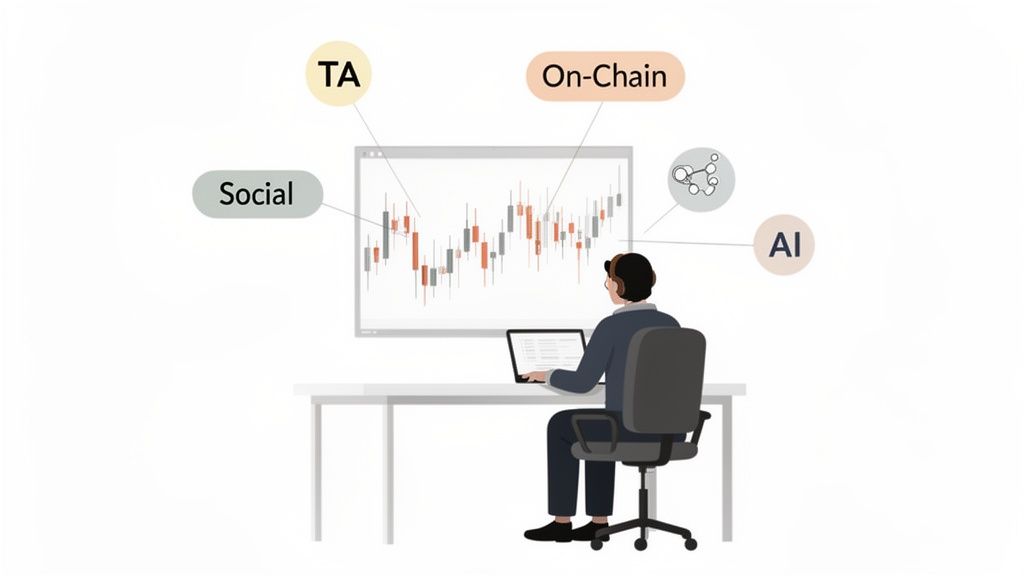
A trader uses a laptop, analyzing candlestick charts with TA, Social, On-Chain, and AI data.

In the crypto world, a few minutes can mean the difference between a massive win and a painful loss. Trading signals are a shortcut, delivering actionable ideas based on technical, on-chain, or social analysis that you don't have time to conduct yourself. The goal is to flag potential opportunities before they hit the mainstream radar, giving you a critical edge.

At its core, the idea is simple: use expert analysis to make smarter, faster decisions. But not all signals are created equal. Quality swings wildly, making due diligence essential.

Why Do Traders Actually Use Signals?

Traders turn to signals for a few key reasons, but it mostly boils down to saving time and leveraging expert analysis. Instead of being glued to charts for hours, a good signal pings you the moment a promising setup appears.

Here’s a breakdown of the core benefits:

  • Time Efficiency: Signals condense hours of complex market analysis into a single, actionable alert.
  • Expert Insight: You tap into the strategies and research of analysts who live and breathe the markets.
  • Broader Market Coverage: A solid service can monitor hundreds of assets simultaneously, something no individual can manage.
  • Emotional Discipline: Trading based on data-driven signals helps you sidestep fear and greed, preventing impulsive decisions.

Before we dive deeper, let’s establish what a high-quality signal looks like.

Key Characteristics of High-Quality Crypto Signals

CharacteristicWhy It MattersWhat to Look ForTransparencyYou need to trust the source. Hidden histories or vague performance claims are major red flags.Verifiable track record, clear methodology, public performance reports.ClarityA signal is useless if you can't understand it. It should be simple, direct, and leave no room for guesswork.Specific entry prices, take-profit levels, and stop-loss targets.TimelinessIn crypto, speed is everything. A signal that arrives late is just noise.Real-time alerts via reliable channels like Telegram, Discord, or SMS.Win Rate & Risk/RewardA high win rate means nothing if the losses are huge. You need a positive risk/reward ratio to be profitable.Look for a win rate above 60% and an average risk/reward ratio of at least 1:1.5.Market RelevanceSignals should be tailored to current market conditions, not just recycled patterns from a bull run.Analysis that considers current trends, volatility, and market sentiment.Support & CommunityGood providers offer support and foster a community where traders can learn and ask questions.Active support channels, educational content, and a community forum.

This checklist is your first line of defense against low-quality providers. If a service can't tick these boxes, it's best to walk away.

The performance of a top-tier signal provider can be a complete game-changer. For instance, one leading service reported an 84% win rate across 1,350 signals, proving what's possible with high-quality, data-backed alerts. You can find more on their signal performance data.

Ultimately, you have two main paths. You can follow signals from established providers, or you can take a more modern approach: create your own signals by tracking the real-time moves of elite traders with a tool like Wallet Finder.ai. This guide will show you exactly how to find, evaluate, and weave the best crypto trading signals into a winning workflow.

Understanding the Different Types of Crypto Signals

To find the best crypto trading signals, you first need to understand where they come from. Signals are generated from different data sources, each offering a unique perspective on the market. Think of it like assembling a team of expert advisors; you want diverse specialties.

Understanding the "how" behind a signal allows you to judge its strengths, blind spots, and whether it fits your trading style. Here are the four main categories.

Technical Analysis Signals: The Market Meteorologist

Technical Analysis (TA) is the traditional method of generating signals. It involves studying historical price charts and trading volumes to forecast future price movements. The core belief is that all known information is already reflected in the price, and human psychology creates predictable chart patterns.

  • What they analyze: Candlestick patterns (e.g., Doji, Hammer), chart formations (e.g., Head and Shoulders), and mathematical indicators (e.g., RSI, MACD).
  • What they're good for: Identifying short-to-medium term trends, spotting potential reversals, and defining precise entry and exit points.
  • Analogy: A TA signal is like a weather forecast predicting a high chance of rain—it’s your prompt to grab an umbrella.

On-Chain Signals: The Company Insider

On-chain signals are unique to crypto, offering a transparent view into the blockchain itself. This analysis tracks the flow of funds between wallets, monitors crypto moving on or off exchanges, and watches the activity of large holders, known as "whales."

Think of it like being an insider with access to a company's raw accounting books. While others guess based on press releases, you see the actual cash flow and what major shareholders are doing.

On-chain data provides an unfiltered look at supply and demand. For example, a large volume of Bitcoin moving off exchanges is a strong bullish signal, suggesting accumulation for long-term holding and reduced selling pressure.

This data often hints at future price movements before they happen. It’s your chance to see what the "smart money" is up to, which is precisely the data platforms like Wallet Finder.ai analyze to deliver actionable insights.

Social and Sentiment Signals: The Crowd Pollster

The crypto market is heavily influenced by emotion and social media hype. Social and sentiment analysis measures the collective mood of the market by scanning platforms like X (formerly Twitter), Telegram, and Reddit, along with news headlines.

This is like a political pollster gauging public opinion. By tracking conversations and the general vibe (bullish vs. bearish), you can predict which way the crowd is leaning. A sudden explosion of positive chatter about a new memecoin can be a leading indicator of an impending pump.

Algorithmic and AI Signals: The Supercomputer

This is the most advanced frontier. Algorithmic and AI signals use complex mathematical models and machine learning to analyze vast amounts of data. These systems can process technical, on-chain, and sentiment data simultaneously, identifying subtle patterns invisible to the human eye.

Imagine a supercomputer processing millions of data points per second—from global economic news to microsecond trading activity—to find a single high-probability outcome. These signals are purely data-driven, removing human emotion from the equation.

A sophisticated DeFi trader might combine all four. They could spot an on-chain signal of a top wallet accumulating a token, see positive sentiment building on social media, and use technical analysis to pinpoint the perfect entry. This multi-layered approach builds a powerful trading thesis.

How to Choose a Signal Provider You Can Actually Trust

Picking the right crypto signal provider is a make-or-break decision. This is where most traders find a massive edge or walk into a costly trap. The market is flooded with services promising the moon, but very few deliver consistent, verifiable results.

Your job is to cut through the marketing hype and find a source you can genuinely rely on. Real quality comes down to transparency, a clear strategy, and a proven track record. Without due diligence, you're gambling on a service that might be running on luck or, worse, is an outright scam.

First Things First: Verify Their Performance and Transparency

The absolute first step is to analyze their track record. Any provider worth their salt will be proud to display their history, but you must verify it.

Look for these signs of genuine transparency:

  • A Public, Verifiable History: They must provide a detailed log of every past signal, including entry price, take-profit targets, stop-loss, and the final result. Be suspicious of providers who only show their wins.
  • Third-Party Audits: The best services often have their results tracked by independent platforms, adding a crucial layer of credibility.
  • Clear Performance Metrics: How do they define a "win"? Does a signal count as a win if it only hits the first take-profit target? Understand their metrics to know if the stats are legitimate.

A provider’s history should tell a story of consistency, not just a highlight reel of a few lucky trades. Vague claims like "90% accuracy" with zero proof are a massive red flag. Always demand data you can check for yourself.

Signal Decay: Why Timing Your Response Matters More Than the Signal Itself

A trading signal is a perishable product. The moment it's generated, it starts losing value. By the time it reaches you, gets processed through an alert system, hits your phone, and you decide to act on it, the opportunity might already be partially or fully gone. Most guides treat signals as static recommendations you can act on whenever you get around to it. That's wrong. Understanding how quickly signals decay — and how that decay rate changes based on market conditions and asset type — is one of the most important skills in signal-based trading.

The decay happens because the market is constantly repricing based on new information. A signal identified an opportunity at a specific price point in a specific market condition. Every second that passes, other traders are also seeing similar information, acting on it, and moving the price. By the time a signal reaches your inbox and you open it, the entry price the signal specified might already be past. You buy at a worse price, your risk-reward ratio deteriorates, and what looked like a clean trade on paper becomes a marginal one in execution.

How Fast Signals Actually Decay

The decay rate isn't uniform. It depends entirely on the asset you're trading and the current market environment, and getting a rough sense of these timelines dramatically changes how you should handle incoming signals.

Memecoins and micro-cap tokens decay the fastest. These assets have thin liquidity and highly reactive price action. A signal identifying a memecoin entry can go from perfectly timed to completely blown out in minutes. If you're following memecoin signals, your window between receiving the alert and executing is measured in seconds to low single-digit minutes. After that, the price has moved so far from the signal's entry that the trade is either no longer viable or carries significantly worse risk than what the signal originally calculated.

Large-cap assets like Bitcoin and Ethereum decay much more slowly because their liquidity absorbs buying pressure without the price moving as violently. A signal on BTC identifying a support level entry might remain actionable for thirty minutes to an hour after generation, depending on market volatility. The price doesn't jump ten percent in thirty seconds the way a memecoin does, so you have a wider execution window. But even here, "wider" is relative — during high-volatility periods like earnings season or macro news events, BTC signals decay significantly faster than during quiet consolidation.

DeFi opportunities on established protocols fall somewhere in the middle. A signal identifying an arbitrage opportunity between two DEXes decays extremely fast — sometimes within the same block — because bots are specifically designed to capture exactly these misfires. But a signal identifying an undervalued new token listing on a DEX with reasonable liquidity might stay actionable for ten to twenty minutes before enough buyers close the pricing gap.

What to Do When a Signal Arrives Late

The practical application is simple but requires discipline. Every time a signal hits your phone, your first action should be checking the current price against the signal's entry price before you execute anything. If the price has already moved significantly past the entry — more than two to three percent for large caps, more than five percent for mid caps — the signal's original risk-reward calculation is no longer valid.

At that point, you have two choices. You can pass on the trade entirely, which preserves your capital for the next signal that arrives while you can still act on it. Or you can recalculate the trade from scratch using the current price as your new entry, which means re-evaluating whether the take-profit target still offers enough upside to justify the risk from where price actually is right now, not where the signal originally suggested entering.

The second option is harder but sometimes correct. If a signal identified a strong fundamental setup — a whale accumulating, a breakout from a significant pattern, a major catalyst approaching — the underlying thesis might still hold even if you're entering at a slightly worse price. The key is that you're making a conscious decision based on current data, not blindly executing a stale signal because it showed up in your inbox.

The worst thing you can do is execute a signal hours after it was generated without checking whether the opportunity still exists. That's not trading on a signal — that's trading on outdated information while believing you're making an informed decision.

Understand How They're Getting Their Signals

Once you’ve confirmed their past results, figure out how they generate their signals. If a provider is secretive about their strategy, that’s an alarm bell. You don’t need their secret formula, but you need to know their general approach.

Are their signals based on:

  • Technical Analysis (TA): Focused on specific chart patterns or indicators?
  • On-Chain Data: Tracking whale wallets and exchange flows?
  • Algorithmic Systems: A bot or AI model calling the shots?
  • A Hybrid Approach: A blend of different analysis types?

Knowing their methodology helps you determine if their style aligns with your risk tolerance. For example, a service firing off high-frequency scalping signals is likely not a fit for a long-term holder. You can learn more in our guide to Telegram signal groups versus common paid scams.

The Modern Alternative: On-Chain Transparency

Traditional signal services rely on trusting an analyst's opinion. The modern approach flips this by relying on transparent, unchangeable data straight from the blockchain.

Instead of following an analyst, tools like Wallet Finder.ai let you track the real-time trades of proven, profitable wallets. Their performance isn't a claim—it's a public record on the blockchain. You can see their entire trading history, P&L, win rate, and average holding period. This lets you follow signals from traders whose success is mathematically proven, eliminating the need to blindly trust a middleman.

Critical Red Flags to Watch For

Dodging scams is as important as finding a good provider. Here’s a quick checklist of red flags that should make you run the other way.

Red FlagWhy It's a ProblemGuaranteed ProfitsThis is the biggest lie in trading. No one can guarantee profits. Ever. It's the #1 tactic used by scammers.Anonymous AdminsIf the team is a complete mystery with no public reputation, there is zero accountability when things go wrong.No Verifiable Track RecordA service that won't show you a detailed history of all trades—including their losses—is hiding something.Excessive Hype and FOMOHigh-pressure sales tactics, countdown timers, and "last chance" offers are signs of a cheap, low-quality service.Vague Signal ParametersSignals without clear entry, take-profit, and stop-loss levels are unprofessional and basically useless.

If you spot any of these warning signs, just move on. The best services build trust with transparency and professionalism, not hype and impossible promises. Data from verified groups shows what's actually possible; some have hit peak win rates of 88.89% and maintained consistency around 84.62% for months. Setting realistic benchmarks is key.

Integrating Signals Into Your Trading Workflow

Getting a great crypto trading signal isn't the finish line—it's the starting pistol. The real skill is in what you do next. A signal is a high-probability suggestion, not a command to blindly buy. What separates profitable traders from others is integrating that signal into a disciplined, structured workflow.

This means turning a raw alert into a well-executed trade with risk defined before you enter the market. A solid process keeps you in control, using the signal as a strategic tool rather than a lottery ticket.

Before you trade, filter for quality. This flowchart breaks down the essential criteria: performance, methodology, and history.

Flowchart outlining three key steps for choosing crypto signals: performance, method, and history criteria.

The takeaway? A systematic evaluation process, focused on verifiable performance and a clear strategy, must happen before you risk a single dollar.

Step 1: Verify The Signal

Never act on a signal without a quick, independent check. This isn't about redoing the provider's entire analysis; it’s about making sure the signal makes sense in the current market context.

Pull up the chart for the asset and look for these basic confirmations:

  • Support and Resistance: Is a buy signal near a clear support level? Is a sell signal near resistance?
  • Trend Confirmation: Does the signal align with the prevailing trend on a higher timeframe, or is it a riskier counter-trend trade?
  • Obvious Red Flags: Has the price already run up significantly? Is it approaching a major obstacle on the chart?

This sanity check takes less than a minute and can save you from jumping on a flawed or late signal.

The Slippage Wall: What Happens When Everyone Gets the Same Signal

Here's a problem nobody in the signal industry wants to talk about: when a signal works, it stops working. Not because the analysis was wrong — because it was right, and enough other people acted on it to move the price past the opportunity. This is called the slippage wall, and it's the single most predictable failure mode of signal-based trading.

The mechanics are straightforward. A signal provider identifies a setup — say, a breakout above a key resistance level on ETH with a specific entry, take-profit, and stop-loss. The signal goes out to their subscriber list. If that list has five hundred traders, and even ten percent of them act on it within minutes, that's fifty buy orders hitting the market simultaneously. Those fifty buy orders push the price above the entry the signal specified. The traders who acted fastest got filled at or near the entry price. The traders who acted a few seconds later got filled at progressively worse prices. The traders who acted last got filled at prices so far above the entry that their stop-loss is now dangerously close to current price.

The slippage wall is worst for smaller-cap assets with thin order books. A signal on a mid-cap token with a daily volume of two million dollars can move the price meaningfully when five hundred traders buy simultaneously. A signal on Bitcoin barely registers because the daily volume is billions and fifty extra buy orders are noise. This is why the best signal providers either focus on large-cap assets where their subscriber base can't meaningfully move the price, or deliberately limit their subscriber count for smaller-cap calls.

How to Position Yourself Relative to the Wall

You can't eliminate the slippage wall, but you can position yourself on the right side of it. The traders who consistently profit from signals despite this dynamic do a few things differently than the traders who consistently get hurt by it.

First, they prioritize speed of execution without sacrificing sanity checks. Getting your alert notification to order execution as fast as possible is not optional if you're trading smaller caps off signals. Set up your alert channels so the notification hits your phone the instant the signal goes out. Have the exchange app already open with the relevant trading pair loaded. Know your position size in advance so you're not calculating it while the price is moving against you.

Second, they use limit orders instead of market orders when possible. A market order guarantees you get filled immediately but at whatever price the exchange's order book dictates in that moment — which during a slippage wall event is significantly worse than the signal's entry. A limit order at or very near the signal's entry price only fills if the market comes to your price. You might not get filled at all if the slippage wall pushes price past your limit before your order executes, but if you do get filled, you got filled at the price the signal actually identified as the entry.

Third, they track their fill prices against signal entry prices over time and use that data to calibrate expectations. If you're consistently filling two to three percent above signal entries on a particular provider's calls, that provider's subscriber base is creating a predictable slippage wall on their signals. You can either adjust your entry expectations accordingly, switch to a provider with a smaller subscriber base, or focus on their large-cap signals where the wall is thinner.

The slippage wall also explains why some signal providers deliberately delay sharing certain signals. A provider who knows their subscriber base will create a wall on small-cap calls might share those signals slightly later — after their own trading accounts have already filled at the good price. This is a conflict of interest that's difficult to detect but worth keeping in mind when evaluating any signal provider's actual incentives.

Step 2: Assess Your Risk And Position Size

This is the most critical step for longevity in trading. Before you execute, you must define exactly what you stand to lose and size your position accordingly. The signal should provide a stop-loss level, which is the foundation for this calculation.

A simple, powerful risk management framework is the "1% rule": never risk more than 1% of your total trading capital on any single trade.

Let's say your trading account has $5,000. Following the 1% rule, the absolute maximum you should be willing to lose on one trade is $50. This discipline prevents one bad trade from blowing a huge hole in your account.

Use this formula to calculate your position size:

Position Size = (Total Capital x Risk per Trade %) / (Entry Price - Stop-Loss Price)

This math ensures that if the trade hits your stop-loss, your loss is capped at your predetermined amount.

Step 3: Execute And Monitor The Trade

With your risk defined and position size calculated, it’s time to execute. Place your entry order, and then immediately set your stop-loss (SL) and take-profit (TP) orders. Setting these right away removes emotion from future decisions.

Once the trade is live, monitor its progress. Many traders move their stop-loss to their entry point (breakeven) once the trade moves into profit, creating a risk-free trade. For more tools to stay on top of your trades, check out our guide on the top tools for entry and exit signal alerts.

Step 4: Close And Review The Outcome

The trade is over. Whether you hit your take-profit, got stopped out, or closed manually, your work isn't done. The final step is to review what happened.

Ask yourself these questions:

  1. Did the trade play out as the signal suggested?
  2. Did I follow my risk management and execution plan?
  3. What could I have done better?

This review loop—win or lose—is how you improve over time. It helps you identify which signals work best for your style and sharpens your trading instincts. The goal isn't just to follow alerts; it's to become a smarter, more disciplined trader.

Generate Your Own Signals with On-Chain Data

Illustration of a smart crypto wallet with Bitcoin, Ethereum, Solana, and Base coins, connected by a network.

While traditional signals have their place, the real edge in crypto comes from moving beyond opinions and into the world of raw, verifiable proof. What if, instead of trusting an analyst, you could tap directly into the moves of the most profitable traders on the blockchain?

This is the power of generating your own signals with on-chain data. The blockchain is the ultimate source of truth, where every transaction is a permanent, public record. This transparency is a goldmine, letting you see what "smart money" is doing in real time.

Tools like Wallet Finder.ai were built for this. They sift through the blockchain's endless data stream and turn it into actionable intelligence, transforming you from a passive signal follower into an active, data-driven trader.

Discovering Top Wallets

Your first step is to pinpoint the wallets that consistently outperform the market. This isn't about finding one-hit wonders; it's about identifying skilled traders through cold, hard data. A powerful platform lets you filter the entire blockchain for wallets matching your criteria for success.

Key metrics for finding "smart money" include:

  • Total Profit and Loss (P&L): The most direct measure of success. Look for wallets with high, consistent net profits.
  • Win Rate: The percentage of profitable trades. A high win rate (often above 60%) indicates a disciplined strategy.
  • Recent Activity: Is a historically successful wallet still active? Focus on recent trades to ensure the strategy is currently relevant.
  • Chain Specialization: Some of the best traders are specialists. You can find wallets that dominate on specific chains, like Solana for memecoins or Base for new DeFi projects.

A Mini-Tutorial for Finding Smart Money

Putting this into practice is easier than it sounds. With a tool like Wallet Finder.ai, you can zero in on high-potential wallets in minutes.

Here’s a quick workflow:

  1. Set Your Filters: Define what a "top-performing" wallet means to you. For example: filter for wallets on the Base chain with a P&L over $100,000 and a win rate above 70% in the last 30 days.
  2. Analyze the Results: The platform will list wallets that meet your criteria. Dive into a few to examine their full trading history, including tokens bought, holding periods, and investment size.
  3. Identify a Promising Wallet: You might find a wallet that consistently buys new memecoins before they trend. You can see its entire history—every entry and every exit. This is a direct look at a winning strategy.
  4. Set Up Real-Time Alerts: Once you’ve found a wallet to follow, set up instant alerts via Telegram or another app. You’ll be notified the second that wallet makes a trade.

This turns the blockchain into your personal, real-time signal feed.

From Signal to Action

When you get an alert like, "Wallet 0xABC... just bought TOKENXYZ," that is your signal. It is arguably one of the best crypto trading signals you can get because it’s based on the live action of a trader with a verifiable track record.

This method changes the game. Instead of a generic "Buy BTC" alert, you get something highly specific: "Wallet 0x123... just bought 10 ETH worth of TOKENXYZ on Base."

This alert provides the token, the chain, and the crucial context that a proven winner believes this is a good entry point. From there, you can do your own quick research and decide whether to mirror the trade. This fuses expert insights with blockchain transparency, putting you in a powerful position to act before the rest of the market.

Common Mistakes to Avoid When Using Signals

Even the best crypto trading signals can lead to losses if used improperly. A signal is a high-probability idea, not a guarantee. Many traders fall into common traps that turn potential wins into certain losses. Knowing these pitfalls is the first step to avoiding them.

Blindly Following Without a Sanity Check

The number one mistake is treating a signal like a command. The alert arrives, and you immediately hit the buy button without a quick, independent check. This is just gambling.

A common scenario: a signal says to buy a token that is rocketing straight into a major, long-term resistance level. A trader who follows blindly gets caught in a sharp reversal. A trader who takes 60 seconds to glance at the chart sees the danger and avoids the trade.

Always pull up the chart yourself. A quick look at basic support and resistance can be the difference between a clean win and getting caught in a liquidity hunt.

The technical patterns behind good signals have a proven edge. A triple top pattern can signal a bearish reversal with up to an 85% success rate. Ascending flags can hit 70% accuracy on liquid coins in a bull market. Understanding the "why" behind a signal helps you judge its strength. For a deeper dive, read up on how traders use these market signals for crypto chart patterns.

Getting Greedy with Leverage

Leverage is a double-edged sword that, for most traders, is just a faster way to an empty account. After a few wins, a trader feels invincible and cranks leverage up to 50x on the next signal. A small 2% move against them results in a full liquidation. A trader using no leverage or a conservative 3x would have barely noticed that dip and might have seen the trade turn profitable.

Revenge Trading a Signal That Fails

Losing is a part of trading. What’s not acceptable is letting that loss trigger an emotional rampage. This is called revenge trading.

Imagine a signal hits its stop-loss, and you're down $100. Feeling frustrated, you immediately jump into another trade—perhaps even the same one—with a bigger size, desperate to "win back" your money. This rarely ends well. Sticking to your plan and risk rules is the only path to long-term success.

Signal Correlation Risk: The Diversification Illusion

Most traders following signals assume that following multiple signal sources automatically diversifies their risk. If Provider A's call fails, Provider B's call should still work because they're using different analysis methods, right? This assumption is wrong more often than it's right, and the reason is that most signal sources — regardless of their stated methodology — end up identifying the same market moves from different angles. When the underlying move fails, all the signals built on top of it fail together.

This is signal correlation risk, and it's one of the least discussed but most costly mistakes in signal-based trading. You think you're spreading your bets across independent opportunities. You're actually concentrating them into a single market thesis wearing different costumes.

How Signal Sources Secretly Converge

Technical analysis signals and on-chain signals look completely different on paper. One is reading chart patterns; the other is tracking wallet movements. But both of them tend to trigger on the same market setups because the market setups that create bullish chart patterns are often the same ones that show whale accumulation on-chain. A breakout pattern forming on the daily chart for a token often coincides with large wallets accumulating that same token over the preceding days. Both signals are saying "this token is about to go up" — they just arrived at that conclusion through different lenses.

Social sentiment signals correlate even more tightly with price-based signals because social buzz and price movement feed each other in a tight loop. Tokens that are breaking out generate social buzz. Tokens generating social buzz tend to break out. A signal from a sentiment-based provider and a signal from a technical provider on the same token are often just two descriptions of the same developing move.

The result is that on any given day, if you're following three or four signal providers, a significant percentage of their active calls might be pointing at the exact same trade or closely related trades. A single event — a market-wide crash, a regulatory announcement, a major protocol exploit — can invalidate all of them simultaneously. What looked like four independent positions is actually four bets on the same outcome.

Building a Signal Portfolio That's Actually Diversified

Real diversification in signal-based trading requires deliberately choosing signal sources that identify genuinely different types of opportunities, then monitoring for convergence and backing off when too many of your active positions are correlated.

The first step is mapping what each signal source actually identifies in practice, not what they claim to identify. Track the signals you receive over two to three weeks and note which tokens and setups keep appearing across multiple providers. If the same three tokens show up across four different providers in the same week, those providers are converging regardless of their stated methodology. You don't need all four signals — you only need one, and the others are redundant risk.

The second step is deliberately including at least one signal source that identifies opportunities other providers miss entirely. This might be a provider focused on a specific blockchain ecosystem that the others don't cover, or one that specializes in a trade type — like short-side setups or DeFi-specific opportunities — that the others rarely touch. These niche providers are less likely to converge with your other sources because they're operating in different market segments.

The third step is setting a hard rule on how many correlated positions you hold simultaneously. If you can identify that three of your current open signal-based positions would all be affected by the same market event — say, a broad altcoin selloff — limit your total exposure across those three positions to what you'd be comfortable risking on a single trade. This means sizing each individual position smaller than you normally would, but your total risk on that correlated cluster stays within your single-trade risk limits.

Correlation risk doesn't disappear when the market is calm. It becomes most visible — and most damaging — when the market moves sharply in one direction and everything you thought was diversified moves together. Building awareness of it into your signal selection process before you need it is the difference between a bad day and a blown account.

Frequently Asked Questions About Trading Signals

Jumping into the world of crypto signals can feel overwhelming. Let's tackle some of the most common questions to help you get started with confidence.

Are Crypto Trading Signals Worth It

Yes, a good crypto signal service can absolutely be worth it, especially if you are new to trading or lack the time for constant market analysis. They provide expert-backed ideas, can improve your win rate, and highlight opportunities you might have missed. However, their value is entirely dependent on the quality of the provider and your own risk management. Signals are a tool to supplement your strategy, not replace it.

How Can I Spot a Scam Crypto Signal Group

Spotting a scam comes down to identifying a few classic red flags. Be immediately skeptical of any group that promises guaranteed profits—that's the number one sign of a scam.

Other major warning signs include:

  • No verifiable track record; they only show wins.
  • Anonymous administrators with no public reputation or accountability.
  • Aggressive marketing hype and pressure tactics to rush you into signing up.

Legitimate providers are transparent. They share their losses alongside their wins and typically have a solid reputation within the crypto community.

The real difference between a legitimate service and a scam is transparency. Trustworthy sources show you their methods and results, while scams hide behind impossible promises and secrecy.

Can I Make My Own Signals Instead of Buying Them

Absolutely. In fact, creating your own signals is the modern, data-driven approach to trading. Instead of trusting someone else's analysis, you can generate your own high-quality alerts using real on-chain data.

How Many Signals Should I Be Following At Once?

The answer depends entirely on your capital, your time, and your risk tolerance, but there's a ceiling that almost everyone should respect regardless of those factors. Following too many signals simultaneously creates a management problem that degrades your execution on every single one of them. You can't monitor ten open positions, track ten incoming alerts, and make quality decisions on each one in real time. Something gets neglected, and the neglected position is usually the one that needed attention most.

For most traders, three to five active signal-based positions at any time is the practical maximum. This gives you enough diversification to avoid being destroyed by a single bad call while keeping the number small enough that you can actually monitor each position properly. When one position closes — either hitting take-profit or stop-loss — you can consider the next signal that comes in. If you're constantly at your maximum and a new signal arrives that looks better than one of your current positions, you need to make a conscious choice about whether to exit something to make room, not just pile on another trade.

The constraint that often gets ignored is cognitive load. Each open position requires ongoing mental bandwidth — you need to know where it is relative to its stop-loss and take-profit, whether the thesis has changed, and whether new information has invalidated the original signal. Five positions you're actually tracking properly will always outperform ten positions where half of them are running on autopilot because you don't have the mental bandwidth to manage them all.

Can Signal Performance Stay Consistent Over Time?

No. This is one of the most important truths about signal-based trading that most providers will never voluntarily tell you. Signal performance degrades over time for almost every provider, and understanding why helps you avoid the expensive mistake of assuming past performance predicts future results indefinitely.

The primary reason is crowding. As a provider's track record grows and their reputation improves, more traders subscribe. More subscribers means more buying pressure on the same signals, which means worse fill prices for everyone and compressed profit margins on the trades that do work. The provider's historical win rate was achieved when their subscriber base was small and the slippage wall was thin. Your experience following them today — with a much larger subscriber base — will be measurably different.

The secondary reason is market adaptation. If a provider's edge comes from a specific technical pattern or on-chain indicator, and enough traders start acting on that exact pattern, the market stops behaving the way it used to around that pattern. The edge gets priced out as more capital floods into the same setup. This is why the best signal providers are constantly evolving their methodology rather than running the same playbook indefinitely.

The practical takeaway is to re-evaluate any signal source every sixty to ninety days using your own performance data, not their historical claims. If your recent results from a provider are significantly worse than their advertised track record, the edge has likely eroded for their current subscriber base. It might be time to rotate to a different source or adjust your expectations.

What's the Difference Between a Signal and a Trade Idea?

This distinction matters more than most people realize, and conflating the two is one of the reasons traders get hurt by signals. A trade idea is an analysis — someone's assessment that an asset might move in a certain direction based on some combination of technical, fundamental, or on-chain factors. A signal is an actionable instruction with specific parameters: a defined entry price, defined take-profit levels, a defined stop-loss, and a defined timeframe.

A trade idea says "ETH looks bullish, could break higher." A signal says "Buy ETH at $3,420, take-profit at $3,580, stop-loss at $3,350, valid for the next twenty-four hours." The signal has enough specificity that you can execute it and measure whether it worked without any interpretation on your part. The trade idea requires you to figure out all those parameters yourself, which means the quality of the outcome depends as much on your execution planning as on the original analysis.

This matters because a lot of what gets marketed as "signals" are actually trade ideas dressed up in signal language. They give you a directional view and maybe a vague price range, but the actual entry, take-profit, and stop-loss require guesswork. When these incomplete signals fail, it's often not because the underlying analysis was wrong — it's because the execution parameters were never properly defined, so the trade was set up incorrectly from the start. Before you follow any signal, verify that it gives you a specific entry price, specific take-profit and stop-loss levels, and a clear timeframe. If any of those elements are missing or vague, what you have is a trade idea, not a signal — and you need to do additional work before it's actionable.

Tools like Wallet Finder.ai allow you to see what top-performing wallets are doing in real time. You're not just getting a signal; you're tracking the live moves of traders with a proven track record, generating your own insights based on transparent, actionable data.

Ready to stop following and start leading? Discover the top-performing wallets and generate your own data-backed signals with Wallet Finder.ai. Start your 7-day trial and see what the smart money is trading right now at https://www.walletfinder.ai.