Best Crypto Indicators for Trading in 2026

Wallet Finder

Blank calendar icon with grid of squares representing days.

February 19, 2026

Navigating the volatile crypto market requires more than just intuition. The difference between profit and loss often comes down to the quality of your signals and the ability to interpret them correctly. While countless indicators exist, only a select few offer a genuine edge by revealing what smart money is doing behind the scenes. This guide cuts through the noise to deliver a definitive roundup of the best indicators for crypto, combining timeless technical analysis with powerful on-chain metrics.

We’ll move beyond basic price action to explore a multi-faceted approach to market analysis. You will learn how to interpret signals from both classic tools and modern data sources, giving you a more complete picture of market dynamics. This isn't just a list of definitions; it's a practical playbook for identifying high-probability setups.

Each section will break down a specific indicator, covering:

  • What it is: A direct explanation of how the indicator works.
  • Pros and Cons: Strengths and weaknesses specific to the crypto markets.
  • Actionable Setups: Concrete examples of how to use the signals for entries and exits.

Most importantly, we'll show you how to synthesize this information. We will detail how to combine these indicators into a powerful workflow, using tools like Wallet Finder.ai to not just spot opportunities, but to validate them with real whale wallet activity. The goal is to equip you with a system for making data-driven decisions before the rest of the market catches on, giving you a tangible advantage in your trading.

1. Moving Average Convergence Divergence (MACD)

The Moving Average Convergence Divergence (MACD) is a classic momentum oscillator that has remained one of the best indicators for crypto due to its reliability in identifying trend direction and strength. It operates by measuring the relationship between two exponential moving averages (EMAs), typically the 12-period and 26-period EMAs. This calculation creates the "MACD line." A nine-period EMA of the MACD line, known as the "signal line," is then plotted over it, generating clear trading signals.

The histogram, the third component, represents the distance between the MACD and signal lines. When the MACD line crosses above the signal line, it suggests upward momentum is building (a bullish signal). Conversely, a cross below indicates bearish momentum.

Actionable Setups and Examples

  • Bullish Crossover: When the MACD line crosses above the signal line, it signals a potential buying opportunity. This is often strongest when it occurs below the zero line, indicating a potential reversal from a downtrend.
  • Bearish Crossover: A MACD line crossing below the signal line suggests it might be time to sell or short an asset. This signal gains strength when it happens above the zero line.
  • Histogram Divergence: A powerful signal occurs when the price makes a new high, but the MACD histogram forms a lower high. This bearish divergence signals that the underlying momentum is weakening and a price reversal could be imminent.

For instance, a trader might notice the MACD crossing bullishly for a Solana token. To validate this, they could use a tool like Wallet Finder.ai to see if top-performing Solana wallets are accumulating at the same time, adding a layer of on-chain confirmation to the technical signal. If you're new to technicals, understanding how to read crypto charts is a foundational skill.

Key Insight: The histogram is more than just a visual aid; its size reflects momentum. A growing histogram indicates an accelerating trend, while a shrinking one signals that the trend is losing steam, often preceding a crossover.

Combining MACD signals with other indicators, like the Relative Strength Index (RSI), can filter out false signals and produce a more robust trading strategy.

2. Relative Strength Index (RSI)

The Relative Strength Index (RSI) is a staple momentum indicator that measures the speed and magnitude of recent price movements. It evaluates overbought and oversold conditions on a scale of 0 to 100, making it one of the best indicators for crypto traders to gauge market extremes. Developed by J. Welles Wilder Jr., this tool helps identify potential price reversals with impressive reliability.

An asset is generally considered overbought when its RSI value rises above 70, suggesting that a bullish run may be losing strength and a correction is possible. Conversely, an RSI below 30 indicates an oversold condition, signaling that bearish pressure could be exhausted and a price bounce may be on the horizon.

Actionable Setups and Examples

  • Oversold Entry: A classic buy signal occurs when an asset's RSI drops below 30 and then crosses back above it. This suggests the sell-off has reached its limit and buyers are stepping back in.
  • Overbought Exit: When an asset's RSI climbs above 70, it signals that the market is overheated. A cross back below 70 can be a strong indication to take profits or consider a short position.
  • Bullish Divergence: This powerful setup appears when the price makes a new low, but the RSI forms a higher low. This discrepancy signals that downside momentum is fading, often preceding a significant price reversal to the upside.

For example, a trader might see an altcoin's RSI dip to 25 while simultaneously using a tool like Wallet Finder.ai to observe that top-performing wallets are accumulating heavily. This on-chain confirmation of whale buying during a technically oversold period provides a high-conviction entry signal, suggesting a bottom is forming.

Key Insight: Don't just watch the 70/30 levels. The 50-level acts as a key battleground. In a strong uptrend, RSI will often find support at or above 50, while in a downtrend, it will face resistance there. A cross of the 50-level can confirm a shift in the primary trend.

Combining RSI with volume analysis can add another layer of confirmation. A move out of oversold territory on high volume is a much stronger signal than one on low volume.

3. On-Chain Volume and Exchange Flows

On-chain volume is one of the best indicators for crypto because it tracks the actual movement of assets between wallets, separating it from speculative exchange trading volume. This metric offers a transparent view into whether smart money is accumulating assets by moving them to cold storage or preparing to sell by sending them to exchanges. Analyzing these flows reveals real capital decisions, providing a powerful edge.
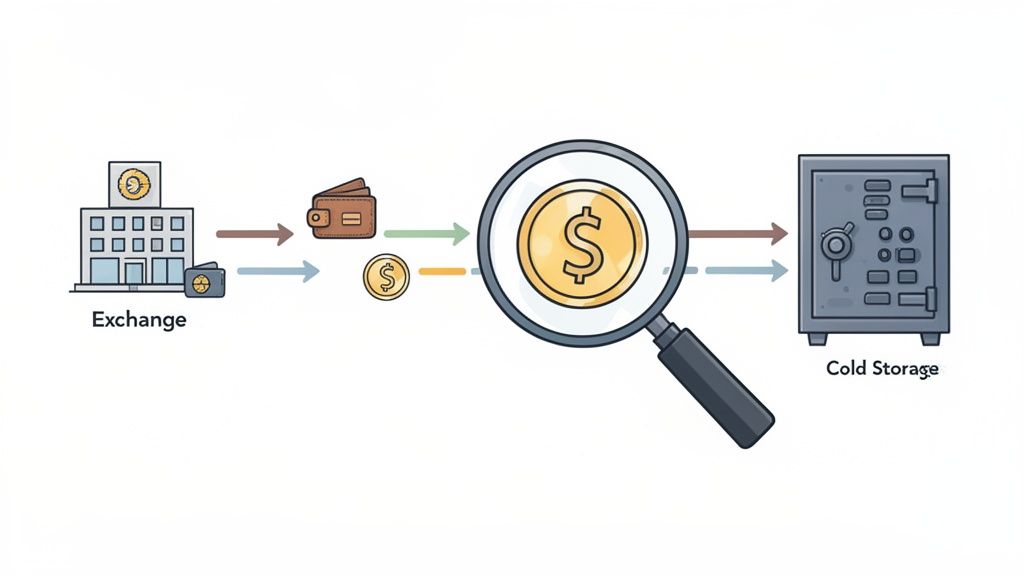
Diagram showing digital asset flow from exchange to wallet, then secured in cold storage, with a magnified coin.

Unlike technical indicators that rely solely on price action, exchange flows show the raw supply and demand mechanics at play. A sustained period of large outflows from exchanges often precedes a rally, as it signifies decreasing available supply and strong holding conviction. Conversely, a spike in inflows can act as an early warning for a potential price drop.

Actionable Setups and Examples

  • Accumulation Signal (Outflow): When large amounts of a crypto, like Bitcoin or Ethereum, move off exchanges to private wallets, it’s a strong bullish signal. This indicates major holders are planning to hold for the long term, reducing sell-side pressure. For example, a $50M+ outflow of BTC from exchanges often precedes significant price appreciation.
  • Distribution Signal (Inflow): A surge of assets moving onto exchanges suggests holders are preparing to sell. If this happens during a price rally, it can signal that the peak is near and a correction is likely.
  • Smart Money Tracking: By monitoring the wallets of known whales or successful traders, you can spot accumulation before it impacts the market. For instance, identifying a group of wallets accumulating a new memecoin before any major announcements can be a highly profitable signal.

A practical workflow involves using a platform like Wallet Finder.ai to set up alerts for significant exchange outflows. When an alert triggers, a trader can cross-reference this on-chain signal with a technical indicator like the RSI. If the asset is also in an oversold condition, it presents a high-probability entry point. Mastering this type of on-chain analysis is fundamental to a data-driven strategy.

Key Insight: Exchange flows are a leading indicator, not a lagging one. While technical indicators react to past price movements, on-chain flows show what investors are doing right now with their actual assets, often before those actions are reflected in the price.

Combining on-chain flow data with traditional technical analysis creates a robust framework, helping you confirm market sentiment and make decisions based on what the largest players are doing.

4. Bollinger Bands

Bollinger Bands are a powerful volatility indicator created by John Bollinger, consisting of three lines plotted on a price chart. The middle line is a simple moving average (SMA), typically over 20 periods, while the upper and lower bands are placed two standard deviations away from it. This setup makes them one of the best indicators for crypto, as they excel at measuring price extremes and identifying periods of high and low volatility.

Candlestick trading chart showing an overall upward trend with several indicator lines and an arrow.

The bands widen when volatility increases and contract when it decreases. When the price touches an outer band, it doesn't automatically mean a reversal is coming; rather, it indicates the price is relatively high or low compared to its recent average. This information is critical for identifying overbought or oversold conditions in the notoriously volatile crypto market.

Actionable Setups and Examples

  • Bollinger Band Squeeze: When the bands contract tightly around the price, it signals a period of low volatility. This "squeeze" often precedes a significant price breakout in either direction. Smart money often accumulates during these periods. For example, a squeeze on Solana's chart, where the band width compressed to 2%, was followed by a 40% rally.
  • Riding the Bands: During a strong uptrend, prices may repeatedly touch or "walk" up the upper band. This signals sustained buying pressure. A Bitcoin bull run often exhibits this behavior, which can be confirmed by checking smart money wallets on a tool like Wallet Finder.ai to see if they are holding their positions without selling.
  • Reversal Signals: When the price hits the upper band multiple times without breaking through, it can signal exhaustion and a potential reversal. This pattern is common in memecoins, where a bounce off the upper band can precede a 30% retracement.

Key Insight: A price move that occurs outside the bands is a continuation signal, not a reversal signal. The first tag of a band often signals the potential for a reversal, but confirmation is needed from price action and other indicators.

Combining a Bollinger Band squeeze with an RSI reading below 30 creates a high-probability entry point for accumulation, making it an excellent strategy for copy trading promising wallets.

5. Volume Profile and Market Profile

Unlike indicators that analyze price over time, Volume Profile displays trading activity across specific price levels. This powerful tool reveals where the most significant volume has historically been traded, creating a horizontal histogram on the chart. These high-volume areas, known as High Volume Nodes (HVNs), often act as strong support or resistance, while low-volume areas (LVNs) indicate price levels that were quickly rejected.

Market Profile builds on this by adding a time dimension, showing how the market's perception of value evolves. Together, they provide one of the best indicators for crypto traders looking to understand market structure and anticipate price reactions at key levels. Instead of guessing at support and resistance, you can see exactly where the market has shown the most interest.

Actionable Setups and Examples

  • High-Volume Node (HVN) Entries: Place limit orders near the Point of Control (POC), the single price level with the most traded volume. For example, if Ethereum’s POC is at $2,200, this level is a high-probability zone for entries or exits because the market has established strong consensus there.
  • Low-Volume Node (LVN) Breakouts: Price tends to move quickly through low-volume "gaps" in the profile. A breakout through an LVN suggests weak resistance and a high probability of continuation. A trader might confirm this by seeing tracked wallets on Wallet Finder.ai not selling into the move, suggesting they expect higher prices.
  • Value Area Rejection/Acceptance: The "Value Area" is where ~70% of the volume was traded. A price drop that finds support at the bottom of the value area is a strong buy signal, while a rally that fails at the top of the value area signals a potential reversal. For instance, a memecoin hitting a high-volume node from a previous rally before reversing 60% shows the power of historical volume.

A practical use case involves tracking smart money. A Bitcoin Volume Profile might show 10,000+ BTC was accumulated at the $42,000 level. By using Wallet Finder.ai to confirm that top wallets were the ones buying there, a trader can identify this level as incredibly strong support built by major players.

Key Insight: Volume Profile is predictive, not lagging. It shows where the market is likely to react based on past participant behavior, giving you an edge in identifying future support and resistance zones that other indicators miss.

By anchoring the Volume Profile to significant market highs or lows, you can track how value areas are shifting in real-time, helping you adapt your strategy as market conviction changes.

6. Funding Rates and Perpetual Futures Flow

Funding rates and perpetual futures flow provide a direct look into the sentiment and leverage within the derivatives market. Unlike technical indicators that rely on past price action, this on-chain-adjacent metric shows the real-time cost of holding a leveraged position. Funding rates are periodic payments exchanged between long and short traders to keep the futures contract price close to the spot price.

When the rate is positive, longs are paying shorts, indicating bullish sentiment and high demand for leverage. When it's negative, shorts are paying longs, signaling bearish sentiment. Extremely high or low funding rates often precede major price corrections, making them one of the best indicators for crypto traders looking to anticipate violent market moves and liquidation cascades.

Actionable Setups and Examples

  • Extreme Positive Funding (Bearish Signal): When the funding rate for a major asset like Bitcoin becomes highly positive (e.g., >0.15%), it suggests the market is over-leveraged on the long side. This creates a prime environment for a "long squeeze," where a small price drop can trigger cascading liquidations, causing a sharp decline.
  • Extreme Negative Funding (Bullish Signal): Deeply negative funding rates indicate that shorts are overcrowded and paying a high premium. This often occurs at market bottoms, setting the stage for a "short squeeze" where a slight price increase forces shorts to cover their positions, fueling a powerful rally.
  • Liquidation Hunting: Observing where large clusters of leveraged positions are concentrated can predict price wicks. For example, if Ethereum has $500M in long liquidations clustered just below a key support level, price may briefly dip to that level to trigger those liquidations before recovering.

A powerful workflow involves setting alerts for funding rate extremes. When an alert triggers, a trader can use a tool like Wallet Finder.ai to see if smart money wallets are taking counter-positions. For instance, if Solana shorts are at a 10:1 leverage ratio with negative funding, and top wallets begin accumulating, it’s a strong signal of a capitulation bottom.

Key Insight: Funding rates are a measure of market sentiment, not a direct entry signal. Extreme readings suggest an imbalance is present, but confirmation from price action or on-chain flow is critical before acting.

Combining funding rate analysis with a Volume Profile can be particularly effective. If liquidation clusters align with strong support or resistance levels on the volume profile, it adds significant confidence to a potential trade setup.

7. Wyckoff Distribution and Accumulation Patterns

The Wyckoff method provides a framework for understanding market cycles by analyzing the behavior of institutional or "smart money" operators. It is one of the best indicators for crypto because it reveals the preparation for major price moves. The theory identifies four distinct market phases: accumulation (smart money buying), markup (uptrend), distribution (smart money selling), and markdown (downtrend). By recognizing these patterns, traders can align their positions with the dominant market forces.

Diagram illustrating Wyckoff Market Phases: Accumulation, Markup, Distribution, and Markdown, with coin imagery.

This classic technical approach is now supercharged by modern on-chain tools. Instead of just interpreting chart patterns, traders can verify them with real-world wallet activity. For instance, the Solana distribution pattern in 2022 was clearly identifiable as tracked wallets were consistently selling into strength before the asset crashed over 90%.

Actionable Setups and Examples

  • Accumulation Confirmation: When you identify a potential Wyckoff accumulation schematic, particularly a "spring" event where price briefly dips below a support range, confirm it by checking smart money activity. If top wallets are buying during this test, it’s a high-probability entry signal.
  • Distribution Warning: A distribution pattern, characterized by repeated failures to break resistance, is a major red flag. If tools show that influential wallets are offloading their positions during these rallies, it’s a strong signal to reduce exposure or consider shorting.
  • Trend Validation: During a markup (uptrend) phase, check if the same smart money wallets that accumulated earlier are still holding. If they begin distributing, it may signal that the trend is nearing its peak.

For example, a trader could spot a potential Bitcoin accumulation phase on the chart. They could then use a platform like Wallet Finder.ai to confirm if top-performing wallets are actively accumulating BTC. This combination of classic chart analysis and on-chain data offers a powerful edge, turning a theoretical pattern into an actionable, data-backed signal.

Key Insight: The Wyckoff method isn't just about identifying when to trade; it’s about understanding why a move is happening. Combining it with wallet tracking gives you a direct view into the smart money playbook, confirming the story the chart is telling.

8. Order Flow and Level 2 Market Depth (Microstructure Analysis)

Order flow analysis moves beyond standard price charts to examine the real-time buy and sell orders at different price levels, known as Level 2 data. This microstructure analysis provides a raw, unfiltered view of supply and demand, revealing where institutions are placing large orders and how retail traders are positioning. By studying this data, traders can anticipate very short-term price movements ranging from minutes to hours, making it one of the best indicators for crypto day trading.

This method gives insight into the immediate intentions of market participants. It helps differentiate between passive limit orders waiting to be filled and aggressive market orders that drive price. Combining this with on-chain data provides a powerful one-two punch for validating trading ideas.

Actionable Setups and Examples

  • Identifying Buy/Sell Walls: A massive cluster of buy orders at a specific price (a "buy wall") can act as strong support. For example, if Bitcoin's Level 2 data shows a $10M+ buy wall at $65,000, it suggests strong institutional interest at that level. If that wall is suddenly pulled, it could signal a "spoof" order and a potential trap.
  • Order Book Imbalance: A significant imbalance, like a 2:1 buy-to-sell ratio on the Solana order book, indicates overwhelming buyer aggression. This often precedes a short-term rally as sellers get absorbed and price moves up to find new liquidity.
  • DOM Delta Reversal: Monitoring the Delta on a Depth of Market (DOM) tool can reveal shifts in momentum. A positive Delta (more aggressive buyers) flipping to negative (more aggressive sellers) can signal institutional distribution right before a correction.

A practical workflow involves using a tool like Wallet Finder.ai to spot a tracked whale wallet accumulating an asset. You can then cross-reference this with the order book. If the on-chain accumulation is confirmed by strong buying pressure and a thick bid side on the Level 2 data, the trade's probability of success increases dramatically.

Key Insight: Focus on order clustering around key technical levels like support, resistance, or daily pivots. Large orders appearing at these junctures are more significant and can confirm or deny the validity of a technical setup.

Be cautious of single, large orders that appear far from the current price. Many are "spoof" orders designed to manipulate sentiment and are often pulled before being filled. True institutional interest is confirmed by sustained volume and a positive cumulative delta.

9. Net Unrealized Profit/Loss (NUPL) and Realized Price

The Net Unrealized Profit/Loss (NUPL) is a powerful on-chain metric that gauges the overall profitability of a crypto network. It is calculated by measuring the difference between the market capitalization and the realized capitalization, then dividing by the market cap. This formula reveals whether the network as a whole is sitting on a profit or a loss, providing a direct look into market sentiment and holder behavior.

When NUPL values are extremely high (above 0.75), it signals "Euphoria," suggesting the market is overheated and a correction may be near. Conversely, values below 0.25 indicate "Capitulation," a point of maximum financial pain where savvy investors often find buying opportunities. The Realized Price, representing the average cost basis of all coins on the network, acts as a dynamic support and resistance level.

Actionable Setups and Examples

  • Euphoria Sell Signal: When NUPL climbs above 0.75, it signals extreme greed and a potential market top. For example, Bitcoin's NUPL reached 0.85 in November 2021 just before a major correction. Traders could use this signal to reduce their exposure.
  • Capitulation Buy Signal: A NUPL dropping below 0.25 indicates widespread selling and capitulation, often marking a market bottom. In June 2022, Ethereum's NUPL bottomed at 0.15, preceding a rally of over 200%. This is a prime moment to look for accumulation.
  • Bullish Divergence: If the price of an asset like Solana makes a new low but its NUPL forms a higher low, this signals underlying strength. It suggests that while the price has dropped, long-term holders are not selling at a loss, which often precedes a strong recovery.

For instance, a macro trader seeing NUPL enter the "Euphoria" zone could use Wallet Finder.ai to see if smart money wallets are also beginning to distribute their holdings. If the top wallets are selling while the market is euphoric, it provides strong confirmation to take profits or open a short position.

Key Insight: The Realized Price is more than just an average; it represents the collective psychological cost basis of the market. When the market price drops below the Realized Price, it puts the average holder into an unrealized loss, often triggering capitulation events that create generational buying opportunities.

Combining NUPL with Realized Price offers a macro-level view of the market, making it one of the best indicators for crypto cycle analysis and identifying major regime shifts.

10. Smart Money Flows and Accumulation/Distribution Line

The Accumulation/Distribution Line (A/D Line) is a volume-based indicator that measures the cumulative flow of money into and out of an asset. Unlike simple volume bars, it combines both price action and volume, determining whether buying (accumulation) or selling (distribution) pressure is dominant. A rising A/D line suggests that an asset is under accumulation, even if the price is flat, signaling potential upward movement.

In crypto, this concept is supercharged by tracking "smart money flows" directly on-chain. This involves monitoring the real-time transactions of high-performing wallets, often referred to as whales or institutional players. By combining the traditional A/D Line with on-chain data from tools like Wallet Finder.ai, traders can validate technical signals with tangible evidence of accumulation by proven market movers.

Actionable Setups and Examples

  • Bullish Divergence Confirmation: When the price of an asset like Ethereum makes a lower low but the A/D line forms a higher low, it signals that smart money is quietly buying the dip. This setup is a classic sign of accumulation and often precedes a strong recovery. You can validate this by checking if Wallet Finder.ai shows top wallets adding to their positions.
  • Persistent Accumulation: If Bitcoin's price is stalling or trading sideways, but the A/D line is consistently making higher highs, it points to strong underlying buying pressure. This often occurs before a major breakout, as large players build their positions.
  • Distribution Warning: A bearish divergence, where an asset's price hits a new high but the A/D line fails to do so, indicates that selling pressure is increasing. This suggests the rally is losing momentum and a top may be forming.

For instance, a memecoin might see its price decline, but the A/D line shows a sharp rise. This divergence indicates whale accumulation at the bottom. Combining this with data from a smart money tracker can pinpoint the exact wallets buying in, providing a high-conviction entry before a potential 200%+ move.

Key Insight: The A/D Line reveals what the "big money" is doing beneath the surface of price action. While price can be noisy, the cumulative flow of volume often tells the real story of market conviction.

Using the A/D Line on daily charts helps identify macro trends, while switching to hourly charts can help time precise entries when aligned with the buying activity of wallets you follow on Wallet Finder.ai. This two-pronged approach is one of the most effective ways to use this indicator.

Top 10 Crypto Indicators Comparison

Indicator🔄 Implementation Complexity⚡ Resource Requirements & Speed📊 Expected Outcomes💡 Ideal Use Cases⭐ Key Advantages
Moving Average Convergence Divergence (MACD)Moderate — EMA calculations + signal tuningLow compute; real-time on-chart; fast for intradayMomentum confirmation; trend-reversal signals but laggingConfirm wallet entry/exit timing; multi-timeframe trend checks⭐⭐⭐ — Clear cross signals; customizable; good for trend confirmation
Relative Strength Index (RSI)Low — simple oscillator, adjustable periodVery low compute; instant updatesOverbought/oversold extremes; divergence-based reversalsTiming entries in ranging markets; divergence setups with wallet data⭐⭐⭐ — Easy to interpret; reliable divergence signals
On-Chain Volume & Exchange FlowsHigh — requires on-chain infra and interpretationHigh data needs; heavier processing; near real-timeEarly detection of accumulation/distribution; high predictive powerInstitutional accumulation detection; pre-price-move signals⭐⭐⭐⭐ — Direct capital-flow insight; early, hard-to-manipulate signals
Bollinger BandsLow–Moderate — SMA + std dev; parameter tuningLow compute; works across timeframes; responsiveVolatility compression/squeeze detection; mean-reversion and breakout cluesVolatility breakout trades; band-squeeze entries for tracked wallets⭐⭐⭐ — Intuitive volatility measure; effective squeeze identification
Volume Profile & Market ProfileModerate–High — needs quality historical volume & anchoringMedium–High compute; data-history dependent; slower loadingIdentifies support/resistance price levels; high-precision targetsSetting stops/targets; locating whale accumulation/distribution zones⭐⭐⭐⭐ — Reveals hidden market structure; precise entry/exit levels
Funding Rates & Perpetual Futures FlowModerate — requires futures knowledge and aggregationMedium data pulls from exchanges; near real-timeEarly warning of liquidation cascades; short-term reversal signalsTiming trades around leverage extremes; anticipate violent moves⭐⭐⭐⭐ — Predictive for short-term reversals; public, exchange-sourced data
Wyckoff Distribution & AccumulationHigh — subjective phase analysis; experience requiredLow compute but high analyst skill & timeExplains institutional intent; predicts multi-week to multi-month movesMacro accumulation/distribution, long-term position timing⭐⭐⭐⭐ — Deep structural insight; powerful when confirmed by on-chain data
Order Flow & Level 2 Market DepthVery high — microstructure expertise neededVery high bandwidth & low-latency data; real-time monitoringImmediate short-term direction (minutes); execution signalsScalping, intraday execution, real-time confirmation of whale orders⭐⭐⭐⭐ — Predicts moves before they occur; reveals institutional order tactics
NUPL & Realized PriceModerate — aggregate on-chain metrics interpretationMedium — relies on on-chain analytics providersMacro sentiment extremes; regime-change signals (euphoria/capitulation)Macro timing, adjusting portfolio exposure, copy-trading with whales⭐⭐⭐⭐ — Strong macro sentiment gauge; historically predictive of reversals
Smart Money Flows & Accum/Distribution LineModerate — combines price-volume with wallet trackingMedium — requires clean volume + wallet-tracking dataDetects accumulation vs distribution; divergence confirms reversalsConfirm whale accumulation/distribution for copy trades⭐⭐⭐⭐ — Differentiates buy/sell flow; wallet-level confirmation improves accuracy

Building Your Edge: From Indicators to Action

You have now explored a powerful arsenal of the best indicators for crypto, ranging from classic technical tools like MACD and RSI to sophisticated on-chain metrics such as Net Unrealized Profit/Loss (NUPL) and Smart Money Flows. The journey from novice to proficient trader isn't about memorizing what each indicator does; it's about understanding the story the market is telling through their combined signals. Each tool offers a unique lens: one reveals momentum, another market sentiment, a third the hidden actions of major players, and another the underlying health of the network.

The true edge is found not in a single, magic signal but in the confluence of several. A standalone overbought RSI reading can be misleading in a strong uptrend, but when it coincides with massive exchange inflows, declining on-chain volume, and a Wyckoff distribution pattern forming, the signal becomes significantly more reliable. This multi-layered approach moves you from guessing to making high-probability decisions based on a weight of evidence. It's the difference between seeing a single puzzle piece and viewing the entire picture.

Synthesizing Signals into a Cohesive Strategy

Mastering these indicators requires a deliberate, structured process. Don't try to implement all ten at once. Instead, build your workflow incrementally. Start by creating a foundational checklist that combines different categories of analysis. This forces you to look at the market from multiple angles before committing capital.

A practical workflow might look like this:

  1. Macro Context (The Big Picture): Begin with long-term on-chain metrics. Is the NUPL indicating widespread euphoria or deep capitulation? What is the trend in long-term holder supply? This sets the stage and helps you determine whether you should be looking for long or short opportunities.

  2. Market Structure (The Narrative): Use tools like Volume Profile and Wyckoff patterns on higher timeframes (daily, weekly) to identify key support/resistance zones and determine if the market is in an accumulation, distribution, or trending phase. This provides the structural context for your trade.

  3. Momentum and Timing (The Entry): Zoom into lower timeframes (1-hour, 4-hour). Look for specific entry triggers using indicators like RSI or MACD divergences, Bollinger Band squeezes, or confirmation from order flow data. Are funding rates resetting, suggesting an over-leveraged position squeeze is imminent?

  4. Real-Time Validation (The Confirmation): This is the final and most critical step. Your entire analysis might point to a perfect long setup, but is smart money acting on it? This is where you validate your thesis. By using a tool like a wallet finder to monitor the activity of proven, profitable traders, you can see if they are accumulating the asset you've identified. Are whale wallets moving tokens off exchanges, confirming your on-chain analysis? This real-world capital flow is the ultimate confirmation.

From Theory to Profitable Action

The goal is to build a system that is repeatable, objective, and tailored to your trading style. The best indicators for crypto are the ones you understand deeply and can interpret correctly under pressure. Backtest your strategies. Keep a detailed journal of your trades, noting which combination of indicators led to successful outcomes and which produced false signals. Over time, you will develop an intuition for the market's rhythm and the specific setups that work best for you.

Remember, indicators are not crystal balls; they are instruments for measuring market psychology and capital flows. They provide a framework for managing risk and identifying opportunities where the potential reward outweighs the risk. By layering technical, on-chain, and sentiment data, and then confirming your thesis with the actions of top market participants, you transform trading from a game of chance into a discipline of strategic execution.


Ready to move beyond theoretical signals and see how the most profitable traders are putting their capital to work? Wallet Finder.ai gives you the power to discover and track the wallets of top performers, providing the ultimate layer of validation for your trading strategy. Stop guessing and start confirming your analysis by seeing what the smart money is doing in real-time with Wallet Finder.ai.