7 Best Meme Coin Trading Tools for 2026
Discover the 7 best meme coins trading platforms and tools for 2026. Get actionable insights, find winning wallets, and trade smarter on CEXs and DEXs.

February 20, 2026
Wallet Finder

February 20, 2026

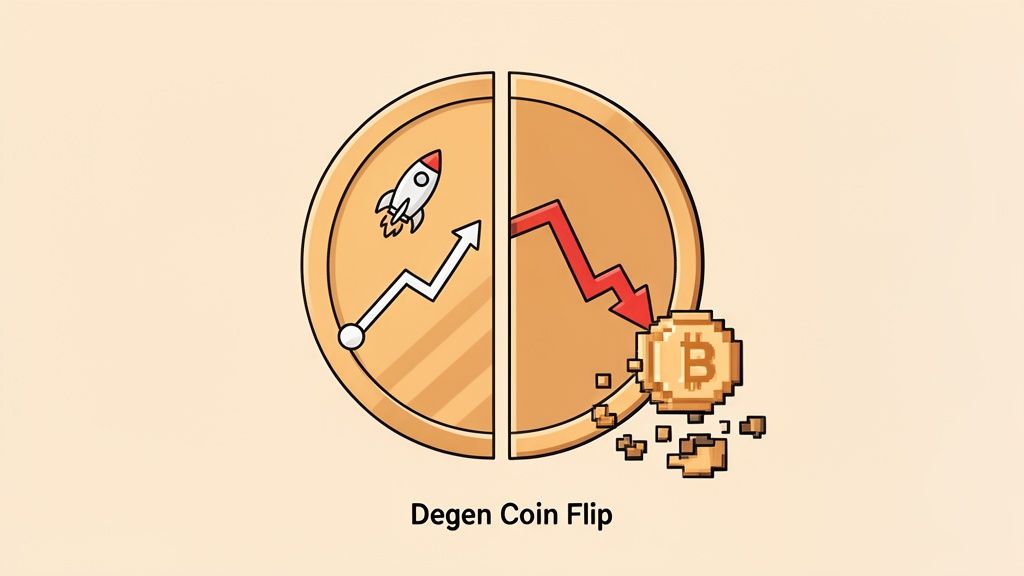
Picture a high-stakes poker hand. The outcome is binary: you either win big, or you lose everything. That's a degen coin flip in a nutshell. It's not a literal coin toss, but it’s a powerful metaphor for the kind of high-risk, high-reward trades on new or wildly volatile tokens, where fortunes are made or lost in the blink of an eye.

At its heart, a degen coin flip is a purely speculative bet on a crypto asset with an absolutely uncertain future. It's the Wild West of decentralized finance (DeFi). Traders throw capital at newly launched memecoins or low-liquidity altcoins, all in the hopes of catching an explosive, parabolic price surge.
This trading style has little to do with fundamentals or long-term value. It’s all about riding a wave of pure, short-term momentum. The "coin flip" analogy nails the binary reality of these trades: the token either skyrockets to the moon or plummets to zero in a "rug pull." There is almost never a middle ground.
The term "degen" is crypto slang for degenerate, a title worn with pride by traders who embrace extreme risk for a shot at life-changing returns. To play this game, you need a cast-iron stomach for risk and the discipline to be okay with losing your entire stake. You can get a deeper look into this culture in our guide on what is a degen.
A degen coin flip is the purest expression of risk and reward in crypto. It’s a gamble on hype, momentum, and market psychology, where a small bet can potentially turn into a massive win.
While it looks like pure gambling from the outside, seasoned degens are always hunting for an edge. They scan for subtle on-chain signals to turn what feels like a 50/50 guess into a slightly more calculated play. The pace is absolutely relentless, with most of these trades lasting just minutes or hours.
To better understand this high-risk environment, the table below breaks down the core components of a typical coin flip.
These characteristics define a chaotic but potentially lucrative corner of the market. This high-stakes environment has even led to on-chain platforms that offer literal coin flip games. The data, however, paints a grim picture. One study of over 10,000 players found that the average user lasted just one day, losing around 5.3% of their total wager before quitting for good.

If you want to understand the degen coin flip, you first have to get inside the mind of the trader making the bet. This isn't just about spreadsheets and profit margins; it's a powerful cocktail of raw human emotion, cognitive biases, and the weird social dynamics of crypto. Most of these trades are fired off from the gut, not the brain.
At the very heart of it all is the fear of missing out (FOMO). You see a new token suddenly rip 100x on your timeline, and it triggers a visceral, almost primal response. An urgent, nagging voice tells you to jump in right now before the opportunity for life-changing money is gone forever.
Then there's the 'lottery ticket' effect. For a small, almost insignificant investment, you’re buying a shot—no matter how ridiculously slim—at an earth-shattering payout. Your brain conveniently downplays the high chance of losing it all and instead focuses on the fantasy of that massive win, making the bet feel completely rational in the moment.
Every single trade, whether it’s a win or a total loss, gives your brain a hit of dopamine, the chemical that makes you feel good. But the wild, unpredictable swings of a degen coin flip supercharge this experience. The absolute thrill of watching your wallet balance explode in minutes creates a feedback loop that can become dangerously addictive.
This chemical rush gets cranked up to eleven inside crypto's social echo chambers. Platforms like X (formerly Twitter) and Telegram are the lifeblood of this world, acting as massive amplifiers for hype and groupthink.
By understanding these emotional triggers, you can begin to distinguish between a calculated risk and being swept up in mass hysteria. This self-awareness is your first and most crucial line of defense against making impulsive, costly mistakes.
This psychological mix is why traders so often ignore glaring red flags. The community's unshakeable confidence, combined with the biochemical thrill of the gamble, can make even the shadiest project feel like the opportunity of a lifetime.
What makes all this even more complex is the belief that you can find a small, exploitable advantage in what looks like a game of pure chance. A degen coin flip might seem like a 50/50 gamble, but it’s rarely that simple. This reminds me of a wild discovery in physics that found a flipped coin is actually 51% more likely to land on the same side it started on. A 2023 study confirmed this "same-side bias" after 350,000 flips, proving that even a tiny 1% edge can lead to real profits when scaled. You can read more about the surprising statistics behind coin flips and crypto ventures.
This is the exact concept that fuels the degen mindset. Traders convince themselves that by finding a tiny bit of information or getting their timing just right, they can tilt the odds ever so slightly in their favor. Suddenly, it’s not a blind gamble anymore; it's a strategic bet. This subtle shift in thinking is what justifies the massive risk. Recognizing these biases is the first step to becoming a more disciplined trader.
A successful degen coin flip isn’t about blind luck. It's about reading the digital tea leaves on the blockchain to stack the odds in your favor. When you learn to spot the right on-chain signals, you stop gambling and start making informed, speculative bets—just like the smart money traders do.
Instead of getting swept up in social media hype, a real edge comes from digging into three key areas: smart contract safety, token distribution, and the first wave of trading activity. These signals paint a far clearer picture of a token's potential and its hidden dangers.
This is exactly what tools like Wallet Finder.ai are built for. They cut through the noise, surfacing these critical signals so you can spot the real opportunities before the masses pile in.
Before you even think about hitting that buy button, you have to vet the smart contract. A sketchy contract is the number one sign of a "rug pull," where devs can just walk away with the money or block you from selling. It's the crypto version of checking if a car has brakes before you take it for a spin.
Here is an actionable checklist for smart contract safety:
These checks are your first line of defense. If a token fails any of these, it's an immediate pass, no matter how much hype is swirling around it.
The way tokens are spread out among holders tells a story. A healthy, wide distribution points to organic interest. But if just a few wallets hold most of the tokens, that’s a massive red flag. These "whales" can crash the price in a second by dumping their entire position.
Analyzing token holder distribution is like checking the cap table of a startup. If a few insiders own 80% of the company, you know they have complete control over its fate—and your investment.
To size up this risk, just look at the token's holder list on a block explorer. You're looking for a balanced spread. If you see any single non-contract wallet holding a scary amount (like more than 5% of the supply), you're looking at a coordinated dump just waiting to happen.
This is where you can get a glimpse of the game plan. An uneven distribution means you're just a pawn in someone else's game. To get better at spotting these threats, check out our in-depth checklist for meme token signal accuracy.
The final piece of the puzzle is to watch what happens in the first few minutes of trading. The actions of the very first buyers often reveal a project's true intentions. Are they making small, tentative buys? Or are they huge, synchronized purchases that scream insider activity?
On-chain tools let you see exactly who is buying, how much they're spending, and whether their wallets have a history of winning trades. If you spot a bunch of brand-new wallets, all funded from the same source, all buying at the same time, you're likely witnessing manipulation.
On the flip side, if you see wallets with a proven track record of profitable memecoin plays starting to build a position, that's a powerful signal. This is the "smart money" you want to be riding with. By watching this early action, you can position yourself alongside the pros instead of becoming their exit liquidity.
Knowing the theory is one thing, but putting it into practice is where you really get an edge. Spotting the right on-chain signals is half the battle. The other half? Finding and shadowing the pro traders who consistently win their degen coin flip bets. This turns trading from a pure guessing game into a repeatable, strategic process.
With a tool like Wallet Finder.ai, you can systematically uncover these "alpha" wallets—traders with a proven history of pulling high profits from insanely volatile tokens. The idea isn't just to find them, but to move when they move, essentially using their expertise to guide your own trades.
This guide will walk you through a clear, actionable workflow to find, analyze, and copy the moves of top-tier degen traders.
First things first: you have to cut through the noise. Millions of wallets are active every day, but only a tiny fraction are consistently profitable. Applying sharp, data-driven filters allows you to isolate the wallets that actually matter. It's like panning for gold—you need the right sieve to separate the valuable nuggets from all the worthless silt.
Here’s how you can set up your filters in Wallet Finder.ai to zero in on elite degen traders. The goal of these settings is to create a focused list of wallets that are not just lucky, but have a proven, repeatable edge in the degen space.
Think of these settings as your initial dragnet. They'll pull in a pool of high-potential wallets, and from there, the real analysis begins.
Once you've flagged a few promising wallets, the next step is to build a curated watchlist. Don't just follow hundreds of accounts blindly. Instead, pick a small, elite group of 5-10 traders whose patterns you can study up close. This focused approach helps you really understand their specific strategies, risk tolerance, and timing.
In the world of the degen coin flip, speed is everything. A new token can rocket 1,000% and crash back to nothing in less than an hour. This is where automated, real-time alerts become your most valuable weapon.
Setting up instant alerts is like having a direct line to a professional trader's desk. The moment they make a move, you know about it, giving you the chance to act before the rest of the market catches on.
Configure your alerts in Wallet Finder.ai to get notifications sent straight to you via Telegram or push notifications. You'll want to know the second a wallet on your list:
This flowchart shows the typical sequence of signals that lead to a trade, from checking the contract's safety to monitoring wallet activity.

As you can see, a smart trader moves from verifying a contract's integrity to analyzing holder distribution and, finally, monitoring real-time wallet moves. Your alerts tap you directly into that final, crucial step.
Finding a wallet and getting an alert is just the beginning. Before you even think about copying a trade, you need to do a quick but thorough analysis of the wallet's history. Your goal is to make sure their strategy fits your own risk tolerance and bankroll.
Ask yourself these critical questions when reviewing a wallet:
By combining powerful filters, real-time alerts, and careful analysis, you can systematically follow the strategies of top degen traders. This method doesn't remove the risk, but it does replace blind gambling with a data-driven process. For those looking to dive deeper, you can start with crypto copy trading in our detailed guide. This disciplined workflow is your key to navigating the chaotic but potentially rewarding world of the degen coin flip.

Jumping into a degen coin flip without a game plan is like skydiving without a parachute. Guts get you into the trade, but it's discipline that lets you trade again tomorrow. This isn't the boring part—it's the part that separates the pros from the people who get wiped out.
Mastering these rules is your ticket to sticking around in a game that's built on chaos. The market is designed to punish greed and reward discipline, and a solid set of rules is your only real defense.
Before you even think about hitting "buy," you have to accept one cold, hard truth: you could lose 100% of whatever you put in. That means every dollar you commit to a degen trade has to be money you can afford to watch disappear without messing up your real life.
Treat it like a casino bankroll. You set aside a specific chunk of "play money," and when it's gone, you're done. This mental firewall is what stops you from making emotional, revenge-fueled decisions when things get crazy.
Your main goal isn't to hit a 100x on every coin flip. It's to survive long enough to catch a 100x. Capital preservation is the skill that makes that possible.
This mindset keeps the high-stakes game from spilling into your actual finances, letting you chase huge opportunities while keeping the potential fallout contained.
One of the simplest and most powerful ways to manage your bankroll is the 2% rule. The idea is dead simple: never risk more than 2% of your total trading portfolio on any single trade.
For instance, if you have a degen portfolio of $5,000, you wouldn't put more than $100 into a single coin flip. This system is a game-changer for a few reasons:
Sticking to this rule brings a level of discipline that’s incredibly rare in the degen world, giving you a massive psychological and financial edge.
The single biggest mistake most traders make is figuring out their exit plan after they've already bought in. Without clear targets, greed takes the wheel during a pump, and fear paralyzes you during a dump. Your exit strategy needs two parts, decided upfront:
This pre-planned strategy is your compass. It keeps you making decisions based on your plan, not on the wild price action and market noise that comes with every single degen coin flip.
Rules and theory are one thing, but seeing a real trade play out is how you really learn. So, let's walk through an actual degen coin flip, from the first signal to the final cash-out. This is a perfect example of how the right on-chain tools and a bit of discipline can turn a wild gamble into a much more calculated play.
For this story, we'll follow a trader we’ll call Alex. He’s not a whale, just a sharp retail guy using a tool like Wallet Finder.ai to find his edge in the memecoin madness.
Alex has already done the prep work. He’s built a tight watchlist of five high-performing wallets—the kind that consistently get into new tokens early and take profits. His real-time alerts are on, just waiting for one of them to make a move.
Then, one evening, it happens. An alert hits his screen: a wallet on his list just dropped $1,500 on a brand-new token called $WENUT. The token is literally minutes old, with a microscopic market cap. The race has started.
But Alex doesn't just blindly ape in. He immediately runs through his 90-second checklist.
The alert is the signal to look, not the signal to buy. A few moments of due diligence can be the difference between a 10x gain and a 100% loss.
With his checks cleared, Alex decides this flip is worth the risk. He sticks to his bankroll management plan and buys $100 worth of $WENUT.
The token starts to get traction over the next hour. Alex sees more wallets from his watchlist start buying in, which is a great sign confirming his initial read. The price doubles.
Just as he planned, he sells 50% of his position for $100. With that single move, he’s recovered his entire initial investment. From here on out, he's playing with house money.
The token keeps ripping, eventually hitting 10x its initial value. Alex sells another 25% of his bag. As the trading volume starts to fizzle out, he sells the last 25%. That initial $100 bet just turned into nearly $850 in profit.
This is a prime example of how you can combine on-chain tools, a solid checklist, and strict exit rules to pull off a killer trade. But remember, for every story like this, there are countless others that go straight to zero. A trader who ignored red flags—like an unlocked LP or a few wallets holding everything—would have been completely wiped out.
Look, diving into the world of degen coin flips is going to bring up some questions. It's a wild space, so let's clear up a few of the most common ones traders have.
It’s easy to see why people think that, since both involve high risk. But there’s a crucial difference. Pure gambling is all about blind luck. A smart degen coin flip is about using on-chain data to find a statistical edge.
Using data like this pulls the game away from pure chance and turns it into calculated speculation. You're not just hoping; you're making an informed bet.
This is the golden rule: only trade with money you are 100% prepared to watch go to zero. There's no magic starting number, but a lot of savvy traders get their feet wet with a small, manageable bankroll—often just $50 to $100.
Starting small lets you learn the ropes and feel the emotional rollercoaster of this trading style without blowing up your finances. Once you nail down a process that works and you feel confident, you can think about slowly increasing your position size. But never, ever invest more than you can comfortably afford to lose.
The risks here are massive and can happen in the blink of an eye. This isn't a place for the careless. Your main threats are:
Ready to stop guessing and start trading with data? Wallet Finder.ai gives you the on-chain intelligence to find and copy the most profitable traders in DeFi. Discover your edge with a 7-day trial today!