Recovery Factor Calculation for Smart Traders
Master the recovery factor calculation to measure a strategy's resilience. Learn the formula, see DeFi examples, and find top wallets with Wallet Finder.ai.

June 20, 2026


Wallet Finder
March 23, 2026
The decentralized finance (DeFi) sector presents a high-stakes arena of financial innovation and potential returns. Identifying projects with genuine substance requires more than surface-level analysis. It demands a rigorous examination of on-chain data, tokenomics, and the strategic maneuvers of "smart money" wallets. This guide cuts through the noise, offering an actionable analysis of the best DeFi cryptos that are positioned to have a significant market presence.
We will dissect the core value proposition of each leading protocol, from giants like Uniswap and Aave to specialized platforms such as GMX and dYdX. This is not simply a list of popular tokens; it is a data-driven playbook designed for traders and investors seeking a tangible edge. For each project, you will find:
This article provides the tools to move from passive observation to active, informed participation in DeFi. We'll explore established leaders like MakerDAO and fast-growing protocols like Frax Finance, all through a lens of verifiable on-chain activity. By the end, you will have a clear framework for evaluating the best DeFi cryptos and implementing data-backed strategies.
As the original automated market maker (AMM) that ignited the DeFi summer, Uniswap remains a foundational pillar for decentralized finance. It operates as the leading decentralized exchange (DEX) across Ethereum and numerous Layer-2 networks, consistently commanding top-tier trading volumes and liquidity. For anyone serious about DeFi, understanding Uniswap is not just beneficial; it's essential, making its native token, UNI, one of the best DeFi cryptos to watch.
At its core, Uniswap facilitates permissionless token swaps. Anyone can provide liquidity to a trading pair and earn fees, or swap between thousands of different assets without a centralized intermediary. This core function is what makes it a primary venue for on-chain price discovery and a crucial component for other DeFi protocols.
Uniswap's primary distinction is its constant evolution and market dominance. While competitors exist, Uniswap's deep liquidity, widespread integration, and active governance set it apart. The recent launch of Uniswap v4 introduced "hooks," which are external contracts that can execute custom logic at different points in a liquidity pool's lifecycle. This opens the door for programmatic liquidity, on-chain limit orders, and dynamic fees, allowing for strategy automation previously only possible on centralized exchanges.
Actionable Insight: The introduction of v4 hooks means developers can build custom trading strategies directly into liquidity pools. For users, this could lead to more efficient trades with dynamic fees and advanced order types like on-chain limit orders, improving overall trading experience.
The UNI token's main function is governance, allowing holders to vote on key protocol changes. A significant development is the ongoing discussion around activating the protocol's "fee switch." If passed, this would distribute a portion of the trading fees generated by the protocol directly to UNI token holders who have staked and delegated their tokens. This change would shift UNI from a pure governance token to a productive asset, directly tying its value to the platform's trading volume.
Uniswap vs. Competitors:
| Feature | Uniswap | Other DEXs (e.g., Curve, PancakeSwap) |
|---|---|---|
| Primary Use Case | Broad-spectrum token swaps | Often specialized (stablecoins, specific chains) |
| Key Innovation | v4 Hooks for custom pool logic | Specialized AMM curves, lower fees on BSC |
| Liquidity Depth | Highest across Ethereum & major L2s | High on native chains, but less cross-chain depth |
| Tokenomics | Governance; potential fee-sharing | Governance, fee-sharing, yield farming rewards |
Top traders and DeFi funds actively use Uniswap for accumulating new positions and executing large swaps. To mirror their strategies, you can use a tool like Wallet Finder to set up alerts for wallets that show a high PnL on UNI or interact with Uniswap LPs in specific ways.
Website: https://uniswap.org
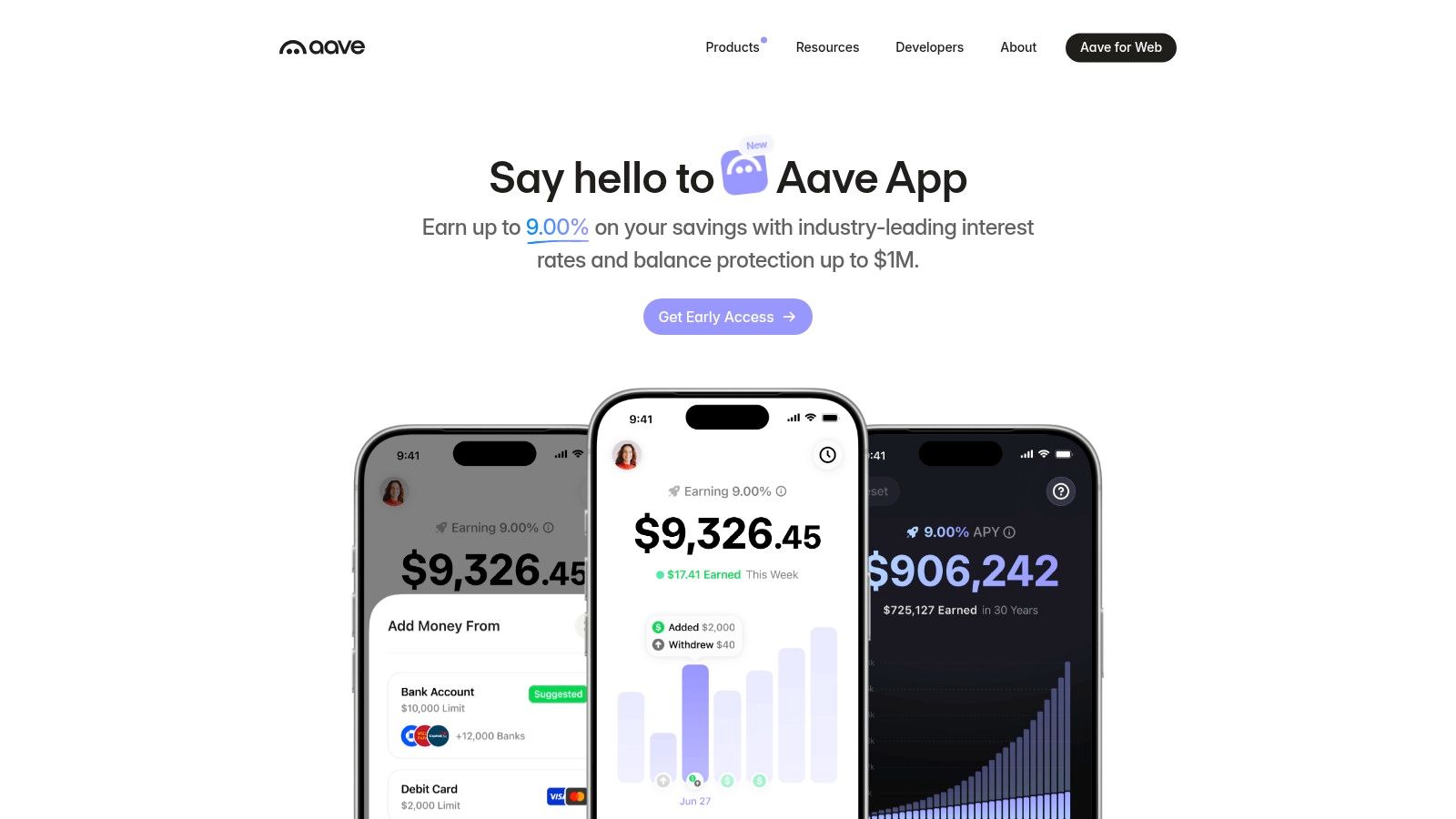
As a cornerstone of decentralized money markets, Aave provides the critical infrastructure for borrowing and lending digital assets. It operates across multiple blockchains as a non-custodial liquidity protocol where users can participate as depositors (lenders) or borrowers. Aave's robust risk management and continuous development make its native token, AAVE, one of the best DeFi cryptos for investors looking for exposure to core financial primitives.
The platform allows users to earn interest on supplied assets or borrow other assets against their collateral. Its open-source and transparent nature has made it a foundational "money lego" for the entire DeFi ecosystem, with countless other applications building on top of its liquidity pools.
Aave's strength lies in its extensive risk management, deep liquidity, and forward-looking architecture. With Aave v3, it introduced features like Efficiency Mode, Isolation Mode, and cross-chain portals, significantly improving capital efficiency and mitigating risk. The protocol is now advancing towards Aave v4, which promises a more unified and efficient "hub-and-spoke" design and a revamped liquidation engine to handle market volatility better.
Actionable Insight: The native GHO stablecoin is a major development for AAVE token holders. GHO is over-collateralized and minted by users against their Aave collateral. Interest payments from GHO borrowers are funneled to the Aave DAO Treasury, directly linking protocol usage to revenue generation for token holders.
The AAVE token is central to the protocol's governance and security. Holders can vote on Aave Improvement Proposals (AIPs) that dictate everything from new asset listings to risk parameter adjustments. Additionally, AAVE can be staked in the Safety Module, which acts as an insurance backstop in case of a shortfall event. Stakers earn AAVE rewards for providing this security layer, creating a direct incentive to secure the protocol.
Aave vs. Competitors:
| Feature | Aave | Other Lending Protocols (e.g., Compound) |
|---|---|---|
| Key Innovation | GHO Stablecoin, Aave v4 architecture | Often follow Aave's feature set (e.g., v3 forks) |
| Risk Management | Advanced (Isolation Mode, Supply/Borrow Caps) | Robust, but often with less granular control |
| Collateral Options | Broad selection of blue-chip assets and RWAs | Primarily major crypto assets |
| Tokenomics | Governance, Safety Module staking, GHO revenue | Governance, liquidity mining incentives |
Large players and DeFi-focused funds often move AAVE tokens in anticipation of key governance votes or changes in GHO's peg stability. Tracking these movements provides a leading indicator of market sentiment.
Website: https://aave.com
As the governance protocol behind DAI, the decentralized finance ecosystem's longest-standing decentralized stablecoin, MakerDAO is a cornerstone of the entire space. It functions as a decentralized central bank, managing the collateral, risk, and stability of DAI, which is used extensively for trading, lending, and yield farming. The protocol’s ongoing "Endgame" upgrade makes its governance token, MKR, one of the best DeFi cryptos for investors to analyze.
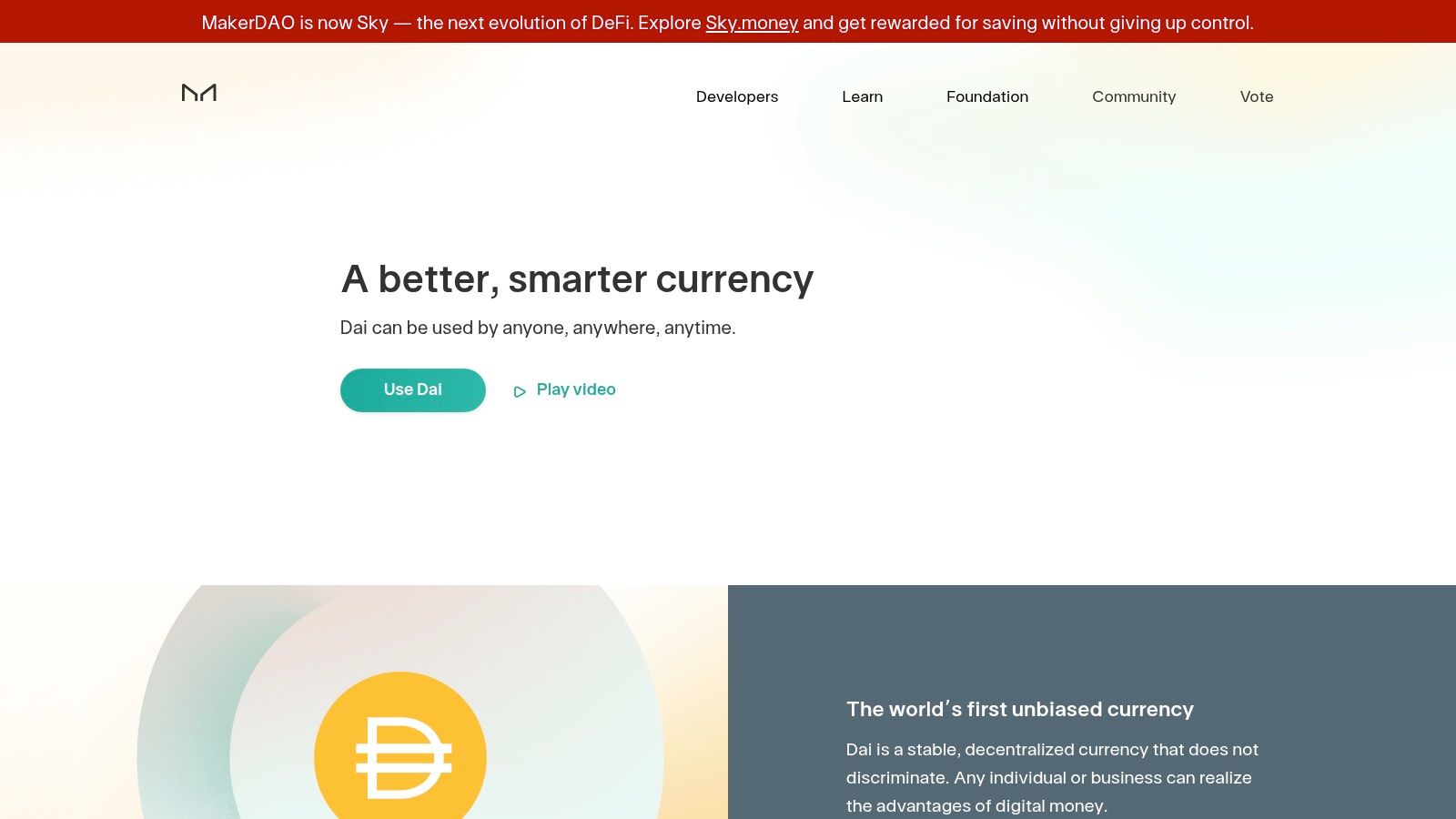
At its heart, MakerDAO allows users to generate DAI by locking up accepted collateral assets like ETH or WBTC in smart contracts called Vaults. The system's health is maintained through a robust framework of governance-managed risk parameters, including stability fees and collateralization ratios. This foundational role makes understanding MakerDAO's mechanics critical for grasping broader DeFi capital flows and risk appetite.
MakerDAO's primary strength is its resilience and deep integration across DeFi. It has weathered multiple market cycles, proving its model where many others have failed. A key recent development is Spark Protocol, a native lending market that provides users with enhanced yield opportunities on DAI through the Dai Savings Rate (DSR) and direct borrowing capabilities. This creates a powerful, self-reinforcing flywheel for DAI demand and utility.
Actionable Insight: The integration of Spark Protocol and the ongoing "Endgame" upgrades are designed to increase DAI's scalability and profitability. This directly impacts the value proposition for MKR holders, as protocol surplus can be used for token buybacks, effectively boosting MKR's value.
MKR's main role is governing the Maker Protocol. Holders vote on everything from adding new collateral types to adjusting stability fees. The token also acts as the protocol's backstop; in the event of a shortfall, new MKR can be minted and sold to recapitalize the system. Conversely, surplus revenue generated by the protocol is used to buy MKR from the open market and burn it, creating deflationary pressure. This direct link between protocol performance and token value is a core tenet of the MKR investment thesis.
MakerDAO vs. Other Stablecoin Issuers:
| Feature | MakerDAO (DAI) | Centralized Issuers (e.g., Circle, Tether) |
|---|---|---|
| Primary Use Case | Decentralized, censorship-resistant stablecoin | Fiat-backed, regulated stablecoin for CEX trading |
| Key Innovation | On-chain, crypto-collateralized borrowing engine | Off-chain, audited fiat reserves |
| Governance | Decentralized via MKR token holders | Centralized corporate entity |
| Tokenomics | Governance; buyback-and-burn from surplus | No direct value accrual to a public token |
The multi-phase "Endgame" plan introduces new sub-DAOs and tokens, which will create significant market events. Smart money wallets are positioning themselves to capitalize on these changes. By monitoring the wallets of core MakerDAO delegates and major MKR holders, you can anticipate moves related to these upgrades.
Website: https://makerdao.com
As the premier destination for decentralized perpetuals trading, dYdX has cemented its position as a critical piece of DeFi infrastructure. It recently transitioned from an Ethereum Layer-2 to its own sovereign appchain built on the Cosmos SDK, a move designed to deliver centralized exchange-level performance in a decentralized, open-source environment. This shift makes the platform and its native token, DYDX, a key player and one of the best DeFi cryptos for traders focused on derivatives.
The platform specializes in perpetual futures contracts, allowing traders to speculate on the future price of crypto assets with leverage. With its migration to the dYdX Chain, all order book management and trade matching now occurs on-chain, providing a transparent firehose of data for analysis. Before diving in, it's wise to ensure you have a compatible wallet; you can explore options by checking out the best DeFi wallet guides to get started.
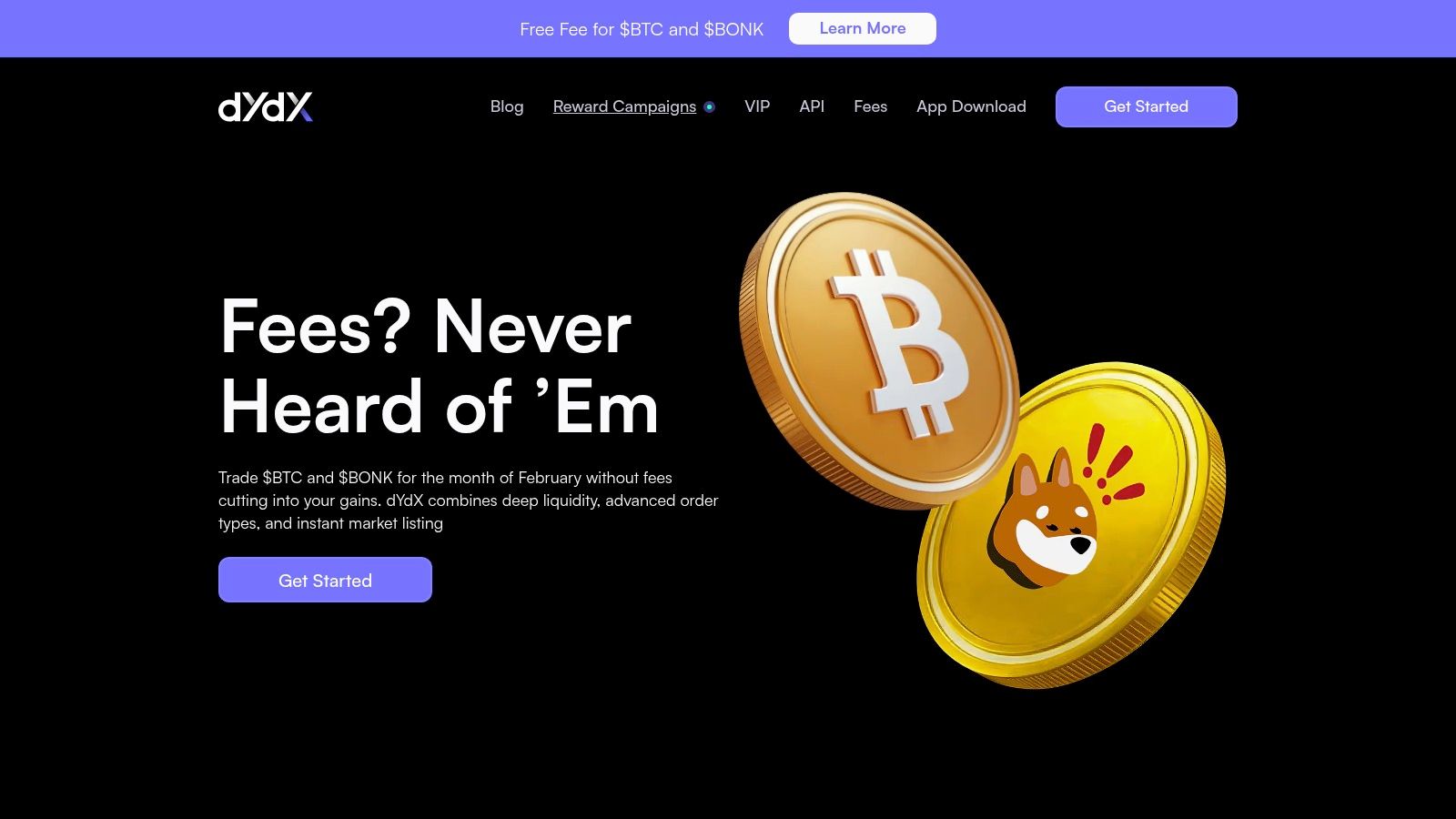
dYdX's main advantage is its high-throughput, off-chain order book and on-chain matching engine, now fully realized on its own Cosmos-based chain. This architecture allows it to handle the immense volume of orders required for a liquid derivatives market, a feat many on-chain DEXs struggle with. The platform's v4 open-source code encourages a growing ecosystem of tools and front-ends, further decentralizing access. Note that due to regulatory considerations, perpetuals trading on dYdX is restricted for U.S. persons and users in other specific jurisdictions.
Actionable Insight: The on-chain order flow from dYdX v4 is a goldmine for quantitative traders. You can analyze real-time order book depth, liquidations, and funding rates directly from the chain to build predictive models or front-run large market movements.
With the launch of the dYdX Chain, the DYDX token's utility was completely revamped. The token, migrated from Ethereum, is now the native gas and staking token for the new chain. Users can stake DYDX with validators to secure the network and, in return, receive a portion of the trading fees generated on the platform, distributed in USDC. This creates a direct economic link between the platform's success and the token's value, rewarding holders based on trading activity.
dYdX vs. Competitors:
| Feature | dYdX | Other Perp DEXs (e.g., GMX, Kwenta) |
|---|---|---|
| Primary Use Case | Order book-based perpetuals trading | Often GLP/synthetic asset-based models |
| Key Innovation | Dedicated Cosmos appchain for performance | Shared liquidity pool models, real-world assets |
| Order Flow | Fully on-chain and transparent | Can be less granular or aggregated |
| Tokenomics | Staking for chain security and USDC fee share | Staking for fee share and governance |
The most successful perpetuals traders on dYdX often signal their directional bias through their positioning. Tracking their net long or short exposure can offer valuable clues about market sentiment. Wallet Finder can be configured to monitor the on-chain activity of these top-performing derivatives traders.
Website: https://dydx.exchange
As the dominant liquid staking protocol for Ethereum, Lido DAO is a cornerstone of the DeFi ecosystem. It allows users to stake their ETH and receive a liquid token, stETH (or wstETH, its wrapped version), which continues to accrue staking rewards while remaining usable across DeFi. This function has made Lido's tokens a primary form of collateral and a yield-bearing asset in lending markets and decentralized exchanges, cementing LDO's position as one of the best DeFi cryptos.
Lido solved the core problems of native Ethereum staking: illiquidity, high capital requirements (32 ETH), and technical complexity. By pooling user funds, Lido makes staking accessible to everyone and provides stETH as a tradable, liquid asset. This integration across DeFi means stETH isn't just an idle investment; it's a dynamic building block for advanced yield strategies, making Lido DAO an essential platform to understand.
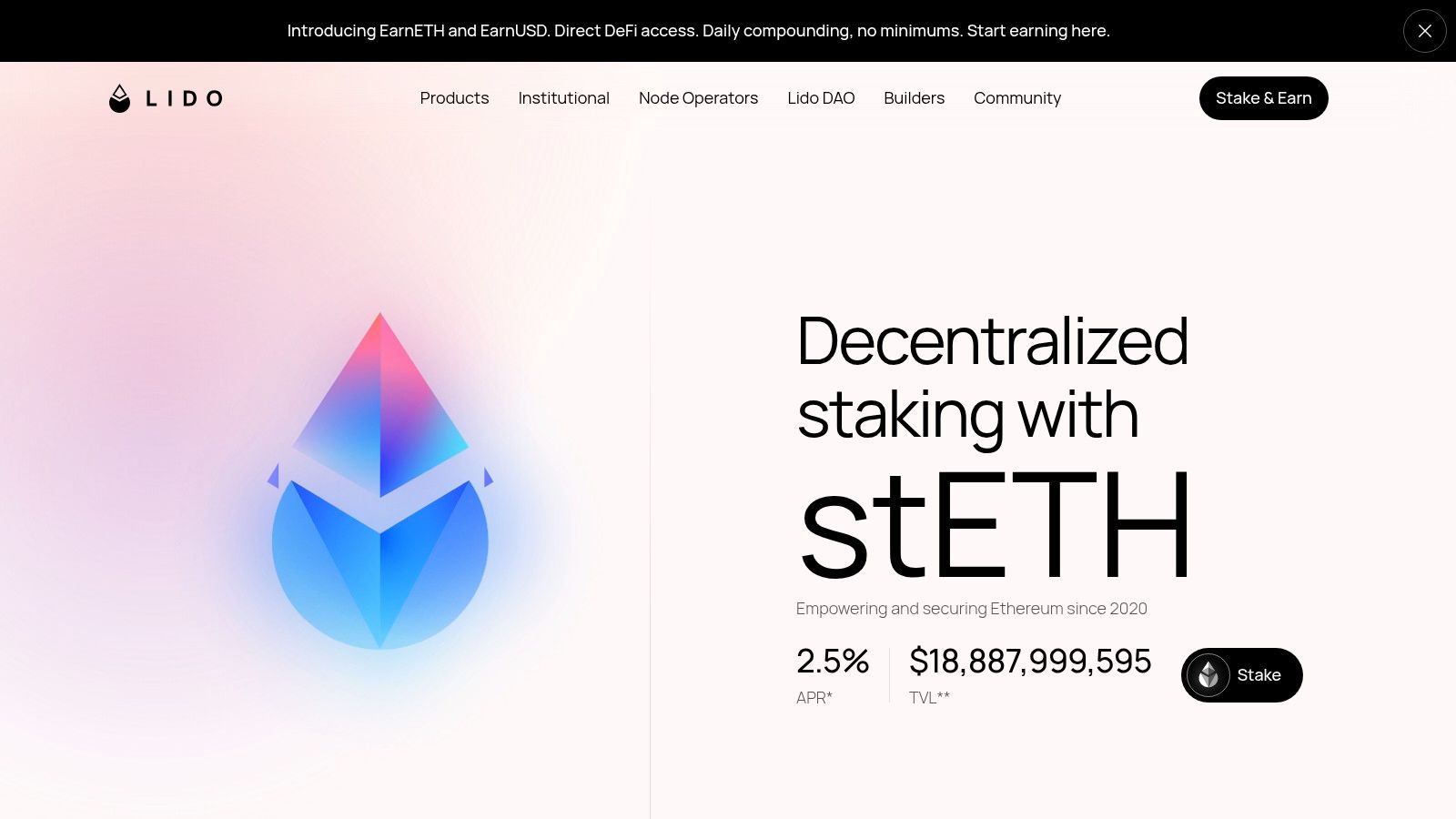
Lido's market leadership and deep integration across DeFi protocols are its main strengths. While other liquid staking providers exist, none have the widespread acceptance of stETH as collateral on platforms like Aave and MakerDAO. Lido is also transparent about its operational risks, maintaining a public record of potential issues and mitigations, including a coverage vault funded by protocol fees to protect against severe slashing events.
The governance model is also evolving. Lido is exploring "dual governance" mechanisms that would grant stETH holders a say in certain protocol decisions, specifically those affecting the safety of their staked assets. This is a critical step in decentralizing power and aligning incentives between LDO token holders and the users who entrust their ETH to the protocol.
Actionable Insight: The deep liquidity of the stETH/ETH trading pair on Curve and other DEXs acts as a primary exit route for stakers. Monitoring the "de-peg," or discount of stETH relative to ETH, can signal market-wide stress or large institutional selling, presenting both risk and opportunity.
The LDO token is used for governing the Lido DAO, allowing holders to vote on key parameters like fee structures, node operator selection, and treasury management. Currently, the protocol directs 10% of staking rewards to its treasury and node operators. The value of the LDO token is directly tied to the protocol's success, growth in staked ETH, and the future distribution of these collected fees. As Lido expands to more networks, LDO's governance reach increases.
Lido DAO vs. Competitors:
| Feature | Lido DAO | Other LSTs (e.g., Rocket Pool, Frax Ether) |
|---|---|---|
| Primary Use Case | Broad, multi-chain liquid staking | Often focus on decentralization (permissionless nodes) or capital efficiency |
| Key Innovation | Deep DeFi integration and market acceptance | Permissionless node operation, dual-token models |
| Market Share | Dominant share of ETH liquid staking | Smaller, but growing market share |
| Tokenomics | Governance; directs protocol fees | Governance, node operator staking, fee-sharing |
Large DeFi funds and whales use stETH not just for staking yield but as a core component of complex strategies, including leveraged staking and lending. Tracking their movements provides a powerful signal about broader market sentiment and capital allocation.
Website: https://lido.fi
As a leader in the decentralized perpetuals market, GMX provides a robust platform for on-chain derivatives trading, primarily on Arbitrum and Avalanche. It allows users to trade spot and perpetual contracts with up to 100x leverage without relying on a traditional order book. Instead, it uses a unique multi-asset liquidity pool (originally GLP, now GM pools in v2) that acts as the counterparty to all trades. This architecture has made GMX a cornerstone of the Layer-2 DeFi ecosystem and positions its token as one of the best DeFi cryptos for gaining exposure to on-chain trading activity.
GMX’s core function is to offer a transparent and efficient trading experience similar to centralized exchanges but in a decentralized manner. Its oracle-based pricing model, powered by Chainlink Data Streams, ensures deterministic execution and minimizes the slippage and toxic fills common on order book DEXs. This reliability makes it a go-to venue for traders looking for deep liquidity and predictable trade settlement on L2 networks.
GMX stands out due to its efficient oracle-indexed pricing and its innovative liquidity pool architecture. The transition to GMX v2 introduced isolated GM pools for different assets (e.g., BTC, ETH), allowing liquidity providers to choose their exposure instead of holding a broad index of tokens. This version also brought Chainlink Data Streams, which provide low-latency price feeds that significantly reduce the risk of front-running and adverse selection for both traders and LPs.
Actionable Insight: The GM pool architecture in v2 allows LPs to provide liquidity for specific assets they are bullish on, like BTC or ETH, rather than the entire GLP basket. This gives LPs more control over their risk and enables them to earn fees from trading activity on their preferred assets.
The GMX token is central to the protocol's value accrual. Holders can stake their GMX to earn a share of the platform's protocol fees, which are paid out in the native chain token (ETH on Arbitrum, AVAX on Avalanche). This mechanism creates a direct financial incentive for holding GMX, as its yield is tied to the platform's trading volume. Stakers also receive Multiplier Points and esGMX, which can be vested or compounded to boost rewards, creating a loyal stakeholder base.
GMX vs. Competitors:
| Feature | GMX | Other Perp DEXs (e.g., dYdX, Synthetix) |
|---|---|---|
| Primary Use Case | Oracle-indexed perpetuals trading | Order book-based perpetuals, synthetic assets |
| Key Innovation | GM/GLP liquidity pools, Chainlink Data Streams | Off-chain order book with on-chain settlement |
| Liquidity Model | Shared liquidity pool (LP vs. traders) | Order book liquidity, peer-to-peer |
| Tokenomics | Fee-sharing through staking | Governance, fee discounts, staking rewards |
Profitable traders and liquidity providers often move capital into GMX's GM pools in anticipation of increased market volatility, as higher volume translates to more fees. Monitoring these flows provides an early signal of market sentiment.
Website: https://gmx.io
Frax Finance has established itself as a multi-product DeFi powerhouse, often described as a central bank for the crypto economy. It started with an innovative fractional-algorithmic stablecoin, FRAX, but has since expanded into a full suite of products including a top-tier liquid staking derivative (frxETH) and a permissionless lending market (Fraxlend). This integrated ecosystem makes its governance token, FXS, one of the best DeFi cryptos for investors looking to gain exposure to real-yield and capital-efficient infrastructure.
The protocol's brilliance lies in its interconnected design. For instance, its Algorithmic Market Operations controllers (AMOs) use protocol assets to deepen liquidity for its stablecoins and frxETH across DeFi, creating a self-reinforcing loop of stability and yield. This complex but powerful system makes Frax a core building block for many other protocols and a key indicator of on-chain liquidity trends.
Frax’s primary distinction is its vertically integrated product stack, which generates fees from multiple sources and directs them back to FXS holders. The frxETH/sfrxETH liquid staking system is particularly notable. Unlike competitors, frxETH acts as a stablecoin-like asset pegged to ETH, while sfrxETH is an ERC-4626 compliant vault that accrues all staking rewards. This design provides one of the highest base yields for ETH staking and excellent composability within DeFi.
Furthermore, Fraxlend offers isolated lending markets that allow for the creation of unique borrowing and lending pairs, a feature that powers advanced leverage strategies. The AMOs automatically manage and deploy protocol-controlled assets into these markets and other venues, acting as an on-chain market maker that supports the ecosystem’s pegs and liquidity.
Actionable Insight: The dual-token liquid staking model (frxETH and sfrxETH) is a capital efficiency machine. Users can pair frxETH with other assets in DeFi protocols to earn trading fees or yield farm, while their staked ETH position in sfrxETH continues to accumulate rewards. This two-pronged approach maximizes returns on a single underlying asset.
The FXS token is central to the entire Frax ecosystem, capturing value through governance and fee-sharing. By locking FXS for veFXS (vote-escrowed FXS), holders gain voting power over protocol governance and gauge emissions, allowing them to direct rewards to specific liquidity pools. A portion of the revenue generated from Fraxlend, frxETH, and other protocol products is used to buy back and burn FXS or is distributed to veFXS lockers, creating a direct link between platform success and token value.
Frax Finance vs. Competitors:
| Feature | Frax Finance (FXS) | Other LST Protocols (e.g., Lido, Rocket Pool) |
|---|---|---|
| Primary Use Case | Integrated DeFi suite (Staking, Lending, Stablecoin) | Primarily Liquid Staking (LST) issuance |
| Key Innovation | Dual-token LST (frxETH/sfrxETH), AMOs | Decentralized node operator sets, broad adoption |
| Yield Source | Staking rewards, lending fees, AMO strategies | ETH staking rewards only |
| Tokenomics | Governance, gauge voting, fee-sharing, buy-backs | Governance; some have fee-sharing mechanisms |
The protocol's AMOs are a form of "smart money" embedded directly into the system. Monitoring the wallets associated with these AMOs provides a leading indicator of where the protocol is deploying capital to deepen liquidity or manage pegs.
Website: https://frax.finance
| Project | Implementation Complexity 🔄 | Resource Requirements ⚡ | Expected Outcomes 📊⭐ | Ideal Use Cases 💡 | Key Advantages ⭐ |
|---|---|---|---|---|---|
| Uniswap (UNI) | Medium — AMM setup; v4 hooks add customization complexity 🔄 | High — multichain liquidity, developer tooling, front-end routing ⚡ | Deep trading volume and efficient price discovery 📊 ⭐ | AMM trading, liquidity provisioning, composable routing 💡 | Massive multichain liquidity; v4 composability; top-tier volumes ⭐ |
| Aave (AAVE) | High — lending parameters, v4 hub‑and‑spoke architecture, liquidations 🔄 | High — capital, oracles, risk monitoring, governance participation ⚡ | Broad borrowing/lending markets and protocol-native stable yield 📊 ⭐ | Borrowing/lending, RWA integration, savings products 💡 | Deep blue‑chip collateral markets; strong risk tooling ⭐ |
| MakerDAO (MKR) / DAI | High — governance-led upgrades (Endgame), stability modules 🔄 | High — large collateral base, governance coordination, risk teams ⚡ | Stablecoin stability, protocol-level risk controls and liquidity 📊 ⭐ | DAI issuance, collateralized borrowing, systemic stable liquidity 💡 | Longest-running decentralized stablecoin; extensive risk frameworks ⭐ |
| dYdX (DYDX) | Medium–High — appchain perp mechanics and on‑chain matching 🔄 | High — high-throughput infra, perp liquidity, compliance checks ⚡ | Deep perpetual markets and on-chain order‑flow signals 📊 ⭐ | Perpetual trading, signal-driven strategies, analytics-driven hedging 💡 | Strong perp liquidity; transparent on‑chain order flow ⭐ |
| Lido DAO (LDO) | Medium — staking operations, governance evolution and safeguards 🔄 | High — validator coverage, capital for insurance/coverage vaults ⚡ | Liquid staking exposure widely usable as collateral and yield 📊 ⭐ | ETH staking, using stETH/wstETH as collateral and yield asset 💡 | Largest liquid staking share; broad DeFi integrations; clear risk docs ⭐ |
| GMX (GMX) | Medium — oracle-indexed perps and pool/reward mechanics 🔄 | Medium — Chainlink oracles, L2 liquidity, staking/reward infrastructure ⚡ | Efficient perp execution on L2s and early L2 risk signals 📊 ⭐ | Oracle-based perpetuals, leveraged trading, L2 market monitoring 💡 | Oracle pricing reduces toxic fills; strong Arbitrum liquidity ⭐ |
| Frax Finance (FXS) | High — multi-token AMOs, ve‑model, ERC‑4626 integrations 🔄 | High — complex treasury/AMO management, multichain deployments ⚡ | Capital-efficient stable yields and liquid staking flows 📊 ⭐ | Advanced liquidity management, liquid staking, novel yield strategies 💡 | AMO tooling; competitive staking yields; strong composability ⭐ |
Identifying the best DeFi cryptos is only the first part of a successful investment process. Throughout this article, we have dissected the core mechanics, tokenomics, and on-chain activities surrounding foundational projects like Uniswap, Aave, MakerDAO, dYdX, Lido, GMX, and Frax Finance. Each represents a distinct pillar of the decentralized economy, offering unique value propositions and, consequently, unique risk profiles.
The true differentiator between a casual participant and a professional trader is the ability to convert these insights into a disciplined, executable strategy. Simply knowing that UNI is a governance token for the leading DEX or that MKR governs the DAI stablecoin system is surface-level information. The real value lies in understanding how the most profitable wallets interact with these assets. This is where on-chain intelligence becomes your most critical tool.
We've moved beyond generic project descriptions to provide a framework for action. The core takeaway is that market outperformance often comes from mirroring, or at least understanding, the actions of "smart money." These are the wallets that consistently demonstrate a deep understanding of market cycles, protocol mechanics, and risk management.
Your next steps should involve creating a structured system for monitoring and analysis. Here’s a summary of the actionable blueprints covered:
The right on-chain analysis tool depends entirely on your objectives. A beginner might prioritize a user-friendly interface for tracking a few key wallets, while a professional trader or quant fund needs advanced filtering, data export capabilities, and API access.
Consider these factors when selecting your platform:
| Feature Focus | Ideal User Profile | Example Use Case |
|---|---|---|
| User-Friendly Dashboards | Retail Investors, Beginners | Creating a simple watchlist of 5-10 "whale" wallets holding AAVE and tracking their net flows weekly. |
| Advanced Filtering & Tags | Pro Traders, On-chain Analysts | Identifying all wallets that bought DYDX within 48 hours of its mainnet v4 announcement and have a PnL over $500k. |
| Real-Time Alert Systems | Active DeFi Traders, Memecoin Hunters | Setting an instant alert for any wallet on your "Smart Money" list that moves more than $100k of GMX to an exchange. |
| API Access & Data Export | Quant Researchers, Hedge Funds | Integrating live wallet activity data into a proprietary trading model to backtest strategies involving Frax Finance's liquidity pools. |
Key Insight: The goal is not to blindly copy every trade. The objective is to use smart money activity as a high-signal indicator to prompt your own research, validate your thesis, or challenge your assumptions about a specific asset.
The DeFi market is relentless and rewards those who are prepared. The frameworks provided for each token in this listicle are not static recommendations; they are dynamic templates. Use them to evaluate new projects as they emerge, to refine your personal risk parameters, and to consistently benchmark your own performance against the most successful participants in the space. Diligence and preparation are your greatest assets.
Ready to stop guessing and start tracking the wallets that define the market? Wallet Finder.ai gives you the on-chain intelligence to discover the best DeFi cryptos by analyzing the behavior of top-performing traders. Turn insight into action and build your own data-driven strategy today by visiting Wallet Finder.ai.

A premier DeFi analytics platform empowering traders to discover and analyze profitable blockchain wallets, trades and tokens.