Your Ultimate Guide to DeFi Wallet Apps
Discover how to choose the right DeFi wallet app. This guide covers features, security, and strategies to turn your wallet into a powerful trading tool.

February 8, 2026
Wallet Finder

January 22, 2026

What’s the best DeFi wallet? That’s like asking what’s the best car—it completely depends on what you plan to do with it. For a beginner just getting their feet wet, a simple mobile app like Trust Wallet is a fantastic starting point. For most people interacting with dApps on a desktop, MetaMask is still the go-to.
But for active traders who demand more—better security warnings, a cleaner interface, and features that actually save time—wallets like Rabby are quickly becoming the new crowd favorite.

In the world of decentralized finance, your wallet isn't just a place to hold coins. It's your digital identity, your transaction hub, and your key to every swap, stake, and yield farm you enter. Picking the right one isn't just a small step; it's the foundation for your entire trading strategy and the first line of defense for your assets.
This guide is designed to cut through the noise. We're not just listing features; we're giving you the context to make a smart decision. The perfect wallet for a beginner making their first swap on Uniswap is worlds apart from what an advanced on-chain sleuth needs. Our goal is to match your priorities—whether that's convenience on the go, fortress-like security, or slick smart features—to the right tool for the job.
The sheer size of the DeFi market shows you just how much is at stake. The global market was valued at USD 26.94 billion in 2025 and is on a rocket ship trajectory to hit USD 1,417.65 billion by 2033. This incredible growth is all built on the back of crypto wallets, which give users direct access to financial services without a middleman.
In North America, which holds a 36.5% market share, platforms like Uniswap and Compound depend entirely on these wallets to onboard users. You can learn more about this growth from the DeFi market's impressive growth trajectory.
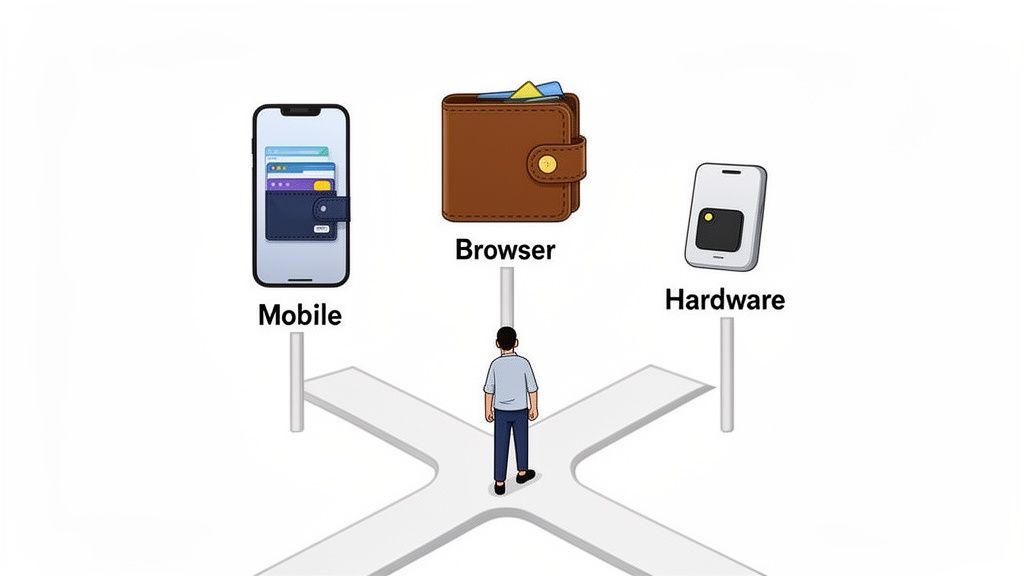
Before diving into specific brands, you need to understand the main categories. Each type is built for a different job, and most serious traders use a combination of them to balance everyday convenience with long-term security.
To give you a quick lay of the land, here’s a breakdown of the main types of wallets you’ll encounter. Think of this as your cheat sheet before we get into the nitty-gritty details of each one.
This table makes it clear that your choice depends heavily on your activity. A mobile wallet is perfect for quick actions, but you wouldn't want to store your life savings on it.
The "best" wallet isn't a single product but a category that aligns with your specific activities. A mobile wallet is perfect for quick swaps, but a hardware wallet is essential for securing your core holdings.
Ultimately, picking the right DeFi wallet comes down to defining what success looks like for you. This guide will give you the framework to do exactly that, so you can move through the ecosystem with confidence.
Before jumping into brand comparisons, we need to agree on what makes a DeFi wallet great. A top-tier wallet isn't just a place to stash your tokens; it's your command center for everything you do on-chain. The features below are what separate the best from the rest.
Think of these as the pillars of a solid foundation. If a wallet gets these right, you can build just about any trading strategy on top of it with confidence.
Security is everything. It's the absolute bedrock of any good DeFi wallet. When you're your own bank, the tools you use have to be bulletproof. This starts with self-custody—a non-negotiable feature where you, and only you, hold the private keys to your funds.
Beyond that basic principle, here are the security markers that truly matter:
The days of DeFi living only on Ethereum are long gone. A modern wallet has to be a fluent navigator of the multi-chain world, seamlessly handling not just Ethereum but also major Layer 1 ecosystems and the growing list of Layer 2 solutions.
This means you should be able to manage all your assets and connect to dApps across different networks without juggling a dozen different wallets. For a deeper dive, our guide on what is a DeFi wallet covers how this cross-chain operation works. A wallet that nails multi-chain support saves you a massive headache.
Your wallet is your passport to the entire universe of decentralized applications (dApps). So, how well it connects to them is a huge deal. The best wallets make this feel effortless and safe.
A great wallet acts as a secure bridge, not a barrier. Its primary job is to make connecting to DeFi protocols intuitive while clearly displaying the permissions you are granting.
This connection usually happens in one of two ways: a reliable in-app browser for mobile, and rock-solid support for WalletConnect, which has become the gold standard for linking your wallet to dApps on a desktop. A slow or buggy connection can cost you money and cause a ton of frustration.
This screenshot shows the clean interface of MetaMask, probably the most recognized wallet for dApp interactions.
The layout keeps it simple, focusing on core actions like sending, swapping, and viewing assets. This makes it easy to manage your portfolio and jump into different protocols without getting lost.
Finally, the best DeFi wallets strike a perfect balance between a clean, intuitive user interface (UI) and a suite of powerful tools for serious traders. A cluttered or confusing design is a recipe for expensive mistakes.
A truly user-focused wallet makes complicated actions—like staking, adding liquidity, or bridging assets—feel simple. At the same time, it gives you advanced controls that provide a real edge, such as:
Alright, let's get into the main event: a head-to-head comparison of the top wallets on the market. Choosing the "best" DeFi wallet isn't about finding a single winner. It’s about finding the right tool for your specific trading style, risk tolerance, and the ecosystems you live in.
We're going to move past the generic top-10 lists and give you clear, situational recommendations. We'll break down how major players like MetaMask, Trust Wallet, Rabby, Phantom, and Argent actually perform in the wild—from user experience and chain support to the advanced security features that can save you from a catastrophic loss.

As this image shows, every great wallet is built on three pillars: rock-solid security, broad multi-chain support, and seamless dApp integration. These are the non-negotiables.
MetaMask is the OG, the default gateway to DeFi for millions. Its greatest strength is its universal acceptance. If a dApp runs on an EVM-compatible chain, you can bet it works flawlessly with MetaMask right out of the box.
But its age is starting to show. The interface can feel clunky compared to newer wallets, and its native security features are pretty bare-bones. Crucially, it lacks built-in transaction simulations, which means you’re flying blind when interacting with new or unverified smart contracts.
Rabby has exploded in popularity with active traders for one simple reason: it directly addresses MetaMask’s biggest weaknesses, especially security. Its killer feature is the pre-transaction risk scan. Before you sign anything, Rabby simulates the transaction and flags potential threats like phishing contracts or malicious token approvals.
It also delivers a far superior multi-chain experience, with a clean dashboard that neatly organizes all your assets across every supported network. No more manual network switching. For traders who are constantly interacting with new protocols, Rabby provides a critical layer of protection that MetaMask simply doesn't have.
Rabby's genius is simple: it shows you what a transaction will actually do before you sign it. This single feature prevents countless scams and is quickly becoming a must-have for serious traders.
This laser focus on proactive security makes it a top contender for anyone who prioritizes safety and efficiency. To go even deeper, check out our guide on the best Ethereum wallets for DeFi trading for more specialized options.
Developed by Binance, Trust Wallet is built for the phone. It's known for its dead-simple setup and massive token support, making it a common first wallet for newcomers dipping their toes into DeFi.
Its integrated dApp browser makes it easy to connect to DeFi protocols on the go. However, it's designed for convenience over complexity. Its security features are standard, and it's not the ideal tool for heavy, desktop-based trading and analysis.
This wallet is part of a much larger trend. DeFi demographics are shifting hard toward mobile-first experiences. Data shows 61% of DeFi users are under 35, with 47 million monthly actives on Ethereum apps alone. This boom includes a 39% year-over-year jump in new users who start with mobile wallets, with an incredible 53% of new wallets originating in Southeast Asia and Africa.
While most wallets here are EVM-first, Phantom is the undisputed king of the Solana ecosystem. It offers incredibly deep integrations with Solana dApps, from DEXs to the biggest NFT marketplaces. The user experience is slick, fast, and built from the ground up for Solana's high-speed network.
If you spend most of your time trading within the Solana ecosystem, Phantom is a no-brainer. Its features are purpose-built for Solana's unique architecture, providing a level of smoothness that no multi-chain wallet can replicate there.
Argent is playing a different game entirely. It’s a smart contract wallet that uses account abstraction to deliver security features that traditional wallets can't touch. This includes social recovery, allowing trusted friends or other devices to help you regain access if you lose your seed phrase.
It also enables daily transfer limits and gets rid of the need to approve every single token for every dApp, which dramatically shrinks your attack surface. Argent represents the future of wallet security, even if its adoption is still catching up to the old guard like MetaMask.
To help you see how these wallets stack up side-by-side, here’s a quick breakdown of their core strengths and features. This table cuts through the noise to highlight what really matters for different types of traders.
Ultimately, the best wallet is the one that aligns with your habits. A Solana degen has different needs than a multi-chain yield farmer, and your choice of wallet should reflect that.
When you're managing serious capital, a standard browser or mobile wallet just won't cut it. While they're great for everyday DeFi, these "hot wallets" keep your private keys in an online environment, which always carries some level of risk. This is where specialized wallets enter the picture, offering a necessary upgrade in protection for your most important assets.
These aren't just places to store crypto; they're fortresses. The two main paths to elite security are hardware wallets, which take your keys completely offline, and smart contract wallets, which add programmable security rules right on the blockchain.
For the highest level of security, nothing beats a hardware wallet. Often called "cold wallets," they physically isolate your private keys from any internet-connected device. The keys are generated and stored on a secure chip inside the physical device, meaning they never touch your vulnerable computer or phone.
When you need to sign a transaction, you just plug in the device. The approval happens right there on the hardware. This means your funds are safe even if your computer is riddled with malware. If you have a portfolio of any significant size, a hardware wallet isn't a recommendation—it's a requirement.
Two brands absolutely dominate this space:
The concept behind a hardware wallet is brilliantly simple: it creates an unbreakable air gap between your private keys and the online world. All transaction signing happens on the device, never exposing your keys to digital threats.
The best setup for most traders involves pairing a hardware wallet with a daily driver like Rabby or MetaMask. Use the hardware wallet to secure your long-term holds and core capital, and keep a smaller amount in the hot wallet for frequent trading. It’s the perfect balance of security and convenience.
While hardware wallets have perfected offline key storage, a new breed of wallet is changing the game for on-chain protection: smart contract wallets. Unlike a traditional wallet controlled by one seed phrase, these are actually smart contracts on the blockchain that you own and control. This design unlocks flexible and powerful security features that were never possible before.
Companies like Safe (formerly Gnosis Safe) and Argent are leading the charge, completely rethinking what a wallet can be. They get rid of the single point of failure that comes with a seed phrase.
Instead, they introduce features that are impossible for normal wallets:
Smart contract wallets are a glimpse into a future where using DeFi is both safer and far more intuitive.
Picking the right DeFi wallet is only the beginning. The real magic happens when you turn it from a simple crypto container into your command center for trading. It's the bridge that connects on-chain intelligence to profitable action.
The first step is learning to monitor your portfolio safely. Instead of connecting your main wallet to every new dApp you find, you can simply use your public address with established portfolio trackers. This gives you a complete overview of your performance without ever putting your private keys at risk. You're essentially turning public data into private insights.
A good wallet is the foundation for a disciplined and repeatable trading workflow. This isn’t about chasing random market pumps; it's about acting on clear signals with both speed and security. Most pros follow a simple, three-step process.
Here is an actionable checklist to turn market data into trades:
A systematic approach like this cuts down on emotional, impulsive trades and sharpens the edge you get from on-chain analysis.
Your wallet should be more than a passive container for your crypto; it should be an active tool for executing a well-defined strategy. The goal is to move from speculation to a calculated, data-driven trading process.
As your trading activity ramps up, your security habits need to level up, too. The convenience of a hot wallet is fantastic for quick trades, but it also means more exposure. One of the most effective security habits you can build is compartmentalization.
Think of it like this: use a dedicated "hot wallet" for daily trading and connecting to dApps, funded with only what you're willing to risk. Your main stash—your long-term holds—should stay locked down in a cold storage solution like a hardware wallet. Our guide on how to move crypto from Coinbase to a wallet covers the basics of funding your wallets securely.
Another non-negotiable habit is to regularly revoke token approvals. Every time you interact with a dApp, you grant it permission to access and spend certain tokens. If you don't clean these up, you’re leaving backdoors open for potential exploits down the line.
The explosive trajectory of the DeFi market is exactly why mastering your wallet now is so critical. We're looking at a trillion-dollar future where the best DeFi wallet will be the key to unlocking serious growth.
Projections show the DeFi market rocketing from $26.94 billion in 2025 to a staggering $1,417.65 billion by 2033. Transaction volumes are expected to blow past $3 trillion by 2026. For copy traders using platforms like Wallet Finder.ai, having a wallet that seamlessly plugs into liquidity hubs like Aave and Uniswap is non-negotiable for finding opportunities backed by real-time data. You can dig deeper into the top DeFi trends shaping the market to see where things are headed.
Navigating DeFi often brings up a ton of questions, especially about the wallets we trust with our funds. Let's clear up some of the most common ones so you can trade with more confidence.
Even seasoned pros have questions, and getting straight answers is the best way to protect your assets.
It's not the slick UI or the built-in token swaps. The one non-negotiable, foundational feature is non-custodial security.
This simply means you—and only you—have full control of your private keys and seed phrase. It's the entire point of decentralized finance. A wallet that holds your keys for you isn't a true DeFi wallet; it's just another bank. Self-custody is what stops a company, government, or hacker from freezing or draining your funds without your consent.
When you're looking at a new wallet, the first question should always be: "Do I have sole control over my private keys?" If the answer is no, walk away. It fails the most basic test.
Features like open-source code and security audits are critical for verifying a wallet's integrity, but they all build on that bedrock of self-custody. This is what truly makes you your own bank.
Absolutely. In fact, you should. Using multiple wallets isn't just a good idea; it's a core risk management strategy for any serious trader. It’s all about compartmentalization.
A standard, highly effective setup looks like this:
This strategy dramatically cuts down your risk. If your hot wallet ever gets compromised by a malicious smart contract, your main stash remains safely offline in your hardware wallet. Many pro traders take it a step further, using different hot wallets for different chains or strategies just to keep everything organized.
Securing your wallet is an ongoing process, not a one-time setup. It’s a mix of using the right tools and building disciplined habits. A proactive defense is the only effective defense.
Here are the critical practices every single trader needs to live by:
The difference boils down to one critical word: custody. Who actually owns and controls the crypto? Getting this right is fundamental to understanding DeFi.
A DeFi wallet (like MetaMask, Trust Wallet, or Rabby) is non-custodial. You hold the private keys. You have 100% sovereign control over your funds. You are the bank.
An exchange wallet (on a platform like Coinbase or Binance) is custodial. The exchange holds the private keys for you. While convenient, this introduces massive counterparty risk—if they get hacked, go insolvent, or freeze your account, your funds are at their mercy.
Here’s a clear breakdown:
While exchange wallets are a great on-ramp into crypto, a non-custodial wallet is the only tool for genuine participation in decentralized finance.
Ready to turn on-chain data into actionable trading signals? Wallet Finder.ai helps you discover the most profitable wallets, track their every move in real time, and copy their strategies before the market catches on. Start your 7-day trial and find your edge at https://www.walletfinder.ai.