Calculate Crypto Profits Without Spreadsheets

Wallet Finder

Blank calendar icon with grid of squares representing days.

January 28, 2026

Figuring out your crypto profits sounds simple, but it's a step that trips up a surprising number of traders. In a nutshell, you need to know your cost basis (what you paid, including all fees) and subtract that from your sale price (what you sold it for, minus fees). For coins you're still holding, the math is Current Market Value - Cost Basis.

Getting this right is essential for tracking your performance, refining your strategy, and for tax reporting.

The Essentials of Crypto Profit Calculation
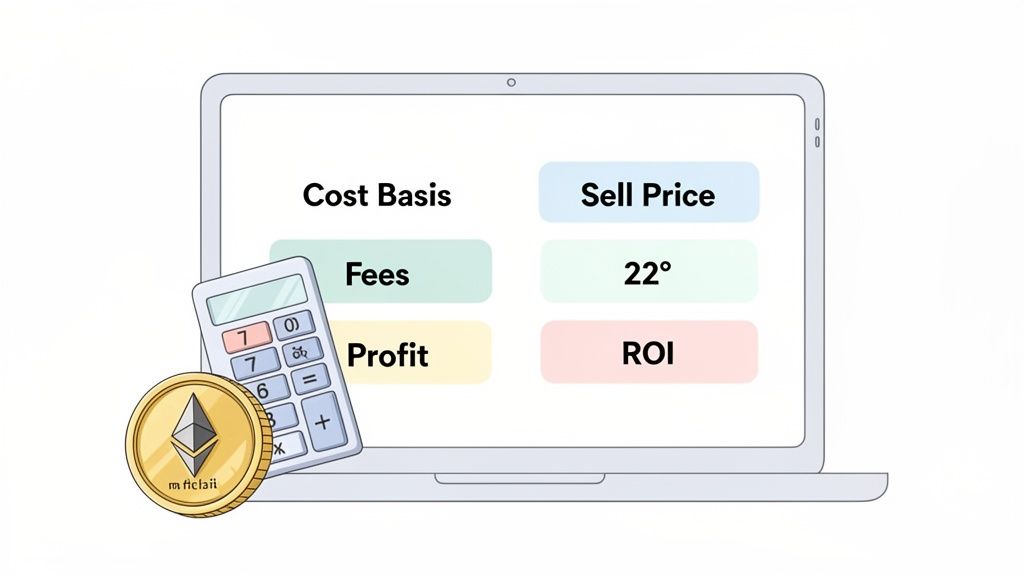
Digital illustration of a laptop, calculator, and Ethereum coin, showing financial terms for crypto profit calculation.

Before diving into complex DeFi strategies, you must nail the fundamentals. Accurately calculating your crypto profits isn't just a chore for tax season—it's how you measure what's working and refine your strategy. Getting these basics wrong can lead to poor decisions and painful financial surprises.

At the heart of it all are a few core terms. These concepts are the building blocks for every scenario, from a simple buy-and-sell trade to tracking a complex liquidity pool position.

Core Metrics for Performance Tracking

Let’s define the key terms you need to know. Your Cost Basis is the total amount you spent to acquire an asset. This isn't just the purchase price; it must include all transaction fees.

Here are the essential metrics for tracking your performance:

  • Cost Basis: The total all-in cost to acquire an asset, including purchase price and all fees.
  • Profit and Loss (PnL): The direct financial result of a completed trade. A positive number means profit; negative means a loss.
  • Return on Investment (ROI): Your profit shown as a percentage of your initial cost. This is the best way to compare the performance of different investments.

The single biggest mistake I see new traders make is ignoring small transaction fees. On active chains like Ethereum, those gas fees can pile up fast and completely wipe out your net profits, turning what looked like a winning trade into a loser.

For a deeper dive, you can learn more about profit and loss analysis in our dedicated guide.

Core Formulas for Tracking Crypto Performance

This table provides a quick reference for the essential formulas you'll use to measure your crypto gains and losses.

MetricFormulaWhat It Tells You
Cost BasisPurchase Price + All Associated FeesYour total initial investment for an asset.
Realized PnL(Sale Price - Sale Fees) - Cost BasisThe actual profit or loss locked in from a completed trade.
Unrealized PnLCurrent Market Value - Cost BasisThe "on paper" profit or loss for an asset you still hold.
ROI (%)(Net Profit / Cost Basis) x 100Your gain or loss relative to your initial investment.

Keep these handy as they form the foundation of all profit calculations.

Long-Term Holding vs. Day Trading

How you calculate profits can change dramatically depending on your trading style. For a long-term hodler, things are relatively clean—you often have one cost basis and one eventual sale. The profit potential here can be staggering.

For instance, in the last five years, Bitcoin delivered an average annual return of over 155%, dwarfing traditional assets like gold (at 7% annually). The historical numbers are even wilder: Bitcoin soared 30,203% in 2010 and another 5,870% in 2013. You can explore more historical data on Bitcoin's performance over time at casebitcoin.com.

Now, contrast that with a day trader who might execute dozens of trades in a single session. Every single one of those trades has its own unique cost basis and sale price. Without a rock-solid system for tracking everything, it's virtually impossible to know your true PnL. This is why meticulous record-keeping isn't just good practice; it's non-negotiable for anyone serious about trading.

Calculating Realized and Unrealized PnL

To get a grip on your portfolio’s health, you must understand the two sides of profit: realized and unrealized. One is money you can actually spend, and the other is potential value that could disappear in an instant.

  • Realized PnL: The profit or loss from a completed trade (buy and sell). This is the number that matters for taxes and for knowing if your strategies are working.
  • Unrealized PnL: The "on-paper" value of assets you’re still holding. It's a snapshot in time and not yours until you sell.

Working with Realized PnL

Let’s walk through a real-world example to see how sneaky transaction fees can be.

Imagine you decide to buy 0.5 ETH.

  • Purchase Price: 0.5 ETH at $3,000 per ETH = $1,500.
  • Transaction Fee (Gas): The network charges you $25 to process the buy.
  • Total Cost Basis: $1,500 + $25 = $1,525.

A few weeks later, ETH pumps to $3,400, and you decide to sell.

  • Sale Price: You sell 0.5 ETH for $1,700.
  • Transaction Fee (Gas): Selling costs you another $15 in gas.
  • Net Sale Proceeds: $1,700 - $15 = $1,685.

Now for the final calculation.

Realized PnL = Net Sale Proceeds - Total Cost Basis$1,685 - $1,525 = $160 Profit

If you hadn't tracked the $40 in total fees, you might have thought you made $200. Multiply that small error across hundreds of trades, and you see why accurate PnL tracking is so important. For a deeper dive, check out our complete guide to PnL tracking for DeFi traders.

Understanding Unrealized PnL

Now let's look at unrealized gains, which represents your portfolio's value for open positions. This number is key for understanding your current net worth and risk exposure.

Let's say you invest in a Solana memecoin.

  • Purchase: You buy 10,000 WIF tokens for $500.
  • Gas Fee: The Solana network fee is $0.50.
  • Your Cost Basis: $500 + $0.50 = $500.50.

A month later, your 10,000 WIF are worth $1,200. You haven't sold any.

Here’s how to calculate your paper gains:

MetricCalculationResult
Current Market ValueThe live value of your 10,000 WIF.$1,200
Cost BasisYour initial all-in investment.$500.50
Unrealized PnLCurrent Market Value - Cost Basis$699.50

That $699.50 is your unrealized profit. It isn't real until you hit the sell button. If the token's value dumps to $300 tomorrow, you’d have an unrealized loss of $200.50. This is why it’s critical to monitor unrealized PnL but always ground your performance in what you’ve actually realized.

Tracking Profits in Complex DeFi Scenarios

Once you step into Decentralized Finance (DeFi), calculating your crypto profits gets much more complicated. Simple buy-and-sell math no longer works. Now you're juggling token swaps, gas fees, liquidity pools, and impermanent loss.

At its core, the process remains the same: you buy an asset, sell it, and then figure out the gain or loss.

Diagram showing the three steps of crypto profit calculation flow: buy crypto, sell crypto, and calculate profit.

This image shows the basic idea, but in DeFi, the devil is in the details between each step.

Mastering Crypto to Crypto Swaps

On a Decentralized Exchange (DEX) like Uniswap, you are swapping one crypto for another. This is a crucial detail: a crypto-to-crypto swap is a taxable event.

Think of it as two separate transactions:

  1. You are selling the first crypto (e.g., ETH) at its current market price.
  2. You are immediately buying the second crypto (e.g., a new token) with those proceeds.

You must calculate the realized profit or loss on the asset you "sold." For example, if you swap 1 ETH (which you bought for $1,500) for 10,000 TOKEN when ETH’s price is $3,000, you just realized a $1,500 profit on your ETH. Your new cost basis for the 10,000 TOKEN is now $3,000.

The Unseen Cost of Gas Fees

Gas fees, especially on Ethereum, are a silent portfolio killer. A trade might look profitable on paper, but after network fees, that profit can vanish or even become a loss.

It is essential to treat gas fees as part of your costs:

  • When you buy: Add the gas fee to your purchase price to get your true cost basis.
  • When you sell or swap: Subtract the gas fee from your sale proceeds.

Skipping this gives you an inflated view of your trading performance.

Navigating Liquidity Pools and Impermanent Loss

Providing liquidity is a popular way to earn yield in DeFi, but tracking profits is a beast. You deposit a pair of assets (e.g., ETH and USDC) into a Liquidity Pool (LP) and receive LP tokens. In return, you earn trading fees but also expose yourself to Impermanent Loss (IL).

Impermanent Loss occurs when the price ratio of your two deposited assets changes. The more the prices diverge, the greater the IL. This means your profit from being a liquidity provider is:

LP Profit/Loss = Fees Earned - Impermanent Loss

Calculating this is difficult because the amount of each token you own in the pool is always shifting. You have to compare the current value of your assets in the pool against what their value would have been if you’d just held them.

This volatility creates huge opportunities. Looking at Bitcoin's monthly performance from 2011 to 2025, it had positive returns in 56% of months. But the real story is in outliers, like the 451.2% gain in November 2013. The annual stats show similar trends: 2017 brought 1,338% returns, and the DeFi summer of 2020 fueled a 302% run. You can dig into this kind of data using tools like Curvo's backtester.

To win in DeFi, you must be meticulous. If you're not tracking these complex scenarios properly, you’re flying blind.

Common Mistakes and Advanced Tax Scenarios

Tracking profits manually is like crossing a minefield. One wrong step can lead to messy records, poor trading decisions, and a massive tax headache. Let's cover the most common errors and tricky situations.

Getting these edge cases right separates the pros from the hobbyists. Everything from bridging assets to handling an airdrop impacts your profit calculations.

Sidestepping Common Tracking Errors

A common mistake is messing up your cost basis, especially when you've bought the same coin at different prices. If you bought ETH at $2,000, $3,000, and $2,500, which one are you selling first? Your answer completely changes your reported profit.

Another pitfall is ignoring taxable events that aren't straightforward sales. In many places, like the US, numerous on-chain actions count as a disposal of your asset and trigger a tax event.

These include:

  • Crypto-to-Crypto Swaps: Legally treated as selling one asset and immediately buying another.
  • Spending Crypto: Buying coffee with BTC or minting an NFT with SOL is a disposition of the asset, creating a taxable gain or loss.
  • Receiving Airdrops: Airdropped tokens are usually considered income. Their value is based on the fair market price on the day you received them, which also becomes their cost basis.

A critical detail that trips up a lot of people is handling staking rewards. These are almost always treated as income, and you're taxed on their value the moment you receive them. That value also becomes the cost basis for those rewards, which you'll need when you eventually sell.

Bridging Assets Across Chains

Moving assets between blockchains—like bridging USDC from Ethereum to Base—adds complexity. While bridging itself isn't typically a taxable event, the fees are important.

The gas fees you pay on the source chain (Ethereum) and any fees on the destination chain (Base) should be added to the asset's overall cost basis. This meticulous tracking keeps your profit calculation accurate.

FIFO vs LIFO Accounting Methods

How you account for your trades can have a massive impact on your tax bill. The two most common methods are First-In, First-Out (FIFO) and Last-In, First-Out (LIFO). The method determines which "batch" of coins you're considered to have sold.

  • FIFO (First-In, First-Out): You sell your oldest assets first. This is the most common and widely accepted method.
  • LIFO (Last-In, First-Out): You sell your newest assets first. This can be a strategic move but might not be permitted where you live.

Imagine you bought 1 BTC at $30,000 and another at $50,000. Later, you sell 1 BTC when the price is $60,000.

Comparing FIFO vs LIFO Accounting Methods

Accounting MethodBest For...Impact on Taxable Gains (Rising Market)Impact on Taxable Gains (Falling Market)
FIFOSimplicity and compliance; long-term holding strategies.Higher taxable gains, as you sell cheaper, older coins first.Lower taxable gains, as you sell more expensive, older coins.
LIFOPotentially deferring taxes in a bull market.Lower taxable gains, as you sell newer, more expensive coins.Higher taxable gains, as you sell cheaper, newer coins first.

With FIFO, your taxable gain would be $30,000 ($60k - $30k). With LIFO, it would only be $10,000 ($60k - $50k). The most important rule is consistency—you can't flip-flop between methods each year.

These scenarios show exactly why manually calculating crypto profits is a recipe for disaster.

Using Wallet Finder to Automate Your Profit Tracking

Illustration of a wallet with a magnifying glass, next to a financial performance graph and 'Wallet History' button.

Manually calculating crypto profits—from simple swaps to the complex math of impermanent loss—is a nightmare. A spreadsheet quickly becomes a source of costly mistakes and a skewed view of your performance.

For any serious trader, manual tracking is slow, reactive, and prone to error.

This is where you graduate from reactive data entry to proactive, data-driven trading. Instead of hunting down transaction hashes, you can automate the whole process and focus on what matters: finding your next alpha.

Leaving Spreadsheets in the Dust

Tools like Wallet Finder do the heavy lifting for you. Simply enter a wallet address, and the platform pulls the entire on-chain history across major chains like Ethereum, Solana, and Base.

It crunches every transaction to create a live performance dashboard. This isn't just a single profit number; you get a full breakdown of the stats that tell a trader's story.

  • Realized & Unrealized PnL: See how much cash a wallet has locked in versus what’s on the table.
  • Win Rate: Get a hard number on how often a wallet’s trades are profitable.
  • Average Holding Period: Instantly know if you’re looking at a degen scalper or a long-term swing trader.
  • Top Performing Tokens: Pinpoint the specific coins driving a wallet's success.

This level of detail is a game-changer. You’re no longer guessing if a wallet is good; you’re looking at cold, hard data.

The true power of on-chain analysis isn't just about tidying up your own portfolio. It's about getting a massive informational edge by seeing—in real time—what the most profitable traders on the planet are doing, with zero filters.

How to Find and Vet Top-Performing Wallets

The real magic of a tool like Wallet Finder is tapping into raw market intelligence. The 'Discover Wallets' feature is a search engine for profitable traders, letting you find and vet the best performers based on real numbers.

You can filter wallets by total PnL, recent gains, or win rate to find traders whose style you want to learn from. Once you spot a promising wallet, you can dive into its history to reverse-engineer its strategy.

With immediate access to verified performance data, you can cut through the noise from influencers and paid groups. You are looking at raw, immutable on-chain facts. If a trader claims to be profitable, the data will either back them up or expose them.

Turning Raw Data Into Actionable Trades

Once you've found wallets that are consistently profitable, add them to a watchlist. This is where automation kicks in. You can set up real-time alerts via Telegram or push notifications that trigger the moment a tracked wallet makes a move.

Imagine getting an instant ping when a top trader you follow:

  • Buys into a new, low-cap gem.
  • Takes profit on a major position.
  • Starts farming a new DeFi protocol.

This lets you act on their moves almost instantly, giving you a chance to get in before the market catches on. You are no longer just looking at old data; you’re using live signals to inform your own trades. You can see how to discover and track top wallets using Wallet Finder.ai to see how powerful this is.

By automating the tedious work to calculate crypto profits and leveraging clean on-chain data, you can stop getting bogged down in the past and start capitalizing on the future.

Frequently Asked Questions

Calculating your crypto profits can bring up many questions. Let's tackle some of the most common ones.

Getting these details right is essential for tracking your real performance and staying on the right side of tax authorities.

How Do I Calculate Crypto Profits for Tax Purposes?

First, determine your cost basis: what you paid for the crypto plus any acquisition fees. A taxable event occurs when you sell, trade, or spend your crypto. Your profit or loss is the final sale price minus that cost basis.

Tax treatment often depends on your holding period:

  • Short-Term Capital Gains: For assets held for a year or less. These are usually taxed at your regular income tax rate.
  • Long-Term Capital Gains: For assets held for more than a year. These typically have a lower tax rate.

You must also consistently use an accounting method, like FIFO (First-In, First-Out). Given the complexities, it’s wise to consult a tax professional or use specialized software.

What Is the Easiest Way to Track Profits Across Multiple Wallets?

Manually tracking transactions across multiple wallets and chains in a spreadsheet is a recipe for disaster. It is time-consuming and prone to errors.

The easiest and most accurate method is to use an automated on-chain analysis tool. These platforms connect directly to the blockchain, pulling all activity from any wallet address. They do the heavy lifting—calculating PnL, ROI, and other key metrics—giving you one clean dashboard without any manual entry.

Is Swapping One Crypto for Another a Taxable Event?

Absolutely. In most jurisdictions, including the US, a crypto-to-crypto swap is a taxable event. Tax authorities view it as two separate transactions: you're selling the first asset and then immediately buying the second.

You must calculate the capital gain or loss on the crypto you disposed of based on its fair market value at the moment of the swap. This is a common trip-up for DeFi users.

It's a classic mistake to think, "I didn't cash out to dollars, so no tax is due." Tax agencies don't see it that way. They consider a swap a "disposition" of property, which triggers a taxable event no matter what.

How Do I Factor Gas Fees into My Profit Calculation?

You must include gas fees in your calculations to get a true picture of your profitability.

  • When Buying: Add the gas fee to your purchase price. If you buy 1 ETH for $3,000 and pay $50 in gas, your true cost basis is $3,050.
  • When Selling: Subtract the gas fee from your sale price. If you sell that ETH for $3,500 but the gas fee is $30, your net proceeds are $3,470.

Ignoring these fees will give you a false sense of profitability. Factoring them in reveals the true cost of trading and provides an accurate PnL.


Stop guessing and start making data-driven decisions. Wallet Finder.ai gives you the on-chain intelligence to discover top traders, analyze their strategies, and get real-time alerts on their every move. Find your edge with a free 7-day trial at Wallet Finder.ai.