Is Trust Wallet Decentralized? An Honest Guide

Wallet Finder

Blank calendar icon with grid of squares representing days.

March 14, 2026

Is Trust Wallet truly decentralized? The short answer is yes, in the way that matters most. At its core, Trust Wallet is a non-custodial wallet, which means you and only you hold the private keys to your crypto. No one else can access your funds.

However, to provide a smooth, all-in-one user experience, the app does connect to some centralized services for functions like displaying real-time token prices.

Breaking Down Trust Wallet's Hybrid Model

Think of it like this: you own your house outright, but you still use the city's power grid. You have total control over your home (your crypto and private keys are 100% yours). That's the decentralized part, and it's the most critical for security.

This self-custody model is a major reason for the wallet's explosive growth, with over 210 million installations. By March 2026, it had already captured a market-leading 35% share of all crypto wallet downloads. It’s clear that users want control, and you can read more about this on the official Trust Wallet blog.

To give you a better idea of how this works, check out the diagram below.
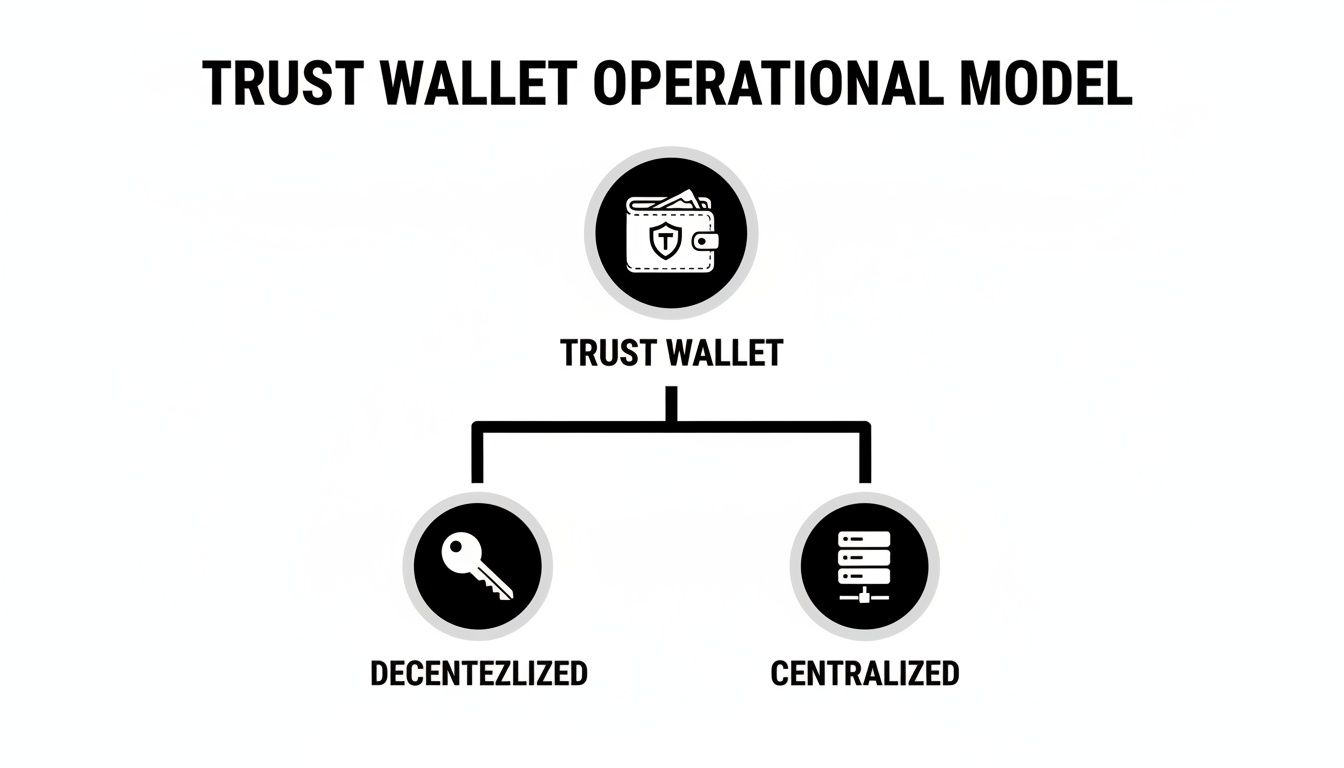
Trust Wallet operational model flowchart showing options for decentralized and centralized architectures.

This chart separates the functions you control (like your keys) from the services the app relies on for convenience (like displaying data). This hybrid approach gives you the security of true decentralization while making the app practical and easy to use.

Trust Wallet Features at a Glance

To make it even clearer, here is a breakdown of which parts are decentralized and which are centralized.

FeatureTypeWhat This Means for You
Private Keys & Recovery PhraseDecentralizedYou have sole ownership. Your keys, your crypto—period.
Blockchain TransactionsDecentralizedYou interact directly with blockchains without a middleman.
Price Feeds & ChartsCentralizedThe app pulls data from centralized providers to show you market prices.
Node InfrastructureCentralizedTrust Wallet uses node providers to communicate with blockchains efficiently.
WalletConnect & DApp BrowserDecentralizedYou can connect to DeFi and other DApps directly from your wallet.

Ultimately, Trust Wallet strikes a balance. It keeps the most critical components—your keys and your assets—fully decentralized while using centralized helpers for non-critical functions that make your life easier.

What Decentralization Means for Your Wallet

Illustration of hands holding a smartphone displaying a safe with a key, connected to servers.

When people ask, "is Trust Wallet decentralized?" they're really asking about one simple concept: control. Who is in charge of your crypto?

Think about the difference between a traditional bank account and the cash in your pocket. With a bank, you're trusting a company to hold your money, give you access to it, and keep it safe. This is a custodial model.

A decentralized, or non-custodial, wallet is the exact opposite. It's like the cash you physically hold. You, and only you, have it. There's no bank manager, no intermediary, and no one you need to ask for permission to spend it. This gets to the heart of that famous crypto saying:

"Not your keys, not your crypto."

This phrase is repeated so often for a reason. It captures the single most important idea in crypto security: true ownership only comes from controlling your own private keys. Your keys are the cryptographic password that proves you own the assets in your wallet.

Why This Distinction Matters

The difference between custodial and non-custodial wallets has massive implications for traders. Understanding this concept is crucial before you can truly grasp the power and risks of a Web3 wallet.

A non-custodial setup gives you several major advantages:

  • True Asset Ownership: Your funds are locked on the blockchain, and only your unique private keys can access them. No one else.
  • Censorship Resistance: A central company can't just decide to freeze, block, or take your assets. This is a very real risk on centralized platforms.
  • Security from Company Failure: If a big exchange goes bankrupt or gets hacked, you’re safe. Your assets aren't sitting on their books.

This idea of self-sovereignty is the bedrock of DeFi. It's what allows you to interact directly with blockchain protocols, giving you total control over your financial moves without needing a middleman's approval.

Breaking Down Trust Wallet’s Decentralized Core

So, is Trust Wallet truly decentralized? The answer is a solid "yes" where it counts the most: control over your funds. The entire design is built around its non-custodial nature, and it all boils down to your private keys.

Think of it this way: when you set up a new wallet, Trust Wallet generates your private keys directly on your device. This isn't just a password; it's the one and only master key to your crypto vault. It never gets sent over the internet or saved on some company server.

This means you have absolute and total control over your assets. The team at Trust Wallet can't freeze your account, block transactions, or touch your funds, even if they were forced to. You are the only one in charge.

This is the engine that drives everything you do in decentralized finance (DeFi). Every time you swap a token, stake an asset, or trade an NFT, you're the one signing off on it directly from your device before it ever hits the blockchain.

Built on Open-Source and Multi-Chain Principles

Trust Wallet doubles down on this decentralized approach by being open-source. This isn't just a buzzword; it means their code has been picked apart and audited by top security firms like Halborn and CertiK. Anyone in the community can look under the hood to verify there are no hidden backdoors.

This philosophy also shows up in its massive ecosystem support. The wallet works with over 100+ blockchains, which provides a kind of infrastructure-level decentralization. You’re not stuck in a single walled garden. Plus, Trust Wallet is always adding integrations with other decentralized tools, like prediction markets, which let you engage with trustless financial products. You can check out how Trust Wallet works with prediction markets for a real-world example.

At the end of the day, these features come together to give you a powerful tool for self-sovereignty. For any serious DeFi trader, using a non-custodial wallet isn't a "nice-to-have"—it's essential for navigating the space securely and on your own terms.

How Trust Wallet Uses Centralized Services

Mobile phone with a key and shield, representing secure access to a decentralized blockchain network.

While your private keys give you total control, no wallet app truly operates in a bubble. For Trust Wallet to deliver a slick, responsive experience, it has to lean on some centralized services for speed and convenience. These features are what make the app practical for everyday use, and they don't compromise the core security of your assets.

Think about it for a second. How does the app actually know your token balance? It has to ask the blockchain. But forcing your phone to run a full blockchain node is completely out of the question—it would vaporize your battery and data plan in no time.

Instead, Trust Wallet talks to blockchains through centralized node providers. These are just powerful, always-on computers that store a full copy of the blockchain's history. When you open the app, it simply pings these nodes to ask for your balance. It’s a quick and efficient solution.

Where Convenience Meets Centralization

This reliance on centralized helpers shows up in a few other places, all designed to make the app more user-friendly. Understanding these touchpoints is key to answering the question "is Trust Wallet decentralized?" with the nuance it deserves.

These services make the app work, but they absolutely do not hold or control your crypto.

The key takeaway here is that these centralized parts are only for displaying information and adding convenience. They never have access to your private keys or the ability to move your funds.

Here are the main centralized services you’ll come across in the app:

  • Real-Time Price Feeds: To show you the value of your crypto in dollars, the app pulls data from centralized price APIs. This is how you see that your 0.5 ETH is worth a specific dollar amount right now.
  • Push Notifications: When you receive crypto, a centralized service is what sends that notification to your phone. It’s the same system that apps like Gmail or Instagram use to give you a heads-up.
  • The dApp Browser: While the dApps you connect to are decentralized, the "Discovery" page suggesting new and popular dApps is curated and managed centrally. This helps highlight verified projects and protect users from scams.
  • Buying Crypto: Those services that let you buy crypto with a credit card are handled by third-party partners. This process is much closer to using a centralized exchange, which is a critical distinction from the wallet's non-custodial nature. If you want to dive deeper into those differences, our guide on a crypto exchange vs wallet is a great place to start.

What This Means for Your Security and Privacy

So, what does this hybrid approach actually mean for you? It's all about a trade-off between rock-solid security and total privacy. Getting a handle on this balance is key to using Trust Wallet smartly.

The biggest win here is the non-custodial design. You, and only you, are in charge of your funds. This is your best shield against the nightmares you hear about in crypto, like exchange hacks or sudden asset freezes. Since your private keys live on your device, no company collapse or angry third party can touch your assets. You hold the keys, you call the shots.

The core principle is that your funds are only as safe as your recovery phrase. Protecting this phrase is your single most important responsibility as a user of a non-custodial wallet.

But here's the other side of the coin. While your funds are locked down tight, your activity isn't completely invisible. Every time the app needs to check your balance or broadcast a transaction, it talks to a centralized node. That node provider can potentially see your IP address and connect it to your public wallet address.

Practical Steps for Protecting Your Privacy

This connection between your IP and your wallet is a privacy issue, not a direct threat to your funds. For traders who prefer to keep their activity anonymous, it’s a gap worth closing. Here are actionable steps you can take:

  • Use a Virtual Private Network (VPN): A good VPN is your best friend here. It masks your real IP address by routing your internet traffic through one of its own servers. This simple step breaks the link between your physical location and your on-chain moves, giving your privacy a major boost.
  • Be Mindful of Your Digital Footprint: Think twice before connecting your main wallet to a dApp you aren't 100% sure about. For any new, risky, or experimental platforms, it’s a great idea to use a separate "burner" wallet with just a small amount of crypto in it.
  • Leverage Built-in Security Tools: Don't ignore the pop-ups! Trust Wallet has a Security Scanner that will flag dApps and addresses known for malicious activity. Always pay attention to these warnings—they are there to stop you from getting scammed or drained.
    1. Write it down on paper or engrave it in metal.
    2. Store it in a secure, private location (like a safe).
    3. Never store it as a digital file, screenshot, or in a password manager.

    By mixing these privacy habits with the wallet's built-in security, you can trade with a lot more confidence. If you want a deeper dive, check our detailed guide on the seed phrase wallet system.

    Common Questions About Trust Wallet and Decentralization

    A balanced scale showing digital security (shield, padlock) and data surveillance (eye, servers).

    When you're dealing with your own crypto, it's natural to have questions about how things really work under the hood. We've pulled together the most common queries we hear from traders to give you straight answers, so you can use Trust Wallet with total confidence.

    Can Trust Wallet Freeze My Assets?

    Absolutely not. Because Trust Wallet is fundamentally non-custodial, the only person who can move your funds is the one holding the 12-word recovery phrase. It’s that simple.

    Your private keys are generated and live exclusively on your device. They never touch a company server, which means the Trust Wallet team has zero technical ability to control, freeze, or take your assets. You're in complete control.

    Is Trust Wallet Safer Than an Exchange?

    When it comes to self-sovereignty, the answer is a firm yes. By holding your own keys with Trust Wallet, you're immune to platform-level risks like an exchange getting hacked, facing a regulatory crackdown, or suddenly halting withdrawals. Your crypto isn't just a line item on a company's balance sheet.

    But here’s the trade-off: this control comes with total responsibility. If you lose your recovery phrase or your phone gets compromised, the loss is on you. There's no customer support line you can call to get your crypto back.

    What Happens if I Lose My Phone?

    This is a common worry, but your crypto isn't actually on your phone. It lives on the blockchain. Your phone just holds the private keys that prove you're the owner.

    That’s why your recovery phrase is everything. As long as you have that 12-word phrase backed up somewhere safe, you're golden. Just download Trust Wallet on a new device, choose "I already have a wallet," and enter your phrase. You'll restore full access to all your funds instantly.

    Does Trust Wallet Make Me Anonymous?

    Not entirely. Trust Wallet doesn't ask for personal info or KYC (Know Your Customer) to get started, but everything you do on-chain is public. Your transactions are permanently recorded on a public ledger for anyone to see.

    What's more, the app’s use of centralized node providers means your IP address could theoretically be linked to your wallet address by that provider. To break this connection, many serious traders route their activity through a VPN. This simple step helps obscure your digital footprint and adds a critical layer of privacy.


    To take your on-chain analysis to the next level and discover top-performing wallets, get started with Wallet Finder.ai. Our platform helps you uncover winning strategies and mirror the moves of pro traders in real time. Start your 7-day trial at https://www.walletfinder.ai.