Guide to a Seed Phrase Wallet
Master your seed phrase wallet. Learn how to secure your crypto assets, avoid billion-dollar mistakes, and protect your portfolio on Ethereum and Solana.

January 18, 2026
Wallet Finder

January 18, 2026

A seed phrase wallet uses a unique 12 to 24-word phrase generated during setup. This isn't just a password; it's the master key to your entire crypto portfolio. Think of it as the ultimate backup—if your device is lost or broken, this phrase is all you need to restore your assets. It’s the very heart of self-custody.
Picture your crypto holdings not in a bank, but in a personal, invisible vault secured on the blockchain. A seed phrase is the one and only combination to that vault. This string of simple words, usually 12 or 24 long, is the absolute proof that you own your assets on networks like Ethereum or Solana.
This is a world away from a traditional bank, where they hold your money and can freeze your account at will. A seed phrase wallet puts you in complete and total control. This idea, called self-custody, is what makes decentralized finance (DeFi) possible. But with great power comes great responsibility.
When you hold your own seed phrase, you are your own bank. No one can touch, move, or freeze your funds without that exact sequence of words. This gives you a level of freedom and control over your digital assets that is unheard of in traditional finance. It’s a foundational concept for anyone serious about crypto.
The flip side? There’s no customer support line to call if you mess up. If your seed phrase is lost or stolen, your assets are gone forever. That's why mastering seed phrase security isn't just a good idea—it's the non-negotiable first step for any crypto user.
Your seed phrase isn't a password to an account; it is the account. Anyone who has it has full, unrestricted access to your funds, making its protection your highest priority.
Understanding how to manage a seed phrase is central to participating in the broader world of decentralized applications and trading. To see how these principles apply to the tools you'll use, check out our guide on what is a DeFi wallet. The concepts of security and self-sovereignty we've talked about here are the bedrock of that entire ecosystem.
It’s kind of wild to think that just 12 or 24 simple words can protect a whole portfolio of digital assets, especially when they’re scattered across different blockchains. But a seed phrase wallet does exactly this, using a clever and rock-solid mathematical process to turn your phrase into a nearly infinite supply of keys.
Think of your seed phrase as the master blueprint for your entire crypto identity. This blueprint gets plugged into a universal algorithm—basically, a standardized math recipe used by almost every modern wallet—to build every private key and public address you’ll ever need.
The whole process is deterministic, which is a crucial concept in crypto. All this means is that the same seed phrase will always generate the exact same set of keys, in the exact same order, every single time. It doesn't matter what compatible wallet software you use.
Your seed phrase isn't just one key; it's the root of a whole family tree of keys. The algorithm takes your unique phrase and creates a single "master" private key from it. From there, it can generate a virtually endless tree of individual private keys and their matching public addresses for all your different cryptocurrencies.
This diagram shows how it works—one seed phrase acting as the foundation for managing assets on completely different chains like Ethereum and Solana.
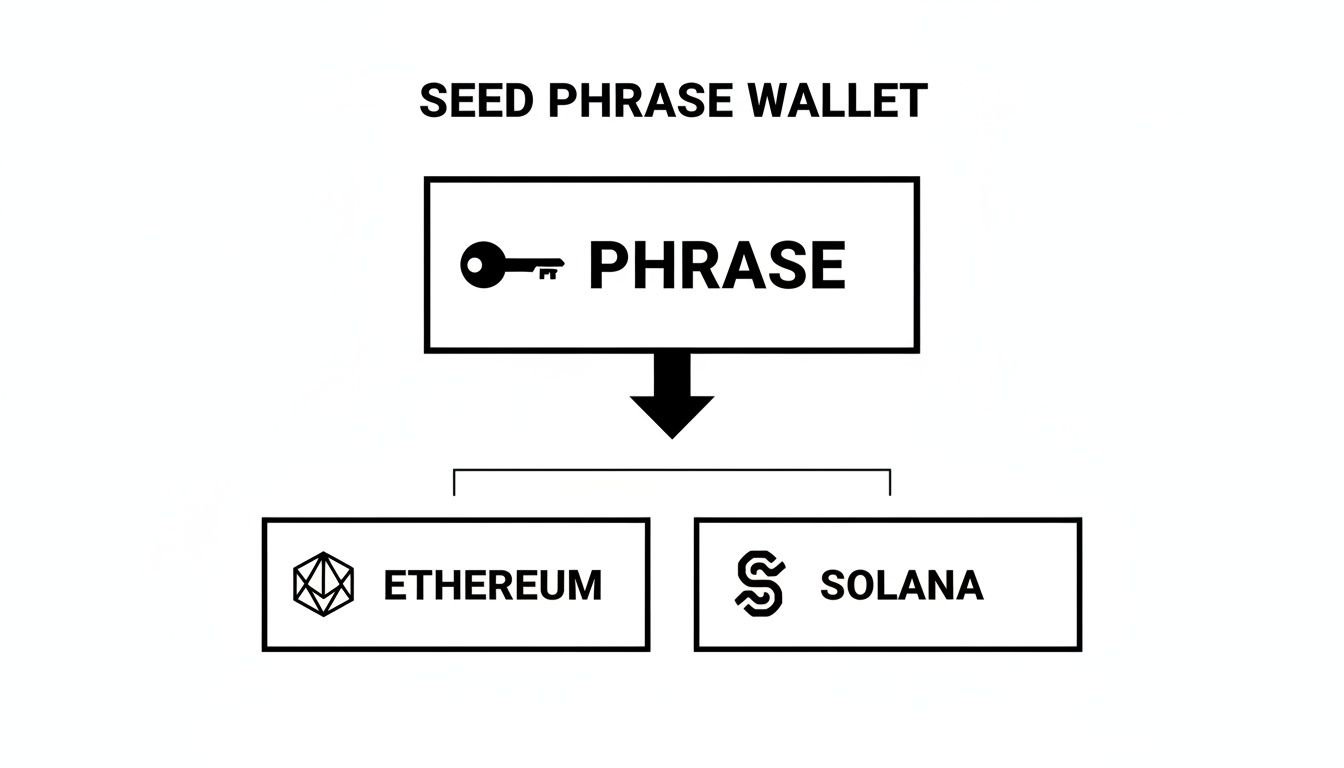
Because of this system, your wallet can give you a fresh, unused address for every transaction you receive. This is a huge plus for privacy, and you never have to create a new seed phrase to do it.
The real magic of this deterministic system shines when you need to recover your wallet. If you lose your phone or your hardware wallet breaks, you don't have to scramble to find individual private keys for your dozens or hundreds of assets. You only need one thing: your original seed phrase.
By simply typing that 12 or 24-word phrase into a new wallet, the algorithm gets to work and rebuilds your entire "building" of keys and addresses exactly as it was before. Your whole portfolio is back in your control, instantly.
This elegant solution is what makes self-custody not just possible, but practical. For an active DeFi trader juggling multiple assets, it means a single, securely stored backup is all you need to protect a complex and growing portfolio. It's security and control, simplified.
Once you've got your head around the power a seed phrase gives you, the next big question is: where do you actually use it? Choosing a wallet is one of the most important security decisions you'll make, and it all boils down to a classic trade-off between security and convenience.
Your choice here will completely shape how you interact with your crypto. There's no single "best" wallet—only the best one for what you need to do. The two main camps are hot wallets and cold wallets, and most serious crypto users end up using a mix of both.
A hot wallet is any crypto wallet that's connected to the internet. This includes browser extensions like MetaMask and mobile apps like Trust Wallet.
Their biggest advantage is pure convenience. Because they're always online, they’re perfect for daily use—making quick trades on a decentralized exchange (DEX), interacting with a DeFi protocol, or sending funds to a friend.
But that constant connection is also their greatest vulnerability. Being online makes them a potential target for hackers, phishing scams, and malware. It’s best to think of a hot wallet like the cash you carry in your physical wallet—only keep what you need for your day-to-day activity.
On the flip side, a cold wallet is a device that stays completely offline. These are usually hardware wallets, which are small physical gadgets like a Ledger or a Trezor.
These devices store your private keys inside a secure, isolated chip. When you need to approve a transaction, you sign it offline directly on the device. This means your precious seed phrase never, ever touches your internet-connected computer.
This offline approach offers the highest possible level of security against online threats, making cold wallets the undisputed champion for long-term storage. Think of it as your personal digital vault, perfect for locking away the bulk of your portfolio.
The core principle is simple: use hot wallets for frequent, small transactions and cold wallets for the secure, long-term storage of the majority of your portfolio.
Beyond hot and cold, there’s one more critical distinction: who actually controls the keys?
Custodial Wallets: If you're holding crypto on a big centralized exchange, you're using a custodial wallet. The exchange holds the seed phrase and private keys for you. While it feels easy, it means you're trusting them completely with your money. This goes against the core crypto motto: "not your keys, not your coins."
Non-Custodial Wallets: This is what a true seed phrase wallet is all about. With a non-custodial wallet, you and only you hold that 12 or 24-word phrase. This gives you absolute control and sovereignty over your funds.
For anyone serious about DeFi, a non-custodial wallet isn't just an option; it's a must-have. It's the only way to achieve real financial autonomy on the blockchain.
Choosing the right wallet can feel overwhelming, but it gets easier when you see the options laid out. This table breaks down the four main categories to help you decide which setup matches your security needs and how often you plan to transact.
Ultimately, a non-custodial wallet is the foundation for truly owning your assets. If you're diving into the world of DeFi, selecting the right one is your first major step. You can explore some of the top choices in our guide to the best Ethereum wallets for DeFi trading to find a good fit for your strategy.
In crypto, the biggest threat isn't a bear market—it's simple human error. The most brilliant trading strategy on the planet is worthless if a preventable mistake gets your wallet drained. The stakes couldn't be higher.
One simple slip-up with the master key to your non-custodial wallet on Ethereum, Solana, or any other chain can result in a total, irreversible loss. You can read more about these crypto wallet vulnerabilities to really get a sense of what’s at risk. To keep from becoming a statistic, you must adopt a mindset of extreme paranoia.

When it comes to your seed phrase, convenience is the enemy of security. Any digital copy of your seed phrase is a sitting duck for hackers, malware, and sophisticated phishing attacks.
Here are the absolute digital "don'ts" of seed phrase management:
Think of it this way: a digital copy of your seed phrase is like leaving your vault combination on a sticky note attached to your computer monitor. It’s a matter of when, not if, someone will find it.
Digital blunders are one thing, but simple human interactions can be just as dangerous. Scammers are masters of social engineering, playing on trust, greed, and fear to trick you out of your assets.
These final rules are the most important ones to remember:
Your seed phrase wallet gives you complete control over your crypto. The trade-off is that you—and you alone—are responsible for its security. By avoiding these common but catastrophic mistakes, you're building a fortress around your assets that no market crash could ever touch.
Now that we've covered what not to do, let's build a proper fortress for your master key. Protecting your seed phrase wallet means getting serious about physical security. A layered, offline strategy is the only reliable way to guard your crypto against both digital hacks and real-world disasters.

Follow these steps to create a resilient, multi-layered backup system.
Tier 1: Redundant Paper Backups
Tier 2: Fire and Flood Proofing
Tier 3: The Ultimate Security Layer (Passphrase)
This final layer transforms your backup from a simple key into a complex combination lock. If a thief steals your physical seed phrase, it's useless without the memorized passphrase. This is a key part of our broader checklist for assessing wallet risks, which you can use to harden your defenses even further.
A common fear holds a lot of traders back: if I use a tool to track a crypto wallet, can that tool somehow see its seed phrase?
Let’s clear this up right away: The answer is a hard no. Understanding why is crucial for using powerful platforms like Wallet Finder.ai with total confidence.
Think of these tools as specialized search engines for the blockchain. The blockchain itself is a giant public library of financial records, and anyone can walk in to read the books (transaction histories). But what they can't do is see the secret combination to the author's personal safe (your seed phrase).
On-chain analytics platforms only read and interpret the data that is already public for everyone to see.
Your seed phrase is the master key used to authorize and sign new transactions. It’s not involved in recording old ones. This is a one-way street: the phrase creates a unique digital signature for a transaction, but that signature can never be reverse-engineered to reveal the phrase.
This fundamental separation is what makes the whole system work. You can safely use on-chain analytics to discover winning wallets, and then use the security best practices from this guide to protect the seed phrase for the wallet you use to act on those insights.
Even after you get the hang of seed phrases, a few practical questions always seem to pop up. Let's tackle the most common ones so you can handle these real-world situations like a pro.
If your hardware wallet gets lost, stolen, or just stops working, don't panic. Your crypto is completely safe—as long as you have your seed phrase tucked away securely. Remember, your assets are on the blockchain, not stored inside that little device.
All you need to do is get a new hardware wallet (it can be the same brand or another compatible one) and use your original seed phrase during setup. This will restore full access to all your funds, just like that.
Yes, you can. A standard BIP-39 seed phrase is designed to be compatible across most non-custodial wallets. This means you can import a phrase you got from one app into a completely different one and see the exact same accounts and funds.
But you need to be extremely careful here. Every single time you type your seed phrase into a device that's connected to the internet, you're opening the door to potential threats like malware or a clever phishing scam. Only ever import your phrase into software you absolutely trust and have verified is legitimate.
The statistical odds of someone guessing a 12-word seed phrase are astronomically low—we're talking less than one in 2^128. It’s far, far more likely for a phrase to be stolen through digital scams or physical theft than for it to be guessed by a computer.
Theoretically? Yes. Realistically? Absolutely not. A 12-word seed phrase has more possible combinations than there are estimated atoms in the known universe. Even the world's most powerful supercomputers would need billions of years to have a chance at guessing just one phrase.
The real danger isn't someone guessing it. The danger is you getting tricked into revealing it through a phishing attack, malware on your computer stealing it, or someone physically finding where you wrote it down. Your security focus should always be on protection, not obscurity.
Ready to turn on-chain data into actionable trading signals? Wallet Finder.ai helps you discover and track the most profitable wallets in DeFi. Start your 7-day trial and see what the smart money is doing. Find your edge at https://www.walletfinder.ai.