How to Analyze Crypto: A Step-by-Step Guide
Learn how to analyze crypto with our guide to fundamental, on-chain, and technical analysis. Get actionable frameworks to evaluate projects and manage risk.

December 6, 2025
Wallet Finder

November 29, 2025

A chain swap in crypto is how you exchange one digital asset for another across two completely separate blockchains. Think of it like trying to wire money between two banks that don't have a direct relationship—you need a special go-between to make it happen. This process is the key to moving value between otherwise isolated ecosystems like Ethereum, Solana, and Avalanche.

At its heart, a chain swap solves a massive problem in crypto: most blockchains are like walled gardens. A token native to Bitcoin can't just be sent to an Ethereum wallet because they run on entirely different code, rules, and technologies. A chain swap crypto transaction is the bridge that makes this cross-ecosystem jump possible.
Imagine you're holding Bitcoin (BTC) but see a hot new DeFi protocol on Solana that requires SOL. Without a chain swap, you'd have to send your BTC to a centralized exchange, sell it, buy SOL, and then withdraw it to a new Solana wallet. It's a slow, clunky process that racks up fees and forces you to trust a third party with your funds.
Cross-chain swaps get rid of all those painful steps, creating a much more connected and fluid digital economy. They are the plumbing that lets capital flow freely between blockchains, which is absolutely critical for the entire Web3 space to grow and become genuinely useful. This interoperability unlocks huge benefits for everyone.
A truly interconnected Web3 requires assets to move as seamlessly as information does on the internet. Chain swaps are the foundational technology making that vision a reality, breaking down digital borders and fostering a more collaborative ecosystem.
In this guide, we’ll dive into the different ways to execute a chain swap crypto transaction. We’ll cover everything from simple cross-chain bridges to the more technical atomic swaps, giving you the know-how to navigate the multi-chain world safely and efficiently.

Executing a chain swap crypto deal isn't a one-size-fits-all game. Over the years, a few distinct technologies have popped up to tackle the challenge of moving value between blockchains, each with its own mechanics, perks, and headaches.
Knowing the difference is key to picking the right tool for the job. Are you prioritizing speed, airtight security, or low fees?
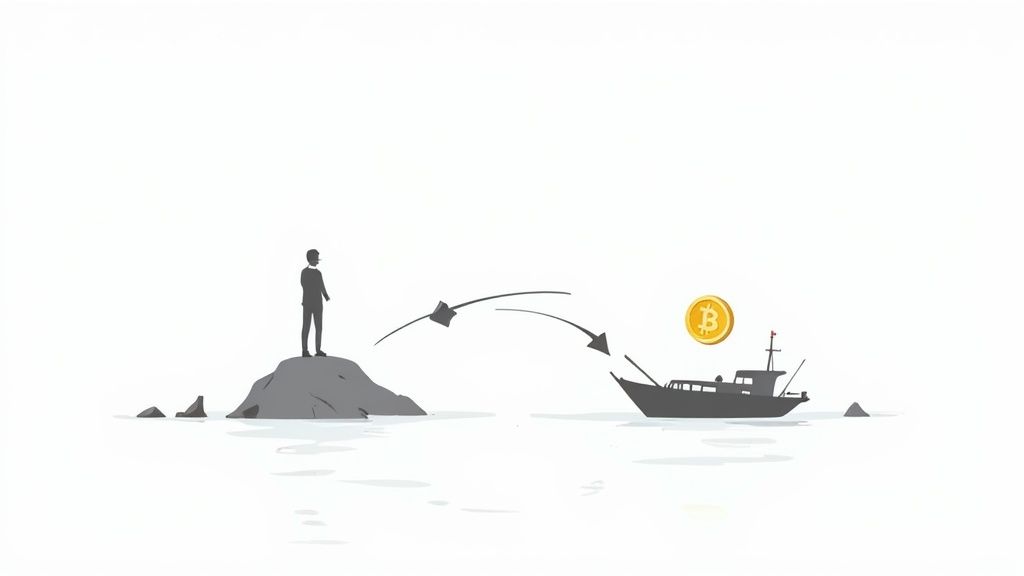
Think of blockchains as isolated islands. To get from one to another, you could take a public ferry, charter a private boat, or even build a temporary bridge. Each option gets you there, but the experience, cost, and risk are totally different. Let's break down the four main ways you'll see this done.
Cross-chain bridges are, by far, the most common and user-friendly way to move assets between blockchains right now. They act like digital ferries, taking an asset on one chain, locking it up, and then issuing a brand-new, equivalent token on the destination chain.
Say you want to move USDC from Ethereum over to Solana. A bridge will lock your Ethereum-native USDC in a smart contract. Then, it mints a "bridged" version of USDC on Solana and sends it to your wallet. The original USDC just sits there, locked up, acting as collateral to make sure the new token holds its value.
This "lock-and-mint" model is super common, though you'll also see "burn-and-mint" or liquidity pool-based systems. The core idea is always the same: create a synthetic IOU on the new chain that's backed by the real deal.
Wrapped tokens are basically a specific product of the bridge concept. They are tokens that represent another asset from a different blockchain. The most famous example is Wrapped Bitcoin (WBTC), an ERC-20 token on Ethereum that’s pegged 1:1 to the price of Bitcoin.
To create WBTC, a custodian—a centralized company—holds real BTC in a vault and mints the matching amount of WBTC on Ethereum. This lets all that Bitcoin value flow into Ethereum’s DeFi world, getting used in lending protocols, DEXs, and more.
While "wrapping" often involves a centralized party, it can also be done through decentralized bridges. The key thing to remember is that the wrapped token is just an "I Owe You" for the original asset, which is stored somewhere else.
The whole idea of wrapped tokens is fundamental to making blockchains talk to each other. It's like teaching a foreign asset to "speak the language" of a new blockchain, unlocking its liquidity and letting it participate in a totally different digital economy.
Atomic swaps are a far more decentralized and secure way to pull off a chain swap crypto transaction. They happen directly between two users, with no bridge or middleman in sight. The "atomic" part means the swap either completes perfectly for both people, or it fails completely and everyone gets their original funds back. No in-between.
This magic is pulled off with a clever bit of cryptography called Hashed Timelock Contracts (HTLCs). Imagine two people putting their funds into separate digital safes that both require the same secret code to open. The swap only goes through if both parties reveal the code within a certain time limit. If not, the safes pop open and return the funds to their owners automatically.
Cross-chain Decentralized Exchanges (DEXs) are the next step in making swaps easy and efficient. These platforms are basically aggregators. They plug into multiple bridges, liquidity pools, and even other DEXs to automatically find the best and cheapest route for your trade.
When you want to swap ETH on Arbitrum for SOL on Solana, a cross-chain DEX gets to work. It might route your trade through one bridge to get the best rate or even split it across several bridges to keep slippage low. From your end, it’s just one seamless transaction.
If you're curious how these platforms work under the hood, it helps to understand what a basic DEX does first. You can learn more about what a DEX does in our detailed explainer before digging into their cross-chain magic.
To make things clearer, here’s a quick rundown of how these four methods stack up against each other.
Ultimately, picking the right method comes down to your priorities. For most people, a cross-chain DEX hits the sweet spot of convenience and good pricing. But if you’re moving a large, life-changing amount, the extra security of an atomic swap might be worth the hassle.
A successful chain swap crypto deal isn't just about getting your assets from point A to point B. It's about ending up with the exact value you thought you were getting. The reality is, a handful of costs—some obvious, some not so much—can take a bite out of your final amount. Getting a handle on these is the key to avoiding nasty surprises.
First up are the most straightforward costs: fees. Every cross-chain swap involves at least two transactions on two different blockchains, which means you’re paying network fees on both sides of the bridge. You'll pay a "gas fee" to send your crypto from the source chain and another fee to claim it on the destination chain.
Then, the platform you're using—be it a dedicated bridge or a cross-chain DEX—will almost always take its own service fee. That’s how they keep the lights on. It’s usually a small percentage of your total transaction value.
But beyond the basic fees, the biggest and most misunderstood cost is slippage. This is the gap between the price you see when you click "swap" and the price you actually get when your transaction finally settles on the blockchain.
It’s a bit like trying to buy a hot stock. The price might wiggle up or down in the seconds it takes for your market order to go through. In crypto, this effect gets cranked up to eleven, mostly due to two things:
At the end of the day, high slippage just means you get fewer tokens than you were quoted. For a big chain swap crypto transaction, even 1-2% in slippage can feel like a punch to the gut.
Let's run through a quick example to see how it all stacks up. Say you want to swap $1,000 worth of ETH on Ethereum for some SOL on Solana.
So, what happened here? Your $1,000 swap actually cost you $28.01 in total fees and lost value. You only end up with $971.99 worth of SOL.
Managing costs is a game of millimeters. Slippage, in particular, is the silent profit killer in cross-chain swaps. Choosing high-liquidity routes and timing your transactions are not just best practices—they are essential for preserving your capital.
The good news is you're not helpless. You can take a few smart steps to keep more of your money where it belongs.
Jumping into the world of chain swap crypto transactions unlocks a ton of new opportunities, but it's not without its own set of dangers. The tech is incredibly powerful, but its complexity can leave openings for bad actors and nasty exploits. Having a security-first mindset isn't just a suggestion—it's absolutely critical if you want to protect your assets out there.
The biggest threats usually zero in on the weakest link in the process: the cross-chain bridges. These platforms are honey pots, holding massive amounts of value in their smart contracts, which makes them a magnet for hackers. A single tiny flaw in a bridge's code can trigger a catastrophic drain of funds that hits thousands of users all at once.
And it’s not just about protocol-level hacks. You also have to be constantly on guard against social engineering and phishing scams. Scammers are getting scarily good at creating fake websites or support channels that look like the real deal, all to trick you into connecting your wallet and signing a malicious transaction. These attacks prey on our sense of urgency and the moments we let our guard down.
To really get what can go wrong, you just have to look at the string of major bridge exploits we’ve seen. In many of the big ones, hackers found a way to exploit a weakness in the smart contract code that's supposed to validate transactions. They basically fool the bridge into releasing funds on the new chain without ever properly locking the original assets on the source chain.
These attacks have siphoned off hundreds of millions of dollars in single events. The aftermath is always messy, leaving users' bridged assets totally unbacked and worthless. It’s a brutal reminder of the huge amount of trust we place in the security and audits of these platforms. When that trust shatters, the consequences are severe. Learning from past incidents is key, and you can see how to trace these complex fund movements in our guide on how to analyze cross-chain bridge transactions.
The very things that make chain swaps so attractive—their speed and borderless nature—are also what criminals love about them. The ability to quickly bounce funds between different blockchains is perfect for obscuring the trail of stolen crypto, making it a nightmare for law enforcement to follow the money. This has turned some cross-chain services into a tool for money laundering.
The scale of this problem is pretty staggering. A recent report found that over $21.8 billion in illicit crypto has been laundered using cross-chain swaps and decentralized exchanges. Bad actors use these platforms to "clean" funds from hacks and scams, moving them between ecosystems like Ethereum and Tron to break the chain of custody. You can dive deeper into these findings in Elliptic's comprehensive report.
Security in the cross-chain world isn't just about dodging scams. It's about fundamentally understanding that the infrastructure itself is a target. Every single swap asks you to trust the bridge's code, its validators, and the integrity of the whole system.
To handle these risks, you need a process. Before you even think about starting a chain swap crypto transaction, run through this security checklist. It’s designed to help you build smart habits and seriously cut down your risk.
1. Vet the Platform and Its Audits
Never, ever use a bridge or DEX aggregator without checking it out first. Stick to platforms that have been through multiple security audits from well-known firms.
2. Lock Down Your Wallet and Connection
Your swap is only as secure as your wallet. Protecting your private keys is job number one.
3. Double-Check Every Transaction Detail
Before you smash that "confirm" button, just stop. Take a breath and carefully review every single detail in your wallet’s pop-up window.
Alright, let's move from theory to practice. This is where you actually get your hands dirty and learn by doing—easily the most empowering part of your crypto journey. I'll walk you through a hypothetical chain swap crypto transaction from start to finish using a cross-chain aggregator as our example.
Following these steps will turn abstract ideas into real skills. By the end, you'll feel much more confident moving assets between blockchains safely and without breaking a sweat.
Every interaction in decentralized finance starts the same way: connecting your wallet. This action lets the platform see your public address and balances, but—critically—it should never ask for or expose your private keys.
This initial connection is just a handshake. It’s read-only and doesn't give the platform permission to move your funds. That comes next, and it's approved on a case-by-case basis for each transaction.
Once your wallet is connected, it’s time to tell the aggregator what you want to do. The interface will feel familiar if you've ever used a standard DEX like Uniswap or Raydium.
This visual guide breaks down the core safety loop for every swap.

It’s a simple but powerful reminder: verify everything first, use a secure wallet, and confirm with care.
This is the most critical part of the process—the point of no return. Here, you'll actually sign permissions and send your funds on their way. It typically involves two separate actions in your wallet.
Before you click that final confirmation, just pause. Seriously. Blockchain transactions are irreversible. A tiny mistake, like sending to the wrong address or misreading a decimal, can lead to a permanent loss of funds.
First, you’ll probably need to approve token spending. This is a security feature where you grant the platform's smart contract permission to access a certain amount of your token. If you have the option, always set a specific limit instead of "unlimited."
With the approval done, you’re ready to execute the main event.
Once you've confirmed, your transaction is officially underway. Most aggregators provide a tracking link, but you can also watch the magic happen yourself using block explorers. It's a two-step process.
This end-to-end tracking gives you full visibility and peace of mind, confirming your chain swap crypto transaction completed successfully.
The ability to move assets freely between blockchains is quickly becoming the backbone of Web3, not just a niche feature for advanced users. For decentralized finance, gaming, and NFTs to truly take off, the experience of a chain swap crypto needs to be faster, cheaper, and a whole lot safer. This is the driving force behind the next generation of interoperability protocols.
Developers are racing to innovate beyond the current reliance on capital-heavy, high-risk bridges. The new wave of solutions is all about creating a single, unified liquidity layer. The goal? Making a swap from Ethereum to Solana feel as simple as a standard transaction on a single network.
We're heading toward a future where Layer-2 scaling solutions and cross-chain infrastructure are no longer separate concepts but are woven together from the ground up. This tight integration is set to create a far more fluid and interconnected digital economy.
The ultimate goal is an 'internet of blockchains' where value flows as freely as information. This requires a level of interoperability that makes the underlying chain irrelevant to the end-user, much like we don't think about which web server hosts a website.
This shift is already showing up in the on-chain data. In a recent quarter, decentralized exchanges exploded with a record $3.9 trillion in trading volume, largely fueled by new-school protocols like LayerZero and Circle’s Cross-Chain Transfer Protocol. At the same time, the total value locked in DeFi jumped 35% to $156 billion, highlighting just how much the industry is leaning on solid cross-chain infrastructure. Discover more insights about these DeFi trends to see exactly where the smart money is moving.
Jumping into the world of chain swaps can feel a bit daunting, so let's tackle some of the most common questions people have. Think of this as your quick-reference guide to nail down the core concepts.
It's a simple but crucial distinction. A regular DEX swap happens on one blockchain. Think of trading ETH for USDC on Uniswap—both tokens live on the Ethereum network. It’s like exchanging dollars for euros at a single bank branch.
A chain swap, on the other hand, is like wiring money from a US bank to a European one. You're moving value between two completely separate financial systems. An example is swapping your ETH on Ethereum for some SOL on Solana, which requires a bridge or some other special tech to connect the two chains.
This is the big question, and the honest answer is: it's a mixed bag. No platform is ever 100% risk-free, and we've all seen headlines about major bridge hacks.
However, the reputable bridges in the space aren't just sitting around hoping for the best. They invest heavily in security, often undergoing multiple independent audits, running bug bounty programs to catch vulnerabilities early, and even setting up insurance funds to make users whole if the worst happens.
The golden rule here is to do your own homework. Trust isn't given; it's earned. Stick to platforms with a long, transparent history of security and community trust before you even think about connecting your wallet.
Patience is a virtue here, because the timing can be all over the place. The total time depends on how fast both the starting and ending blockchains are confirming blocks, not to mention the specific technology the bridge itself is using.
A swap could be done in a few minutes, or it could take over an hour, especially if one of the networks is clogged with traffic.
In a word: no. Once a transaction is confirmed on the blockchain, it's set in stone—it can't be reversed, canceled, or changed. This immutability is one of the foundational principles of crypto.
This is why you have to be almost paranoid about checking the details. Double-check every single digit of the destination address and confirm you've selected the right network. One tiny mistake can send your funds into the void forever.
Ready to turn on-chain data into actionable trading signals? Wallet Finder.ai helps you discover profitable wallets and mirror their strategies in real time. Start your 7-day trial and trade smarter by tracking the smart money. Get started with Wallet Finder.ai today!
"I've tried the beta version of Walletfinder.ai extensively and I was blown away by how you can filter through the data, and the massive profitable wallets available in the filter presets, unbelievably valuable for any trader or copy trader. This is unfair advantage."
.avif)
Pablo Massa
Experienced DeFi Trader