Guide to Wallet Scanner Protection

Wallet Finder

Blank calendar icon with grid of squares representing days.

March 16, 2026

When you’re trading in DeFi, you’re operating in the open. Wallet scanner protection is all about shielding your on-chain moves from the prying eyes of bots and bad actors who feast on public blockchain data. It’s no longer just a good idea—it's a critical defense for any active trader.

Why Wallet Scanner Protection Matters Now

Think of the blockchain as a city made of glass, where every single transaction is a public spectacle. A wallet scanner is like a digital P.I., constantly sifting through those public records. For a researcher or a fellow trader, this is great—it helps uncover winning strategies. But in the wrong hands, it’s a reconnaissance tool for thieves to spot your every move and plan their attack.

In this glass city, your wallet address is your identity. Every swap, every NFT mint, and every token transfer leaves a permanent digital footprint. Without proper protection, those footprints create a map leading straight to your trading strategies, your holdings, and, ultimately, your vulnerabilities.

The Financial Stakes of Inaction

These threats aren't just hypotheticals; they come with a massive price tag. As on-chain tools get smarter, so do the criminals. They can pinpoint wallets with huge balances, front-run your profitable trades, or target you with custom phishing scams based on the dApps you use. Every unprotected trader is a potential target.

The numbers are staggering. In the first half of 2025 alone, crypto thieves made off with over $2.47 billion through various exploits. Wallet compromises accounted for $1.7 billion of that across just 34 major incidents. The trend is clear: attacks on personal wallets now make up 23.4% of all stolen funds as hackers shift their focus to individuals like you. You can read more about these security trends and how they impact DeFi traders.

In a world of open ledgers, your on-chain activity is your biggest liability. Protecting how and when your actions are seen is the first and most important step to securing your assets long-term.

Ultimately, ignoring wallet scanner protection is like leaving the blueprints to your vault out in a public square. It’s not a matter of if someone will notice, but when. Understanding these risks is the first step toward building a solid defense against the ever-present watchers of the blockchain.

Decoding the Top On-Chain Threats

To build solid wallet scanner protection, you first need to know what you’re up against. Bad actors don't just stumble upon profitable wallets; they use the public nature of the blockchain to run calculated, automated attacks based on your on-chain footprint.

Think of it this way: every transaction you make leaves a breadcrumb. Scanners gather these breadcrumbs, connect them to on-chain analysis tools, and turn your success into a target for someone else.
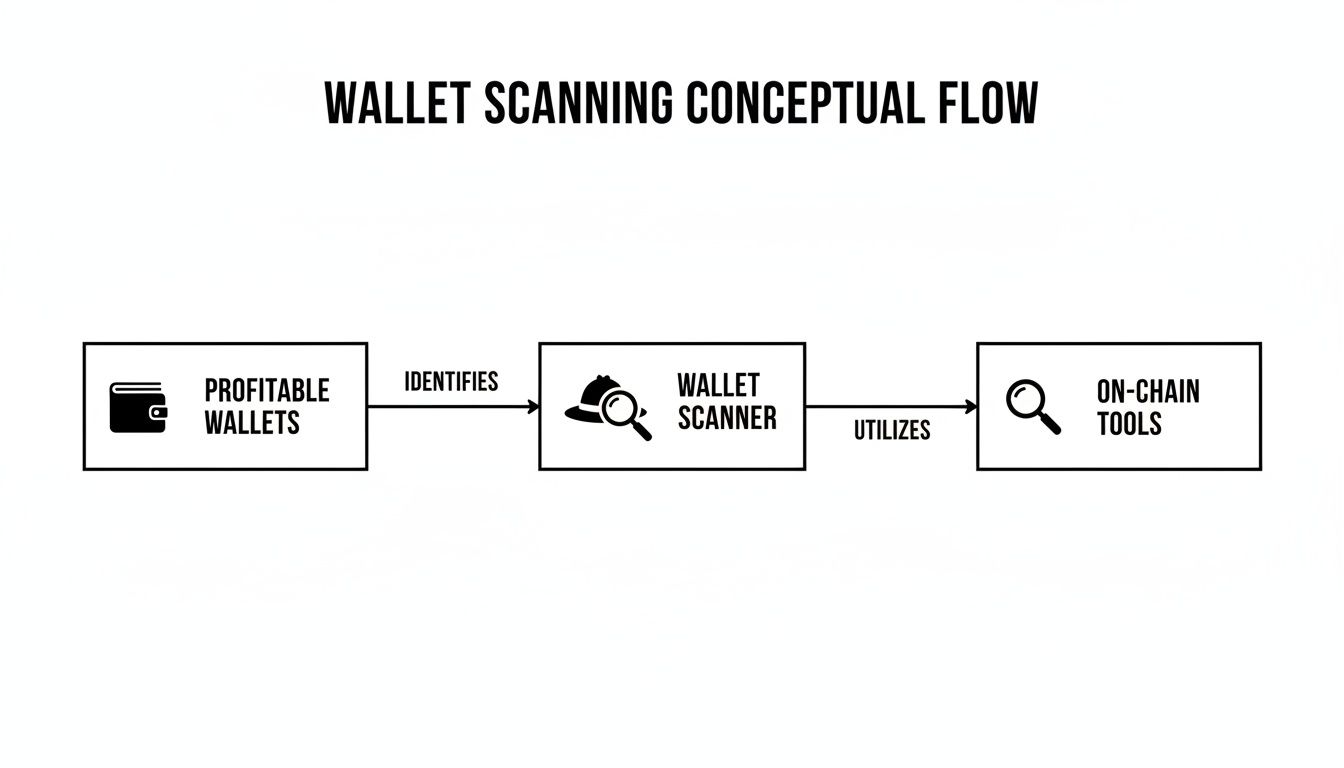
A conceptual flow diagram illustrating how a wallet scanner identifies profitable wallets and utilizes on-chain tools.

This flow shows how scanners create a bridge from public data to actionable intelligence for attackers. Let's break down the most common threats that pop up from this process.

MEV and Sandwich Attacks

One of the biggest and most frustrating threats is Maximal Extractable Value (MEV). Imagine you’re about to make a big swap on a decentralized exchange (DEX). Once you hit "confirm," your transaction doesn't execute instantly. It goes into a public waiting room called the mempool.

MEV bots are constantly watching this mempool. When they see your large buy order, they can launch a "sandwich attack" in milliseconds:

  1. Front-running: The bot sees your trade and immediately submits its own buy order for the same token. It pays a higher gas fee to cut in line, ensuring its transaction is processed right before yours. This tiny action pushes the token price up.
  2. Your Trade Executes: Your purchase goes through, but you end up paying the slightly higher price the bot just created. Your own trade pushes the price up even more.
  3. Back-running: The bot instantly sells the tokens it just bought, capturing a neat, risk-free profit from the price difference you created.

You get fewer tokens for your money, and the bot walks away with your slippage. It's a classic example of how your own on-chain activity can be weaponized against you.

Privacy Leaks and Targeted Phishing

Every transaction tells a story. Scammers are experts at reading them. By digging into your wallet history, they can see which NFT projects you love, the DeFi protocols you use daily, and the tokens you’re holding.

This isn't just snooping—it's ammo for crafting hyper-personalized phishing attacks. For instance, if a scammer sees you hold a Bored Ape, they might slide into your DMs on X or Discord with a fake link to a "special airdrop for holders." Because the bait is tailored to your actual holdings, it feels far more believable than a generic scam. You can dive deeper into these schemes in our guide to DeFi wallet scams.

Protecting yourself isn’t just about hiding your P&L; it's about hiding the behavioral patterns that make you an easy mark. These are just a few of the risks, but they highlight the different angles of attack traders face.

Common On-Chain Threats from Wallet Scanning

The table below breaks down the primary threats that arise from wallet scanning, who they impact, and what's at stake.

Threat TypeDescriptionPrimary ImpactMost Vulnerable Traders
Sandwich Attacks (MEV)A bot detects your pending trade, front-runs it, and then back-runs it to profit from the price slippage you created.Loss of funds on trades, reduced profitability.DEX traders, especially those making large swaps.
Targeted PhishingScammers analyze your wallet activity (e.g., specific NFT collections or DeFi protocols you use) to craft highly convincing, personalized scam messages.Total wallet drain, loss of specific high-value assets.Active community members, NFT collectors, airdrop hunters.
Honeypot TrapsA wallet with an incredible P&L is promoted to lure copy traders. The assets it trades are scam tokens that can be bought but not sold by others.Complete loss of capital invested in the honeypot token.Copy traders, anyone looking for 'alpha' on-chain.
Privacy Leak & DoxxingAggregating your on-chain and off-chain data (like social media) to link your real-world identity to your wallets.Risk of real-world extortion, targeted harassment, and social engineering attacks.High-profile traders, influencers, anyone linking a wallet to a public profile.

As you can see, the threats range from automated financial extraction to deeply personal security risks. Understanding them is the first step toward building a trading workflow that keeps you safe.

Actionable Steps for Wallet Protection

Knowing the threats is one thing, but actually doing something about them is what keeps your funds safe. Effective wallet protection isn't about finding a single magic bullet; it's about building layers of security around your assets. Think of this as your playbook for hardening your on-chain defenses, starting with simple habits and building up to more technical moves.

Secure, layered digital wallet illustration with HODL, Trading, Burner sections, private RPC, alerts, and multisig features.

By mixing and matching these strategies, you can seriously shrink your visible footprint and make it much, much harder for bots and bad actors to track or exploit your activity.

Master Your Wallet Hygiene

This is the absolute foundation. Stop using one wallet for everything. You wouldn't keep your life savings in the same wallet you use for pocket cash, right? The same exact logic applies to your crypto.

  • The HODL Vault (Cold Storage): This wallet is for your long-term holds—the assets you aren't actively trading. It should be a cold wallet, like a hardware device, that rarely ever touches a dApp. Its security is everything.
  • The Trading Wallet (Hot Wallet): This is your daily driver for swaps and DeFi farming. It should only hold the capital you need for your current strategy, which caps your potential losses if it ever gets compromised.
  • The Burner Wallet (Temporary Hot Wallet): Got a new, unaudited dApp you want to try? Minting an NFT from a project you just heard about? Use a disposable burner wallet. If it turns out to be a scam, you only risk the handful of funds in that wallet, not your entire stack.

Separating your funds like this contains the blast radius. A mistake in one area (like that degen mint) won't sink your whole ship. It’s a core principle of good security. While it takes a bit of organization, you can get a handle on the fundamentals by reading our guide on the role of a seed phrase wallet and how to secure it.

Implement Technical Defenses

Once your funds are separated, you can get more technical to hide your activity from prying eyes and hungry bots. These methods add some serious muscle to your wallet protection strategy.

Your IP address is a huge piece of data that connects your on-chain moves to your real-world location. Most wallets use public RPC endpoints by default, and these services often log your IP, making that data available to the node provider and, potentially, to chain surveillance firms.

Here are some key technical defenses you can implement:

Defense MethodAction RequiredWhy It Works
Use a Private RPCSwitch your wallet's network settings from the default public RPC to a private one from services like Alchemy or Infura.Breaks the link between your IP address and your wallet address, obscuring your physical location and preventing IP-based tracking.
Set Up Custom AlertsUse a tool (like Wallet Finder) or a bot to create instant notifications (Telegram, Discord, email) for any transaction on your high-value wallets.Provides immediate awareness of unauthorized activity, giving you a chance to react before funds are completely drained.
Enable MultisigFor significant capital, use a multi-signature wallet that requires multiple private keys (e.g., 2-of-3) to authorize transactions.Eliminates a single point of failure. A thief must compromise multiple devices/keys, making theft exponentially harder.
Use MEV ProtectionUse DEX aggregators or wallet features that offer MEV protection, which routes transactions through private mempools to shield them from sandwich attacks.Prevents bots from front-running your trades, ensuring you get better execution prices and don't lose value to slippage.

How Wallet Finder.ai Enhances Your Security

While taking practical steps to protect your wallets is a great start, the tools you use for on-chain research matter just as much. We built Wallet Finder.ai with a security-first mindset because we believe a powerful research platform should never add new risks to your workflow.

Think of it as a secure analysis layer that sits on top of the blockchain. It gives you all the insights you need to find winning strategies and track smart money, but without ever compromising your operational security or putting your own assets in the crosshairs.

Your Keys Stay Yours, Always

Let's make this crystal clear: Wallet Finder.ai will never ask for your private keys or seed phrases. This is a non-negotiable rule for us. Your keys represent your ownership, and they must always stay under your control, stored safely in your own wallet.

This is your most important line of defense. By never handling your keys, we completely remove the risk of a platform-level breach ever affecting your funds. You can connect a wallet to view our dashboards and analytics, but it’s strictly a read-only connection.

We believe that the best wallet scanner protection comes from tools that respect your self-custody. Our platform is built to provide intelligence without ever needing access to your assets, ensuring your funds are never at risk from using our service.

This separation is fundamental. It means that even in a worst-case scenario, like a database hack, attackers would find nothing to steal because we simply don't store private keys. This design lets you safely scan protected wallets and break down their strategies without opening up a new vulnerability in your own setup.

Secure Authentication and Encrypted Connections

Your security isn't just about your crypto—it's also about your personal data. That’s why we use AWS Cognito for all user authentication. Cognito is an industry-leading service from Amazon Web Services that securely manages everything from user sign-up and sign-in to access control.

By handing over credential management to AWS, we get the benefit of their world-class security infrastructure. It means your login details are handled by a system designed to repel sophisticated attacks, not some homegrown solution.

On top of that, every shred of data sent between your browser and our platform is protected with end-to-end encryption. This blocks any "man-in-the-middle" attacks where a snooper could intercept your research activity. All your interactions, from searching a wallet to building a watchlist, are kept completely private.

Advanced Strategies for Safe Copy Trading

For traders chasing real alpha, your research has to go way deeper than a simple profit and loss statement. Blindly copying a wallet just because it has a high P&L is a recipe for disaster. Real wallet scanner protection is about becoming a detective—you have to vet a wallet's entire history and hunt for the red flags that separate a trading genius from a cleverly disguised trap.

An illustration of vetting a wallet using history and checklist before securing with a shield.

This is what "intelligent copy trading" is all about. It’s not about just mimicking every transaction someone makes. It’s about digging in to understand the why behind their trades, sizing up their risk management, and making sure their strategy is legit before you even think about putting your own capital on the line.

Spotting Honeypot Wallets and Other Red Flags

Honeypot wallets are pure deception. They're crafted to look incredibly profitable, luring in copy traders with jaw-dropping returns. The catch? They often trade scam tokens that anyone can buy, but only the creator can sell. Your job is to spot the con before you get stuck.

When you're vetting a wallet on a platform like Wallet Finder.ai, keep an eye out for these tell-tale signs:

  • Unusual Token Concentration: Does the wallet almost exclusively buy one or two obscure tokens and never sell? This is a massive red flag. It strongly suggests the token is a trap that regular users can't unload.
  • No Profit-Taking: Any real trader takes profits off the table. A wallet that just keeps accumulating a specific token without ever cashing out could be part of a pump-and-dump or a honeypot scheme.
  • Interaction with Known Scam Contracts: Use a block explorer to see what contracts the wallet is interacting with. If they’re already flagged as scams or have malicious functions coded in, run the other way.
  • Erratic, Illogical Trading: Is the wallet making massive, high-slippage trades at bizarre hours? That might not be a person on the other end. It could easily be a bot executing a pre-planned scam.

The global crypto security market is exploding, projected to grow from $3,998.1 million to over $28,494.5 million by 2036, driven by a surge in wallet-related threats. For DeFi copy traders, this means wallet vetting is no longer optional. As regulators tighten rules, platforms like Wallet Finder.ai that prioritize security and enable deep analysis become essential tools. You can read the full report on rising crypto crime to understand the shifting landscape.

A Checklist for Vetting Potential Wallets

Before you even consider adding a wallet to your watchlist, run it through this quick diagnostic checklist. This structured approach helps ensure you don’t overlook critical warning signs in the heat of the moment.

  1. Analyze the P&L History: Is the profit steady and consistent over time, or did it all come from one lucky moonshot? Consistency is almost always a sign of a more reliable, repeatable strategy.
  2. Review Win/Loss Ratio: A high win rate looks great on the surface, but you have to look at the size of the losses. One catastrophic loss can easily wipe out dozens of small wins and blow up an account.
  3. Check Token Diversity: Is the wallet trading a healthy mix of legitimate, well-known assets, or is it hyper-focused on one or two unknown tokens? The latter is far riskier.
  4. Examine Transaction Frequency: Does the activity level look like something a human could realistically manage? Or does it look more like a high-frequency bot firing off trades 24/7?
  5. Inspect First and Last Transactions: When did this wallet pop into existence? A brand-new wallet showing an unbelievable P&L almost overnight is extremely suspicious.

Use Offline Data for Secure, Deep Analysis

One of the most powerful—and safest—ways to analyze a wallet is to take your research offline. Wallet Finder.ai lets you export all the transaction data you need. By doing this, you can load everything into a spreadsheet or your own local analytics tool.

This technique is a game-changer for advanced wallet scanner protection, accomplishing two critical goals:

  • It minimizes your on-chain footprint. You aren't constantly pinging the blockchain or a public tool with queries, which drastically reduces the digital breadcrumbs you leave for bots and bad actors to follow.
  • It allows for deeper, custom analysis. In a private, offline environment, you're in complete control. You can run custom scripts, build complex models, and cross-reference data without any limitations, turning raw on-chain data into protected, actionable intelligence.

Common Questions About Wallet Security

When you start digging into wallet scanner protection, a lot of questions pop up. Let's clear up some of the most common ones so you can build a stronger security habit and trade with more confidence.

Is a VPN Enough to Protect Me From Wallet Scanners?

No. Using a VPN is a great start, but it's only one piece of the puzzle. A VPN is fantastic for hiding your IP address, which stops basic trackers from connecting your on-chain moves to your real-world location. That’s a critical part of your operational security.

But here’s the thing: a VPN can't hide your activity on the public blockchain. Every single transaction your wallet makes is logged on that ledger, visible to anyone who looks. Attackers can still pull your wallet's entire history, figure out your strategies, and target you based on what you do on-chain.

Real wallet scanner protection is about layers. A VPN secures your internet connection, but you also need other techniques—like using separate wallets for different activities and routing transactions through private RPCs—to protect your on-chain identity.

What's the Difference Between Hot and Cold Wallets for Scanning?

The main difference is all about online exposure. Think of it like this:

  • A hot wallet (like MetaMask or Phantom) is always connected to the internet. It’s built for active trading, making it super convenient but also constantly exposed to threats like phishing scams and malicious smart contracts.
  • A cold wallet (like a Ledger or Trezor hardware device) is kept completely offline. Its private keys never touch an internet-connected device, which makes it virtually immune to remote hacks.

Wallet scanners can see the public address and transaction history for both hot and cold wallets—that data is public. The crucial distinction is that they can only directly compromise a hot wallet through an online attack. To get the funds from a cold wallet, a thief would need to physically steal your device or, more likely, trick you into plugging it in and signing a malicious transaction.

This is why the best strategy is to use cold wallets for long-term storage ("HODLing") and keep only smaller, active trading amounts you're willing to risk in your hot wallets.

How Can I Spot a Honeypot Wallet?

Spotting a honeypot wallet takes a bit of detective work before you start copying its trades. These wallets are set up to look incredibly profitable to bait you into a trap. Here are some of the biggest red flags to look for when you're analyzing a wallet's history:

  • One-Way Trades: The wallet is constantly buying one or two specific, unknown tokens but almost never sells them. This often means the token has a contract that blocks anyone except the creator from selling.
  • Suspicious Token Contract: Use a block explorer to dig into the token contract itself. Watch out for functions that restrict transfers or contain address blacklists. Contract analysis tools can be a huge help here.
  • Unrealistic Profits: A brand-new wallet showing nothing but massive, uninterrupted gains is a major red flag. Real trading has wins and losses. A perfect track record usually means it's a scam.

Always do your own research on the wallet's full transaction history and the tokens it trades before you even think about following its moves.


Ready to turn on-chain data into actionable intelligence without compromising your security? Wallet Finder.ai helps you discover profitable wallets, track smart money, and get real-time alerts so you can act ahead of the market. Start your 7-day free trial and see what you’ve been missing at https://www.walletfinder.ai.