Master Your DeFi with a Smart Contract Wallet

Wallet Finder

Blank calendar icon with grid of squares representing days.

April 30, 2026

Losing a seed phrase is the kind of mistake that keeps crypto traders awake at night. So does clicking through a string of approvals just to complete one routine DeFi move. If you've ever approved a token, signed a swap, then signed another action for staking or bridging, you've already felt the limits of the old wallet model.

A traditional wallet works like a single metal key. Hold the key, control the funds. Lose it, and you're stuck. A smart contract wallet changes that model. Instead of relying only on one secret, it lets you set rules around how the account behaves onchain.

That difference matters more than most beginner guides admit. You're not just upgrading security. You're changing what a wallet is. It stops being a passive container and becomes an active account that can enforce approvals, limits, recovery methods, and multi-step actions.

For traders, that shift is practical. It changes how transactions appear, how strategies execute, and how you should interpret wallet behavior when studying smart money. Some of the cleanest onchain activity now comes from wallets that don't act like simple retail addresses at all.

Introduction Beyond the Private Key

The old wallet model is brutally simple. One private key controls everything. That's easy to understand, but it's also fragile. A single compromised device, a lost seed phrase, or one bad signing session can turn a manageable mistake into a permanent loss.

A smart contract wallet solves that by replacing single-key control with programmable rules. You still control your funds, but the control can be shared, delayed, limited, or recovered depending on how the wallet is configured.

A broken rusty padlock and key next to a glowing blue digital wallet with mechanical gears.

Why traders started paying attention

Institutions moved early because the benefits look familiar to treasury teams. According to SQ Magazine's 2025 wallet adoption data, 52% of institutional wallets interact with smart contracts monthly to use enhanced security features. That matters because it shows this isn't a niche wallet preference. It's part of how serious capital is operating onchain.

For a newer trader, the easiest way to think about it is this:

  • EOA wallets are keys
  • Smart contract wallets are rule-based accounts

That one change provides better control over approvals, spending, team access, and recovery. It also creates richer behavior onchain. A wallet can require multiple signers. It can reject transfers above a threshold. It can bundle several actions together as one operation.

If you want a baseline on how standard crypto wallets differ before going deeper, this guide to the crypto DeFi wallet is a useful primer.

A better mental model

Think of a normal wallet like a house key taped to the front door. Whoever has the key gets in. A smart contract wallet is closer to a building with staff, access logs, approval rules, and backup contacts.

That sounds more complex, and it is. But the complexity is there to remove the all-or-nothing risk that comes with single-key wallets.

Practical rule: If your strategy depends on large balances, shared capital, or frequent DeFi actions, a wallet that follows rules is usually safer than a wallet that trusts one signer forever.

This is also why smart contract wallets matter to analysts. Their transactions often reflect deliberate setup rather than impulse. When you study these wallets, you're not just looking at trades. You're looking at decision systems.

How Smart Contract Wallets Fundamentally Work

The engine behind the modern smart contract wallet is usually account abstraction. That phrase sounds technical, but the idea is simple. It separates the account from the old assumption that one private key must directly authorize every transaction.

With account abstraction, your wallet can be a smart contract. That contract defines what counts as valid authorization. The rule might be one signature, multiple signatures, a passkey, a sponsored gas flow, or some other approved method.
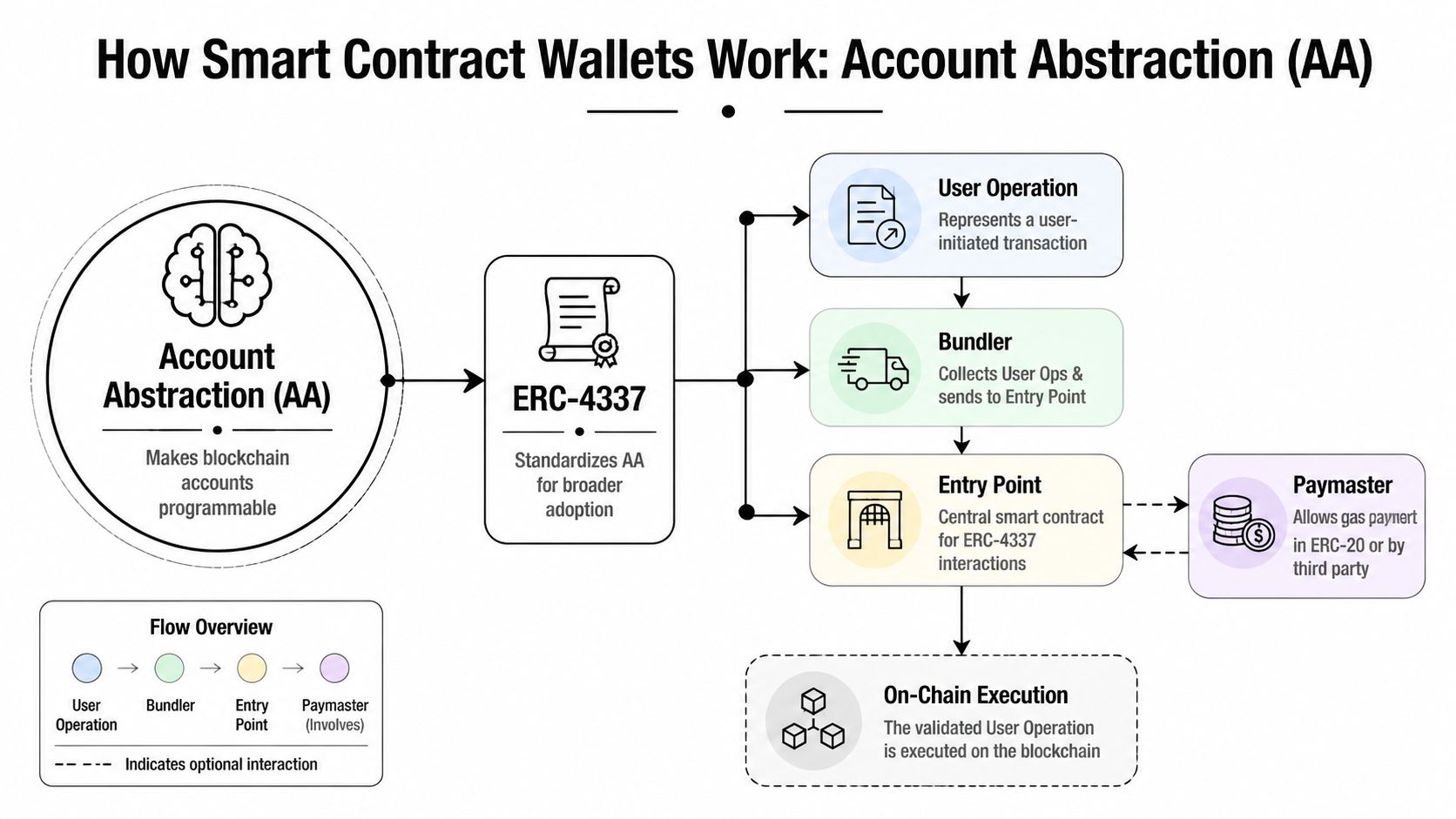
A diagram explaining how Account Abstraction and ERC-4337 work for smart contract wallets via blockchain components.

Think of it like a programmable assistant

A good analogy is a personal trading assistant with written instructions.

You tell the assistant what you're trying to do. Not every instruction gets executed automatically. The assistant checks the rules first. Does this action need another approval? Is the amount within a spending limit? Can gas be paid another way? If the conditions are met, the action goes through.

That assistant is the wallet contract.

Under ERC-4337, the process is standardized. As explained in Ledger's ERC-4337 overview, the architecture has five core components: UserOperations, Bundlers, EntryPoint, Paymasters, and Smart Accounts. Ledger also notes ERC-4337 was formally announced for production on March 1, 2023, and can work on any EVM-compatible blockchain.

The five pieces in plain English

This outlines each part's function.

ComponentPlain-language roleWhy it matters to traders
UserOperationYour instructionIt describes what you want the wallet to do
BundlerA courierIt collects user instructions and sends them onward
EntryPointThe gateway contractIt verifies and executes the operation
PaymasterA fee sponsorIt can let someone else cover gas, or support alternate fee flows
Smart AccountYour programmable walletIt enforces the wallet's custom rules

A normal wallet signs and broadcasts a transaction directly. A smart contract wallet often sends intent through this ERC-4337 flow instead.

That changes the shape of execution.

Why the flow feels different onchain

The term UserOperation confuses a lot of new traders because it isn't the same as a traditional transaction. It's closer to a request packet. It says what the user wants done, along with the proof and wallet logic needed for validation.

A Bundler collects those requests and submits them. The EntryPoint contract acts as the shared place where those requests are checked and executed. A Paymaster can step in if the wallet is designed to support sponsored gas or alternate fee handling.

Smart accounts don't just hold assets. They evaluate instructions against policy before execution.

That last point is where the fundamental shift happens. The wallet itself becomes the rule engine.

What this means in live DeFi use

Suppose a trader wants to approve a token and swap it in one coordinated action. With a basic wallet, that often means separate signatures and separate chances for something to go wrong. With a smart contract wallet using ERC-4337-style logic, those steps can be bundled into one atomic flow.

That matters when markets move fast. Atomic execution reduces the awkward gap between step one and step two.

It also makes wallet activity more nuanced for anyone reading the chain. You may see fewer obvious retail-style sequences and more compressed, policy-aware execution patterns.

If you're analyzing top-performing addresses, that distinction helps. A smart contract wallet is often showing you a system, not just a person clicking buttons.

Key Features Unlocking a Better DeFi Experience

Features are where the smart contract wallet stops sounding theoretical and starts feeling useful. The same programmable logic that changes validation also changes the daily trading experience.

The easiest mistake is to treat these features as convenience add-ons. They're not. They reshape risk, execution, and account recovery.

Multi-signature approval

Multi-signature, often shortened to multisig, works like a shared safe that needs several people to turn their keys before it opens. No single signer can move funds alone unless the rules allow it.

According to ChainUp's explanation of smart contract wallet architecture, smart contract wallets replace single-key authorization with M-of-N multi-signature requirements, time-based conditions, and amount-based restrictions. That same architecture enables enterprise-grade controls and social recovery without depending on a seed phrase.

For traders and treasury operators, multisig changes behavior in two ways:

  • Large transfers become deliberate because multiple approvals can be required.
  • Internal fraud risk drops because one operator can't act alone if the policy blocks it.
  • Auditability improves because the authorization path is embedded in wallet logic.

This is why multisig wallets often look calmer onchain. You tend to see fewer random reactions and more intentional positioning.

Social recovery

Social recovery is easier to understand with a non-crypto analogy. It's like being locked out of a bank account and having pre-approved trusted people confirm your identity so you can regain access.

With a traditional wallet, losing the seed phrase can end the story. With social recovery, the wallet can define guardians or recovery contacts in advance. If access is lost, those parties help restore control without exposing a single master secret.

That doesn't remove responsibility. It changes the kind of responsibility you have. You now need to choose reliable guardians and define a recovery process before anything goes wrong.

Spending rules and time-based controls

Most beginner wallet guides focus on storage. Smart contract wallets focus on policy.

That policy can include:

  • Amount-based restrictions that limit how much can move in one action
  • Time-based conditions that delay or schedule execution
  • Role-based access for teams handling treasury operations
  • Allowlist logic for approved counterparties or actions

These rules are especially useful when one wallet manages shared capital, family assets, or strategy funds.

A wallet with guardrails is often more valuable than a wallet with one perfect key.

Gas abstraction and smoother execution

Gas abstraction means the wallet can support more flexible fee handling than a standard EOA. In practice, that can make the experience feel less brittle.

Instead of forcing the user into one narrow funding pattern, the wallet architecture can support sponsored fees or alternate fee flows depending on its design. That makes onboarding and repeated DeFi actions easier, especially for users who don't want the old ritual of keeping native gas tokens topped up on every chain.

For active traders, convenience isn't the main point. Reliability is. Fewer funding frictions means fewer interrupted workflows.

Transaction batching

Batching is one of the most underrated features for DeFi users. It's comparable to giving one signed instruction sheet to a clerk instead of standing in line three times for three separate actions.

A smart contract wallet can package several steps into one operation. Common examples include:

  1. Approve and swap in one coordinated flow
  2. Move collateral and borrow without separate manual confirmations
  3. Run multi-leg DeFi actions as one atomic execution path

For traders, batching has two practical benefits. It reduces awkward sequencing risk, and it creates cleaner execution when timing matters.

For analysts, it changes how you read wallet behavior. A batched action may represent a full strategy move that would look fragmented in a normal wallet.

Comparing Smart Contract Wallet Implementations

Not every smart contract wallet is built for the same job. Some are designed for treasuries and teams. Others focus on individuals who want a cleaner mobile experience. The right choice depends less on hype and more on who controls the funds, how often the wallet transacts, and how much policy you need.

The names most traders run into first are Safe, Argent, and Ambire. They all sit under the broad smart wallet umbrella, but they don't feel the same in practice.

Smart Contract Wallet Comparison

WalletPrimary Use CaseSupported ChainsKey Security FeatureGas Abstraction
SafeTeam treasuries, DAOs, shared capitalMultiple EVM chainsMulti-signature policy controlAvailable in wallet workflows depending on setup
ArgentIndividual DeFi users, mobile-first usageSelected supported networksSocial recovery oriented designDesigned to reduce fee friction for users
AmbireEveryday multi-chain users who want smart wallet featuresMultiple supported networksPolicy-based smart account controlsSupports smoother fee handling in wallet experience

Safe for shared capital

Safe is the wallet many traders first notice when following treasury addresses and DAO operations. Its reputation comes from structured approvals and shared control. If a wallet needs multiple parties to authorize a move, Safe is often the reference point.

That makes it strong for:

  • Team operations
  • Treasury management
  • Funds that need clear signer policies

Its trade-off is obvious. It can feel heavier for a solo trader who just wants speed and simple recovery.

Argent for personal usability

Argent took a different route. It pushed hard on making smart wallet behavior feel normal for individuals, especially on mobile.

That tends to appeal to users who want:

  • Seedless-style recovery paths
  • Cleaner consumer UX
  • Less operational overhead than a treasury wallet

Argent makes the smart contract wallet concept easier to live with day to day. The trade-off is that some advanced users may want more custom policy depth or broader workflow flexibility than a consumer-first design emphasizes.

Ambire for flexible multi-chain use

Ambire sits in the middle for many users. It aims to make smart wallet benefits accessible without feeling like enterprise software.

That can suit traders who care about:

  • Multi-chain access
  • Improved signing experience
  • Practical smart account controls without a treasury setup

The main question with any mid-spectrum wallet is whether its defaults match your actual risk profile. Some users want minimal friction. Others want stricter controls than a convenience-first setup offers.

A useful way to choose

If you're deciding between implementations, ignore branding for a minute and ask four direct questions:

  1. Who needs authority over this wallet
  2. How costly would a mistaken transaction be
  3. Do I need recovery that doesn't depend on one seed phrase
  4. Will I run multi-step DeFi actions often

Those answers usually narrow the field faster than feature lists do.

Security Practices and Copy Trading Considerations

A common claim about the smart contract wallet is that it's "more secure." That's incomplete. It's often more controllable, and that's different.

Control adds safety in many cases. It also adds timing friction, extra logic, and more moving parts. For copy traders and onchain analysts, those trade-offs matter.

A hand holding a digital tablet displaying secure blockchain transactions and a rising returns growth graph.

The trader's security checklist

Before looking at copy trading, start with wallet hygiene. Smart wallet features only help if the rules are sensible.

  • Choose guardians carefully. If your wallet supports social recovery, use people or devices you trust to be responsive and discreet.
  • Set realistic spending controls. Limits that are too loose won't protect you. Limits that are too strict will interrupt normal trading.
  • Review permissions often. A programmable wallet can accumulate modules, approvals, or signer assumptions that no longer match your needs.
  • Separate roles. If one wallet handles treasury functions and another handles fast speculation, don't force them into the same policy design.

These are operational choices, not just technical settings.

Why latency changes the signal

As noted in Cobo's discussion of smart contract wallet trade-offs, policy-driven authorization such as multi-sig can create latency, and that creates a meaningful trade-off for copy traders who depend on immediate signal detection.

A delayed transaction can mean two very different things:

Observed behaviorPossible interpretation
Approval takes timeInternal review or required co-signing
Batched execution appears suddenlyStrategy was prepared in advance and pushed atomically
Fewer impulsive transactionsStronger policy discipline, but slower mirror opportunities

For a copy trader, this means the first visible action may not be the true start of the decision. By the time the chain shows the final execution, the wallet's owners may have discussed, approved, and prepared the move offchain already.

That can reduce your reaction window.

Why slower can still be better

Latency isn't always bad from a signal perspective. A multi-sig wallet making a sizable move may deserve more attention than a random single-key wallet firing off ten swaps in a panic.

Don't treat execution delay as weakness. Sometimes it's evidence the trade passed a higher approval threshold before it touched the chain.

That doesn't guarantee quality. It does tell you the wallet likely follows process.

For more detail on how tracked smart wallets differ from standard addresses, this smart wallet crypto overview adds useful context.

How analysts should adjust

When monitoring a smart contract wallet for copy trading, don't read it like a retail EOA. Focus on:

  • Atomic bundles instead of isolated actions
  • Approval structure instead of just speed
  • Consistency over time rather than one flashy trade
  • Recovery and governance clues that suggest institutional or team-managed behavior

A slow wallet can still be a high-quality signal source. You just need to judge it by the right criteria.

Tracking Smart Wallets with Wallet Finder.ai

Tracking a smart contract wallet isn't the same as watching a simple swap feed. The wallet may batch actions, route through standardized infrastructure, or execute under policy conditions that hide the actual intent until the final onchain moment.

That's exactly why many traders misread them.

A magnifying glass inspecting connected financial wallets with yen coins, representing smart contract wallet security analysis.

What makes smart wallets worth tracking

A smart wallet often leaves stronger structural clues than a basic address. You may see coordinated execution, cleaner strategy grouping, and fewer low-conviction clicks.

Those traits matter because serious traders care about repeatability, not just one profitable moment.

When analyzing a smart wallet, look for patterns like these:

  • Batched actions that combine approval and execution into one visible sequence
  • Consistent protocol usage rather than random token hopping
  • Wallet behavior that suggests governance or team process
  • Repeatable entry and exit logic across multiple trades

These patterns can help separate disciplined operators from noisy activity.

How a tracker helps decode complexity

The challenge with smart wallets is interpretation. A raw block explorer view can show contract calls and nested actions that are technically accurate but hard to read quickly.

A tracking platform helps by translating wallet behavior into something a trader can evaluate:

What you need to knowWhy it matters
Whether a wallet acts consistentlyConsistency matters more than isolated wins
How entries and exits are timedTiming quality often defines copy trade outcomes
Whether the history is readable across many tradesClean historical context helps you judge real edge
Which wallets deserve alertsYou can't monitor every address manually

This is especially important when the wallet doesn't behave like a normal retail signer. A tracker that can surface the trading history, recurring patterns, and timing profile gives you a far better read than manual monitoring alone.

Practical signals to watch for

If you're studying smart wallet activity, start with a short checklist:

  1. Look for non-random execution

    One atomic bundle often says more than five scattered swaps.

  2. Check if the wallet repeats the same style

    Repetition suggests process. Process is easier to evaluate than one-off luck.

  3. Judge reaction speed carefully

    Some smart wallet trades are best copied early. Others are better treated as confirmation that a narrative is strengthening.

  4. Prefer readable history over mystery

    If you can't understand how the wallet makes money, don't chase it.

For traders who want a focused view of how tracked smart wallets can be monitored in practice, this smart wallet tracker guide is a helpful follow-up.

The edge isn't just finding a profitable wallet. It's understanding whether that wallet's structure makes its signals usable.

Conclusion Your Future Wallet is Programmable

The biggest shift in wallets isn't cosmetic. It's architectural. A smart contract wallet changes the account from a key-controlled object into a rule-controlled system.

That matters for security because one lost secret no longer has to define the entire outcome. It matters for usability because complex DeFi actions can be handled more cleanly. It matters for analysis because these wallets often express intention differently than standard EOAs do.

New traders usually focus on the visible features first. Multi-sig. social recovery. batching. gas flexibility. Those are important, but the deeper change is that authorization becomes programmable. Once that clicks, the rest of the smart wallet model starts to make sense.

For active traders, the lesson is straightforward. You can't evaluate all wallets with the same lens anymore. Some addresses are just individuals clicking through trades. Others are smart accounts enforcing policy, shared control, and coordinated execution. If you read both the same way, you'll miss context that affects timing, conviction, and copy-trade quality.

For analysts, this creates a practical edge. The more onchain activity shifts toward programmable accounts, the more valuable it becomes to identify wallets that act with structure rather than noise.

A smart contract wallet isn't just a better version of the old wallet. It's a different category of account. Traders who understand that difference will read the chain more accurately, manage risk more intelligently, and spot stronger signals earlier than traders who only look for obvious buys and sells.


Wallet Finder.ai turns complicated onchain wallet behavior into something traders can use. If you want to discover profitable wallets, inspect full trading histories, monitor smart money in real time, and build alerts around high-signal activity, explore Wallet Finder.ai.