Cryptocurrency Compound Interest Calculator & DeFi Guide
Use our cryptocurrency compound interest calculator to project earnings. Learn to account for APY vs APR, DeFi risks, and taxes for real-world returns.

April 13, 2026
Wallet Finder

April 13, 2026

Most copy traders know the feeling. You catch a wallet alert, the setup still looks good, and then the old wallet flow slows you down.
First you approve. Then you swap. Then you sign another step because the route changed. Gas spikes, the token moves, and now you're deciding whether to chase or pass. One clumsy click can also expose more risk than the trade was worth.
That friction is why smart wallet crypto matters. For active DeFi traders, a wallet isn't just storage anymore. It's part execution engine, part risk control, part recovery system. Used well, it turns a wallet from a passive key holder into trading infrastructure.
A traditional wallet works fine until speed and precision start to matter. If you're copying wallets on Ethereum, Solana, or Base, delays compound fast. By the time a standard wallet user handles approvals, checks gas, and confirms every action manually, the trader they're following may already be out.
The older wallet model was built for custody first, not execution. The wallet journey started with Bitcoin-Qt in 2009, moved to hardware wallets like Trezor in 2014 after major hot wallet hacks, and by 2026 the next milestone is smart wallets using account abstraction such as ERC-4337, with features like gasless transactions and social recovery that reduced user errors by up to 90% in tests according to CoinLaw's history of crypto wallets.
An Externally Owned Account, or EOA, gives you direct control with a private key. That's simple. It's also rigid.
For copy trading, that creates a few common problems:
Smart wallets matter when execution and security have to work together, not compete.
Smart wallets solve a trader's real problem. They don't just hold assets. They let you define how the account behaves.
That changes the workflow from reactive to structured. Instead of racing your wallet every time a setup appears, you can pre-configure permissions, reduce unnecessary signing, and build safer paths for bots, mobile trading, and multi-step DeFi actions.
For anyone serious about mirroring on-chain traders, the wallet itself becomes part of the edge.
A copy trader following a fast wallet has a simple problem. The market moves in one burst, but a traditional wallet often forces approval, swap, stake, and risk checks into separate steps. Each extra signature adds delay, more room for slippage, and more chances to approve the wrong contract.
A smart crypto wallet solves that by turning the wallet from a basic key holder into programmable account infrastructure. You still control the assets. The difference is that the account can apply rules, permissions, and execution logic before a transaction goes through.
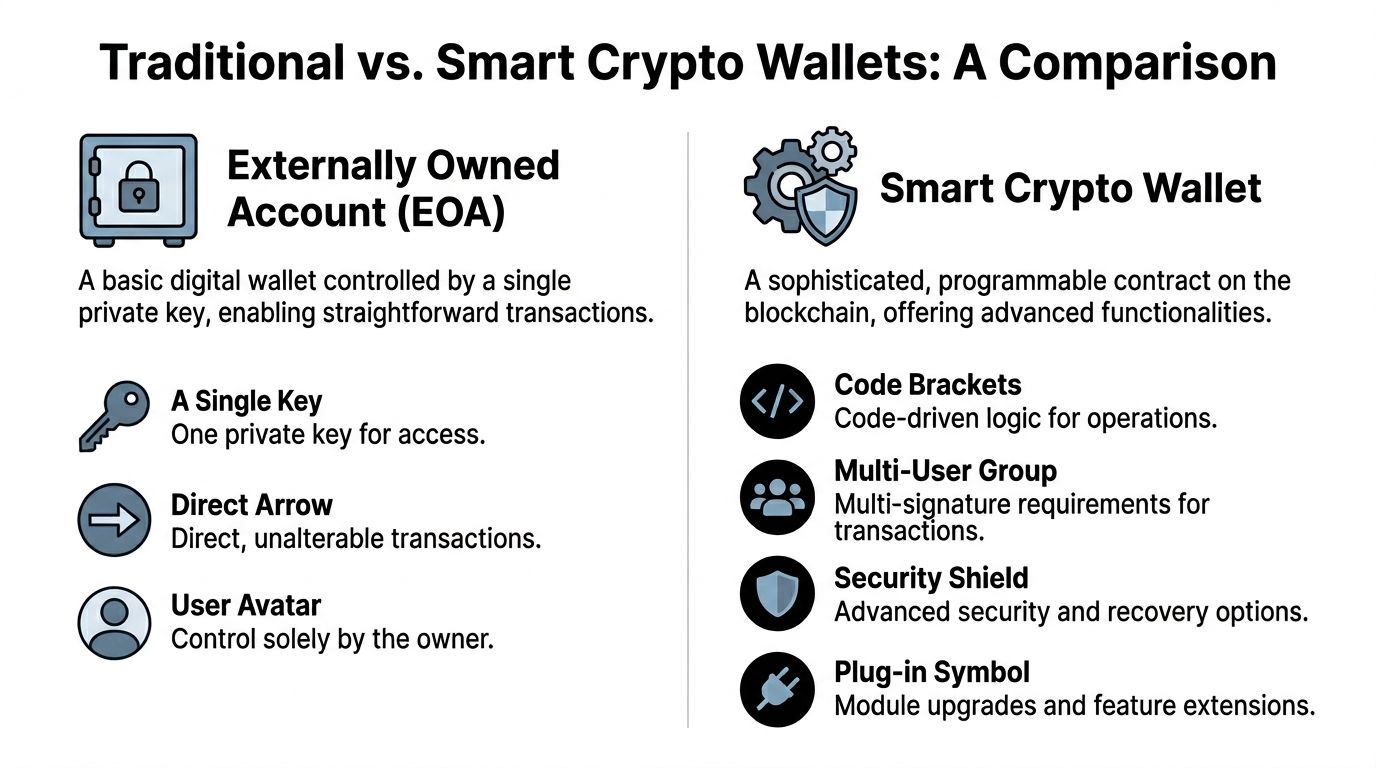
An EOA is an account controlled directly by one private key.
A smart wallet is an account run through smart contract logic or similar programmable authorization architecture. In practice, that gives the account features a plain EOA cannot handle on its own, such as:
For traders learning the mechanics of crypto copy trading, that difference matters fast. The wallet stops being a passive signing tool and starts acting like execution policy.
Most modern smart wallet design comes back to account abstraction, especially ERC-4337.
At a practical level, account abstraction separates ownership from transaction logic. A normal account mostly answers one question: did the private key sign this? A smart wallet can answer more useful questions first: is this within the spending limit, is the destination approved, can these three actions be executed together, should a bot have temporary permission for this session only?
That is a significant shift.
For a copy trader, account abstraction works like replacing a manual gearbox with a transmission that can follow rules you set ahead of time. You still choose the route. The wallet just handles execution with more control and less friction.
Common results include:
For active DeFi use, the benefit is not theory. It is fewer failure points during live execution.
A smart wallet can be set up so a copy trading system has permission to mirror trades up to a fixed size, only on approved protocols, only for a defined time window. That is a major improvement over exposing a hot wallet with broad permissions and hoping nothing goes wrong. The trader gets speed without giving up all control.
Batching matters too. If the source wallet rotates capital from one token into another and then deposits into a vault, a smart wallet can handle that as one planned sequence instead of several disconnected transactions. The result is tighter execution and fewer moments where price can move against you.
| Feature | Externally Owned Account (EOA) | Hardware Wallet | Smart Wallet |
|---|---|---|---|
| Control model | Single private key | Single private key stored offline | Programmable rules, often with multiple authorization options |
| Best use case | Basic transfers and broad dApp compatibility | Long-term cold storage | Active DeFi, automation, copy trading, team controls |
| Transaction logic | Direct signing only | Direct signing only | Custom validation and execution logic |
| Recovery options | Usually seed phrase only | Usually seed phrase backup | Can support social recovery or other built-in recovery paths |
| Approvals | One signer | One signer | Can require multiple signers or conditional approval |
| Batch transactions | Limited in standard flow | Limited in standard flow | Designed to support batched actions |
| Gas flexibility | User pays gas directly | User pays gas directly | Can support gas abstraction or sponsored flows |
| Automation | Minimal | Minimal | Strong fit for recurring or rule-based actions |
| Security posture | Simple but fragile if key is lost | Strong for storage, slower for active trading | Strong if well designed, but depends on contract quality |
| Ideal trader profile | Casual user | Long-term holder | Active trader who wants execution and policy controls |
Smart wallets improve account behavior. They do not improve trade selection.
They will not fix bad entries, poor sizing, or copying the wrong wallet. They also introduce a different risk surface, because contract quality, permission design, and module setup matter. A poorly configured smart wallet can create new problems instead of reducing old ones.
The right way to judge one is simple. Check whether it gives a measurable edge in execution speed, delegation, recovery, approval control, or trade safety. If it does not, the extra complexity is not worth carrying.
The strongest case for smart wallet crypto isn't theoretical. It's that top on-chain operators already behave in ways that reward better wallet infrastructure.
One standout smart money wallet reached an unrealized profit of $52.77 million and a 305,000x return, while ONDO drew more than $663,947,957 in smart money allocations in February 2025, as tracked by Wallet Finder.ai's review of top smart money wallet performance. You don't copy those wallets by using slower tools than they do.
If you're new to the mechanics, this overview of crypto copy trading is a useful baseline. The edge shows up once you connect wallet features to execution.
The first edge is transaction batching.
A lot of DeFi trades aren't one action. They might require approval, swap, and deposit. With a normal wallet flow, each step is separate. That creates delay, more exposed surface area, and more chances for price movement between steps.
With a smart wallet, those actions can be handled as one atomic sequence.
That matters because:
A lot of traders want automation but don't want to hand a bot the keys to the kingdom. That's where session keys or restricted permissions become useful.
You can grant temporary, narrow permissions for a script or agent to perform certain actions under specific limits. That is a much better setup than exposing the primary signing authority just to automate entries or exits.
Good use cases include:
For copy traders, this is the difference between safe automation and reckless automation.
Don't automate with full wallet authority unless you would trust that bot with your entire portfolio.
Plenty of missed trades come from something dumb. You had the right asset, the right thesis, and the wrong gas token balance.
Smart wallets can abstract that friction. Depending on the setup, gas can be handled more flexibly, which reduces the chance that a trade stalls because the account isn't funded the old-fashioned way.
For active traders, this matters most when:
The underrated edge is policy enforcement.
A good smart wallet can restrict what the account is allowed to do before you get emotional, tired, distracted, or phished. That's more valuable than most traders admit.
Useful rules include:
Retail traders usually think security starts after something goes wrong. Professionals build it into the wallet before they trade.
Choosing a provider isn't about chasing features. It's about matching wallet architecture to trading style.
Some traders need hardened treasury controls. Others need smooth mobile access. Others care more about cross-chain visibility or cleaner daily execution. The right pick depends on the job.
Safe is the name most traders and teams know when multisig security matters.
Its core strength is controlled authorization. If you're managing a serious portfolio, a shared fund, or a desk where approvals shouldn't rest with one person or one device, Safe is the practical choice. It fits traders who care more about control and process than one-tap convenience.
Best fit:
Trade-off: it can feel heavy for rapid-fire solo trading.
Argent is a cleaner fit for individual users who want smart-wallet benefits without treasury-style overhead.
Its appeal has long been usability. If you trade from your phone, want a friendlier recovery model, and don't want every security upgrade to feel like enterprise software, Argent is a practical option.
Best fit:
Trade-off: advanced users may want more custom control than a simplified mobile flow provides.
Ambire tends to appeal to traders who want smart wallet behavior with less ceremony.
It usually fits users who care about smoother signing, flexible account use, and a wallet that can support active on-chain workflows without feeling over-engineered. For traders who bridge often, test new protocols, or want a more utility-focused interface, that balance can be appealing.
Good match for:
Trade-off: convenience only helps if you stay disciplined about permissions and app connections.
Zerion sits closer to the portfolio management side of the wallet spectrum.
If your process starts with watching positions, rotating between ecosystems, and keeping a broad view of allocations before acting, a wallet with strong portfolio context can be useful. Traders who monitor a lot of positions often value that more than raw technical flexibility.
Best fit:
Trade-off: portfolio visibility doesn't replace stricter operational security.
Use this when choosing:
| If you care most about | Better fit |
|---|---|
| Multi-person approval and treasury controls | Safe |
| Mobile simplicity and recovery UX | Argent |
| Day-to-day DeFi utility | Ambire |
| Portfolio visibility with execution | Zerion |
The wrong wallet usually fails in one of two ways. It either adds too much friction for your pace, or it gives you too much freedom without enough control.
Smart wallets improve security, but they also change what you're trusting.
With a basic wallet, the core rule is simple. Protect the key. With a smart wallet, the rule becomes more nuanced. Protect the wallet design, the signer setup, the recovery path, and the contracts you authorize.
That shift is worth it for many traders, but only if you understand the trade-offs.
Smart wallets generally rely on one of two broad security patterns.
According to Bleap's breakdown of smart wallet architecture, some use on-chain smart contract logic while others rely on Multi-Party Computation (MPC). The distinction matters. MPC wallets can offer faster execution and lower gas for high-frequency strategies, while on-chain logic gives you transparent, auditable security rules visible in transaction history.
That difference changes how traders use them:
For a deeper look at the broader attack surface around wallet architecture and protocol integrations, review this guide to smart contract security.
Social recovery sounds simple. If you lose access, trusted guardians help restore it.
In practice, that can be far safer than relying entirely on one seed phrase that can be stolen, misplaced, or mishandled. But the setup only works if the guardians are reliable, reachable, and chosen with care.
A few rules matter:
Passkey-based wallets are attractive because they can reduce phishing exposure and make login feel normal. That's useful for traders who hate seed phrase management.
But convenience can obscure recovery assumptions. Device loss, backup behavior, and provider-specific implementation all matter. A seedless setup can be safer in one threat model and weaker in another.
Risk check: if you can't explain how you'd recover the wallet after losing your main device, you don't understand the wallet yet.
The wallet's code becomes part of your security perimeter. If the contract logic is weak, poorly reviewed, or badly integrated, the advanced features stop being an edge and start being a liability.
Before using any smart wallet for serious capital, check:
The best setup for many traders isn't one wallet. It's a stack.
One wallet can hold longer-term assets with stricter controls. Another can run active DeFi. A third can sit behind limited automation. Smart wallets work best when the wallet design matches the role.
You spot a wallet that catches a breakout early, exits in size, and avoids the messy approval spam that shows up in weaker accounts. The edge is not the single trade. It is the operating pattern behind it.
Smart wallets leave a different on-chain footprint from standard EOAs. A copy trader who can read that footprint gets more than entry alerts. You get clues about execution quality, automation style, and how disciplined the operator is when markets move fast.

ERC-4337 style wallets and other smart contract accounts often compress multi-step actions into cleaner execution flows. Instead of separate approve, swap, bridge, and rebalance transactions scattered across a timeline, you may see a tighter sequence routed through wallet logic. For a copy trader, that matters because cleaner structure usually means less wasted gas, fewer missed steps, and more deliberate trade mirroring.
Useful signals include:
A skilled trader's wallet history often reads like a playbook. A weak wallet looks improvised.
Basic block explorers are fine for checking a hash. They are weak for studying trader behavior over time. Copy trading smart wallets requires history, labeling, watchlists, alerts, and a way to compare execution patterns across chains and time periods. That is where Wallet Finder.ai fits. It tracks wallet history, trading behavior, PnL trends, and smart money activity across major ecosystems.
A practical workflow looks like this:
Filter for process first
Start with wallets that show repeatable behavior. Consistent sizing, similar route choices, and disciplined exits matter more than one outsized winner.
Read the transaction shape
Check whether the account behaves like a standard retail wallet or a contract-based operator using batching, automation, or delegated permissions.
Study follow-through
Good traders do not just enter well. They manage adds, trims, rotations, and exits with a pattern you can track.
Build segmented watchlists
Group wallets by style, chain, or setup. A momentum wallet on Base should not sit in the same bucket as a slower size trader farming new Solana narratives.
Set alerts after the homework is done
Alerts help with timing. They do not replace analysis.
If you want to compare monitoring workflows, this guide to the best wallet tracker tools is a useful starting point.
Many traders copy the entry and ignore the machinery around it. That is how they end up late, overpaying on gas, or mirroring a move without understanding whether it was a starter position, a hedge, or an exit into strength.
The primary edge is pattern recognition. When you track how smart wallets batch actions, how they move capital between protocols, and how they handle follow-up transactions, you stop copying isolated clicks and start copying a method. That is where smart wallet analysis becomes useful for traders, not just interesting for researchers.
The gap between amateur and professional DeFi trading often isn't research alone. It's infrastructure.
Smart wallets give traders tighter execution, programmable controls, better recovery options, and cleaner ways to automate without handing over total authority. For copy traders, those aren't convenience features. They're part of staying close to the wallets worth following.
Traditional wallets still have a place. They're simple and broadly compatible. But simple isn't always enough when you're trying to mirror traders who structure entries carefully, manage permissions tightly, and move fast across DeFi.
If you're active on-chain, the wallet should help enforce discipline. It should reduce drag, not add it. It should also fit your role, whether that's treasury protection, mobile trading, bot-assisted execution, or multi-chain portfolio management.
The traders who treat wallet architecture as strategy usually make fewer avoidable mistakes. That's the upgrade.
Wallet Finder.ai helps traders monitor on-chain wallets, review trading histories, build watchlists, and set alerts for wallet activity across major ecosystems. If your goal is to turn smart wallet behavior into tradable signals, it's a practical place to start your research.