Tik Tok Token: A Trader's Guide to Finding Real Alpha

Wallet Finder

Blank calendar icon with grid of squares representing days.

April 30, 2026

A tik tok token starts the same way most bad trades start. You see a familiar brand name, a vertical chart, and a feed full of people acting like you’re already late.

That’s when traders make the expensive mistake. They assume the name means legitimacy, or at least enough attention to keep the move alive. In practice, a branded memecoin can be tradable for a short window and still be structurally awful.

The edge isn’t guessing whether hype will appear. Hype is the easy part. The edge is identifying what kind of “tik tok token” you’re looking at, then deciding whether the setup deserves capital at all.

The Tik Tok Token Pump Is It Real or a Trap

A trader sees “Tik Tok” in the pair name, opens the chart, and the candle already looks stretched. The room goes quiet for a second because everyone knows what happens next. Either you catch a fast momentum move, or you become exit liquidity for people who bought earlier and need your market order to get out.

A cartoon man in a grey hoodie excitedly looking at a mobile phone showing rising crypto trends.

The confusion is understandable. TikTok has a real economic engine behind its in-app virtual currency. According to Naavik’s analysis of TikTok’s in-app purchase economy, TikTok Coins powered a $6 billion+ economy in 2024. That kind of real consumer spending makes the brand irresistible to speculators and copycat token launches.

That’s why a branded token can feel more credible than it is. Traders see a familiar app, assume some relationship to the platform, and skip the basic checks they’d normally run on any new memecoin.

Why the name matters less than the structure

A token called TikTok Coin, Tik Tok Token, TIKTOK, or any variation of that theme can still be completely unofficial. The name tells you almost nothing about legal affiliation, contract safety, liquidity quality, or holder behavior. It only tells you the launch creator understands attention.

The right first move isn’t buying. It’s classification.

Ask these questions before you even consider an entry:

  • What exactly is this asset? A memecoin, a social token, an app currency, or a developer credential.
  • Where does it trade? If it’s on a decentralized exchange, contract risk and liquidity risk immediately matter.
  • Who benefits from the brand confusion? Usually the earliest holders and deployer-connected wallets.
  • What would invalidate the trade fast? Thin liquidity, holder concentration, or suspicious contract permissions.

Practical rule: If the ticker relies on a famous brand for attention, assume higher manipulation risk until the on-chain evidence proves otherwise.

A lot of traders don’t need more token ideas. They need a better pre-trade process. If you want to understand how hype can distort early price action, this breakdown of pump coin price behavior in speculative markets is a useful companion.

Decoding the Three Types of Tik Tok Tokens

Most search confusion comes from one phrase covering three completely different things. If you don’t separate them immediately, you can end up researching the wrong market, using the wrong tools, or worse, trading something you never intended to trade.
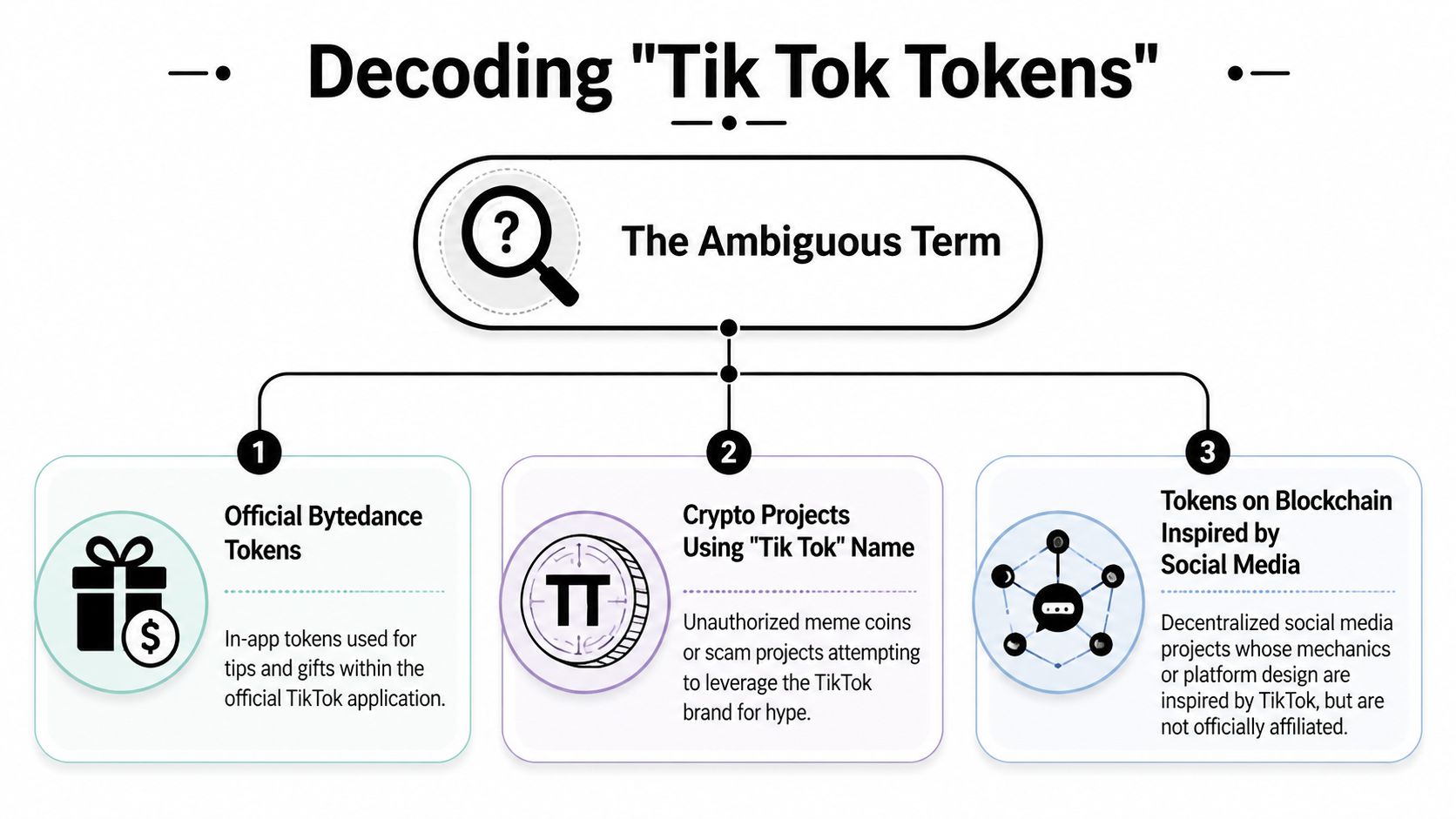
A flow chart explaining three distinct meanings of the term Tik Tok Tokens in digital contexts.

Official TikTok Coins

These are not crypto. TikTok Coins are the platform’s in-app virtual currency used for gifting during LIVE streams and similar in-app interactions. They function inside TikTok’s ecosystem, not on a decentralized exchange.

For a trader, the practical point is simple: you can’t treat TikTok Coins like a memecoin chart. They reflect a centralized platform economy, not an on-chain token market.

Unofficial crypto tokens using the TikTok name

This is the category most traders generally mean when they search tik tok token. These are unofficial blockchain assets that borrow the branding to pull attention, volume, and social speculation.

Some may be straightforward memecoins. Some may be short-lived pump vehicles. Some may be outright traps dressed up as “community” launches. They can still produce tradeable moves, but that doesn’t make them credible projects.

A few things distinguish this category fast:

  • They trade on-chain. You’ll find a contract, a pool, and wallet flows.
  • They depend on narrative velocity. Price often reacts more to social buzz than utility.
  • They require hard due diligence. Contract review, liquidity review, and wallet review matter more than the logo.

Developer access tokens

Many newer users often misunderstand this concept. TikTok’s developer platform uses OAuth 2.0 access tokens for authentication and permissioning. These are technical credentials, not investments.

According to TikTok’s OAuth user access token management documentation, these access tokens manage permissions for apps to read user data and have no monetary value. They exist so developers can authenticate sessions and request approved scopes such as user info or public video access.

If a page talks about refresh tokens, scopes, or token storage, you’re probably reading developer documentation, not researching a trade.

A quick classification test

Use this whenever you encounter a new “Tik Tok token” mention:

TypePrimary useTradable on DEXWhat traders should do
TikTok CoinsIn-app gifting and virtual spendingNoDon’t confuse platform currency with crypto exposure
Unofficial memecoinSpeculation and narrative tradingYesRun full on-chain due diligence before touching it
OAuth access tokenApp authentication and permissionsNoIgnore for trading purposes

The fastest way to avoid a bad trade is to stop treating every token-shaped object as a token you can buy.

On-Chain Due Diligence A Trader's Safety Checklist

Once you’ve confirmed you’re looking at an unofficial memecoin, the job changes. You’re no longer asking “is this interesting?” You’re asking “what can hurt me here, and how quickly?”

For a Solana-based example, Bitget’s overview of TikTok Coin notes a fixed maximum supply of 1,000M tokens and current liquidity of $143.36K. Those two datapoints already tell you a lot. Supply structure shapes dilution risk, and shallow liquidity can make even a moderate position move the market against you.

Start with the pool, not the posts

Most retail traders begin with social chatter. I start with the pool.

If the liquidity is thin, every later decision gets harder. Entries slip, exits get uglier, and stop discipline becomes harder to execute because price gaps instead of moving cleanly.

Check these first:

  • Liquidity depth: A pool can exist and still be too shallow for your size.
  • Lock status: If the deployer can remove liquidity, your chart can go vertical in the wrong direction.
  • Recent pool changes: Sudden adds and removals can signal staging behavior rather than organic growth.

Read holder structure like a risk map

A meme token with broad distribution trades differently from one controlled by a small cluster. You don’t need perfect decentralization. You do need to know whether a handful of wallets can wreck the market whenever they want.

Look for:

  • Top wallet concentration: If a few wallets hold too much, they control your downside.
  • Connected wallet behavior: Fresh wallets funded from the same source often move together.
  • Insider timing: Early entries before promotion matter. So do synchronized sales.

A healthy chart can hide unhealthy ownership. Holder concentration usually shows up before the public notices it.

Contract review matters even when the vibe is strong

A token can trend hard and still contain features you should never trade against. Depending on chain and launcher setup, dangerous permissions may include blacklist behavior, transfer restrictions, fee toggles, or mint-related concerns.

Use scanners, but don’t outsource judgment to a green checkmark. Automated tools are good for catching obvious issues. They’re weaker at explaining how deployer behavior, wallet clustering, and liquidity management combine into a rug setup. If you need a framework for that review process, this guide to how traders use rug check workflows before entering new tokens is worth keeping nearby.

Social proof is the last check, not the first

Some launches have real communities. Many have bots, recycled memes, and volume-chasing callers. Don’t confuse activity with commitment.

A simple test helps:

  1. Check whether discussion is specific. Real holders talk about contract, pool, timing, and wallet activity.
  2. Look for repetition. Bot-heavy promotion repeats the same phrasing and shallow claims.
  3. Compare chat to chain. If social channels scream conviction but the largest wallets are distributing, trust the chain.

Memecoin Due Diligence Red Flag Checklist

Red FlagWhat it MeansWhy it's Dangerous
Unclear token identityTraders can’t tell whether it’s official, unofficial, or purely technicalBrand confusion pulls in uninformed buyers and supports bad pricing
Thin liquidityThe pool can’t absorb size cleanlyYou get worse entries and may not exit near your expected level
Concentrated holdersA few wallets control large portions of supplyCoordinated selling can crush price before retail reacts
Unlocked or unstable liquidityKey pool capital can move suddenlyRug risk rises sharply when liquidity isn’t durable
Suspicious contract permissionsThe contract may allow harmful controlsTrading can be restricted or manipulated after you enter
Bot-heavy social activityAttention looks larger than real demandPrice can stall as soon as paid or automated promotion stops
Narrative with no verificationThe story depends on branding aloneBuyers pay for hype instead of verifiable structure

How to Track Smart Money with Wallet Finder.ai

When a tik tok token starts moving, most traders stare at the chart and guess. That’s the slowest layer of information. Wallet activity usually tells the story earlier.

A cartoon detective using a magnifying glass to investigate digital wallet addresses on a laptop computer screen.

The better workflow is to work backward from money flow. Which wallets bought first. Which wallets added into strength. Which wallets sold into the spike instead of posting memes about long-term conviction.

Find the right contract first

Start in the token discovery layer and verify you’re looking at the correct asset. Name-based searches can be messy with branded meme tokens because copycats often appear fast.

What you want to confirm:

  • Exact contract address
  • Correct chain
  • Recent trade activity
  • Whether multiple near-identical tickers are competing for attention

This step sounds basic, but it prevents a common error. Traders often analyze one contract and accidentally buy another.

Filter for wallets that actually trade well

After the contract is confirmed, move from token view to wallet view. You’re not looking for the loudest wallet. You’re looking for wallets with behavior you’d want to learn from.

Useful filters include:

  • PnL profile: Strong realized performance matters more than flashy screenshots.
  • Consistency: One lucky hit means less than repeatable execution.
  • Recent activity: A wallet that traded well months ago may not be relevant to the current cycle.
  • Position behavior: Some wallets scale in early. Others chase breakouts. You need to know which.

A good wallet list helps you separate signal from spectator noise. That’s why many traders use tools built for tracking crypto wallets across active ecosystems instead of relying on social call channels.

Don’t mirror a wallet until you know what kind of trader it is. Some wallets are momentum buyers. Some are launch snipers. Some are liquidity-aware scalpers. Those are not the same strategy.

Study one wallet deeply before you copy anything

The best wallet analysis is boring in a useful way. You open the history and inspect decisions, not just outcomes.

Questions worth answering:

  1. When did the wallet enter relative to the crowd? Early accumulation often looks very different from public breakout chasing.
  2. Did it size responsibly? Position sizing reveals whether the trader viewed the setup as a flyer or a real conviction bet.
  3. How did it exit? Many strong wallets sell in pieces rather than trying to nail a top.
  4. What else does it trade? If the wallet rotates across similar social tokens, that pattern is more important than one isolated trade.

A wallet with good numbers but reckless sizing isn’t a model. It’s a warning.

Build a watchlist before the market gets loud

The practical move isn’t waiting for the token to trend. It’s building a watchlist of wallets that repeatedly spot social momentum early, then monitoring their activity around similar themes.

That matters because branded memecoins often move in bursts. By the time public timelines are filled with green candles, the smart entries are usually gone. Watchlists and alerts help you move from reaction to preparation.

For traders who want a visual walkthrough of this workflow, this short demo is useful:

Use alerts to catch behavior, not just buys

A buy alert alone is incomplete. Context matters.

The alerts that help most are the ones that tell you:

  • Which wallet acted
  • What token was involved
  • Whether it was an entry, add, trim, or exit
  • How that action fits the wallet’s broader pattern

That last point is where traders usually level up. Copy trading works better when you copy decision quality, not just transaction direction. If a wallet buys tiny size into a chaotic launch, that isn’t a full-conviction endorsement. It may just be information gathering with capital.

What usually works and what usually fails

A few habits consistently improve results:

  • Track clusters, not heroes: Multiple capable wallets entering around the same time is stronger than one famous address making a move.
  • Compare trade timing: Early entries near low attention are more informative than late buys after the chart is obvious.
  • Respect wallet specialization: A wallet strong on Solana memes may not translate cleanly to every chain or theme.

And a few habits fail repeatedly:

  • Blind mirroring: You inherit timing risk without understanding the setup.
  • Ignoring exits: Many copied trades lose money because traders see the entry and miss the trim.
  • Confusing visibility with skill: Popular wallets aren’t always the best-performing ones.

Risk Management and Copy Trading Best Practices

Most memecoin losses don’t come from missing the winner. They come from sizing bad trades too large, holding too long, and pretending a clear distribution event is just “volatility.”

This is the lesson from the unofficial TIKTOKT token. According to Coinranking historical data for TIKTOKT, after peaking in June 2025, it crashed over 95% in a single week. If you entered near the top without a plan, there was no heroic recovery thesis. There was only damage control.

Position sizing decides whether you survive

A memecoin can be attractive and still deserve a small position. Those aren’t contradictions. They’re often the same trade.

Good traders treat size as their first risk tool, not their last. If liquidity is shaky, holder concentration looks ugly, or social heat is running ahead of on-chain quality, size down.

A practical framework:

  • Small when structure is questionable: You’re paying for information, not proving conviction.
  • Larger only when multiple checks align: Better holder spread, cleaner liquidity, and favorable wallet behavior.
  • Never all-in on a narrative token: Branded memes can unwind faster than your reaction time.

Define exits before entry

The worst time to invent an exit plan is during a spike. Greed gets louder as unrealized gains grow, and denial gets louder after the reversal starts.

Set your conditions first:

  • What confirms the trade is working
  • What invalidates it
  • Where you’ll trim
  • What wallet behavior would make you leave early

Predefined exits turn a memecoin trade into a controlled bet instead of an emotional negotiation with the chart.

Copy the method, not every transaction

Copy trading breaks down when traders assume every move from a profitable wallet should be mirrored at the same size and speed. That’s lazy, and it ignores context.

A wallet may buy for reasons you can’t reproduce cleanly:

  • It entered earlier than your alert reached you.
  • It has better execution because it trades smaller relative to pool depth.
  • It’s hedging elsewhere.
  • It’s testing a thesis with exploratory size.

The professional approach is to copy patterns selectively. If a wallet consistently enters social tokens before retail attention, scales in cautiously, and trims strength quickly, that strategy may be worth adapting. If the wallet sprays across chaotic launches and relies on speed you don’t have, the raw wallet stats won’t save you.

Take profits like a trader, not a believer

Memecoin traders often talk themselves out of good exits because they don’t want to miss the final blow-off move. In practice, partial profit-taking is what keeps your equity curve from looking like everyone else’s highlight reel turned obituary.

A disciplined routine usually includes:

  1. Trim into strength instead of waiting for perfection
  2. Reduce risk after a sharp move
  3. Leave a smaller runner only if the setup still looks healthy
  4. Exit fully when smart wallets distribute into public excitement

The point isn’t to sell too early. The point is to stop turning a good trade into a round trip.

Conclusion Gaining Your Edge in a Hype-Driven Market

A tik tok token can be a search term, a misunderstanding, a technical credential, an in-app currency, or a speculative memecoin wrapped in borrowed branding. Traders lose money when they treat all of those as the same thing.

The useful mindset is simple. Classify first. Verify second. Risk capital only after the structure makes sense. A familiar name doesn’t reduce risk. Most of the time, it increases it because it attracts buyers who skip the hard questions.

The traders who last in this corner of the market don’t rely on vibes. They check the contract. They inspect the pool. They read holder concentration. They study wallet behavior. They decide in advance how much they can lose and what conditions will make them exit.

That process doesn’t remove risk. Nothing in social memecoins does. It gives you a way to participate without acting like every pump is an invitation to gamble blindly.

When the next branded token starts running, you don’t need to be first. You need to be accurate. That’s the difference between chasing hype and trading it.


If you want a faster way to spot profitable wallets, inspect token flows, and monitor smart money before social hype peaks, Wallet Finder.ai is built for that job. It helps traders track wallets, trades, and token activity across major chains so you can research setups with real on-chain context instead of relying on timeline noise.