7 Best Meme Coin Trading Tools for 2026
Discover the 7 best meme coins trading platforms and tools for 2026. Get actionable insights, find winning wallets, and trade smarter on CEXs and DEXs.

February 20, 2026
Wallet Finder

February 15, 2026

Ever witnessed a "pump coin price" event? It's a token's price suddenly spiking on hype, then crashing just as fast. Understanding this dynamic is your first step to navigating the wild world of crypto trading and protecting your capital.
A pump coin price event is a manufactured price surge. An obscure coin's chart suddenly goes vertical with no real news or fundamental reason. It's not organic growth; it's a coordinated effort to create a "get rich quick" illusion. These events are incredibly fast, often playing out over just a few hours.
The orchestrators are typically a small group of insiders or influential traders. They quietly accumulate a large position in a low-volume coin. Then, they unleash a marketing blitz across social media and Telegram groups to trigger massive FOMO (Fear Of Missing Out), luring in retail buyers to artificially inflate the price.
Not all pumps are created equal. Understanding which type you're facing changes everything about your entry, exit, and risk management strategy.
This isn't a coordinated attack—it's genuine excitement that spirals out of control. A project announces a major partnership, a celebrity mentions the token, or a technical breakthrough happens. The price jumps legitimately, then FOMO takes over and pushes it into bubble territory.
Trading approach:You can ride these longer. Set wider stop-losses (15-20%) and take profits in smaller increments. The crash comes eventually, but you have more warning signals.
Real example pattern:Token announces Coinbase listing → Price doubles over 3 days → FOMO kicks in → Price triples in next 2 days → Whale profit-taking begins → 40% correction over a week.
A private Telegram or Discord group with 500-5,000 members agrees to buy a specific low-cap token at an exact time. They've done their homework: picked a coin with terrible liquidity and almost no attention.
Trading approach:Don't touch it. By the time you see the pump, the organizers are already selling. If you somehow catch it early (you won't), you have maybe 3-10 minutes before the dump starts.
Sophisticated trading bots create artificial price action to trigger stop-losses, liquidate shorts, or attract algorithmic trading systems. This is the most technical type and hardest to detect without proper tools.
Trading approach:If you spot bot activity early, you can sometimes scalp small profits by riding their momentum. But set tight stops (5-7%) because bots can reverse direction instantly.
What the data shows:Bot-driven pumps typically last 2-6 hours and generate 40-120% gains before reversal. The key is recognizing the pattern within the first 30 minutes.
Someone knows a token is about to get listed on a major exchange. They accumulate quietly for days or weeks, then the listing announcement triggers explosive growth.
Trading approach:The real profit happens in the accumulation phase, which you'll only catch with wallet tracking tools. Once the announcement hits, you're already late. Take quick profits (2-3x) and exit.
Each pump type requires different tools, different timing, and different risk tolerance. WalletFinder.ai helps you identify the type by showing you:
Trading a coordinated group pump the same way you'd trade organic momentum is how accounts get destroyed.
The challenge isn't just spotting a pump—it's distinguishing it from a coin gaining legitimate momentum. A solid project's price might climb after a major tech upgrade or partnership. A pump, however, is built on nothing but hot air.
FactorOrganic GrowthPump EventFoundationTechnology, adoption, utilityManufactured social media hypeCatalystProduct launch, partnershipCoordinated influencer shillingDurationSustained, gradual climbRapid spike followed by a crashGoalLong-term value creationQuick, profitable exit for insiders
Mistaking a pump for a genuine breakout is a surefire way to get wrecked. Just as the hype peaks, the organizers dump their holdings. The price collapses instantly, leaving late buyers with worthless bags. To avoid this, you must learn to analyze on-chain data and see what the smart money is really doing before the pump begins.
Every pump follows a predictable playbook. Learning to spot the four classic phases—Accumulation, Hype, Peak, and Dump—is like having a storm tracker for the market. By recognizing the early patterns, you can prepare before the chaos hits.
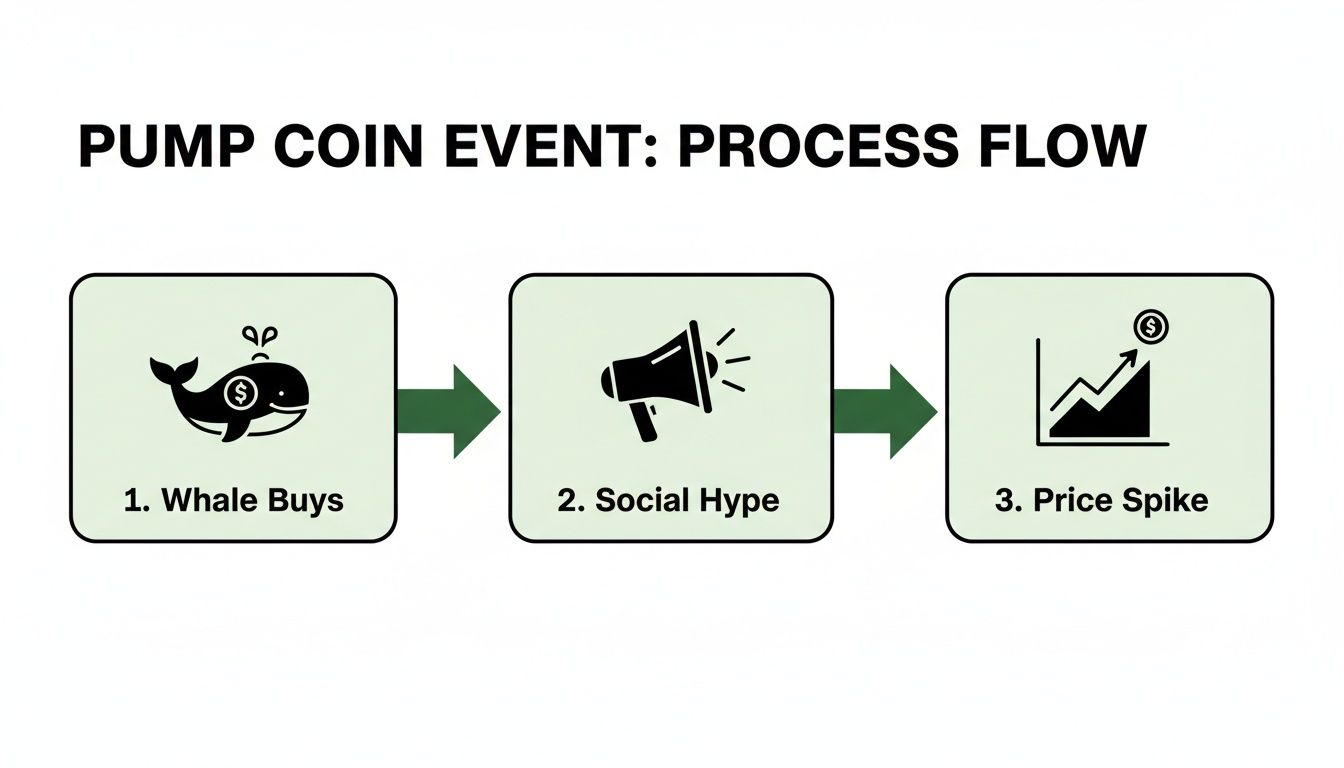
This lifecycle starts with quiet buying from whales, followed by a social media firestorm that triggers the price explosion and subsequent collapse.
Price charts lie. Social media lies. On-chain data doesn't. Here are the specific metrics that give you 6-24 hours of advance warning before a pump goes public.
This tells you how much of the total supply sits in the top wallets. High concentration means a few players control the price action.
The calculation:(Top 10 wallets' holdings ÷ Total circulating supply) × 100
How to use it:Before a coordinated pump, concentration spikes as organizers accumulate. WalletFinder.ai tracks this in real-time. If you see concentration jump from 40% to 65% over three days, something's cooking.
Real scenario:Token X sits at 42% concentration for weeks. Over 72 hours, it climbs to 68%. Two days later, the pump starts. Early observers who noticed the concentration change could position before the move.
Pumps attract new participants. But organizers also create dozens of fresh wallets to hide their accumulation and make the pump look organic.
Two scenarios:Scenario A (Organic): New wallets arrive gradually. Transaction sizes vary wildly ($10, $500, $2,000). Wallet ages are random.
Scenario B (Coordinated): New wallets all created within 48 hours. Transaction amounts cluster around specific numbers ($100, $250, $500). All funded from a small number of source addresses.
How WalletFinder.ai helps:It shows you the funding source for new wallets. If 50 "new" wallets all received their first ETH/SOL from the same three addresses, they're controlled by the same entity.
This metric separates genuine interest from manufactured hype.
The formula:24h Trading Volume ÷ Market Cap
Why it matters:During accumulation, this ratio stays low. Whales buy slowly to avoid detection. Right before the pump announcement, it spikes as organizers make final purchases. Then it explodes during the hype phase.
How fast are tokens changing hands? Pumps have a specific velocity signature.
What to track:Average time tokens stay in a wallet before moving again.
During pump accumulation:Tokens move into wallets and sit there. Velocity drops. Smart money is holding, waiting for the pump.
During pump peak:Velocity explodes. Tokens change hands every few minutes as traders panic buy and organizers dump.
Fresh wallets are either new retail (vulnerable) or organizer-controlled (dangerous).
What to analyze:Percentage of total holders whose wallets are less than 30 days old.
Why fresh wallets matter:Organizers can't use established wallets because those are easy to track. They create new ones. A sudden flood of brand-new wallets buying the same token screams coordination.
When you're evaluating a potential pump, run this quick checklist:
Three or more red flags? Walk away. Two red flags? Proceed with extreme caution and tight stops. One or zero? Might be worth a small, calculated position.
This is the quiet beginning. A coordinated group of organizers, or "whales," starts buying large amounts of a low-liquidity coin. They do this discreetly, often spreading buys across dozens of wallets to hide their activity. The only on-chain clues are a steady increase in buy orders and a growing number of new holder wallets.
Once the organizers are set, the hype machine roars to life. Coordinated campaigns explode across platforms like Telegram, Discord, and X (formerly Twitter). Influencers, often paid, shill the coin with promises of 100x gains. This creates a powerful wave of FOMO that pulls in retail investors, generating viral, explosive attention.
The volatility here is extreme. For example, the token for Pump.fun hit an all-time high of $0.234 after a massive interest surge. On the same day, it also logged its biggest single-day loss of -56.55%, showing how fast the floor can drop out.
The peak is pure euphoria. The price chart is parabolic, and trading volume is through the roof. This is the exact moment organizers "dump"—selling all their holdings at once. Their massive sell-off floods the market, overwhelming buyers and causing the price to crash spectacularly. Retail investors who bought at the top are left holding nearly worthless bags. Understanding this is critical; you can get a deeper look at how liquidity impacts this kind of volatility in our dedicated article.
A crypto pump is an exercise in manufactured momentum. The accumulation phase builds the pressure, the hype phase cranks the heat, and the dump phase is the inevitable explosion for everyone who arrived late.
Trading a pump coin event is like big-wave surfing: exhilarating but incredibly dangerous. For every trader who rides the wave to profit, dozens are wiped out by the crash. Success isn't about luck; it's about having a cold, hard plan and executing it with discipline.
Without a strategy, you're not trading—you're gambling. Before you buy, you must define your entry price, profit targets, and, most importantly, a non-negotiable stop-loss to automatically cut losses. This removes emotion from the equation and prevents a small mistake from becoming a portfolio-killer.

Your trading plan is your anchor in a hurricane. Use this checklist to stay grounded and avoid FOMO-driven decisions.
Define Max Entry Price: Determine the highest price you'll pay and stick to it. Chasing a vertical chart is a losing strategy.
Set Tiered Profit Targets: Don't get greedy. Lock in profits by selling portions of your position (e.g., 25% or 50%) as the price climbs.
place a Hard Stop-Loss: This is your eject button. A stop-loss order is the single most important tool for protecting your capital.
Determine Position Size: Never risk more than a small, predefined percentage of your portfolio on a single high-risk trade.
Pre-plan Your Exit: Know what signals will cause you to sell, whether it's hitting a profit target or seeing whale wallets begin to dump.
Waiting for social media to announce a pump means you're already the exit liquidity. This protocol gives you 1-3 days of advance warning using pure on-chain intelligence.
What you're looking for: Unusual buying from wallets with strong historical performance.
Why this works: Professional traders and insiders accumulate before retail knows the token exists. When multiple proven wallets converge on one obscure token, they know something you don't.
Action to take: Research the token. Check holder concentration, liquidity depth, and developer activity. If fundamentals look sketchy but smart money is buying, they're likely positioning for a pump. Consider a small position (1-2% of portfolio).
What you're looking for: Trading volume climbing while price stays flat or rises slowly.
The math: Compare today's volume to the 30-day average.
Why this works: Organizers must finish accumulating before launching the pump. This creates elevated volume without corresponding price movement (they're absorbing sells quietly). Once accumulation completes, they stop buying and start promoting.
Action to take: If volume hits 5x average, set tighter alerts. Move to hourly monitoring. Prepare entry orders at current price +5% and +10% (in case it gaps up).
What you're looking for: Coordinated but subtle social media activity.
Why this works: Organizers prime the audience before the official announcement. They plant seeds so when the pump launches, people feel like they "discovered" it themselves.
Action to take: Cross-reference social signals with on-chain data. If you see both social seeding AND wallet accumulation, confidence increases. Finalize your position sizing and entry strategy.
What you're looking for:Price starting to move on increasing volume.
The pattern:
Why this works:Organizers and early insiders are taking final positions. They know the announcement timing. Price acceleration tells you the launch is imminent.
Action to take:If you're not in yet, enter now or accept you missed it. If you're in from the accumulation phase, set your first take-profit at +50% and trail your stop to breakeven. The announcement will hit within hours.
Day -3 (Tuesday):
Day -2 (Wednesday):
Day -1 (Thursday):
Without the 72-hour protocol, you would have bought at $0.32 and sold at $0.19 (40% loss).
The risks go beyond a falling price. During a dump, liquidity can vanish instantly, leaving no buyers to fill your sell orders. The token's price history is a stark reminder: after hitting its all-time high, it plummeted by roughly 98.7%. This catastrophic drop is common. You can explore more data on crypto price volatility on Coinbase.
Many pump coins are also outright scams like rug pulls, where developers disappear with investors' money. A disciplined approach is your only defense. For more on this, check our guide on position sizing for high-volatility trades.
Trying to trade a pump after it's trending is a losing game. The smart money—the insiders who initiated the event—are already planning their exit. To succeed, you must shift from being reactive to proactive by using on-chain intelligence tools to see what profitable traders are doing before their moves make headlines.
Instead of chasing hype, you follow the digital breadcrumbs on the blockchain. These tools help you identify and track the wallets of top traders, giving you a front-row seat to their strategies.

Wallet finders allow you to set custom alerts on specific wallets. By focusing on consistently winning addresses, you get notified the second they make a move, turning their actions into your actionable intelligence.
First, find the right wallets to follow. A good wallet finder uses hard data to pinpoint addresses with a proven track record.
Key Metrics for Filtering Wallets:
Once you find a promising wallet, you can analyze its entire trading history to understand its playbook: average hold time, preferred token types, and typical entry/exit points.
Finding smart money is half the battle; you must act on their moves in real time. Automated alerts are your secret weapon. The best platforms send instant notifications via Telegram or push alerts the moment a tracked wallet executes a trade.
By setting up alerts, you transform historical on-chain data into a live feed of trading opportunities. You get notified the instant a top trader buys a new token, giving you time to analyze and enter before the market catches on.
This proactive approach provides a massive advantage. While others scroll through social media, you receive direct signals based on the actions of proven winners.
Tracking wallets isn't about blind copying; it's about understanding the why behind the moves. This separates simple copy-trading from strategic mirroring.
Actionable Steps for Strategic Mirroring:
Following these steps turns signals from top traders into a starting point for your own research. For more, our guide on how to build a smart money tracker offers advanced techniques.
Let's walk through a classic pump event to see how on-chain data provides a powerful trading edge. Imagine a new, low-liquidity token launches quietly. For days, there's no social media buzz and minimal trading volume. This is the calm before the storm.
A savvy trader using a tool like Wallet Finder.ai would be scanning for on-chain whispers, not off-chain shouts. They might spot several new wallets buying the same obscure token within hours of each other—a textbook accumulation signal.
These first wallets are digital breadcrumbs. A wallet finder would flag this coordinated activity, revealing that a few addresses are quietly amassing a huge portion of the token's supply. By setting an alert on these early-mover wallets, a trader gets a clean, data-backed signal that something is happening long before the first influencer tweet. You’re making moves based on the actions of well-funded players, not the noise of the crowd.
Once insiders have their bags, the hype phase begins. The token is suddenly all over social media, and the price chart goes vertical. Trading volumes explode, often hitting multi-billion-dollar levels. In one real case, daily volumes swung from $18.14 million to $47.01 million in a month. Later, that token's 30-day volume topped $9.14B. You can see similar examples of historical token trading volumes on OKX.
While everyone else experiences FOMO, a trader using a wallet finder gets a different notification.
The real signal isn't the soaring price. It's the first transaction alert showing one of those initial whale wallets has started to sell. This is the canary in the coal mine—the earliest warning that the dump is beginning.
While the public sees a small dip as a "buying opportunity," on-chain data shows smart money is cashing out. An alert system delivers this critical exit signal in real time, allowing a prepared trader to sell near the top and lock in profits before the crash.
This boils down to two trading approaches:
By focusing on on-chain footprints, you can navigate the chaos of a pump with a clear, strategic advantage.
Every platform claims to help you spot pumps early. Here's what they actually deliver.
Best for: Pre-pump detection, following smart money
Bottom line: Only tool that catches pumps in accumulation phase, not after they're trending.
Best for: Quick price checks during a pump
Bottom line: Good for monitoring once you're in a position. Useless for early detection.
Best for: Verifying suspicious wallets after you find them
Bottom line: Research tool, not a detection tool. Use it to verify after WalletFinder.ai alerts you.
Best for: Social sentiment confirmation
Bottom line: Late signal. By the time social sentiment spikes, you're buying from early accumulators.
Best for: Institutional tracking (if you have the budget)
Bottom line: Does similar things as WalletFinder.ai but costs 5-20x more. Overkill for pump trading.
Best for: Safety check before buying
Bottom line: Run every token through this before entering. Prevents rug pulls.
Primary tool: WalletFinder.ai - Early detection through wallet tracking ($21-49/mo)
Secondary tool: LunarCrush - Social confirmation ($50-200/mo, optional)
Safety check: Token Sniffer - Scam detection (Free)
Execution monitor: Dexscreener - Price tracking during pump (Free)
Total monthly cost: $21-71 depending on whether you add LunarCrush. Pays for itself with one successful early entry.
Free tools show historical data. Pumps are about future action.
By the time Dexscreener's trending page shows a token, it's been pumping for 30-90 minutes. You're not early. You're the exit liquidity.
WalletFinder.ai costs money because it processes real-time wallet movements and filters for predictive signals. That infrastructure isn't free to build or maintain.
One successful trade caught in accumulation phase pays for a year of the tool.
Yes, but not the way most people try. Chasing pumps after they trend on social media has maybe a 15% success rate. Detecting them 24-72 hours early through wallet tracking and on-chain analysis flips those odds. You're buying in accumulation, not euphoria.
Consistency comes from process, not luck. Track 50-100 proven wallets. Set alerts for coordinated buying. When 3+ wallets buy the same obscure token, investigate. If volume diverges from price (volume rising, price flat), position small. When social seeding starts, add to position. When the pump launches, take profits in stages.
Realistic expectations: 60-70% of early-detected pumps will be profitable if you follow strict exit rules. The 30-40% that fail usually fail during accumulation (the pump never launches), so losses are small (10-20%). The winners average 100-300% when caught early.
Buying after seeing the token trend on Twitter or Telegram. By that point, organizers are 10-30 minutes into their dump. The chart looks parabolic, FOMO takes over, you enter, and the price immediately drops 40-60%.
Second fastest way: Holding through the dump. You see your position hit +150%, think it'll go to +500%, don't take any profits, and ride it back down to -30%. Set take-profit levels before entering. Stick to them.
Third fastest way: Position sizing incorrectly. Putting 20-30% of your portfolio into a single pump play. One bad entry and you've nuked your account. Keep individual positions at 2-5% max. Even if you're confident.
Depends on the type:
Coordinated group pumps: 15-45 minutes from launch to complete collapse. These are surgical. Organizers announce at 3:00 PM, everyone buys at 3:01 PM, price peaks at 3:15 PM, dump starts at 3:20 PM, it's over by 3:35 PM.
Bot-driven pumps: 2-6 hours. Bots run algorithms that gradually exit. The dump is slower but still brutal if you're not watching.
Organic momentum pumps: 3-14 days. These start with real news and transition into FOMO-driven bubbles. You have more time to exit, but the crash can still wipe out 60-80% of the peak value.
Insider exchange listing pumps: The accumulation phase lasts weeks. The actual pump (post-announcement) lasts 1-3 days. The decline takes 7-14 days as profit-takers gradually exit.
Never plan to hold through the entire pump. Take profits on the way up. Getting 80% of the move beats trying for 100% and getting 0%.
It reduces the risk significantly but doesn't eliminate it. Here's what it does:
How to use it properly:WalletFinder.ai tells you when smart money is accumulating. Before you follow them, you still verify:
Smart money sometimes bets on scams too (they just plan to exit before the rug). The tool shows you what they're doing. You decide if the risk/reward makes sense for your strategy.
Normal volatility:
Pump:
The key difference: sustainability. Normal volatility has moments of equilibrium. Pumps are all or nothing. The price either climbs or crashes. There's no stable middle ground because there's no fundamental support.
If you see a token gain 200% in six hours with no news, that's a pump. If it gained 200% over six weeks after announcing three major partnerships, that's volatile growth.
From a legal perspective: Participating in a coordinated pump and dump is market manipulation and illegal in regulated markets. Crypto exists in a gray area, but regulators are watching. Several pump group organizers have been prosecuted.
From a practical perspective: If you're asking this question, you don't have the tools or speed to profit. Coordinated pumps work for organizers who buy before the announcement and dump within seconds of the price peak. Retail members almost always lose.
The smarter play: Use detection tools to identify when a pump is being organized (unusual wallet accumulation), position yourself during the accumulation phase, and exit when the pump launches. You're not participating in the coordination. You're frontrunning it with better intelligence.
Minimum: $500-1,000. Less than this and transaction fees (gas on Ethereum, trading fees) eat too much of your profits. You need enough capital to make 2-5 entries without fees destroying returns.
Comfortable: $2,000-5,000. This lets you position size properly (2-5% per trade) and take 3-5 positions simultaneously if multiple opportunities appear.
Optimal: $10,000+. You can spread risk across 5-10 positions, take partial profits without worrying about minimum trade sizes, and weather losses without emotional damage.
The bigger risk isn't having too little capital—it's risking too much per trade. Traders with $10,000 who put $3,000 into a single pump blow up faster than traders with $1,000 who put $100 into each opportunity.
Depends how you define success:
From the organizer's perspective: 80-90% succeed. They accumulate cheap, pump, dump at the peak, walk away with profit.
From retail's perspective: 10-20% succeed. Most retail buys during or after the pump announcement, entering at inflated prices. They're exit liquidity.
From a wallet-tracking early detector's perspective: 60-70% succeed. You enter during accumulation (low risk), exit during pump (profit). The 30-40% that fail usually fail before the pump even launches (it gets cancelled, not enough momentum, organizers change plans).
This is why methodology matters more than token selection. Same pump, three different outcomes depending on when you entered.
Absolutely. The skills transfer directly:
Wallet tracking: Works for any token. If smart money accumulates a DeFi token, altcoin, or NFT project, it's worth investigating.
Volume divergence: Applies to everything. Volume rising while price stays flat signals accumulation across all markets.
Social seeding detection: Same patterns appear before exchange listings, major announcements, and influencer-driven runs.
Take-profit discipline: Critical for all volatile trading, not just pumps.
The difference: Pumps are manufactured events on a compressed timeline. Normal volatile trades follow similar patterns but play out over weeks or months instead of hours or days.
If you master pump detection and trading, you've mastered the most extreme version of volatile trading. Everything else becomes easier by comparison.
They focus on the pump instead of the accumulation.
Beginners see a chart going vertical and think "I need to get in now before it goes higher!" They're entering during distribution (when organizers sell), not accumulation (when they buy).
The money is made before the pump becomes visible. By the time your friend texts you about a token pumping, you're already late. By the time it trends on Twitter, you're catastrophically late.
Shift your mindset from "catch the pump" to "detect the accumulation." Use tools to see what smart money is buying before anyone's talking about it. Then position yourself and wait for the crowd to show up and pump your bags.
The pump is the exit, not the entry.
Use a tiered exit strategy, not a single target:
Tier 1 (30-40% of position): Exit at +100-150%. This secures your initial capital plus profit. Now you're playing with house money.
Tier 2 (30-40% of position): Exit at +200-300%. This locks in solid profits and removes most risk.
Tier 3 (20-30% of position): Trail with a stop-loss at 15-20% below current peak. This captures extended runs while protecting profits.
Example with $1,000 position:
What happens:If price continues to $0.50, your trailing stop moves to $0.40. You exit the final 3,000 tokens at $0.40 = $1,200.
Total out: $770 + $1,225 + $1,200 = $3,195 (219% total gain)
If you held for the peak trying to get 300%, you might have hit it but risked riding the dump back down. Tiered exits guarantee profit capture.
Brutal honesty: It disappears. Not immediately, but effectively.
The typical bag-holder scenario:You bought at $0.30 during the pump. It peaked at $0.40 (you didn't sell, thought it would hit $1.00). Now it's at $0.08 and still falling.
Your options:
The math on bag-holding:If you're down 75% (bought at $0.40, now at $0.10), the token needs to gain 300% just to break even. How many tokens realistically 3x from post-dump lows? Less than 5%.
Your $1,000 is now worth $250. In that same time, you could have sold, eaten the $750 loss, moved to different trades, and potentially recovered through better opportunities.
The psychological trap:Bag-holders can't accept the loss. They hold because selling makes the loss "real." But the loss already happened when the price fell. Holding just prevents you from recovering elsewhere.
Cut your losses fast on failed pumps. Protect your capital for the next opportunity.
Most traders think the opportunity ends when the pump dumps. They're wrong. The aftermath creates a different kind of edge.
After a pump crashes, retail bag-holders refuse to accept losses. They pray for recovery. This creates predictable bounce patterns you can exploit.
How it works: Pump peaks at $0.50, crashes to $0.12 within an hour. Over the next 6-24 hours, it bounces to $0.18-$0.22 as bag-holders see "a recovery starting" and add to positions or new traders think they're "buying the dip."
The trade: Enter at $0.13-$0.15 (near the crash bottom). Exit at $0.19-$0.21 (the bounce peak). You're targeting 30-50% gains in hours, not the 200-500% from the original pump.
Win rate: 40-50%. Lower than early pump detection, but when it works, the gains come quickly.
Some pumped tokens actually have fundamentals buried under the hype. After the dump, these can become legitimate long-term plays.
The trade: Wait 7-14 days post-dump. Let the panic subside. Enter when price stabilizes and volume normalizes. This isn't a quick flip—you're buying for a 3-6 month hold.
Target return: 100-300% if the project actually delivers on roadmap.
Risk: High. Most pumped tokens stay dead. Only allocate 1-2% of portfolio to these recovery plays.
Real scenario: Token pumped from $0.05 to $0.60, dumped to $0.08. You wait two weeks. It stabilizes at $0.09-$0.11 for five days. You enter at $0.10. Three months later, the project launches its beta product. Price climbs to $0.28. You exit at +180%.
Some pump organizers are repeat offenders. They run pumps every 2-4 weeks on different tokens. If you can identify their wallets, you can frontrun their next pump.
How to find them: After a pump, use WalletFinder.ai to identify the wallets that entered during accumulation and exited near the peak. These are likely organizers.
What to do: Add them to your tracking list. Set alerts for their next purchases.
The edge: When you see the same wallet that organized TOKEN_X's pump start accumulating TOKEN_Y, you know another pump is likely coming. You can position before the accumulation phase even completes.
Success rate: 60-70%. Some organizers change wallets between pumps, but many reuse the same addresses.
Time investment: High. You're essentially building an intelligence file on known pump operators.
Some traders go the opposite direction: short the pump or the bounce.
The setup: Token pumps hard. You don't try to catch it. Instead, you wait for signs of distribution (organizers dumping) and enter a short position.
The trade: Enter short when you see organizer wallets dumping. Cover when price falls 50-70% from peak.
Danger level: Extreme. If a second wave of hype appears, your short can get liquidated fast. Only for experienced traders with high risk tolerance.
Alternative approach: Instead of shorting, buy put options if they exist (rare for pump coins). This caps your downside at the premium paid.
Depends on your goals:
For quick profits (hours to days): Dead cat bounce trading. High frequency, moderate win rate, requires constant monitoring.
For larger gains (months): True bottom accumulation. Low frequency, low win rate, but winners can be massive.
For systematic edge: Organizer wallet tracking. Medium frequency, good win rate, leverages intelligence gathering.
For advanced traders only: Sentiment fade shorting. High risk, high reward, not for beginners.
Most traders should focus on early pump detection rather than post-pump plays. But if you miss the entry or want to diversify strategies, these tactics create additional opportunities.
The key insight: Pumps aren't single events. They're the start of a multi-week pattern with several profitable phases. Most traders only see one (the pump itself). The sophisticated traders see all of them.
The following on-chain and off-chain signals should raise immediate alarm bells:
Legitimate projects build technology and utility. If the only thing anyone talks about is the price, you’re probably walking into a trap.
Absolutely. Beyond short-term pumps, these tools are excellent for uncovering long-term gems. You can find and follow the wallets of venture capitalists or crypto funds to see which under-the-radar tokens they are accumulating. This gives you a peek at what the smartest investors are betting on months or years before the projects become mainstream, providing a serious edge for your long-term portfolio.
Free tools show you what happened. Dexscreener's trending page, CoinGecko's top gainers, Twitter's trending hashtags—all trailing indicators. You see them after the pump is underway.
WalletFinder.ai shows you what's happening. Real-time wallet accumulation. Smart money converges on obscure tokens. Volume divergences as they develop. You see the setup 24-72 hours early.
The profit difference: One successful early-detected pump (entry at +20%, exit at +150%) on a $1,000 position nets $1,300 profit. Pays for 26-52 months of the tool.
Break-even analysis: If the tool helps you catch just one pump per year in accumulation instead of at the peak, you're massively profitable. Most users catch 3-8 per year.
The question isn't whether you can afford the tool. It's whether you can afford not to have it while your competition does.
Ready to stop chasing hype and start tracking smart money? Wallet Finder.ai gives you the on-chain intelligence to discover profitable wallets, get real-time trade alerts, and see the moves that matter before they happen. Start your 7-day trial and gain your edge today at https://www.walletfinder.ai.