Spotting and Avoiding DeFi Wallet Scams

Wallet Finder

Blank calendar icon with grid of squares representing days.

December 9, 2025

A DeFi wallet scam is a digital con designed to trick you into handing over your crypto or giving scammers access to your funds. They use deceptive tactics like fake websites or malicious smart contracts to drain assets directly from your wallet.

What Defines a DeFi Wallet Scam

Think of your DeFi wallet as a digital safe where you hold the only keys. A scammer is the smooth-talking thief who convinces you to either give them a copy of your key or sign a bogus contract that lets them walk in and empty the safe.

Unlike a bank robbery, these heists happen with your unknowing permission. And that’s what makes them so dangerous. We’ve all heard the DeFi mantra, "be your own bank," which is great for control but also means you're fully responsible for security. There's no customer service line to call or a bank manager to reverse a fraudulent transaction. Once the money is gone, it’s gone.

If you're new to the space, our guide on what a DeFi wallet is breaks down the fundamentals of these digital vaults.

The Soaring Financial Stakes

The amount of money being siphoned out of the ecosystem is staggering, and the problem is getting worse. Scammers are leveling up their game, and everyday wallet holders are their primary targets.

In the first half of 2025, a mind-boggling $2.17 billion was stolen from crypto services. To put that in perspective, that’s already more than the total amount stolen in all of 2024. This isn’t just petty theft; it’s organized, sophisticated crime operating at a massive scale.

Individual wallets are increasingly in the crosshairs. Personal wallet hacks now account for 23.35% of all stolen funds so far in 2025, a clear sign that attackers are shifting their focus from big protocols to individual users. You can dig into more of these stats in the 2025 crypto crime mid-year update.

Why Awareness Is Your Best Defense

Here’s the thing: scammers don't just hack code; they hack people. They play on our emotions by creating a sense of urgency, dangling once-in-a-lifetime returns, and tapping into our fear of missing out (FOMO). Their entire strategy is designed to get you to act first and think later.

The best way to protect yourself is to learn their playbook. By understanding the common scams and recognizing the red flags, you can flip the script. You stop being an easy target and become a savvy, vigilant user. This guide will walk you through exactly what you need to know to keep your assets safe.

A Field Guide to Common DeFi Wallet Scams

If you want to protect your digital assets, you first have to get inside the attacker's head. A DeFi wallet scam isn't just one single threat; it’s a whole family of sneaky tactics, each one built to exploit our human tendencies and wiggle through technical gaps. By learning their playbook, you can flip the script—turning a scammer's best weapon (surprise) into your biggest advantage.

The scale of the problem is staggering. DeFi has become a favorite hunting ground for cybercriminals, which says a lot about its rapid growth and, unfortunately, its vulnerabilities.

Decentralized Finance (DeFi) platforms were major targets for crypto-related hacks and scams, with losses totaling nearly $1.5 billion in 2024 alone due to security exploits and fraud. Out of the $2.2 billion stolen from hacks that year, DeFi platforms were the top targets.

A big reason scams work so often comes down to user habits. An alarmingly small 10.8% and 16.3% of DeFi users regularly check and revoke token permissions, leaving their wallets wide open to some of the most common attacks out there. You can get the full rundown on these security challenges in this 2025 crypto crime report.

The core threat is simple: scammers just want to get between you and your money.
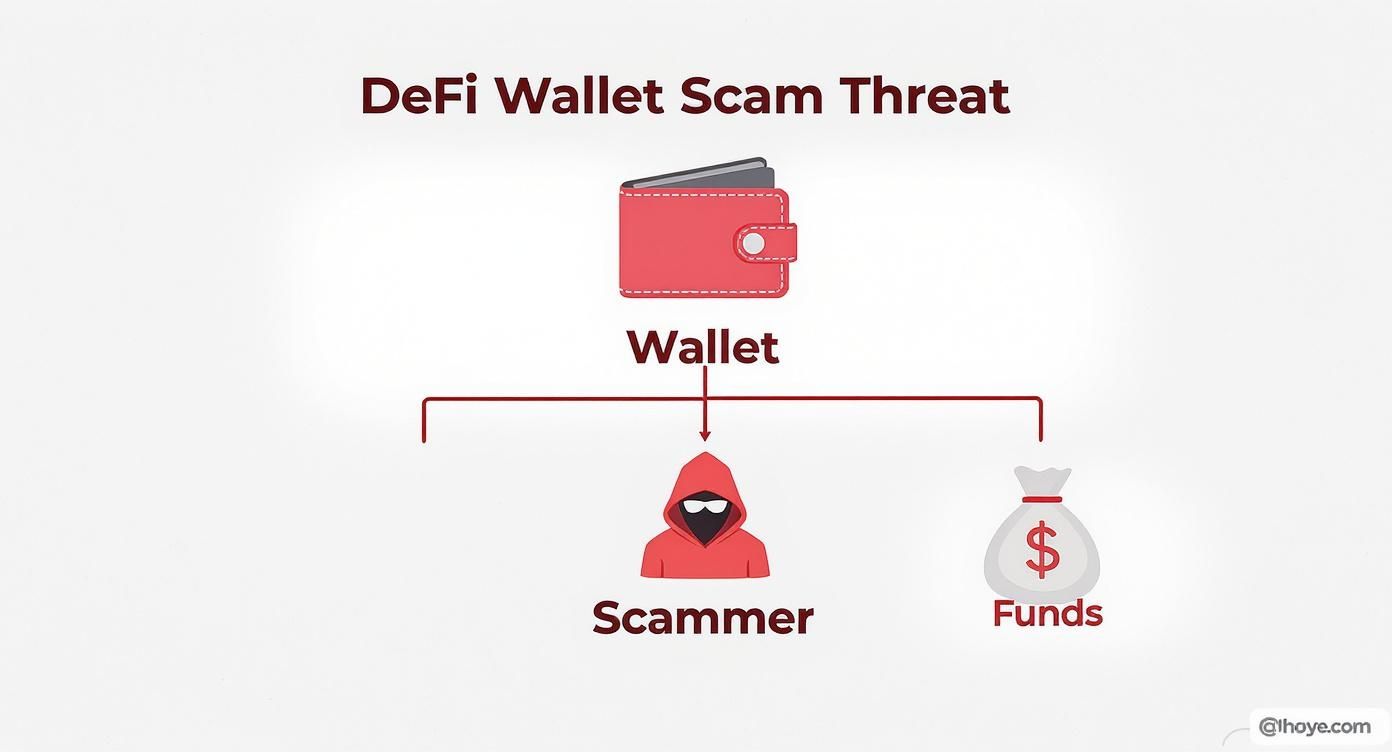
Illustration of a DeFi wallet scam threat, showing funds being stolen by a scammer from a digital wallet.

The image above breaks it down. You have your wallet, your funds, and the scammer. The scammer’s only job is to create a backdoor to your assets.

To help you spot these threats in the wild, let's break down the most common types of scams you'll encounter.

DeFi Scam Types at a Glance

This table gives you a quick overview of the most common scams, how they operate, and the key red flag to watch out for.

Scam TypeHow It WorksPrimary Red Flag
PhishingScammers create fake websites or apps to trick you into entering your seed phrase or private keys.A URL that looks almost right but has a subtle misspelling or a different domain extension.
Malicious ContractsYou're tricked into signing a transaction that grants a contract unlimited permission to spend your tokens.A transaction requests suspiciously broad permissions, like an "infinite approval."
Rug PullsProject developers hype a new token, attract investors, and then drain the liquidity, crashing the price to zero.A new, unaudited project with anonymous founders promising unbelievably high returns.
Social EngineeringScammers build fake trust or create false urgency to trick you into sending them money or signing a bad transaction.An "influencer" or new "friend" contacts you out of the blue with a can't-miss investment opportunity.

Now that you have the big picture, let's zoom in on how each of these scams actually works.

Phishing Scams: The Digital Impersonator

Phishing is one of the oldest tricks in the book, just repackaged for the crypto world. Scammers create pixel-perfect copies of legitimate websites—like Uniswap or MetaMask—and lure you there. Their goal is to get you to type your private key or seed phrase into their counterfeit site. The moment you do, they have the keys to your kingdom and can empty your wallet in seconds.

Actionable Steps to Avoid Phishing:

  • Bookmark official sites: Never find a DeFi app through a search engine. Find the official link from their X (Twitter) profile or Discord, then bookmark it and only use that bookmark.
  • Double-check URLs: Look for subtle misspellings (e.g., "MettaMask" instead of "MetaMask") or different domain extensions (.co instead of .io).
  • Never enter your seed phrase: A legitimate dApp will never ask for your seed phrase. Ever.

Malicious Smart Contracts: The Trojan Horse

This scam is more sinister. Instead of stealing your keys, scammers trick you into signing a malicious transaction that gives them permission to spend your tokens. For example, you might think you're approving a simple token swap, but you're actually signing an "infinite approval." This gives the scammer's contract the power to withdraw any amount of a specific token from your wallet, at any time, without asking again.

Rug Pulls: The Vanishing Act

A rug pull is an exit scam by a project's own developers. They launch a new token, market it aggressively to attract investors and liquidity, and then—once enough money is in the pot—they pull all the funds from the liquidity pool. The token’s value instantly plummets to zero, and the developers disappear. These are especially common with new, unaudited projects promising astronomical returns.

Social Engineering: The Psychological Game

Beyond technical tricks, many scams are just old-fashioned mind games designed to build false trust or create urgency.

Here are two of the most popular plays:

  1. "Pig Butchering" Scams: A long con where scammers build a relationship with you over weeks or months on social media or dating apps. After gaining your trust, they "let you in" on a secret investment opportunity—a fraudulent platform they control.
  2. Fake Airdrops: Scammers send worthless tokens to your wallet. When you visit their site to "claim" or sell them, you're prompted to sign a transaction that drains your real assets.

By getting familiar with these common attacks, you start building a mental checklist. This allows you to spot red flags and steer clear of threats before they ever get a chance to hurt your portfolio.

Identifying Red Flags and Suspicious Signals

To outsmart a scammer, you have to learn to think like a digital detective. Spotting a DeFi wallet scam often comes down to recognizing the subtle clues that tell you something isn't right.

These warning signs show up everywhere—from the project's website and social media chatter all the way down to the blockchain's permanent transaction history.

Illustration of financial analysis with a clipboard, wallet, pie charts, and a browser window with search results.

Developing a keen eye for these red flags is your best defense. It allows you to sidestep traps long before you ever connect your wallet. Let's break down the most critical signals to watch for.

Off-Chain Warning Signs

Before you interact with a smart contract, you need to do your homework on the project itself. Scammers often leave a trail of obvious clues.

Red Flag Checklist:

  • Unsolicited Contact: Did a stranger slide into your DMs with a "can't-miss" investment? Legitimate projects don't do this.
  • Guaranteed Profits: Any project promising "guaranteed high returns" or "risk-free" profits is a massive red flag. DeFi is volatile; there are no guarantees.
  • Low-Quality Website: Look for typos, broken links, and fake URLs (e.g., "PancakkeSwap"). A sloppy site suggests a scam.
  • Anonymous or Fake Teams: A credible project will have a public, verifiable team. Be wary of anonymous founders. Use a reverse image search on headshots to spot fakes.

On-Chain Investigation Basics

This is where you look at the blockchain itself. Tools like Etherscan, Solscan, or BscScan are your magnifying glass, revealing the truth that slick marketing materials might be hiding.

On-chain data is the ultimate source of truth. Scammers can lie in a whitepaper or on social media, but they can't fake transaction histories or smart contract code on an immutable ledger.

Start by looking up the project's token or contract address on a block explorer. Once you're there, you can start digging into a few key areas that often scream "scam."

Key On-Chain Signals of a Scam

On-chain analysis might sound intimidating, but a few simple checks can tell you almost everything you need to know about a project's legitimacy.

1. Token Holder Distribution
Check the "Holders" tab for the token. A major red flag is when a tiny number of wallets hold a massive percentage of the total supply (like 5-10 wallets controlling over 80%). This means the owners can dump their tokens at any time, crashing the price in a classic rug pull.

2. Liquidity Pool Analysis
For a token to be tradable, it needs a liquidity pool on a decentralized exchange.

  • No Locked Liquidity: If the project's liquidity isn't secured in a time-locked contract, developers can pull it out at any moment. Legitimate projects use services to lock liquidity, proving their commitment.
  • Low Liquidity: A tiny liquidity pool relative to the project's market cap makes the token price extremely volatile and easy to manipulate.

3. Smart Contract Verification
A legitimate project will have its smart contract source code publicly verified on the block explorer. An unverified contract is a black box. Even with verified code, look for an official audit from a reputable security firm like CertiK or Hacken. While an audit isn't a 100% guarantee of safety, the complete absence of one is a huge warning.

Learning to spot these behavioral patterns is essential. You can explore how advanced tools use similar principles by reading our article on how anomaly detection identifies suspicious wallets.

By combining these off-chain and on-chain checks, you create a robust vetting process that will dramatically reduce your risk of falling for a DeFi wallet scam.

Your Essential DeFi Security Checklist

Knowing the enemy is half the battle, but proactive defense is what really keeps your assets safe. Instead of reacting after a DeFi wallet scam hits, it's far better to build a security routine that stops threats before they ever get a chance to strike.

Think of it as a pre-flight checklist for your crypto. It's a series of simple, repeatable steps that eventually become second nature.

A hand-drawn illustration of a clipboard with a checklist of three items and a checkmark.

This section breaks down an actionable checklist into three critical phases: what to do before connecting your wallet, the checks to run during a transaction, and the ongoing habits that keep you secure over the long haul.

Phase 1: Before You Connect Your Wallet

The moment right before you click "Connect Wallet" is your most powerful point of defense. This is where you can vet projects with a clear head.

Actionable Pre-Connection Checklist:

  1. Bookmark Official Websites: Never use a search engine to find a DeFi app. Scammers pay for ads that put their fake phishing sites at the top of search results. Find the official link from a trusted source, then bookmark it immediately.
  2. Verify the Contract Address: Don't just trust a token's name. Always verify the official contract address from the project's documentation or a trusted aggregator like CoinGecko or CoinMarketCap.
    • "Vault" Wallet: A hardware wallet for long-term holdings that never connects to dApps.
    • "Transaction" Wallet: A hot wallet (like MetaMask or Phantom) with just enough funds for your intended transaction.
    • "Degen" Wallet: A separate wallet for experimenting with high-risk protocols. If compromised, your main stash is safe.

    Phase 2: During a Transaction

    Once you’ve decided to move forward, your focus shifts to the transaction itself. The details in that signature request window are the "fine print" of your on-chain agreement.

    A transaction signature is a legally binding on-chain action. Scammers design malicious contracts to look innocent but hide dangerous permissions. Rushing this step is like signing a blank check.

    When your wallet prompts you to sign, slow down and scrutinize every detail.

    • Read What You Are Signing: Your wallet shows you what permissions you are granting. Are you just sending tokens, or giving unlimited approval to spend all your funds? Be wary of "SetApprovalForAll" requests unless you are 100% certain of the platform's legitimacy (like listing an NFT on OpenSea).
    • Verify the Recipient Address: Triple-check the recipient's address. Clipboard-hijacking malware can secretly replace the address you copied with a scammer's.
    • Check Gas Fees: Absurdly high gas fees can sometimes point to a faulty or malicious contract.

    Phase 3: Ongoing Security Habits

    DeFi security isn't a one-time setup; it's a continuous practice. Just like regular maintenance on a car, these ongoing habits keep your wallet running safely. For a deeper dive, our checklist for assessing wallet risks offers more insights.

    Your DeFi Security Routine

    This schedule breaks down essential security habits that will help protect your DeFi wallet from scams.

    FrequencySecurity ActionWhy It's Important
    WeeklyReview and Revoke Token ApprovalsUse a tool like Revoke.cash to see which dApps can access your tokens. Kill any permissions for platforms you no longer use. This dramatically shrinks your attack surface.
    MonthlyUpdate All SoftwareMake sure your wallet extension, browser, and operating system are always running the latest version. These updates often contain critical security patches that protect you from new exploits.
    QuarterlyReview Your Wallet StrategyRe-evaluate your wallet setup. Has your risk tolerance changed? Does your "vault" and "transactional" wallet separation still make sense?
    As NeededUse a Wallet Drainer Simulation ToolBefore interacting with a new protocol, use a transaction simulator like Pocket Universe. It shows you exactly what will happen if you sign a transaction and warns you if it's a known DeFi wallet scam.

    By weaving these three phases into your routine, you shift from being a passive target to an active defender of your own assets. Each check is another layer of armor, forming a formidable defense.

    What to Do If You've Been Scammed

    That sinking feeling when you realize your wallet's been hit is a gut punch. But in this moment, panic is your worst enemy—calm, decisive action is your only friend. Time is critical. Your only job is damage control: cut the attacker's access and get any remaining funds out before they vanish.

    You are not alone. Scammers drained nearly $3.1 billion from investors in the first half of 2025 alone. These are sophisticated operations that prey on human habits. You can get a clearer picture of the current state of crypto scams at Ledger.com.

    Your very first move is the most important one. You need to slam the door shut on whatever entry point the scammer used.

    Immediate Damage Control Steps

    Think of this as an emergency first-aid plan for your wallet. Run through these steps in order, as quickly as you can.

    1. Revoke All Malicious Approvals: Immediately go to a trusted approval checker like Revoke.cash. Connect your compromised wallet and revoke any and all recent or suspicious token approvals. This is the digital equivalent of changing the locks.
    2. Transfer Remaining Assets: Move any valuable assets still in the wallet to a brand new, completely secure wallet. This new wallet must have a freshly generated seed phrase that has never been typed into a computer or stored digitally.
    3. Abandon the Compromised Wallet: Once the important assets are safe, that wallet is burned. Never use it again. Scammers can leave behind hidden backdoors.

    A word of warning: Do not send new funds into the compromised wallet to pay for gas to rescue other trapped assets. Scammers often run sweeper bots that will instantly drain any incoming ETH. You'll just be feeding them more of your money.

    Following this response plan gives you the best chance to minimize your losses and take the first critical step toward rebuilding.

    Frequently Asked Questions About DeFi Wallet Security

    Diving into DeFi often raises a lot of questions, especially around keeping your funds safe. Let's clear up some of the most common points of confusion you might run into when protecting your assets from a potential DeFi wallet scam.

    Can a DeFi Wallet Be Drained Without My Seed Phrase?

    Yes, absolutely. This is one of the biggest misconceptions in crypto. Most modern scams don't try to get your seed phrase. Instead, they trick you into signing a malicious transaction that grants a scammer's smart contract unlimited permission to spend your tokens. Think of it less like a thief breaking into your house and more like you unknowingly signing a contract that hands them the keys. This is why you must scrutinize every transaction and regularly revoke old token approvals.

    How Do Hardware Wallets Protect Against Scams?

    Hardware wallets add a powerful layer of security by keeping your private keys completely offline. Because the keys never touch your internet-connected computer, they are immune to remote hacks, malware, or keyloggers.

    However, they aren't a magic bullet. You can still be tricked into approving a malicious transaction on the device itself. Their main advantage is forcing you to physically confirm every outgoing transaction on the device's screen. This gives you one final, crucial moment to review what you're actually signing before it's sent to the blockchain.

    What Is the Difference Between a Rug Pull and a Hack?

    The end result is the same—you lose your money—but the "who" and "how" are completely different.

    AspectRug PullHack
    PerpetratorInside job by the project's own developers.External attack by a third-party cybercriminal.
    MethodDevelopers drain liquidity and abandon the project.An attacker exploits a vulnerability in the smart contract code.
    NatureA betrayal of trust; a premeditated exit scam.A technical failure of the protocol's security.

    Stay ahead of scammers by tracking and analyzing wallet activities with Wallet Finder.ai. Discover profitable strategies and get real-time alerts to make smarter, safer trading decisions. Start your free trial at https://www.walletfinder.ai.

Copy Winning Trades Instantly

4.9 Rating based reviews on

Product of the Day Badge

"I've tried the beta version of Walletfinder.ai extensively and I was blown away by how you can filter through the data, and the massive profitable wallets available in the filter presets, unbelievably valuable for any trader or copy trader. This is unfair advantage."

Portrait of a man with short dark hair and beard wearing a dark t-shirt, smiling softly against a plain white background.

Pablo Massa

Experienced DeFi Trader