Cross Chain Wallet: A Guide for DeFi Traders

Wallet Finder

Blank calendar icon with grid of squares representing days.

January 15, 2026

Think of a cross-chain wallet as a universal passport for your crypto. It’s a single hub where you can manage, swap, and send assets across different blockchains like Ethereum, Solana, and Base without juggling a dozen different apps. It’s all about making your DeFi life simpler and more profitable.

Why Single-Chain Wallets Are Holding You Back

In today’s fast-moving DeFi world, sticking to just one blockchain is like trying to navigate New York City with a map of only Manhattan. A single-chain wallet works perfectly in its own neighborhood, but it builds digital walls that cut you off from the rest of the market.

Imagine a trader who needs a separate bank account, in a different currency, for every single country they do business in. It’s a recipe for chaos—scattered funds, confusing statements, and painful delays when you need to move money fast. That’s exactly the headache traders deal with when using separate wallets for each blockchain.

The Problem of Digital Isolation

When your funds are trapped on individual chains, you run into some serious roadblocks that can eat into your profits and waste your time:

  • Missed Opportunities: The hottest trades often pop up on newer, faster chains like Solana or Base. By the time you’ve created a new wallet, sent funds to an exchange, and bridged them over, the alpha is long gone.
  • Fragmented Capital: Your money is spread thin across multiple wallets. This makes it nearly impossible to get a clear picture of your total portfolio or quickly put your capital to work where it’s needed most.
  • Complex Management: Juggling a collection of seed phrases, addresses, and interfaces isn’t just annoying—it’s a massive security risk. One mistake, and you could be in serious trouble.

This fragmentation is a huge obstacle for anyone serious about DeFi. The market no longer operates in silos, and traders need tools that can keep up.

A cross-chain wallet is no longer just a nice-to-have gadget; it's the 'universal passport' every modern DeFi trader needs. It lets you move capital seamlessly, chase opportunities anywhere, and manage everything from one secure command center.

The Shift to a Multi-Chain Mindset

The push for interoperability isn't just a passing trend—it's a fundamental change in how we interact with crypto. Traders want to follow smart money wherever it goes, and cross-chain wallets are what make that possible.

The numbers back this up. The global crypto wallet market is expected to have around 820 million active users by 2025, with hot wallets—many of which are now cross-chain—making up a massive 78% of the total. This growth shows just how much users want multi-chain capabilities.

Looking ahead, the market is projected to hit $14.84 billion by 2026 and explode to $98.57 billion by 2034, driven largely by this need to break down blockchain barriers. You can explore more cryptocurrency hot wallet statistics to see just how big this shift is.

How Cross Chain Wallets Bridge Blockchains

A cross chain wallet isn’t some kind of crypto magic. Under the hood, it's a sophisticated piece of software that uses clever technology to let you move your assets between totally separate blockchain ecosystems. Once you understand the basic mechanics, you can appreciate how these wallets create a smooth experience out of what is actually a very complex process.

Let's skip the dense technical jargon and use some simple analogies to see how it all works.

The whole point of a cross-chain wallet is to solve the headache of managing assets scattered across different blockchains. For any serious trader, especially DeFi copy traders on platforms like Wallet Finder.ai, this is a game-changer. Instead of juggling wallets for Ethereum, Solana, Polygon, and others, you get one unified interface to store, send, and swap your tokens.

This problem of "wallet fragmentation" is a real drag on performance. It leads to missed opportunities, makes your portfolio a nightmare to manage, and leaves your funds scattered and inefficient.
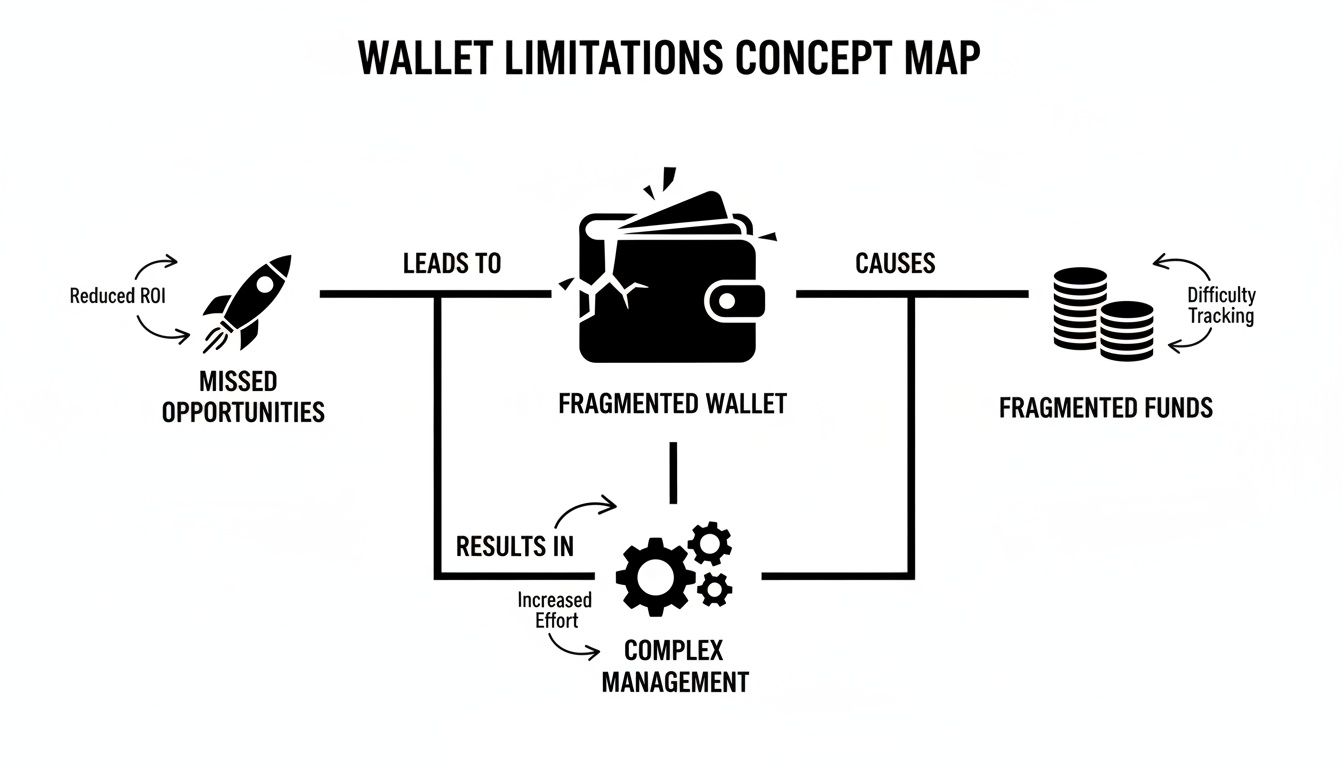
A concept map illustrating how fragmented wallets lead to missed opportunities and complex management.

As you can see, these pain points make it tough to act fast and keep a clear picture of your total holdings. A single, unified wallet is the only logical solution.

The Role of Blockchain Bridges

The most common way wallets move assets between chains is through blockchain bridges. Think of a bridge as a secure currency exchange counter at an international airport. You show up with your US Dollars (your tokens on Ethereum) but need Euros (tokens on Polygon) for your trip.

Here's the process step-by-step:

  1. Lock: You deposit your original asset (e.g., USDC on Ethereum) into the bridge's smart contract. This asset is now locked and held in custody.
  2. Mint: The bridge verifies the deposit and then mints a new, "wrapped" version of that asset (e.g., USDC.e on Polygon) on the destination chain.
  3. Transfer: This newly minted, pegged token is sent to your wallet address on the new chain, ready for you to use.

When you want to bridge back, the process reverses: the wrapped token is "burned" (destroyed), and your original asset is unlocked and returned to you.

Bridges are the workhorses of the cross-chain world, enabling value to flow between otherwise isolated networks. But remember, their security hinges entirely on the integrity of the smart contracts that lock and mint those assets.

Atomic Swaps: The Trustless Trade

Another powerful method is the atomic swap. Imagine you want to trade your rare comic book for a friend's vintage action figure, but you don't fully trust each other to mail the items at the same time. An atomic swap is like using a special, automated escrow box with two separate locks.

You both place your items inside. The box is programmed to only unlock and give you the other person's item if, and only if, both items are present. If one of you backs out or fails to put their item in, the box automatically returns everything to its original owner. This all-or-nothing process guarantees a fair trade happens simultaneously, completely removing the need for a trusted middleman. If you want to go deeper, check out our guide on how chain swap crypto works.

Smart Contract Wallets: The Personal Assistant

Finally, there are smart contract wallets. These are much more than just a place to hold your private keys; they are programmable accounts that live directly on the blockchain. The best way to think of a smart contract wallet is as a personal financial assistant who has authorized access to accounts at several different banks on your behalf.

You can give this assistant a single, high-level command, like, "Move $1,000 from Bank A to Bank B and use it to buy some specific stocks." The assistant handles all the underlying paperwork, transfers, and brokerage orders automatically. In the same way, a smart contract wallet can execute complex, multi-step actions across different chains from a single instruction, making it incredibly powerful for sophisticated DeFi strategies.

Comparing Cross Chain Technologies

Each of these technologies comes with its own set of trade-offs when it comes to speed, security, and what it’s best used for. This quick comparison table breaks down the key differences to help you understand what's likely powering your cross-chain wallet.

TechnologyHow It Works (Analogy)Best ForSecurity ModelTypical Speed
BridgesA currency exchange locking one asset to issue another.Transferring specific tokens between major blockchains.Trust in the bridge's smart contract security.Minutes to hours.
Atomic SwapsA self-executing escrow box for direct peer-to-peer trades.Trustless, direct swaps between two users on different chains.Cryptographic hash functions (HTLCs).Seconds to minutes.
Smart Contract WalletsA financial assistant executing tasks across multiple systems.Automating complex, multi-chain DeFi strategies and transactions.Depends on the wallet's code and user permissions.Varies by transaction.

Ultimately, understanding these core concepts helps you see past the interface and appreciate the engineering that makes seamless cross-chain activity possible.

Navigating Cross-Chain Security Risks

A cross-chain wallet gives you the power to move assets pretty much anywhere, but that freedom comes with its own set of security headaches. We need to move beyond generic advice like "don't share your keys" and get into the real risks of cross-chain life, like bridge exploits and malicious smart contracts designed to trip up multi-chain users.

Think of your security strategy as building a digital fortress. Your private key is the master key to the entire thing—it needs to be guarded like your life depends on it. Every time you use a bridge or interact with a new protocol, you're opening one of the fortress gates. You have to be absolutely sure that gate is secure and you know exactly who's coming through.

A glowing key floats before a vault door, flanked by 'Audited Bridge' and 'Smart Contract' signs.

Fortifying Your Digital Assets

Your first line of defense is, and always will be, securing that master key. If your private key gets compromised, an attacker gets control of your funds on every single chain at once. This is exactly why hardware wallets are non-negotiable for anyone serious about trading.

A hardware wallet, often called a cold wallet, keeps your private keys completely offline. When you need to make a transaction, you sign it inside the secure device. This means your keys are never exposed to your internet-connected computer, where malware could easily snatch them.

Your cross-chain wallet is only as secure as the method you use to protect your private key. Using a software-only (hot) wallet for significant funds is like leaving the master key to your fortress under the doormat.

Beyond the hardware, you still need to practice good digital hygiene. Phishing attacks are everywhere, with fake websites trying to trick you into connecting your wallet and signing a malicious transaction. Always bookmark the official sites for the dApps, bridges, and exchanges you use regularly. Never, ever click on suspicious links from emails, social media DMs, or Discord messages.

Your Cross-Chain Security Checklist

To operate safely in this environment, you need a repeatable security process. Every single cross-chain interaction needs to be approached with caution. Follow this checklist to build strong habits that will protect your capital.

  1. Use Audited Bridges and Protocols: Before you even think about sending assets across a bridge, check its security credentials. Stick to protocols that have gone through multiple third-party security audits from well-known firms. A bridge's smart contract is a massive target for hackers; billions have been lost in bridge exploits. Choosing a battle-tested bridge is like picking the most heavily guarded gate for your fortress.
  2. Simulate Transactions Before Signing: Many modern cross-chain wallets have a transaction simulation feature. This is a game-changer. It shows you exactly what will happen if you approve a transaction—which tokens will leave your wallet, and what you’ll get back. Think of it as your final security scan, helping you spot shady contracts designed to drain your funds.
  3. Regularly Revoke Contract Approvals: When you use a dApp, you often give its smart contracts permission to spend your tokens. If that dApp ever gets compromised, those old permissions can be used to steal your funds. Make it a habit to use a tool like Revoke.cash to review and cancel any unnecessary approvals. This is like locking old, forgotten doors to your fortress.
  4. Understand Smart Contract Risk: Every interaction you make involves a smart contract, and each one introduces risk. Malicious contracts can have hidden functions that aren't obvious at first glance. Taking the time to understand how different protocols work is essential. For a deeper dive, our guide on how cross-chain contract calls impact DeFi security is a great place to start.

By adopting this security-first mindset and turning these steps into habits, you can confidently explore the multi-chain world, cutting down your risks while you hunt for opportunities.

Choosing the Right Cross Chain Wallet

Not all cross chain wallets are built the same. The wallet that works wonders for a high-frequency arbitrage trader might be a terrible fit for an on-chain analyst digging for alpha. Picking the right tool isn’t about chasing the longest feature list; it’s about finding the one that slots perfectly into your specific trading style and workflow.

A good wallet should feel like a natural extension of your strategy, not a clunky roadblock.

Think about it this way: an alpha hunter exploring brand-new, obscure ecosystems needs a wallet with the broadest possible chain support. Their top priority is getting in early, even on networks that just launched. On the other hand, a trader running arbitrage strategies between established chains like Ethereum and Base needs something entirely different—lightning-fast bridging, low fees, and a bulletproof UI to snatch up fleeting price differences.

Core Features That Define a Great Wallet

When you start comparing wallets, the noise can be overwhelming. To cut through it, zero in on the criteria that directly impact your performance, security, and efficiency. These are the non-negotiables that separate a professional-grade tool from a basic one.

Take a second to think about your day-to-day operations. Do you need to bridge assets in seconds, or is a delay of a few minutes okay? Are you mostly just swapping tokens, or are you deep in the weeds interacting with complex DeFi protocols? Answering these questions will point you straight to what actually matters.

Evaluating Chain Coverage and dApp Integration

The most fundamental feature is chain support. Plain and simple, a wallet is useless if it doesn't connect to the blockchains where you see the most opportunity. Look for a wallet that not only covers the big EVM chains (think Ethereum, Base, Polygon) but also reaches into non-EVM ecosystems like Solana if that's part of your game plan.

Just as critical is the quality of its integrated dApps and bridges. A top-tier wallet is more than just a place to hold your crypto; it’s a command center. It should give you built-in access to reputable bridges and swap aggregators. This saves you from bouncing between a dozen different websites, which cuts down on security risks and shaves off precious time when a trade is on the line.

A superior cross chain wallet makes the complexity disappear. It should feel like you're managing a single, unified portfolio, while the tech in the background automatically finds the best route to move your capital from Point A on one chain to Point B on another.

The User Experience and Fee Structure

A wallet's user experience (UX) can absolutely make or break your trading. A clunky, confusing interface is a recipe for costly mistakes. The best wallets offer a seamless bridging and swapping flow, clearly showing you all the fees, slippage, and estimated transaction times before you ever click "confirm." Some even offer sub-second swaps by moving logic off-chain, which dramatically reduces the chance of a failed transaction.

Finally, always put the fee structure under a microscope. Cross-chain transactions can stack up multiple costs: source chain gas, bridge protocol fees, and destination chain gas. A good wallet is transparent about every single one. Even better, it might use aggregators to hunt down the most cost-effective route for your transfer. For active traders, those small fee differences add up fast.

Feature Checklist for Your Next Cross Chain Wallet

Use this checklist to evaluate and select a cross-chain wallet based on features that directly impact your trading efficiency and security.

FeatureWhy It Matters for TradersYour Priority (High/Med/Low)
Broad Chain SupportAccess to more ecosystems means more opportunities to find alpha before the crowd.
Integrated Bridges & SwapsSaves time and reduces security risks by keeping you within a trusted environment.
Transaction SimulationLets you preview transaction outcomes to avoid malicious contracts and costly errors.
Hardware Wallet CompatibilityNon-negotiable for securing significant capital against online threats.
Transparent Fee DisplayAllows you to accurately calculate the cost of a trade and avoid hidden charges.
Portfolio AnalyticsProvides a clear, unified view of your P&L and asset allocation across all chains.

By thinking through each of these points, you can move beyond the marketing hype and choose a wallet that is genuinely equipped to support your strategy and secure your assets.

Actionable Workflows for DeFi Traders

Knowing the tech and picking the right tool is just the start. To really get a feel for what a modern cross-chain wallet can do, you need to see it in action. So, let's jump from theory to practice with two real-world workflows for common types of traders.

These scenarios show how a single wallet can turn complex, multi-chain strategies into simple, repeatable steps.

Digital wallet on a tablet managing cryptocurrencies across Ethereum, Base, and Solana blockchains for research and following traders.

For the Smart Money Follower

This trader’s whole game is about finding and copying the moves of top-performing wallets. They need to act fast on strong signals, which often means hopping between blockchains to catch a new trend before it takes off.

Picture this: you're tracking a whale who's been farming airdrops on Ethereum. Suddenly, you see them bridge $100,000 in ETH to the Base network and immediately pile into a new, low-cap token. That's a huge signal. With a cross-chain wallet, you can follow that move in minutes.

Here’s exactly how it works:

  1. Start the Bridge: Right inside your wallet, you hit the "Bridge" button. You pick Ethereum as your source chain and Base as your destination, then punch in how much ETH you’re sending.
  2. Review and Go: The wallet finds the best route for you, pulling from an integrated bridge aggregator. It lays everything out on one screen: the bridge fee, the estimated gas on the other side, and how long it'll take. You just confirm.
  3. Make the Swap: As soon as your ETH lands on Base (usually just a few minutes), you use the wallet’s built-in "Swap" feature. You find that same low-cap token the whale bought and execute the trade, all without ever leaving your wallet.
  4. Bring Profits Home: Once the trade pays off and you've locked in your gains, you just do the reverse. Bridge your profits from Base back to Ethereum, ready for the next move.

This entire sequence used to be a clunky mess of multiple websites, different wallets, and a high chance of messing something up. Now, it's a slick, four-step process managed from one secure app.

For the On-Chain Researcher

This type of trader is less about pure speed and more about deep-dive analysis. The on-chain researcher needs to build a complete picture of a target wallet's strategy, which means analyzing their entire portfolio and profit-and-loss (P&L) across every single chain they use.

Before integrated cross-chain wallets, this was a total nightmare. An analyst would have to manually paste the same wallet address into Etherscan, then BaseScan, then PolygonScan, and on and on, trying to piece together a fragmented puzzle.

A cross-chain wallet with native portfolio tracking is the ultimate tool for on-chain analysis. It rolls up a target's entire multi-chain footprint into a single dashboard, turning hours of grunt work into a one-click affair.

Now, the workflow is incredibly streamlined.

Let's say you've found a trader you want to dig into. You just add their public address to your wallet's tracking or portfolio view. Instantly, the wallet fetches data from every supported EVM chain and gives you a consolidated view that includes:

  • Total Portfolio Value: See their entire net worth, all chains combined.
  • Chain-by-Chain Allocation: Understand what percentage of their capital is on Ethereum vs. Arbitrum vs. Base.
  • Complete P&L History: Analyze their realized and unrealized gains across their whole operation, not just one network.
  • Full Asset Breakdown: View every single token they hold, no matter which chain it’s on.

This unified view gives you immediate, deep insights into the trader's macro strategy. You can spot patterns—like a habit of taking profits on Ethereum and deploying speculative cash on Layer 2s—that would be almost impossible to see otherwise. This transforms your wallet from just a place to hold coins into a powerful intelligence hub, supercharging your analysis.

Finding Alpha with Wallet Finder

Think of your cross-chain wallet as a high-performance vehicle—it’s the execution tool you use to navigate the multi-chain world at speed. But even the best car is useless without a destination. To find the most profitable routes, you need an intelligence engine. That’s exactly where Wallet Finder comes in.

Our platform is purpose-built to uncover the opportunities that are actually worth chasing with your wallet. The single biggest headache for any on-chain trader is sifting through millions of wallets to find the real smart money. We solve that problem with laser-focused tools designed to spot profitable traders, follow their moves across different chains, and get ahead of their signals before the rest of the market even knows what's happening.

Pinpointing Cross-Chain Winners

The first step to finding real alpha is to locate the traders who don't just win on one chain, but consistently crush it across multiple ecosystems. A trader who is profitable on Ethereum is interesting. A trader who also nails winners on Base and Arbitrum? That’s someone operating on a completely different level, often a sign of deep research and a rock-solid market thesis.

Wallet Finder’s filters are built for exactly this kind of discovery. Instead of drowning in the noise of single-chain wonders, you can instantly zero in on wallets that demonstrate multi-chain mastery.

  • Cross-Chain Activity Filters: Isolate wallets that are actively bridging and trading across more than one network. This is how you find the sophisticated operators who move capital to chase alpha wherever it pops up.
  • Chain-Specific P&L: Analyze a single entity’s performance on Ethereum, then immediately pivot to see their P&L on various Layer 2s. This uncovers their complete strategy, showing you where they take risks and where they lock in profits.

Using these features turns the chaotic multi-chain landscape into a curated list of high-potential wallets to track.

Turning Intelligence into Actionable Signals

Once you’ve identified a wallet to follow, the real game begins. The most critical moves made by top traders often start with a cross-chain transaction—a clear signal that they’re positioning for a new play. If you miss that initial move, you’re already playing catch-up.

Wallet Finder closes this gap with real-time alerts that feed directly into your trading workflow.

The moment a top trader bridges assets to a new chain, it's more than just a transaction—it's a declaration of intent. They are moving capital with purpose, and being alerted to that action in real-time is a significant competitive edge.

You can set up custom alerts for when a tracked wallet initiates a bridge transaction. For example, you can get an instant Telegram notification the moment a top wallet moves $50,000 USDC from Ethereum to Base. That isn't just noise; it’s a powerful, actionable signal.

Armed with this intel, you can fire up your own cross chain wallet to mirror the move, investigate what's happening in that new ecosystem, and position yourself ahead of the herd. Our complete cross-chain wallet analytics guide breaks down even more strategies for turning these data points into profitable trades.

This synergy creates a complete system: Wallet Finder is your discovery and alerting engine, while your cross-chain wallet is the execution layer. Together, they form a potent combination that helps you not only find alpha but act on it with speed and precision, no matter which blockchain it’s on.

Frequently Asked Questions

Jumping into the multi-chain world can throw up some new questions, even for seasoned traders. Here are some straightforward answers to the things we hear most often about cross-chain wallets.

Are Cross Chain and Multi-Chain Wallets the Same?

People often use these terms interchangeably, but there's a subtle yet important difference. A multi-chain wallet is one that can hold assets from different blockchains. Think of it like having separate bank accounts in the US, Europe, and Japan—you can see all your balances, but you still need a separate service like Wise to move funds between them.

A true cross-chain wallet builds that transfer service right in. It doesn't just hold the assets; it has the integrated bridging tech to move them from one chain to another, all within the same app. It's your bank account and your international transfer service rolled into one. The good news is, most modern wallets are now aiming for this all-in-one experience.

Are Cross Chain Transactions More Expensive?

Yes, they typically are. Unlike a simple swap on a single network, a cross-chain transaction is a multi-step process, and each step has a cost. You’re usually looking at a stack of at least three separate fees:

  1. A gas fee on the starting chain to send your assets out.
  2. A protocol fee paid to the bridge for doing the heavy lifting.
  3. A gas fee on the destination chain to finalize the transaction and receive the assets.

Smart traders always run the numbers on this. The extra cost of bridging is only worth it if the profit on the other side is big enough to make it worthwhile.

How Can Wallet Finder Track One Wallet Across Chains?

It's a common practice for traders to use the same private key across all EVM-compatible chains like Ethereum, Polygon, Arbitrum, and Base. When they do this, it generates the exact same public wallet address on every single one of those networks.

Wallet Finder.ai leverages this fact to give you a massive analytical edge. We scan every supported EVM chain for activity tied to that single address and then pull it all together into one unified dashboard. This means you see the complete picture of a trader's multi-chain strategy without having to manually jump between a half-dozen different block explorers.


Ready to see what the smartest traders are doing across every major blockchain? Wallet Finder.ai is the intelligence engine you need to find profitable wallets, follow their cross-chain moves in real time, and turn raw on-chain data into your next big win. Start your 7-day trial today!