Crypto Price Alert Guide for Pro Traders
Master the crypto price alert. Learn to set advanced triggers, track smart money wallets, and integrate alerts into a winning trade strategy.

March 1, 2026
Wallet Finder

March 1, 2026

A modern crypto price alert is a powerful trigger for your trading strategy, not just a simple reminder to check prices. Think of it as an intelligent signal that automates your market watch, letting you act on critical movements the moment they happen—not hours later.

In crypto, timing isn't just important—it's everything. The market's wild volatility means fortunes can be made or lost in minutes. Trying to manually track every chart, asset, and wallet is not just hard; it’s flat-out impossible. This is where a modern crypto price alert system becomes your most valuable ally.
The days of setting a simple alert for when Bitcoin hits a certain dollar value are long gone. Today’s tools are so much more sophisticated, transforming passive pings into proactive trading signals.
A basic alert might tell you that Solana (SOL) just crossed $200. It's useful, sure, but it’s missing all the context. Why did it move? Was it a broad market rally, a massive whale purchase, or a sudden surge in trading volume? Answering these questions is the difference between making a smart trade and a purely reactive one.
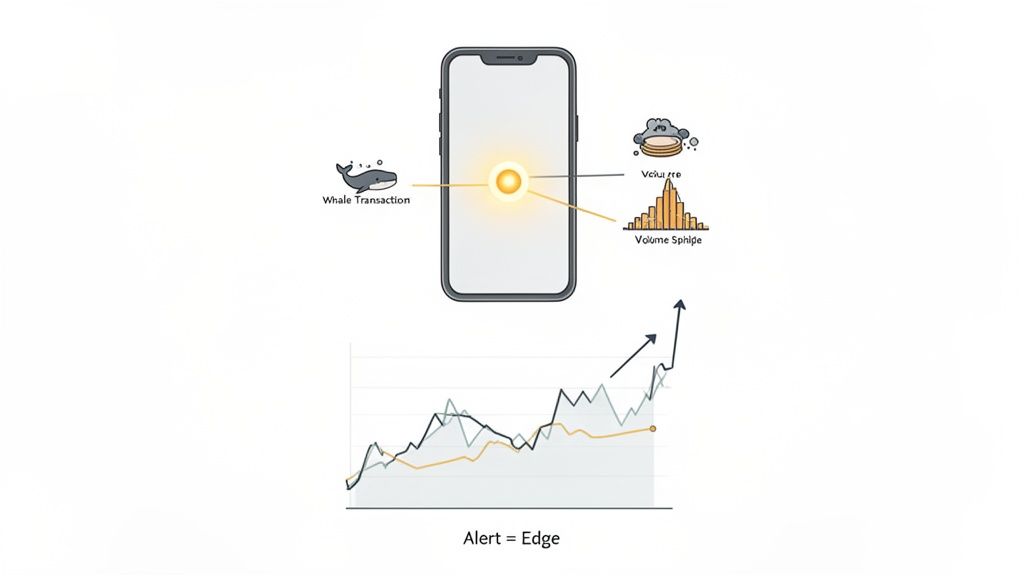
The real edge comes from alerts that signal why a price is moving. A notification about a sudden 300% volume spike on a low-cap token provides a much stronger trading thesis than a simple 10% price jump.
Advanced alert systems are built to give you this deeper context. They let you monitor not just the price but the underlying market dynamics driving it. To see how different platforms stack up, it's worth exploring a top-tier crypto price alert app.
Here’s how this evolution completely changes the game for traders:
Let's say you’re tracking a new memecoin. Setting a price alert for a 20% increase is standard practice. But what if you could set an alert that triggers only when a wallet known for smart memecoin trades makes a purchase of over $50,000? That one notification is infinitely more valuable.
This is the new paradigm of crypto alerts. It’s about creating intelligent tripwires that give you a crucial head start. A single, well-timed notification—whether it's about a whale's transaction, a smart money wallet's new position, or a sudden change in on-chain metrics—can mean the difference between catching a breakout and becoming someone else's exit liquidity.
Alright, let's move from theory to practice. This is where a crypto price alert system really starts to shine. Setting up your first intelligent alert doesn't have to be a headache. Using a platform like Wallet Finder.ai, you can start with the basics and quickly level up to more powerful, strategic triggers that cut through the noise.
The first move is always to pick your assets and define some simple price levels. For example, if you're watching Ethereum, you might set an alert for when it breaks a key resistance level, say $4,500, or dips to a support level at $3,800. This is the bread and butter of any alert strategy.
But honestly, static price points are just the beginning. The real edge comes from creating alerts based on how the market is actually moving.
To really get ahead, your alerts need to track the speed and momentum of price changes. A sudden, sharp move is almost always more telling than a slow, gradual one. You can set up your alerts to catch this velocity.
Here are some actionable, advanced trigger types you can set up today:
These dynamic triggers help you filter out the routine market chatter and focus only on the events that actually demand your attention.
An alert isn't just a notification; it's a pre-defined filter for opportunity. By setting triggers for volatility and volume, you’re telling your system, "Only bother me when something truly important happens."
This is the kind of setup that helps you navigate extreme market swings. Picture this: it’s January 15, 2026, and Bitcoin smashes through its all-time high, soaring past $97,000 for the first time before quickly pulling back into the high $80,000s. With forecast models for 2026 showing a wild range between $75,000 and $150,000, having smart alerts at key levels isn't just helpful—it's a necessity. You can explore the detailed 2026 Bitcoin price predictions to get a sense of the volatility we're all bracing for.
How you get an alert is just as important as what triggers it. The best systems give you multiple delivery channels, and each one is suited for different situations.
By matching the right channel to the urgency of the alert, you build a system that keeps you informed without blowing up your phone. A high-priority alert about a major liquidation should hit your Telegram for immediate action, while a summary of minor price moves can wait in your inbox.
While a standard crypto price alert is essential, pro traders know the real edge comes from seeing market-moving events before they hit the charts. This means digging deeper than just price and volume to track on-chain activity—where the “smart money” leaves its footprints. Setting up alerts for these actions is how you shift from reacting to the market to anticipating it.
The whole process is pretty straightforward. You pick an asset or wallet to watch, define what action should trigger a notification, and then decide how you want to get that ping.

This simple framework is your key to turning raw, noisy blockchain data into clear, actionable trading signals.
Your first move is to figure out which wallets are worth following. The goal isn’t to track thousands of random addresses but to build a high-signal list of proven winners. A platform like Wallet Finder.ai is built specifically for this, helping you discover top wallets based on their real-world performance.
When you’re building your watchlist, look for wallets with these traits:
Once you’ve got a curated list of 10-20 top-performing wallets, you’re ready to set up alerts that mirror their every move. This is the bedrock of effective copy trading.
With your watchlist ready, it’s time to create alerts that give you a direct window into what these pros are doing. Forget a simple crypto price alert—you’ll be tracking specific transactions. This gives you an insider’s view of what successful traders are buying, selling, and holding.
An alert that a top trader just swapped $200,000 of ETH for a new, low-cap altcoin is an incredibly powerful signal. It tells you someone with a proven track record is making a big bet, giving you a chance to do your own research and get in before the wider market even knows the token exists.
For a complete picture, you'll want to set up notifications for different kinds of on-chain moves.
Moving beyond basic price pings, advanced alerts let you monitor the specific actions of top traders. Here’s a breakdown of the most valuable triggers available through platforms like Wallet Finder.ai.
By combining these alert types, you build a powerful intelligence system. For instance, you could get a ping the moment a wallet you follow buys a brand-new token, giving you a crucial head start to investigate. To get even deeper on this, check out our complete guide on how to build a smart money tracker and find the most profitable traders to follow.
This method delivers actionable intelligence that a simple crypto price alert could never match. You’re seeing conviction through action, which lets you get ahead of trends and make smarter, data-driven copy trading decisions.
Getting a crypto price alert is just the first domino. If you don't have a plan for what comes next, that timely notification is nothing more than noise. The real magic happens when you weave your alert system directly into your risk management strategy, turning pings into pre-planned actions that protect your capital.
At its core, it's about using alerts to force yourself to stick to your trading rules, especially when emotions are running high. It's how you remove the hesitation and guesswork from those make-or-break trading moments.
The most common way traders do this is by using alerts to manage their entries and exits. This isn't just about the old "buy low, sell high" cliché; it's about systematically shielding your portfolio from sudden nosedives and locking in gains before a trend flips.
Here are a few actionable ways to put this into practice:
By pre-committing to these actions, an alert becomes more than just a notification—it's an instruction from your past, more rational self. It’s your personal mechanism for sticking to the plan when volatility is trying to throw you off your game.
Smart traders don't just watch individual asset prices. They set alerts to monitor the bigger picture—the macro risk signals. The crypto market doesn't live in a bubble; its connection to traditional finance is a critical factor that can signal broad market sell-offs before they happen.
A perfect example is the relationship between Bitcoin and stock market volatility. In 2026, Bitcoin's correlation with the S&P 500 hit 0.75, and its correlation with the VIX (the "fear index" for stocks) shot up to an all-time high of 0.88. On days with major risk-off events, where the VIX can spike +32.60%, it's not uncommon to see BTC plunge over 7% and ETH over 12%. You can learn more about how crypto volatility now moves with equity markets on Gate.com.
So, what’s the move? Set an alert for a sudden, sharp spike in the VIX. This can give you an early warning to de-risk your crypto portfolio before a systemic shock ripples through the market. This is a powerful strategy used by institutional traders, and it’s something you can easily implement. It transforms your alert system into an automated defense mechanism for preserving your hard-earned capital.
For a deeper dive into protecting your portfolio, check out our guide on DeFi portfolio risk assessment tools and techniques. This framework turns a simple crypto price alert from a basic ping into an essential part of your capital preservation strategy.

Setting up an intelligent alert system is a game-changer. But if your phone is buzzing every few minutes, you’ll quickly hit a wall of "alert fatigue." It's a real problem. When every tiny market flutter triggers a ping, you naturally start tuning them out. That’s when you risk missing the one big move that truly matters.
The secret is to refine your setup until every notification is a high-signal, actionable insight, not just another distraction. It’s about quality over quantity.
A great first step is to ditch rigid, static price targets. The market’s volatility is always changing—what counts as a huge move on a slow Tuesday is just background noise during a weekend pump. Your alerts need to adapt, and you can do this with dynamic thresholds.
One of the most practical strategies is setting up tiered alerts based on an event's urgency. This helps you instantly distinguish between routine market chatter and critical moments that demand your immediate attention.
Here's a simple, actionable framework you can adopt:
A tiered system like this ensures that when you get that high-priority ping, you know it counts. It keeps your focus sharp and your mind clear.
Your goal isn't to track every ripple in the market. It's to build a system that only grabs your attention when a specific, strategic opportunity or risk appears. Think of it as programming a vigilant assistant who knows exactly what you care about.
Another huge source of noise, especially when you’re tracking wallet activity, is the endless stream of tiny transactions. A popular wallet might execute dozens of tiny "dust" transactions a day that are completely irrelevant to your strategy. You have to filter this out.
The easiest way to combat this is by setting minimum transaction value filters.
For example, if you’re using a tool like Wallet Finder.ai, you can configure your wallet alerts to only trigger for transactions above a certain size, like $10,000. This one simple tweak immediately cleans up your notification feed.
By filtering out all the noise, you can laser-focus on the high-conviction capital moves that give you real insight into a pro trader’s strategy. Suddenly, every alert becomes a valuable piece of intelligence.
As you start using more advanced notifications, a few practical questions always seem to pop up. It's one thing to set up a system of crypto price alerts, but it’s another thing entirely to use it without getting overwhelmed or making costly mistakes.
Let's clear up some of the most common questions from traders.
There's no single answer here, but my guiding principle is quality over quantity. If your phone is buzzing every five minutes, you're just creating noise and will eventually tune it all out. That defeats the whole purpose.
A good starting point is to focus on 5-10 core assets you're actively trading or have on your watchlist.
Instead of setting a dozen simple price pings for each one, think in tiers. For example:
The same logic applies to wallet tracking. Don't try to follow hundreds of wallets. Curate a focused list of 10-20 high-performing wallets you've identified. If you find yourself constantly swiping away notifications without a second thought, it’s a clear sign you need to go back and tighten your filters.
Technically, yes, you can connect alerts to automated trading bots via an API, but this is expert-level territory and requires extreme caution. Most alert platforms, including Wallet Finder.ai, are designed to give you the signal, leaving the final call to you. This is a deliberate risk-management feature.
To set up automation, you'd typically link an alert system’s API to a trading bot or directly to an exchange's API. For instance, you could program a rule like, "If a BTC price alert for $80,000 triggers, execute a market buy order of 0.1 BTC."
This is an advanced strategy. If you go this route, always—and I mean always—start with a very small amount of capital and backtest your strategy thoroughly before deploying it with significant funds. One misconfigured rule can be disastrous.
Price alerts are reactive—they tell you what the market is doing. Wallet activity alerts are predictive—they signal what smart money is doing ahead of the crowd. The most effective strategy combines both.
This is a classic question, and the answer is that they're both critical—they just serve different purposes. A crypto price alert is your go-to for managing risk (like setting a digital stop-loss) and reacting to big market swings. It tells you what's happening right now.
Wallet activity alerts, on the other hand, give you an informational edge.
Think about it: an alert that a top trader just swept a new, obscure token is a predictive signal. It's something a price chart can't show you yet. The smartest traders use them together. Use wallet alerts to discover fresh opportunities, then switch to price alerts to nail your entry, manage the trade, and protect your profits.
Ready to stop reacting and start anticipating the market? Wallet Finder.ai gives you the tools to track smart money and receive instant alerts on the moves that matter. Discover profitable wallets, get in early on new tokens, and trade with an edge. Start your 7-day trial at https://www.walletfinder.ai today.