How to Analyze Crypto: A Step-by-Step Guide
Learn how to analyze crypto with our guide to fundamental, on-chain, and technical analysis. Get actionable frameworks to evaluate projects and manage risk.

December 6, 2025
Wallet Finder

November 28, 2025

Ever looked at a crypto chart and felt like you were staring at random, chaotic squiggles? It's a common feeling. But what if there was a hidden pattern, a predictable rhythm to the madness? That’s exactly what a crypto cycle chart helps you see.
Think of it as a roadmap for the market's emotional and financial journey. Instead of getting lost in the day-to-day noise of price spikes and dips, this chart reveals the bigger picture—a repeating story of how markets behave. It’s a lot like the four seasons; each phase has its own distinct feel, letting you know what to expect next.
A crypto cycle chart is a visual representation of the recurring patterns that assets like Bitcoin have historically followed. These cycles aren't random. They're driven by a powerful mix of fundamental factors, like token supply, and the deeply ingrained tides of human psychology—our collective fear and greed.
Just like nature has its seasons, financial markets have their phases. A cycle chart helps you identify which "season" you're in right now.
This is a powerful perspective shift. You move from reacting to daily price action to understanding the overarching trend. It gives you the high-level view needed to see where the market has been and, more importantly, where it might be headed. Armed with this knowledge, you can make smarter, more strategic decisions and avoid classic emotional blunders like FOMO-buying the top or panic-selling the bottom.
At its heart, the crypto cycle is broken down into four distinct phases that follow one another in a sequence. Understanding these is the first step to making sense of it all.
The crypto market cycle is a story of sentiment shifting from fear to greed and back to fear again. The chart is the illustration of that story, providing clues at each chapter.
This framework isn't just theory; it's a reflection of how capital and emotion flow through a market.
To make it even clearer, here’s a quick snapshot of what to look for in each phase.
This table gives you a quick summary of the key characteristics of each phase. It helps you identify where we are in the cycle based on price, sentiment, and the overall mood of the market.
Once you internalize this structure, the crypto cycle chart stops being some complex analytical tool and starts feeling more like an intuitive map. It gives you the context you need to navigate the volatility, manage your risk, and spot much better opportunities to enter and exit your positions.
Knowing the theory behind a crypto cycle chart is one thing, but actually seeing it play out in real-time is a completely different ballgame. Every cycle has four distinct phases, each with its own personality driven by the collective mood of millions of investors. Once you learn to spot the unique price action, trading volume, and market sentiment of each stage, you can turn a chaotic chart into a clear story.
This diagram gives you a great visual for how the four phases flow from one to the next in a never-ending loop.
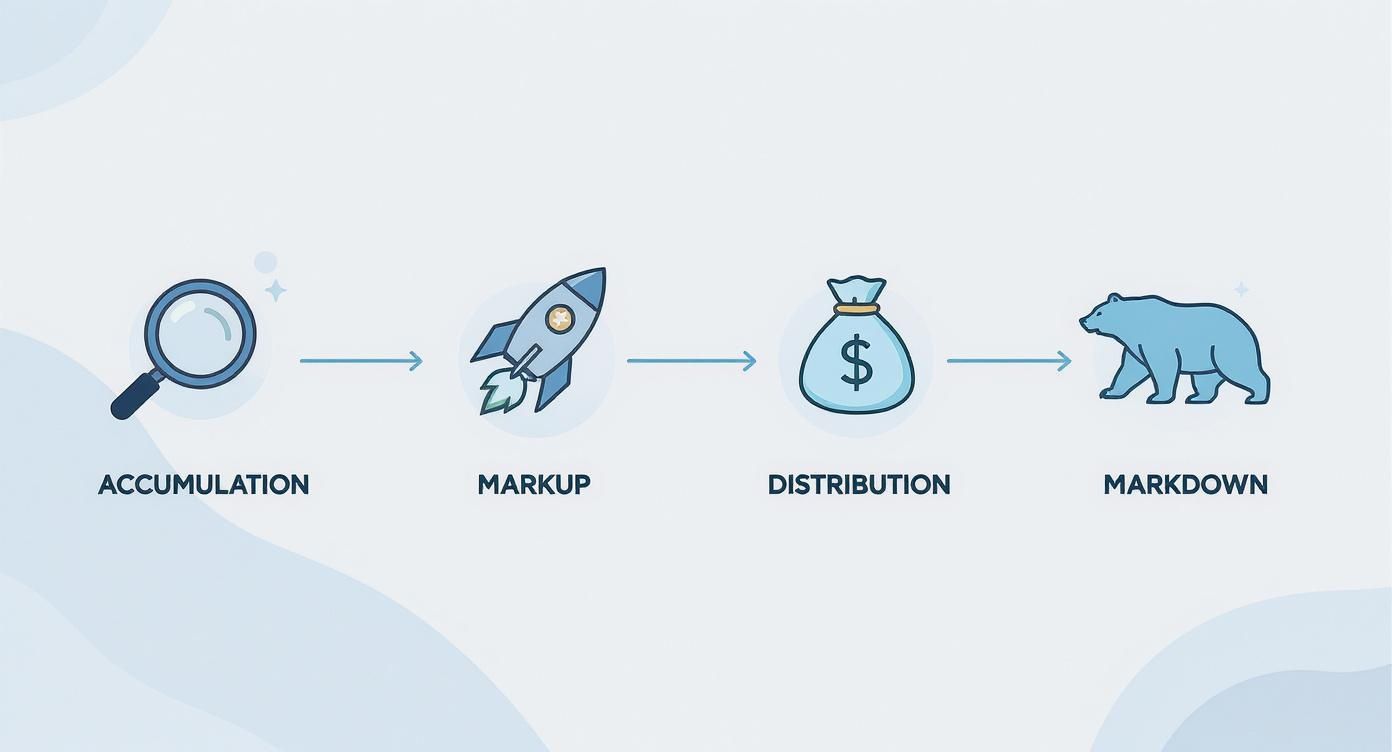
You can see the journey from the sleepy Accumulation phase to the explosive Markup, followed by the uncertain Distribution phase, and finally, the painful Markdown that resets the whole process.
The accumulation phase is the quiet bedrock of every bull market. It kicks off after the last cycle's crash has completely fizzled out, leaving behind a market full of despair and sheer boredom. Most retail investors are long gone, and the headlines are nothing but doom and gloom.
During this time, prices just drift sideways in a tight range, sometimes for months or even years. Volume is usually dead because nobody cares anymore. But under the surface, the smart money and the true believers are quietly buying up, or accumulating, assets at rock-bottom prices.
You'll know you're in an accumulation phase when you see:
This is the point of maximum financial opportunity, but it’s also the toughest time to invest psychologically. You have to be willing to go against the herd.
The markup phase is when the market finally wakes up. After a long snooze in accumulation, enough of the supply has been scooped up by strong hands that it doesn't take much buying to start moving the price. The asset begins to break out of its long-term range, and the more observant traders start to take notice.
At first, most people dismiss it as just another "sucker's rally." But as prices keep climbing, belief slowly creeps back in. The media starts running positive stories, and the retail investors who sat on the sidelines start piling back in. This creates a feedback loop of rising prices and growing hype.
The markup phase is a masterclass in market psychology. It starts with disbelief, transitions to hope, grows into optimism, and culminates in pure euphoria as FOMO (Fear of Missing Out) takes over.
This is where the biggest gains of the entire cycle are made. We see it time and time again in Bitcoin’s price history. For example, the 2018 bottom around $3,100 was a classic accumulation period after the 2017 peak. What followed was a massive markup phase, often supercharged by Bitcoin halving events that choke off new supply. The most recent halving on April 19, 2024, is historically a trigger for this kind of speculative growth. Learning how to analyze these cyclical crypto market patterns is the key to spotting this shift.
The markup party can't last forever. The distribution phase kicks in when the explosive uptrend starts to run out of gas and prices hit a plateau. At this point, the market is absolutely euphoric. Everyone is convinced prices are headed to the moon, and stories of people becoming overnight millionaires are everywhere.
But behind the scenes, the same smart money that was buying at the bottom is now quietly selling, or distributing, their bags to the flood of new, ecstatic buyers. The price action gets wild and choppy, with huge swings in both directions. Volume is sky-high, but the price isn't really going anywhere—a dead giveaway that big sellers are absorbing all the new demand.
Here are a few warning signs of a distribution phase:
The markdown phase begins when the selling pressure from the distributors finally overwhelms all the buying demand. The market slowly starts to realize the top is in, and fear begins to replace greed.
Prices go into a steep decline, crashing through key support levels on the way down. Investors who bought at the top are now underwater and start panic-selling to cut their losses, which just pours gasoline on the fire. This phase often looks like a waterfall-style crash, followed by a few weak bounces that ultimately fail and lead to even lower lows.
The markdown phase ends in capitulation. This is the moment when even long-term holders can't take the pain anymore and finally throw in the towel. This last wave of selling clears out the last of the weak hands, setting the stage for the next accumulation phase to begin all over again.
So, what actually makes these market cycles tick? The four phases we see on a crypto chart don't just happen randomly. They’re the result of a fascinating tug-of-war between two core forces: the cold, hard logic of code and the wild, unpredictable mess of human emotion.
Think of it this way: one force is the steady, predictable beat of a drum setting the rhythm. The other is the chaotic, emotional crowd dancing to that beat, creating the wild swings—the euphoric highs and the crushing lows—that define a crypto cycle.
At the heart of it all is the Bitcoin Halving, a pre-programmed event baked directly into Bitcoin’s code. It’s the market’s pacemaker, and it happens like clockwork roughly every four years. In simple terms, it cuts the reward that miners get for securing the network in half.
Why does this matter so much? It all comes down to supply and demand.
Time and time again, the months following a halving have lit the fuse for a new markup phase, pulling the entire crypto market up into its next major bull run.
"The Bitcoin Halving is the metronome of the crypto market. It sets the rhythm that everything else, from altcoin performance to market sentiment, eventually dances to."
This predictable event lays the groundwork, but it’s human psychology that turns a gentle slope into a rocket launch—and a painful freefall.
If the halving is the spark, human emotion is the jet fuel. The insane volatility you see on a crypto cycle chart is a direct mirror of our collective psychology swinging violently between two poles: greed and fear.
These emotions aren't just feelings; they trigger specific, predictable behaviors that create the cycle's peaks and troughs.
Fear of Missing Out (FOMO)
As prices start to climb during the markup phase, FOMO kicks in. People see friends and strangers posting massive gains online and pile in, often with little research, terrified of being left behind. This frantic buying from the masses is what pushes prices to irrational, parabolic heights, creating the euphoric peak right before the music stops.
Fear, Uncertainty, and Doubt (FUD)
On the flip side, once the markdown phase begins, FUD spreads like wildfire. A bit of negative news or a sharp price drop triggers a wave of panic. People rush to sell, desperate to avoid more losses. This selling pressure feeds on itself, accelerating the crash and leading to the final stage of despair and capitulation at the cycle bottom.
This emotional rollercoaster is why crypto markets don't just rise and fall—they overshoot wildly in both directions. These patterns aren’t new. Historically, Bitcoin and the wider crypto market have moved in three-to-four-year cycles, often anchored to the halving.
For example, the cycle from January 2015 to December 2017 saw Bitcoin explode over 100 times from its low, topping out near $20,000. The next cycle, from December 2018 to November 2021, saw a jump of about 20 times, peaking around $69,000. You can dig deeper into these patterns in this Grayscale research report.
Once you grasp both the predictable catalyst (the halving) and the predictably irrational human reactions that follow, a crypto cycle chart is no longer just a line on a screen. It becomes a rich story of technology meeting human nature.
Theory is one thing, but rolling up your sleeves and getting your hands dirty is where the real learning happens. Looking at historical charts is useful, but building your own gives you a practical feel for how these massive market waves actually play out.
We'll walk through a simple, no-nonsense process using TradingView, a powerful (and free) charting platform that's an industry standard.
The goal isn't to clutter your screen with a dozen confusing indicators. Instead, we'll focus on just three high-signal tools that have consistently provided a clear framework for spotting cycle phases.
Think of this setup as your command center for market cycles. It helps you cut through the daily noise and focus on the big picture that truly matters.
Before you add a single indicator, the first and most important step is getting your chart set up correctly. Market cycles unfold over years, not hours, so your timeframe needs to reflect that reality.
This high-level view smooths out all the short-term volatility, making the long, sweeping arcs of the market cycles much easier to see.
With your canvas ready, it's time to add a few simple yet powerful indicators. These tools will act as your guideposts, helping you pinpoint key zones of opportunity and risk within the cycle.
1. Moving Averages (MAs)
Moving averages are the absolute backbone of long-term trend analysis. They smooth out price data to reveal the underlying trend. For cycle analysis, we only need two:
2. Relative Strength Index (RSI)
The RSI is a momentum oscillator that tells you how fast and how far the price is moving. It's fantastic for identifying overbought and oversold conditions.
On the weekly timeframe, an RSI reading above 70 suggests the market is getting euphoric and overheated (a classic sign of a distribution phase). A reading below 30, on the other hand, suggests the market is oversold and full of despair (typical of an accumulation phase).
3. Logarithmic Growth Curves
This one is a bit more advanced but incredibly insightful. Logarithmic Growth Curves are channels plotted on the chart that map out Bitcoin's long-term growth path. Over a full cycle, the price tends to bounce between the lower support band and the upper resistance band. Hitting the bottom has historically marked cycle lows, while touching the top has signaled cycle peaks.
You can easily find custom-built Logarithmic Growth Curve indicators in TradingView's community scripts library.
Once you have these indicators layered on your weekly log chart, the phases of the crypto cycle become incredibly clear. You can visually track how the price bottoms out near the 200-week MA and the lower log curve, climbs with support from the 21-week EMA, and eventually tops out as the RSI gets overbought and the price smacks into the upper log curve.
While these chart-based tools are fantastic, you can get an even bigger edge by mixing them with other signals. For investors wanting to go deeper, exploring the best tools for wallet trend analysis can show you exactly how smart money is positioning itself, adding another powerful layer of confirmation to what your cycle chart is telling you.
A crypto cycle chart gives you a powerful high-level map, but to really navigate the market with confidence, you need some ground-level intelligence. That's where on-chain analysis comes in.
Think of it as your reconnaissance team, scouting ahead to confirm what the map is telling you. It means looking directly at the blockchain's public ledger to see what investors are actually doing with their coins, not just what the price chart says.
This approach cuts through the noise of price action and shows you the real economic activity driving the market. By tracking the behavior of different players—from massive "whale" wallets to small retail investors—you can add a profound layer of confirmation to each cycle phase. It's the difference between guessing where an army is moving and having a live satellite feed of its troops.

You don’t need to get lost in a sea of complex data. Instead, you can focus on a few key metrics that provide clear signals about market health and sentiment. These act as your on-the-ground confirmation for the accumulation, markup, distribution, and markdown phases we talked about earlier.
1. Net Unrealized Profit/Loss (NUPL)
This metric is basically a thermometer for market psychology. NUPL measures the total paper profits or losses of all coins in circulation, giving you a raw, unfiltered gauge of market-wide sentiment.
2. Whale Transactions
Whales are wallets holding enormous amounts of a cryptocurrency, and their actions can create major waves. A sustained increase in large-value transactions often signals that a big shift is coming.
3. Exchange Flows
Tracking how much crypto is flowing in and out of exchanges gives you a direct look at supply and demand. It tells you whether investors are in a buying (HODLing) mood or a selling one.
Key Takeaway: When coins leave exchanges, it's generally bullish because it reduces the immediately sellable supply. When coins flood onto exchanges, it's bearish because it signals an intent to sell.
Let's put this all together into a practical framework. You can use these on-chain signals as a checklist to validate what your crypto cycle chart is showing you.
By cross-referencing these real-time economic signals with the patterns on your chart, you gain a much sharper edge. You're no longer just interpreting lines; you're verifying them with tangible evidence of investor behavior.
To dive even deeper, our complete guide to on-chain analysis breaks down more advanced metrics and strategies.
Even after you've got a handle on the four phases, you're bound to have questions when it's time to actually put the theory into practice. Let's tackle some of the most common ones that pop up, clearing up any confusion so you can use these charts as a real tool in your trading arsenal.
Think of a crypto cycle chart as a seasoned weather forecaster, not a psychic. It’s an incredibly powerful way to map out historical patterns driven by raw market psychology and simple supply and demand. Its reliability comes from showing you what has happened over and over again, giving you a serious statistical edge.
Past cycles, which have been heavily anchored to the Bitcoin halving, have shown an almost eerie consistency. But that's not a guarantee. New forces are always coming into play—think big-money institutional adoption, sweeping regulations, or black swan global events—that can stretch, squash, or intensify a cycle.
The one thing that doesn't change? Human emotion. Fear and greed are timeless. The best way to use the chart is as a strategic guide for managing risk. It helps you spot the high-risk euphoria zones and the high-opportunity despair zones, rather than trying to nail exact tops and bottoms. Always layer it with other data, like on-chain metrics and volume profiles, to get the full picture.
Mostly, yes. Bitcoin is the sun in the crypto solar system. Its massive gravitational pull sets the market's general direction. Because of its sheer size and network dominance, when Bitcoin is healthy and climbing, capital naturally overflows into altcoins, kicking off the explosive "altseason" every trader dreams about.
During these runs, it’s not unusual to see dozens of altcoins post gains that dwarf Bitcoin's. They are, in essence, higher-beta bets on the same macro trend.
But it cuts both ways. When Bitcoin rolls over and enters a bear market, altcoins tend to bleed out much, much harder. An individual altcoin might have a mini-cycle of its own thanks to a big product launch or partnership, but it’s rarely strong enough to defy a market-wide trend set by Bitcoin for very long. The golden rule is simple: always know what phase Bitcoin is in. It sets the stage for everything else.
The relationship is simple: A rising Bitcoin tide lifts all boats, but a falling tide can leave many altcoin projects stranded. Understanding Bitcoin's position in the crypto cycle is foundational to any altcoin investment strategy.
Getting the most out of cycle charts is less about making perfect calls and more about not making catastrophic errors. Just knowing the common pitfalls can be enough to save you from emotional, account-draining decisions.
Here are the top three mistakes I see traders make all the time:
The flood of institutional money is probably the biggest new variable in the current crypto cycle. The launch of spot Bitcoin ETFs, for instance, has unlocked a steady firehose of demand that simply didn't exist in past cycles.
This could absolutely change the game in a few ways:
But while institutional capital brings legitimacy and deep pockets, it doesn't erase the cycle. At the end of the day, professional fund managers are human too. The core rhythm of fear and greed will almost certainly stick around, even if the waves look a little different this time.
Ready to move beyond the chart and see what smart money is doing right now? Wallet Finder.ai gives you a real-time view of the wallets that are leading the market. Track their buys and sells, get instant alerts, and turn on-chain data into your unfair advantage. Start your 7-day trial of Wallet Finder.ai today.
"I've tried the beta version of Walletfinder.ai extensively and I was blown away by how you can filter through the data, and the massive profitable wallets available in the filter presets, unbelievably valuable for any trader or copy trader. This is unfair advantage."
.avif)
Pablo Massa
Experienced DeFi Trader