Best Crypto Price Alert Apps for Traders

Wallet Finder

Blank calendar icon with grid of squares representing days.

February 16, 2026

Crypto price alert apps are your personal market watchdog. They send you instant notifications when a cryptocurrency hits a price you care about, letting you react to market movements without being glued to your screen all day. This is a game-changer for capturing opportunities and managing risk in the volatile crypto space.

The Psychology of Alert Fatigue (And How To Avoid It)

Here's what nobody tells you about crypto price alerts: they can actually make you a worse trader. Sounds crazy, right? You'd think more information equals better decisions. But there's a dark side to alerts that destroys more portfolios than it saves.

Alert fatigue is real. It happens when you set so many alerts that you stop trusting them entirely. Your phone buzzes 40 times a day. Bitcoin hit $95K. Ethereum dropped 2%. Solana pumped 3%. Your altcoin moved 1.5%. After a week of this noise, your brain learns to ignore every single notification. Then when the one alert that actually matters fires—the one signaling a major whale dump or critical support break—you scroll right past it like all the others.

The solution isn't fewer alerts. It's smarter alerts. You need a framework that filters signal from noise before it ever reaches your phone.

The Three-Tier Alert System

Professional traders don't treat all alerts equally. They build hierarchies. Here's the framework that works:

Tier 1: Critical Action Required (SMS + Phone Call + App)
These are your "drop everything" alerts. Reserved for massive moves that demand immediate response. Examples: Bitcoin breaks below $90K (major support), your DeFi position liquidation warning, whale wallet you track dumps 50%+ of holdings. You should receive maybe 2-5 Tier 1 alerts per month. If you're getting them daily, you've misconfigured them.

Tier 2: High Priority Review (Push Notification Only)
These need attention within 1-4 hours but not instantly. Examples: Ethereum drops 5% in an hour, trading volume on your altcoin spikes 3x normal, correlation break between Bitcoin and your portfolio. You might get 10-20 Tier 2 alerts monthly.

Tier 3: Information Only (Email Digest)
Useful data but no urgency. Examples: Coin you're watching moves 2%, daily volume summary, weekly price reports. These get batched into a single email you review when convenient, maybe once daily or weekly.

This tiered system does two things. First, it trains your brain to treat different alert types appropriately. Phone rings? That's serious. Email? Check it later. Second, it prevents the notification overload that causes you to ignore everything.

The FOMO Trap in Real-Time Alerts

Real-time alerts are designed to trigger FOMO. That's not an accident—it's a feature. When your phone screams "PEPE COIN UP 25% IN 15 MINUTES," your lizard brain goes into panic mode. You think: "Everyone's buying! I'll miss out! Buy now!"

This is exactly when you make your worst trades. You market-buy into a parabolic spike at the top. By the time your order executes, the pump's over and you're underwater. You just became exit liquidity for the smart money who bought 30 minutes earlier.

The antidote is simple: add a 15-minute delay rule. When any alert fires that triggers emotional urgency, force yourself to wait 15 minutes before acting. Set a phone timer. During those 15 minutes, check on-chain data, look at the order book, see if whales are accumulating or dumping.

In most cases, that 15-minute pause saves you from buying the top. If the opportunity was real, it'll still be there. If it was a pump-and-dump, you'll watch it crash during your waiting period and dodge the bullet entirely.

The Emotional Tax of Constant Monitoring

Every alert carries an emotional cost. Each notification jolts you out of whatever you're doing and forces your brain into market-analysis mode. Do this 50 times a day and you're mentally exhausted. You make worse decisions because decision fatigue is real.

Track this for one week: count every crypto alert you receive. Include price alerts, news alerts, whale alerts, everything. Most traders discover they're getting 30-60 notifications daily. That's insane. You're interrupting your life every 20-30 minutes for crypto. This isn't making you richer—it's making you anxious.

Cut that number by 70%. Keep only the alerts that have historically led to profitable trades. Archive the rest. Your mental health and your portfolio will both improve.

Why Crypto Price Alert Apps Are Essential

The crypto market never sleeps. It’s a relentless, 24/7 machine that creates a huge problem for every trader: you can't possibly watch every single price tick or market shift. Burnout is real. This is where crypto price alert apps become your most valuable ally, solving the impossible challenge of constant monitoring.
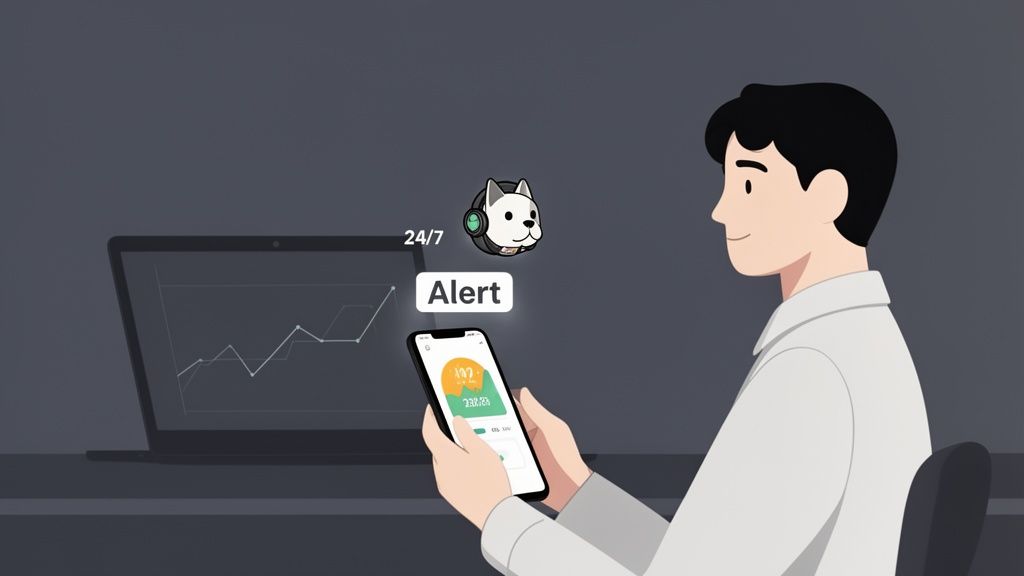
A person receives a 24/7 crypto price alert on their phone, with a dog mascot and a laptop displaying a graph.

Without these tools, you're always playing catch-up. By the time you manually spot a major price swing, the best entry or exit point has likely vanished. This reactive approach is a recipe for missed profits and, even worse, avoidable losses.

From Reactive to Proactive Trading

The real magic of these apps is how they flip your trading style from reactive to proactive. Instead of chasing past events, you set your conditions ahead of time and let the technology do the legwork. It's a simple switch with a massive impact.

This frees up your time and mental energy, saving you from the exhaustion of non-stop chart-watching. More importantly, it forces discipline into your strategy. By setting alerts for both your profit targets and your stop-loss triggers, you’re committing to a plan before emotions like greed or fear can get in the way.

This foundation lets you:

  • Seize Opportunities: Get pinged the second a target asset hits your perfect buy-in price.
  • Mitigate Risk: Receive an immediate heads-up when a position turns against you, giving you time to get out.
  • Execute with Discipline: Take the emotion out of the equation by pre-defining your entry and exit points.

By automating market surveillance, crypto price alert apps give you the freedom to focus on strategy rather than being a slave to the charts. You define the rules, and the app watches the market for you.

Think of these apps as your first line of both defense and offense. They are your automated eyes and ears, making sure you never miss a critical market event. This sets the stage for more sophisticated strategies that use different kinds of alerts and even advanced on-chain analysis.

Understanding the Different Types of Crypto Alerts

Not all notifications are created equal. Modern crypto alert apps offer a menu of triggers that go way beyond simple price points. Understanding each type is key to building a robust trading strategy, moving you from basic signals to seeing what’s really happening on the blockchain itself.

Four icons representing key crypto data metrics: Price, Percentage Change, Volume, and On-chain features.

Here's a breakdown of the essential alert categories every trader should have in their toolkit.

Price Threshold Alerts

This is your bread and butter—the most fundamental alert and the bedrock of any trading plan. Think of it as setting a digital tripwire. You pick a specific price, and the second the asset crosses it, you get a ping.

  • Actionable Tip: Set alerts slightly before a key support or resistance level. For example, if Bitcoin's support is at $60,000, set an alert at $60,500. This gives you time to prepare your trade before the critical level is tested.

Percentage Change Alerts

While price thresholds are about hitting a specific number, percentage alerts are all about the speed of the move. These are your early warning systems for sudden, explosive volatility—often called "pumps and dumps."

  • Actionable Tip: Customize your percentage alerts for each asset's volatility profile. For Bitcoin, a 5% move in an hour is huge. For a new altcoin, you might set the threshold at 20% to avoid constant, noisy notifications.

These alerts are all about spotting behavior that’s out of the ordinary. A 5% move in Bitcoin is a big deal, but for a brand-new memecoin, a 5% move might just be another Tuesday. Customizing these by asset is what makes them powerful.

Volume Spike Alerts

Price tells you what is happening, but volume tells you how much conviction is behind the move. A volume spike alert goes off when trading activity for an asset explodes past its recent average. It’s like hearing a sudden roar from a stadium crowd; you know something important just went down.

  • Actionable Tip: Combine a volume alert with a price threshold alert. A breakout through a resistance level is far more convincing if it's accompanied by a massive spike in trading volume. This combination helps you avoid "fakeouts."

The False Breakout Alert Trap

Price threshold alerts set at resistance levels are one of the most common configurations in any crypto alert setup. They're also one of the most reliably frustrating — generating repeated false signals that erode both capital and confidence. Understanding why resistance-level alerts fire falsely so often, and how to filter the noise, is worth more than any alert app feature list.

False breakout alerts occur when price crosses your trigger level, fires the notification, and then immediately reverses below resistance — often within minutes. You receive the alert, enter the trade, and watch price snap back as if the breakout never happened. This isn't random. It's frequently manufactured.

Why Resistance Levels Are Manipulation Targets

Major resistance levels on watched assets — the $100,000 BTC level, the $4,000 ETH level, well-known round numbers on large-cap altcoins — are known to every market participant simultaneously. That shared knowledge creates a predictable concentration of stop orders and pending buy orders just above resistance, and sell orders from holders looking to exit into strength.

Large players exploit this concentration deliberately. A whale or algorithmic trading desk can push price fractionally above resistance, trigger the cascade of buy orders sitting above it, absorb that buying into their existing short or sell position, then let price fall back below the level. The entire sequence can complete in 30–90 seconds. Your alert fires, you see the "breakout," you enter — and you've bought the liquidity that the manipulation required.

This tactic is sometimes called a stop hunt or liquidity grab, and it's measurably more common at psychologically significant price levels. An analysis of BTC price action around major round-number levels showed that false breakouts — defined as price crossing the level and returning below it within 15 minutes — occurred 3–4 times more frequently than genuine sustained breakouts. If you're firing alerts at every resistance cross, you're getting alerted on manipulation more often than on real moves.

The Confirmation Filter That Changes Everything

The fix is not to avoid threshold alerts on resistance levels. It's to require confirmation before acting — specifically, waiting for the alert and then requiring at least one of these secondary conditions before entering:

  • Time above resistance: Price must remain above the breakout level for a minimum of 3 full candles on your trading timeframe (3 minutes for a scalper, 3 hours for a swing trader). Manipulation typically completes in under 2 candles. If it's still above resistance on candle 3, the odds of a genuine move increase substantially
  • Volume confirmation: The candle that crosses resistance must have volume at least 120% of the previous 10-candle average. Manipulation breakouts are characteristically done on light volume — the whale doesn't need much buying to push through thin resistance; they just need to trigger the orders sitting there
  • Bid-depth check: On exchanges with visible order books (Binance, Bybit), check whether significant bid walls have appeared below the new level after the breakout. Genuine breakout buyers defend the level; manipulation leaves no defensive bids
  • On-chain correlation: For assets where on-chain data is available, a resistance breakout accompanied by no increase in exchange inflows from large wallets is more likely genuine accumulation than a distribution event

Apply the threshold alert as your trigger to look — not your trigger to act. The alert says "something is happening at $X." What happens in the next 3–10 minutes tells you whether that something is real.

Setting Confirmation Alerts in Practice

Most alert platforms support conditional alerts or alert sequences that operationalize this automatically:

On TradingView, use Pine Script to create alerts that require both price and volume conditions simultaneously — the built-in alert wizard only handles price, but custom scripts can require price above resistance AND volume above a 20-period average in the same trigger.

On Coinglass, layer a price alert with a separate volume alert set slightly above resistance — if both fire within 5 minutes of each other, that's your confirmation signal without requiring scripting knowledge.

On Wallet Finder.ai, cross-reference the price breakout with on-chain wallet activity: a genuine breakout is often accompanied by fresh buy activity from historically profitable wallets. A manipulation breakout typically shows no correlated on-chain buying from smart money addresses.

The traders who consistently execute breakouts profitably aren't faster — they're more patient. The alert fires, they wait for confirmation, they miss the first 0.5% of the move, and they avoid the 3% false breakout reversion that burns everyone who acted on the notification alone.

On-Chain and Wallet Activity Alerts

Now we're getting to the next frontier of crypto alerts. This is where you move beyond simple exchange data and start analyzing the blockchain directly. Instead of just tracking price, you track the actions of the most influential players in the market. Platforms like Wallet Finder.ai specialize in turning raw on-chain data into actionable signals.

Think of it as having an insider's view. You can get an alert when:

  • A "whale" wallet shifts $10 million of Ethereum to an exchange, possibly signaling they’re about to sell.
  • A trader with a history of incredible returns buys into a new, under-the-radar token.
  • A project's own developer wallet starts dumping large amounts of its own token.

These on-chain alerts are leading indicators. You get to see what the "smart money" is doing before their actions fully ripple through the market, giving you a massive strategic edge.

Comparing Crypto Alert Types

This table gives you a quick-glance comparison of the alerts we've covered, showing you where each one shines.

Alert TypePrimary Use CaseBest ForExample OpportunityPrice ThresholdExecuting a pre-set trading planSwing traders, investorsBuy BTC if it drops to $65,000 support level.Percentage ChangeDetecting sudden volatilityDay traders, scalpersInvestigate an altcoin that jumps 20% in an hour.Volume SpikeConfirming the strength of a price moveAll tradersConfirm a breakout when price and volume spike together.On-Chain/WalletFront-running market-moving eventsAdvanced traders, researchersSee a whale move ETH to an exchange before a potential sell-off.

Each alert type gives you a different piece of the puzzle. Basic price alerts help you stick to your plan, while volume and percentage alerts help you react to the market in real-time. But on-chain alerts? They let you see the moves before they happen.

Integrating Alerts Into Your Trading Strategy

Getting a notification is easy. The real trick is turning that ping into a profitable move. A well-tuned crypto alert app stops being just a notification tool and becomes a core part of your trading plan, helping you execute with discipline when the market moves. The key is matching the right alert to your specific strategy.

The strategic mindset is catching on. The global market for crypto payment apps—which rely on the same core notification tech as alert apps—hit USD 623.92 million in 2023 and is on track for USD 718.26 million in 2024. With projections aiming for USD 2.95 billion by 2035, it’s clear that traders are demanding better tools to navigate crypto's wild volatility.

Alerts for Day Traders and Scalpers

If you're a day trader or a scalper, you live and die by speed. You’re hunting for small, rapid price swings, so low-latency alerts are essential. Your goal is to get in, capture a quick profit from intraday movement, and get out.

Strategy ComponentActionable SetupPrimary AlertsPercentage Change & Volume SpikePercentage SettingSet tight alerts for 1-2% moves on your target assets.Volume SettingTrigger alerts when volume exceeds its 5 or 15-minute average by 100%.GoalUse alerts as a "tap on the shoulder" to spot immediate scalp opportunities.

You aren't trying to trade every single alert. Think of them as a real-time scanner, telling you exactly where to focus your attention right now.

Alerts for Swing Traders

Swing traders play a completely different game. You're not concerned with the minute-to-minute noise. Instead, you're looking to capture much larger market swings over days or even weeks. Your alerts need to reflect that longer-term focus.

For a swing trader, an alert isn't just a signal to act—it's a prompt to validate a long-term thesis. It confirms that a major support or resistance level is in play, prompting a deeper analysis.

Strategy ComponentActionable SetupPrimary AlertsPrice Threshold & Long-Term Percentage ChangePrice SettingSet alerts just above major resistance and below key support zones.Percentage SettingSet alerts for 10-15% moves over a 7-day period to spot new trends.GoalUse alerts to confirm major shifts in market structure, not minor fluctuations.

By matching your alerts to your trading timeframe, you filter out the market chatter that doesn't matter to you. For a complete walkthrough, check out our crypto trading alerts setup checklist for more detailed steps.

Using Alerts for Risk Management

This might be the single most powerful way to use a crypto price alert app: managing your risk. We all know that keeping emotions in check is the hardest part of trading. Alerts can act as your disciplined, unemotional trading partner.

Here’s a simple but non-negotiable action plan:

  1. Enter a Trade: The moment you open a new position, determine your stop-loss price.
  2. Set the Alert: Immediately create a price threshold alert at that stop-loss price.
  3. Honor the Alert: When that notification hits your phone, it’s a signal to exit the position according to your plan. No second-guessing.

This simple, automated rule can protect your capital from catastrophic losses and, just as importantly, stop you from making irrational, emotional decisions when the pressure is on.

The Advanced Alert Strategy Nobody Teaches

Basic price alerts are where most traders stop. "Tell me when Bitcoin hits $100K." That's fine for beginners, but it leaves massive edges on the table. Here's what separates profitable alert users from the noise-chasers.

Layered Price Ladders for Staged Entries

Never set a single price alert. Set three.

Say you want to buy Ethereum if it dips. Don't just set one alert at $3,000. Set three: $3,200 (first dip, buy 33%), $3,000 (deeper dip, buy another 33%), $2,800 (capitulation, buy final 33%).

This does two things. First, you average into the position as it drops, improving your overall entry. Second, you don't blow your entire load at $3,200 only to watch it dump to $2,800 (which would've been your killer entry).

The same logic works for exits. Don't sell everything at one target. Ladder out: sell 25% at +30%, another 25% at +60%, another 25% at +100%, and let the final 25% ride for a potential moonshot.

This removes emotion from the equation. The alerts tell you exactly when to execute each piece of your strategy. No guessing, no hesitation, no second-guessing.

Correlation Alerts: The Hidden Edge

Here's an alert type 95% of traders never touch: correlation breaks.

Normally, Ethereum follows Bitcoin. They move together 80% of the time. So set an alert for when they don't. If Bitcoin drops 3% but Ethereum only drops 0.5%, that's relative strength. Ethereum might be preparing for an independent run. Or flip it: if Bitcoin pumps 4% but Ethereum only moves 1%, that's relative weakness—Ethereum might dump hard soon.

Most alert apps can't do this natively, but you can hack it. Set two alerts: one for Bitcoin at -3%, one for Ethereum at -3%. If Bitcoin's alert fires but Ethereum's doesn't within the same hour, you've spotted a correlation break manually.

The same concept applies to:

  • Bitcoin vs altcoin total market cap
  • Stablecoin dominance vs Bitcoin price
  • DeFi TVL vs DeFi token prices
  • Exchange inflows vs price (usually bearish when they increase together)

These correlation breaks predict major moves 12-48 hours early. By the time it shows up on a price chart, you've already positioned.

Time-Based Volume Alerts: Filtering Fake Breakouts

Price going up means nothing if volume is dead. That's a fake breakout. But if price goes up AND volume explodes 3x normal? That's real momentum.

Set volume-based alerts triggered only during specific timeframes. For example, alert me when Bitcoin's 1-hour volume exceeds $2 billion BUT only between 8am-4pm ET when US markets are open. This filters out the low-liquidity overnight fakeouts that dump immediately.

Or reverse it: alert me when volume dies. If your altcoin normally trades $500K daily but volume drops under $100K, that's a liquidity desert. Price can get manipulated easily. This alert warns you to reduce position size or step aside entirely until volume returns.

Ratio Alerts for Rotation Plays

Most traders obsess over USD prices. Smart money watches ratios. The ETH/BTC ratio tells you if Ethereum is outperforming Bitcoin or underperforming. When ETH/BTC rises, money is rotating from Bitcoin into Ethereum. When it falls, the opposite.

Set alerts on key ratios:

  • ETH/BTC at major support or resistance (e.g., 0.035 or 0.055)
  • Your altcoin vs Ethereum ratio (is it gaining or losing ground?)
  • Stablecoin dominance ratio (rising = fear, falling = greed)

When these ratio alerts fire, you front-run the rotation. If ETH/BTC breaks resistance, you buy Ethereum before the crowd notices. If it breaks support, you sell before the dump accelerates.

This requires using trading platforms like TradingView or Cryptocurrency Alerting Pro, which support custom ratio calculations. But the edge is massive—you're catching momentum shifts 24-48 hours before they're obvious on USD price charts.

The Whale Shadow Alert Tactic

This is my favorite advanced strategy. You identify 10-20 whale wallets that consistently win. Then you set alerts not on price but on their activity.

Use a tool like Wallet Finder.ai (for on-chain whale tracking) or Nansen (for Ethereum specifically). When a whale you track buys $50K+ of a token, your alert fires. You then have a decision: copy the trade immediately, or dig deeper to see if their entry makes sense.

The key is selectivity. Track only whales with:

  • Win rate over 65% (they're right more than they're wrong)
  • Hold time matching your style (if you swing trade, don't copy a 2-day scalper)
  • Transparent on-chain activity (they're not using mixers to hide moves)

When 2-3 of your tracked whales all buy the same token within a 24-hour window, that's a massive signal. They rarely coordinate perfectly by chance. Somebody knows something. Your alert gives you the heads-up to investigate immediately.

Alert Fatigue: How a Good Setup Destroys Itself

There's a failure mode that no alert app review ever covers, because it's self-inflicted and takes weeks to develop: alert fatigue. It's the process by which a well-intentioned alert configuration gradually trains you to ignore your own notifications — until the one alert that actually matters fires and you dismiss it on autopilot.

The mechanics are identical to what happens in hospital ICUs with monitor alarms. Studies in clinical settings found that nurses ignored 72–99% of alarms because the false-positive rate was so high that responding to every alert became irrational. Crypto traders replicate this exact dynamic, just faster and with financial consequences.

How a Healthy Alert Stack Decays

It starts reasonably. A trader sets price threshold alerts on five assets, volume spike alerts on their top three positions, and a percentage change alert for anything moving more than 3% in an hour. For the first week, every notification gets checked. Then a few things happen in sequence.

The 3% hourly alert fires during overnight low-liquidity moves that don't matter. The trader wakes up to four notifications about altcoins that spiked and immediately reversed with no volume behind them. After two weeks of this, the reflex shifts from "check immediately" to "probably nothing." Then the volume spike alert on one of their core positions fires at 2am during a genuine breakout. The trader sees it on the lock screen, doesn't recognize it as significant, goes back to sleep. Misses the move entirely.

The volume alert didn't fail. The threshold was too low, generating too many low-quality signals, which eroded the response behavior that makes alerts valuable in the first place.

The Calibration Rules That Prevent Fatigue

Alert fatigue is entirely preventable with disciplined configuration. These thresholds aren't guesses — they're derived from what separates signal from noise on each asset class:

  • Bitcoin and Ethereum price thresholds: Only alert on moves that require your attention. For BTC, this means 1.5% or greater moves over 30 minutes. Anything less is chart noise that resolves without meaningful follow-through 80%+ of the time
  • Altcoin percentage alerts: Set the threshold at 2.5x the asset's average hourly volatility. If a token typically moves 2% per hour, your alert threshold should be 5%+ — otherwise you're alerting on normal behavior
  • Volume spike calibration: Require volume to exceed the 20-period average by at least 150%, not just any spike. A 50% volume increase on thin assets happens constantly and means nothing
  • Time gating: Most platforms allow you to suppress repeated alerts on the same asset within a window. Set this to minimum 20 minutes — if you've already been alerted to an ETH move, another notification 4 minutes later about the same move continuing is pure noise
  • Total simultaneous alerts: Cap your active alert stack at 15–20 maximum. More than this creates cognitive overload where the mental effort of triaging notifications exceeds the value of having them

The Priority Hierarchy That Keeps You Responsive

Not all alerts deserve equal urgency, and treating them the same is how fatigue develops. Structure your alert stack into tiers with different notification behaviors:

Tier 1 — Act immediately (audible alarm, phone vibration): Stop-loss thresholds on open positions, whale wallet movements on assets you hold, exchange withdrawal alerts indicating potential security events. These should be rare — if Tier 1 fires more than twice a day on average, the threshold is wrong.

Tier 2 — Check within 5 minutes (standard push, silent on lock screen): Breakout candidates crossing key resistance, volume spikes exceeding 200% of average on watchlist assets, on-chain wallet buys from tracked addresses.

Tier 3 — Review when convenient (batched email digest, no push): General market movement alerts, percentage changes on assets you're watching but don't hold, low-urgency price targets being approached.

Most traders run everything through a single channel at the same alert volume. Differentiating by tier prevents the situation where a genuine emergency notification competes for your attention against an alert about an asset you vaguely thought about buying three weeks ago.

How to Choose the Right Crypto Price Alert App

Picking a crypto price alert app isn't just about getting notifications. The right tool can sharpen your trading edge, while the wrong one leads to missed opportunities. Focus on what actually impacts your results.

Essential App Features Checklist

Use this checklist to evaluate any crypto price alert app before committing:

  • Speed and Reliability: Are alerts delivered instantly (low latency) without crashes or missed notifications?
  • Customization: Can you create complex, multi-condition alerts (e.g., price AND volume)?
  • Exchange Coverage: Does it support the exchanges you trade on (e.g., Binance, Coinbase)?
  • Blockchain Coverage: Does it track assets on key blockchains like Ethereum, Solana, and Base?
  • On-Chain Capabilities: Can it provide alerts for wallet movements and smart contract interactions?
  • Notification Channels: Does it deliver alerts where you need them (push, Telegram, email, webhook)?
  • User Interface (UI): Is the app intuitive and easy to set up complex alerts?

Why These Features Matter

FeatureImpact on Your TradingSpeedThe difference between profit and loss in fast-moving markets. A 30-second delay is an eternity.CustomizationFilters out market noise so you only get high-quality, relevant signals for your strategy.CoverageEnsures you can track your entire portfolio, from Bitcoin to the newest altcoin, in one place.On-Chain DataGives you a leading edge by showing what "smart money" is doing before it impacts the price.

A top-tier app will give you broad coverage and the flexibility you need. For anyone wanting to peek behind the curtain at how this data gets delivered, our guide on using an API for crypto prices is a great place to start.

Alert Latency: The Hidden Cost Nobody Calculates

Every crypto alert app claims to be "instant." Almost none of them are — and the gap between what "instant" means on different platforms has a direct, measurable impact on your P&L. This is the most ignored variable in every alert app comparison guide published on the internet, and it deserves a hard look.

Alert latency is the time between a market event occurring on an exchange and the notification arriving on your device. It sounds trivial. It isn't. In crypto markets where a 10% move can develop and reverse inside four minutes — as happened with Bitcoin on multiple occasions during 2024 — a 15-second delivery delay isn't a minor inconvenience. It's the difference between entering at $67,400 and entering at $68,100 after the initial spike already happened.

Where the Delay Actually Comes From

The delay chain has four stages, and most traders only think about the last one. First, exchange data propagation: major exchanges like Binance and OKX push price data via WebSocket feeds with roughly 100–500ms delay. Second, platform processing: the alert service needs to receive that data, run it against your trigger conditions, and queue the notification — this takes anywhere from 200ms on premium tiers to several seconds on free tiers with rate-limited API calls. Third, push notification infrastructure: Apple's APNs and Google's FCM both introduce variable delay, typically 1–3 seconds but spiking to 30+ seconds during high-traffic events (which is exactly when you need your alert most). Fourth, device wake latency: if your phone is in deep sleep with battery optimization enabled, receiving the push can add another 5–15 seconds.

Stack these stages and a "real-time" alert on a free-tier app can arrive 45–90 seconds after the triggering event. On a premium platform with direct WebSocket connections and optimized push delivery, you're looking at 2–5 seconds total. That gap is not academic.

What Latency Actually Costs in Fast Markets

Run the numbers on a concrete scenario. Ethereum breaks above a key resistance at $3,800 and runs to $3,920 over the next 90 seconds before pulling back to $3,850. A 2-second alert gets you in at $3,810 — a clean breakout entry. A 45-second alert gets you in at $3,890 — chasing the tail end of the move, with the pullback taking you immediately underwater. On a $10,000 position, that's an entry price difference of $210 per ETH, or roughly $550 in immediate unrealized loss before the trade even has a chance to work.

This dynamic is worst on altcoins with thinner liquidity where breakout moves are faster and more violent. A token moving from $0.42 to $0.61 (a 45% move) in under two minutes — which is a routine occurrence on Solana-based memecoins — becomes completely untradeable with a 45-second latency alert. By the time the notification arrives, the opportunity is gone and the risk of buying the peak is very real.

Testing Latency Before You Commit

Most traders never test the actual latency of their alert platform before relying on it for live trading. The test is simple:

  • Set a price alert 0.1% above current price on the asset you trade most, at a time of moderate market activity
  • Start a stopwatch the moment the price crosses your trigger (visible on the exchange chart)
  • Stop it when the notification arrives on your device
  • Repeat five times at different times of day and take the average

Anything under 5 seconds average is acceptable for swing trading. Day traders should demand under 3 seconds. If your platform is averaging 15+ seconds, you're systematically entering trades after the optimal window has passed. For reference: TradingView alerts on paid tiers consistently hit 2–4 seconds; free tier TradingView averages 8–15 seconds. Coinglass Telegram alerts typically arrive in 3–6 seconds. Generic free alert apps from the app store regularly hit 20–60 second averages.

The fix isn't always switching platforms. Telegram delivery is consistently faster than push notifications across every platform that offers both. If your current tool supports it, routing alerts to a Telegram bot instead of push notifications cuts latency by 40–60% on average — this one setting change costs nothing and immediately tightens your entry windows.

Gaining an Edge with On-Chain Wallet Alerts

Standard crypto price alert apps are great for keeping an eye on the market, but they have one fundamental limitation: they're reactive. They only tell you what the price has already done.

The next leap in trading intelligence is to shift from these lagging indicators to the leading signals happening right now on the blockchain. This is where on-chain wallet alerts completely change the game.

Instead of just watching a ticker, imagine getting a ping the exact moment a highly profitable trader—what many call "smart money"—makes a move. That's the whole idea behind advanced tools like Wallet Finder.ai. You're not just tracking a token; you're tracking the elite wallets that consistently beat the market.

From Price Following to Wallet Following

The process is surprisingly straightforward but incredibly powerful. It fundamentally shifts your strategy from passively following prices to actively mirroring the moves of top-tier traders.

Here’s an actionable workflow to get started:

  1. Identify Top Wallets: Use a platform to filter and discover wallets based on real performance metrics like Profit and Loss (PnL), win rate, and recent activity.
  2. Analyze Their Strategy: Dig into a promising wallet's trading history. What tokens do they trade? How long do they hold? What is their average position size?
  3. Set Up Instant Alerts: Add the best wallets to a watchlist and set up real-time notifications via Telegram or push alert. You'll get notified the instant they buy or sell.

This approach gives you a massive advantage across major ecosystems like Ethereum, Solana, and Base. It essentially turns the blockchain's transparent ledger into your personal alpha-generating machine.

On-chain wallet alerts are the closest you can get to looking over the shoulder of a professional trader. You see their entries and exits in real-time, giving you the opportunity to act on the same information they have.

Webhooks and Automated Execution: Where Alerts Become Actions

The logical endpoint of a well-configured alert system is removing the human from the execution loop entirely — receiving an alert and having your trading system act on it automatically, without you needing to wake up, unlock your phone, evaluate the situation, and place the order manually. Webhook integration makes this possible on most major alert platforms. It also introduces a specific set of failure modes that can generate losses larger than any manual execution error would.

A webhook is an HTTP callback — your alert platform sends a POST request to a URL you specify the moment a trigger condition is met. That URL points to a server or service you control, which can then execute a trade via exchange API, log the event, send a custom Telegram message, or trigger any other programmatic action. Platforms supporting outbound webhooks include TradingView (paid tiers), Coinglass (premium), and most professional-grade alert services.

The Basic Webhook-to-Trade Pipeline

The standard implementation connects three components: your alert platform (TradingView or similar) sends a webhook payload containing the asset, price, and trigger type. A middleware layer (typically a lightweight server running on a VPS, or a no-code tool like Make/Zapier for simpler setups) receives that payload, validates it, and formats an order request. The exchange API receives the formatted order and executes it.

This pipeline works reliably for straightforward, single-condition triggers on liquid assets. A webhook from a price threshold alert on BTC → middleware formats a market buy for 0.05 BTC → Binance API executes. Under normal conditions, this completes in 200–800ms from alert trigger to order fill — faster than any human can manually execute.

The problems begin when traders extend this automation beyond its reliable operating envelope.

The Four Failure Modes That Cost Real Money

Webhook duplication. Alert platforms occasionally send the same webhook payload multiple times when there's network instability between the platform and your server. Without idempotency handling in your middleware — code that checks whether this exact alert has already been processed — a single trigger fires two or three market buy orders. On a $5,000 position size, a duplicate execution means $10,000–$15,000 deployed when you intended $5,000. Build in a deduplication check using the alert timestamp and asset as a unique key; if you've seen this combination within the last 60 seconds, discard the duplicate.

Slippage on fast-moving triggers. Webhooks connected to market orders on percentage change alerts have a structural problem: by the time the alert fires, the middleware processes, and the exchange API executes, the price has already moved. On a liquid asset like ETH, this is manageable — you might pay 0.1–0.3% more than the alert trigger price. On a thin altcoin that triggered your 15% alert, the price may have moved another 5–8% between alert and fill. Automated execution on illiquid assets using market orders converts a momentum signal into a high-slippage chase trade. Use limit orders set 0.5–1% above the trigger price for breakout automation — you get fill priority without chasing the tail end of the move.

Alert condition persistence. Price threshold alerts don't know whether a condition is still valid when the webhook fires. If BTC is set to alert at $95,000 and price spikes through $95,000 to $95,800 before your webhook is processed, the market order fills at $95,800 — not $95,000. More dangerously, if you've set a recurring alert (not a one-time trigger) and price oscillates back and forth across the threshold during a volatile session, your automation fires repeatedly, building a position far larger than intended. Always use one-time trigger alerts for automated execution — recurring alerts are for monitoring, not execution.

API key scope creep. Automated execution requires an exchange API key with trade permissions — a meaningfully different security surface than the read-only keys used for alert monitoring. A compromised trade-enabled API key can drain an account. Keep automated trading keys on a separate sub-account with a strict position size cap (set at the sub-account level, not just in your code), enable IP whitelisting to restrict API calls to your specific server IP, and never store API keys in plain text in your webhook server's environment — use a secrets manager or at minimum environment variables that aren't logged.

When Automation Makes Sense and When It Doesn't

Webhook automation earns its complexity for traders who are genuinely away from screens during trading hours and need execution speed that manual monitoring can't provide — specifically, stop-loss execution on overnight positions, and entry on pre-validated setups where the only variable is price hitting a specific level.

It does not make sense for on-chain wallet alerts. The whole value of tracking a smart money wallet is understanding what they bought and why — context that a webhook can't capture. If Wallet Finder.ai sends you an alert that a high-PnL wallet just bought a new token, automating a buy without checking the position size, the asset's liquidity, and whether the wallet has a history on similar tokens removes exactly the analytical layer that makes the signal valuable. Wallet alerts should trigger human review, not automatic execution. The information edge is in the analysis, not the speed.

Why This Gives You a Decisive Advantage

The explosive growth of the crypto wallet market shows just how critical these sophisticated tracking tools are becoming. The market jumped from USD 8.42 billion in 2023 to USD 10.51 billion in 2024, and it's projected to hit USD 77.21 billion by 2032. This surge highlights the need for instant, reliable notifications to manage complex portfolios across different chains.

Platforms that offer these advanced alerts provide a clear edge. When you're tracking a specific wallet, for instance, you can see their exact entry and exit points, not just a vague price level.

Process flow for choosing alert apps based on speed, customization, and coverage criteria.

By analyzing data like this, you can build confidence in your own trades. Seeing that a proven, successful trader has also taken a position provides a layer of confirmation that simple price alerts could never offer. To learn more about tracking the biggest market movers, check out our guide on how to use a whale alert app effectively. These on-chain signals empower you to trade with much greater conviction.

Alert Security: Protecting Yourself from Scams

Price alert apps have a dark side nobody talks about: they're vectors for scams. Here's how to avoid getting wrecked.

The Fake Alert Phishing Scam

This one's common and brutal. You get an alert: "URGENT: Bitcoin dropped below $50K! Log in immediately to close positions!" You click the link in the alert, enter your exchange credentials on what looks like the real Coinbase login page, and congratulations—you just gave scammers your account.

The tell: real alerts from legit apps never include login links. They just tell you the price event happened. If you see a link, especially one demanding urgent action, it's a phish 95% of the time.

Protection: Only install apps from official sources (App Store, Google Play, official websites). Never click links in alert notifications. If you need to check something, manually open your exchange app or bookmark, don't use the link.

The Pump-and-Dump Telegram Alert Groups

You'll find thousands of Telegram channels promising "premium crypto alerts" or "VIP whale signals." They claim to spot coins before they pump and alert members early. Here's the scam: the channel owner buys a micro-cap shitcoin, then alerts the channel to buy it. The flood of buys from channel members pumps the price. The owner dumps on his own members and profits.

You can spot these easily. They:

  • Charge for "premium" access ($50-$500/month)
  • Focus on low-cap tokens you've never heard of
  • Claim 80-95% win rates (impossible over time)
  • Show screenshots of gains but never losses
  • Use urgent language ("BUY NOW OR MISS OUT")

Protection: If someone's charging for alerts, they make money from subscriptions, not from their own trading. If their signals were actually good, they'd be trading millions with them, not selling $99/month subscriptions to you.

The Compromised App Risk

Even legit alert apps can be compromised. If a hacker gains access to an alert platform's notification system, they can send fake alerts to millions of users. "Urgent: All users must re-verify wallets within 24 hours" with a link to a fake site.

This happened to several crypto news services in 2023. Hackers got into their notification systems and sent mass phishing alerts. Thousands of users got wrecked.

Protection: Enable two-factor authentication (2FA) on any app that has your email or phone number. Never store exchange API keys in alert apps unless you 100% trust them and use API keys with trade permissions disabled (read-only keys only). Verify any "urgent" alert by manually visiting the official website or app, never through notification links.

The Malware-Infected Alert App

Some sketchy "free crypto alert apps" are actually malware. You download them, grant permissions (notification access, contacts, etc.), and now the app is:

  • Logging your keystrokes (stealing passwords)
  • Reading clipboard data (stealing wallet addresses when you copy-paste)
  • Sending your contacts spam
  • Mining crypto using your phone's CPU

Protection: Only download apps with:

  • 100,000+ downloads and 4+ star ratings (harder to fake at scale)
  • Recent updates (shows active development, not abandoned malware)
  • Clear privacy policy (even if you don't read it, malware doesn't bother)
  • Developer contact info (legitimate companies aren't anonymous)

Better yet, stick to established names: Cryptocurrency Alerting, CoinMarketCap, Coinwink, TradingView. These have been around for years and have reputations to protect.

Frequently Asked Questions About Crypto Price Alerts

How do I know if I'm using too many alerts?

Track your alert-to-action ratio. Count how many alerts you receive in a week versus how many actually led to a trade or position adjustment. If you're getting 100 alerts but only acting on 5, your signal-to-noise ratio is 5%—way too low.

The ideal ratio is 25-40%. If you receive 20 alerts weekly, you should be acting on 5-8 of them. This means each alert has enough significance to potentially warrant action. Anything below 20% means you're drowning in noise and should cut your alerts by 50-75%.

Another symptom of alert overload is notification numbness. If you find yourself dismissing alerts without even reading them, or if you've turned off notification sounds because they're too frequent, you've crossed the line. Scale back until every notification gets your full attention again.

Can automated trading tools work with my price alerts?

Yes, but it's risky. Some platforms like 3Commas, Cryptohopper, and Pionex let you connect alerts to automated trading bots. When an alert fires, the bot executes a preset trade. For example, Bitcoin drops 3% → bot automatically buys $500 worth.

The upside is speed and removing emotion. The bot executes in milliseconds and never hesitates. The downside is catastrophic if misconfigured. If you accidentally set a bot to buy $50,000 instead of $500, or you forget to set a stop-loss, you can lose everything while you're asleep.

If you go this route, start extremely small. Test with $50-100 positions max for at least a month. Make sure stop-losses are hardcoded and can't be accidentally removed. Only increase size once you've proven the system works without your intervention.

Most traders are better off keeping alerts as information and manually executing trades. The slight delay is worth the safety of human oversight.

What's the difference between price alerts and trading signals?

Price alerts are factual and objective. "Bitcoin reached $100,000." That's data, not advice. What you do with that data is up to you.

Trading signals are subjective recommendations. "Bitcoin hit $100K—TIME TO SELL NOW!" or "Buy Ethereum here for 200% gains." Signals tell you what to do, alerts just tell you what happened.

Alerts are generally safe if you trust the data source. Signals are dangerous if you trust them blindly. Many signal providers are:

  • Tracking records are fake (they delete losing calls)
  • Pumping their own bags (they bought before telling you to buy)
  • Using vague language so they can claim success either way ("prepare for movement" means nothing)

Stick with alerts for facts, then do your own analysis to decide action. Avoid signal services unless you've verified their track record independently over 6+ months of real-time trades.

Why do some apps offer way more alerts than others?

Simple: features cost money to build and maintain. Free apps (CoinMarketCap, Coinwink) offer basic price alerts because that's cheap to run—just monitor price and ping you. They limit quantities because each notification has a tiny cost multiplied by millions of users.

Premium apps (Cryptocurrency Alerting Pro, TradingView Paid) offer hundreds of alerts including volume triggers, whale activity, technical indicators, and more because they charge users $10-50/month. That revenue pays for the infrastructure.

Don't assume "more alerts" equals "better." A free app with smart, focused alerts beats a premium app with 200 alerts you never use. Start free, identify what alerts you actually need, then upgrade only if the free tier can't deliver those specific alerts.

Are free crypto alert apps reliable enough for serious trading?

Absolutely—with caveats. CoinMarketCap and Coinwink have been around for years and handle millions of alerts daily without issues. Their data is solid and notifications are reliable.

The limitations aren't reliability, they're features. Free apps typically offer:

  • Limited alert quantities (5-10 max)
  • Basic triggers only (price only, no volume or indicators)
  • Notification delays of 30-120 seconds (vs near-instant on paid)
  • No support (if something breaks, you wait for them to fix it)

For casual traders or those with small portfolios (under $10K), free apps are fine. You don't need millisecond-fast alerts if you're swing trading. But if you're trading volatile altcoins with $50K+ positions where 30 seconds can mean a 5% price move, paid apps with faster alerts might pay for themselves.

The reliability question matters more for newer, unknown apps. Stick with established names in the free tier. Avoid sketchy "FREE PREMIUM CRYPTO SIGNALS" apps that are probably just data-harvesting schemes.

How can I avoid alert fatigue without missing important opportunities?

Use the tier system from earlier (Critical, High Priority, Info Only) but add one more layer: scheduled quiet hours.

Most of your alerts probably fire during dead market hours when you can't or won't trade anyway. Bitcoin moving 1% at 3am doesn't help you if you're asleep. So set quiet hours: 11pm to 7am, for example. Only Tier 1 Critical alerts can break through during quiet hours. Everything else queues up for 7am.

Second technique: batch your Tier 3 informational alerts into a daily digest. Instead of 20 small alerts throughout the day about minor 1-2% moves, get one email at 5pm summarizing everything. You review it once, make decisions once, then forget about it.

Third: use conditional alerts with multiple criteria. Instead of "alert me if Bitcoin drops 2%," set "alert me if Bitcoin drops 2% AND volume is above average AND it happens during US market hours." This filters out low-confidence signals, leaving only high-probability setups. The goal isn't zero alerts—it's zero alerts that don't deserve your attention.

Why do my alerts fire but the trade opportunity is already gone by the time I check?

This is an alert latency problem, and it's more common than most platforms admit. The delay chain from market event to notification on your device runs through four stages: exchange data propagation (100–500ms), platform processing (varies dramatically by tier), push notification infrastructure (1–30+ seconds depending on server load and your device state), and device wake latency if battery optimization is active. Stack these and a "real-time" alert on a free-tier app arrives 30–90 seconds after the trigger event.

Two fixes have the most impact: switch alert delivery from push notifications to Telegram bot messages, which consistently deliver 40–60% faster across all platforms that support both. And upgrade to a paid tier on your alert platform — free tiers typically use rate-limited API polling instead of direct WebSocket feeds, adding 5–15 seconds of processing delay that doesn't exist on premium tiers. For assets where seconds matter, this cost is trivial relative to a single improved entry.

How many alerts is too many — and how do I know if alert fatigue is affecting me?

There's no universal number, but there are clear warning signs. If you find yourself dismissing notifications without checking them, assuming an alert is probably noise before you've even seen what triggered it, or looking at your alert history and discovering you missed a significant move because you "didn't feel like" checking — those are behavioral signs of alert fatigue, not platform failure.

The structural fix is aggressive calibration. Most traders run alert thresholds that are too sensitive — alerting on 3–5% moves on altcoins that routinely move 3–5% every few hours, or volume spikes that trigger on any increase above average rather than a meaningful multiple. As a baseline: cap your active alert stack at 15–20 total, require alerts to exceed 2.5x the asset's normal volatility range before triggering, and set minimum repeat suppression windows of 20 minutes per asset. This cuts notification volume by 60–80% for most traders while preserving the signals that actually matter.

Can I use alerts to automate trades, and is that safe?

Webhook-based automation is technically available on most paid alert platforms and can connect to exchange APIs for automated execution. The safety of this depends entirely on implementation discipline. The specific risks: webhook duplication can fire multiple orders from a single trigger event (always build idempotency checks); market orders on volatile alerts fill at worse prices than the trigger (use limit orders set 0.5–1% above the trigger instead); and trade-enabled API keys have a fundamentally different security risk profile than read-only monitoring keys.

The practical answer: automation makes sense for stop-loss execution on overnight positions and pre-validated setups where price reaching a level is the only variable. It does not make sense for on-chain wallet alerts — the value of tracking smart money wallets is the analytical context around their moves, not execution speed. Automate execution only on setups where price alone is sufficient information to act. For anything requiring judgment about why a trigger fired, keep a human in the loop.

Ready to stop watching price charts and start watching the pros? With Wallet Finder.ai, you can get instant on-chain alerts when proven, profitable wallets make a trade. Discover top traders, analyze their strategies, and get the edge you need. Start your free trial today at https://www.walletfinder.ai.