Best Cryptocurrency Price API

Wallet Finder

Blank calendar icon with grid of squares representing days.

January 19, 2026

A cryptocurrency price API is an application programming interface that gives developers programmatic access to real-time and historical crypto price data. Think of it as a data pipeline connecting your application directly to market information from a whole universe of exchanges. It's how you integrate pricing, volume, and market cap data right into your software.

Understanding the Core Function of a Crypto Price API
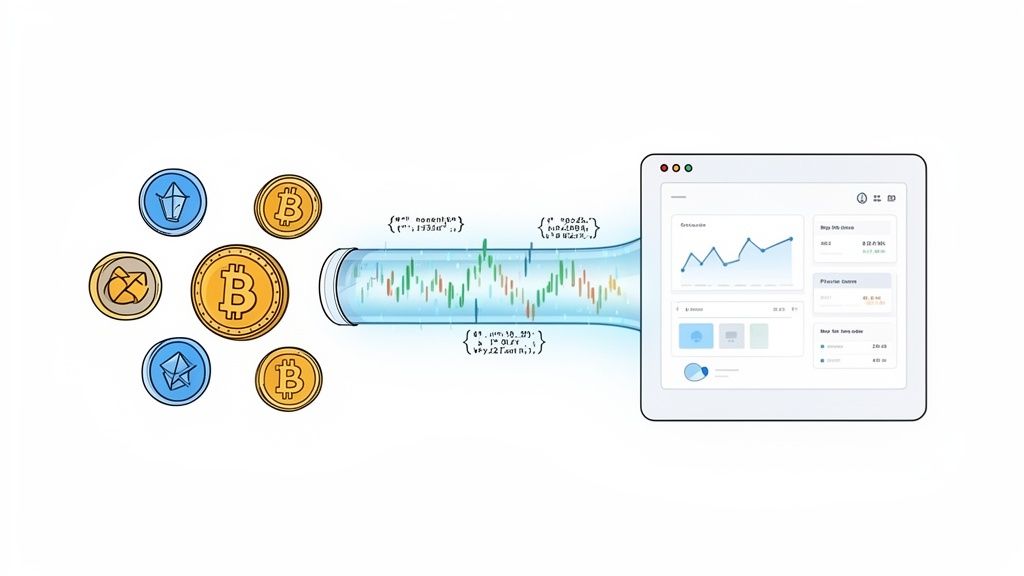
Cryptocurrency coins flow into a data tube with charts, leading to a digital dashboard displaying analytics.

At its heart, a cryptocurrency price API is the engine powering countless applications in the digital asset space. Instead of having your code manually scrape prices across dozens of exchanges—a messy and unreliable process—you can make a simple call to an API endpoint to get structured, clean data. This is fundamental for building any tool that needs up-to-the-minute market info.

You can think of it as a universal translator. It takes the complex, fragmented data from all these different market sources and does the heavy lifting of aggregating, cleaning, and standardizing it. Then, it delivers everything to your app in a predictable format like JSON.

Why APIs Are Indispensable

The demand for accurate, timely crypto data isn't just growing; it's exploding. The global cryptocurrency market is on track to hit USD 18.26 billion by 2033, growing at a compound annual rate of 14.5%. This rapid expansion shines a spotlight on the critical need for dependable API providers that can supply the data backbone for sophisticated market intelligence tools. If you want to dig into the numbers, the full market analysis from Grand View Research is worth a read.

This growth is fueled by everyone from retail traders to huge institutions, all of whom rely on this data for critical functions:

  • Portfolio Tracking: Automatically updating the real-time value of assets in a wallet or portfolio.
  • Algorithmic Trading: Feeding live price data into automated trading bots that execute strategies based on market movements.
  • Market Analysis: Supplying historical data for backtesting trading strategies and running technical analysis.
  • DeFi Applications: Providing reliable price feeds (oracles) for smart contracts, lending platforms, and decentralized exchanges (DEXs).

Without a robust cryptocurrency price API, these applications would be slow, unreliable, and simply unable to compete. APIs form the foundational data layer for a massive slice of the crypto economy, giving developers the power to create valuable tools that help us all make better financial decisions.

Key Evaluation Criteria For a Crypto API

Choosing the right crypto price API is the bedrock of your entire project. Get this wrong, and you're looking at failed trades, wonky portfolio tracking, and a user experience that sends people running for the exit. That's why it's critical to vet any potential provider against a solid set of benchmarks.

Think of it like picking the engine for a race car. You wouldn't just grab one off the shelf. You’d dig into its horsepower, reliability stats, and efficiency numbers. We need to apply that same level of rigor here. The API's data accuracy, latency, asset coverage, and uptime will directly define how well your application performs in the real world.

Data Accuracy and Latency

First up, and arguably the most important, is data accuracy. Your API has to pull its information from reputable, high-volume exchanges to give you a true market price. An API that scrapes data from low-liquidity sources is serving up poison—skewed prices that can wreck any financial application.

Just as critical is latency, which is simply how fast the API delivers fresh price updates. For anything like trading bots or real-time arbitrage finders, milliseconds matter. A low-latency feed, usually powered by WebSockets, is completely non-negotiable for these time-sensitive jobs. High latency means you're trading on old news, and that’s a fast track to losing money.

Coverage and Reliability

Next, you need to look at the breadth of its asset coverage. Does the API even support the specific cryptocurrencies, tokens, and exchanges you need? A service with spotty coverage will hamstring your app's usefulness from day one, forcing you to patch in multiple APIs and adding a ton of complexity and cost.

Reliability, measured as uptime, is another deal-breaker. A serious API provider will offer a Service Level Agreement (SLA) that guarantees a specific uptime, which should be 99.9% or higher. Constant downtime makes your application useless and shatters user trust. Before you even think about committing, check the provider's historical uptime records and their public status page.

Key Takeaway: Your application's reliability is a direct mirror of your API's reliability. Choosing a provider with documented high uptime and a clear SLA is essential for building a professional-grade product that people can actually depend on.

Finally, don't forget how external factors can move the needle on price data. You can learn more about how social media sentiment predicts crypto prices in our guide on the topic.

API Evaluation Checklist

To make this process easier, use this checklist to score potential API providers against the most important technical and business requirements. It helps standardize your evaluation and ensures you don't overlook a critical detail.

CriteriaDescriptionWhy It Matters
Data AccuracyAre the prices sourced from high-volume, reputable exchanges?Low-quality sources lead to inaccurate prices and bad trades.
LatencyHow fast are new data points delivered (in milliseconds)?Low latency is crucial for real-time applications like trading bots.
Asset CoverageDoes it support all the coins, tokens, and chains you need?Incomplete coverage limits your application's utility.
Reliability (Uptime)What is the provider's guaranteed uptime (SLA)? Look for 99.9%+.Frequent downtime makes your product unreliable for users.
Documentation QualityIs the documentation clear, complete, and full of code examples?Good docs save hundreds of hours in development time.
Scalability & Rate LimitsCan the API handle your projected request volume as you grow?Hitting rate limits can break your app; high costs can kill your business.
Connection TypesDoes it offer both REST API and WebSockets for real-time streams?WebSockets are essential for low-latency, real-time data feeds.
Pricing ModelIs the pricing clear, predictable, and aligned with your business model?Unexpected costs can make your project financially unviable.

This checklist isn't exhaustive, but it covers the non-negotiables. Running each potential provider through this gauntlet will quickly separate the serious contenders from the ones that will only cause headaches down the road.

Documentation and Scalability

Never underestimate the power of great developer documentation. It can literally save you hundreds of hours during the integration phase. The docs should be crystal clear, comprehensive, and packed with practical code examples you can actually use. Before you subscribe to anything, spend some time in their developer portal to see if the documentation is easy to follow.

Lastly, think about the API’s scalability and rate limits from day one. Rate limits dictate how many requests you can make over a certain period. Make sure the free or entry-level plan gives you enough room to build and test, and that the paid tiers can handle your app's growth without costing a fortune. Planning for scale now prevents a painful and expensive migration later.

Comparing the Top Cryptocurrency Price APIs

Now that we have a solid set of evaluation criteria, it's time to put the leading cryptocurrency price API providers under the microscope. The market is packed with options, but a few key players have risen to the top through a combination of reliability, deep data coverage, and developer-friendly tools.

Choosing the right one really boils down to your specific use case. Are you building a high-frequency trading bot, a simple portfolio tracker, or a sprawling market research platform? The answer will steer you toward the perfect fit.

The Major Players in Crypto Data

This head-to-head comparison will focus on the providers you see time and again in developer toolkits, like CoinGecko, CoinMarketCap, and CryptoCompare. We’ll size them up based on the factors we’ve already established—data types, asset coverage, real-time capabilities, and of course, what you can get with their free tiers. This is about cutting through the marketing hype to give you a clear, functional overview.

The world of crypto data is largely built on the backs of a few established names. These services have become the foundational infrastructure for the digital asset market, tracking thousands of cryptocurrencies in real-time by aggregating data from countless exchanges. For professional traders and researchers, especially those in the copy-trading space, this access to accurate, real-time API data is the absolute backbone of any informed strategy. For a deeper dive into how top traders leverage this data, check out TokenMetrics' blog.

This flowchart offers a simple decision tree to help guide your choice based on your project's main needs, whether that’s trading automation, data volume, or pure budget constraints.

Flowchart illustrating the decision process for choosing a Crypto API based on use case and budget.

As the chart shows, a hobbyist on a shoestring budget and a high-volume institutional trader have wildly different API needs. This can help point you toward the right category of provider from the get-go.

Feature Comparison Of Leading Crypto API Providers

To make your research a bit easier, the table below gives you a side-by-side look at the most popular cryptocurrency price APIs. It breaks down their core features, from the type of data they specialize in to the limits you'll hit on their free plans. This format is perfect for a quick assessment of which service aligns best with your technical needs and budget.

ProviderPrimary Data TypeAsset CoverageReal-Time Data (WebSocket)Free Tier Rate LimitBest For
CoinGeckoMarket Data (Price, Volume)14,000+ coins across 1,000+ exchangesNo (REST API only)10-30 calls/minuteHobbyist projects and broad market analysis.
CoinMarketCapMarket Data & Aggregated Stats20,000+ coins across 600+ exchangesNo (REST API only)333 credits/day (~60 calls)Portfolio trackers and general market data.
CryptoCompareMarket & On-Chain Data5,300+ coins & 240,000+ pairsYes100,000 calls/monthInstitutional use and real-time trading.
CoinAPIMarket & Order Book Data18,000+ assets from 400+ exchangesYes100 requests/dayAlgorithmic trading and detailed market depth analysis.

This comparison quickly reveals a clear trade-off. For instance, while CoinGecko offers an extremely generous free tier that’s perfect for getting started, it lacks the real-time WebSocket feeds that are mission-critical for serious trading applications.

On the other hand, providers like CryptoCompare and CoinAPI cater to more professional needs with lower-latency data streams, but their plans are naturally more restrictive or costly. Their tiered pricing structures allow developers to start free for development and then scale into paid plans as their application’s user base and data demands grow.

Expert Insight: Choosing a cryptocurrency price API is a strategic decision. For rapid prototyping or a personal project, a free API from CoinGecko is often more than enough. However, for any commercial application—especially one involving trading—investing in a paid plan with WebSocket support and a high uptime SLA isn't just a good idea, it's a necessary cost of doing business.

How to Integrate a Crypto Price API

Alright, let's get our hands dirty. Connecting to a cryptocurrency price API is where theory meets practice. It's the moment you stop just looking at data and start turning that raw market feed into something useful, like a real-time portfolio value or a slick price chart.

While it might sound overly technical, the process is pretty straightforward once you get the hang of making a request and handling what the API sends back. We'll walk through a practical example using Python, which is a go-to for this kind of work because of its simplicity and fantastic libraries. Our goal will be fetching the current prices of Bitcoin and Ethereum, showing you the whole workflow from scratch.

Getting Your Environment Ready

Before you can write a single line of code, you need to set up your environment. The first move is installing the requests library. Think of it as the standard toolkit for making HTTP requests in Python. If it's not already on your system, you can add it with one quick command in your terminal.

This little library makes the whole process of talking to a cryptocurrency price API and getting data back incredibly simple. Once that's installed, you’re ready to start pulling down some data.

pip install requests

Making Your First API Call

With your setup complete, it's time to make your first real API call. This just means sending an HTTP GET request to a specific URL—the "endpoint"—that your API provider gives you. Most APIs will require an API key to authenticate your request, which you'll typically pass along in the request headers or as a parameter in the URL.

Let's imagine we're using a hypothetical API endpoint to get the latest prices for Bitcoin (BTC) and Ethereum (ETH).

  • API Provider: We'll use a conceptual provider just for this example.
  • Endpoint URL: https://api.example.com/v1/prices
  • Query Parameters: We'll need to specify ids=bitcoin,ethereum and currency=usd.

Here’s a Python script that builds the request, sends it off, and prints whatever comes back.

import requestsimport json# Define the API endpoint and parametersAPI_URL = "https://api.example.com/v1/prices"params = {'ids': 'bitcoin,ethereum','currency': 'usd'}# Make the API requesttry:response = requests.get(API_URL, params=params)response.raise_for_status()  # This will raise an exception for bad status codes (4xx or 5xx)# Parse the JSON responsedata = response.json()# Print the formatted data so it's easy to readprint(json.dumps(data, indent=4))except requests.exceptions.RequestException as e:print(f"An error occurred: {e}")

Understanding the JSON Response

If everything went smoothly, the API server will send back data, almost always in JSON format. JSON (JavaScript Object Notation) is a lightweight, human-readable format that's also a breeze for machines to parse. Your application's next job is to pick out the specific pieces of information it needs from this response.

For our example, the data coming back from our hypothetical API might look something like this:

{"bitcoin": {"usd": 68500.75},"ethereum": {"usd": 3550.21}}

To actually use this information, you just need to access the nested values. For instance, to grab Bitcoin's price, your code would reference data['bitcoin']['usd']. This is the fundamental logic you'd use to power something like a portfolio tracker; you'd loop through your list of assets, fetch their current prices, and calculate their total value in real time.

This same data is perfect for creating dynamic visuals. For DeFi traders looking to build their own dashboards, we have an in-depth guide covering real-time visualization techniques.

Important Takeaway: Always, always build in solid error handling. APIs go down, network connections fail, and keys can be invalid. Your code needs to anticipate these hiccups and handle them gracefully. Otherwise, you risk crashing your app and frustrating your users.

Navigating API Rate Limits and Pricing Models

Before you write a single line of code, you need to get a handle on the financial and technical constraints of any crypto price API. This stuff—pricing models and rate limits—directly impacts your app's scalability and how much you'll end up paying. Picking the wrong plan can lead to surprise service outages or a bill that completely sinks your budget.

Most API providers use one of three pricing structures. Each one is built for a different kind of user, from a hobbyist tinkering on a small project to a high-frequency trading operation. The key is to match your choice to how you actually expect to use the API.

Understanding Common API Pricing Structures

The most common starting point is the freemium model. It gives you a basic level of access for free, which is perfect for development, testing, or apps with low traffic. While these free tiers are a great way to get your feet wet, they always come with tight rate limits and usually don't include premium data endpoints.

If your project has traffic that’s hard to predict, a pay-as-you-go model is incredibly flexible. You only pay for the API calls you actually make, so you’re not shelling out cash for capacity you don't use. The catch? You have to monitor your usage closely to avoid a monster bill if your app suddenly gets popular.

Finally, tiered subscriptions are the standard for any serious commercial application. You pay a fixed monthly fee for a set number of calls and features, with different tiers available as you grow.

A classic mistake I see developers make is underestimating their call volume. Always project what you’ll need down the road and pick a plan with a comfortable buffer. You don't want to hit your limits right when your app starts gaining traction.

Working Within API Rate Limits

Think of rate limits as the non-negotiable rules of the road for any API. They put a hard cap on how many requests you can make in a given time, like 30 calls per minute or 100,000 calls per month. Providers need these limits to keep their service stable for everyone and prevent one app from hogging all the resources. If you ignore them, your requests will get blocked, and parts of your app will simply break.

The only way to operate efficiently is to design your application with these limits in mind from day one. It’s a proactive approach that saves you from performance headaches later and ensures your users have a smooth experience.

Here are a few solid strategies to keep your API usage in check:

  • Implement Caching: Don't fetch the same data over and over. Store recent API responses locally for a short time. For something like Bitcoin's price, caching the result for just 60 seconds can slash your call volume by over 98% without anyone noticing the data isn't tick-by-tick.
  • Use WebSockets for Real-Time Data: If you genuinely need live price updates, polling a REST endpoint is a huge waste. A WebSocket connection is the right tool for the job. It keeps a connection open so the server can push updates to you, which dramatically cuts down on requests.
  • Optimize Your Calls: Batch your requests whenever the API allows it. Instead of making ten separate calls for ten different coins, see if you can make a single call that requests all ten at once. It’s way more efficient and counts as one request against your limit, not ten.

Securing Your API Keys and Data

Illustration showing API key security with a shield, key, locked cloud, and environment variables code.

When you integrate a cryptocurrency price API, you get a unique API key. Think of this key as the master credential for your data subscription—it's not just a random string of characters. You have to treat it with the same seriousness as a password. It's not just a best practice; it's absolutely essential for protecting your application and the integrity of your data.

A leaked API key can cause real trouble. A malicious actor could easily exhaust your rate limit, disrupting your service. Even worse, if the key unlocks paid data tiers, you could be looking at a serious financial hit. The first and most important rule is simple: never hardcode your API keys directly into your source code. Doing so makes them visible to anyone who can get their hands on your repository.

Best Practices for API Key Management

Instead of hardcoding, you should always store your keys as environment variables. This simple step separates your credentials from your codebase, making things significantly more secure. Your app can then just read the key from the server's environment when it runs, keeping it out of sight.

Another great security layer to add is IP whitelisting, a feature many API providers offer. You can specify exactly which IP addresses are allowed to make requests with your key, effectively blocking any unauthorized attempts coming from unknown servers.

Finally, you need to make sure your data is confidential while it's in transit.

Crucial Tip: Only make API calls over HTTPS. Using an unencrypted HTTP connection sends your API key and all the data you receive in plain text. That makes it trivial for an attacker on the same network to intercept everything.

Sticking to these core principles—storing keys securely, restricting access, and encrypting communications—is the foundation of a solid security posture for any app using a crypto price API. For projects dealing with sensitive financial information, a comprehensive strategy is non-negotiable. You can learn more about beefing up your project's defenses in our guide on the benefits of a blockchain security audit service.

Frequently Asked Questions About Crypto APIs

Jumping into the world of crypto data APIs brings up a ton of questions, especially when you're trying to pick the right tools for a new project. Let's cut through the noise and get you direct answers to the most common questions we see.

What Is The Difference Between REST And WebSocket APIs

The real difference comes down to how your application gets the data.

A REST API works on a simple request-response model. Think of it like knocking on a door to ask for the time; you have to initiate the request every single time you need an update. This makes it a great fit for pulling historical data or for apps where you only need to check prices every now and then.

On the other hand, a WebSocket API opens up a persistent, two-way communication channel. Once that connection is live, the server can push new data to your app the second it's available—no new requests needed. If you're building anything that needs real-time info, like a trading bot or a live price chart, WebSocket is the only way to go for speed and efficiency.

Can I Get On-Chain Data From a Standard Price API

Generally, no. A standard crypto price API, like the ones from CoinGecko or CoinMarketCap, is built to aggregate market data. This means they pull information like price, trading volume, and market cap from a mix of centralized and decentralized exchanges.

To get your hands on true on-chain data—we're talking specific wallet transactions, token movements, or smart contract events—you'll need a dedicated blockchain data API from a provider like Alchemy or Moralis. Most serious applications actually use both: a price API for the big-picture market context and a blockchain API to see the granular, on-chain action. It's a powerful combo.

Key Insight: Price APIs tell you what the market is doing, while on-chain APIs tell you how and why it's happening at the ground level. Using both gives you a massive analytical advantage.

How Do I Choose A Reliable Free Crypto API

When you're looking at free crypto price APIs, your main focus should be on providers with a solid reputation, crystal-clear documentation, and transparent rate limits. Big names like CoinGecko and CoinMarketCap offer really dependable free tiers that are perfect for getting a project off the ground, testing ideas, or running low-traffic apps.

Before you build your whole project around a free API, run these quick checks:

  1. Verify Rate Limits: Know exactly how many calls you can make per minute or day. You don't want your app to suddenly break because you hit a limit you weren't aware of.
  2. Check Historical Uptime: Look for the provider’s public status page. Consistent uptime is non-negotiable for any serious application.
  3. Plan for Growth: A good free tier is a starting point, not a final destination. Make sure the provider offers paid plans you can easily switch to as your app scales up.

Discovering profitable trading strategies requires more than just price data. Wallet Finder.ai helps you track the on-chain movements of top traders, providing actionable signals before the market moves. Find your edge by analyzing winning wallets and mirroring their success in real time. Start your 7-day trial at https://www.walletfinder.ai.