DeFi Yield Farming: A Practical Guide
Discover DeFi yield farming with our guide. Learn proven strategies, how to manage risks like impermanent loss, and find top opportunities.

January 15, 2026
Wallet Finder

January 15, 2026

Ever wondered how some crypto investors seem to earn passive income on their digital assets? It's not magic. It's often DeFi yield farming, and it's a lot like putting your money to work in a high-yield savings account, but supercharged for the crypto world.
Instead of letting your tokens just sit in a wallet collecting digital dust, you can lend or "stake" them within a decentralized finance (DeFi) protocol. In return for your contribution, the protocol rewards you with more crypto.

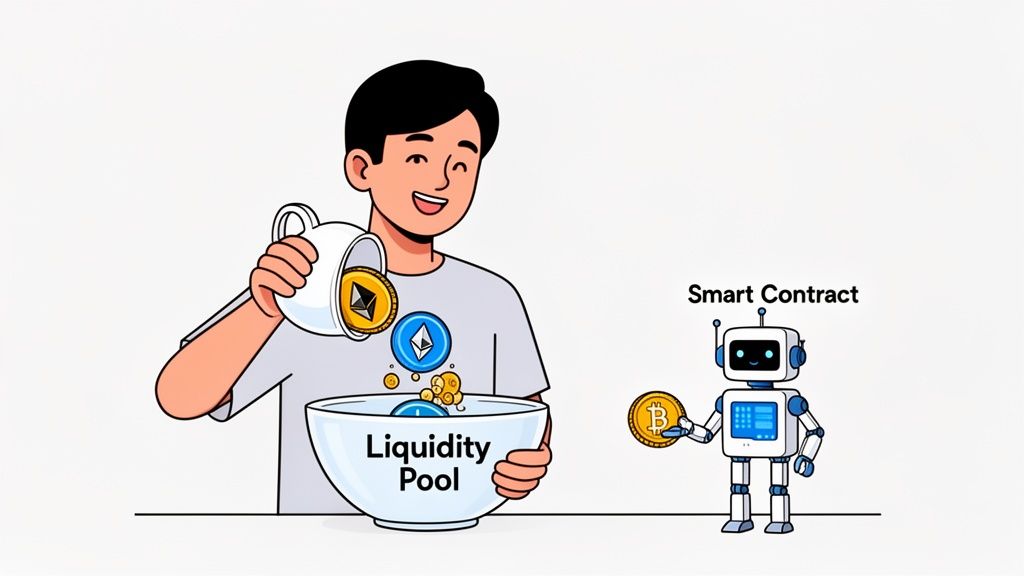
At its core, yield farming is a way to generate rewards from the cryptocurrency you already own. You lock up your digital assets in a DeFi protocol, which uses them to provide liquidity for other users who want to trade, borrow, or lend. For providing this crucial service, you get a slice of the fees generated.
Think of it like contributing to a community-run investment pool instead of using a traditional bank. This pool of funds fuels all sorts of financial activities, and as a contributor, you get paid a percentage of the profits. By cutting out the middlemen, this decentralized model opens the door to much higher potential returns.
To really get how this all works, you need to understand the three key players that make the system tick. Each one is essential.
To help you visualize how these pieces fit together, here’s a quick breakdown.
This table breaks down the fundamental building blocks of DeFi yield farming, explaining the role of each component in simple terms.
Simply put, these components work in concert to create a self-sustaining financial engine, driven entirely by code and community participation.
The name of the game in DeFi yield farming is maximizing your returns. This often means strategically moving your assets between different DeFi protocols to chase the highest rewards, which are usually shown as an Annual Percentage Yield (APY).
This strategy has become incredibly popular, fueling massive growth in the market. The DeFi yield farming platform market was valued at USD 79.4 million in 2024 and is projected to jump to USD 154 million by 2031.
This surge is part of the wider DeFi explosion. The total value locked (TVL) across all DeFi protocols soared past USD 90 billion by late 2024, with a huge chunk of that coming from liquidity pools and staking farms. You can read the full research about these DeFi market projections for more details.
This explosive growth proves there’s real demand for financial systems that give people more control and better returns. When you participate in yield farming, you're not just earning rewards—you're also helping to provide the liquidity that keeps the entire DeFi ecosystem running smoothly.
Those eye-popping returns in DeFi yield farming don't just materialize out of thin air. They're generated by a few core economic activities that keep the decentralized finance world spinning. When you're farming, you're essentially providing a valuable service with your capital, and the yield is your payment.
Think of your yield as a reward for putting your assets where they're needed most. Let's pull back the curtain on the three main engines that generate these returns so you know exactly how your crypto is being put to work.
One of the most popular ways to jump into yield farming is by becoming a liquidity provider (LP) for an Automated Market Maker (AMM). AMMs are decentralized exchanges (DEXs) like Uniswap or PancakeSwap that ditch the old-school order books and instead use algorithms and liquidity pools to execute trades.
For these platforms to work, they need a deep pool of different tokens that traders can swap between at a moment's notice. As an LP, you step in and deposit a pair of assets—say, ETH and USDC—into a specific pool. For providing this critical service, you get a cut of the trading fees every single time someone swaps between those two tokens.
With this method, your earnings are tied directly to the trading volume on the platform. The more action your pool sees, the more fees you rake in.
Another massive source of yield comes from lending out your crypto on decentralized lending protocols like Aave or Compound. These platforms operate like peer-to-peer banks, connecting people who want to lend their assets with those who want to borrow them, all without a middleman.
When you deposit your crypto, like DAI or WBTC, into a lending protocol, it becomes available for others to borrow. Borrowers, in turn, have to pay interest on their loans. A slice of that interest gets passed right back to you, the lender, as your yield.
Interest rates on these platforms are never static; they're set by raw supply and demand. If tons of people want to borrow an asset but only a few are lending it, the interest rate—and your potential yield—will shoot up to attract more lenders.
This mechanism is a core pillar of DeFi, allowing capital to move around efficiently. Your earnings here are a direct reflection of how much demand there is for the specific asset you're lending.
Staking is a third powerful way to earn, but it serves a completely different function. Here, you lock up your tokens to help secure and operate a blockchain network or a specific DeFi protocol. This is the backbone of Proof-of-Stake (PoS) networks.
By staking your tokens, you're essentially casting a vote of confidence with your capital and helping the network reach a consensus on transactions. In exchange for this vital service, the network rewards you with newly created tokens or a share of the transaction fees.
Here's a quick breakdown of how these three yield sources stack up.
These mechanisms absolutely exploded during the legendary "DeFi Summer" of 2020. Platforms like Curve Finance (CRV) were dishing out jaw-dropping returns that turned modest investments into life-changing money. Launched right in the middle of the frenzy, Curve offered initial APYs of 300-500%, which then rocketed to peaks over 2,500%. This led to a mind-blowing 40x ROI as CRV's price ripped from $0.30 to $12. You can learn more about the best historical yield farming crypto returns to get a sense of what's possible.
At the end of the day, whether you're enabling trades, funding loans, or securing a network, you're playing an active part in the DeFi economy. Getting a grip on where yield actually comes from is the first critical step to making smart moves on your farming journey.

The world of DeFi yield farming is packed with opportunities for massive returns, but let's be clear: it's a high-stakes game where risk is always part of the deal. Understanding these dangers isn’t just a good idea; it’s absolutely essential for survival. Ignoring them is like trying to cross a minefield with a blindfold on.
To protect your capital, you have to be able to spot and manage the most common threats you'll run into. So, let’s break down the four biggest risks that every yield farmer needs to keep on their radar.
Impermanent loss is easily one of the most misunderstood risks for anyone providing liquidity. It happens when the price ratio of the two tokens you’ve locked into a liquidity pool changes after you've deposited them. The more the prices diverge, the more "impermanent" loss you'll see.
Imagine a seesaw. You put Token A on one side and Token B on the other, perfectly balanced. If Token A's price suddenly shoots up while Token B's stays flat, the seesaw gets thrown off balance. The AMM’s job is to rebalance it by selling some of the token that went up and buying more of the other.
When you go to withdraw your funds, this rebalancing can leave you with a completely different mix of tokens than you started with. If the total value of your withdrawn tokens is less than what you would've had by just holding them in your wallet, you've just experienced impermanent loss. It’s only a "loss" once you actually pull your liquidity out.
Impermanent loss is the opportunity cost of being a liquidity provider. You might still come out ahead from earning trading fees, but your profits could be a lot smaller than if you had simply held the original assets.
Trying to calculate this risk on the fly is tough. Using a dedicated tool can give you a much clearer picture of your potential exposure. You can get a better handle on this specific risk by using an impermanent loss calculator to run through different scenarios.
Yield farming protocols are built on smart contracts—just lines of code running on the blockchain. While this is what makes automation possible, it also opens up a huge vulnerability. If there's a bug, a flaw, or a backdoor in that code, hackers can exploit it to drain every last cent from the protocol.
This risk is especially high with new, unaudited projects. A professional security audit from a respected firm is a good sign, but even audited contracts aren't bulletproof. DeFi history is filled with stories of protocols losing tens or even hundreds of millions of dollars in a single hack.
How to Spot Red Flags:
When you start using lending platforms to borrow against your crypto for leveraged farming, you're introducing liquidation risk. If the value of your collateral drops below a certain point, the protocol will automatically sell it off to pay back your loan. This is a forced sale, and it happens in a flash to protect the platform.
For example, say you deposit $1,000 of ETH as collateral to borrow $500 of USDC. If the price of ETH suddenly tanks, it could trigger your liquidation. You'd lose your ETH instantly, and there's no way to reverse it. This is one of the fastest ways to lose your shirt in DeFi.
Finally, we have the most cynical risk of them all: the rug pull. This is a flat-out scam where developers create hype, attract a ton of liquidity from investors, and then just disappear, draining the pools and taking everyone’s money with them.
Rug pulls are rampant in the wilder corners of DeFi, often preying on the FOMO that surrounds new tokens promising insane returns. Protecting yourself boils down to a healthy dose of skepticism and doing your homework before jumping into any new or unproven protocol. Stick with projects that have transparent teams and a real, long-term vision.
Alright, let's move past the theory. It’s time to get into the practical strategies you can actually use to generate returns in DeFi.
The right approach for you depends entirely on your personal risk tolerance and what you’re trying to achieve. There's no magic bullet here; what works for a seasoned degen could wipe out a cautious beginner. To help you find your footing, we'll break down four distinct strategies, each with its own risk-reward profile.
If you're just dipping your toes into yield farming or simply want to protect your capital, stablecoin farming is the perfect place to start. This strategy is all about providing liquidity for or lending stablecoins—cryptocurrencies like USDC, USDT, or DAI that are pegged to a stable asset like the U.S. dollar.
Because stablecoins are designed to hold their value, this approach helps you sidestep the gut-wrenching price volatility that causes impermanent loss. The returns are more modest, typically ranging from 2% to 15% APY, but they're far more predictable than what you'd find with more volatile assets.
Ready to dial up the risk a bit for a shot at higher rewards? Providing liquidity for blue-chip assets is a solid, middle-of-the-road strategy. This means pairing up established, high-market-cap cryptocurrencies like Ethereum (ETH), Wrapped Bitcoin (WBTC), or Solana (SOL).
A common setup might be an ETH/USDC or WBTC/ETH pool. Since these assets are more volatile than stablecoins, you’re now exposed to impermanent loss. However, their strong market presence and high trading volume often generate enough fee revenue to offset that risk and deliver much juicier APYs.
This strategy is a great middle ground. You get exposure to the upside of major crypto assets while earning yields that can often beat a simple buy-and-hold approach, as long as the market doesn’t go completely parabolic or crash.
Welcome to the wild side. "Degen" farming is the high-octane, high-risk end of the yield farming world, where you dive into new, often unaudited protocols promising astronomical APYs—sometimes in the thousands of percent. These farms almost always involve new, highly speculative tokens.
The potential for life-changing gains is very real, but so is the risk of losing your entire stack. These projects are magnets for rug pulls, smart contract exploits, and insane token volatility that can lead to catastrophic impermanent loss. This is strictly for experienced farmers who know the risks inside and out and are only investing money they're truly willing to lose.
Extreme Caution Required:
If you want the returns without the round-the-clock manual effort, yield aggregators are your best friend. Platforms like Yearn Finance or Beefy Finance are essentially crypto robo-advisors. They automatically shuttle your funds between different DeFi protocols to hunt down the best yields available.
These platforms use sophisticated "vaults" that auto-compound your rewards, saving you a ton of time and gas fees. By pooling everyone's funds, they can execute strategies far more efficiently than any single farmer could. You just deposit your assets into a vault, and the aggregator does all the heavy lifting.
Here’s a quick comparison of how these strategies stack up:
Picking the right strategy is the most important decision you'll make. Start with what feels comfortable for your risk appetite, and you can always explore more complex options as you get more confident and knowledgeable.
Chasing the highest advertised APY is a classic rookie mistake in DeFi yield farming. Real, sustainable success comes from a disciplined process—finding and seriously vetting opportunities before you put a single dollar on the line. Let’s walk through a professional framework for analyzing key metrics, spotting red flags, and using powerful on-chain tools to get a genuine edge.
The DeFi space is incredibly noisy. But a few core metrics can help you cut through the hype and zero in on what actually matters. Think of these as the vital signs of a protocol’s health, credibility, and the market’s trust in it.
Before you get lost in the weeds, start with a quick, high-level check. These numbers tell you a lot about a farm’s legitimacy and whether it has any staying power.
This decision tree gives you a visual for how to match your personal risk tolerance with the right kind of farm.

The main takeaway? Align your strategy with what lets you sleep at night, whether that means sticking to low-risk stablecoin farms or venturing into more aggressive, high-reward territories.
Once a farm passes that initial sniff test, it's time to dig deeper. This checklist is your best friend for systematically picking apart any potential opportunity.
Use this checklist to systematically evaluate the safety and potential of any DeFi yield farming opportunity before you invest.
Running through this process forces you to look past the flashy marketing and evaluate the actual strength and safety of a protocol. It’s the difference between gambling and investing.
The best farmers don't just wait for announcements; they follow the "smart money." By using on-chain intelligence tools, you can see what top-performing wallets are doing in real time and essentially reverse-engineer their strategies. This is how you find alpha before it hits Crypto Twitter.
Following the moves of profitable wallets is like getting an over-the-shoulder look at a pro trader's screen. You see their entries, exits, and the new farms they're rotating into, giving you a powerful data-driven advantage.
Platforms like Wallet Finder.ai are built for exactly this. You can filter for wallets based on their profitability, win rate, and other key performance metrics. This lets you build a watchlist of elite farmers and get alerts the moment they enter a new position. To get a better sense of the power here, you can explore the top features of yield farming monitoring tools and see how they can sharpen your strategy.
By analyzing these top wallets, you can spot which new pools or protocols are attracting serious capital from proven winners. That’s often one of the strongest signals that you’ve found a promising opportunity worth digging into.
Jumping into DeFi yield farming can feel like a lot at first, but with a clear roadmap, it’s much more approachable than it seems. This last section is all about turning theory into action, giving you a launchpad for your very first farming adventure.
Success really boils down to three things: solid research, a clear strategy, and not getting reckless with risk.
The best way to learn is by doing. Start small, see how things work, and lean on powerful on-chain tools to guide your choices. If you follow a structured process, you can step into the world of earning yield with confidence.
Ready to get your hands dirty? This simple, five-step guide will walk you through everything from initial setup to making your first deposit. Following these steps ensures you’ve got all the essentials covered before putting any capital on the line.
Set Up a Web3 Wallet: Think of your wallet as your passport to the entire DeFi world. You'll need to install a self-custody wallet like MetaMask or Trust Wallet. They work as simple browser extensions or mobile apps. Most importantly, always back up your seed phrase offline and never, ever share it.
Fund Your Wallet: Next, you'll need to get the right crypto into your new wallet. You’ll need the two assets for the liquidity pool you’re targeting (like ETH and USDC) and a little extra of the network’s native token (like ETH on Ethereum) to pay for transaction fees, also known as gas.
Choose a Reputable DeFi Platform: Stick with the big, audited names when you're starting out. Protocols like Uniswap, Aave, or Curve are great places to begin because they've been around for a while, are trusted, and have a massive Total Value Locked (TVL).
For a beginner, the smartest move is to start with a platform that has been battle-tested. Prioritize security and reliability over chasing the absolute highest APY on some new, unproven protocol.
Select Your First Liquidity Pool: Don't dive into the deep end just yet. Start with a lower-risk option to get a feel for the mechanics. A stablecoin pair (like USDC/DAI) is a fantastic choice because it minimizes volatility. A "blue-chip" pair like ETH/WBTC is another solid option.
Deposit Assets and Start Farming: Find your chosen pool on the platform's interface. You'll need to approve the smart contracts to interact with your wallet, then deposit your tokens. Once that transaction is confirmed on the blockchain, congratulations—you're officially a liquidity provider and will start earning rewards.
Diving into the practical side of DeFi yield farming always surfaces a few common questions. Getting these sorted out is the key to farming with confidence, so let's tackle the ones we hear most often.
Officially, there isn't one. You could technically start with just a few dollars.
But—and this is a big but—you have to think about transaction fees, also known as gas fees. On networks like Ethereum, these can be pretty high. If you're only putting in a small amount, those fees could wipe out any potential profit before you even get started.
For that reason, it's usually better to start with at least a few hundred dollars to make the gas fees worthwhile. A great alternative is to look at layer-2 solutions like Arbitrum or Base, where the fees are a tiny fraction of Ethereum's, making them perfect for smaller-scale farmers.
This is a tricky one, as tax rules for DeFi are different everywhere and are changing all the time. But in general, the rewards you earn are considered income, meaning they're taxable as soon as they hit your wallet. If you sell those rewards later for a profit, you’ll likely face capital gains tax on top of that.
Because the rules are so complex and depend entirely on where you live, you should absolutely talk to a tax professional who knows your local laws. Keeping a clean record of every transaction is non-negotiable for getting your reporting right.
Yes, you absolutely can. It's crucial to go into this with your eyes wide open.
The biggest dangers are rug pulls, where shady developers just run off with everyone's money, and smart contract exploits, where hackers find a vulnerability and drain a protocol's funds.
You also have to worry about extreme impermanent loss, especially if one of the tokens in your pair crashes to zero. This is exactly why doing your homework, sticking to well-known and audited protocols, and never, ever investing more than you can afford to lose are the golden rules of yield farming.
Ready to stop guessing and start following the smart money? Wallet Finder.ai helps you discover the most profitable DeFi wallets and mirror their strategies in real time. Find your edge and act on opportunities before the market does. Start your 7-day trial at Wallet Finder.ai.