Recovery Factor Calculation for Smart Traders
Master the recovery factor calculation to measure a strategy's resilience. Learn the formula, see DeFi examples, and find top wallets with Wallet Finder.ai.

June 20, 2026


Wallet Finder
March 4, 2026
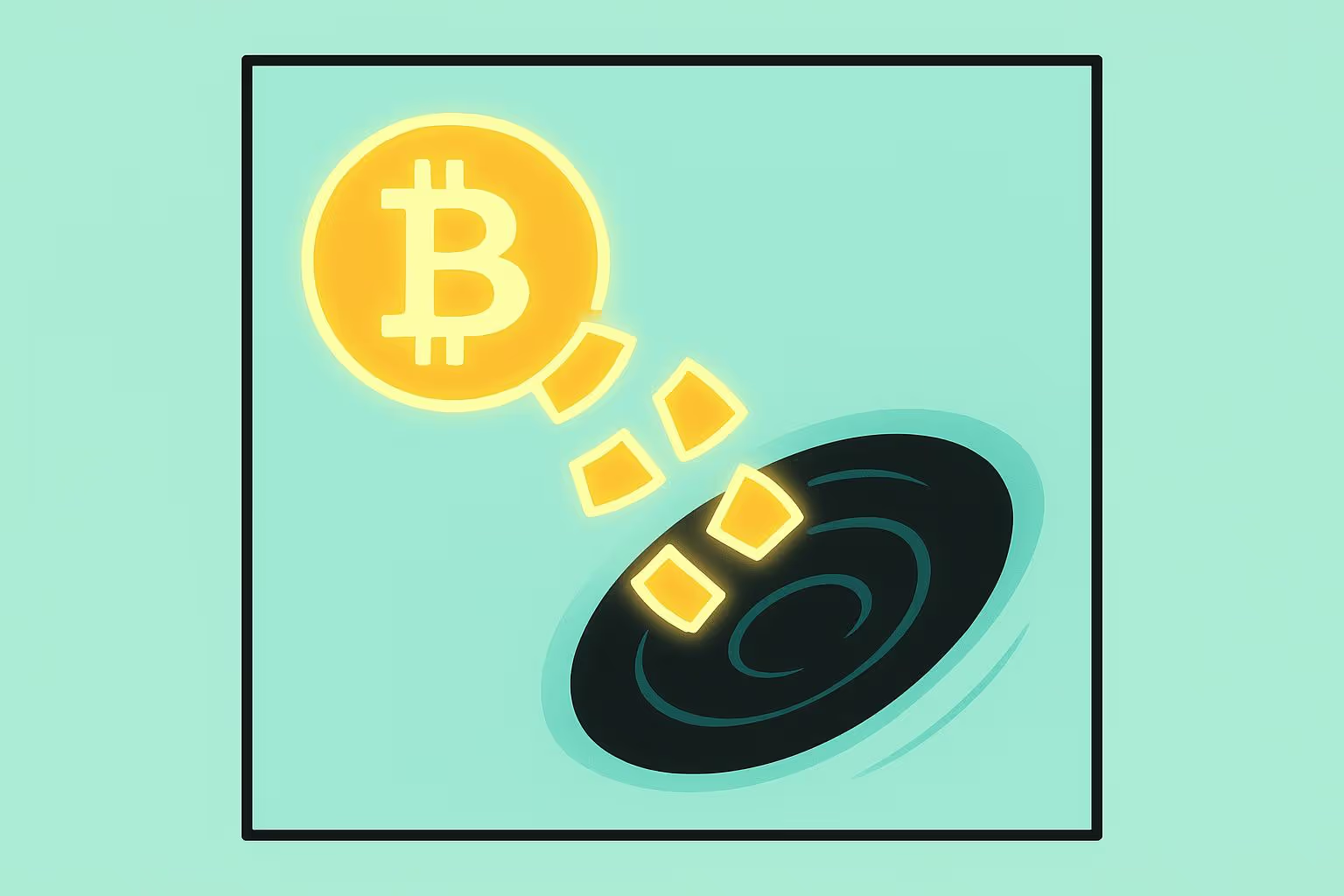
Crypto mixers make tracking cryptocurrency harder by breaking the connection between sender and receiver. They use tricks like splitting amounts, random delays, and address changes to hide transaction trails. Detecting these transactions is crucial for compliance, wallet analysis, and understanding crypto flows.
Here’s what you need to know:
Crypto mixers are evolving, but with the right tools and strategies, you can stay ahead.

Crypto mixers are tools designed to make it harder to trace cryptocurrency transactions. They work by breaking the connection between the sender and the receiver, making it nearly impossible to track where the funds originally came from. Let’s take a closer look at how these mixers operate. To understand the evolving landscape of secure transactions, check out the Ultimate Guide to Layer 2 Privacy for Ethereum, which explores how new scaling solutions are enhancing confidentiality without sacrificing efficiency.
The process of crypto mixing typically happens in three stages, each designed to make transactions harder to trace.
First, users deposit their cryptocurrency into the mixer by sending it to specific pool addresses. At this point, the deposits are still traceable. Next comes the actual mixing. Here, the mixer combines funds from many users into a single large pool. To make things even more complex, advanced mixers use techniques like fan-in and fan-out transactions, random delays between transfers, and breaking funds into standardized amounts. All of these tricks make it harder to connect deposits to withdrawals. Finally, in the withdrawal stage, the mixed funds are sent to new wallet addresses, effectively cutting off any clear link to the original source.
Different platforms use unique methods to achieve this level of anonymity. Let’s explore a few well-known examples.
These platforms show how mixing technology has evolved - from simpler centralized systems to more advanced decentralized methods. Each approach comes with its own set of challenges for those trying to trace transactions. Understanding these methods is essential for anyone looking to analyze or identify mixer activity.
Certain clues can reveal when funds have passed through mixers. These clues often form patterns that skilled analysts can recognize, helping to develop tools for identifying such activities.
One of the clearest signs is direct involvement with mixers - when funds are sent to or received from known mixer services. This kind of activity often points to an attempt to obscure the origin or destination of funds. But some users go even further to hide their tracks.
A common tactic is structuring, also called "smurfing." This involves breaking up large transactions into smaller ones that stay just under reporting limits or using consistent, round-number amounts. For example, instead of transferring $50,000 in one go, someone might split it into fifty $1,000 transactions.
Another red flag is rapid movement of funds. When funds are quickly received and withdrawn - sometimes within minutes - it could indicate the use of a temporary wallet as a stopover.
Converting to privacy coins, like Monero, right after funds leave the public blockchain is another warning sign. This immediate shift suggests an effort to erase the transaction trail.
Finally, multiple large transfers in a short time can also indicate mixing. If several large transactions occur within minutes or hours, especially in similar amounts, it’s more likely to be part of a deliberate mixing process rather than routine trading behavior.
Spotting crypto mixing activities has become more advanced, thanks to cutting-edge techniques. Law enforcement, compliance teams, and blockchain analysts now rely on sophisticated tools to uncover even the most hidden mixer transactions.
Artificial intelligence has completely changed how mixer transactions are detected. Machine learning models can analyze thousands of transaction patterns at once, spotting subtle links that might escape human attention.
Using large datasets, systems like deep learning algorithms and graph neural networks excel at untangling complex transaction flows. These tools examine factors such as transaction timing, recurring amount patterns, address clustering, and how funds move across the blockchain. For example, graph neural networks create maps of entire transaction flows, highlighting suspicious clusters where multiple addresses receive similar amounts in a short period - a telltale sign of mixing.
What’s more, these AI systems work in real-time. They scan blockchain data and flag suspicious transactions within minutes. They’re especially good at identifying layering techniques, where criminals move funds through many addresses to hide their origin. These AI-driven tools make it possible to monitor blockchain activity continuously and respond quickly.
Building on AI’s findings, real-time monitoring systems help pinpoint suspicious activities as they happen. These systems scan every new block added to the blockchain, looking for patterns or interactions with known mixer addresses.
One powerful feature is real-time address clustering, which groups addresses that likely belong to the same entity based on transaction behavior, timing, and amounts. If one of these clusters interacts with a known mixer, the system raises an alert immediately.
Transaction graph analysis is another key tool. It tracks how funds flow across multiple addresses, flagging cases where money moves quickly through several hops with consistent amounts or timing - a common sign of mixing. These systems can follow transaction trails across dozens of steps, uncovering even the most complex laundering schemes.
Behavioral pattern recognition adds another layer of insight. It spots unusual wallet activity, such as sudden spikes in transaction frequency, strange amount patterns, or interactions with privacy-focused services - activities that might suggest mixing.
Real-time monitoring also keeps up with new mixer platforms. As new services emerge, these systems identify their unique patterns and add them to detection databases. This proactive approach ensures even newer mixing methods are spotted quickly.
The article covers AI and machine learning as detection tools but does not address the specific algorithmic architectures that produce the highest attribution accuracy in production blockchain forensics systems. Graph neural network architecture for mixer detection is a fundamentally different problem from standard transaction anomaly detection because mixer activity creates structured topological signatures in the transaction graph that require graph-aware models to identify, rather than feature vectors extracted from individual transactions in isolation.
Standard machine learning approaches treat each transaction as an independent data point and extract features like amount, timing, and frequency. This approach works reasonably well for simple structuring detection but fails systematically against sophisticated mixing because the most informative signal is relational, not transactional. A single transaction that deposits exactly 1.0 ETH into an address is indistinguishable from a legitimate transfer in isolation. The same transaction embedded within a graph where 47 other addresses made identical deposits within a 20-minute window, all subsequently receiving outputs distributed to fresh addresses in varying fractional amounts, is a mixer pool participation event with high statistical confidence. Only a model that processes the full graph structure simultaneously can recognize this pattern.
Graph neural networks address this by representing the blockchain as a directed graph where nodes are addresses and edges are transactions, then learning node and edge embeddings that capture multi-hop neighborhood structure rather than just local features. The key operation in a GNN is message passing: each node aggregates information from its neighbors, and that aggregated representation is used to update the node's own embedding. After multiple rounds of message passing, a node's embedding reflects information from its k-hop neighborhood where k is the number of message passing layers. For mixer detection, this means a suspicious address can be identified not just by its own transaction history but by the structural properties of the entire subgraph it participates in, including the behavioral patterns of addresses several hops away that were part of the same mixing event.
GraphSAGE (Graph Sample and Aggregation) is the most widely deployed GNN architecture in production blockchain analytics systems because it supports inductive learning on graphs with changing node and edge populations. This matters for real-time blockchain monitoring because new blocks are added continuously, meaning the transaction graph is growing and changing at all times. Transductive GNN methods that require the entire graph to be present at training time cannot update predictions as new transactions arrive without full retraining. GraphSAGE samples a fixed-size neighborhood for each node at inference time and aggregates features from that sample, which makes real-time incremental inference computationally tractable even on graphs with billions of nodes. In published benchmarks on labeled blockchain transaction datasets, GraphSAGE models trained on Elliptic's Bitcoin transaction dataset achieve area under the curve scores of 0.97 or higher for illicit transaction classification, compared to 0.90 for gradient-boosted tree models operating on individual transaction features without graph structure.
Graph Attention Networks extend the message passing framework by learning attention weights that determine how much each neighbor's embedding contributes to the central node's update, rather than treating all neighbors equally. This is particularly valuable for mixer detection because mixer pools have heterogeneous participant profiles: some depositing addresses are high-value wallets with long transaction histories while others are freshly created addresses used for a single deposit. Uniform neighbor aggregation treats these equally, while attention mechanisms learn to weight informative neighbors more heavily. Empirically, GAT models show improved precision on mixer pool attribution tasks compared to uniform aggregation methods, particularly for cases where mixing pools contain a mix of high-activity and low-activity participants.
Temporal Graph Networks add an explicit time dimension to graph neural network processing, which is critical for mixer detection because the temporal ordering of transactions within a mixing sequence carries detection signal that static graph models discard. A standard GNN trained on a static transaction graph cannot distinguish between a deposit that happened before the pool was filled and one that happened after the first withdrawal cycle began, but these orderings are diagnostically significant for attribution. TGNs maintain a memory state for each node that is updated as new transactions arrive, allowing the model to track how a node's role in the graph evolves over time. This architecture has demonstrated superior performance on temporal transaction graph benchmarks and is increasingly being integrated into production forensics pipelines at major analytics firms.
GNN approaches address the pattern recognition problem but require labeled training data and significant computational infrastructure. Heuristic-based address clustering provides a complementary approach that identifies mixer-related addresses through deterministic logical rules rather than learned patterns, making it deployable without training data and interpretable without model introspection.
The common input ownership heuristic is the foundational clustering rule in Bitcoin UTXO analysis: addresses that appear together as inputs to the same transaction are controlled by the same entity, because constructing such a transaction requires signing with the private keys of all input addresses simultaneously. Mixers break this heuristic deliberately by using a single deposit address per user and distributing outputs to multiple fresh addresses, which is why the heuristic alone is insufficient for mixer analysis. However, the heuristic remains powerful for identifying the funding sources that deposit into mixers and the consolidation addresses that receive mixer outputs, even when the mixer pool itself resists clustering.
Poison heuristics propagate contamination labels forward through the transaction graph from known mixer addresses. Any address that receives funds traceable to a mixer output within a specified number of hops receives a contamination score that decays with graph distance. The contamination threshold for compliance purposes is a policy decision rather than a technical one: financial institutions using one-hop contamination thresholds will flag many more addresses as mixer-related than those using five-hop thresholds, and the appropriate threshold depends on the specific risk framework and regulatory environment. Research by Chainalysis and similar firms has found that applying a two-hop contamination threshold to confirmed Tornado Cash interactions in the period before its OFAC sanctioning would have flagged approximately 35% of active Ethereum addresses due to the protocol's widespread use, which illustrates the compliance challenge of broad contamination models for protocols with significant legitimate use.
Peel chain detection identifies the specific subgraph topology created by peeling chain obfuscation, where a large input is successively reduced through a series of transactions each sending most funds to a fresh address and a small amount to an apparent destination. The topological signature is a nearly linear chain in the transaction graph with a characteristic amount reduction pattern. Detection algorithms scan for chains exceeding a minimum length threshold (typically five or more hops) with amount reduction ratios falling within the range characteristic of fee-covering behavior rather than genuine payment fragmentation. False positive rates for peel chain detection are low because the combination of chain length and amount pattern is statistically unlikely in legitimate payment flows.

Practical tools like Wallet Finder.ai bring all these advanced methods together, making detection even more effective. This platform offers comprehensive tracking features that help identify possible mixer-related activities.
Wallet Finder.ai’s real-time alert system and filtering tools are particularly useful. They notify users when wallets show suspicious behavior, such as frequent small transfers or interactions with unknown addresses. Users can also filter wallets based on rapid fund movements, unusual transaction frequencies, or sudden trading pattern changes.
The platform also tracks historical wallet performance, revealing long-term patterns. For instance, wallets that consistently show profitability but occasionally engage in complex, low-value transactions might be using mixers to hide their most lucrative trades.
Custom watchlists allow users to keep an eye on specific wallets suspected of mixer usage. Over time, users can monitor these wallets for behavioral shifts or transaction trends that confirm or dismiss suspicions. Additionally, Wallet Finder.ai’s data export feature makes it easy to analyze suspicious transactions further using other tools.
Finally, the platform’s trading pattern analysis can highlight when successful traders suddenly change their behavior. This could indicate they’re using mixers to conceal profitable strategies from competitors or regulators.
Even with advanced AI tools and real-time monitoring, identifying transactions involving crypto mixers is no easy task. Mixers constantly adapt, evolving their techniques to stay ahead of detection methods, while regulations struggle to keep up with the pace of technological change.
One of the biggest hurdles lies in the rapid advancements in privacy-focused technologies. Decentralized mixers, for instance, operate across multiple nodes and smart contracts, making them harder to track than centralized services.
Techniques like peeling chains add to the complexity. These involve breaking large sums into smaller, seemingly unrelated transactions, making it incredibly difficult to trace the flow of funds from start to finish without high-level analysis tools. On top of that, modern mixers use strategies like randomizing transaction times, amounts, and routes to evade detection systems.
The rise of privacy-focused cryptocurrencies, such as Monero and Zcash, makes things even trickier. These coins are designed with built-in privacy features that obscure transaction trails. When someone uses a mixer to convert Bitcoin into a privacy coin and then back to Bitcoin, the resulting gaps in the transaction history are tough to fill.
Regulatory challenges also play a significant role. Agencies like FinCEN, OFAC, and FATF have ramped up their scrutiny of crypto mixers. However, the lack of a global regulatory standard complicates efforts for businesses operating across borders. Exchanges and DeFi platforms face growing pressure to identify and report mixer-linked transactions, with the risk of penalties looming if they fail to comply. Even businesses that aim to follow the rules may struggle due to the technical difficulties of detection.
Given these challenges, a layered and flexible detection approach is essential.
To tackle these issues, a multi-layered strategy is key. Combining various detection methods rather than relying on just one can help counter the advanced tactics employed by mixers.
For organizations using tools like Wallet Finder.ai, features like custom watchlists can be incredibly effective. These allow for long-term tracking of wallets showing unusual behavior, potentially uncovering mixer usage over time. Configuring alert systems to flag multiple warning signs at once can also boost detection accuracy.
Maintaining thorough documentation and audit trails is another important step. Clear records of detection criteria, false positive rates, and decision-making processes can be invaluable during regulatory reviews.
Regular system testing is crucial, too. By analyzing known mixer transactions - both historical and recent - organizations can ensure their detection methods remain effective against evolving techniques.
Finally, don’t underestimate the value of staff training. Even the best AI systems need skilled operators who understand both the technical side of mixer detection and the regulatory requirements that guide these efforts. A well-trained team can make all the difference in staying ahead of the curve.
The article addresses regulatory challenges for mixer detection at a general level but does not cover the specific legal frameworks, enforcement mechanisms, and cross-border compliance architecture that financial institutions and exchanges actually operate within when building mixer detection programs. Regulatory enforcement architecture for crypto mixers has evolved significantly since 2022 and now encompasses a specific body of sanctions law, financial intelligence guidance, and cross-jurisdictional coordination mechanisms that define the legal obligations of regulated entities with meaningful precision.
The most consequential regulatory action in mixer enforcement history was the August 2022 OFAC designation of Tornado Cash as a specially designated national, which represented the first time a smart contract protocol rather than a legal entity or individual was placed on the Specially Designated Nationals list. This designation created immediate compliance obligations for all US persons and entities to avoid transacting with any of the 44 Ethereum addresses associated with Tornado Cash smart contracts, and by extension created compliance risk for any address that had interacted with those contracts. The legal implications of the designation were contested in litigation, with the Fifth Circuit Court of Appeals ruling in November 2024 that OFAC overstepped its authority under the International Emergency Economic Powers Act by sanctioning immutable smart contracts that cannot be owned or controlled by any person. This ruling created legal uncertainty about the scope of OFAC's authority to sanction decentralized protocols that does not yet have definitive resolution, making it an active area of compliance risk management for exchanges and analytics firms.
The Financial Action Task Force Travel Rule requires virtual asset service providers to collect, verify, and transmit originator and beneficiary information for virtual asset transfers above specified thresholds, mirroring the wire transfer information sharing requirements that have existed in traditional finance since 1996. Travel Rule implementation for crypto transfers above $3,000 (the US threshold under FinCEN's interpretive guidance) requires VASPs to identify whether the counterparty to a transfer is itself a VASP or an unhosted wallet, and to handle each case according to different information sharing requirements.
Mixer-related transactions create specific Travel Rule compliance challenges because the information chain required by the rule is deliberately broken by the mixing process. When a VASP receives funds that have passed through a mixer, the originator information that should accompany the transfer under the Travel Rule is either absent or falsified, because the mixing process replaced the true originator's identifying information with the mixer's technical fingerprint. Compliance programs for VASPs operating in Travel Rule jurisdictions are therefore required to implement mixer detection as a component of Travel Rule compliance verification, not merely as an optional risk management tool. The FATF's updated guidance on virtual assets from 2021 explicitly identified mixers and tumblers as high-risk service categories requiring enhanced due diligence when detected in incoming transfers.
Jurisdiction-specific threshold variations complicate cross-border compliance significantly. The European Union's Transfer of Funds Regulation, which came into full effect in January 2025, applies Travel Rule requirements to all crypto-asset transfers regardless of amount with no de minimis threshold, compared to the $3,000 threshold in the United States and the $1,000 threshold recommended in FATF guidance. A VASP operating across US and EU regulatory perimeters must implement different information collection and verification requirements for the same transaction depending on which regulatory framework governs the specific interaction, requiring jurisdiction-aware compliance logic that updates dynamically as regulatory thresholds and requirements change.
Suspicious Activity Report obligations under the Bank Secrecy Act require US financial institutions including money services businesses that operate crypto exchanges to file SARs for transactions involving funds from suspected illegal activity. FinCEN's 2019 guidance on convertible virtual currencies confirmed that this obligation extends to crypto transactions, and subsequent enforcement actions against exchanges including BitMEX, Binance, and others have established that failure to implement adequate mixer detection as part of SAR filing programs creates material BSA liability risk.
The technical integration between mixer detection systems and SAR filing workflows requires establishing clearly documented detection-to-filing pipelines that create audit trails demonstrating that suspicious transaction flags were reviewed, investigated, and either cleared or escalated to SAR filing within legally required timeframes. FinCEN's SAR filing guidance requires that financial institutions file within 30 days of initial detection of suspicious activity, with a 60-day extension available for complex investigations. Detection systems that flag transactions must therefore be integrated with case management workflows that track detection timestamps, investigator assignments, review documentation, and filing deadlines to demonstrate regulatory compliance during examination.
Batch SAR filing for mixer-related activity is an accepted practice that allows institutions to aggregate multiple related suspicious transactions into a single SAR filing rather than filing individually for each flagged transaction. This is particularly relevant for mixer detection because a single mixing event may generate dozens of flagged transactions across multiple user accounts, and batch filing reduces both operational burden and the risk of inconsistent characterization of related activity across separate SAR filings. Implementing batch filing requires detection systems capable of clustering individually flagged transactions into related groups based on shared mixer pool identifiers, timing correlation, and amount patterns, which is a non-trivial technical requirement that must be designed into the detection architecture rather than added retrospectively.
Cross-jurisdictional information sharing through mechanisms like the Egmont Group's financial intelligence unit network and bilateral memoranda of understanding between national FIUs enables coordination on mixer-related investigations that span multiple countries. The practical effect for compliance programs is that SAR or Suspicious Transaction Report filings made with a single national FIU may be shared with counterpart agencies in other jurisdictions as part of coordinated investigations, meaning the quality and specificity of mixer attribution included in regulatory filings has implications beyond the filing jurisdiction. Compliance programs that rely on low-confidence contamination heuristics rather than high-confidence GNN-based attribution risk generating filings that do not survive cross-jurisdictional scrutiny and may create adverse regulatory attention if filed filings prove to be poorly supported.
The evolution of this regulatory landscape is moving consistently toward higher specificity requirements for mixer detection attribution, shorter investigation timelines, and broader geographic coverage. Organizations building mixer detection programs on technically robust foundations that combine graph neural network attribution with heuristic clustering and documented audit trails are better positioned to meet both current requirements and the more demanding standards that enforcement trends indicate are coming. Staying current on wallet activity patterns, behavioral signatures of mixing-adjacent behavior, and emerging mixer protocol architectures requires continuous monitoring infrastructure that goes beyond periodic manual review.
Identifying crypto mixer transactions plays a key role in blockchain analysis, meeting regulatory standards, and making smarter trading decisions. Tools like pattern recognition and AI-driven analysis have proven to be effective in uncovering these hidden activities.
However, the landscape is shifting. With the rise of privacy-focused cryptocurrencies and decentralized mixing protocols, detecting these transactions is becoming more complex. At the same time, regulatory bodies are ramping up their scrutiny of mixer-related activities. This creates both hurdles and opportunities for traders and compliance teams alike.
For users of platforms like Wallet Finder.ai, combining mixer detection insights with wallet performance tracking can add significant value. Knowing whether a successful wallet involves mixers can guide you toward better trading strategies and decisions.
The layered approach - blending pattern recognition, AI tools, and real-time monitoring - remains the most reliable way to counter advanced mixing techniques. No single method can catch everything, but using multiple strategies together increases your chances of identifying such activity.
As the crypto world continues to evolve, detecting mixer transactions may soon become a must-have skill rather than an optional tool. Whether you're ensuring compliance for a financial institution, vetting trading partners, or analyzing market trends, these detection methods are invaluable for navigating the complexities of blockchain.
Staying alert and prepared is crucial. While mixer technologies advance, keeping up with updated tools, refined practices, and regulatory developments will help ensure you stay ahead in the ever-changing crypto space.
AI and machine learning are key tools in spotting transactions that might involve crypto mixers. They sift through massive amounts of blockchain data to uncover unusual patterns and behaviors. For instance, they can detect things like irregular wallet activity, sudden spikes in transactions, or complex layering methods often tied to mixing practices.
Using advanced algorithms, AI can keep an eye on transactions in real time, flagging anything that seems off. This boosts detection accuracy and allows for swift responses to suspicious activity. The result? A more transparent and secure blockchain ecosystem.
Tracking transactions with privacy-focused cryptocurrencies like Monero is incredibly difficult because of its sophisticated privacy tools. Monero uses technologies such as ring signatures, stealth addresses, and confidential transactions to keep the sender, receiver, and transaction amounts hidden. These features make privacy the default setting, ensuring transaction details are almost impossible to trace back to individual users.
Even if vulnerabilities or malicious nodes were present, uncovering past transactions on Monero's blockchain is still highly improbable. This strong focus on privacy has made Monero a popular choice for those prioritizing anonymity, though it also poses serious challenges for anyone attempting to monitor or analyze its transactions.
Financial institutions need to keep up with changes in mixer technologies and evolving regulations to better tackle issues like money laundering and fraud. As crypto mixers become more sophisticated, tracing transactions can get trickier, which raises the stakes for these institutions.
By staying in the loop, they can adjust their compliance strategies, meet legal obligations, and safeguard their operations. This forward-thinking approach not only reduces financial risks but also helps avoid regulatory fines and contributes to a safer financial system.
Graph neural networks improve mixer detection by processing the full relational structure of the transaction graph rather than treating each transaction as an independent data point. Standard machine learning extracts features from individual transactions in isolation, which makes it impossible to recognize mixer pool participation events whose most informative signals exist in multi-hop neighborhood structure rather than single-transaction properties. A deposit of exactly 1.0 ETH is indistinguishable from a legitimate transfer when examined alone, but becomes a high-confidence mixer participation event when the model simultaneously processes the 47 other identical deposits made to the same pool within a 20-minute window, all subsequently distributing fractional outputs to fresh addresses.
GraphSAGE is the most widely deployed GNN architecture in production blockchain analytics because it supports inductive learning on continuously growing transaction graphs, allowing real-time incremental inference without full retraining as new blocks arrive. On Elliptic's labeled Bitcoin transaction dataset, GraphSAGE models achieve area under the curve scores of 0.97 or higher for illicit transaction classification, compared to 0.90 for gradient-boosted tree models without graph structure. Graph Attention Networks improve on uniform message passing by learning attention weights that prioritize informative neighbors, which is valuable for mixer pools containing heterogeneous participants with different transaction history depths. Temporal Graph Networks add explicit time-awareness by maintaining per-node memory states that update as new transactions arrive, capturing the diagnostic significance of transaction ordering within mixing sequences that static graph models cannot represent. These three architectures are increasingly used together in ensemble configurations where each contributes a distinct type of structural or temporal signal to the final attribution decision.
The regulatory framework for mixer detection creates obligations through three distinct legal channels. OFAC sanctions compliance requires US persons and entities to avoid transacting with addresses on the Specially Designated Nationals list, which since the August 2022 Tornado Cash designation includes specific smart contract addresses. All US-regulated exchanges must implement real-time SDN screening that flags transactions involving designated mixer addresses before execution, and must freeze and report funds from sanctioned sources. The November 2024 Fifth Circuit ruling that OFAC exceeded its authority under IEEPA by sanctioning immutable smart contracts introduced legal uncertainty about the scope of this obligation for decentralized protocols, making this an active area requiring ongoing legal monitoring.
The FATF Travel Rule requires virtual asset service providers to collect, verify, and transmit originator and beneficiary information for transfers above jurisdictional thresholds: $3,000 under US FinCEN guidance, $1,000 under FATF recommendations, and no minimum threshold under the EU Transfer of Funds Regulation effective January 2025. Mixer transactions deliberately break the information chain the Travel Rule requires, making mixer detection a mandatory component of Travel Rule compliance verification rather than an optional risk tool. Bank Secrecy Act Suspicious Activity Report obligations require US money services businesses to file SARs within 30 days of detecting suspicious activity, including mixer-related transactions, with documented detection-to-filing audit trails demonstrating timely review and escalation. Enforcement actions against BitMEX, Binance, and others have established that inadequate mixer detection creates material BSA liability, and cross-jurisdictional information sharing through the Egmont Group FIU network means the quality of mixer attribution in regulatory filings has implications beyond the filing jurisdiction.

A premier DeFi analytics platform empowering traders to discover and analyze profitable blockchain wallets, trades and tokens.