Duo Token Price: A Complete Guide

Wallet Finder

Blank calendar icon with grid of squares representing days.

January 29, 2026

Currently, the DUO token price is a mere $0.0009654. This isn't just a number; it's a clear signal of a project facing severe market headwinds, underscored by a near-total absence of trading volume and investor interest.

For traders, this combination of low price and non-existent liquidity is a critical warning sign. Before considering any action, it's essential to understand the data behind the price.

A Snapshot Of The Duo Token Price

To properly evaluate any asset, you must first analyze its core metrics. For the DUO token, the data tells a story of decline and inactivity. Key indicators like trading volume, market capitalization, and historical performance provide the necessary context to understand its current state.

Compared to the broader crypto market, DUO's activity has effectively ceased. The token trades at a minuscule fraction of its $3.28 all-time high, reached in January 2018. More importantly, its 24-hour trading volume is often listed as "N/A" on major tracking platforms—a clear indicator that no one is trading it.

This liquidity crisis makes trading DUO extremely hazardous. Any attempt to buy or sell a significant amount can lead to severe slippage, meaning your trade could execute at a price far worse than you anticipated. You can review DUO's market data on platforms like Crypto.com, but the grim reality remains consistent across all sources.

Duo Token At A Glance

This table provides an at-a-glance summary of DUO's key metrics, offering a quick way to assess its current market standing.

MetricCurrent ValueImplication for Traders
Price~$0.0009654Reflects extremely low market valuation and sentiment.
Market Rank#17,630Far outside the range of assets typically traded or watched.
Volume/Market Cap~0.00Indicates a critical lack of liquidity; very difficult to trade.
All-Time High$3.28Shows a dramatic, sustained decline from its peak value.

The data is unambiguous: DUO's deep market rank and near-zero liquidity ratio confirm that it exists in an inactive and unhealthy market.

Actionable Takeaways from Key Indicators

Let's break down what these metrics mean in practical terms for a trader analyzing the DUO token price.

  • Market Rank: At #17,630, Duo Network Token is effectively invisible to most professional traders and institutional investors. Assets ranked this low rarely have the community or development support needed for a recovery.
  • Liquidity: A volume-to-market-cap ratio of 0.00 signals a "ghost town." This means executing trades of any meaningful size is nearly impossible without drastically affecting the price.
  • Exchange Availability: DUO has been delisted from most exchanges, or trading pairs show no activity. This lack of access is a major barrier for anyone looking to enter or exit a position. For those interested in tracking more liquid assets, our guide on using an API for crypto prices can be a valuable resource.

The complete absence of meaningful trading volume is a huge tell. It suggests that nearly all sophisticated traders and smart money have long since packed their bags and moved on to assets with actual liquidity, rendering DUO almost useless for tracking any kind of advanced trading strategy.

Navigating the Confusing World of Duo Tokenomics

A significant risk when researching the duo token price is the existence of multiple, unrelated projects using the same "DUO" ticker. This confusion can lead to costly analytical errors if you're not careful. Each of these tokens has a different purpose, blockchain, and economic model.

To avoid this trap, you must look beyond the ticker symbol. A token's unique contract address is its true identifier—like a digital fingerprint. Always verify the contract address to ensure you are analyzing the correct asset.

This map breaks down the core metrics for a DUO token, showing its current price alongside its non-existent volume and liquidity.
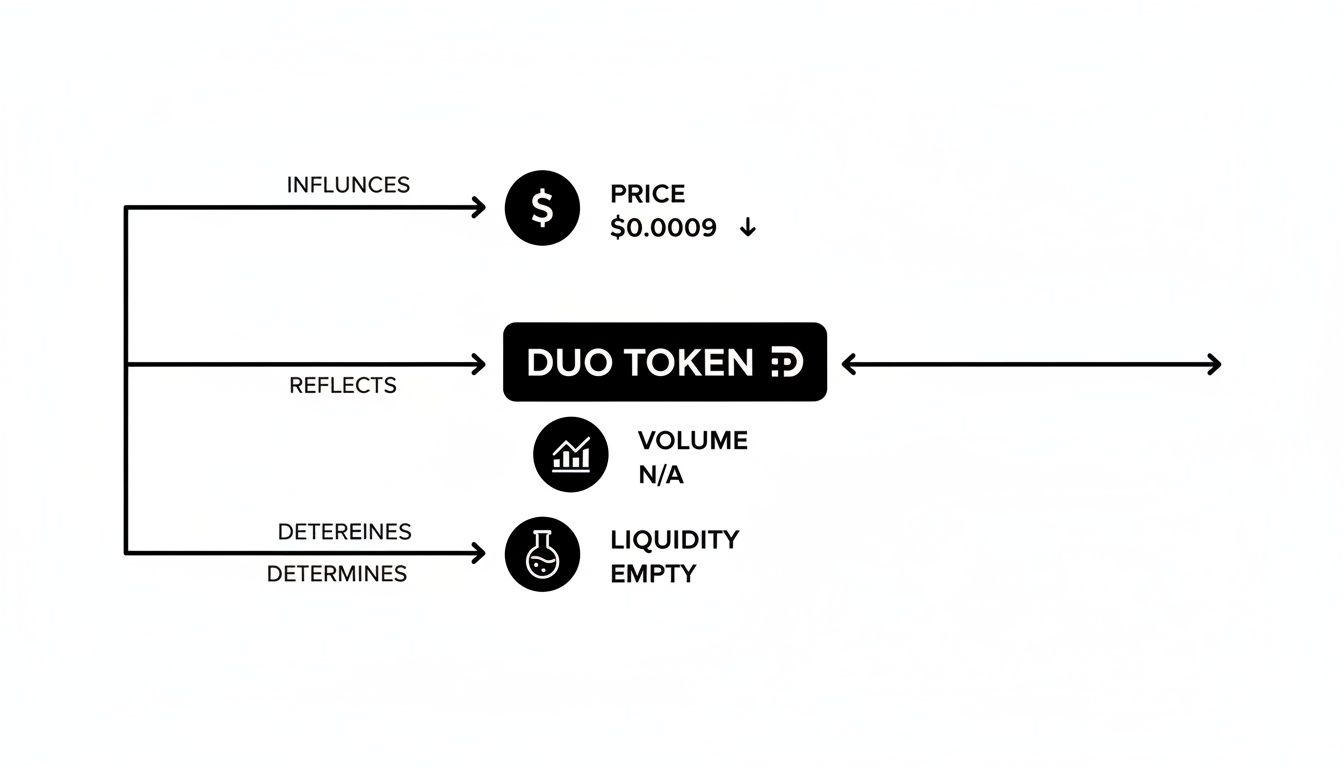
A diagram illustrating the relationships between DUO TOKEN and its price, volume, and liquidity.

As you can see, even though a price exists, the total lack of trading activity and liquidity means that price is incredibly fragile and unreliable.

Unpacking the Different DUO Variants

The various DUO projects are fundamentally different. For instance, one is a Multichain Yield Maximizer on Avalanche with a max supply of 500,000 DUO, designed for dual earnings in $DUO and $AVAX. Another shows a circulating supply of 0 DUO out of 1,300, potentially indicating a token migration. Then there is ParallelCoin DUO, a 2017 project with 314,719 tokens in circulation. You can discover more about these DUO token variants on CoinMarketCap.

These differences highlight why using a tool like Wallet Finder.ai is crucial for accurate on-chain analysis. Without distinguishing between projects, you could misinterpret data, such as a large transfer of one DUO variant for another.

Verifying a token's contract address is a non-negotiable step in modern on-chain analysis. It's the only way to ensure the data you're acting on—from wallet movements to historical price action—corresponds to the asset you intend to trade.

Here’s a quick breakdown to help you differentiate them:

  • ParallelCoin (DUO): An older project from 2017 with its own unique supply mechanics and history.
  • Multichain Yield Maximizer (DUO): A DeFi protocol on the Avalanche network focused on generating yield.
  • DUO Network Token: Yet another variant with its own tokenomics and market history, often mixed up with the others.

Each operates in a separate ecosystem. Treating them interchangeably is a recipe for analytical disaster. Always start by confirming the contract address.

A Look Back: DUO's Price History From Bull Market Peak to Oblivion

The history of the duo token price is a classic crypto cautionary tale of a rapid rise followed by a prolonged collapse. Analyzing this journey provides valuable lessons on market cycles, hype, and the volatility inherent in early-stage altcoins.

DUO's story began during the 2017-2018 bull run, a period of speculative frenzy where thousands of altcoins soared to unprecedented heights. DUO was part of this wave, capitalizing on the widespread excitement.

The All-Time High and The Inevitable Aftermath

Like many projects from that era, DUO's peak was brief. The DUO Network Token variant hit its all-time high of $3.28 on January 11, 2018. This marked the height of market euphoria for the project.

However, the bubble eventually burst, and the token entered a multi-year "crypto winter." Its value plummeted, wiping out nearly all gains in a long, painful decline that mirrored the broader market collapse.

The trip from a $3.28 peak to its current value of basically zero is a textbook example of the lifecycle for many altcoins from the 2017-2018 boom. It’s a harsh reminder that rallies driven by pure hype, without real development, adoption, and liquidity to back them up, usually don't last.

The key factors that contributed to DUO's decline include:

  • Shifting Market Narratives: Investor focus moved towards new trends like DeFi, NFTs, and Layer-2 solutions, leaving older projects behind.
  • Liquidity Evaporation: As interest waned, exchanges delisted the token, making it nearly impossible to trade and trapping remaining holders.
  • Community Abandonment: Without positive price action or new developments, the community and investors gradually disappeared.

This historical context is vital. The DUO Network Token's journey, with its circulating supply of approximately 314,719 out of one million, illustrates how severely market sentiment can turn against a project. For a deeper statistical review, you can explore DUO’s performance data on Coinranking. This background is essential before considering entering such a high-risk market.

Finding Trading Signals in Illiquid Markets

When a token's liquidity vanishes, traditional technical analysis becomes useless. The DUO token price chart is a flatline, devoid of the patterns and indicators traders rely on. In such an environment, the most valuable signals are found not on the charts, but on the blockchain itself.

On-chain data reveals the digital footprints of the few remaining influential wallets. These subtle clues can foreshadow price movements long before they appear on an exchange.

Actionable On-Chain Indicators to Monitor

In a thinly traded market, even small actions can have a significant impact. Here is a checklist of on-chain events you should be watching:

  • [ ] Large Wallet Movements: Monitor transfers between non-exchange wallets. A "dusty" wallet that has been inactive for years suddenly moving tokens is a major signal that something is about to happen.
  • [ ] Sudden Exchange Deposits: This is a strong bearish indicator. A large transfer of an illiquid token to a known exchange wallet almost always precedes a sale, as the holder prepares to unload their position.
  • [ ] Shifts in Holder Distribution: Track the concentration of tokens among top wallets. Are a few wallets quietly accumulating the supply? This could suggest consolidation before a pump. Conversely, are top holders dispersing tokens into smaller wallets? This could be an attempt to exit without causing a price crash.

In illiquid markets, the movement of tokens is far more telling than the price itself. A single large transfer can give you more insight into market sentiment than a week of flat price action on a chart.

Decoding the Narrative Behind the Data

Simply observing on-chain events isn't enough; you must understand the context. For instance, a whale moving DUO between their own cold storage wallets is likely just portfolio management. However, that same whale moving tokens to a Binance deposit address tells a much more urgent, bearish story.

The age of the wallet also adds a crucial layer of context. A wallet that has held DUO since the 2018 peak suddenly becoming active carries more weight than a new wallet making a small transaction. By piecing together these events, you can build a clearer picture of potential future price action.

How to Track Smart Money Wallets Trading DUO

An illustration showing a central golden DUO coin connected to six diverse wallets, representing Smart Money.

Now that you know what signals to look for, the next step is to identify and track the "smart money" wallets generating them. For a low-liquidity coin like DUO, following the alpha traders who have a proven track record is one of the only viable strategies.

Using a tool like Wallet Finder.ai, you can systematically uncover these profitable wallets and receive real-time alerts on their trades.

Step 1: Set Up Your Search Filters

Your first task is to find wallets that have successfully traded DUO in the past. Precision is key.

  1. Start a new search in Wallet Finder using the DUO token's specific contract address to ensure you're tracking the correct asset.
  2. Apply filters to isolate the top performers.

Here are the key filters to use:

  • Token Traded: Input the exact DUO contract address.
  • Profitability (PnL): Filter for wallets with a positive realized PnL on DUO trades.
  • Win Rate: Set a high threshold, such as 70% or more, to find consistently successful traders.
  • Transaction Dates: Optionally, focus on wallets active during specific periods of volatility to see how they navigated market shifts.

Step 2: Analyze and Select Top Wallets

Once you have a list of wallets, dive into their trading history to understand their strategies. Don't just copy trades; learn from their patterns.

The goal is not just to find what smart money is trading, but to understand how they trade. Analyzing their entry points, exit strategies, and position sizes provides a blueprint you can learn from and adapt.

Ask these questions for each wallet:

  • Do they buy after major dips or during consolidations?
  • At what profit levels do they typically sell?
  • What is their average holding period?

Answering these helps you build a profile of each trader's strategy. For more on this topic, see our detailed guide on how to track crypto wallets.

Step 3: Create a Watchlist and Real-Time Alerts

After identifying 3-5 wallets with impressive trading histories, set up a system for real-time monitoring.

  1. Select Top Wallets: Choose the most consistent and profitable wallets from your analysis.
  2. Create a Watchlist: Add them to a new watchlist in Wallet Finder and name it "DUO Smart Money."
  3. Configure Telegram Alerts: Connect your watchlist to the Telegram bot to receive instant push notifications whenever a tracked wallet buys, sells, or transfers DUO.

This setup transforms your research into a live intelligence feed, giving you a crucial head start to analyze smart money moves as they happen.

Risk Management for Low-Liquidity Tokens

Illustration of a boat by a dock and a checklist on trading: limit orders, slow buys, avoid slippage.

Trading an illiquid asset like DUO requires a completely different risk management approach than trading mainstream cryptocurrencies. The primary danger is slippage—where your trade executes at a significantly worse price than expected due to insufficient market depth. A single market order can trigger disastrous price swings.

Your strategy must prioritize capital preservation. This means operating with precision to minimize your market impact.

Essential Tactics for Survival

Follow these non-negotiable rules to protect your capital when trading a low-liquidity token:

  • Always Use Limit Orders: This is your most important tool. A limit order guarantees your trade will only execute at the price you set (or better), preventing catastrophic slippage.
  • Accumulate Positions Slowly: Never attempt to buy your entire position at once. Break your order into smaller, patient chunks to avoid artificially inflating the duo token price with your own buying pressure.
  • Have a Clear Exit Plan: Define your exit points (both for profit-taking and cutting losses) before you enter a trade. In an illiquid market, you may not get a second chance to sell. Set take-profit and stop-loss limit orders in advance to enforce discipline.

These concepts are explored further in our guide on the five key metrics for analyzing meme token liquidity risk, which are also relevant here.

Trading Strategy Comparison For Illiquid Tokens

Choosing the right strategy is crucial when liquidity is low. This table compares common approaches in the context of a token like DUO.

StrategyProsCons & RisksBest For
Small, Slow BuysMinimizes price impact; lower risk of slippage.Can miss sudden price pumps; takes time to build a position.Cautious traders with a long-term outlook.
Swing TradingAims to profit from medium-term price swings.Extremely difficult with no volume; exit liquidity may disappear.Experienced traders who have confirmed a catalyst.
Market MakingProvides liquidity to profit from the spread.High risk of holding a depreciating asset; requires technical skill.Advanced traders with significant capital.

For most traders, the "slow and steady" approach is the most sensible path in these conditions. More advanced strategies carry immense risks and should only be attempted by experts.

Common Questions About the Duo Token

When researching the DUO ecosystem, several key questions often arise concerning the duo token price and associated risks. Here are direct answers to the most common inquiries.

Why Is the Duo Token Price So Low?

The extremely low price is a result of several converging factors: the token's age, a complete loss of market interest following its 2018 peak, delistings from major exchanges, and a total lack of trading volume. This prolonged decline reflects a project with no active development or liquidity.

Is Trading the Duo Token Safe?

Trading DUO is exceptionally risky. The primary danger is not a security flaw but market illiquidity.

The biggest problem you'll face is illiquidity. Even a small trade can send the price swinging wildly, a nasty effect known as slippage. This makes it almost impossible to get in or out of a position at a predictable price. You could easily find yourself stuck with tokens you can't sell because there are simply no buyers.

How Can I Tell Different Duo Tokens Apart?

With multiple projects using the "DUO" ticker, relying on the symbol alone is a mistake. The only reliable method of identification is the token's unique contract address on its respective blockchain.

Before trading or analyzing, always verify the contract address using a blockchain explorer or a tool like Wallet Finder. This simple verification step can prevent a costly error.


Ready to stop guessing and start tracking the smart money? Wallet Finder.ai gives you the on-chain intelligence to discover profitable wallets, analyze their strategies, and get real-time alerts on their next big move. Start your free 7-day trial today at https://www.walletfinder.ai and trade with an edge.