High APY Crypto Staking: A Sustainable Yield Guide

Wallet Finder

Blank calendar icon with grid of squares representing days.

December 29, 2025

When you hear "high APY crypto staking," you're tapping into one of the most popular ways to earn passive income by putting your crypto to work. It involves locking up your assets to help run a blockchain network, and in return, you get rewarded. But let's be clear: these high returns are rewards for securing the network, not just free money.

The real trick for any investor is learning how to tell the difference between a solid, high-yield opportunity and a project that's built to fail.

What's Really Going On with High APY Staking?
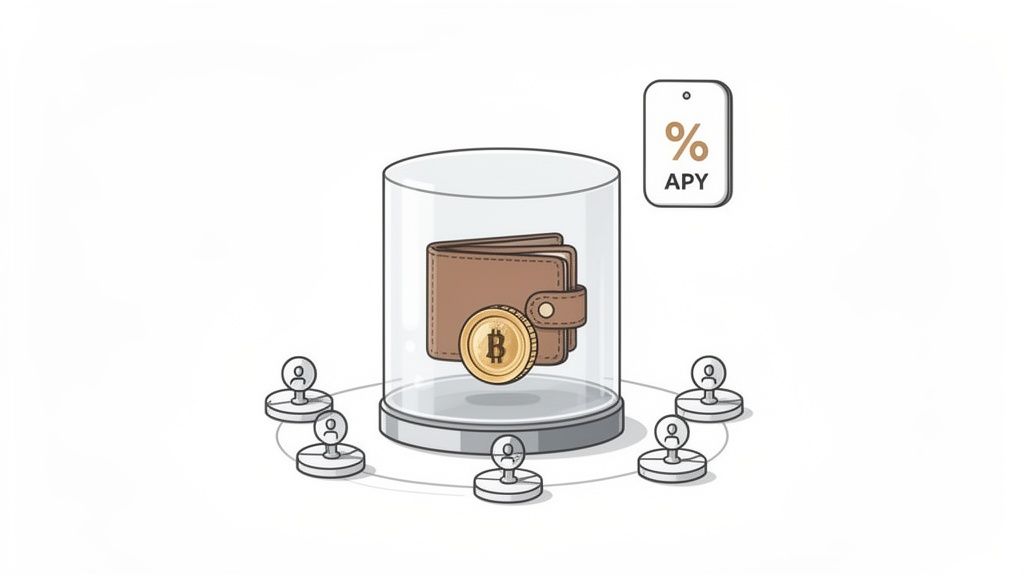
A Bitcoin wallet and coin in a secure display case, surrounded by networked users, indicating high apy crypto staking.

It’s easy for newcomers to see a headline promising triple-digit Annual Percentage Yield (APY) and think of it like a supercharged savings account. While the end goal of earning yield is the same, the way it works is completely different. Staking isn’t a passive deposit; you're actively contributing to a network’s health and security.

When you stake your tokens, you're essentially casting a vote for a "validator"—a computer that’s responsible for verifying transactions and adding new blocks to the chain. The network rewards you for that vote and for locking up your assets temporarily. That’s where the high APY comes from, but where the network gets those rewards and whether it can keep paying them out is another story entirely.

This guide is built on one core idea: success in high APY crypto staking comes from analysis, not hype. Forget chasing the biggest number you see. You're going to learn how to use on-chain data and smart tools to make calls based on what's actually happening, finding opportunities rooted in real network activity and the proven playbooks of other successful investors.

The Real Goal Behind Staking

The temptation of huge returns is strong, but it helps to understand the bigger picture. Staking is the lifeblood of Proof-of-Stake (PoS) blockchains. When you participate, you're helping the network achieve some pretty important goals:

  • Network Security: The more tokens are staked, the harder and more expensive it becomes for someone to attack the network.
  • Transaction Validation: Your staked tokens give power to validators to confirm transactions, keeping the blockchain running smoothly.
  • Decentralization: When staked assets are spread out across many different validators, no single person or group can gain too much control.

Think of it this way: Staking is like becoming a shareholder in a decentralized company. Your staked tokens are your shares and show your commitment. The APY you earn is your dividend for helping the company grow and stay secure.

Separating Real Yield from Marketing Hype

The single most important skill you can develop is telling a real opportunity from a mirage. A project might flash a 2,000% APY, but if its token price is crashing because they're printing new tokens like there's no tomorrow, your actual return will be deep in the red.

This guide will give you the tools to look past the advertised APY and dig into the fundamentals. You can get a deeper dive into the mechanics in our guide on what DeFi staking is. Real, sustainable yield comes from networks with actual use cases, growing user bases, and clear economics—not just an out-of-control token printer.

What Actually Creates High Staking Yields

When you see a project dangling an eye-popping APY, the first question you should always ask is: where is this money coming from? The answer is what separates a legitimate opportunity from an unsustainable house of cards. High APY crypto staking isn't magic; that yield is generated by real economic activity happening on the blockchain.

Think of staking rewards like dividends from a company. A healthy company pays dividends out of its profits, rewarding shareholders for their belief and investment. In the same way, a blockchain network pays stakers "dividends" for helping to secure and operate the whole system. These rewards mainly flow from two core sources.

The Two Engines of Staking Rewards

The yield paid out to stakers doesn't just appear out of thin air. It's a calculated part of a network's economic design, built to incentivize people to participate and keep the network safe.

  1. Network Inflation: This is the most common source. The blockchain protocol is literally programmed to create new tokens every time a new block is added—a process called token emission. A big chunk of these freshly minted tokens goes directly to stakers as their payment for participating. It’s the network’s way of paying its own security bill.

  2. Transaction Fees: Every single time someone sends a token, swaps on a DEX, or uses a smart contract, they pay a small fee. These fees get collected, and a portion is often passed along to the validators and the people staking with them. On a busy network with tons of real users, transaction fees can become a huge and, more importantly, sustainable source of yield.

A healthy network should eventually have its transaction fees cover a huge portion of its security costs. If a yield is 100% reliant on high inflation and nobody is actually using the network, that's a massive red flag. It’s just devaluing the token to pay rewards.

Why Some APYs Are So Insanely High

Okay, so inflation and fees are the fundamentals. But what pushes yields into the triple or even quadruple digits? A few key factors can pump up these numbers, especially when a project is just getting off the ground. You need to know if you're looking at a temporary growth strategy or a broken economic model.

  • Aggressive Token Emission: New projects often launch with a high inflation rate to attract early stakers and quickly secure the network. This is a temporary marketing push.
  • Low Staking Participation: When a network launches, the fixed rewards are split among fewer people, leading to a massive APY for each person. As more stakers join, the APY naturally drops.

How to Tell if a Yield Is Sustainable

The single most important skill you can develop in high-APY crypto staking is telling the difference between a genuine, temporary growth phase and an unsustainable "token printer" scheme. The latter just creates the illusion of profit while the token’s price craters from hyperinflation.

To protect yourself, start asking the hard questions:

  • What's the real inflation rate? Dig into the tokenomics. If the APY is 500% but the total token supply is inflating by 600% a year, you’re actually losing value.
  • Is there any real network activity? Fire up a block explorer and check the daily active users and transaction counts. Are people actually using this thing, or is all the activity just stakers compounding their rewards?
  • What’s the token’s purpose? Does the token do anything other than get staked for more tokens? A strong project's token will be used for things like governance votes, paying gas fees, or accessing dApps on the network.

These reward structures and sustainability metrics vary wildly from one blockchain to the next. To see how the major networks stack up, check out this ultimate guide to staking rewards by blockchain for a side-by-side comparison.

At the end of the day, a sustainable yield is always backed by a project with a real use case, a strong community, and a transparent economic model that isn't just printing money out of nothing.

Okay, we've covered the "what" and "why" of high APY. Now, let's get our hands dirty and look at some real-world blockchains where you can put this knowledge to work.

Seeing how different networks generate their staking rewards is the key to moving from theory to practice. Each one has its own unique recipe for value, which directly impacts the APY you can expect—and the risks you'll encounter.

Think of it this way: APY isn't just one thing. It's a cocktail mixed from three main ingredients.

Bar chart illustrating high APY sources: Inflation, Fees, and Incentives, each contributing to APY.

As you can see, the final APY is a blend of new tokens being created (inflation), what people pay to use the network (fees), and special rewards programs (incentives). Getting a feel for this mix is the first step toward judging whether a protocol’s juicy APY is actually sustainable.

Cosmos: The Internet of Blockchains

Cosmos isn't just one blockchain; it's a network designed to let dozens of independent blockchains talk to each other. Staking is the glue that holds this "internet of blockchains" together, making it a hotspot for anyone hunting for competitive yields.

With APYs reaching as high as 25.17%, Cosmos (ATOM) is a regular on high-yield staking lists. That reward secures an interoperable hub connecting over 80 different chains. Launched back in 2019, Cosmos’s Tendermint consensus model relies on delegators staking their ATOM to validators. In return, they get a slice of the annual supply emissions—roughly 100 million ATOM are handed out each year at the current rate.

The numbers speak for themselves. By late 2025, a staggering 222 million ATOM (worth $2.5 billion) is staked. The total value locked (TVL) has exploded by 150% since 2024, largely thanks to the DeFi boom on networks like Osmosis and Kava, which are part of the Cosmos ecosystem. For a deeper dive into the numbers, check out the data on Cosmos staking rewards on Koinly.io.

The system runs on Delegated Proof-of-Stake (DPoS). For a staker, it’s pretty straightforward:

  1. Delegate Your Tokens: You pick one or more validators and "delegate" your ATOM. You never lose ownership, but your stake boosts that validator's power.
  2. Earn Rewards: Validators get paid for processing transactions. They take a small cut (their commission) and pass the rest right back to you.
  3. Have a Say: Staking ATOM isn't just about earning. It gives you voting rights on proposals that steer the future of the entire Cosmos Hub.

In Cosmos, the high APY is mostly fueled by token inflation, which is a deliberate design to keep the network secure. Over time, as more people use the network and transaction activity picks up, the plan is for fee-based rewards to take over, making the yield more sustainable.

Ethereum: The Bedrock of DeFi

Ethereum’s switch to Proof-of-Stake (PoS) during "The Merge" was a game-changer for the entire crypto industry. It instantly turned ETH staking into a foundational way to earn yield within crypto's largest and most established ecosystem.

While its APY is more modest than what you'll find on newer chains, its stability is second to none.

Unlike the delegated model of Cosmos, native staking on Ethereum requires you to lock up a hefty 32 ETH to run your own validator node. That’s a tall order for most people, which is why a whole ecosystem of more accessible staking options has sprung up.

  • Liquid Staking: This is the most popular route. Platforms like Lido let you stake any amount of ETH. In exchange, you get a "liquid staking token" (like stETH), which is basically a receipt for your staked ETH. The cool part? You can use that stETH token across DeFi to earn even more yield while your original ETH is still earning staking rewards.
  • Centralized Exchanges: Big players like Coinbase and Kraken offer ETH staking as a simple, one-click service. They handle all the technical heavy lifting behind the scenes and take a small fee for their trouble. It's a great, hassle-free entry point for beginners.

The APY for staking ETH usually sits in the 3-5% range. This yield comes from a mix of new ETH being issued to validators and a share of transaction fees—especially the "priority fees" users pay to get their transactions confirmed faster.

Tron: High Throughput and DPoS

Tron was built for speed and high transaction volume, making it a go-to platform for dApps, especially in the gaming world. Like Cosmos, it uses a Delegated Proof-of-Stake (DPoS) model, but with its own unique twist.

On Tron, the community elects 27 "Super Representatives" (SRs) who are in charge of producing blocks. To get voting power, you "freeze" your Tron (TRX) tokens, which gives you "Tron Power." You then use that power to cast your vote for the SRs you want to support.

The reward system is simple: the SRs who get elected earn block rewards, and they share those rewards with the people who voted for them. This creates a really competitive environment where SRs actively try to attract voters with better reward-sharing plans. The result is a steady APY, often in the 3-5% range, on a network that handles a massive amount of transactions.

To give you a clearer picture, here’s how these protocols stack up against each other.

Comparison of High-Yield Staking Protocols

This table offers a quick snapshot of how some popular staking protocols compare, focusing on their typical returns, the technology they use, and what makes their ecosystems tick.

ProtocolTypical APY RangeConsensus MechanismKey Ecosystem Strengths
Cosmos10% - 25%Delegated Proof-of-StakeMassive interoperability (IBC), strong developer community, airdrop culture
Ethereum3% - 5%Proof-of-StakeLargest DeFi ecosystem, high security, extensive liquid staking options
Tron3% - 5%Delegated Proof-of-StakeHigh transaction throughput, popular for dApps and stablecoins

Each of these protocols offers a different flavor of staking. Cosmos is for those chasing higher yields in a rapidly expanding, interconnected ecosystem. Ethereum is the blue-chip choice, offering stability and deep liquidity. Tron provides consistent, moderate returns powered by high network usage.

Red Flags of Unsustainable Staking Platforms

Diving into high-APY crypto staking can be an absolute gold rush, but it’s a landscape littered with hidden traps. That lure of massive returns can easily blind you to some critical warning signs. Learning to spot these red flags isn’t just good practice—it's your number one defense against projects designed to do nothing but drain your wallet.

Think of it this way: a legit project is like a well-built house with a solid foundation and a clear blueprint. An unsustainable project is a house of cards. It looks impressive for a minute, but it’s designed to collapse at the slightest gust of wind. Your job is to kick the tires and check the foundation before you even think about moving in.

Warning signs for crypto investments, showing cracked coins, anonymous actors, unaudited documents, and token overflow.

Unrealistic and Fixed APYs

The most obvious red flag? An impossibly high and—more importantly—fixed APY. Real, sustainable staking yields are always in flux. They move with the market, reacting to things like network participation, transaction volume, and token emissions. They are dynamic, never static.

When a platform starts guaranteeing a fixed APY of 1,000% or more, your alarm bells should be screaming. These returns are almost always funded by printing new tokens at an insane rate. This leads to hyperinflation, which absolutely demolishes the token's price. Sure, you might be earning more tokens, but the total value of your bag is likely plummeting.

Anonymous Teams and Vague Roadmaps

In crypto, trust is everything. While privacy is a core principle of the space, a completely anonymous team behind a high-stakes financial project is a massive warning sign. If the people running the show aren't willing to put their reputations on the line, why on earth should you risk your capital?

Look for projects that have:

  • Publicly Doxxed Teams: Founders with real, verifiable professional histories (think LinkedIn profiles) and a solid track record.
  • Clear Communication: A team that’s active and transparent on Discord, Telegram, and Twitter, actually answering tough community questions.
  • A Detailed Roadmap: A clear, achievable plan for the future, not just fluffy promises of "building the future of finance."

An anonymous team can vanish into thin air, leaving investors holding worthless tokens with absolutely no one to hold accountable. This was the classic move in countless DeFi rug pulls where founders ghosted their communities overnight.

Unaudited or Flawed Smart Contracts

The smart contract is the engine of any staking platform; it's the code that holds and manages your funds. A single bug or vulnerability can lead to a catastrophic loss of every last asset staked. This is exactly why a third-party security audit is non-negotiable.

Always demand to see an audit report from a reputable firm like CertiK, Trail of Bits, or OpenZeppelin. But don't just see the checkmark and move on. Actually read the findings. Did the auditors flag critical issues? And more importantly, did the project’s team fix them? A project that ignores or downplays serious security flaws is waving a giant red flag right in your face.

Poorly Designed Tokenomics

Tokenomics—the economics of a token—is the blueprint for its long-term value. A project with weak, nonsensical tokenomics is built on quicksand.

Here are the specific tokenomics red flags to hunt for:

  • No Real Utility: The token's only purpose is to be staked to earn more of the same token. This creates a death spiral with no real demand outside of chasing yield.
  • High Inflation with No Cap: The protocol just prints new tokens forever with no mechanism to burn them or at least slow down the emissions. It's a race to the bottom.
  • Unfair Token Distribution: A huge chunk of the total supply is held by the team and early investors with short or non-existent lock-up periods. This is a setup for massive sell pressure as soon as they can cash out.

A project with 90% of its supply allocated to "team and marketing" is a disaster waiting to happen. It signals that the goal isn't to build a sustainable ecosystem but to make the founders rich. By learning to spot these signs, you can filter out the junk and focus on the high-APY opportunities that are actually built to last.

Your Due Diligence Checklist for Staking

To actually succeed with high-APY crypto staking, you have to stop chasing flashy numbers and start doing some real research. A solid, repeatable checklist is your best friend here. It transforms you from a gambler into an analyst who can spot a solid project from a mile away and confidently vet the story behind the yield.

Before you even think about staking a single token, you need to dig into the project's economic guts. This first step is all about figuring out if those juicy returns are built on a real, sustainable model or just an inflationary house of cards waiting to collapse.

Analyze Tokenomics and Supply

Tokenomics is just a fancy word for the economic rules of a cryptocurrency. Get this wrong, and the project is doomed from the start, no matter how high the staking APY is. Your job is to figure out if the token is designed for long-term value or just a quick pump-and-dump.

Start by asking these make-or-break questions:

  • What's the inflation rate? Find the token's emission schedule. If the APY is 100% but the supply is inflating by 150% every year, your stake is actually losing value. You’re being diluted into oblivion.
  • Is there a max supply? A hard cap on supply creates scarcity, which can help support the price over the long run. A token with no cap needs powerful deflationary tricks (like burning transaction fees) to have any hope of survival.
  • Who owns the tokens? Look at the supply distribution. If a huge chunk of the tokens (over 50%) is sitting in the wallets of the team and early investors with short vesting periods, get ready for a tidal wave of selling pressure that will crush the price.

Verify Smart Contract Audits

The smart contract is the digital vault holding all the staked funds. A bug here isn't just a small problem; it's a ticking time bomb that could wipe everything out. That’s why a clean security audit from a respected firm is an absolute, non-negotiable must-have.

Don't just see the word "audited" and move on. Go find the actual report and read it. Look for audits from big names in security and see what they found. A project that blows off or downplays critical security warnings is asking for trouble.

A clean audit is the bare minimum for security. It confirms the code does what it claims without obvious exploits. Staking on an unaudited platform is like depositing your money in a bank that doesn't have a vault door.

Assess the Team and Community

Behind every crypto project is a team of builders and a community of believers. The quality of these two groups is a huge clue about the project's chances of sticking around. If the team is anonymous and the Discord is full of bots, that's a massive red flag.

  • Research the Founders: Look for a public team with real, verifiable track records. Have they built successful projects before? Are they actually communicating with their community transparently?
  • Gauge Community Health: Jump into their Discord and browse their Twitter. Is the conversation real and focused on building, or is it just a bunch of "wen moon" hype and automated spam? A genuinely engaged community is a sign of a healthy, invested user base.

Evaluate On-Chain Health

On-chain data doesn't lie. It cuts through all the marketing fluff and shows you the raw truth about whether people are actually using the network. This is where you confirm if there's any real demand to support those staking rewards.

Take Ethereum staking, for example. It completely changed after The Merge on September 15, 2022. The move to proof-of-stake unlocked APYs between 4%-6%, and liquid staking options like Lido pushed effective yields up to 7.09%. It also slashed energy consumption by 99.95%, which is a huge win. By December 2025, projections show over 17.8 million ETH will be staked, proving there's massive network participation. You can read more about the evolution of crypto staking at Cryptomus.com.

Use a block explorer and check these key metrics:

  • Daily Active Users (DAU): Is the number of unique wallets interacting with the protocol actually growing over time?
  • Transaction Volume: Are people using the network for things other than just staking? Real utility matters.
  • Total Value Locked (TVL): A rising TVL is a great sign, showing that more money and more confidence are flowing into the ecosystem.

Finally, read the fine print of the staking agreement itself. Before you commit a dime, understand the lock-up periods, how long it takes to un-stake (the unbonding period), and any penalties (slashing) that could cost you money. These rules directly affect your risk and how easily you can access your funds.

Find and Mirror Profitable Staking Wallets

Magnifying glass inspects wallets, highlights one golden, then copies appear, leading to a bell notification.

Once you’ve got a handle on due diligence, it’s time to put that knowledge into practice. Instead of throwing darts at a board, a much smarter approach is to see what the most successful players are doing and learn from them. This means looking directly at the blockchain to mirror the strategies of top-performing wallets.

Tools like Wallet Finder.ai are built for this. They let you systematically find these "smart money" stakers. It's not about blindly copying every move, but about decoding their playbook to sharpen your own high-APY staking game.

Discover Elite Wallets

First things first: you need to find wallets with a real track record of success. I’m not just talking about wallets with a huge bag, but ones that show consistently profitable behavior in staking and DeFi. The right tools let you filter the entire blockchain for the metrics that actually matter.

You can zero in on wallets that fit your criteria:

  • High Profit and Loss (PnL): Pinpoint wallets that have racked up the biggest returns from their staking moves.
  • Impressive Win Rate: Isolate traders who consistently pick winners and cash out with a profit.
  • Specific Asset Focus: Find the most profitable stakers for a single token, like ATOM or ETH, to learn from the specialists.

This approach cuts through all the social media hype and shows you who is actually winning, not just who's making the most noise.

Analyze Their Staking Strategies

After you’ve tagged a few elite wallets, the real detective work begins. The goal is to understand their strategy. Just looking at what they’re holding now is surface-level stuff; you have to dig into their transaction history to see the whole story.

You need to examine not just what they stake, but how and when. For instance, top Tron wallets often use sophisticated tactics. Big-time stakers will pair their TRX staking with yield farming on platforms like SunSwap, pushing their effective yields up to 30% by mirroring whale activity. Even with over 60% of Tron's supply staked, these moves stand out.

When you review a wallet's history, you start to see the patterns. Do they compound rewards daily? Do they jump on new opportunities before they hit the mainstream? These are the kinds of insights that give you a real edge.

Set Real-Time Alerts for Smart Money Moves

The final piece of the puzzle is timing. Crypto moves at lightning speed, and the juiciest staking opportunities are fleeting. Once you’ve identified and analyzed the top wallets, you can set up automated alerts to get a ping the second they make a move.

This is a game-changer for staying ahead of the crowd. You can get instant notifications when a wallet you're tracking:

  1. Stakes a new asset, potentially signaling the next big high-yield farm.
  2. Compounds its rewards, showing they’re confident in their current position.
  3. Unstakes or sells, which could be your early warning to take a closer look at your own stake.

This workflow turns the chaotic firehose of on-chain data into a clear, actionable signal. It lets you learn from proven winners and make smarter, more confident decisions on your own high-APY staking journey. To dive deeper, check out our guide on automated staking rewards tracking to get your monitoring system dialed in.

Frequently Asked Questions About High APY Staking

To wrap things up, let's tackle some of the most common questions that pop up when you start digging into the world of high APY crypto staking. Think of this as a quick-fire round to lock in the key ideas from this guide.

Is High APY Crypto Staking Safe?

The short answer? It depends entirely on the project. While it can be a legitimate way to earn yield, it’s never completely risk-free. Real safety doesn't come from a high number; it comes from doing your homework.

A project's security really comes down to a few key things:

  • Smart Contract Audits: Has a well-known security firm kicked the tires and checked the code for holes?
  • Sustainable Tokenomics: Are the rewards coming from real platform fees and network usage, or are they just printing new tokens into oblivion?
  • Team Reputation: Do the founders have their names and faces out there? Are they accountable to the community?

Remember, the APY is a moving target, not a guarantee. The single biggest risk isn't some dramatic hack—it's staking a token whose price tanks, making whatever rewards you earned worthless.

What Is the Difference Between APY and APR?

Getting this right is absolutely crucial if you want to accurately forecast your potential returns. The entire difference boils down to one powerful concept: compounding.

  • APR (Annual Percentage Rate): This is just simple interest. If you stake 100 tokens at a 10% APR, you’ll have 110 tokens after a year. Straightforward.
  • APY (Annual Percentage Yield): This is where the magic happens. APY accounts for compounding, which means you start earning rewards on your rewards. That same 10% APY, if compounded daily, will leave you with more than 110 tokens after a year because every day, your pile of earnings starts earning for you, too.

Can I Lose Money From Staking?

Yes, absolutely. Losing money is a very real possibility, and it happens in a couple of ways. The most common pitfall isn't a platform getting hacked; it's the value of the token you're staking collapsing. If your token's price drops 50%, even a juicy 20% APY won't save you from being deep in the red.

There's also the risk of slashing. This is a penalty that networks can automatically impose on a validator for messing up—like having too much downtime or validating fraudulent transactions. If you've delegated your coins to that validator, you could lose a portion of your stake right along with them. It's a direct loss of your tokens.


Ready to stop guessing and start learning from the best? Wallet Finder.ai gives you the on-chain intelligence to discover and mirror the strategies of the most profitable stakers in DeFi. Find your edge and start your free trial today.