How to Analyze Crypto: A Step-by-Step Guide

Wallet Finder

Blank calendar icon with grid of squares representing days.

December 6, 2025

Trying to analyze crypto without a plan is like sailing without a map—you get tossed around by the waves of hype and FUD. Professional investors don't guess; they use a repeatable framework to make informed decisions.

This guide isn't about a secret formula. It’s about building a consistent process to evaluate an asset, manage risk, and align your trades with your financial goals. Whether you're a long-term HODLer or a short-term trader, your objectives shape your entire approach.

This simple workflow gives you a bird's-eye view of how to structure your analysis, from setting clear goals to executing a trade.
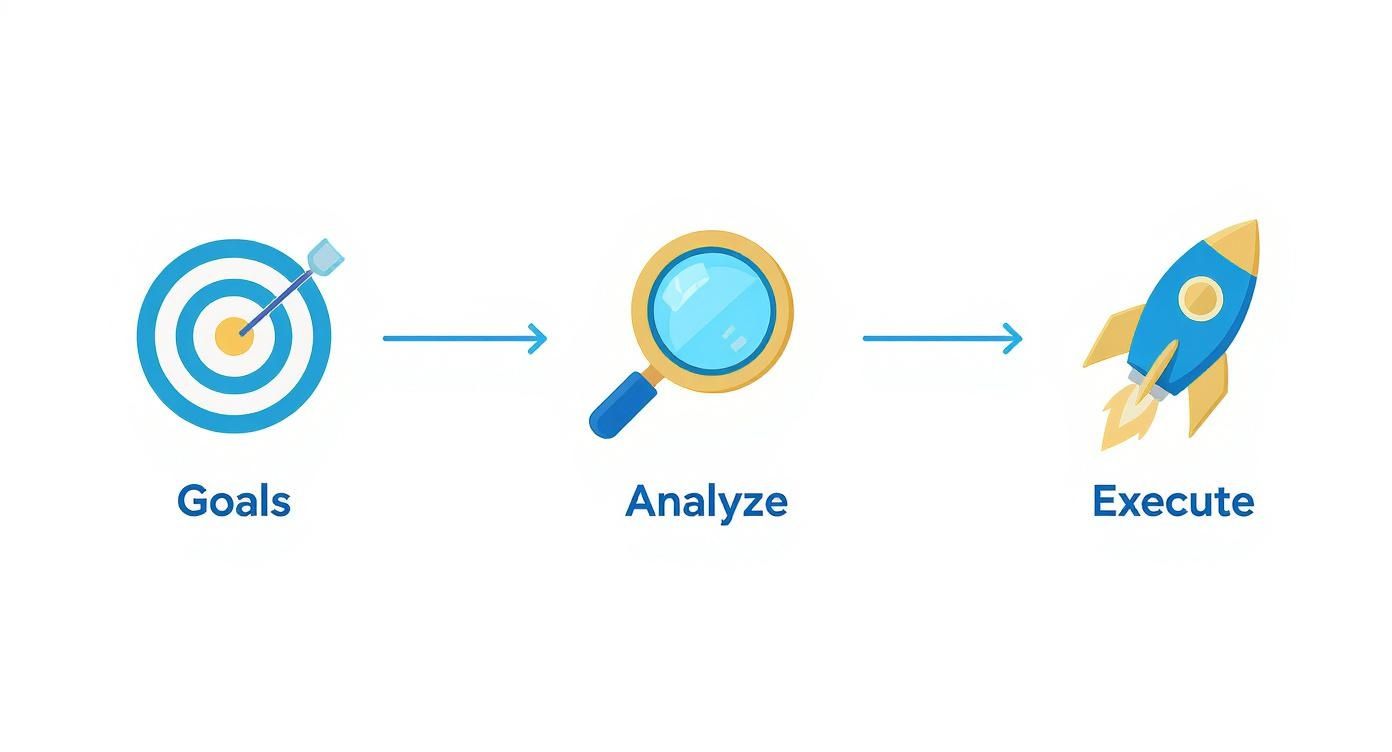
Goals, Analyze, Execute workflow diagram with a target, magnifying glass, and rocket icons.

The key takeaway? Analysis is a deliberate process, not a shot in the dark. It starts with your goals and leads to confident, well-reasoned execution.

The Three Pillars of Crypto Analysis

Any solid framework is built on three distinct but complementary methods. Think of them as different lenses that, when used together, give you a complete picture of any crypto asset.

No single analysis type tells the whole story. Fundamental analysis helps you find what to buy, on-chain analysis shows what smart money is actually doing, and technical analysis helps you decide when to act.

This synergy is where the magic happens. Imagine you find a project with solid fundamentals—a great team and real-world utility. Then, you look on-chain and see a huge spike in whale wallets scooping up tokens. To top it off, the technical charts are flashing a potential breakout. That’s a powerful, multi-layered confirmation for your thesis.

A Quick Look at Each Method

To make these pillars work for you, you need to know their specific strengths and when to pull each one out of your toolbox.

Analysis TypePrimary FocusKey Questions AnsweredBest For
Fundamental (FA)The intrinsic value and long-term potential of a project.Is this project solving a real problem? Who is the team?Long-term investing
On-Chain (OCA)The health and activity of the blockchain network itself.Are users joining the network? Are large holders buying?Gauging market sentiment
Technical (TA)Historical price action and market psychology.Where are key price levels? Is the asset overbought?Short-term trading

Each method provides a different piece of the puzzle, and the most successful analysts learn to weave them together.

The broader market context always matters. For instance, the global crypto market was recently valued at around USD 5.7 billion and is projected to hit USD 11.7 billion by 2030, largely thanks to growing institutional interest and DeFi innovation. Knowing this macro trend helps frame your analysis of individual assets. This growth is exactly why having the right DeFi analytics tools for crypto traders is more critical than ever.

Getting a Read on a Project's Real Value

A killer narrative can make a token's price go vertical, but only solid fundamentals can keep it there. To properly analyze any crypto asset, you must learn to see past the hype and dig into what makes the project tick. This means thinking like a venture capitalist sizing up a startup, not just a trader staring at a chart.

Think of this section as your battle-tested due diligence checklist. It’s a systematic way to figure out if a project has the legs to be a long-term winner. We'll break down exactly what to look for, from the people writing the code to the token that fuels the ecosystem.

A man checking a task list and target, next to progressively taller columns topped with paper balls, symbolizing project progress.

Who’s Behind the Curtain? The Team and Vision

The first question you should ask is: who is actually building this? A project lives or dies by the team's experience, integrity, and ability to execute.

While anonymous founders are part of crypto lore—Satoshi Nakamoto is the ultimate example—a public (doxxed) team adds a serious layer of accountability. Start digging for the founders and key developers on LinkedIn and Twitter. Do they have a history of building successful products in crypto or traditional tech?

Once you know who they are, you need to understand their vision. A project's whitepaper should spell out, in no uncertain terms, the exact problem they're solving. A mission statement that's vague, overly ambitious, and lacks a clear execution plan is a massive red flag.

It's All in the Tokenomics

Tokenomics—the economic engine of a token—is arguably the most critical piece of your fundamental analysis. It governs supply, demand, and how value ultimately accrues to holders. Get this part wrong, and even a fantastic project can be a terrible investment.

Here’s a checklist of what to put under the microscope:

  • Total Supply & Distribution: Is the supply capped, like Bitcoin's 21 million, or inflationary? How were tokens allocated (team, VCs, public)? If insiders hold a huge chunk with short vesting periods, expect heavy sell pressure later.
  • Token Utility: What can you do with the token? Real utility is key. This could be governance rights (voting), staking rewards, paying network fees, or unlocking features. The more essential the token is to the platform, the more sustainable its demand.
  • Vesting Schedules: When can team and investor tokens be sold? A slow, multi-year vesting schedule aligns everyone for the long term. A large "cliff" unlock, where a massive amount of tokens hits the market at once, can crater the price.

A project's tokenomics is its economic blueprint. If that blueprint funnels value mostly to insiders and early VCs, retail investors are often left holding the bag.

Does Anyone Actually Need This? Product-Market Fit and Roadmap

A brilliant idea is worthless if there’s no market for it. Does this project solve a painful, genuine problem for a specific group of people? Look for hard evidence of adoption and a clear edge over the competition.

Is the project offering something cheaper, faster, or more secure than what's already out there? For example, a new Layer-2 for Ethereum needs a clear advantage over giants like Arbitrum or Optimism to gain traction.

Next, pull up the project’s roadmap. A good roadmap isn't a fantasy list of buzzwords; it's a strategic plan with concrete, achievable milestones.

What a Solid Roadmap Looks Like:

  1. Specific Goals: "Launch v2 of our DEX with limit orders by Q4" is actionable. "Implement AI integration" is not.
  2. Realistic Timelines: Building a world-changing protocol in three months is a recipe for rushed, buggy code.
  3. A History of Hitting Targets: Check their blog, GitHub, and community channels. Has the team delivered on past promises? A team that consistently ships is a team you can trust.

Finally, take the pulse of the community and developer activity. A healthy project has an active Discord and Twitter with real discussions, not just "wen moon?" posts. Check the project's GitHub repository. Frequent updates mean development is alive and well. This 360-degree view is how you truly analyze crypto for its long-term potential.

Using On-Chain Data to Spot Market Trends

If fundamental analysis tells you what to buy, on-chain analysis tells you what the market is actually doing with it. This is crypto's secret weapon. A blockchain is a public, open book where every single transaction is recorded. Learning how to read this book gives you an incredible edge.

By digging into the flow of funds, network activity, and wallet behavior, you can get a real feel for market sentiment and spot trends before they show up in the price.

Core Metrics for Network Health

Before getting lost in complex dashboards, master a few foundational on-chain metrics. Think of these as the vital signs of a blockchain network.

Start with Active Addresses, a simple count of unique addresses interacting with the network. A steady, sustained climb in active addresses is a strong sign of growing user adoption and a fundamentally bullish signal. On the flip side, if the price is pumping but active addresses are flat or falling, the rally is likely fueled by speculation and may not be sustainable.

Here is a quick reference for key on-chain metrics:

MetricWhat It ShowsBullish SignalBearish Signal
Active AddressesUser adoption and network activity.Steady increase.Stagnant or declining.
Transaction VolumeEconomic throughput of the network.Increasing volume confirms price trends.Decreasing volume signals weakening trends.
Exchange NetflowFunds moving to/from exchanges.Large outflows (to private wallets).Large inflows (to exchange wallets).
NVT RatioNetwork valuation vs. transaction value.Low or decreasing ratio.High or increasing ratio.

Tracking the Flow of Money

It’s not just about counting users; you have to follow the money. Two of the most powerful indicators for this are transaction volume and exchange flows.

Transaction Volume is the total value of assets transferred on the network. A big spike in volume during a price run-up confirms the trend's strength. It also reveals real-world adoption patterns. For example, on-chain data shows massive crypto activity growth globally. In the 12 months ending last June, the Asia Pacific (APAC) region saw a 69% increase in on-chain value received, with total transaction volume jumping from $1.4 trillion to $2.36 trillion. This data, highlighted by Chainalysis, shows where global adoption is heating up.

The NVT (Network Value to Transactions) Ratio is another killer tool. Calculated by dividing the market cap by daily transaction volume, it’s crypto’s version of the Price-to-Earnings (P/E) ratio.

  • A high NVT ratio suggests the valuation is outpacing on-chain use, potentially indicating an overvalued asset.
  • A low NVT ratio means transaction volume is high relative to the market cap—a potential sign of an undervalued asset.

Reading Whale and Exchange Signals

Some of the most powerful signals come from watching whales (large holders) and cryptocurrency exchanges. What they do often telegraphs major market moves.

When you see a large, sustained flow of a token out of exchange wallets, it's usually bullish. It means investors are moving assets to cold storage for the long haul, shrinking the available supply. Conversely, a huge inflow to exchanges can be bearish, suggesting holders are preparing to sell. Mastering this is a huge part of building a solid strategy; you can go deeper with our guide on on-chain analysis.

Tools like Glassnode and Nansen are essential for this, turning complex data into clear charts. Here’s a Glassnode chart showing the balance of Bitcoin on exchanges over time.

That steady downward slope clearly shows investors are consistently pulling Bitcoin off exchanges, which historically points to a bullish, long-term holding mindset.

Watching whale activity is like getting a peek at the "smart money's" playbook. A sudden spike in accumulation by the largest wallets can signal that well-informed, deep-pocketed investors are building a position in anticipation of a future price increase.

When you start combining these on-chain insights with your fundamental research, you stop guessing and start making data-driven decisions.

Applying Technical Analysis to Time Your Trades

Once you’ve done your homework on fundamentals and confirmed network health with on-chain data, it's time to pull up the price chart. This is where technical analysis (TA) comes in, helping you answer the critical question: when is the best time to enter or exit a position?

Think of TA as reading the market's collective psychology through its fingerprints—price action, volume, and statistical indicators. While hundreds of complex tools exist, a handful of core concepts will give you the most leverage.

A conceptual diagram showing financial analysis from NVT data through a ZONT system to output metrics and coins.

This diagram shows how different data streams, like on-chain metrics, can be pulled together to create actionable trading signals. Layering these signals with classic chart analysis builds a much more robust trading thesis.

Identifying Key Price Levels

The absolute bedrock of TA is support and resistance. These are horizontal price zones where buying or selling pressure has historically been strong enough to halt or reverse a trend.

  • Support: A price level where demand consistently steps in, preventing the price from dropping further. It’s the floor.
  • Resistance: A price level where supply consistently overwhelms demand, preventing the price from climbing higher. It’s the ceiling.

One of the most powerful patterns is when a price decisively breaks through resistance. That old ceiling often flips to become the new floor. Spotting these zones on a chart gives you clear, logical areas to place buy orders, set stop-losses, and map out profit targets.

Gauging Market Momentum and Trend

After mapping out key levels, indicators help you read the room. They act like a dashboard, giving you a sense of the trend's strength and direction.

Technical indicators don't predict the future; they measure the present. They are most powerful when used to confirm what you already see in the price action, not as standalone buy or sell signals.

Instead of plastering your chart with dozens of indicators, focus on a few that measure different things. A solid starting trio would be one for trend, one for momentum, and one for volume.

Essential Technical Indicators for Crypto

IndicatorWhat It MeasuresHow to Use It
Moving Averages (MA)The average price over a specific period, smoothing out volatility.A short-term MA (like the 20-day) crossing above a long-term MA (like the 50-day) is a classic bullish signal called a "golden cross."
Relative Strength Index (RSI)The speed and magnitude of recent price changes to measure momentum.A reading above 70 suggests an asset might be overbought and due for a pullback. A reading below 30 suggests it may be oversold.
VolumeThe number of units of an asset traded over a period.A price breakout on high volume is a strong confirmation of the move. A rally on declining volume often signals the trend is losing steam.

These indicators become truly powerful when used together. For example, if a token's price is bumping up against a major resistance level while the RSI is screaming over 70, that adds serious weight to the idea that a pullback is on the horizon.

This kind of multi-layered analysis is crucial for timing your trades, especially when you consider the boom-and-bust cycles inherent to this market. To get a better handle on this, it’s worth learning how to analyze cyclical crypto market patterns.

It's also important to keep an eye on the bigger picture of market liquidity. The explosive growth in stablecoin supply, which recently topped $300 billion, is a huge indicator of the capital waiting on the sidelines. With the total crypto market cap crossing the $4 trillion threshold, understanding these macro flows is more important than ever.

Integrating Your Analysis and Managing Risk

Gathering data is only half the battle. The real skill in learning how to analyze crypto is weaving all those threads together into a repeatable process that not only spots opportunities but, more importantly, protects your capital.

This is where you graduate from being a researcher to a strategist. A disciplined process turns chaotic market signals into a clear plan. It means building a personal checklist, writing down your reasoning for every trade, and having a rock-solid risk management framework in place before you click "buy."

Hand-drawn candlestick chart with a moving average, showing price trends, a character with 'RSII' and 'Buy Sel' text.

Building Your Investment Thesis and Checklist

For every asset you consider, you need an investment thesis. This can be a simple document—even just a few paragraphs—that lays out exactly why you believe this asset is a good investment at its current price. This simple act forces you to clarify your thinking and serves as an anchor when emotions run high.

Your thesis should pull together key findings from your analysis:

  • What’s the core value proposition? (Fundamental Analysis)
  • What does on-chain data show about adoption and smart money? (On-Chain Analysis)
  • Where are the key price levels on the chart? (Technical Analysis)

To make this consistent, create a standardized research checklist. It’s your safeguard against skipping crucial steps when you're hyped about a new token. It holds every potential investment to the same high standard.

The Bedrock of Success: Risk Management

No amount of brilliant analysis will save you from sloppy risk management. In a market where assets can drop 50% or more in a few days, managing your downside is the only way to stay in the game long enough to win.

Actionable Risk Management Rules:

  1. Position Sizing: Never go "all-in." Risk no more than 1-2% of your total portfolio on any single trade. If you have a $10,000 portfolio, your maximum loss on one position should be just $100-$200. This ensures a string of bad trades can't knock you out of the game.
  2. Set Intelligent Stop-Losses: A stop-loss is a pre-set order to sell an asset if it drops to a certain price. Base them on market structure, not arbitrary percentages. Place your stop just below a clear support level. Your trade is only invalidated if the market structure actually breaks down.
  3. Diversify Your Portfolio: Real diversification isn't just owning 10 different memecoins. It means holding assets with different use cases across different sectors (e.g., Layer-1s, DeFi, gaming, RWAs). This approach helps insulate your portfolio from a sector-specific downturn.

True portfolio diversification involves a mix of assets across different narratives—such as Layer-1s, DeFi, gaming, and real-world assets (RWAs). This approach helps insulate your portfolio from a sector-specific downturn.

Taming the Psychological Demons: FOMO and FUD

Finally, the biggest obstacle to your success is often psychological. The pressures of FOMO (fear of missing out) and FUD (fear, uncertainty, and doubt) can make even the most disciplined analyst abandon their strategy.

When you see a coin pumping and feel the urge to chase it, stop. Go back to your checklist. Has anything fundamentally changed, or are you just reacting to a green candle?

Likewise, when the market is crashing and FUD is thick, revisit your thesis. If the reasons you invested are still valid, that dip might actually be a buying opportunity. Having a written plan is your best defense against making emotional, irrational decisions.

Common Questions About Crypto Analysis

Even with a great framework, you're always going to have questions. The market moves, things get choppy, and new situations pop up. Learning how to analyze crypto is a continuous process of refinement.

Let's tackle some of the most common questions from new and experienced traders.

Which Type of Analysis Is Most Important?

This is the classic debate, but it's the wrong question. Fundamental, on-chain, and technical analysis aren't competitors—they're different lenses to view the same asset, and they work best together.

  • Fundamental analysis asks: Is this a good project?
  • On-chain analysis asks: What are the smart wallets doing?
  • Technical analysis asks: When should I buy or sell?

Relying on just one is like trying to navigate with only a map but no compass. You need the complete toolkit to get the full picture.

How to Analyze a Brand New Cryptocurrency

Jumping into a brand new token with no price history feels like flying blind. This is where your fundamental analysis skills must do all the heavy lifting.

With a new launch, be laser-focused on a few key things:

  • The Team: Are they public (doxxed)? Do they have a real track record? A credible, experienced team is a huge green flag.
  • Tokenomics: This is crucial. Look at the token allocation and vesting schedules. If insiders and VCs own a massive slice that unlocks in three months, expect heavy selling pressure.
  • Community and Vision: Is there a real, engaged community building around the project? Does it solve an actual problem in a unique way?

Even with limited on-chain data, you can still spot red flags. Check the initial wallet distribution. If a handful of wallets hold almost the entire supply, that's a major warning sign.

The single biggest mistake I see beginners make is chasing hype on X or Telegram without doing a lick of their own research. That’s just pure FOMO, and it’s a guaranteed way to get wrecked. Ignoring risk management and fixating on one metric are close seconds.

At the end of the day, every move you make should be backed by your own analysis, not just some influencer's latest call.


Ready to turn on-chain data into your competitive advantage? Wallet Finder.ai helps you discover and track the most profitable wallets in DeFi, giving you real-time alerts on their trades. Stop guessing and start mirroring the strategies of top performers. Start your 7-day free trial today.

Copy Winning Trades Instantly

4.9 Rating based reviews on

Product of the Day Badge

"I've tried the beta version of Walletfinder.ai extensively and I was blown away by how you can filter through the data, and the massive profitable wallets available in the filter presets, unbelievably valuable for any trader or copy trader. This is unfair advantage."

Portrait of a man with short dark hair and beard wearing a dark t-shirt, smiling softly against a plain white background.

Pablo Massa

Experienced DeFi Trader