Reading a Meme Coin Chart: A Trader's Guide

Wallet Finder

Blank calendar icon with grid of squares representing days.

February 16, 2026

A meme coin chart is a real-time map of a token's price, volume, and on-chain data. But it runs on a different engine than traditional stock charts. Forget fundamentals; think of it as a live feed of internet hype, where community mood swings and massive "whale" buys dictate price direction.

Quick Start: Read Any Meme Coin Chart in 60 Seconds

Before you dive deep into analysis, here's your 60-second chart reading framework. This quick scan tells you instantly whether a meme coin deserves deeper research or should be avoided entirely.

Step 1: Check the timeframe (5 seconds)Set your chart to the 1-hour view. This captures the sweet spot between too much noise (5-minute charts) and too slow (daily charts). Meme coins move fast—hourly charts show you what's happening right now.

Step 2: Read the last 24 hours of candles (10 seconds)Look at the most recent 24 candles. Are they mostly green (buying pressure) or red (selling pressure)? One long green candle isn't enough—you want to see sustained green momentum over 6-12 hours minimum.

Step 3: Verify volume matches price (10 seconds)Scroll down to the volume bars below the price chart. When price pumps, volume bars should be 2-3x taller than normal. If you see a 50% price pump on tiny volume, that's manipulation or a fake-out. Walk away.

Step 4: Check market cap instantly (10 seconds)Look at the top of your chart interface where market cap is displayed. Under $1M = extremely high risk but 100x potential. $1M-$10M = moderate risk, 10-50x potential. Over $100M = lower risk but likely only 2-5x from here.

Step 5: Scan liquidity pool size (10 seconds)Find the LP (liquidity pool) metric, usually shown on DEX screeners like DexScreener or DEXTools. Under $50K liquidity = don't touch it (you can't sell). $50K-$500K = tradeable but risky. Over $500K = safe enough to trade without massive slippage.

Step 6: Count holder wallets (15 seconds)Check the holder count on the token's page. Under 100 holders = too early and risky. 100-1,000 holders = early but growing. 1,000-10,000 holders = established community. Over 10,000 = probably past its major run.

Total time: 60 seconds. Decision: Go deeper or move to the next coin.

Why Meme Coin Charts Behave Differently
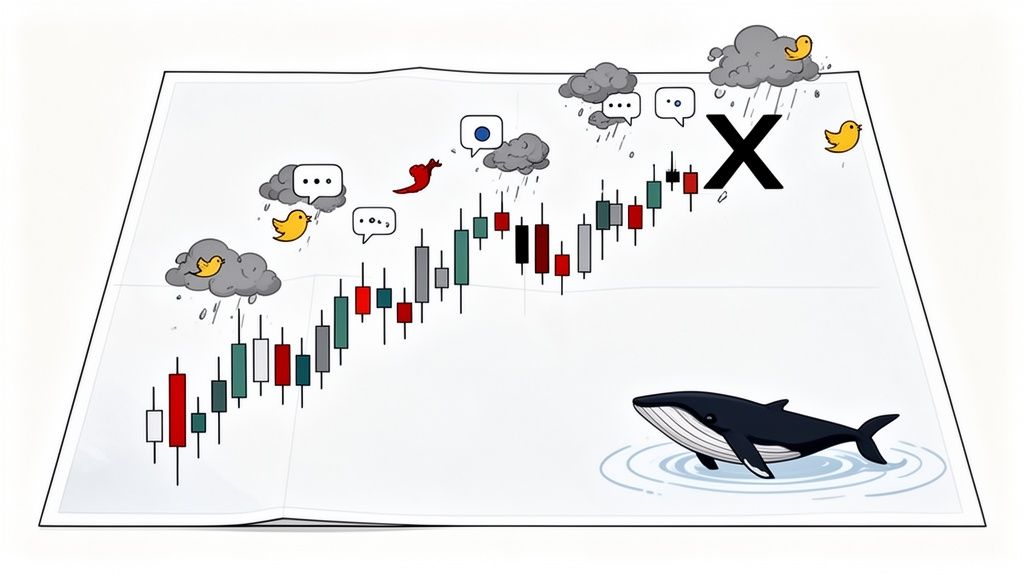
A candlestick chart on paper with a whale, rainy clouds, birds, and social media icons.

If a regular stock chart is a detailed weather report based on predictable economic seasons, a meme coin chart is a treasure map sketched during a social media hurricane. These charts don't follow usual rules because their prices aren't tied to revenue, profits, or product roadmaps.

They’re fueled by something else entirely.

The Real Drivers of Meme Coin Prices

The value of these tokens is almost entirely driven by narrative and momentum. Understanding this is the first step to reading a meme coin chart correctly. Here are the forces you’re actually dealing with:

  • Social Hype and Viral Narratives: A single tweet, a trending Reddit thread, or a viral TikTok can ignite a massive buying frenzy, sending a token’s price into orbit for no logical financial reason.
  • Whale Transactions: A handful of large holders ("whales") can move the market by themselves. When they buy or sell huge amounts, they create waves that smaller investors often ride.
  • Community Sentiment: The shared belief and excitement of a token's community is its lifeblood. Positive sentiment can sustain a rally, while fear can cause a total collapse in minutes.

This market creates a high-risk, high-reward playground where prices can do a 100x or go to zero in hours. The meme coin market showed its explosive side in early 2024, jumping over 30% in market cap to hit $47 billion in days. That dramatic reversal captures why these tokens are magnetic to speculators.

The real trick for any trader is turning this market chaos into signals you can actually use. Reading a meme coin chart means shifting your focus from old-school metrics to on-chain intelligence and sentiment.

To get good at this, you must blend standard price action with deeper on-chain data. The wild instability is often cranked up by low liquidity, which can make price swings even more dramatic. You can learn more about how low liquidity increases meme token volatility in our detailed guide.

Using the right tools to see both the chart and the story happening on-chain is what gives you a serious edge.

How Coordinated Pump Groups Manufacture Chart Patterns

The article correctly identifies social hype and whale transactions as meme coin price drivers. It doesn't explain the organizational infrastructure behind the largest coordinated moves — and understanding that infrastructure changes how you read every chart you look at.

Pump groups are organized communities, typically operating through private Telegram channels and Discord servers, that coordinate simultaneous buying of a pre-selected token. The largest groups have memberships exceeding 50,000 participants. They operate in structured tiers, and each tier receives the buy signal at a different time, which is precisely why the chart patterns they generate look organic rather than coordinated.

The mechanics work like this. Tier 1 members, typically numbering 50 to 200 insiders, receive the target token 12 to 24 hours before the official signal. They accumulate quietly while price is flat. Tier 2 members, numbering several thousand, receive the signal 30 to 60 minutes before it goes public. Tier 3, the general membership, receives the public signal and creates the visible volume spike that retail traders see on their charts and interpret as organic discovery. By the time the chart shows an "emerging" pattern, three layers of buyers are already in at lower prices and waiting to sell into the Tier 3 wave.

The Chart Signatures That Reveal a Pump Group Campaign

These patterns look different from organic price action in specific and consistent ways once you know what to look for.

Abnormally clean volume ramp. Organic discovery produces choppy, irregular volume as different traders notice the token at different times. Pump group campaigns produce a suspiciously smooth, stepwise volume increase in the hours before the main spike — the Tier 1 and Tier 2 accumulation periods. If you see volume increasing by roughly equal increments over 6 to 12 hours before a major spike, that regularity is a flag.

Zero consolidation after launch. Tokens that have genuine community-driven momentum typically show at least one meaningful pullback in the first 48 hours as early holders take profits and new buyers replace them. Pump group campaigns frequently show price climbing with almost no red candles because every pullback is being absorbed by the next tier of coordinated buyers. A chart with 90%+ green candles across its first 24 hours is more likely manufactured than organic.

Telegram activity preceding chart movement. The public pump signal is almost always announced in a Telegram channel before price moves visibly on the chart. If you're monitoring the relevant Telegram communities in your research, you'll sometimes see volume begin increasing in the minutes after a channel announcement — before most chart watchers have spotted anything. The signal preceding the chart is the tell.

Dump timing at round number gains. Pump group organizers typically announce profit targets in percentage terms, such as "take profits at 3x" or "sell at 5x from signal." This creates a predictable cluster of sell orders at those exact multiples. On a chart, this shows up as sharp reversals at prices that correspond to exactly 2x, 3x, or 5x the pre-signal accumulation price. If you see a violent reversal at a price that's a clean multiple of the recent base, a pump group exit is a plausible explanation.

The correct response to identifying a pump group campaign is not to avoid the token entirely. It's to position yourself in Tier 2 timing rather than Tier 3. The token is still going to pump. The question is whether you're buying before or after the majority of coordinated sellers are ready to exit. Monitoring the Telegram and Discord communities associated with active pump groups, watching for announcement timing, and entering within minutes of the Tier 2 signal rather than after the Tier 3 spike is how informed traders participate in these moves without being the exit liquidity.

The Life Cycle of Every Meme Coin (And Where You Should Enter)

Understanding where a meme coin is in its life cycle is more important than any technical indicator. Every single successful meme coin follows the same pattern. Miss this and you'll buy tops and sell bottoms.

Phase 1: Stealth Launch (Days 1-3)

This is when the token first launches. Only insiders, bots, and extremely early degen traders know about it.

Chart characteristics:

  • Extremely choppy price action
  • Volume spikes are erratic and unpredictable
  • Liquidity pool is tiny ($5K-$50K)
  • Holder count under 50
  • Price might be up 1000% but from $0.000001 to $0.00001

Should you trade it?Only if you're monitoring launches 24/7 and have bots ready. By the time you hear about it on Twitter, this phase is over. For 99% of traders, skip this phase entirely.

Risk level: Extreme (90% of coins die here)

Phase 2: Discovery (Days 3-7)

The token starts getting attention. Crypto Twitter influencers mention it. The first batch of retail traders arrive.

Chart characteristics:

  • First sustained uptrend appears (series of green candles)
  • Volume increases 5-10x from launch
  • Liquidity pool grows to $100K-$500K
  • Holder count hits 100-500
  • Market cap reaches $500K-$5M

Should you trade it?This is your first realistic entry window. The token has proven it's not an instant rug pull. It has growing community interest. But it's still extremely risky—most coins still die in this phase.

How to enter: Wait for the first major dip after initial pump (usually 30-50% correction). Buy the dip if volume stays strong and holder count keeps growing.

Risk level: Very High (70% fail here)

Phase 3: Viral Growth (Days 7-21)

The token goes viral. Everyone's talking about it. It trends on crypto Twitter. Trading volume explodes.

Chart characteristics:

  • Near-vertical price pumps (100-500% in 24-48 hours)
  • Volume hits $1M+ daily
  • Liquidity pool grows to $1M+
  • Holder count explodes to 1,000-10,000
  • Market cap reaches $10M-$100M

Should you trade it?This is where most retail makes or loses money. If you bought in Phase 2, you're up huge—time to start taking profits. If you're just discovering it now, you're late. You can still make money on short-term momentum trades, but set tight stop-losses.

How to trade: If entering now, only buy during pullbacks (not during pumps). Sell 50% of your position at 2x, another 25% at 3x. Never hold through this phase hoping for more.

Risk level: High (price can crash 70% in hours)

Phase 4: Distribution (Days 21-60)

Smart money starts exiting. The price is still up massively from launch, but momentum is fading.

Chart characteristics:

  • Price goes sideways or makes lower highs
  • Volume decreases 50-80% from peak
  • Whale wallets start selling (visible on-chain)
  • New holder growth slows or stops
  • Market cap plateaus or slowly declines

Should you trade it?If you're still holding from earlier phases, sell everything. This is the exit window. New buyers here are providing exit liquidity for early winners. Don't be exit liquidity.

Trading strategy: Short-term bounces can happen, but they're bear market rallies. Trade them with 10-20% position sizes maximum and strict 15% stop-losses.

Risk level: Very High (70-90% drawdowns coming)

Developer Wallet Behavior: The Rug Signal That Appears Before the Chart

The article covers rug pull risk in the context of liquidity pool size and lock status, which is correct. But the most reliable rug pull signal doesn't appear in the LP metrics. It appears in the deployer wallet's transaction history, typically 12 to 48 hours before the rug pull executes. Most traders never look at deployer wallet behavior because it requires a block explorer and basic pattern recognition skills that no chart screener surfaces automatically.

The deployer wallet is the address that created the token contract. Every token on Ethereum, Solana, and Base has one. You can find it by looking up the token contract address on Etherscan, Solscan, or Basescan and checking the contract creation transaction. The address that submitted that transaction is the deployer.

What the deployer does after launch tells you more about their intentions than anything else visible on a chart. Four specific transaction patterns, visible in a deployer wallet's transaction history, have preceded the majority of documented rug pulls.

Pre-rug wallet funding. In the 24 to 48 hours before a rug pull, deployers frequently top up their operational wallets with small amounts of ETH or SOL to cover transaction gas costs for the pull itself. If you check the deployer wallet and see a fresh inbound transfer of 0.1 to 0.5 ETH from a wallet that previously had no connection to the project, that's a deployer preparing for an exit transaction.

Token allocation movement. Many deployers retain a percentage of the token supply at launch, either visibly in the wallet or through a secondary wallet linked to the deployer. In the hours before a rug pull, these tokens frequently move to a new wallet or directly to a DEX sell address. On Solscan and Etherscan, filter the deployer wallet's token transfers by the token in question. If a large token balance starts moving after weeks of sitting still, the exit is being staged.

Liquidity position changes. On Uniswap V2 and Raydium pools, the LP tokens representing the liquidity are held in a wallet address. If those LP tokens were locked, the lock contract will show the release date. If they were not locked, they sit in the deployer or a related wallet. Watch for LP token movements. LP tokens moving from a holding wallet toward the pool contract in reverse is a remove-liquidity preparation. This specific transaction pattern, an approval of LP tokens followed by a pool interaction from the deployer address, almost always executes within minutes.

Cross-wallet coordination. Sophisticated rug operations use multiple wallets that never interact directly with the deployer during normal operation, then converge simultaneously during the pull. Look at the top 10 holder wallets on Etherscan or Solscan and check their transaction history. If two or three of them received funding from the same original source address, they are likely the same operator using multiple wallets. Simultaneous movement of these clustered wallets is a high-confidence rug signal.

DexScreener and DEXTools both surface the deployer address in their token information panels. The block explorer lookup takes under two minutes and adds a layer of rug pull detection that no chart pattern analysis can provide. Make it a standard step before entering any position above $500.

Phase 5: Death Spiral (Days 60+)

The token is dead or dying. Volume dries up. Price bleeds slowly or crashes violently.

Chart characteristics:

  • Price down 80-99% from peak
  • Volume under $10K daily
  • Holder count declining as people give up
  • Liquidity pool shrinking
  • Market cap under $100K

Should you trade it?Never. It's over. Even if it pumps 50-100% randomly, that's just noise. The risk-reward is terrible.

Exception: Some coins in death spiral get "revived" by new teams or narratives and restart the cycle. But this is rare (under 5% of dead coins). Don't bet on it.

Risk level: Extreme (total loss likely)

The Entry Sweet Spot

The absolute best risk-reward is entering late Phase 2 or very early Phase 3. You want proof the token isn't a scam (survived 5-7 days), but you're still early enough that viral growth hasn't peaked.

Perfect entry signals:

  • Token is 5-10 days old
  • Holder count growing 20%+ daily
  • Volume increasing daily
  • Market cap $1M-$5M (room to run)
  • Price just pulled back 30-40% from a local high
  • Whale wallets are accumulating, not selling

This is where the 10x-50x trades happen with reasonable risk.

Breaking Down the Anatomy of a Meme Coin Chart

Illustration of cryptocurrency market concepts, including Bitcoin, liquidity, market cap, and candlestick charts with a heartbeat.

To understand a meme coin chart, you must look beyond the price line. Think of it as a control panel with four critical gauges that tell the real story behind a token's health and momentum. Trading without checking all of them is like flying a plane just by looking at the speedometer.

Each piece gives you a different angle. When you learn to read them in sync, you go from being a passenger tossed around by the market to a pilot making informed decisions. Let's break down these core elements.

Price Action: The Market's Heartbeat

Price action, usually shown with candlesticks, is the most immediate signal of how the market feels.

  • Green Candle: Buyers are in control, pushing the price up.
  • Red Candle: Sellers have taken over, pushing the price down.

It’s an EKG for the market, showing every beat of buying and selling pressure. By looking at candle patterns, you can see the tug-of-war between bulls and bears in real-time. A long string of big green candles suggests powerful upward momentum, while a row of red ones can signal a downtrend or panic.

Trading Volume: The Crowd's Excitement

If the price is the market's heartbeat, then trading volume is the roar of the crowd. It shows the total amount of the coin being bought and sold. Big volume means big interest and, more importantly, big conviction from traders.

  • High Volume on a Price Pump: A strong sign the move has serious backing.
  • Low Volume on a Price Pump: A red flag that the move is weak, artificial, and could collapse.

Volume tells you if the party is packed or if it’s just a few people trying to make noise.

A key takeaway is that volume validates price. A strong price trend without strong volume to back it up should always be viewed with suspicion. It often precedes a sharp correction.

Liquidity Pool: The Market's Foundation

The liquidity pool (LP) is the foundation of the entire market. It's the stash of tokens locked on a decentralized exchange that allows people to buy and sell. A deep, stable liquidity pool means the ground you're trading on is solid.

  • Large & Locked LP: Signals stability and reduces the risk of a "rug pull"—where devs drain the pool and vanish.
  • Small LP: Means even small trades can cause wild price swings, making the token incredibly volatile and dangerous.

Always check the size and status of the LP before you consider trading.

Market Cap: The Coin's Total Size

Finally, the market capitalization (Market Cap) tells you the coin's overall size. It’s calculated as: Current Price x Circulating Supply. This number helps you gauge a token's scale and potential for growth.

A coin with a low market cap, say $1 million, has far more room for 100x-style growth than a token already at a $1 billion market cap. Of course, that potential comes with far more risk. Market cap helps you compare projects and set realistic expectations.

Key Indicators on a Meme Coin Chart

This quick-reference table summarizes what each component of a meme coin chart is telling you.

Indicato rAnalogyWhat It SignalsPrice ActionThe market's heartbeat (EKG)Shows immediate buyer/seller momentum and market sentiment.Trading VolumeThe roar of the crowdConfirms the strength and conviction behind a price move.Liquidity PoolThe building's foundatio nIndicates token stability and risk of price volatility or a rug pull.Market CapThe coin's total sizeHelps gauge growth potential and compare its scale to other projects.

By cross-referencing these four indicators, you can build a much richer, more accurate picture than by looking at price alone.Advanced Chart Patterns That Actually Work for Meme Coins

Traditional technical analysis patterns (head and shoulders, double tops, etc.) barely work on meme coins. The market moves too fast and is too sentiment-driven. But three specific patterns have proven to be reliable.

Pattern #1: The Stair-Step Pump

This is the healthiest, most sustainable meme coin pump pattern.

What it looks like:Instead of one giant green candle shooting straight up, you see a series of pumps and consolidations that look like stairs. Pump 30-50%, consolidate sideways for 6-24 hours, pump again, repeat.

Why it works:Each consolidation phase shakes out weak hands and let's new buyers enter without pumping the price to unsustainable levels. This allows the pump to continue much longer than a vertical spike.

How to trade it:Enter during the consolidation phases (the flat "steps"). Set buy orders 10-15% below the current consolidation range. When the next pump leg starts, you're already in. Take profits on each pump—sell 20-30% when price moves up 50% or more. Buy back during the next consolidation.

Win rate: 60-70% when combined with strong on-chain signals (increasing holders, whale accumulation)

Real example:PEPE's initial run in May 2023 followed this exact pattern. Instead of pumping 1000% in one day, it climbed the stairs over 2-3 weeks, allowing smart traders multiple entry and exit points.

Pattern #2: The Liquidity Grab Reversal

This is a trap pattern that wipes out impatient traders but creates perfect entries for those who understand it.

What it looks like:Price pumps 30-50%, then suddenly crashes 40-60% below the pre-pump level on high volume, triggering everyone's stop-losses. Then it immediately reverses and pumps even higher than before.

Why it happens:Whales or bots deliberately push price down to "grab liquidity"—triggering stop-loss orders and forcing panic selling. This lets them accumulate huge positions at low prices before the real pump begins.

How to trade it:The trick is setting your stop-loss just wide enough to avoid the liquidity grab. Instead of a 20% stop-loss (which will get hit), use a 30-35% stop-loss and smaller position size. Or don't use stop-losses at all on meme coins—instead, define your risk by position sizing (only risk 1-2% of portfolio).

Entry signal:When you see a violent 50-60% dump on massive volume that recovers 50% within 1-2 hours, that's your liquidity grab. Buy immediately on the recovery.

Win rate: 50-60% (risky but high reward when it works)

Warning: Not every dump is a liquidity grab. If volume stays low during the dump, it's probably just regular selling. The key is HIGH volume on the dump followed by immediate strong recovery.

Pattern #3: The Failed Breakout Reversal

This pattern catches over-leveraged traders betting on a breakout that never comes.

What it looks like:Price consolidates in a tight range for 12-48 hours. It then breaks above resistance on decent volume, triggering FOMO buying. But instead of continuing up, it immediately reverses, crashes back below the breakout level, and dumps another 20-40%.

Why it works as a trade:Everyone who bought the "breakout" is now underwater and panicking. Their stop-losses and panic selling create huge downward pressure, driving price well below fair value. This oversold condition creates the opportunity.

How to trade it:DON'T buy the breakout—wait for it to fail. When price crashes back below the consolidation range, wait for signs of stabilization (1-2 hours of sideways action). Then buy. The failed breakout often leads to a V-shaped recovery within 6-24 hours.

Entry rules:

  • Wait for price to drop at least 30% from the fake breakout high
  • Wait for volume to decrease (panic selling ending)
  • Enter when price consolidates for 2+ hours
  • Set stop-loss 20% below entry
  • Target 40-60% gain

Win rate: 55-65%

Example:Countless Solana meme coins follow this pattern. They'll consolidate around $0.0005, "break out" to $0.0007, then crash to $0.0003. That crash to $0.0003 is your buy signal.

The One Pattern to Avoid: The Vertical Spike

When you see a meme coin pump 500-2000% in a single 1-4 hour candle, DO NOT BUY IT. This is called a vertical spike and it's the #1 way traders lose money.

Why it's a trap:The entire move happened on one candle. By the time you see it, it's over. You're buying from people who are up 1000%+ and desperate to sell. The second you buy, they dump on you.

What happens next:The candle immediately retraces 50-80%. Then it either dies completely or chops sideways for days/weeks before maybe trying another move.

How to think about it:Vertical spikes are for bots and insiders who bought before you ever saw it. When you see the spike on your screen, your job is to wait for the retrace and THEN consider entering if fundamentals look good.

Never chase vertical spikes. Ever.

Finding Alpha with On-Chain Signals

Illustration of on-chain signals, tracking increasing wallet activity, whale transactions, and DEX buy pressure.

While a meme coin chart tells you what just happened, on-chain signals can show what might happen next. Think of the chart as a satellite image of a battlefield; it shows troop movements but not their supply lines.

On-chain data is your intelligence on the ground. It reveals the hidden activity that often precedes major price action, giving you a serious competitive edge, or "alpha." By looking directly at the blockchain, you can see the footprints of smart money, gauge market sentiment, and spot risks before they appear on the price chart.

Reading the Blockchain Footprints

A few key on-chain metrics add a powerful layer of context that a traditional chart can’t provide. These indicators tell the story behind the price.

Here are the most critical on-chain signals to watch:

  • Wallet Concentration (Top Holders): Shows the percentage of the total supply held by the top wallets. If a few wallets hold 30-40% or more, it's a massive red flag. One whale selling could tank the price instantly.
  • New Holder Growth: Tracking the number of new wallets holding a token gauges its adoption rate. A steady climb in new holders is a strong sign of growing community interest and viral momentum.
  • DEX Buy/Sell Pressure: This is the raw count of buy versus sell orders on decentralized exchanges. A high ratio of buys to sells—say, 5 buys for every 1 sell—points to intense, immediate demand that often precedes a sharp move upward.

Understanding these on-chain fundamentals is non-negotiable in the meme coin arena. A token might have a picture-perfect chart, but if whale concentration is dangerously high and holder growth has flatlined, you could be walking straight into a trap.

You can dive deeper into this topic by exploring different methods of on-chain analysis in our comprehensive guide. It breaks down exactly how to turn raw blockchain data into actionable trading ideas.

Translating Signals into Action

Let's make this real. Imagine a meme coin chart where the price has gone sideways after a small pump. On the surface, momentum looks like it's fizzling out.

But then you check the on-chain data. You notice:

  1. The number of new holders has been quietly increasing by 15% daily.
  2. The buy-to-sell ratio on DEXs is a very strong 3:1.

This tells a completely different story. While the price looks sleepy, smart money and new retail traders are accumulating positions under the radar. This combination of a consolidating chart and bullish on-chain activity is a classic setup for an explosive breakout. The on-chain data gives you the confidence to get in before the next big leg up.

Spotting High-Probability Trades Before They Happen

Let's move from theory to action. Knowing the pieces of a chart isn't enough—the real money is made by putting them together to spot a killer setup before everyone else. This is where classic chart patterns get supercharged by on-chain intelligence.

When you layer real-time on-chain data over a familiar chart pattern, you can confirm a potential trade with much more confidence. It's the difference between a wild guess and a data-backed decision. This process helps you pinpoint solid entry and exit points.

Bullish Setup: The Consolidation Breakout

One of the most reliable bullish patterns is the consolidation breakout. It's a powerhouse in the meme coin space when backed by on-chain signals. This setup occurs when a coin’s price goes flat and trades sideways in a tight range after its first big pump, coiling up for its next move.

Here’s exactly what to look for:

  • The Chart Signal: Price action forms a clear sideways channel or a "flag" pattern. Crucially, trading volume dries up, a sign that sellers are exhausted and patient buyers are accumulating.
  • The On-Chain Confirmation: On-chain tools show a steady climb in new holders. At the same time, the DEX buy-to-sell ratio is heavily skewed towards buys. This is proof that smart money is loading up under the radar.

When the price finally breaks through the top of that consolidation range on a massive volume spike, you're not just guessing. The on-chain data provides the conviction that this breakout has real legs.

Bearish Setup: The Top Holder Exit

Learning to spot when a coin is about to dump is how you protect your capital. The "Top Holder Exit" is a massive red flag that almost always precedes a price crash, with warning signs flashing on-chain long before the chart falls apart.

  • The Chart Signal: The price might still look strong, perhaps even climbing. This creates FOMO for inexperienced traders who think the pump will last forever.
  • The On-Chain Warning: You notice one or more of the top 10 wallets are sending huge chunks of their tokens to a centralized exchange. Simultaneously, new holder growth flattens or even declines.

This is the classic setup for a major dump. Big players are preparing to sell into the retail hype. By the time that giant red candle finally appears on the chart, they’ve already cashed out, leaving everyone else holding worthless bags.

PEPE: A Masterclass in On-Chain Signals

The frog-themed token, Pepe (PEPE), is a perfect real-world example of these dynamics. Its history is a lesson in meme coin volatility, full of insane pumps and brutal corrections driven by whale moves.

For instance, a 70% price surge in late 2023 was preceded by weeks of quiet accumulation visible on-chain. Conversely, a devastating 40% drop in May 2023 was initiated when a single whale dumped 1.67 trillion tokens. You can dig deeper into these dramatic PEPE market movements and what drove them.

By analyzing the PEPE meme coin chart alongside its on-chain holder data, sharp traders could have spotted both the subtle accumulation before the monster rallies and the huge wallet outflows that screamed "get out now!" before the crash.

Combining Chart Analysis with Smart Wallet Tracking

https://www.youtube.com/embed/aUe72Xck61k

Reading a meme coin chart in isolation is like solving a puzzle with half the pieces missing. You might see a promising pattern, but you lack the conviction to pull the trigger.

This is where smart wallet tracking changes the game. It’s the difference between a speculative guess and a data-backed decision.

Imagine you spot a potential trade and could look over the shoulder of a trader who consistently nails their entries and exits. That's what you get when you combine chart analysis with on-chain intelligence. It bridges the gap between what the chart suggests and what the smart money is actually doing.

The Power of Confirmation

The workflow is simple but incredibly powerful. You start by spotting a high-probability setup on a meme coin chart—maybe a consolidation after a big pump. But instead of jumping in, you pivot to on-chain intelligence.

This is your moment to verify. Are wallets with a proven track record buying this same token? A "yes" is a massive signal that your analysis is on track. This two-step process—chart pattern first, smart money confirmation second—filters out noise and stacks the odds in your favor.

This simple flow breaks down the three-step process for locking in on high-probability setups.

A process flow diagram illustrating three steps for spotting trade setups: Pattern, Wallets, and Confirm.

It’s a systematic approach: identify a technical pattern, verify what top wallets are doing, and then confirm your trade with confidence.

From Signal to Actionable Intel

The best on-chain platforms make this process seamless. They let you find traders with a documented history of high profits on tokens like the one you're watching. You can dig into their trading history—what they bought, when they bought, and when they sold—to understand their playbook.

The ultimate goal is to move beyond just copying trades and start understanding the why behind them. Analyzing a top trader's patterns helps you recognize what a winning strategy looks like on-chain, refining your own instincts over time.

Once you’ve found wallets that match your style and risk appetite, you can set up alerts to get notified the second they make a move. This is how you can mirror their trades in real-time, piggybacking on their deep research and precise timing.

For a deeper look at how this works, you can learn how a dedicated smart money tracker can give you an edge by automating the whole discovery and alert process.

By layering wallet intelligence over your technical analysis, you’re adding a crucial layer of validation to your trades. It’s no longer just you against the market; it’s you, backed by the proven actions of the sharpest players in the game.

Your Pre-Trade Checklist for Meme Coins

Theory is one thing, but making money in meme coins comes down to discipline. Before throwing capital at a hot chart, you need a systematic, repeatable checklist.

This isn't about finding a magic bullet. It's about building a process that replaces emotional FOMO with a clear plan, manages risk, and ensures you only take high-quality trades. Think of it as your defense against the wild, unpredictable nature of the market.

The On-Chain Metrics That Predict Pumps 24-48 Hours Early

Charts show you what happened. On-chain metrics show you what's about to happen. Master these and you'll enter positions before the chart even moves.

Metric #1: Wallet Velocity (New Holders Per Hour)

This measures how fast new wallets are buying the token.

How to find it:Use a block explorer (BSCScan, Solscan) and check the "Holders" tab. Note the total holder count. Check again 1 hour later. Divide the increase by 1 to get holders per hour.

What it tells you:

  • Under 5 new holders per hour: Dead or dying
  • 5-20 per hour: Slow growth, could be building
  • 20-50 per hour: Strong growth, momentum building
  • 50+ per hour: Viral growth incoming, huge pump likely within 24-48 hours

Why it predicts pumps:New holders = new buyers = buying pressure. When wallet velocity accelerates (goes from 20/hour to 50/hour), a price pump almost always follows within 1-2 days.

How to trade it:Track wallet velocity every 4-6 hours. When you see acceleration (doubling or tripling), buy immediately before the chart reflects it.

Example:Before BONK's major pump in December 2023, wallet velocity went from 30/hour to 200/hour over 24 hours. The price was still flat. 48 hours later, it pumped 400%.

Metric #2: Whale Accumulation Score

This tracks whether large wallets (whales) are buying or selling.

How to calculate it:Look at the top 20 holders on a block explorer. Count how many have increased their holdings in the last 24 hours vs. how many decreased.

Scoring:

  • 15+ increasing, 5 or fewer decreasing: Extremely bullish (9/10)
  • 12-14 increasing, 6-8 decreasing: Bullish (7/10)
  • 10-11 increasing, 9-10 decreasing: Neutral (5/10)
  • 8 or fewer increasing, 12+ decreasing: Bearish (3/10)

Why it matters:Whales don't accumulate unless they expect a pump. When 75%+ of top wallets are buying, they know something. Follow them.

How to trade it:Only buy when the score is 7/10 or higher. If score drops below 5/10, consider taking profits or tightening stop-losses.

Red flag:If score is 9/10 but price is already up 300%+ in the past week, whales are probably about to dump. They accumulate before pumps, not during them.

Metric #3: DEX Net Flow (Buy Pressure vs Sell Pressure)

This shows whether more tokens are being bought or sold on decentralized exchanges.

How to find it:DEX screeners like DexScreener or DEXTools show "Buys" vs "Sells" over the last 1 hour, 6 hours, and 24 hours.

What to look for:

  • Buy/Sell ratio over 2:1: Strong buying pressure
  • Buy/Sell ratio 1.5:1 to 2:1: Moderate buying pressure
  • Buy/Sell ratio 1:1: Balanced (no edge)
  • Buy/Sell ratio under 1:1: Selling pressure (avoid)

Advanced insight:Check the dollar value of buys vs sells, not just the count. Ten $10,000 buys (total $100K) is way more bullish than one hundred $100 buys (total $10K).

How to trade it:When buy/sell ratio exceeds 2.5:1 AND total buy value exceeds $50K per hour, that's your signal to enter within the next 1-6 hours.

Metric #4: Liquidity Pool Growth Rate

This measures how fast the liquidity pool is growing.

How to track it:Note the LP size (total value locked in the liquidity pool). Check it 24 hours later. Calculate the percentage increase.

What it means:

  • LP shrinking: DANGER—possible rug pull or exodus
  • LP flat (0-5% growth): Stable but not growing
  • LP growing 5-20% daily: Healthy growth
  • LP growing 20%+ daily: Explosive growth, major pump likely

Why it predicts pumps:When LP grows fast, it means people are adding liquidity (usually the team or whales preparing for a pump). They wouldn't add liquidity if they didn't expect more trading volume.

How to trade it:If LP grows 30%+ in 24 hours while price is still relatively flat, buy immediately. The pump is being set up behind the scenes.

Metric #5: Smart Money Copy Rate

This tracks how many proven profitable wallets are buying.

How to measure it:Use a tool like WalletFinder.ai. Filter for wallets with 70%+ win rate and $50K+ total profit. See how many of them hold the token you're researching.

Scoring:

  • 0-2 smart wallets: No interest from pros
  • 3-5 smart wallets: Some interest
  • 6-10 smart wallets: Strong interest
  • 10+ smart wallets: Extremely strong signal

How to trade it:When 10+ proven profitable wallets all buy the same meme coin within a 48-hour window, that's an incredibly strong signal. Buy immediately.

Example:Before WIF (dogwifhat) exploded 50x, over 20 smart money wallets accumulated it in a 72-hour window while price was still under $0.01. Tracking this metric alone would have given you a 50x return.

Your Go/No-Go Framework

Use these six questions to qualify every single trade. If you can't get a solid "yes" on the first five and haven't locked in the last one, the answer is simple: don't trade. Wait for a better setup.

StepActionable Question"Go" Signal (Green Light)"No-Go" Signal (Red Light)1. Chart CheckIs there a clear technical setup?Price is building a base near support or showing clear upward momentum.Chart is messy, choppy, or trading far from key levels.2. Volume CheckDoes volume confirm the price move?A significant spike in buy volume supports the upward price action.Price is moving on low volume, signaling a weak or fake move.3. On-Chain CheckIs holder data healthy?Holder count is climbing, and wallet concentration is low (<15% in top 10).Holder count is stagnant/declining; top wallets hold a large supply.4. Liquidity CheckIs the liquidity pool safe?There is a large, locked liquidity pool, ensuring trade stability.Liquidity is low, unlocked, or has been recently drained.5. Smart Money CheckAre proven wallets buying now?Wallets with a high PnL are accumulating the token at current levels.Smart money is inactive, selling, or has never touched the token.6. Risk CheckIs your trade plan defined?You have a pre-defined entry, stop-loss, and take-profit target.You have no exit plan and are trading based on feeling or FOMO.

A structured approach like this is what separates the pros from the crowd. Meme coins like DOGE and SHIB have delivered insane gains that turned tiny "joke" buys into life-changing money. As this market matures, a disciplined strategy is your only edge. You can see more examples of how meme coins have made millionaires on kiboshib.com.

Frequently Asked Questions About Reading Meme Coin Charts

What's the single most important metric on a meme coin chart?

Volume. Nothing else comes close. You can have the prettiest chart pattern in the world, but if it's happening on low volume, it means nothing. Volume validates everything else.

Here's the rule: price moves are only meaningful when accompanied by volume that's at least 2-3x the average daily volume. A 50% pump on 200% of normal volume is real. A 50% pump on 50% of normal volume is fake and will retrace immediately.

Think of volume as conviction. High volume means people are putting serious money behind their trades. Low volume means nobody really believes in the move—it's probably just bots or a few whales manipulating the price. When you see a price pump, always look down at the volume bars first. If they're tiny, don't trust the price move. Wait for high-volume confirmation or move on to the next opportunity.

Can I profitably trade meme coins using only price charts without on-chain data?

Technically yes, but your win rate and profit potential will be much lower. You'll miss the best entries and you'll get trapped in more rug pulls and dumps.

Price charts tell you what's happening right now. On-chain data tells you what's about to happen in the next 6-48 hours. Imagine trying to trade stocks without seeing insider buying data or institutional accumulation. That's what you're doing when you ignore on-chain metrics.

The traders making consistent money on meme coins are combining both. They use charts to time specific entries and exits, and they use on-chain data to choose which coins to trade in the first place. For example, a chart might show a perfect consolidation breakout pattern. But if on-chain data shows the top 10 wallets are all selling, that "breakout" is a trap. On-chain data would have saved you from that loss.

Start with on-chain data to identify the 3-5 best opportunities. Then use charts to time your exact entry and exit. This is the winning formula.

How do I avoid buying the top of a meme coin pump?

The number one rule: never buy when price is making a new all-time high on the same day you discovered the coin. You're late. The pump already happened. You're exit liquidity.

Here's the systematic approach to avoid tops. First, check how long ago the token launched. If it's less than 24 hours old and already up 500%+, you're way too late. Wait for a retrace. Second, look at the chart timeframe. If the biggest pump happened on one single hourly candle and you're seeing it after that candle closed, you missed it. Third, check holder count. If it went from 100 holders to 5,000 holders in the last 6 hours, the viral phase is already over—everyone who's going to buy probably already bought.

The safe approach is to wait for the first major correction (30-50% drop) after you hear about the coin. This shakes out weak hands and late FOMO buyers. Then, if the fundamentals still look good (holder count still growing, whales still accumulating, LP growing), buy the dip.

Remember: in meme coins, there's always another opportunity. Missing one pump is fine. Buying the top and losing 70% of your capital is not fine.

What chart timeframe should I use for different trading styles?

Your trading style should dictate your timeframe. The faster you trade, the shorter your timeframe needs to be.

For day trading (in and out within 1-8 hours), use the 5-minute and 15-minute charts. These show you every micro-move and let you scalp small pumps of 10-30%. Set tight stop-losses (10-15%) and take profits quickly when you're up 15-25%.

For swing trading (holding 1-5 days), use the 1-hour and 4-hour charts. These filter out noise and show you the actual trend. You're looking for bigger moves (50-200% gains) and willing to hold through small dips. Set stop-losses at 25-30% and take profits in stages at 50%, 100%, 200%.

For position trading (holding 1-4 weeks), use the 4-hour and daily charts. You're playing the entire life cycle of a meme coin from Phase 2 to Phase 4. You're looking for 5x-50x returns and willing to endure significant volatility. Set stop-losses at 40-50% or use position sizing instead of stops.

Never use timeframes longer than daily for meme coins. These tokens don't have multi-month trends like Bitcoin. They live and die in weeks. The daily chart is the longest useful timeframe.

How can I tell if a meme coin chart is being manipulated?

Manipulation is extremely common in meme coins. Here are the telltale signs that what you're seeing isn't organic price action.

Sign #1: Perfectly symmetrical pumps and dumps. Real markets are messy. If you see price pump exactly 47.3% at exactly 2:00 PM and dump exactly 47.3% at exactly 4:00 PM, that's a bot or algo manipulation. Real buying and selling creates irregular patterns.

Sign #2: Huge price pumps on tiny volume. If price moves 50% but volume is only 20% of normal, someone is painting the tape—making fake trades to move price without actually buying much.

Sign #3: All green candles or all red candles for hours. Real markets have back-and-forth. If you see 15 consecutive green hourly candles with no red at all, that's coordinated buying (probably a pump group). Sell before they dump.

Sign #4: Weird repeating patterns. If you notice the exact same buy orders at the exact same times every day (like $5,000 at 10:00 AM, $3,000 at 2:00 PM, etc.), that's automated manipulation.

Sign #5: Massive spread between buy and sell orders. Check the order book. If the lowest sell order is 20-30% higher than the highest buy order, someone is manipulating the spread to trap traders.

When you spot manipulation, don't try to trade against it—you'll lose. Just find a different coin with organic price action.

Is it possible to consistently profit from meme coin chart trading?

Yes, but it requires iron discipline, excellent risk management, and acceptance that you'll lose on 40-50% of trades.

The profitable meme coin traders have a few things in common. They never risk more than 1-2% of their total portfolio on a single trade. They take profits aggressively—selling portions at 50%, 100%, 200% rather than holding for 10x. They use stop-losses religiously or position size so small that a total loss doesn't hurt them. They don't trade every day—they wait patiently for the highest-probability setups and skip everything else.

Most importantly, they combine chart reading with on-chain analysis. Charts alone give you maybe a 45-50% win rate. Add on-chain metrics and you can push that to 60-65%. That edge—10-15 percentage points—is the difference between consistent profitability and slowly bleeding money.

The math works like this: if you win 60% of trades, lose 40%, and your average win is 2x your average loss, you'll be profitable. For example, 10 trades where 6 win +$1,000 each and 4 lose -$400 each. That's +$6,000 - $1,600 = +$4,400 profit.

But you must accept that individual trades will fail. Some coins will rug pull. Some pumps will fail. Your edge comes from the aggregate of many trades, not perfection on every single one.

What are the biggest mistakes new traders make reading meme coin charts?

The single biggest mistake is confusing a chart that looks good with a chart that IS good. A meme coin can have a beautiful consolidation pattern, perfect support and resistance levels, and textbook volume—but if the on-chain data shows whales dumping and holder count declining, that beautiful chart is a trap.

The second mistake is using stop-losses that are too tight. Meme coins are volatile. A 10% stop-loss will get hit on normal volatility, not just on real dumps. You'll get stopped out constantly and miss the eventual pump. Either use 25-30% stops or position size smaller and skip stops entirely.

The third mistake is not taking partial profits. New traders either sell everything too early or hold everything too long. The winning approach is scaling out—selling 25% at 2x, 25% at 4x, 25% at 6x, letting 25% ride. This locks in profits while giving you exposure to potential 10x moves.

The fourth mistake is ignoring liquidity pool size. You see a pump and buy without checking if there's enough liquidity to sell later. Then when you try to exit, you face 30-40% slippage because the LP is tiny. Always check LP before entering—you need at least $100K for small trades, $500K+ for larger positions.

The fifth mistake is chasing. You see a coin pump 100%, FOMO in, and it immediately dumps 50%. Pumps come in waves. When you see a pump already in progress, wait for the pullback. The next wave up is your entry, not the current wave.

Ready to combine powerful chart analysis with smart money tracking? Wallet Finder.ai gives you the on-chain intelligence to see what top traders are doing in real time. Start your free trial and turn market noise into actionable signals.