Price of LDO: A Trader's On-Chain Analysis Guide
Decode the price of LDO using on-chain data. This guide covers key drivers, historical cycles, and actionable trading strategies using Wallet Finder.ai.

April 7, 2026
Wallet Finder

April 7, 2026

You are usually staring at one of three things in MetaMask when this question hits: a string that starts with 0x, a prompt asking you to connect a wallet, or a warning telling you never to share your recovery phrase. Most traders know one of those is safe to use and one of those can wipe them out. The problem is that many people are not fully sure which is which in the moment.
That hesitation matters. In DeFi, your metamask wallet id is not just a technical detail. It is the public identifier tied to your transfers, swaps, approvals, and trading history. If you understand how to use it correctly, you can receive funds safely, audit your own activity, track other wallets, and plug into serious on-chain research workflows without exposing control of your assets.
MetaMask sits at the center of a huge share of self-custody activity. It reached approximately 30 million monthly active users by mid-2025, up about 55% from 19 million in September 2023, according to CoinLaw's MetaMask wallet statistics. That scale matters because the conventions MetaMask trains users to follow often become the conventions of the broader EVM ecosystem.
If you trade on Ethereum, Base, Arbitrum, or other EVM-compatible networks, your wallet address becomes your operating identity. It is how protocols know where to send tokens. It is how explorers display your transaction history. It is also how analysts and copy traders trace wallet behavior across time.
Most confusion comes from lumping three different things into one mental bucket:
Only one of those should be routinely shared for normal activity. That is the public address.
The practical issue is simple. Many DeFi actions require you to move fast. You may be claiming an airdrop, sending funds between wallets, reviewing a whale buy, or checking whether a smart money wallet rotated into a token early. If you do not know exactly what your MetaMask wallet ID is and when to use it, you slow down or make avoidable mistakes.
A properly used public address helps you:
Tip: The best traders treat wallet addresses as operational tools, not just receive-only strings. A public address is how you organize strategy, attribution, and risk visibility.
This forms the basis of an edge. Blockchain transparency means your address is not only where assets land. It is also the index key for your on-chain history. Used well, it gives you better records, cleaner wallet segmentation, and a much clearer view of what other market participants are doing.
The MetaMask wallet ID is really your public wallet address. Consider it similar to an email address or bank account number for crypto. You can give it to someone so they can send you assets. What you never give them is the credential that controls it.
Technically, the MetaMask wallet ID is a 42-character hexadecimal string starting with 0x, generated deterministically from your private key, as explained in this MetaMask setup guide on nft now. That address acts as the public on-chain identifier for transactions on EVM-compatible networks.
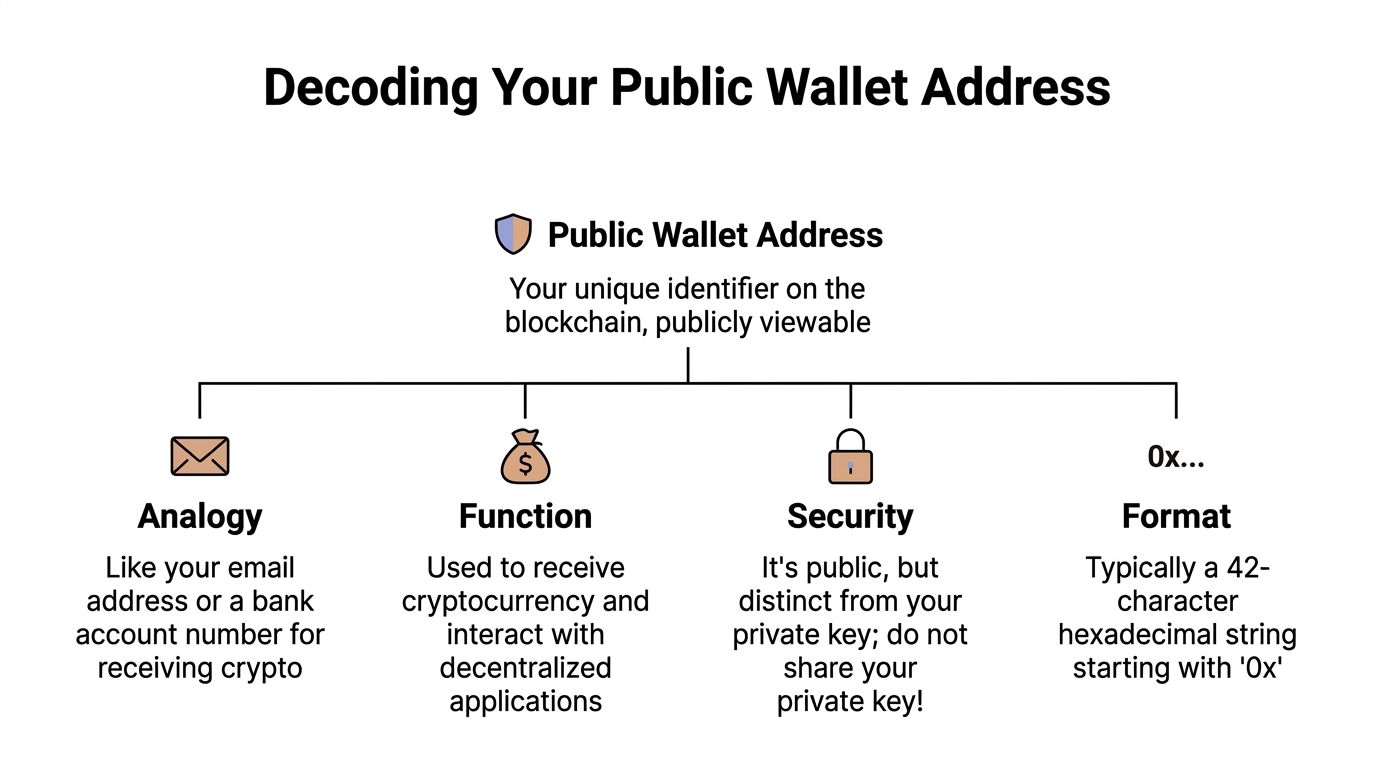
A normal EVM address has a few recognizable traits:
It starts with 0x
That prefix signals a hexadecimal format.
It is 42 characters long
That includes the 0x plus the rest of the address string.
It is public by design
Anyone can look it up on a block explorer once they know it.
That public nature is not a flaw. It is the reason on-chain analysis works at all. When a trader says they are “watching wallets,” they are really monitoring public addresses and the transaction trails attached to them.
Every swap, transfer, and contract interaction associated with the address can be reviewed on-chain. That means researchers can reconstruct behavior patterns such as:
If you want a plain-language breakdown of how Ethereum addresses work, this guide to an Ethereum wallet address is a solid companion read.
Use this model when you are deciding what to paste where:
| Item | Real-world analogy | Safe to share? | Main use |
|---|---|---|---|
| Public wallet address | Email address | Yes | Receive funds, track on-chain activity |
| Private key | House key | No | Sign transactions, control funds |
| Seed phrase | Master backup to the whole property | No | Restore the wallet |
Key takeaway: If a platform only needs to identify your on-chain history or send you funds, it should only need your public address.
That single distinction removes a lot of fear. The address is meant to be seen. The secrets are not.
This is the line that keeps funds safe. A metamask wallet id is public. A private key is secret. A seed phrase is even more sensitive because it can restore the entire wallet.
If you mix them up, the consequences are immediate. Sharing a public address may expose your activity. Sharing a private key or seed phrase can expose your assets.
| Component | What It Is | Can I Share It? | Analogy |
|---|---|---|---|
| Wallet ID | Your public wallet address used to receive funds and identify activity on-chain | Yes, when needed | Your home address |
| Private Key | The secret credential that controls a specific address | No | The key to your front door |
| Seed Phrase | The master recovery phrase that can restore your wallet and its accounts | No | The deed, blueprint, and master key set |
The safest workflow is boring on purpose:
The most common mistakes are not technical. They are operational.
Rule to remember: A dApp can ask you to connect a wallet. A scam asks you to hand over recovery credentials.
One more trade-off is worth naming. Using one address for everything is convenient, but it creates a full public map of your behavior. Serious traders often separate wallets by function. One for public experimentation. One for longer-term holdings. One for active trading. One for research. The point is not paranoia. The point is cleaner attribution and less self-inflicted exposure.
Most users do not need a long tutorial here. They need a fast, reliable way to copy the right address without typos.

The safest habit is simple: use MetaMask’s built-in copy action instead of manually highlighting the string.
On the extension, the wallet address is usually accessible directly from the main account view.
If your version shows multiple network-specific addresses, open the area that lists network addresses and choose the one you need.
The mobile flow is just as quick:
For a walkthrough focused on the broader process across wallets and interfaces, this guide on how to find a crypto wallet address is useful.
A fast check saves pain later:
Confirm the account name
If you run multiple accounts, make sure you are copying from the right one.
Check the network context
On EVM networks, the same 0x address may apply across multiple chains. In newer multichain setups, some non-EVM addresses can differ.
Use paste, not retyping
Manual entry creates unnecessary risk.
A quick visual guide can help if you are showing someone else where to click:
First, label your accounts clearly. “Trading,” “Long-term,” and “Research” are better than “Account 1,” “Account 2,” and “Account 3.”
Second, keep a local note with your public addresses only. No private keys. No seed phrase. Just a clean list of public identifiers you regularly use for transfers, tax review, and wallet monitoring.
Most wallet education stops at “this is your public address.” That is only the first layer. The more important question for a trader is what you can do with it once you have it.
MetaMask’s own safety guidance strongly emphasizes protecting your Secret Recovery Phrase, but there is minimal guidance on safely using your public wallet ID for legitimate tasks like portfolio tracking or copy trading, as discussed in MetaMask’s safety documentation. That leaves a considerable gap between security advice and trading workflows.

Because the address is public, you can use it to inspect wallet behavior without touching the wallet’s secrets.
That includes:
For traders, this turns the metamask wallet id into a research handle. Paste an address into an analytics platform, and you can evaluate whether a wallet is consistently early, reactive, concentrated, scattered, or purely noisy.
The useful workflow is not “follow whales blindly.” It is narrower and more disciplined.
Start with public addresses that show repeatable behavior. Then compare:
| Research task | What to look for | Why it matters |
|---|---|---|
| Reviewing your own wallet | Timing of buys, sells, and transfers | Finds execution mistakes and drift |
| Tracking a skilled trader | Repeated token categories and position behavior | Shows whether the edge is real or random |
| Watching a wallet cluster | Shared patterns across several addresses | Helps separate one-off luck from strategy |
| Studying exits | Whether the wallet trims, scales, or fully rotates | Entry gets attention, but exits define PnL |
Consequently, on-chain analysis becomes practical rather than theoretical. A public address is the input. Trade history is the raw material. Your edge comes from interpretation.
Public transparency cuts both ways.
It helps you study skilled wallets. It also lets others study yours. If you post a wallet publicly, connect it to your identity, or use it as a social proof badge, you should assume anyone can inspect your behavior, concentration, counterparties, and timing.
Tip: Keep one wallet for visibility and another for discretion if you care about privacy, signaling risk, or strategy leakage.
The primary risk is privacy and behavioral visibility, not direct custody loss. That is the right way to think about wallet IDs in DeFi. They are not just receive addresses. They are public strategy surfaces.
Once the basics are solid, the next upgrade is usability and context. Long 0x strings are functional, but they are not elegant. Traders who move size, manage multiple accounts, or collaborate with teams benefit from better labeling and better wallet intelligence.
One route is ENS, which replaces a long address with a readable name like yourname.eth. It does not change the underlying address. It makes the address easier to recognize, share, and remember.

ENS is useful when you:
It is less useful when privacy matters more than convenience. A readable name can make a wallet easier to recognize and associate with you.
MetaMask’s Snaps ecosystem extends wallet functionality with modular plugins. According to MetaMask developer documentation, Snaps can support custom wallet ID enhancements such as advanced EVM address derivation for cross-chain tracking, and a Transaction Insights Snap flagged risky approvals in user tests while reducing fraud losses by 87%.
That matters because many expensive mistakes happen at the approval stage, not the swap stage. If your wallet can warn you before you sign a risky setApprovalForAll or suspicious contract interaction, that is operational protection, not cosmetic UX.
Think in layers:
Key takeaway: The best setup is not the fanciest one. It is the setup that reduces signing mistakes, lowers address confusion, and keeps your wallet workflow readable under pressure.
For advanced users, the value of Snaps is not novelty. It is context at the point of action. Seeing extra transaction detail before you sign is often more valuable than reading about a scam after the fact.
Most wallet ID problems come down to format, account selection, or network mismatch. The good news is that these are usually easy to fix once you know where to look.
Check the obvious first:
Wrong string copied
Make sure the address starts with 0x if you are using an EVM address.
Extra spaces
Some forms reject pasted values with hidden spaces before or after the string.
Wrong network destination
An exchange or app may expect a different network format.
If the app still rejects it, copy the address again directly from MetaMask instead of from a note or chat window.
For EVM chains, the same public address commonly works across Ethereum, Base, Arbitrum, and similar networks. But in newer multichain wallet setups, non-EVM ecosystems can use different address formats.
That means “same account” does not always mean “same visible address on every chain.”
Clear labeling is important here. If you switch often between a trading wallet, a vault wallet, and an experimental wallet, it is easy to paste the wrong one.
Use a quick checklist:
| Problem | Likely cause | Fix |
|---|---|---|
| Sent funds to the wrong personal wallet | Wrong account selected | Rename accounts clearly |
| Tracker shows unexpected history | Pasted an old or different address | Re-copy from the exact account |
| Address mismatch across chains | Different network address type | Confirm the destination network first |
Can my MetaMask wallet ID change?
Your address for a given account stays tied to that account. If you switch accounts, import another wallet, or use a different network address type, you may see a different address.
Should I use the same public wallet for everything?
Convenient, yes. Ideal, usually no. Separate wallets give you cleaner analysis and less public linkage between strategies.
Can someone steal my funds with just my wallet ID?
A public address alone does not give them signing control. The primary risk is privacy and behavioral visibility, not direct custody loss.
Why does a tracker show everything I did?
Because blockchains are transparent by design. Your public address is the lookup key for that history.
If you want to turn a public wallet address into something useful, not just identifiable, Wallet Finder.ai is built for that workflow. You can track profitable wallets, review complete trading histories, monitor smart money activity across major chains, and act on wallet-level signals without exposing private keys.