Save Big on Flights with Kayak Price Alerts

Wallet Finder

Blank calendar icon with grid of squares representing days.

March 18, 2026

Tired of manually checking flight prices day after day? Setting up a price alerts kayak automates the whole process, pinging you the moment a fare drops for your trip. It turns you from a passive searcher into a savvy deal hunter, saving you a ton of time and, more importantly, money.

How Kayak Price Alerts Unlock Smarter Travel

We’ve all been there—stuck in that endless loop of searching, refreshing, and hoping for a better flight deal to magically appear. Think of Kayak Price Alerts as your own personal deal scout working behind the scenes. It’s more than just a simple notification; it's a tool that changes how you book travel. Instead of just guessing when to pull the trigger, you get solid, data-backed advice to book with confidence.

It's a must-have for any traveler trying to make their budget go further. The system keeps an eye on the fares for a specific flight or hotel you're interested in, then sends an email or push notification as soon as the price moves. Simple.

The Power of Data-Driven Travel

So, what’s the secret sauce? It’s the sheer volume of data fueling Kayak's alerts. Let's say you're eyeing a flight to Paris, but the prices are all over the place. Kayak's system is built to analyze these constant fluctuations with impressive accuracy.

Based on Kayak's own numbers, these alerts can hit up to 85% accuracy in normal market conditions. That’s because their machine learning crunches over 250 million prices every single day, factoring in things like seasonality, demand spikes, and even what's happening on the ground at your destination. You can learn more about how all that travel data leads to real savings on The Traveler.

By turning big data into simple pings, Kayak effectively gives you an insider's edge. It's the difference between guessing and knowing when to book your trip.

This infographic gives you a quick look at the performance metrics that matter.
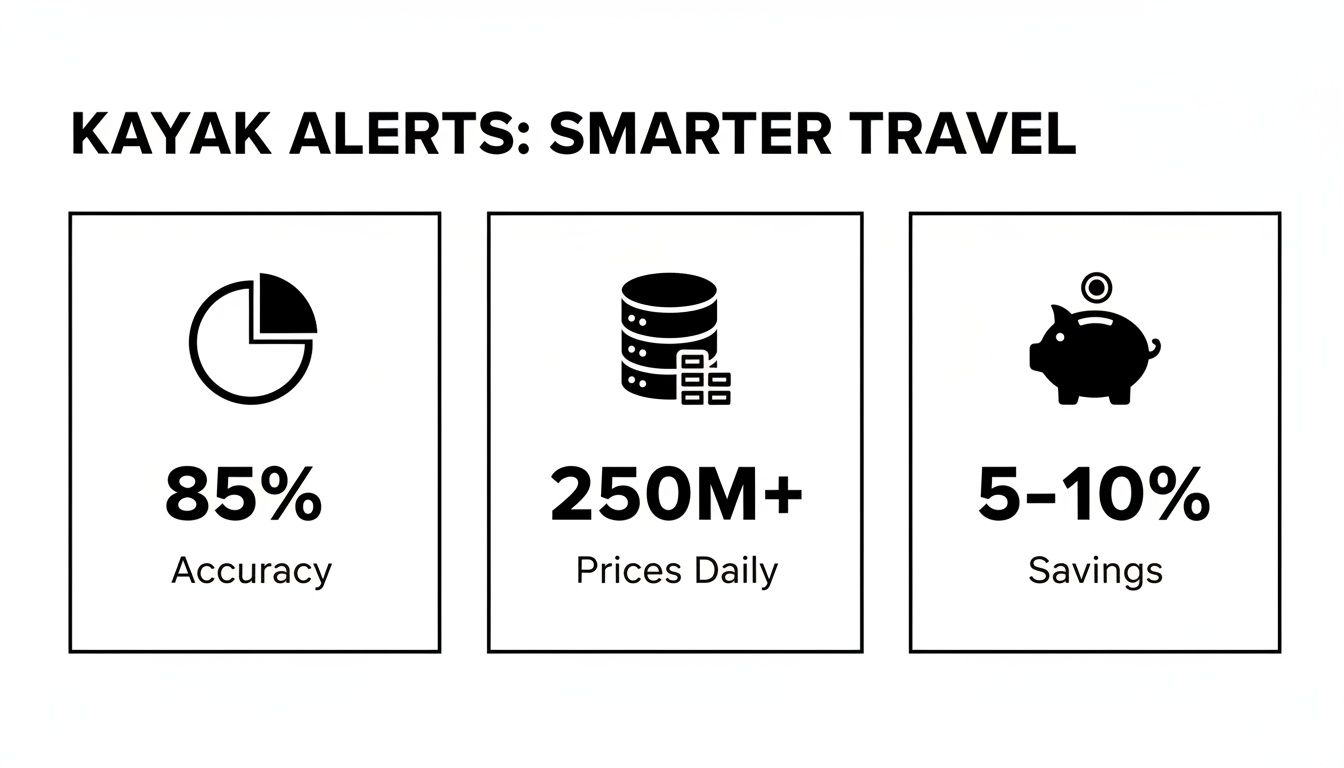
Infographic displaying Kayak Alerts' benefits: 85% accuracy, 250M+ daily prices, and 5-10% savings.

These aren’t just random notifications. You’re getting alerts backed by some serious data analysis, which is how you end up with real cash back in your pocket.

Your Core Benefits at a Glance

But what does this actually look like in practice? The benefits go way beyond just saving a few bucks. It’s really about making your entire travel planning process smoother and less stressful. Here’s a breakdown of the key advantages of making price alerts kayak a core part of your booking strategy.

This table sums up the main reasons why integrating Kayak's price alert system into your travel planning is a no-brainer.

BenefitHow It Helps YouTypical Outcome
Effortless MonitoringAutomates the tedious task of checking prices daily.Frees up your time and reduces planning stress.
Timely NotificationsGet instant alerts when prices drop.Opportunity to book at the lowest possible price.
Data-Backed AdviceProvides "Buy" or "Wait" recommendations.Increased confidence in your booking decisions.
Maximized SavingsHelps you avoid overpaying for flights and hotels.An average savings of 5-10% on airfare.

Ultimately, using these alerts helps you book smarter, not harder. You get the peace of mind that you’re not overpaying and can focus on the more exciting parts of planning your trip.

Creating Your First Kayak Price Alert

Alright, let's put this into action. Knowing about flight alerts is one thing, but actually setting them up is how you stop overpaying for flights. The good news? It’s incredibly simple and takes less than a minute. Follow these actionable steps:

  1. Start a Search: Go to Kayak and enter your departure city, destination, and initial dates just like you normally would.
  2. Find the Toggle: On the results page, locate the "Track prices" switch. It's typically in the upper-left corner on desktop and a bell icon in the top-right on the mobile app.
  3. Activate Tracking: Flip the switch. You'll be prompted to log into your Kayak account. This is how Kayak knows where to send your email or push notifications.
  4. Choose Your Alert Type: Select whether to track prices for your exact dates or for flexible dates (e.g., a specific month or "anytime").
  5. Confirm and Relax: Once confirmed, Kayak's system is on the job. You'll be notified as soon as a price change is detected.

Here’s a look at exactly where you'll find that all-important toggle on the desktop site.

A smartphone displaying a flight tracking app with 'Track Prices' button highlighted, showing email and date options.

Specific vs. Flexible Dates: A Strategic Choice

This is where a little strategy comes into play. Kayak gives you two main ways to track prices, and the one you choose can make a huge difference in the deals you find.

  • Specific Dates: Got a wedding to attend or non-negotiable vacation days? This is your go-to. Set the alert for your exact itinerary, and Kayak will only monitor prices for those specific days.
  • Flexible 'Anytime' Dates: This is the money-saver. If your schedule has some wiggle room, choosing a flexible month or the "Anytime" option unleashes the full power of the tool. It tells Kayak to hunt for the absolute cheapest fare to your destination, no matter the date.

If you can be flexible, always choose flexible date alerts. The biggest price drops almost always happen on off-peak days, and you'll completely miss them if your dates are locked in.

Let’s imagine you want to fly from New York to London sometime in October.

Alert TypeHow It WorksBest For
Specific DatesTracks only for Oct 14-21Travelers with fixed dates for events or holidays.
Flexible MonthTracks all possible date combinations in OctoberTravelers who can shift their trip by a few days or weeks to get a much better price.

By going flexible, you might learn that flying on a Tuesday a week earlier saves you hundreds of dollars compared to the original Friday you searched. Once you confirm your alert preferences, you're done. Kayak’s on the job, and you’ll get an email or a push notification the second a worthwhile price drop happens.

Advanced Strategies to Maximize Your Savings

Flight price alerts system on a world map with location pins, airplanes, calendar, and price funnel.
Setting a basic alert is a great first step. But if you want to move beyond casual savings and start finding truly incredible deals, you need to think like a travel hacker. This is all about turning simple notifications into a powerful, data-driven strategy. The core idea is simple: cast a wider net.

Creating a Multi-Alert Strategy

A single alert for "New York to Paris in May" is good, but a multi-alert strategy is where the real magic happens. By setting several targeted alerts for the same trip, you expand your search and give yourself a much better shot at catching a price drop. Here’s an actionable checklist:

  • Set your primary alert: Track your ideal route and dates first.
  • Add nearby airports: Create separate alerts for alternate departure and arrival airports. A budget airline might launch a flash sale to a secondary airport that could save you hundreds.
  • Track flexible dates: If possible, add an alert for the entire month or season to catch off-peak deals.
  • Monitor different airlines: If you have a preferred carrier, set an alert for it, but also set a general one for all airlines to see competitor price drops.

This layered approach ensures you're monitoring all the key entry points and timeframes. The minimal effort it takes to set up these extra price alerts on Kayak can lead to some seriously significant savings.

Decoding the Buy or Wait Recommendation

One of Kayak’s most powerful features is its price forecast, which gives you a straightforward "Buy" or "Wait" recommendation. This advice isn't just a guess; it's powered by algorithms that chew through historical price trends and current demand.

Pay close attention to the confidence level that comes with it. A recommendation to "Buy" with 90% confidence is a very strong signal, backed by a massive amount of data. If the confidence is lower, say 60%, it means the trends are less clear. In that case, you might want to hold off, especially if your trip is still months away.

The "Buy/Wait" advice is a guide, not a guarantee. Use it as a key data point, but always weigh it against your own budget, flexibility, and how critical the trip is.

The travel market is incredibly dynamic. Flight alert usage climbed 4% year-over-year, and with international fares projected to drop by 10% in 2026, the market is ripe for savings. Kayak crunches 250 million prices daily to spot these trends, which is what makes its recommendations so valuable for the 70% of travelers who use alerts strategically. You can learn more about how Kayak's statistics translate to savings on Hotelagio.com.

Leveraging Price History and Strategic Timing

Before you even set an alert, do your homework. Kayak provides historical price charts for many popular routes, and this data is pure gold.

Take a minute to look at the price trends over the last 90 days. You’ll quickly spot the typical high and low price points for your route. This is similar to how traders analyze assets to find the right entry point, a concept you can explore further by understanding how to master crypto app alerts.

This historical context helps you set realistic expectations and pounce at the right moment. If the current fare is already hovering near the historical low, it’s probably a good time to book. But if it’s at a peak, you know there’s a good chance it will come down, making that price alert your most important tool.

Managing and Optimizing Your Alert Portfolio

Dashboard displaying an alert portfolio with watchlist folders, notification icons, and a pie chart of alert categories.
Setting a Kayak price alert is easy. The real challenge is preventing your inbox from turning into a chaotic mess of notifications you no longer need. An effective price alert strategy isn't something you just "set and forget." To actually save money, you need to actively manage your alerts like a travel portfolio.

Keeping Your Travel Watchlist Clean

Think like an investor pruning their stock portfolio. A smart traveler does the same with their price alerts on Kayak. This simple habit keeps your focus sharp and ensures your notifications are always valuable. To manage your alerts:

  1. Log into your Kayak account.
  2. Navigate to "Price Alerts" in your profile menu.
  3. Review your list of tracked flights, hotels, and car rentals.

For every alert on your dashboard, you can:

  • View: Check the latest price and its history.
  • Edit: Tweak your dates, airports, or other details if your plans shift.
  • Delete: Get rid of alerts for trips you’ve already booked or decided against.

This isn't just busywork; it's crucial. A clean dashboard means you're only getting pinged for deals that matter right now. Just like a trader needs a clear view of their positions, you need a clear view of your travel interests. This principle of tracking relevant data is universal, whether you're monitoring flights or finance. In fact, you can see similar tracking methods applied in guides to the best crypto price alert systems.

Think of your alert dashboard as mission control for your travel goals. Reviewing and refining it regularly keeps you ready to pounce on the best deals without getting lost in notification static.

Organizing Alerts for Multiple Destinations

What happens when you're juggling a few different trip ideas? Maybe you're torn between a beach getaway to Mexico and a city break in Europe. This is where a little organization goes a long way.

Instead of creating a long, messy list, build a "travel watchlist" with alerts for each potential trip. Let's say you're eyeing a summer vacation—set up alerts for both Cancun (CUN) and Lisbon (LIS) with flexible dates.

This lets you compare real-time price drops side-by-side. You might find a flash sale on flights to Portugal that makes it a far better deal than you expected. This comparative approach lets your budget guide the destination, guaranteeing you get the best value for your money.

Understanding the Data Behind Kayak Alerts

Ever wonder what’s going on behind the scenes when a Kayak price alert hits your inbox? It’s not just a simple price change notification. That alert is the final piece of a massive data-crunching puzzle, all designed to tell you the best moment to book your flight.

Think of it like being an investor who understands market cycles. When you know what drives flight prices up or down, you can read those alerts with more confidence and decide whether to pounce on a deal or hold out for something even better.

Market Forces and Your Alerts

Several powerful factors influence the price predictions that trigger your alerts. These aren’t just abstract ideas; they're the real-world dynamics that dictate what you'll pay for a ticket.

Market ForceImpact on Flight Prices
Travel DemandHigh search volume for a destination often leads to price increases. Low demand can trigger fare drops to fill seats.
Global EventsMajor concerts, sports, or political shifts can cause demand and prices for a specific region to skyrocket or plummet.
Airline CompetitionOn routes with multiple carriers, airlines frequently engage in price wars, leading to sudden, competitive fare drops.
SeasonalityPrices naturally rise during peak travel seasons (e.g., summer, holidays) and fall during the off-season.

This entire travel meta-search market is booming. It was valued at US$710.5 million in 2022 and is expected to climb to US$975.6 million by 2031. This shows just how vital tools like price alerts on Kayak are becoming, especially when you see data from 2026 showing travel searches climbing 9% while international airfares actually fell by 10%. You can dig into more of the 2026 travel trends on Stocktitan.net.

Turning Data Into Actionable Savings

It's one thing to know that market forces are at work, but it's another to see how that translates into actual savings. This is where Kayak's algorithm shines by turning all that complex data into a simple "Buy" or "Wait" recommendation.

Let’s say an alert tells you prices for summer flights to Asia are down 16%. That's not just a random number—it's a data-backed signal giving you the confidence to either lock in a great deal or wait for an even bigger price drop.

This is the real value of the platform. It takes complicated market trends and gives you a clear, actionable insight right in your inbox. The process is a lot like how financial tools help investors track assets, a concept we explore more in this guide to the GE price tracker.

By understanding the data, you stop being just a passive traveler waiting for a notification and become a strategic planner who knows exactly why it's the right time to book.

Common Mistakes to Avoid with Price Alerts

Setting up a Kayak price alert is easy. Turning that alert into actual savings? That takes a little more strategy. I've seen too many travelers make the same simple mistakes that end up costing them money instead of saving it.

Avoiding these common traps is what separates the passive searcher from the strategic deal-hunter. Once you know what not to do, you’ll be in the perfect position to snag the best fares out there.

Being Too Specific with Your Search

This is probably the biggest mistake people make: they set an alert that’s way too narrow. Tracking a single flight on one specific date from your home airport feels right, but you're essentially putting on blinders. You might save a few bucks on that exact flight, but you could be missing a $200 saving on a flight landing at a nearby airport just one day earlier.

Think of it as fishing with a single hook instead of casting a wide net. To really catch a deal, you need to broaden your search:

  • Include Nearby Airports: Always check that "include nearby airports" box. A flight into Fort Lauderdale (FLL) can be dramatically cheaper than one into Miami (MIA), and they’re just a short drive apart.
  • Use Flexible Dates: If you have any wiggle room in your schedule, use the flexible date search. This lets Kayak scan an entire month to find the absolute rock-bottom cheapest time to fly.

A broader approach seriously stacks the odds in your favor of finding a true bargain.

Don't get tunnel vision. The best deals almost always hide just outside your initial, perfect itinerary. Flexibility is the single most powerful tool you have when using price alerts on Kayak.

Ignoring Your Alert Portfolio

Another classic error is the "set it and forget it" approach. You set an alert, book the trip (or decide against it), and then just let the old alert sit there. Soon your inbox is flooded with useless notifications.

This creates notification fatigue, and you'll start ignoring all the emails—including the one for a trip you actually want.

Treat your alerts like a travel watchlist that needs occasional pruning. Hop into your Kayak alerts dashboard once a month and take two minutes to delete old or irrelevant ones. This simple bit of housekeeping means that when a new alert hits your inbox, you'll know it's for a deal that actually matters. A clean dashboard is a clear strategy.

Got Questions? We’ve Got Answers

Even the most seasoned deal hunters run into questions when setting up flight alerts. Let's clear up some of the most common ones you might have about using Kayak to track prices.

How Accurate Are the Alerts, Really?

I've found Kayak’s price alerts to be pretty reliable, hitting about 85% accuracy in a stable market. That’s because their system is constantly crunching huge amounts of flight data, looking at over 250 million price points every single day.

But let's be real—no system is flawless. When something unexpected happens, like a flash sale or a major global event, the accuracy can take a slight hit. Think of the alerts as your expert guide, not a crystal ball.

What if the Price Never Drops?

It’s a bummer to set an alert only to see the price creep up. If a week or two goes by without any good news—especially for a trip that’s still months away—it’s probably time to switch up your game plan.

Here’s what I do:

  • Broaden your horizons: Add alerts for a couple of nearby airports. Sometimes flying into a smaller, alternative airport can save you a bundle.
  • Get flexible: If your dates aren't set in stone, create a new alert for a flexible range, like "any weekend" in your target month.
  • Know when to book: If your travel dates are getting close and the prices are only climbing, the current fare might honestly be the best deal you're going to get.

For some high-demand routes during peak travel season, prices just don't drop. In those cases, waiting too long can seriously backfire.

How Long Should I Wait Before Booking?

Ah, the million-dollar question! It really boils down to when you plan on traveling.

As a general rule, aim to book domestic flights 1-3 months in advance and international flights 2-8 months out. Use this as your starting point, and let your price alerts tell you when to pull the trigger within that timeframe.

If an alert pops up with a price that’s near the historical low for that route and you're in that ideal booking window, that's a huge green flag. Don't hold out for some mythical "unicorn" fare that might never show up.

Kayak vs. Google Flights Alerts: What’s the Difference?

Both Kayak and Google Flights are fantastic for tracking prices, but they each have their own quirks and strengths.

FeatureKayak Price AlertsGoogle Flights Alerts
Alert ScopeGreat for flights, but also covers hotels and rental cars.Laser-focused on flights, and exceptionally good at it.
RecommendationGives you a direct "Buy/Wait" signal with a confidence score.Shows a price history graph but leaves the final call more up to you.
InterfaceI love how it builds "Hacker Fares" (two separate one-ways) right into the results.Known for being incredibly fast, clean, and having a great map feature.

Honestly, most travel pros I know use both at the same time. Set alerts on both platforms. It doubles your coverage and gives you the best shot at snagging the absolute lowest price out there.


Ready to stop overpaying and start finding winning deals with data? Wallet Finder.ai gives you the tools to track smart money movements on the blockchain, get real-time alerts, and mirror the strategies of top traders. Start your 7-day trial and turn on-chain data into actionable insights today. Learn more at Wallet Finder.ai.