7 Best Meme Coin Trading Tools for 2026
Discover the 7 best meme coins trading platforms and tools for 2026. Get actionable insights, find winning wallets, and trade smarter on CEXs and DEXs.

February 20, 2026
Wallet Finder

February 14, 2026

The price of IC is a moving target, constantly shifting based on its real-world adoption, how much it’s actually being used on the Internet Computer network, and the crypto market's overall mood swings. Think of it as the native currency for a decentralized 'world computer' aiming to take on giants like Amazon Web Services. Because of that, its value is deeply connected to actual developer activity and real use cases, not just speculation.
When you’re looking at the price of IC, it helps to shift your perspective. Don’t think of it as just another crypto coin. It’s much closer to owning a piece of foundational technology, like having stock in a company building the next internet. The whole point of the Internet Computer is to be the new home for decentralized apps (dApps) and services. And just like a tech stock climbs when its products take off, IC’s value is tied to its network’s growth.
At its heart, the IC token is the fuel that powers this entire ecosystem. Developers have to convert IC into "cycles" to pay for things like computation and data storage—it’s their version of paying for server space. So, the more developers that build and run their dApps on the Internet Computer, the higher the demand for cycles becomes. This, in turn, drives up the demand for the IC token itself.
But it's not just a simple game of supply and demand. A few key factors are always at play, creating a dynamic environment where the token's price is constantly reacting to new information and what’s happening on-chain. Getting a grip on these drivers is the first step to making smarter trading decisions.
Here's a breakdown of the primary elements that influence the value of the Internet Computer (IC) token.
FactorDescriptionPotential Price ImpactNetwork Adoption & UtilityThe more developers build on IC and the more users interact with dApps, the more IC is needed for "cycles" (computation fees). This is the purest measure of real-world demand.Strongly Positive: High adoption directly increases demand for IC tokens to be converted into cycles, pushing the price up.Tokenomics (Staking & Burning)A significant portion of IC is locked (staked) in the Network Nervous System (NNS) for governance, reducing the tradable supply. Additionally, converting IC to cycles effectively "burns" tokens, permanently removing them from circulation.Positive: Staking and burning create deflationary pressure. A shrinking supply with steady or growing demand is a classic recipe for price appreciation.Broader Market SentimentIC doesn't exist in a vacuum. Its price is heavily swayed by the overall crypto market. If Bitcoin is surging, IC often follows. If the market is fearful, IC will feel the impact.Variable: Can be positive or negative. A bull market can lift all boats, while a bear market can drag IC down regardless of its own fundamentals.Ecosystem & dApp GrowthThe launch of popular dApps, especially in sectors like SocialFi or GameFi, can attract thousands of new users to the network, creating a surge in demand for IC.Positive: Major dApp launches act as catalysts, boosting both network utility and speculative interest.
Understanding these factors is crucial because they give you the context behind the price chart. It’s not just random numbers; it’s a reflection of network health, token mechanics, and market psychology.
Actionable Tip: A rising number of dApps and active users directly translates to a higher burn rate for IC tokens. This creates a natural supply squeeze that can positively impact price. Monitor the IC dashboard on sites like DappRadar to track this growth.
If you want to get a real feel for the price of IC today, you have to look at where it's been. The token’s journey is a classic crypto tale: massive initial hype, a brutal correction during the crypto winter, and then a slow, steady grind back up. This isn't just a chart with random squiggles; it's a story that shows just how tuned-in the token is to the wider market's mood swings.
The Internet Computer (ICP) token’s launch in early 2021 was nothing short of explosive. It shot up from about $131 in March to a mind-boggling all-time high of $700.65 on May 10, 2021—that’s a 434% surge in just two months. For a moment, ICP was a top-tier project.
But then the crypto winter came, and it hit hard. By the end of 2022, the token had cratered 88.55% to $3.94, getting dragged down with the rest of the market. Still, ICP didn't die. In 2023, it clawed back with a 231.35% rebound to $13.30 as interest in scalable blockchains picked up again. For DeFi traders, this rollercoaster history hammers home one point: track the smart money. The traders who used tools like Wallet Finder.ai to mirror wallets accumulating below $10 locked in some serious gains. You can dig into the full price history yourself on sites like CoinGecko.
The article above correctly identifies that IC gets converted to cycles to pay for computation, and that this conversion burns IC permanently. What it doesn't tell you is how to actually use the burn rate as a leading indicator for price movements, or that the burn rate varies dramatically based on network utilization in ways that are completely predictable once you understand the pattern.
The cycles burn mechanism is deflationary by design. Every time a developer pays for computation or storage on the Internet Computer, they convert IC tokens into cycles at a dynamically calculated rate. Those cycles get consumed as the dApp runs, and the IC tokens that created them are gone forever — burned out of existence. This isn't a one-time event. It happens continuously as long as the network is processing computation.
The burn rate isn't static. It fluctuates directly with network activity. When more dApps are running and more users are interacting with those dApps, cycles consumption increases, which means more IC needs to be converted to cycles to sustain that activity. High network activity equals high burn rate. Low network activity equals low burn rate. The relationship is mechanical, not speculative.
The burn rate data is publicly available on the Internet Computer dashboard, but most traders don't know what to do with it beyond acknowledging that "burns happen." The actionable version requires tracking the burn rate over time and looking for acceleration or deceleration in the trend.
Burn rate acceleration — when the daily IC burn increases week-over-week for multiple consecutive weeks — signals that network utilization is growing. This is a structural positive for IC price because it means demand for the token is increasing for its core utility purpose, not just speculation. When developers need more cycles to support growing user bases on their dApps, they buy IC and convert it. That buying pressure, combined with the supply reduction from the burn itself, creates dual upward price pressure.
Burn rate deceleration — when the daily burn decreases week-over-week — signals declining network utilization. This is often an early warning that dApp activity is slowing, user engagement is dropping, or developers are scaling back their applications. The reduced need for cycles means less IC gets converted and burned, removing both the buying pressure and the deflationary benefit. Prices can remain elevated on speculation alone for a while, but sustained burn rate deceleration eventually shows up as price weakness once the market catches up to the reality.
The lag between burn rate changes and price impact varies depending on market conditions. During bull markets when sentiment is strong, burn rate deceleration might not matter for weeks because speculative buying overwhelms the signal. During bear markets or neutral periods, burn rate changes show up in price action much faster because there's less speculative cushion absorbing the fundamental shift.
What makes the burn mechanism particularly powerful over longer timeframes is that it compounds. A network with a million users burns more IC daily than a network with ten thousand users, but the difference isn't linear — it's exponential if those users are interacting with resource-intensive dApps like social platforms or games.
This means that as the Internet Computer adds more users and more complex applications, the burn rate doesn't just grow — it accelerates. The gap between a ten percent user growth month and a twenty percent user growth month isn't ten percent more burn. It could be twenty-five or thirty percent more burn depending on what those new users are doing.
Tracking the burn rate alongside user growth metrics gives you a forward-looking view of supply dynamics. If user growth is strong but burn rate isn't accelerating proportionally, it suggests the new users aren't engaging deeply with the network — they're creating wallets but not actually using dApps in a way that requires significant computation. That's a yellow flag for growth quality. If user growth is moderate but burn rate is accelerating faster than user growth, it means existing users are engaging more intensely or new dApps are more resource-intensive, both of which are structurally positive.
For a trader, knowing these historical phases is everything. It gives you the context to understand what’s happening right now. Each period had its own unique on-chain signals and opportunities, especially for those paying attention. Let's break down the timeline so you can spot the patterns.
This timeline gives you a visual breakdown of what was moving the IC price during each of these cycles.
As you can see, the market drivers have grown up. We've moved from pure hype to actual network adoption and solid tokenomics. Getting a handle on this evolution is what separates a decent trading strategy from a great one.
Price charts show where a token has been, but they only tell half the story. To get a real edge in figuring out where the price of IC is headed, you need to dig into on-chain data. Think of it like this: a price chart is a replay of the game. On-chain data is a peek at the coach's playbook during the game.
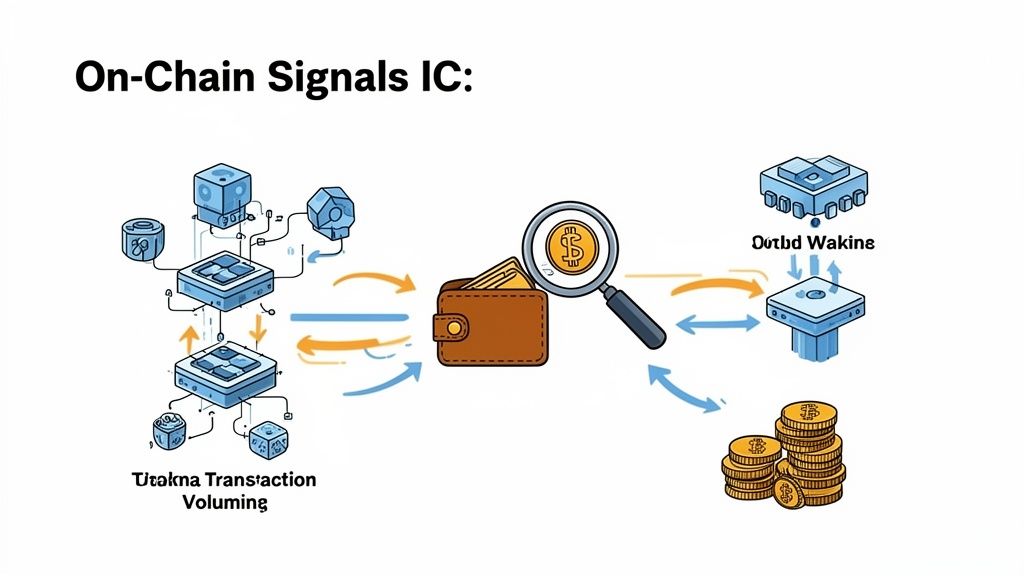
This data shows you what smart money is doing right now, often before their moves register on the price chart. By watching how tokens move around on the blockchain, you can spot patterns that often signal a major price shift is on the horizon.
The blockchain is a public ledger, meaning every transaction leaves a digital footprint. For a smart trader, these footprints are valuable clues. Here are the most powerful on-chain signals to watch for IC:
Actionable Tip: A spike in new active wallets combined with large token outflows from exchanges is a powerful bullish combination. It suggests new users are arriving and are confident enough to hold their assets for the long term. This is a signal to investigate further.
By combining these different data points, you can build a much more complete, forward-looking view of the market, allowing you to act on intelligence instead of just reacting to price charts.
On-chain data gives you an incredible edge, but it’s just a mountain of raw information without the right tools. Turning that data into actionable trading signals is the real challenge. This is exactly where a platform like Wallet Finder.ai comes into play. It’s built to cut through the noise and show you precisely which wallets are crushing it with IC.
Let's break down how to turn "following smart money" into a concrete, actionable strategy.
Staking IC in the Network Nervous System reduces circulating supply, which the article mentions as a deflationary pressure. What it doesn't mention is that staked IC isn't permanently locked — it has dissolve delays that can range from zero to eight years, and the distribution of when that staked IC becomes liquid again tells you exactly how much supply could hit the market in the near future.
Every neuron in the NNS has a dissolve delay period. This is the amount of time the holder has to wait after initiating the dissolve process before they can withdraw and sell their IC. The longer the dissolve delay, the more voting power that neuron gets, which incentivizes long lock-ups. But the critical detail is that these lock-ups expire on a schedule, and when they do, previously illiquid IC becomes liquid and available to sell.
The unlock schedule is visible on-chain if you know where to look. You can see how much IC is locked in neurons dissolving within the next month, the next quarter, the next year. This gives you a precise forecast of potential selling pressure that most traders completely ignore because they only look at total staked supply, which is a useless metric for predicting near-term price action.
IC locked for eight years can't affect price tomorrow. IC locked for thirty days absolutely can. When a large amount of IC is scheduled to unlock in the next thirty to ninety days, that's future supply that will become available to sell regardless of what price is doing. If that unlock coincides with a price rally, the newly liquid IC creates immediate selling pressure as holders who've been waiting months or years finally get their liquidity and take profits.
The most dangerous unlock scenario is when a cluster of neurons all dissolve around the same time after similar lock periods. This happens when a wave of staking occurred during a specific event — maybe a price bottom where smart money was accumulating and locking, or after a major network upgrade that incentivized participation. When those neurons start unlocking simultaneously, the supply shock can overwhelm demand and push price down sharply.
Tracking the thirty-day and ninety-day unlock schedules as part of your pre-trade analysis tells you whether you're buying into a period of structural supply pressure or a period where supply remains locked. If a significant unlock is coming in the next month and you're considering a long position, you either adjust your timeframe to exit before the unlock or size the position smaller to account for the upcoming supply increase.
The flip side of the unlock schedule is when wallets that are about to unlock choose to renew their stake instead. This shows up on-chain as a neuron dissolve being stopped and reset to a longer period. When this happens in volume — when many neurons scheduled to dissolve in the next few months suddenly reset to longer lock periods — it's a powerful bullish signal.
Renewing a stake means the holder explicitly chose to remain illiquid for longer despite having the option to take liquidity. That decision reveals conviction. They're betting that locking for another year or more will be more profitable than selling into current prices. When multiple large wallets make this choice simultaneously, they're collectively removing supply from the market for an extended period and signaling their belief that IC price will be higher when they finally unlock.
Monitoring renewal activity gives you advance notice of supply being taken off the table before that supply reduction shows up in price action. The market often doesn't react immediately to renewals because they're not as visible as burns or exchange outflows, but the effect on future supply is just as real.
Here is a practical workflow you can implement today to start leveraging on-chain data for your IC trading.
This hands-on method transforms abstract on-chain data into real, tradable insights, giving you a much more powerful tool for navigating the volatile IC market. For any trader trying to get an edge, learning how to use a smart money tracker like this can be a total game-changer.
Finding a smart money wallet is one thing, but knowing when to follow their lead is where the real profit is made. Copying the right traders is only half the battle. To sharpen your entry and exit timing, you need to dive into their historical Profit and Loss (PnL). This shifts you from a passive follower to an active strategist, allowing you to decode their trading personality.

Every successful trader has a system. By looking at their past trades in IC, you can essentially reverse-engineer their approach. Ask these critical questions:
Actionable Tip: By analyzing a wallet's average entry price for IC, you can identify historical accumulation zones. When multiple high-performing wallets consistently buy around the same level, it often signals a strong area of support, giving you a data-backed reason to consider an entry.
This kind of analysis takes you way beyond simple copy-trading. You're not just blindly mirroring moves; you're using elite traders' actions to build your own market thesis grounded in verifiable on-chain data. For a deeper dive, our guide on PnL tracking for DeFi traders breaks this down even further.
The Internet Computer's architecture is built on subnets — independent blockchains that collectively make up the network. Each subnet handles computation and storage for the dApps running on it, and each subnet consumes cycles to operate, which means each subnet creates structural demand for IC tokens to be converted into those cycles.
When the network adds a new subnet, it's not just expanding capacity. It's adding a new permanent source of cycles demand that will exist as long as that subnet stays active. This makes subnet creation one of the most reliable leading indicators for IC token demand that nobody in the general market talks about or tracks.
Here's the part most traders miss: subnets have baseline operational costs independent of how many dApps are running on them. Just keeping the subnet online, maintaining consensus, and processing the minimal housekeeping transactions required for network health consumes cycles. This means the moment a new subnet launches, cycles demand increases immediately, even if no developers have deployed dApps to it yet.
The lag between subnet creation and dApp deployment to that subnet is usually measured in weeks to months. During that lag, the subnet is consuming cycles but not yet generating the user activity and fee revenue that comes from active dApps. This creates a window where cycles demand has increased — creating buying pressure for IC tokens to be converted — but the market hasn't fully priced in the eventual dApp activity that the subnet was created to support.
Tracking subnet launches gives you advance notice of structural demand increases before they show up in burn rate data or price action. By the time a subnet is hosting multiple successful dApps with thousands of daily users, the cycles consumption from those dApps has already been pushing IC demand higher for weeks. You're late if you're waiting for the dApp success to be obvious. You're early if you're tracking subnet launches and positioning for the demand increase before the dApps arrive.
The relationship between subnet count and IC price isn't immediate or linear, but it's directional over medium timeframes of several months. Each subnet added represents a permanent increase in baseline cycles demand. Ten subnets create more demand than five subnets. Twenty create more than ten. The growth is cumulative.
The price impact shows up most clearly when subnet creation accelerates. If the network adds one subnet per quarter for a year and then adds three subnets in a single quarter, that acceleration signals the foundation expects significant dApp deployment and user growth in the near future. Subnets aren't created on speculation — they're added when there's demonstrated need for more capacity.
Monitoring the Internet Computer's subnet count through its public dashboard and noting when new subnets launch gives you a data point that complements burn rate and staking metrics. If subnet count is growing, burn rate is accelerating, and staked supply is increasing, those three indicators converging is a much stronger bullish signal than any single one in isolation.
PnL analysis helps you spot potential support and resistance zones before they become obvious on a price chart.
ScenarioOn-Chain SignalYour Actionable InsightFinding ResistanceYou notice that several of your tracked "whale" wallets consistently sell their IC holdings whenever the price approaches the $15 mark. Their PnL history confirms they take profits here.This suggests a strong resistance level is forming around $15. You could set a take-profit order just below this level to secure gains before a potential rejection.Finding SupportThe same wallets consistently accumulate more IC whenever the price dips into the $9-$10 range. Their transaction history shows repeated buys in this zone.You've likely identified a major support zone. This gives you a strategic area to place buy orders, helping you avoid FOMO and enter at a data-backed level.
Even with a solid game plan, the crypto market always finds a way to throw curveballs. Let's tackle some of the most common questions traders have about the Internet Computer token, what it actually does, and how to keep your risk in check.
The IC token is the engine that powers the Internet Computer network. Its primary job is to be converted into "cycles," which are used to pay for computation and data storage, similar to gas fees on Ethereum. This creates a direct link between real-world network usage and the token's value. The token also has two other critical functions:
The Internet Computer is developed by the Dfinity Foundation, and major announcements from the foundation — new subnet launches, protocol upgrades, partnership announcements, developer incentive programs — consistently move IC price, but the direction and magnitude of the move depends on whether the announcement creates immediate cycles demand or promises future demand without near-term impact.
Announcements that create immediate cycles demand — like a major dApp launching that already has a user base, or a subnet specifically allocated for a high-profile project that's deploying immediately — tend to produce sharp positive price reactions within hours because the market can immediately price in the cycles consumption those events create. The burn rate will increase, subnet utilization will rise, and those effects show up in on-chain data almost immediately.
Announcements that promise future cycles demand — like developer grants for projects that won't launch for months, or protocol upgrades that enable functionality but don't immediately drive usage — produce much more muted price reactions or even no reaction at all. The market has learned to discount these announcements until the actual dApp deployments and user activity materialize, because too many past announcements resulted in developers taking grants and never shipping functional products.
The actionable insight is to distinguish between announcements with immediate on-chain impact and announcements that are speculative bets on future activity. Trade the former. Wait for on-chain confirmation before trading the latter.
IC, like virtually every altcoin, has a positive beta to Bitcoin and Ethereum. When the broad crypto market crashes, IC crashes harder because it's less liquid and carries more risk premium. But the magnitude of IC's crash relative to the market crash tells you a lot about whether the network's fundamental demand is holding up or eroding.
During the May 2021 crypto crash, IC fell harder than Bitcoin in percentage terms because it had just launched and had no established demand floor — it was pure speculation. During subsequent crashes in 2022 and 2023, IC's drawdowns became more correlated with ETH and other Layer-1 platforms because by then it had established some real usage and cycles consumption creating a demand floor that didn't exist at launch.
The pattern to watch during crashes is whether IC's burn rate and cycles consumption remain stable or decline alongside price. If price crashes but burn rate stays elevated because dApps keep running and developers keep building, that divergence between price and fundamentals creates a value opportunity for longer-term positions. If price crashes and burn rate collapses simultaneously, the crash is exposing that the recent usage was less real than market participants believed, which means the recovery will take longer.
Separating speculative demand from utility-driven demand for IC is possible by comparing trading volume to cycles conversion volume. Trading volume represents people buying and selling IC for profit. Cycles conversion volume represents developers buying IC specifically to convert it into cycles for running their dApps.
If trading volume is one hundred times cycles conversion volume, the price is overwhelmingly speculation-driven. A small amount of real utility exists but the vast majority of price action comes from traders and speculators, not developers using the network. This makes IC extremely volatile because speculative demand can evaporate overnight if sentiment shifts.
If trading volume is closer to ten times cycles conversion volume, a meaningful percentage of IC demand comes from actual network usage. This creates more price stability because cycles demand doesn't disappear when traders get scared — developers still need to pay for computation regardless of market sentiment. The floor under price is higher when real utility represents a larger share of total demand.
Tracking this ratio over time tells you whether IC is becoming more or less dependent on speculation for price support. A ratio that's declining — trading volume shrinking relative to cycles conversion — is structurally bullish because it means the network is maturing toward real usage. A ratio that's rising means speculation is growing faster than utility, which is a warning sign for sustainability.
Managing risk isn't optional, especially with a volatile asset like IC. The golden rule is simple: only invest what you're prepared to lose. Beyond that, a few practical steps can protect your capital.
Here is a quick risk management checklist:
You can find the live and historical price of IC on any major crypto data aggregator.
However, these platforms only show you what the price is, not why it's moving. For a much deeper understanding, you need a platform that layers on-chain intelligence over price data. This gives you a massive advantage, letting you see not just the price, but the actions of the smart money wallets that are actually moving it.
Ready to stop guessing and start tracking the smart money behind the price of IC? Wallet Finder.ai gives you the tools to discover profitable wallets, set real-time alerts, and make data-driven decisions. Start your 7-day trial today and turn on-chain data into your trading advantage.