A Guide to Using a Ripple Block Explorer

Wallet Finder

Blank calendar icon with grid of squares representing days.

January 8, 2026

Think of a Ripple block explorer as a powerful search engine for the XRP Ledger (XRPL). It's your transparent window into every transaction, account, and event on the network, making the complex, decentralized world of the XRPL searchable and understandable for anyone.

Your Window into the XRP Ledger

Imagine the XRP Ledger as an enormous, public digital book where every financial entry is permanent. A Ripple block explorer is the tool that lets you read that book. Instead of raw code, an explorer organizes ledger data into a clean, human-readable format. This allows everyone—from seasoned traders to curious newcomers—to track funds, verify payments, and check the network's health without needing to be a coding wizard.

At its heart, an explorer gives you a real-time feed of on-chain activity. Every payment, token swap, and new account created on the XRPL is a public record. The explorer indexes this data so you can pinpoint specific details using a few key identifiers.
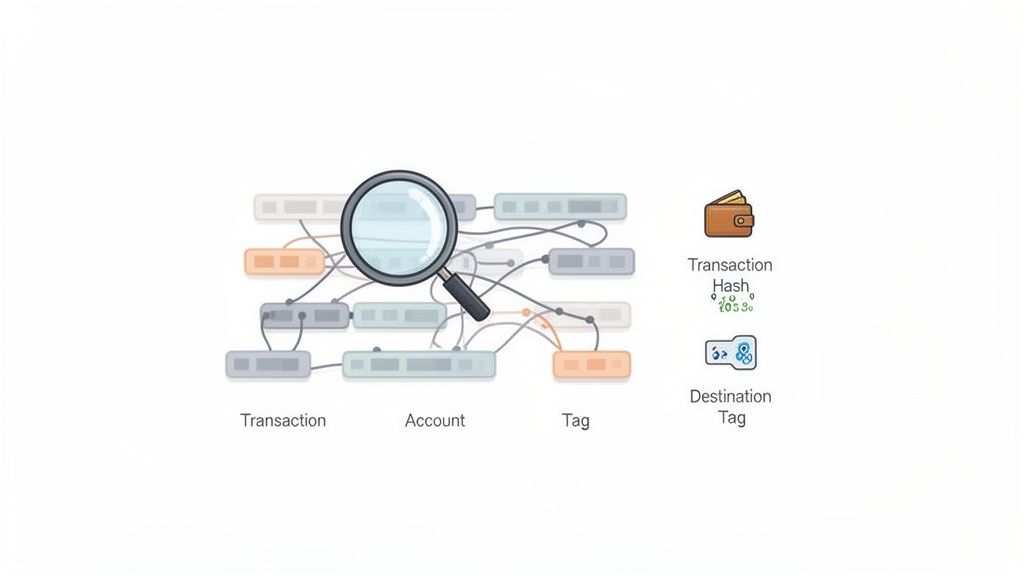
A magnifying glass over a network of blockchain nodes (transactions, accounts, tags), with icons for transaction, hash, and destination tag.

Key Terms You Need to Know

To get the most out of a Ripple block explorer, you’ll encounter a few core terms. Mastering these is the first step to analyzing on-chain data like a pro.

  • Account Address: The public ID for an XRPL wallet, always starting with an 'r' (e.g., rP1...xyz). It functions like a bank account number for sending and receiving funds.
  • Transaction Hash (Tx Hash): A unique string of characters that acts as a digital receipt for a specific transaction. Searching this hash reveals every detail of that event.
  • Destination Tag: An optional number used to route funds to the correct individual within a shared wallet, commonly used by centralized exchanges to ensure your deposit is credited to your account.

As XRP grew into a major digital asset, specialized explorers like XRPSCAN and Bithomp emerged. These tools are built for the XRP Ledger’s unique architecture, which has reliably processed over 2.8 billion transactions since its launch in 2012. You can dig into more stats on XRP’s market performance on CoinGecko. These explorers provide a mission control-style dashboard to monitor everything happening on the network.

Core Ripple Block Explorer Features for Traders

A block explorer is more than a lookup tool; it's a source of market intelligence. Here’s how its core features translate into actionable insights for traders.

FeatureWhat You Can Do With ItActionable Insight for Trading
Transaction SearchLook up any transaction using its unique hash.Verify if a large payment to or from an exchange has been confirmed, helping you anticipate market movements.
Account/Wallet ViewerSee the complete balance, transaction history, and active offers for any XRPL address.Track the activity of "whale" wallets or exchange hot/cold wallets to spot accumulation or sell-offs before they impact price.
Live Transaction FeedWatch a real-time stream of all transactions being processed on the ledger.Identify sudden spikes in transaction volume or large-value transfers that could signal an impending market event.
Rich Lists/Top AccountsView a ranked list of the largest XRP holders.Monitor shifts in the distribution of XRP. Are the top wallets selling or buying more? This gives you a macro view of sentiment.
Token (IOU) InformationLook up details on specific tokens issued on the XRPL, including the issuer and total supply.Vet new projects and trace token issuance to understand tokenomics and identify potential red flags.

By using these features together, you can move from just seeing data to understanding the stories the ledger is telling. This is the foundation for building a data-driven trading strategy on the XRP Ledger.

How to Read XRPL Data Like a Professional

An XRPL block explorer is your window into the ledger's financial history. While the data stream can seem overwhelming at first, knowing what to look for allows you to trace value and verify transactions with confidence. Let's break down the essential components you'll find on explorers like XRPSCAN.

The first thing to check on any transaction is its status. You're looking for one result: tesSUCCESS. This is your green light, confirming the transaction was validated and permanently recorded on the ledger. It's the definitive proof of execution.

Next, you’ll see the sender and receiver, clearly labeled with their public XRPL addresses (always starting with 'r'). Confirming these addresses is crucial for any transfer.

Understanding Key Transaction Details

Beyond the sender and receiver, other fields paint a richer picture. Mastering these details is what separates a casual observer from a serious analyst and is a core skill in on-chain analysis. To go deeper on this subject, check out our comprehensive guide to on-chain data analysis.

Here are the critical data points to master:

  • Payment: A simple transfer of XRP or another asset.
  • OfferCreate: An order placed on the XRPL's native decentralized exchange.
  • TrustSet: An action to create a "Trust Line" to hold a non-XRP token.
  • Amount: This field shows the exact quantity and type of asset moved. Always check the currency—was it XRP, or an IOU token like USDC or SOLO?
  • Destination Tag: This number is vital when sending funds to an exchange. It acts as a reference, telling the exchange which specific account to credit within their large shared wallet. Without it, your funds could be lost in limbo.
  • A concept that often trips people up is the Trust Line. To hold any token besides XRP, a wallet must first create a "Trust Line" with that token's issuer. If you try to send a token to an address that hasn't set this up, the transaction will simply fail.

    These user-friendly explorers were born out of necessity. As XRPL activity exploded—with tools like Bithomp now clocking over 1.86 million transactions on a busy day—it became impractical for individuals to run a full historical database. Explorer services stepped in to index this data and make it searchable for everyone. You can even explore the infrastructure behind XRPL data accessibility on GitHub. By learning to piece these elements together, you gain the power to reconstruct the story behind any on-chain event.

    Finding Actionable Trading Signals On-Chain

    Reading on-chain data is one skill; turning it into profitable trades is another. A Ripple block explorer is your secret weapon for market intelligence. By analyzing the flow of funds on the XRP Ledger, you can spot market-moving signals before they hit the headlines. This requires a shift from passive observation to active on-chain detective work.

    The goal is to build repeatable workflows that turn raw ledger data into solid trading ideas. The image below shows the basic three-step loop—Find, Verify, and Trace—that forms the foundation of all on-chain analysis on the XRPL.

    A three-step transaction data reading process flowchart showing Find TX, Verify, and Trace steps.

    Tracking XRP Whales and Smart Money

    One of the most effective strategies is tracking "whales"—wallets holding enormous amounts of XRP. When they move, they create waves. A block explorer is your periscope.

    Here's an actionable plan to track them:

    1. Identify Whales: Start with the "Rich List" or "Top Accounts" section on an explorer like XRPSCAN. Filter out known exchange or corporate wallets to find large individual holders.
      • Movements to Exchanges: A large transfer to a known exchange wallet (e.g., Binance, Coinbase) often signals intent to sell. This can be a bearish indicator.
      • Movements from Exchanges: A large transfer from an exchange to a private wallet usually signals accumulation or a move to cold storage for long-term holding. This is typically a bullish sign.

      A single large transaction isn't a definitive signal. It could be an internal transfer or a private OTC deal. The real insight comes from spotting patterns over time and correlating them with price action.

      Identifying Early Investment Opportunities

      The XRPL is home to thousands of tokens. A block explorer is essential for due diligence on new projects. When a new token launches, use the explorer to trace its initial distribution.

      Here's what to look for:

      • Token Concentration: Check the issuer's account and trace where the initial supply went. Is a massive chunk held by a few wallets? High concentration in team or investor wallets could signal future sell-off risk.
      • Initial Distribution: Was the token airdropped widely to the community or distributed to a small group of insiders? A fair launch often indicates better long-term project health.

      This forensic work helps you find promising projects and avoid those with risky tokenomics. For a deeper dive, learn more about analyzing wallet transfers for trading signals in our detailed guide. The depth of today's explorers makes these strategies incredibly powerful. For instance, Bithomp's live stats show the XRP Ledger can process nearly 1.9 million transactions from over 23,000 active accounts in a single day—a treasure trove of data.

      Automating Your On-Chain Analysis

      Manual analysis on a Ripple block explorer is powerful but time-consuming. You're always reacting to moves that have already happened. To gain a true edge, shift from manual intelligence gathering to an automated, real-time alert system.

      This approach bridges the gap between spotting an on-chain signal and acting on it. Use an explorer for initial research, then delegate constant monitoring to a specialized tool. This combination turns raw XRPL data into a 24/7 automated advantage.

      Illustration showing automated on-chain analysis from tracking blockchain data to mobile alerts.

      From Manual Discovery to Automated Alerts

      Here's a step-by-step workflow:

      1. Discover: Use a Ripple block explorer like XRPSCAN to find a "smart money" wallet—an address with a history of profitable trades. You might find one by tracing airdrops or analyzing wallets that consistently buy low and sell high on the XRPL's DEX.
      2. Tag: Once you've identified a promising address, the hard part is over.
      3. Automate: Instead of bookmarking the address and checking it manually, plug it into an automated tracking platform like Wallet Finder.ai.

      This is where the magic happens. You're no longer a spectator of past events. You're setting up a system to notify you the moment something new happens, giving you a chance to move alongside the market’s sharpest players.

      This automated workflow flips your process from pulling data to having it pushed to you.

      Here’s how that changes the game:

      • Instant Alerts: Receive real-time notifications via Telegram or push alerts the moment a tracked wallet makes a move.
      • Aggregated P&L: Instantly view a wallet's performance history—total profit, win rate, average hold time—without manual calculation.
      • Visualized History: See a wallet's trades laid out in a clear, graphical format, making it easier to spot strategic patterns.

      This workflow—discover on a block explorer, then automate with a tracking tool—is how professional traders stay ahead. It allows you to systematically monitor dozens of high-performing wallets, effectively creating your own alpha-generating network based on proven on-chain activity.

      Understanding Privacy and Its Limits

      To pull accurate insights from a Ripple block explorer, you must understand privacy on the XRP Ledger. The XRPL is not anonymous; it is pseudo-anonymous. This means while every transaction and wallet address is public, they are not automatically tied to real-world identities.

      Think of an XRPL address (rP1...xyz) like a username on a forum. It’s a public identifier, but it remains unlinked to a person or company unless external information—like an exchange's KYC process—connects it to a real-world identity.

      This public-by-default design is a double-edged sword. It provides perfect transparency for analysis, but once an address is linked to an identity, its entire financial history is exposed. To learn how users attempt to obscure this trail, see our guide on blockchain privacy and obfuscation techniques.

      Why Context Is Everything

      A common mistake is taking raw on-chain data at face value. You might see a massive XRP transfer and assume a whale is preparing to sell, sparking panic. However, that same transaction could be:

      • An exchange moving funds between its own hot and cold wallets for security.
      • A company conducting routine treasury management.
      • A private over-the-counter (OTC) trade.

      Key Takeaway: A single large transaction is not a reliable trading signal. It’s a clue that requires more investigation to understand the full picture.

      To avoid costly misinterpretations, look for patterns and corroborating evidence. Is the receiving wallet a known exchange deposit address? Does the sending wallet have a history of selling after similar transfers? Context is crucial.

      The Critical Role of Destination Tags

      One of the most vital—and misunderstood—details is the Destination Tag. When you send XRP to a centralized service like an exchange, you’re sending it to a massive, shared wallet owned by the exchange.

      The Destination Tag is a unique number that acts like a memo, telling the exchange which specific user account to credit.

      • Correct Usage: Your deposit lands safely in your personal exchange account.
      • Incorrect Usage: Forgetting the tag means your funds arrive at the exchange’s main address with no name attached. The exchange has your XRP but doesn't know it's yours, leading to a long and stressful recovery process.

      Getting these details right is crucial. The data on a Ripple block explorer is incredibly powerful, but its true value is unlocked only when you interpret it with a clear understanding of its capabilities and limitations.

      Got Questions? We've Got Answers

      Even after getting the hang of a Ripple block explorer, practical questions will arise. This section provides clear answers to the most common queries traders have, helping you navigate the XRPL with confidence.

      Which Ripple Block Explorer Is Best for Traders?

      While several solid options exist, most traders favor XRPSCAN. Its clean user interface, deep historical data, and powerful metric charts make complex information digestible—perfect for quickly assessing a wallet or spotting a market trend.

      Another top contender is Bithomp, which excels at real-time network stats and detailed account information. Ultimately, the "best" explorer is the one that fits your workflow, but XRPSCAN is an excellent starting point due to its intuitive layout for wallet and transaction tracking.

      Can I See the Transaction Value in Dollars?

      Yes, but with a caveat. A Ripple block explorer's primary function is to report on-chain data precisely—for example, that 10,000 XRP was sent. It doesn't natively show the fiat value at the moment of transfer.

      However, top explorers like XRPSCAN integrate historical price feeds to display an approximate USD value for a transaction based on the price at that time. For precise profit and loss calculations, serious traders often combine explorer data with specialized charting tools that match the exact transaction timestamp to high-fidelity price data.

      Is It Safe to Look Up Wallet Addresses?

      Yes, it is completely safe and anonymous to use a public Ripple block explorer to look up wallet addresses or transaction hashes. It's a passive, read-only activity, similar to browsing websites with a search engine. You do not need to log in, and your searches are not broadcast to the network. This allows you to conduct deep research without interacting with wallets or revealing your identity.

      This read-only access is a fundamental feature of blockchain transparency. It ensures anyone can audit the network's activity without compromising their own privacy or security—a principle that makes on-chain analysis possible in the first place.

      Can a Block Explorer Help Trace Stolen XRP?

      Absolutely. In the event of theft, a Ripple block explorer is your most essential tool. Because every transaction on the XRP Ledger is public and immutable, you can create a clear, permanent trail showing exactly where stolen funds have moved.

      This on-chain evidence is an undeniable record of the funds' journey. While the explorer cannot recover the assets, the information it provides is critical for several reasons:

      • Law Enforcement: The transaction history serves as concrete evidence for authorities.
      • Exchange Cooperation: If the funds land in an account on a centralized exchange, the platform may be able to freeze the assets, particularly if they are linked to a real identity via KYC procedures.

      Tracing the flow of funds is always the first and most critical step in any potential recovery effort, and the block explorer is the primary tool for that job.


      Ready to turn on-chain insights into automated trading signals? Wallet Finder.ai helps you discover profitable wallets, track their every move in real time, and mirror winning strategies effortlessly. Stop reacting and start anticipating the market. Begin your 7-day free trial today.