7 Best Meme Coin Trading Tools for 2026
Discover the 7 best meme coins trading platforms and tools for 2026. Get actionable insights, find winning wallets, and trade smarter on CEXs and DEXs.

February 20, 2026
Wallet Finder

February 14, 2026

The Tesla Token price is a rollercoaster, to put it mildly. Like many meme coins and smaller-cap assets, its value isn't tied to the performance of Tesla, Inc., but rather to social media buzz, market hype, and pure speculation—meaning prices can shift dramatically in mere minutes. This guide provides actionable steps and insights to navigate its volatility using on-chain data.
Trying to understand the live Tesla Token price by looking at a single number is like trying to understand a car's performance by only looking at the speedometer. You need the whole dashboard. For traders, key market metrics provide that complete picture, showing not just what the token is worth right now, but how much money and interest are actually flowing through it.
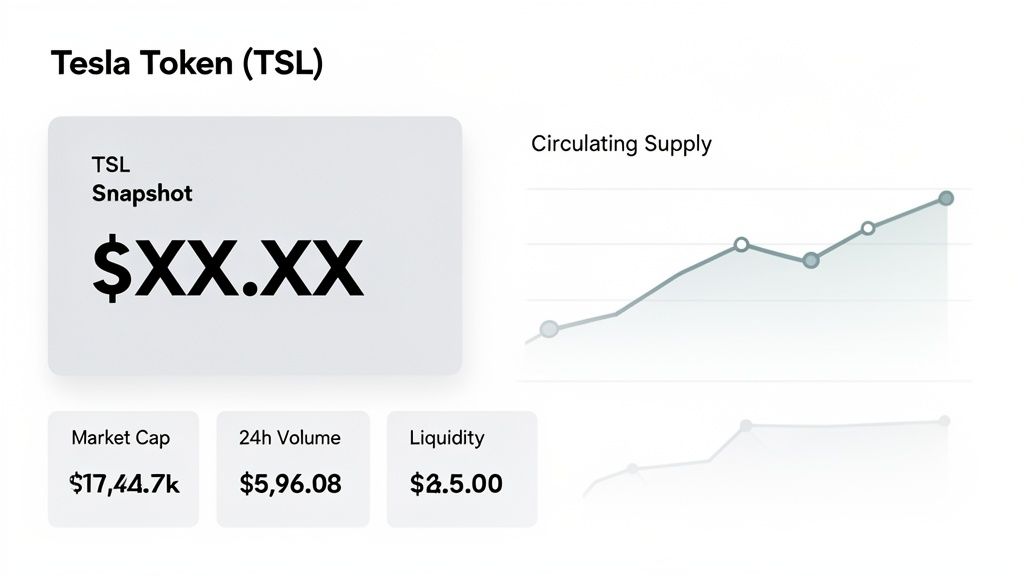
To get a real feel for the TSL market, traders lean on a few core indicators. These vitals give the price some much-needed context, helping to flag potential risks and uncover hidden opportunities.
Here’s a quick look at the essential real-time and historical data points for the Tesla Token. These are the numbers traders watch constantly to gauge market health and make their next move.
MetricCurrent ValueWhat It Means for TradersMarket CapitalizationTotal value of all circulating TSL tokensA higher market cap can suggest more stability, while a lower one often points to higher volatility and bigger swings.24-Hour Trading VolumeAmount of TSL bought and sold in the last 24 hoursHigh volume signals strong trader interest and good liquidity, making it easier to enter and exit positions.Circulating SupplyTotal number of TSL tokens available on the marketThis is key for understanding scarcity. A capped or shrinking supply can potentially drive up the price over time.
These figures are the first checkpoint for any serious DeFi trader. For instance, a token with a high market cap but consistently low trading volume is a major red flag. It signals poor liquidity, meaning it could be tough to sell a large position without crashing the price yourself.
The article above correctly identifies 24-hour trading volume as a key metric for gauging trader interest and liquidity. What it doesn't tell you is that for low-cap tokens like TSL, that volume number is often massively inflated by wash trading — fake volume generated by the same entity buying and selling to itself to create the illusion of activity. You can't trust the volume number at face value, and most traders don't know how to separate real volume from manufactured noise.
Wash trading works because most DEXes don't have the same surveillance and enforcement mechanisms that centralized exchanges do. A trader or market maker can control multiple wallets, use one wallet to sell TSL and another wallet to buy the same TSL back, over and over. Each cycle shows up as legitimate volume on chain and gets aggregated into the 24-hour volume total displayed on price tracking sites. To anyone looking at the top-level stats, it looks like TSL is actively traded when in reality it might be one or two actors creating circular volume.
The motivation for wash trading varies. Sometimes it's legitimate market makers providing liquidity by trading with themselves to narrow spreads. More often, it's manipulation — project insiders or pump groups creating fake volume to make the token look more active than it is, attracting retail traders who use volume as a signal of legitimacy. High displayed volume makes TSL look safer and more liquid than it actually is, which draws in buyers who then discover they can't exit their positions without massive slippage because the real liquidity was never there.
The on-chain fingerprints of wash trading are visible if you know what to look for. The trades themselves are real transactions recorded on the blockchain, but the pattern they create is different from genuine trading activity in specific, detectable ways.
The first signal is abnormally high volume relative to unique wallet activity. If TSL shows a million dollars in 24-hour volume but only fifty unique wallets transacted, that's a massive red flag. Real trading activity at that volume level should involve hundreds or thousands of wallets, not dozens. A small number of wallets generating outsized volume means those wallets are trading with each other or with themselves.
The second signal is symmetrical trade sizes and timing. Wash trading often appears as matched pairs of buys and sells of identical or very similar amounts happening within seconds or minutes of each other. A wallet sells exactly 10,000 TSL, and a different wallet buys exactly 10,000 TSL thirty seconds later. This pattern repeated dozens of times creates volume but doesn't represent genuine price discovery or legitimate buying and selling interest.
The third signal is zero or minimal price impact despite high volume. If TSL shows huge trading volume but the price barely moves, the volume isn't applying genuine buying or selling pressure — it's circular. Real volume from genuine interest should move price noticeably unless the liquidity is so deep that large trades get absorbed without impact, which is never the case for a low-cap token like TSL.
The defensive approach is ignoring headline volume numbers entirely and focusing instead on metrics that are harder to fake. Unique active wallets over a rolling timeframe. The number of wallets that bought versus sold. Average trade size. These give you a more honest picture of actual trading activity and interest. When wash trading is rampant, the real volume might be ten to twenty percent of the displayed volume, which completely changes your assessment of whether TSL is liquid enough for your position size.
Tesla Token's price history is a classic example of high-risk, high-reward trading. The charts are filled with sharp peaks and deep valleys.
Take the 2021 bull run, for example. TSL exploded with a massive 600.75% increase from its opening price, hitting a high of $0.00164. But the year before, in 2020, it saw a brutal 88.29% decline.
This kind of extreme movement is precisely why seasoned traders rely on advanced tools to navigate the chaos. You can dive deeper into TSL's past performance on platforms like CoinLore. And if you're interested in how professional traders pull this kind of data for their own systems, our guide on using an API for crypto prices breaks down the technical side.
A token's price tells a story, and the Tesla Token price is no different. Its value doesn’t just move on its own; it gets pushed and pulled by a mix of huge market trends and tiny, project-specific events. If you want to anticipate market reactions instead of just being shocked by them, you first have to understand these drivers.
Think of the entire crypto market as a powerful ocean current. When giants like Bitcoin or Ethereum are on a tear, they create a rising tide that lifts almost every other boat, including smaller tokens like TSL. This is exactly why a big move in Bitcoin’s price can send ripples across thousands of other assets, even if they have no direct connection.
On the flip side, when the market gets bearish, that same tide goes out, dragging capital away from more speculative plays like TSL. It's a fundamental concept every trader needs to get comfortable with.
Beyond those big market waves, a few specific things can directly tank or pump the Tesla Token price. These are the catalysts that can spark sharp, sudden moves, creating both massive risk and juicy opportunities for traders who are paying attention.
For speculative tokens like TSL, the story and social buzz are often way more powerful price drivers than any technical fundamentals. That's a key takeaway.
This is exactly why TSL can be so volatile. Its price is incredibly sensitive to what people are thinking and how the crowd is feeling at any given moment.
Every DEX aggregator shows you a price for TSL — the last trade price, or the mid-point between bid and ask. That displayed price creates the illusion that you can buy or sell TSL at that price in any size you want. For low-cap tokens with thin liquidity pools like TSL, that illusion shatters the moment you try to execute a real trade of any meaningful size. The displayed price is only executable for tiny amounts. Beyond that, slippage destroys your entry or exit.
Liquidity pool depth refers to how much total value is sitting in the pool available to trade against. A TSL/ETH pool might have the equivalent of fifty thousand dollars in total liquidity. That sounds like a lot until you realize that a single ten-thousand-dollar buy order will consume twenty percent of the pool's liquidity on one side, moving the price dramatically against you before your order fills. You think you're buying at the displayed price of 0.00005 ETH per TSL, but by the time your order executes, the average fill price might be 0.000055 or higher because your buying pushed the price up as the order filled.
This is the liquidity pool depth trap, and it's one of the most expensive mistakes traders make with tokens like TSL. They see a price on CoinGecko or DexTools, decide to buy, submit a market order, and get filled at a price ten or twenty percent worse than what they expected. The displayed price wasn't a lie — it was just the price before their own order moved the market.
The only way to know if a displayed price is real for your position size is checking the actual pool depth before you trade. This requires going directly to the DEX where TSL trades — usually Uniswap or a similar platform — and examining the liquidity pool reserves.
Every liquidity pool shows you how much of each token is in the pool. For a TSL/ETH pool, you'll see something like "50,000 TSL and 2.5 ETH." The depth on the ETH side tells you how much buying power exists in the pool to absorb TSL sells without the price cratering. The depth on the TSL side tells you how much TSL is available to be bought before you've exhausted the pool and pushed the price to unacceptable levels.
The rule of thumb for position sizing relative to pool depth is keeping your trade size below two to three percent of the total pool liquidity. If a pool has fifty thousand dollars in total liquidity, your trade should be fifteen hundred dollars or less to avoid meaningful slippage. Go bigger than that and you're guaranteed to move the price against yourself.
Most retail traders skip this check entirely. They just see a price, submit an order, and hope for the best. The ones who consistently profit from low-cap tokens always check pool depth first and either size their trades accordingly or wait for liquidity to build before entering larger positions.
Thin liquidity isn't always bad. It cuts both ways. The same thin pools that make large positions expensive to enter also make them expensive for others to enter, which means competition for the trade is limited. When you've identified a genuine opportunity in a thinly traded token like TSL and you can position before liquidity and attention arrive, thin pools actually work in your favor because they create barriers to entry for the crowd.
The key is timing. Enter when liquidity is thin but before the catalyst hits. Exit when liquidity has built up during the pump and you can actually get out at reasonable prices. Trading thin liquidity successfully means being the early buyer and the early seller, not the one chasing after the move is obvious to everyone.
To make smarter moves, it helps to sort these influences into a few buckets. Some are internal to the TSL project itself, while others are external forces completely out of its control.
Factor TypeExamplesLevel of ControlImpact on TSL PriceExternal ForcesBitcoin's price swings, new regulationsLowUsually creates the big, market-wide trends that TSL gets caught in.Internal ForcesNew partnerships, community programsHighCan trigger token-specific rallies or dumps separate from the market.Sentiment ForcesSocial media trends, influencer shout-outsVariableCreates those wild, fast, high-volatility price swings.
By figuring out whether a price move is happening because of a broad market trend or something specific to TSL, you can get a much better sense of how long it might last and how important it really is. Making that distinction is crucial for building a trading strategy that doesn't break when conditions change.
If you want to understand the Tesla Token price today, you have to look at its past. A token’s history is a map of its personality—it shows you exactly how it reacts to pressure, hype, and fear. By digging into its major price swings, we can turn a simple chart into a powerful story about how the market thinks and behaves.
This isn’t about trying to predict the future with a crystal ball. Think of it more like building a strategic memory. When you understand how TSL has behaved during past booms and busts, you’re better equipped to anticipate what might happen next and build smarter, more resilient trading plans.
The timeline below lays out TSL’s dramatic journey, showing its major peaks and valleys over the years.

It’s a clear picture of extreme volatility, from a massive all-time high to a crushing correction that followed. This visual alone tells you a lot about the high-risk, high-reward nature of this asset.
TSL's past is marked by a few explosive bull runs that offer some serious lessons in market psychology. During these surges, the price was often pushed sky-high by a perfect storm of factors, giving us clues about what might trigger the next big rally.
Here’s what typically fueled those massive gains:
These bull runs were easy to spot—they had nearly vertical price charts and insane trading volumes. The big takeaway for traders is that TSL's most dramatic moves are often tied to what’s happening in the broader market and social media, not necessarily some fundamental breakthrough with the project itself. Learning to spot the early signs of a market-wide sentiment shift is absolutely critical.
A rising tide lifts all boats, but in crypto, it can turn speculative tokens into rocket ships. TSL’s history proves it often needs a strong market tailwind to truly take off.
Of course, what goes up must come down. The valleys are just as important as the peaks. TSL's chart is littered with brutal corrections where the price completely cratered, like the gut-wrenching 99% drop from its 2018 all-time high. These crashes reveal the token's biggest vulnerabilities and the triggers that cause massive sell-offs.
Here are the hard-learned lessons from TSL's nosedives:
Getting a handle on these historical patterns—both the euphoric climbs and the painful freefalls—isn’t about trying to time the market perfectly. It’s about being able to read the room, understand the environment you’re trading in, and manage your risk accordingly.
The article discusses tracking whale movements and smart money accumulation, but it doesn't address the most important context for interpreting those movements: when those wallets originally acquired their TSL and at what prices. A wallet holding a million TSL tokens means something completely different if they bought at 0.00001 versus 0.0001. The first wallet is sitting on ten-x gains and is a massive dump risk. The second wallet is underwater and unlikely to sell. Holder distribution isn't just about how many tokens each wallet holds — it's about the timeline of when those positions were built and what unrealized profit or loss they represent.
TSL's holder distribution evolved dramatically during different phases of its price history. During the early accumulation phases at rock-bottom prices, a small number of wallets accumulated the majority of the supply. As the price pumped and retail attention arrived, distribution widened as early holders sold portions of their positions and new wallets bought in at higher prices. During corrections, distribution often tightened again as weak hands sold at losses and strong hands re-accumulated at lower prices than their initial entries.
Understanding this evolution tells you where current price sits relative to different cohorts of holders. If current price is above most accumulation zones, almost everyone holding is in profit and selling pressure from profit-taking is a constant risk. If current price is below major accumulation zones, many holders are underwater and unlikely to sell, which removes selling pressure and creates support.
The on-chain data that reveals this is the transaction history of large TSL wallets. You can see exactly when each wallet acquired its tokens and at what prices by examining their historical trades. A wallet that accumulated two million TSL between prices of 0.00001 and 0.00002 has an average cost basis in that range. If current price is 0.0001, that wallet is up five to ten times on paper.
This cost basis analysis lets you predict wallet behavior with reasonable accuracy. Wallets sitting on large unrealized gains typically start selling portions of their holdings as price rallies, taking profits along the way. The selling might not be immediate — they often wait for specific price levels or catalysts — but the incentive to realize some of those gains is always present. Monitoring these wallets for any outflows to exchanges or large sells into liquidity pools gives you advance warning that distribution from early holders is beginning.
Wallets that accumulated recently at current prices or higher have no profit to take and no incentive to sell unless their thesis has changed or they're cutting losses. These wallets are more likely to hold or even accumulate more if price dips, providing buying support. The newer the accumulation and the closer their cost basis is to current price, the less selling pressure that wallet represents.
When a large percentage of circulating TSL is held by wallets sitting on huge unrealized gains, that's called an unrealized profit overhang. It's latent selling pressure waiting for the right moment to actualize. The overhang isn't a problem during strong uptrends when buyers keep arriving and absorbing the selling. It becomes catastrophic when the trend reverses and those profit-taking sells hit a market with no buyers.
Quantifying the overhang requires adding up the total TSL held by wallets that accumulated below current price and calculating how much profit they'd realize if they sold at current levels. If a large percentage of the supply was accumulated at prices ten or twenty times below current price, the overhang is enormous. Any significant selling from that cohort creates massive downward pressure because they can dump large amounts and still be profitable even as price falls dramatically.
The inverse situation — when most supply was accumulated above current price — creates a different dynamic. Holders are underwater. They're not selling because selling locks in losses. This provides price support because the natural sellers are sitting out, waiting for price to recover to their cost basis before they exit. Understanding which scenario TSL is in right now based on holder distribution history changes everything about how you should approach the trade.
If you really want to understand what's driving the Tesla Token price, you need to look beyond the charts. On-chain analysis lets you peer directly into the blockchain, giving you a transparent view of what the most influential traders are doing right now.
It’s less like reading yesterday's news and more like getting a live feed from the trading floor. You can see which wallets are quietly accumulating TSL before a price surge or spot when the biggest players start moving their tokens to an exchange.

This is the secret to tracking “smart money”—wallets with a proven track record of profitable trades. By monitoring their activity, you can catch trends like “whale accumulation” (when large holders are buying up a token) long before they show up on a price chart.
On-chain data is the raw, unfiltered truth of every transaction. It’s all public, and it reveals patterns that are completely invisible if you're only looking at price action. Think of it as the difference between watching the scoreboard and having a direct line into the team's huddle.
Here are a few of the game-changing signals you can pull from the blockchain:
For instance, a tool like Wallet Finder.ai lets you see exactly which tokens are being scooped up by top traders.

The data makes it obvious which assets smart money is interested in, giving you a powerful edge. You can learn more about how a smart money tracker works to give you this kind of real-time advantage.
So, how does this compare to traditional technical analysis—you know, drawing lines on charts? While charting is great for understanding past price movements and market psychology, on-chain analysis tells you what's happening fundamentally on the blockchain itself.
They’re two different but equally valuable tools in your trading arsenal.
On-chain data shows you what smart traders are doing with their money now, not just what the price did in the past. It’s a forward-looking perspective that helps you anticipate moves before they happen.
To put it in context, let's break down what each method tells you about the Tesla Token.
Indicator TypeWhat It Tells YouExampleAdvantage for TSL TradersOn-Chain SignalThe flow of capital and holder behavior.A large number of wallets are withdrawing TSL from exchanges.Suggests strong holding sentiment and potentially lower selling pressure ahead.Traditional ChartingHistorical price action and market psychology.TSL price is approaching a historical resistance level.Helps identify potential price ceilings where selling pressure has been high in the past.
Neither method replaces the other; they work best together. Charting might help you find a good entry point based on historical support levels, but on-chain data can confirm whether smart money agrees with your play.
By combining the two, you move from making educated guesses to making truly data-backed decisions. And in a market as fast-moving as TSL, that can make all the difference.
Understanding what makes the Tesla Token price tick is one thing, but actually turning that insight into a profitable trade is a whole different ballgame. This guide is here to bridge that gap, giving you a clear, step-by-step framework for making your first TSL trade on a decentralized exchange (DEX). We'll stick to the must-know basics that will help protect your capital in a market that can turn on a dime.
Trading a token like TSL isn't about gut feelings; it's about having a methodical approach. Every single step, from picking the right platform to knowing when to cut your losses, is critical.
Before you even dream of hitting that "swap" button, you need a game plan. The traders who last don't just react to the market—they prepare for it. That means setting firm rules for yourself before you enter a position, which is the single best way to keep emotions from wrecking your decisions.
Here’s a simple pre-trade checklist to get you started:
Once your plan is locked in, executing the trade is purely a test of discipline. This is where so many new traders stumble, letting FOMO (fear of missing out) or outright fear dictate their clicks. The key is to trust your plan and stick to it, no matter how wild the short-term price swings get.
Risk management isn't just a friendly suggestion; it's the bedrock of any sustainable trading strategy. In a market as unpredictable as TSL, protecting your downside is far more important than chasing every last bit of upside.
A stop-loss is your most important safety net. It’s an order you set up to automatically sell your position if the price falls to a predetermined level, effectively capping how much you can lose. For example, if you buy TSL at $0.00005, you could set a stop-loss at $0.000045 to limit your potential loss to 10%.
Finally, pay attention to slippage tolerance. This is the price difference you’re willing to accept between the moment you submit your trade and when it actually executes on the blockchain. For a jumpy token like TSL, you might need a slightly higher slippage (1-3%) to get your trade through, but be careful—it can mean you get a worse entry price. If you want to go deeper on this, check out our guide on position sizing for high-volatility trades for some more advanced techniques.
The article discusses trading TSL but doesn't address providing liquidity to TSL pairs, which is an entirely different risk profile that traders sometimes consider when they see the APY percentages displayed on DEXes. Providing liquidity to a volatile token like TSL can generate enormous fee income during volume spikes, but it also exposes you to impermanent loss that can easily exceed the fees you earn. Understanding this tradeoff is essential before you even think about depositing funds into a TSL liquidity pool.
Impermanent loss happens when the price of tokens in a liquidity pool changes relative to each other. You deposit equal values of TSL and ETH into a pool. If TSL's price doubles while ETH stays flat, the pool automatically rebalances by selling some of your TSL and buying ETH to maintain the fifty-fifty value ratio. When you withdraw, you have more ETH and less TSL than you deposited. You missed out on some of TSL's gains because the pool forced you to sell TSL as it went up. That's impermanent loss — the difference between what you'd have if you just held the tokens versus what you actually have after providing liquidity.
For a stable token pair like USDC/USDT, impermanent loss is minimal because the prices don't move much relative to each other. For a volatile token like TSL paired with anything, impermanent loss can be massive. A hundred percent move in TSL relative to its pair creates roughly six percent impermanent loss. A five hundred percent move creates around twenty-five percent impermanent loss. TSL can move five hundred percent in days during a pump, which means liquidity providers can lose a quarter of their position's value to IL even while they're earning trading fees.
The only time providing liquidity to TSL makes economic sense is when trading volume is so high that the fees generated exceed the impermanent loss you're experiencing. This happens during peak FOMO periods when everyone is buying and selling TSL in a frenzy, generating huge trading fees for the liquidity pool that get distributed to LP token holders.
A liquidity pool charging a 0.3% fee on all trades generates fees proportional to volume. If a TSL pool processes a million dollars in volume in a day, that's three thousand dollars in fees split among all liquidity providers based on their share of the pool. If you own one percent of the pool, you earn thirty dollars that day. If that volume continues for a week, your fee income might be two hundred dollars or more. If TSL didn't move much during that week, your impermanent loss is small and the fees are pure profit.
But if TSL doubled during that same week while ETH stayed flat, your impermanent loss might be six percent of your position value. If your position was ten thousand dollars, that's six hundred dollars in IL against two hundred dollars in fees. You lost money providing liquidity despite the high volume and high APY displayed on the DEX interface.
The profitable LP strategy for volatile tokens like TSL is understanding the lifecycle and timing your entry and exit around it. Provide liquidity during the quiet periods when TSL's price is relatively stable and volume is moderate. The fees are lower but so is IL risk. You're earning a steady income stream without massive price volatility destroying your position value.
When you see signs that a pump is starting — increasing social media activity, whale accumulation, volume picking up — that's your signal to consider withdrawing liquidity before TSL's price goes vertical. You miss out on the huge fee spike that comes during the pump, but you also avoid the catastrophic IL that would have eaten all those fees and more. You can always re-enter the LP position after the pump settles and volatility calms down.
The worst LP timing is entering during a pump because you see the high APY. You're providing liquidity at exactly the moment when IL risk is highest. Your position gets shredded by IL as TSL's price whipsaws, and the fees you earn don't come close to covering the loss. This is the liquidity provision trap that destroys capital for traders who don't understand how IL works on volatile pairs.
The crypto market never sleeps, but you have to. Trying to manually track every single tick of the Tesla Token price is a fast track to burnout and missed opportunities. This is exactly where automation becomes your secret weapon, turning a flood of on-chain data into sharp, actionable signals you can use—without being chained to your screen.
With a platform like Wallet Finder.ai, you can essentially put your TSL monitoring on autopilot. This isn’t about handing over control to a trading bot. It's about getting the most critical information delivered to you the second it happens, so you can be the one to make the smart, decisive move.
Imagine getting a notification right on your phone, just like this one, telling you a top wallet just made a big TSL purchase.

This kind of setup turns your phone into a powerful market radar, ensuring you're always in the loop when a wallet you care about makes a move.
First things first, you need to build a custom watchlist of wallets that are actually good at trading TSL. Wallet Finder’s "Discover" tools are perfect for this, helping you pinpoint traders who have a proven track record of profitability. Once you have your list, it's time to set up alerts.
Here's an actionable workflow you can implement today:
By automating your monitoring, you stop chasing the market and start anticipating it. You get data-backed signals from proven traders, allowing you to make informed decisions without being glued to a chart.
This approach completely flips your strategy from reactive to proactive. Instead of seeing a price pump and frantically trying to figure out why, you’ll see the smart money loading up before the big move happens. By mirroring the activity of wallets that consistently win, you're tapping into their research and timing, giving you a serious advantage in the fast-moving TSL market.
Let's clear up a few of the most common questions people have about Tesla Token's price, background, and how to manage it safely.
The displayed 24-hour volume on most price tracking sites includes wash trading and other artificial volume, which means it's not a reliable indicator of genuine liquidity or trading interest. The way to separate real volume from fake is checking the ratio of volume to unique active wallets and looking for symmetrical trade patterns.
Pull up TSL's on-chain transaction data and count how many unique wallets traded in the last 24 hours. If the token shows a million dollars in volume but only thirty or forty unique wallets transacted, the volume is obviously fake — those few wallets are trading with each other repeatedly to inflate the number. Real volume at that level should involve hundreds of unique participants.
The second check is looking at trade sizes and timing. Wash trading shows up as matched pairs of identical or very similar amounts trading within seconds or minutes of each other. If you see the same 10,000 TSL amount being bought and sold over and over in a rhythmic pattern, that's not genuine market activity. It's one entity manufacturing volume. Real trading has irregular sizes and timing because different people are making independent decisions.
Position sizing for a volatile, low-liquidity token like TSL is completely different from sizing a Bitcoin or Ethereum position. The two constraints you need to respect are the liquidity pool depth and your total portfolio risk tolerance.
For liquidity pool depth, keep your trade size under two to three percent of the total pool liquidity to avoid moving the price against yourself with slippage. If the TSL/ETH pool has fifty thousand dollars total, your trade should be fifteen hundred dollars or less. Go bigger and you're paying a significant premium just to get your order filled.
For portfolio risk, volatile tokens like TSL should represent a small percentage of your total trading capital — one to three percent maximum per position. TSL can go to zero faster than you can react. If that happens, you want the damage contained to a small fraction of your portfolio, not a catastrophic loss that wrecks your entire account. Multiple small positions in different volatile tokens gives you exposure to potential big winners while keeping any single blowup survivable.
If you've built a position that represents a meaningful percentage of TSL's total liquidity, exiting that position without tanking the price requires breaking it into multiple smaller sells executed over time rather than trying to dump everything at once. A single large sell into a thin liquidity pool will crash the price and give you a terrible average exit price. Multiple smaller sells over hours or days gives the market time to absorb each one and allows the price to recover between sells.
The rule of thumb is never selling more than one to two percent of the pool's liquidity in a single transaction. If the pool has fifty thousand dollars and you need to exit a ten thousand dollar position, that's five separate sells of two thousand dollars each, spaced out by at least several hours to give liquidity and price time to stabilize between transactions.
The alternative if you're truly stuck with a position too large to exit cleanly is providing liquidity yourself to deepen the pool before you start selling. Deposit your TSL and an equivalent value of the pair token into the pool to add liquidity, then slowly withdraw your liquidity over time as others trade against the pool. This converts your large illiquid position into a liquid one gradually without a single catastrophic market sell. It's more complex but it's how large holders exit positions in thin markets without destroying their own exit price.
The Tesla Token price lives and dies by the hype cycle. It’s incredibly sensitive to the overall mood in the crypto market and pure speculation. For smaller tokens like this, things like social media chatter, shoutouts from influencers, and big moves by large holders (we call them "whales") tend to have a much bigger impact on the price than any underlying project developments.
Absolutely not. This is a critical point to understand: Tesla Token (TSL) has no official connection, endorsement, or affiliation with Elon Musk or Tesla, Inc. It's a completely separate crypto project that just happens to be using the famous "Tesla" name for branding—a tactic you see all the time in this space. Always do your own homework before getting involved.
The golden rule in crypto is simple: "Don't trust, verify." Always double-check a project's official ties through their own channels, because anyone can use a big name without permission.
If you do decide to hold TSL, you can keep it in a non-custodial wallet you control, like MetaMask, or a hardware wallet like Ledger for the best security. That way, you—and only you—are in charge of your private keys.
Ready to take your on-chain analysis from amateur to pro? With Wallet Finder.ai, you can discover the top wallets to follow, get trade alerts in real-time, and finally get an edge. Start your free trial today and see what you've been missing.