A Guide to Finding Crypto Gems in Token Pre Sales

Wallet Finder

Blank calendar icon with grid of squares representing days.

January 18, 2026

Ever heard of a token presale? It's a fundraising event where a new crypto project sells its tokens to early investors before it's available to the general public. Think of it like getting VIP early-access tickets to a concert, often at a discount. It's a classic high-risk, high-reward chance to get in on a project's ground floor.

This strategy is designed to be a win-win. New projects get the capital they desperately need for development, and investors get a shot at a potentially massive return on their investment.

What Are Token Pre Sales And Why Should You Care?

A token presale is the crypto world's version of an early-stage venture capital round for a tech startup. It's the first real opportunity for a project to raise money, build a dedicated community, and get the ball rolling. For you, the investor, it's a chance to buy in before the project hits the mainstream market, often at the absolute lowest price you'll ever see.

But this early access comes with a major catch. While the potential for huge returns is real, so is the risk. The crypto space is littered with the ghosts of projects that never delivered on their promises, and let's be honest, plenty of presales are just straight-up scams. That's why doing your homework isn't just a good idea—it's absolutely essential for survival.

The Allure Of Early Access

The biggest draw for joining token presales is, without a doubt, the potential for explosive growth. Early investors are buying tokens at a serious discount compared to the price they might list at on a public exchange. If that project takes off, these early backers can see returns that are orders of magnitude greater than those who buy in after the public launch.

The legendary example everyone points to is Ethereum's 2014 presale. They offered ETH for about $0.31 per token. For the diamond-handed investors who held on until its peak, that translated to an almost unbelievable 1,400,000% return. We're talking about turning small, speculative investments into life-changing fortunes. You can find plenty of historical data on early crypto fundraising events to see just how impactful these initial offerings can be.

When you get in early, you're not just buying a token. You're funding the development of something new and becoming a founding member of that project's community.

Navigating The High-Stakes Environment

While the success stories are incredibly tempting, the hard truth is that most presales are a gamble. It's a largely unregulated landscape, making it tough to tell a future unicorn from a project destined to fail. This is why you need a structured, almost skeptical, approach.

To succeed, you must learn to critically evaluate key project elements. Here's your initial actionable checklist:

  • Project Viability: Does it solve a real problem or offer genuine utility? Is there a reason for it to exist beyond speculation?
  • Team Credibility: Is the team public with verifiable experience? Or are they hiding behind anonymous profiles?
  • Tokenomics: Is the token's economic model built for sustainable, long-term growth, or is it designed for a quick pump and dump?

This guide is here to arm you with the knowledge and tools you need to navigate this tricky environment. We'll walk you through how to conduct proper due diligence, spot the most critical red flags, and use on-chain data to give yourself an edge. Your ability to analyze these factors is what will separate a winning bet from a costly mistake.

The Anatomy Of A Crypto Pre Sale

To really get a handle on token pre sales, you have to stop thinking of them as one-off events. It’s more like a journey with multiple stages. I like to think of it as a rocket launch sequence—every phase serves a specific purpose, involves different people, and carries its own level of risk. The earliest stages are super exclusive and risky; later, the doors open to a wider crowd as the project picks up steam.

A project’s funding journey usually flows from private, strategic money to a broader public sale. Knowing which stage a presale is in tells you a ton about how mature the project is, the potential discount you're getting, and just how much risk you’re taking on. Early birds get the best prices but have to stomach a lot more uncertainty. Later participants pay a higher price but for a project that's already got some momentum.

This timeline of Ethereum’s presale really drives home the mind-blowing potential of getting in on the ground floor. It’s a perfect example of the kind of returns early believers can see.
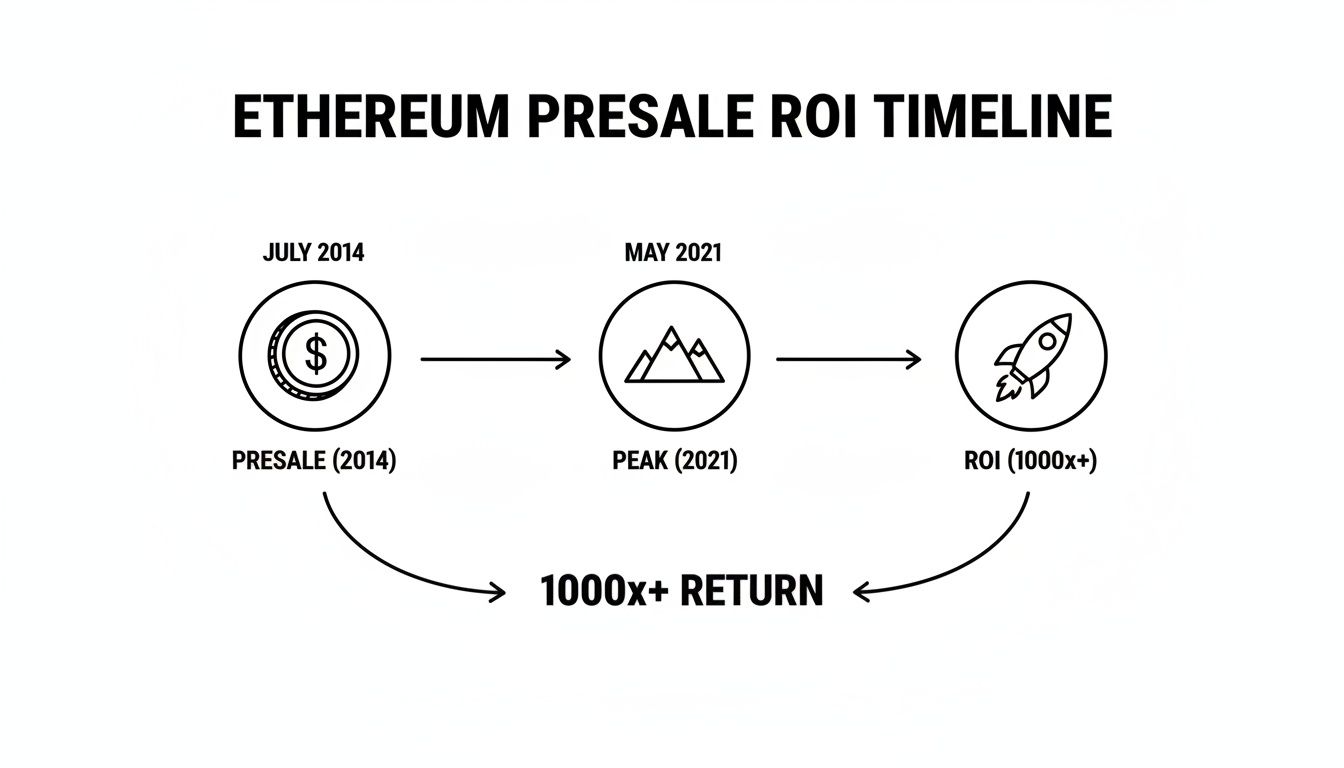
Timeline illustrating Ethereum's presale investment journey from 2014 to 2021, showing over 1000x return.

What this shows is how a tiny investment during the presale could have ballooned into life-changing money by the time the asset hit its peak. That right there is the core appeal of these early funding rounds.

Early Funding Rounds: Seed And Private Sales

The very beginning of a token’s life starts with the Seed and Private sales. These rounds are behind closed doors, usually only open to venture capital (VC) firms, angel investors, and key strategic partners. At this point, the project might be nothing more than an idea on a whitepaper, making it the riskiest phase of all.

Investors in these rounds inject the first critical cash in exchange for tokens at rock-bottom prices. But there’s a catch: their tokens almost always come with long vesting schedules. This means their tokens are locked up and released slowly over several years, preventing these whales from dumping on the market right after the public launch and crashing the price.

Public Pre Sale Rounds

After a project has locked in its initial funding and maybe built out a basic product or a community, it’s time for a Public Pre Sale. This is often the first real chance for the average crypto investor to get involved. These sales are way more accessible and are usually run on specialized platforms.

The token price here is higher than what the seed investors paid, but it's still expected to be a discount compared to the price when it finally lists on an exchange. Vesting schedules for public buyers are typically much shorter, and sometimes there are no lockups at all. This stage is all about spreading the token ownership out and building a bigger army of supporters before the big launch.

ICO vs. IEO vs. IDO: What You Need To Know

The way projects run these public presales has changed a lot over the years. Getting the difference between these models is crucial for figuring out how safe and easy it is to participate. Each one offers a different balance of centralization, security, and user-friendliness.

Sale TypePlatformKey CharacteristicMain BenefitMain Drawback
ICOProject's WebsiteDirect sale from the project to investors.Full control for the project team.High risk of scams; minimal vetting.
IEOCentralized ExchangeSale hosted and vetted by an exchange (e.g., Binance).Increased trust and security; easy access for users.Highly centralized; limited project selection.
IDODecentralized ExchangeSale conducted on a DEX launchpad (e.g., Raydium).Permissionless and accessible; immediate liquidity.Can be complex; risk of smart contract bugs.

An Initial Coin Offering (ICO) was the wild west original. The lack of oversight led to a ton of scams, which paved the way for Initial Exchange Offerings (IEOs) and Initial DEX Offerings (IDOs). These newer models bring in third-party platforms for more security and vetting. Which one is best for you really comes down to your risk tolerance and how comfortable you are with the tech.

How To Analyze Tokenomics And Vesting Schedules

Think of tokenomics as the economic engine of a crypto project. It's the complete set of rules that dictates how a token is created, who gets it, and how many are available. This blueprint is one of the single most important factors in a project's long-term survival. You can have the most brilliant technology in the world, but if the tokenomics are garbage, the project is likely doomed to fail under a mountain of sell pressure.

Getting a real read on a project's tokenomics means going way deeper than just looking up the total supply. You have to roll up your sleeves and figure out who gets what, and more importantly, when they get it. This is your number one defense against projects that are secretly designed to make the founders rich while leaving the community holding the bag.

A diagram of tokenomics, showing token allocation, a vesting schedule, security lock, and healthy versus risky status.

Unpacking The Token Allocation Pie

The first place you should look is the token allocation chart. You can usually find this in the project's whitepaper or on a dedicated tokenomics page on their website. This pie chart breaks down how the total supply is split between different groups—the team, private investors, the public sale, ecosystem funds, and marketing budgets.

A healthy allocation feels balanced and clearly puts the community and future development first.

You need to be extremely cautious of projects where the team and private investors control a massive slice of the pie. If insiders are holding over 50% of the total supply, that's a huge red flag for centralization. It means they could easily team up, dump their tokens on the market, and completely tank the price, leaving all the public presale buyers with worthless tokens.

A project's token allocation tells you everything you need to know about their priorities. If the team and their VC buddies own most of the tokens, their priority is probably lining their own pockets—not building a healthy, decentralized network.

A healthy token allocation usually includes:

  • Public Sale: A significant portion of the supply should be available to the public to promote wide distribution.
  • Ecosystem/Treasury: A well-funded treasury is critical for developer grants, partnerships, and long-term growth.
  • Team & Advisors: A reasonable allocation is normal, but these tokens must be subject to a long vesting schedule.
  • Liquidity Provision: A specific allocation for providing liquidity on decentralized exchanges is a strong positive signal.

To get an even clearer picture, you can use specialized tools to see how tokens are actually spread across different wallets. You can learn more about using a token distribution analyzer to spot wallets with huge holdings that could pose a major sell-off risk.

The Critical Role Of Vesting Schedules

That token allocation chart doesn't mean a thing if you don't also look at the vesting schedules. Vesting is simply the act of locking up tokens for a set amount of time and then releasing them slowly. It’s the most important tool for preventing the team and early investors from immediately dumping their cheap tokens on the public.

Just imagine a project gives the team 20% of the total supply, but it's all unlocked on the first day of trading. What's stopping them from selling it all, pocketing millions, and walking away? Nothing. A proper vesting schedule forces them to have skin in the game for the long haul.

Look for vesting schedules that last for at least a year, but the best projects often have them for four years or even longer. A standard practice is the "cliff," which is an initial lock-up period (like six months or a year) where no tokens are released. After the cliff, the tokens start unlocking gradually, usually month by month. This staggered approach prevents huge amounts of new supply from suddenly hitting the market and causing a price crash.

Typical Token Allocation And Vesting Schedules

To give you a practical framework, this table breaks down common token allocations and vesting schedules. Use it to quickly spot the difference between a project with a healthy, sustainable model and one that's a ticking time bomb.

Stakeholder GroupTypical Allocation %Common Vesting ScheduleWhat It Means
Team & Advisors10-20%12-month cliff, then linear release over 2-4 yearsShows long-term commitment. The team can't just cash out and abandon the project.
Private/Seed Investors5-15%6-12 month cliff, then linear release over 1-2 yearsAligns early backers with the project's long-term success, preventing instant dumps.
Public Sale (Presale)15-30%Partial unlock at TGE (Token Generation Event), then linear release over 6-12 monthsEnsures fair distribution while managing initial sell pressure from public buyers.
Ecosystem & Treasury20-40%Gradual release over 3-5 years, controlled by DAO/FoundationA healthy fund for future development, grants, and partnerships signals a long-term vision.
Liquidity & Marketing10-20%Mostly unlocked at TGE or released as neededEssential funds for ensuring deep liquidity on exchanges and promoting the project.

Seeing allocations and schedules like these should give you confidence that the project is structured for sustainable growth. Deviations aren't always bad, but they demand closer scrutiny.

At the end of the day, tokenomics and vesting schedules reveal the true character of a project's founders. By taking the time to analyze these economic details, you can easily filter out the weak or predatory projects and zero in on the ones that are actually built to last.

Your Due Diligence Checklist For Spotting Red Flags

Jumping into token pre sales without a solid game plan is like trying to cross a minefield blindfolded. The crypto space is packed with incredible opportunities, but it's just as full of projects designed to fail and outright scams. A systematic due diligence process isn't just a good idea—it's your best defense.

This battle-tested framework gives you a repeatable checklist to methodically pick apart any presale that catches your eye. By splitting your analysis into two key areas—Off-Chain and On-Chain—you can slice through the marketing hype and focus on the signals that actually matter. Think of this process as your personal filter for spotting red flags and protecting your capital.

A magnifying glass inspecting a checklist for token pre-sales: Whitepaper, Team, and On-chain status.

Off-Chain Analysis: The Human Element

Before you even glance at a smart contract, your investigation begins with the people and the plan behind the project. This is where you dig into the vision, the team, and the community—the true foundation of any legitimate venture. Here is your actionable checklist:

  • Whitepaper Review: Is it detailed, professional, and clear about the problem, solution, and roadmap? Vague language or copy-pasted content is a red flag.
  • Team Vetting: Is the team public with real names and verifiable LinkedIn profiles? Anonymous teams offer zero accountability. Look for relevant experience in blockchain, business, or marketing.
  • Community Health Check: Dive into Discord and Telegram. Is there genuine discussion about the technology, or just price hype? Are admins answering tough questions or deleting them? Look for authentic engagement, not inflated member counts.

A project's greatest asset is its team. If the founders aren't willing to put their reputations on the line by being public, you have to ask yourself why you should be willing to put your money on the line.

On-Chain Analysis: Verifying The Code

Once a project passes the off-chain sniff test, it's time to get on-chain to verify the technical and financial guts of the operation. This is where you confirm that what they say they're doing matches what's actually coded into the blockchain. This step is absolutely non-negotiable for avoiding rug pulls and technical exploits. Follow this checklist:

  • Smart Contract Audit: Has a reputable third-party security firm audited the code? Legitimate projects proudly display their audit reports. No audit is a major red flag.
  • Wallet Concentration Check: Use a block explorer like Etherscan to check token distribution. If the top 10 wallets hold over 40-50% of the supply, it poses a significant dump risk.
  • Locked Liquidity Verification: The team must lock the initial liquidity provided to a DEX for at least 6-12 months. Use platforms like Unicrypt or Team.Finance to verify this lock. No locked liquidity is an absolute deal-breaker.

By systematically working through this two-part checklist, you build a powerful filter. The off-chain analysis vets the people and the plan, while the on-chain analysis verifies the code and the capital. Together, they give you the complete picture you need before putting any money on the line.

How To Track Smart Money In Pre Sales

Reading a whitepaper and checking out the team is a good start, but that’s just static due diligence—a snapshot in time. To get a real edge in finding the best token pre sales, you need to look at what’s happening on-chain, right now. This means tracking the moves of "smart money," which are the wallets of experienced, consistently profitable investors whose actions are often a leading indicator of a project's future success.

When you follow the on-chain footprints of these top-tier wallets, you’re basically piggybacking on all their hard work and deep research. If a wallet with a proven history of picking winners invests in a new presale, that’s a massive signal that the project is worth a closer look. It’s a data-driven approach that helps you move beyond pure speculation and make decisions based on real evidence.

Identifying And Filtering Top Wallets

First thing’s first: you have to find these high-performing wallets. On-chain analysis platforms are built for this. They let you sift through millions of transactions and wallets to find the needles in the haystack. Instead of just guessing, you can use concrete data to pinpoint investors who have a history of nailing it with early-stage projects.

Your main goal is to build a watchlist of wallets that meet some pretty strict criteria. You're looking for skill, not just a one-time lucky bet.

  • High Profitability (P&L): Seek out wallets with a high realized profit and loss. A track record of significant gains is proof they know how to spot and act on opportunities.
  • Strong Win Rate: A high percentage of winning trades—say, over 60-70%—shows they have a consistent and repeatable strategy, not just a single moonshot that bailed them out.
  • Presale Participation History: Filter specifically for wallets that have a history of getting into successful presales. This tells you they specialize in this high-risk, high-reward corner of the market.

Tools like Wallet Finder.ai are designed to make this whole process much smoother, letting you apply these filters and surface the wallets that fit your exact criteria. The platform's dashboard gives you a clean way to spot wallets with a proven edge.

This view lets you see key stats like realized P&L and win rate at a glance, making it incredibly simple to identify and start tracking true smart money.

Setting Up Real-Time Alerts

Okay, so you’ve found a handful of elite wallets. Just watching them isn’t enough. The presale world moves at lightning speed; opportunities can appear and vanish in a matter of hours. To actually act on their insights, you need real-time notifications the second they make a move.

This is where setting up alerts becomes a game-changer. It transforms your passive research into an active signal-generation machine. You can get notifications sent straight to you on platforms like Telegram or as browser push notifications.

By setting up alerts, you're essentially creating a personalized "presale radar." When a top wallet invests, your radar pings, giving you an immediate heads-up to start your own final due diligence.

These alerts give you a massive time advantage. You can be one of the very first to know when a well-vetted project is picking up steam with serious investors, giving you a chance to investigate and get in before the wider market even knows what's happening. To dive deeper into this strategy, check out our guide on how to build a smart money tracker to automate this whole process.

Analyzing Trading History To Understand Strategy

Tracking wallets isn’t about blindly copying trades. It’s about understanding the why behind their decisions. An investor's entire transaction history is out there on the blockchain—a completely transparent ledger of their strategy. By digging into their past trades, you can start to see patterns in how they operate.

Ask yourself these kinds of questions when you're reviewing a wallet's history:

  1. What types of projects do they favor? Are they laser-focused on specific niches like DeFi, GameFi, or maybe infrastructure plays?
  2. How early do they invest? Do they consistently manage to get into private or seed rounds, or do they stick to public presales?
  3. What is their exit strategy? Do they dump their tokens right after the token generation event (TGE) for a quick flip, or are they in it for the long haul?

Analyzing these patterns gives you invaluable context. It helps you understand their risk appetite and investment thesis, which allows you to find and follow investors whose strategies align with your own goals. This deeper level of analysis takes you from simple copy-trading to genuine strategic intelligence, giving you a powerful and repeatable method for finding and validating high-potential presales.

How To Safely Participate In A Token Presale

You’ve done the hard work, vetted a project, and decided it's worth a shot. Now for the final, and arguably most critical, step: execution. Safely participating in token presales isn't just about clicking a button; it requires a specific set of security habits to shield your funds from the swarms of scammers and technical traps laid for eager investors. Nailing this part is just as important as all the research that got you here.

First things first: use a dedicated "burner" wallet. This is a brand-new, completely separate wallet that you fund with only the exact amount of crypto you plan to invest. Never, ever connect your main wallet—the one holding the bulk of your assets—to a new presale website or smart contract. This one simple move isolates your risk, meaning that even if the project turns out to be a complete rug pull, your primary portfolio stays untouched.

Navigating The Technical Steps

With your burner wallet locked and loaded, you'll typically join the presale through a launchpad or the project's official site. This is a high-stakes moment where paranoia is your best friend. Scammers are masters of disguise, creating pixel-perfect fake websites and social media profiles to lure you in.

Always triple-check the URL. Get the official link directly from the project's verified Discord or Telegram announcements. Never, ever click on a link someone sends you in a direct message, even if it looks like it’s from a team member.

Here’s a step-by-step guide to the technical process:

  1. Verify the Official Link: Cross-reference the presale link on the project’s official website, Twitter, and pinned messages in Discord or Telegram.
  2. Connect Your Burner Wallet: Use the website's interface to connect your dedicated, pre-funded wallet.
  3. Enter Contribution Amount: Type in how much you want to invest. Carefully review all transaction details before proceeding.
  4. Manage Gas Fees: For competitive sales, you may need to set a higher gas fee (priority fee) to ensure your transaction is processed quickly.
  5. Confirm the Transaction: Before you sign, double-check that the contract address you are interacting with matches the official one posted by the team. This is your final defense against phishing scams.

Staying Safe From Common Scams

Beyond fake websites, be on high alert for scammers impersonating team admins in community chats. They'll slide into your DMs offering "special deals" or "private sale access." Let's be clear: a real project team will never DM you first to ask for money. Any message like that is a 100% guaranteed scam.

Your final layer of defense is understanding what you're interacting with on-chain. The more you know about the fundamentals of smart contract security, the better you'll get at spotting potential risks before you connect your wallet. By mixing careful operational security with a healthy dose of skepticism, you can confidently navigate the process and protect your capital.

Common Questions About Token Presales

Let's tackle some of the most frequent questions that come up when people are thinking about jumping into a token presale.

What’s the Difference Between a Presale and an ICO?

It's easy to get these two mixed up. An Initial Coin Offering (ICO) is a specific kind of public sale event. The term "presale" is much bigger; it's an umbrella that covers the entire fundraising journey.

This journey includes multiple stages:

  • Seed/Private Rounds: Super-early sales exclusive to VCs and strategic partners.
  • Public Rounds: Sales open to the general public, which can take the form of an ICO, IEO, or IDO.

Think of an ICO as just one possible stop on the much longer presale road.

How Much Should I Invest in a Token Presale?

Here's the honest answer: only invest what you are completely, 100% willing to lose. No exceptions.

Even projects that look like a sure thing can go sideways, making token presales incredibly high-risk. A smart approach is to carve out a very small slice of your total crypto portfolio for these kinds of speculative plays. That way, you limit your downside while still getting a ticket to potential high rewards.

Here's the golden rule for any high-risk investment: if the thought of it dropping to zero will cost you sleep, you’ve put in too much. Your number one job is always capital preservation.

Are Anonymous Teams Always a Red Flag?

In almost every case, yes. A public, transparent team with a history you can actually verify is one of the biggest trust signals you can get. It creates real-world accountability.

Sure, some corners of the crypto world have a culture that's okay with anonymous founders, but it massively cranks up the risk of a rug pull or the team simply vanishing. For most investors, making it a rule to avoid anonymous teams is a simple, powerful way to protect your capital.


Ready to stop guessing and start tracking the experts? Wallet Finder.ai gives you the on-chain intelligence to see where smart money is moving in real time. Discover top-performing wallets, get instant trade alerts, and leverage data-driven insights to find your next crypto gem before the crowd. Start your 7-day trial and gain a critical edge at https://www.walletfinder.ai.