Recovery Factor Calculation for Smart Traders
Master the recovery factor calculation to measure a strategy's resilience. Learn the formula, see DeFi examples, and find top wallets with Wallet Finder.ai.

June 20, 2026


Wallet Finder
March 27, 2026

The intersection of artificial intelligence and blockchain has created a new frontier for investors and builders. While headlines buzz with AI advancements, a new asset class is quietly powering the decentralized AI revolution. This guide cuts through the noise to analyze the top AI coins that form the backbone of this emerging ecosystem, from decentralized GPU marketplaces to AI-driven data indexing.
We will move beyond surface-level hype to provide a data-driven look at projects with genuine utility, established tokenomics, and actionable on-chain signals. For traders, this is not just about identifying what's hot; it's about understanding the fundamental drivers and learning how to track the smart money that moves these markets. We'll explore which projects are solving real-world AI challenges, like compute shortages and data integrity, and equip you with the tools to analyze their on-chain activity.
This article provides a comprehensive breakdown of the leading AI crypto tokens, including:
Each entry is structured for clarity, featuring direct links, screenshots, and specific examples to help you make informed decisions. Whether you are a DeFi copy trader, a retail investor, or a professional analyst, this roundup offers the detailed insights needed to navigate the top AI coins and find opportunities within this rapidly growing sector. Let's dive into the projects building the future of decentralized AI.
Render Network has established itself as a foundational piece of infrastructure in the decentralized physical infrastructure network (DePIN) and AI sectors. It functions as a decentralized marketplace for GPU computing power, connecting creators and AI developers who need processing muscle with node operators who have idle GPUs. This symbiotic relationship, powered by the RENDER token, addresses the critical shortage of high-end compute required for complex 3D rendering and, more importantly, for training and running AI models.
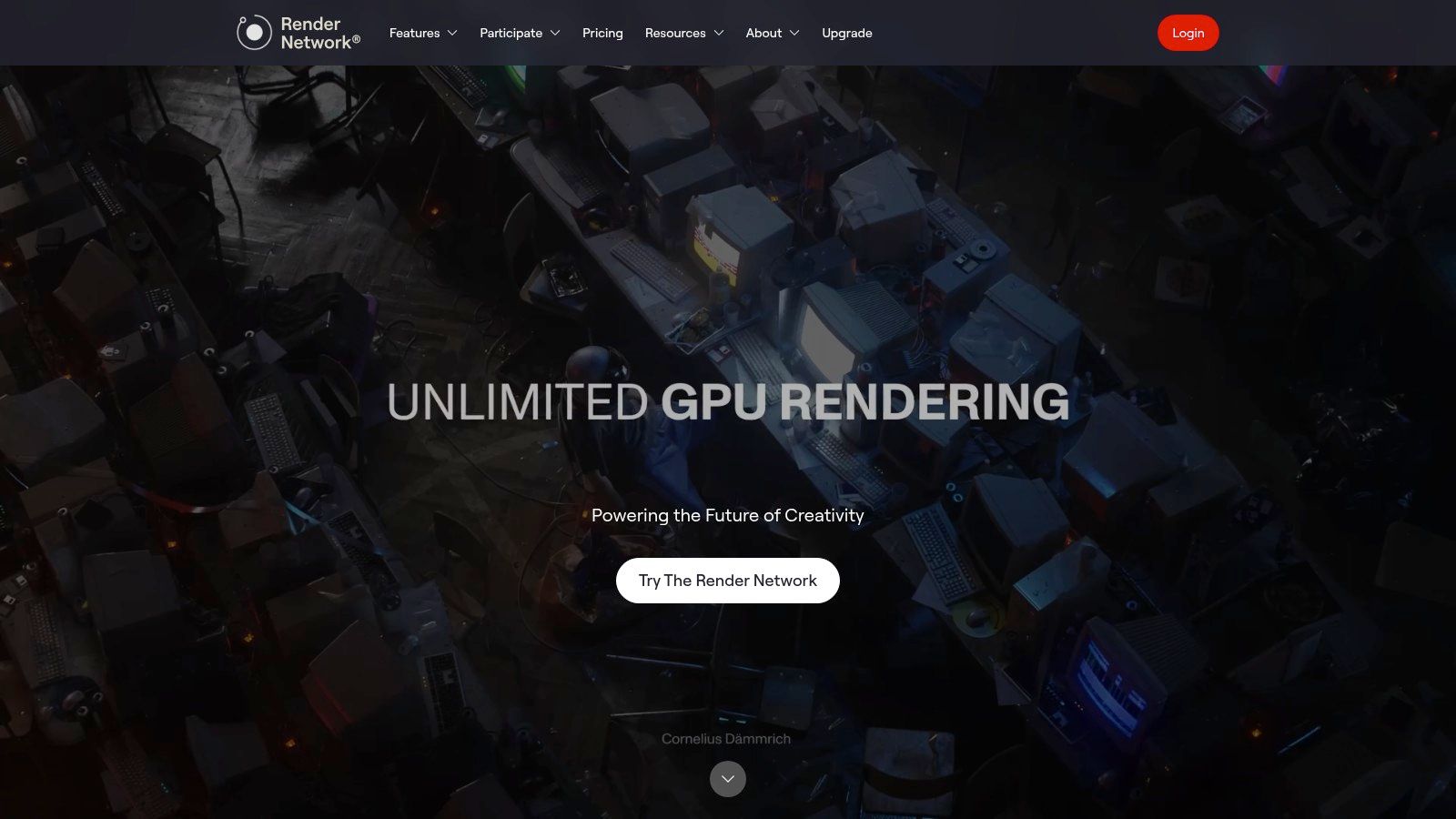
The project’s recent migration from Ethereum to the Solana blockchain marks a significant upgrade. By moving to a higher throughput, lower-fee environment, Render is better positioned to handle the high volume of micro-transactions typical of a distributed compute marketplace. This move solidifies its standing as one of the top AI coins by improving the platform's efficiency and scalability for both GPU providers and consumers.
The platform operates on a simple yet effective model. Creators submit jobs to the network, and node operators with available GPU capacity bid on and complete these tasks. The RENDER token is the exclusive medium of exchange for these services.
The migration from the old Ethereum-based RNDR to the new Solana-based RENDER token created both opportunities and confusion. Smart money wallets have been observed consolidating their positions into the new Solana asset, presenting a clear on-chain signal.
Tracking Top Wallets:
To monitor this activity, use a tool like Wallet Finder to track large RENDER holders and their transaction patterns. Set alerts for significant transfers from exchanges to private wallets, as this can indicate accumulation by major players.
| RENDER Token Snapshot | Details |
|---|---|
| Current Chain | Solana (SPL Token) |
| Primary Use Case | Payments, Staking (BME), Governance |
| Legacy Token | RNDR (Ethereum ERC-20) |
| Migration Status | Ongoing via upgrade.rendernetwork.com |
Pro Tip: Be cautious when trading. Many exchanges still list the legacy RNDR token. Ensure you are trading the Solana-native RENDER asset, as this is the focus of all future development and foundation support. The foundation has officially ceased support for the legacy Polygon-bridged tokens, making them obsolete.
Visit the official website at https://rendernetwork.com to access the migration portal and learn more about becoming a node operator or creator on the network.
Bittensor is pioneering a decentralized "neural internet" where thousands of independent AI models and subnets compete and cooperate. This open-source protocol incentivizes intelligence on a global scale, using its native token, TAO, to reward valuable contributions and secure the network. The project introduced the concept of "proof-of-intelligence," a system that uses market-driven dynamics to allocate rewards to subnets that produce the most useful and accurate AI outputs, making it one of the top AI coins for a decentralized future.
The core idea is to create a more efficient and censorship-resistant marketplace for artificial intelligence than what centralized tech giants offer. By allowing anyone to contribute, Bittensor aims to accelerate AI development and prevent a single entity from controlling its future. Its fair-launch ethos and active research community have generated significant interest from developers and investors alike.
The network is composed of numerous specialized subnets, each focused on a specific AI task like text generation, data analysis, or image creation. Miners contribute their models to these subnets and are rewarded in TAO based on their performance, which is evaluated by validators.
Bittensor's complex, dynamic tokenomics present both unique opportunities and risks. A key activity to monitor is the flow of TAO into different subnets. Smart money often moves TAO to stake on subnets they believe will perform well, front-running future reward cycles.
Tracking Top Wallets:
Use a wallet tracking tool to identify large TAO holders and monitor their staking decisions. Observing which subnets attract the most delegated stake from top wallets can be a leading indicator of network sentiment and potential performance. You can also learn more about AI agents and their crypto applications to understand the broader context.
| TAO Token Snapshot | Details |
|---|---|
| Current Chain | Bittensor (Native Polkadot Parachain) |
| Primary Use Case | Staking, Governance, Peer-to-peer payments |
| Tokenomics | Halving cycle every ~4 years, dynamic emissions |
| Key Risk | Subnet complexity and a steep learning curve for new participants |
Pro Tip: Due to the network's complexity, the user experience can be fragmented across different wallets and staking tools. Before participating, thoroughly research the specific subnet you wish to join, understand its validation mechanism, and choose a trusted validator to delegate your stake to. Incorrect delegation can lead to missed rewards.
Visit the official website at https://bittensor.com to explore the subnet ecosystem and access the documentation for getting started as a miner or validator.
The Artificial Superintelligence Alliance (ASI) represents a significant consolidation in the decentralized AI space, merging three established projects: Fetch.ai (FET), SingularityNET (AGIX), and Ocean Protocol (OCEAN). This strategic union aims to create a unified, powerful open-source network for AI development. The merger consolidates their respective technologies, communities, and tokens into the single ASI token, positioning it as one of the top AI coins by combining resources to compete with centralized AI giants.
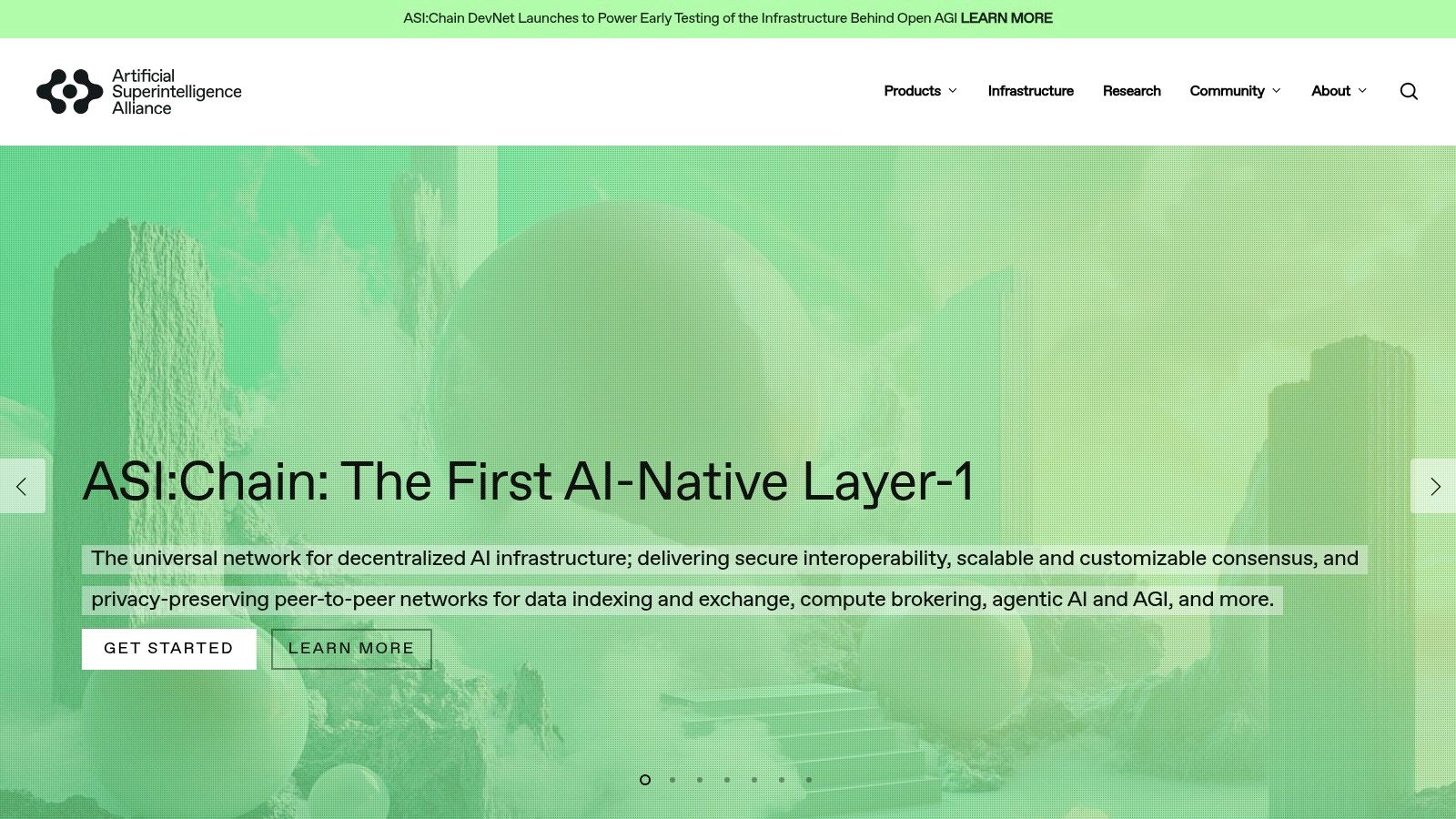
The alliance's primary goal is to build a decentralized AI infrastructure that is both ethical and transparent. By pooling Fetch.ai's autonomous agents, SingularityNET's AI services marketplace, and Ocean Protocol's data-sharing capabilities, ASI provides a complete stack for creating, deploying, and monetizing AI. This merger streamlines development and creates a more liquid, single-ticker asset for investors and ecosystem participants.
The transition from FET, AGIX, and OCEAN to the new ASI token is executed through a multi-phase migration process. Holders of the original tokens can convert them to ASI at fixed rates, a process managed through official token migration contracts.
The phased rollout of the merger across different exchanges and platforms has created short-term arbitrage opportunities and points of confusion. Observant traders noted price discrepancies between the legacy tokens and the implied ASI value during the initial migration phases. Smart money wallets have been strategically navigating this transition.
Tracking Top Wallets:
Use a tool like Wallet Finder to monitor large holders of FET, AGIX, and OCEAN as they migrate to ASI. Set alerts for large deposits to the migration contract or significant movements of the new ASI token from exchanges, which can signal long-term accumulation and confidence in the merged entity.
| ASI Token Merger Snapshot | Details |
|---|---|
| Unified Token | ASI (Artificial Superintelligence) |
| Primary Use Case | Network Transactions, Governance, Staking |
| Legacy Tokens | FET, AGIX, OCEAN |
| Conversion Rates | 1 FET = 1 ASI; 1 AGIX = 0.433350 ASI; 1 OCEAN = 0.433226 ASI |
Pro Tip: Always use the official migration portal and double-check contract addresses before initiating any token swaps. Due to the merger's high profile, phishing scams impersonating the official platforms are common. Verify all information through the official Superintelligence Alliance website and social media channels.
Visit the official website at https://www.superintelligence.io to access the official migration tools and developer documentation.
Akash Network has carved out a critical niche as a decentralized cloud marketplace, often described as the "Airbnb for GPUs." It directly connects users needing computational resources for AI/ML training and inference with providers who list their server capacity. This open-source cloud model allows developers to deploy applications using a decentralized network of providers, often securing high-demand GPUs like NVIDIA H100s at a fraction of the cost of centralized hyperscalers.
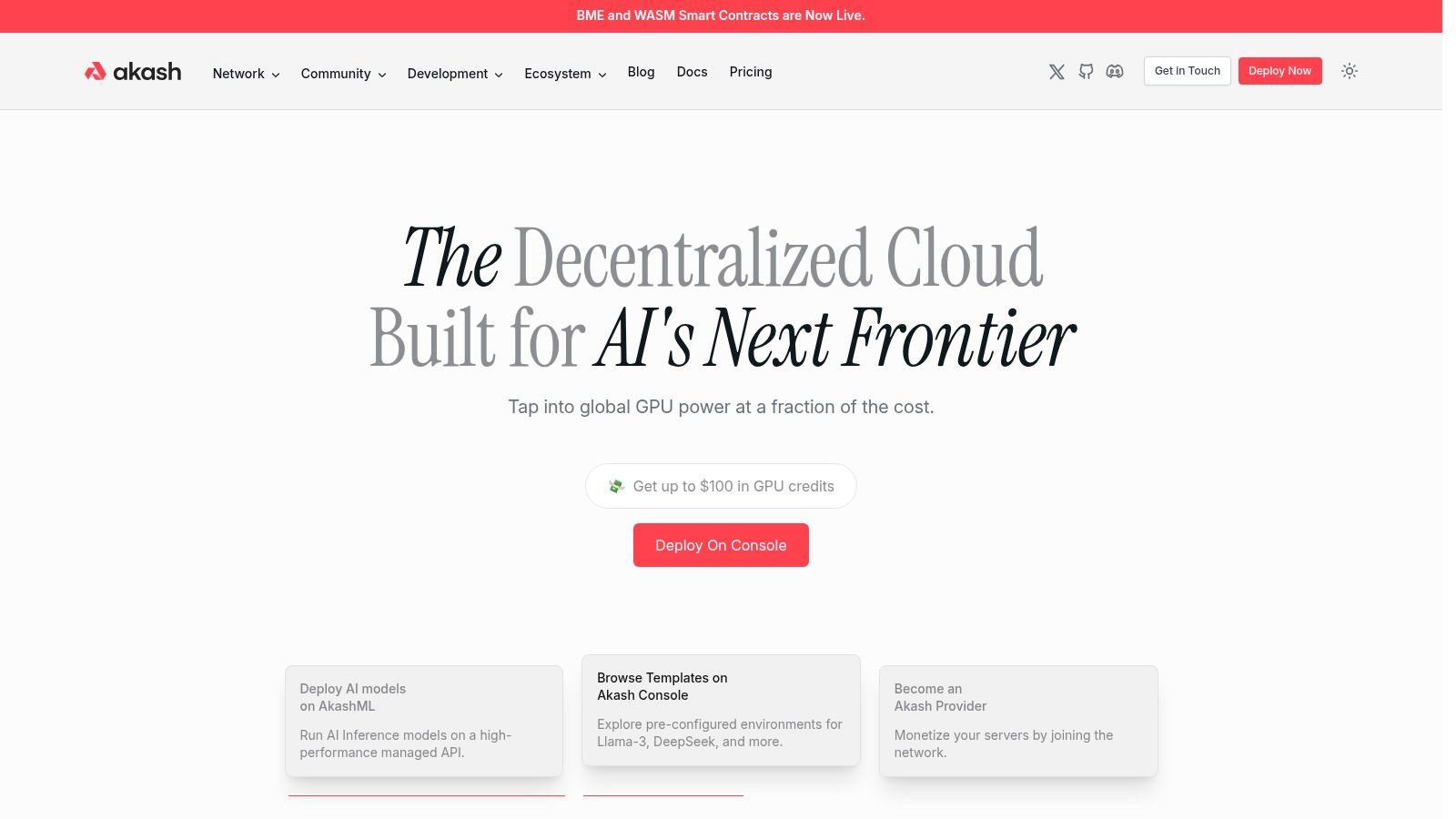
Built on the Cosmos SDK, Akash operates as its own sovereign proof-of-stake blockchain, giving it the flexibility to create a purpose-built environment for cloud computing. Its native token, AKT, is the lifeblood of the ecosystem, used for paying for compute, securing the network through staking, and participating in governance. This positions AKT as one of the top AI coins by tying its value directly to the adoption and usage of its decentralized cloud services.
Akash employs a reverse auction system. A user defines their deployment needs, and providers bid on the request. The user then selects the best offer, typically the lowest price, creating a competitive marketplace.
The growth of Akash is directly correlated with the supply and demand within its marketplace. High-profile partnerships and an expanding roster of GPU providers are key bullish signals. On-chain data reveals consistent accumulation by wallets that actively participate in the Cosmos ecosystem.
Tracking Top Wallets:
Use a Cosmos-compatible explorer or a tool like Wallet Finder to monitor staking and governance activity from large AKT holders. Setting alerts for wallets that unstake large amounts or send tokens to exchanges can be an early warning of selling pressure. Conversely, consistent staking rewards compounding and minimal outflow signal long-term conviction. It is also important to recognize how advanced tools detect unusual on-chain behavior, as you can learn more about how machine learning detects wallet anomalies to better inform your own analysis.
| Akash Token (AKT) Snapshot | Details |
|---|---|
| Current Chain | Akash (Cosmos SDK) |
| Primary Use Case | Payments, Staking, Governance |
| Technical Barrier | Requires knowledge of Docker/Kubernetes |
| Market Access | Available on major US exchanges (e.g., Coinbase, Kraken) |
Pro Tip: While Akash can be significantly cheaper, provider pricing varies. Use the Akash deployment guides and marketplace pricing pages to compare real-time costs for specific GPU models. The user experience is geared toward those with technical expertise, so it's not a one-click solution like a traditional SaaS platform.
Visit the official website at https://akash.network to browse the provider marketplace and explore the documentation for deploying your first application.
Positioning itself as a key player in the decentralized compute space, io.net is a Solana-based network designed to aggregate GPU power on a massive scale. It taps into underutilized resources from independent data centers, crypto mining farms, and consumer-grade hardware, creating a vast, distributed "Internet of GPUs." The network's core purpose is to provide affordable and accessible compute for AI and machine learning startups, which face significant cost barriers with traditional cloud services.
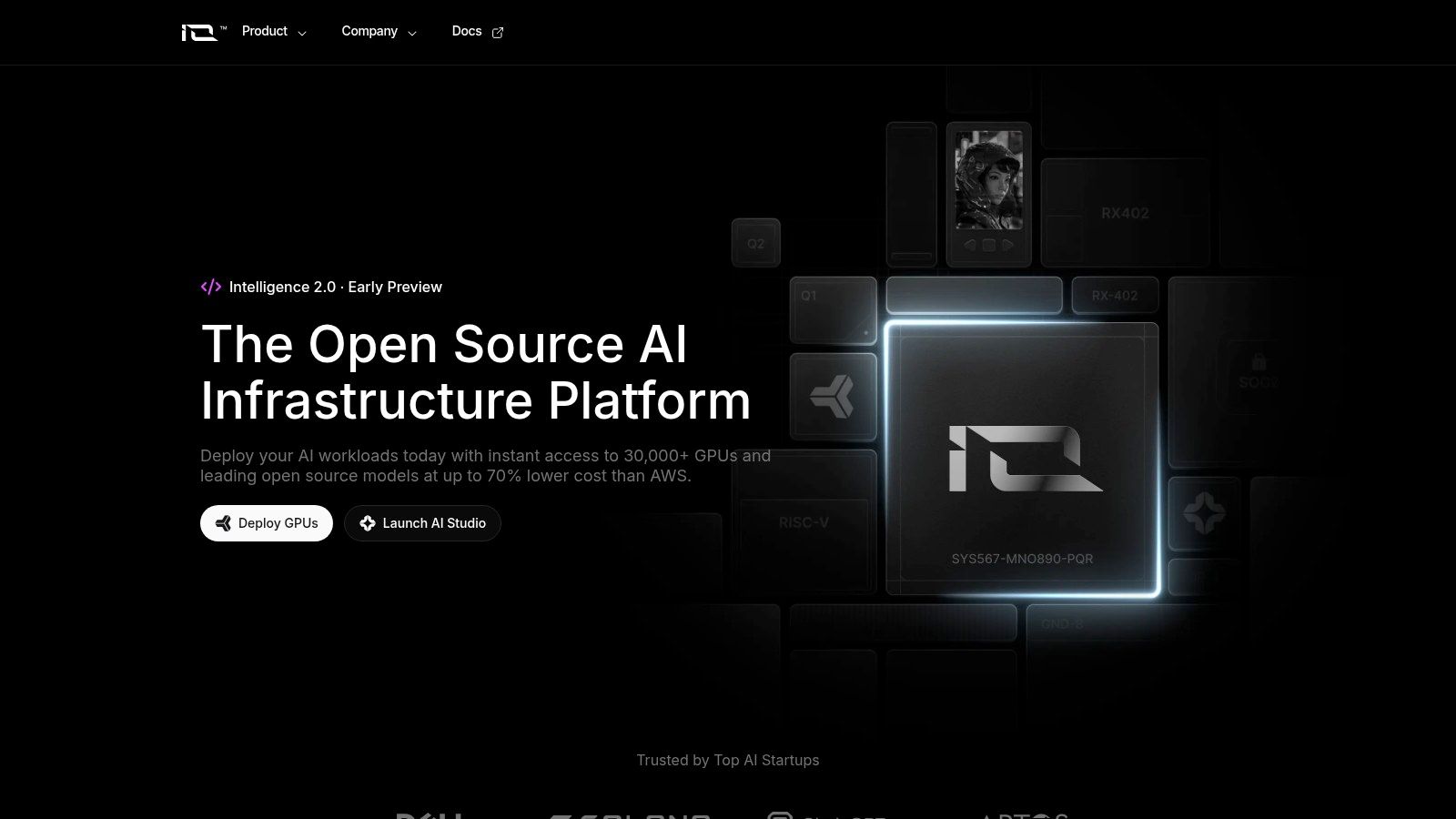
Built on Solana, io.net is architected for the high-transaction throughput and low settlement costs necessary for managing a global compute network. This allows for rapid job deployment and efficient payments, making it a competitive choice for AI companies needing to cluster thousands of GPUs for demanding training and inference tasks. Its model makes it one of the top AI coins to watch as the demand for compute continues to explode.
The platform connects suppliers of GPU power with consumers who need it. The IO token is central to the ecosystem, facilitating transactions and incentivizing network participation.
As a newer project with significant backing, io.net has attracted considerable attention from both investors and on-chain analysts. However, its early stage also presents unique risks and opportunities that require careful monitoring. Past incidents, like an early network exploit involving GPU ID spoofing, highlight the need for due diligence.
Tracking Network Health:
Use the official io.net Explorer and network dashboards to monitor active hardware, cluster availability, and job statistics. This provides a real-time view of the network's supply and demand dynamics, which can influence token value.
| IO Token Snapshot | Details |
|---|---|
| Current Chain | Solana (SPL Token) |
| Primary Use Case | Payments, Staking, Network Incentives |
| Network Status | Mainnet, Actively Onboarding Workers |
| Key Risk | Early-stage operational risks, network security |
Pro Tip: When interacting with the IO token, always verify the official contract address listed in the project's documentation. The crypto space is filled with fraudulent tokens imitating popular projects. Use a tool like Wallet Finder to identify and track smart money wallets that are accumulating IO, paying close attention to their transaction sizes and frequency to gauge institutional interest.
Visit the official website at https://io.net to read the tokenomics, access worker setup guides, and explore the network's capabilities.
The Graph serves as a decentralized indexing protocol, often called the "Google of blockchains," that makes on-chain data accessible and useful. While not a direct AI model or compute project, its role is critical for the AI ecosystem. It provides the structured, reliable, and fast data streams that AI applications, such as on-chain agent frameworks and prompt marketplaces, need to function effectively. By organizing blockchain data into accessible APIs called subgraphs, GRT is a key piece of infrastructure for building intelligent decentralized applications.
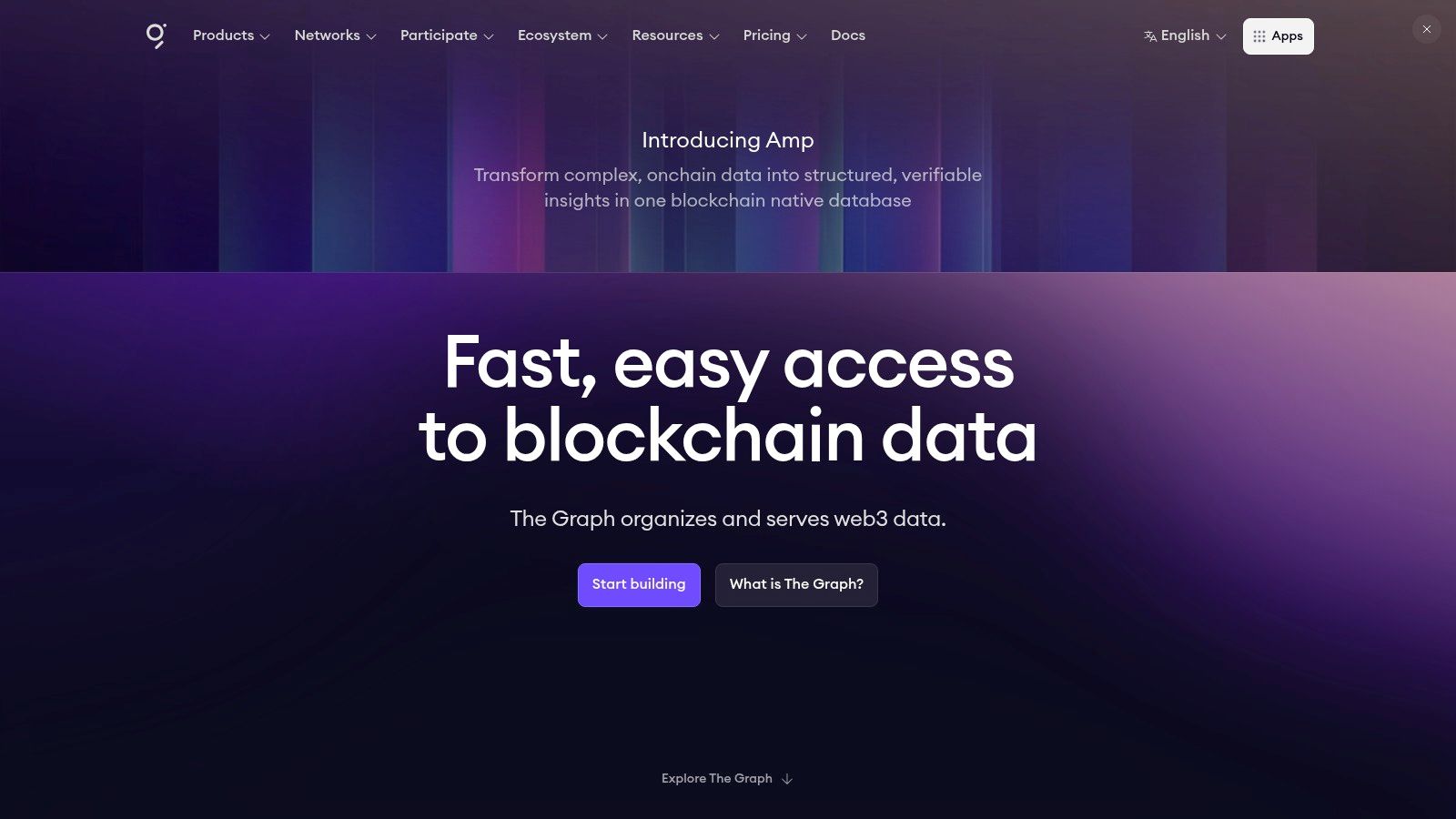
The protocol's maturity and widespread adoption across Web3 make it a standout. With its extensive tooling, clear documentation, and a vibrant ecosystem of network participants, The Graph has become a standard for dApp development. Its recent expansion to new chains and the introduction of Substreams for high-speed data streaming further solidifies its position, making it an essential, if indirect, player among the top AI coins by powering the data layer.
The Graph’s ecosystem relies on several key roles, all coordinated through the GRT token, to deliver decentralized query services. This creates a market-driven system for data indexing and retrieval.
The Graph's value is tied directly to the health of the Web3 ecosystem and the demand for on-chain data. As a utility token, GRT's price is influenced by network usage (query fees) and staking activity. Significant on-chain movements often correlate with staking and unstaking events by large Indexers or Delegators.
Tracking Top Wallets:
Use a tool like Wallet Finder to identify the largest GRT holders, particularly those tagged as Indexers or venture funds. Set alerts for large GRT transfers to and from exchange addresses. A sustained outflow from exchanges to private or staking wallets may indicate long-term holding and network participation, while inflows could signal selling pressure.
| GRT Token Snapshot | Details |
|---|---|
| Current Chain | Ethereum (ERC-20), Arbitrum |
| Primary Use Case | Payments (Query Fees), Staking, Curation, Governance |
| Network Roles | Indexer, Curator, Delegator, Consumer |
| Key Metric | Total Query Fees, Total GRT Staked |
Pro Tip: When analyzing GRT, pay close attention to the protocol's query fee burn rate, which was implemented via EIP-1559. A rising burn rate indicates increasing network demand, which is a positive fundamental signal for the token's value. This data is available on The Graph's network dashboards.
Visit the official website at https://thegraph.com to explore the Graph Explorer, view network statistics, and learn how to participate as an Indexer, Curator, or Delegator.
AIOZ Network is carving out a niche as a Layer-1 blockchain built specifically for the intersection of AI, decentralized storage, and media streaming. It provides a full-stack decentralized physical infrastructure network (DePIN) that aims to power real-time AI and media applications. By creating an ecosystem where users can contribute compute, storage, and bandwidth, AIOZ facilitates a distributed marketplace for digital assets and services, positioning it as one of the top AI coins for the creator economy.
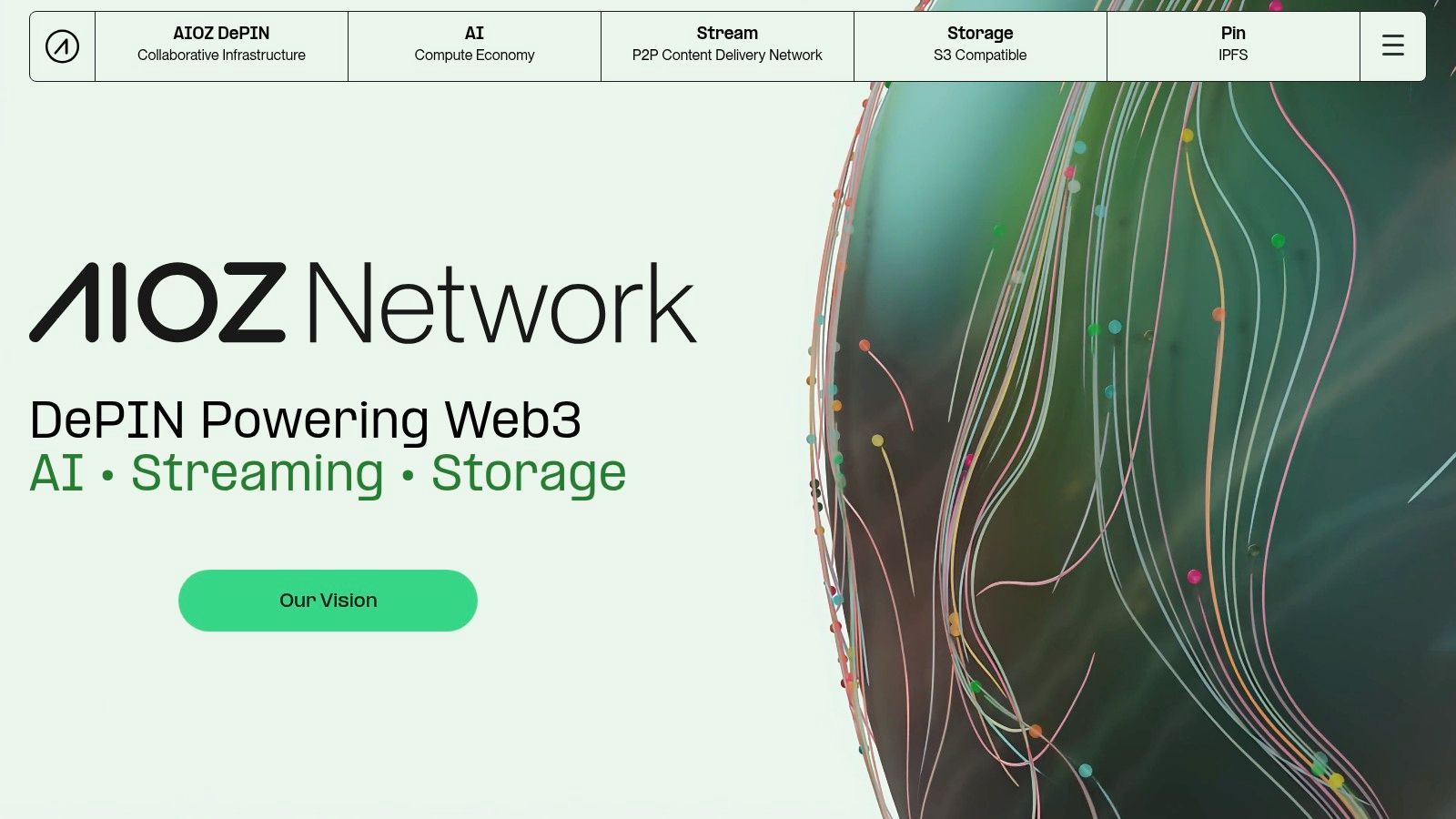
The network’s core offering, AIOZ AI, is a decentralized platform for AI models, datasets, and compute power. This allows developers to build, deploy, and monetize AI applications without relying on centralized cloud providers. This holistic approach, combining AI compute with native storage and delivery, is particularly suited for applications that require low-latency edge computing, such as video analysis, interactive media, and real-time AI inference.
AIOZ operates on a multi-layered model where participants contribute to the network's infrastructure and are rewarded with AIOZ tokens. Its interoperability with both Ethereum and Cosmos ecosystems broadens its reach and utility.
The AIOZ token's utility is tied directly to network activity, including transactions within its AI marketplace and fees from its streaming services. Recent listings on major exchanges like Coinbase have brought increased attention and liquidity, attracting a new wave of smart money traders. Tracking the flow of AIOZ to and from these exchanges can provide signals about market sentiment and accumulation trends.
Tracking Top Wallets:
To identify emerging patterns, use a tool like Wallet Finder to monitor wallets interacting with AIOZ-related smart contracts and exchange deposit addresses. Set alerts for large AIOZ movements from CEXs to private wallets, which often precedes a decrease in available sell-side supply. Analyzing this flow can give you an edge, as you discover how NLP analyzes crypto social media data to gauge market sentiment shifts.
| AIOZ Token Snapshot | Details |
|---|---|
| Current Chains | AIOZ Mainnet, Ethereum (ERC-20), BSC (BEP-20) |
| Primary Use Case | Gas/Transactions, Staking, Node Rewards, Marketplace Payments |
| Network Type | Layer-1, Cosmos SDK with EVM Compatibility |
| Key Features | DePIN for AI, Storage, and Streaming |
Pro Tip: The AIOZ token exists on multiple chains. Before trading or transferring, always verify you are using the correct network (native, ERC-20, or BEP-20) to avoid loss of funds. Pay close attention to exchange announcements regarding which version they support for deposits and withdrawals.
Visit the official website at https://aioz.network to learn more about running a node or exploring the AIOZ AI marketplace.
| Project | 🔄 Implementation complexity | ⚡ Resource requirements | ⭐ Expected outcomes | 📊 Ideal use cases | 💡 Key advantages |
|---|---|---|---|---|---|
| Render Network (RENDER) | Moderate — marketplace integration plus RNDR→RENDER migration steps | High — aggregated GPUs and Solana infra (low fees, high throughput) | ⭐ High — scalable decentralized GPU rendering and AI compute marketplace | Rendering, model inference/training requiring decentralized GPU capacity | Clear migration docs; Solana throughput and broad exchange support |
| Bittensor (TAO) | High — complex subnet mechanics and tokenomics (proof-of-intelligence) | Moderate — distributed contributors, models and staking infrastructure | ⭐ Variable — market-driven incentives can yield high-quality model contributions | Research networks, collaborative model training and incentive experiments | Novel PoI incentives; fair-launch ethos and active researcher interest |
| Artificial Superintelligence Alliance (ASI) | High — multi-phase cross-chain token merger and migration processes | High — pooled agents, models and datasets across founding ecosystems | ⭐ Potential — consolidated liquidity and unified cross-chain AI services | Cross-project marketplaces, integrated agent/data/model ecosystems | Merges FET/AGIX/OCEAN for greater liquidity; founder-led migration docs |
| Akash Network (AKT) | Moderate — requires DevOps/Kubernetes knowledge for deployments | High — GPU providers list hardware; competitive pricing vs hyperscalers | ⭐ High — cost-effective GPU rentals for scalable AI workloads | Cost-sensitive ML training and inference where teams manage infra | Lower-priced GPUs, Kubernetes “supercloud” positioning, price comparisons |
| io.net (IO) | Moderate — Solana-native worker setup and evolving operations (early risks) | High — aggregated idle compute from data centers/miners/individuals on Solana | ⭐ Growing — potential for large-scale, low-fee GPU settlement on Solana | Solana-native AI workloads needing high-throughput, low-fee settlement | Solana-native tooling and incentives; expanding hardware footprint |
| The Graph (GRT) | Low — mature protocol with established tooling and roles (indexers, curators) | Low — indexing infrastructure (not GPU-heavy) but requires node resources | ⭐ High — reliable on-chain data delivery for dApps and AI data needs | Prompt marketplaces, agent frameworks, apps needing indexed blockchain data | Mature tooling, production usage, broad exchange custody and listings |
| AIOZ Network (AIOZ) | Moderate — Layer‑1 DePIN with staged feature rollouts and integrations | High — distributed storage, edge compute and streaming bandwidth | ⭐ Promising — integrated media + AI infra and emerging model marketplace | Real-time media, streaming AI, edge compute and dataset/model marketplaces | Holistic DePIN stack (compute + storage + streaming); cross-chain bridges |
Throughout this guide, we've moved beyond surface-level analysis of the top AI coins. We dissected each project, from the GPU marketplaces of Render (RNDR) and Akash (AKT) to the decentralized intelligence of Bittensor (TAO) and the newly formed Artificial Superintelligence Alliance (ASI). We examined The Graph's (GRT) critical role in data indexing, and saw how networks like io.net (IO) and AIOZ Network (AIOZ) are building the physical infrastructure for a decentralized AI future.
But identifying promising projects is just the starting point. The real alpha in the crypto market is generated by translating this knowledge into a repeatable, data-backed trading strategy. The AI sector is particularly volatile, driven by technological breakthroughs, narrative shifts, and significant capital rotations. Relying only on official announcements or roadmap updates means you’re often getting information after the smart money has already made its move.
The most effective traders operate differently. They use the blockchain's inherent transparency as their primary source of truth, observing where capital flows in real-time. This on-chain approach provides an unfiltered view of market conviction, revealing which tokens are being accumulated by experienced funds and which are being distributed.
Your goal is to build a framework that combines fundamental analysis with on-chain intelligence. Here’s a practical way to structure your approach after identifying a potential AI coin to trade or invest in:
TAO or IO.AIOZ after a major dip, it provides a much stronger buy signal than simply looking at a price chart.Key Insight: Price action tells you what happened. On-chain data from smart-money wallets can tell you why it's happening and what might happen next. This is the difference between reacting to the market and anticipating it.
Not every AI coin presents the same type of opportunity, and your strategy should adapt accordingly. Your use of on-chain tools will differ based on the token’s maturity and your trading goals.
Ultimately, the power of on-chain analysis is that it strips away the noise. It bypasses the hype on social media and the often-biased project marketing. Instead, it provides a direct, immutable record of where the most experienced market participants are placing their capital. By learning to read these digital footprints, you move from being a passive investor to an active, informed trader equipped to navigate the dynamic world of the top AI coins.
Ready to stop guessing and start tracking the smart money in the AI crypto sector? Wallet Finder.ai gives you the power to discover and monitor the wallets of top-performing traders, providing real-time alerts on their trades. Use our platform to build your on-chain edge and make data-driven decisions on the top AI coins today.

A premier DeFi analytics platform empowering traders to discover and analyze profitable blockchain wallets, trades and tokens.