Agents AI Crypto: The Ultimate Guide

Wallet Finder

Blank calendar icon with grid of squares representing days.

January 12, 2026

When you hear "AI agents in crypto," don't picture old, clunky trading bots that just followed a simple "if-then" script. We've moved way beyond that. Think of it less like a rigid calculator and more like a savvy financial analyst that works for you 24/7, constantly learning and adapting to the chaos of the crypto market.

What Are Autonomous Agents in Crypto?

At its heart, an AI crypto agent is a smart program built to operate on its own within the wild world of decentralized finance (DeFi). The old bots were pretty basic—maybe they'd buy an asset when a price indicator crossed a line. These new agents have a much more sophisticated digital mind. They can sift through massive streams of on-chain data, spot complex patterns, and execute entire strategies with multiple steps, all without you needing to lift a finger.

This independence is what truly makes them different. They aren't just tools you command; they're goal-oriented decision-makers. You could give an agent a simple goal, like maximizing the yield on your ETH, and it would get to work. It would constantly scan liquidity pools, compare lending rates, and even factor in gas fees to figure out the absolute best way to hit that target.

The Perfect Playground for AI

The crypto market is basically the ultimate playground for these AI agents. It never sleeps, and the blockchain provides a transparent, ever-expanding ocean of public data. This creates the perfect sandbox for an AI to learn, test, and execute.

An AI agent can analyze every single transaction on a blockchain—something no human team could ever do—to learn the behaviors of successful traders, identify emerging token trends, and react to market shifts in milliseconds.

The sheer volume of this data is staggering and only getting bigger. The global cryptocurrency market is on track to hit over $15 billion by 2030, with daily trading volumes already soaring. This massive scale creates the rich signal environment that agents need to find a statistical edge and effectively track what the "smart money" is doing. You can learn more about these market projections and their impact.

When you combine this firehose of data with clear success metrics (profit and loss) and the ability to directly execute trades on-chain, it's easy to see why crypto is becoming the premier training ground for the next wave of financial AI.

How AI Agent Architectures Actually Work

So, how do these crypto AI agents actually think? It’s not just a bunch of random code firing off transactions. There’s a structured, repeatable process at the heart of it all, one that mimics how a human expert might operate—only at a speed and scale that’s impossible for any person to match.

At its core, the agent’s logic often follows a simple but powerful cycle: Observe, Orient, Decide, and Act. It’s a concept borrowed from military strategy, but it applies perfectly to the fast-paced world of DeFi.

  1. Observe: The agent constantly pulls in a massive firehose of real-time data from countless sources. This includes prices, transaction volumes, social media sentiment, wallet movements—everything. Getting this data stream right is mission-critical, which is why a solid crypto price API is often the starting point.
  2. Orient: The agent sifts through all that noise to find the signal, identifying patterns, potential risks, and fleeting opportunities.
  3. Decide: Based on this analysis, it determines the best possible move to hit its programmed goal.
  4. Act: Finally, it executes a swap, a transfer, or another transaction directly on the blockchain.

This entire flow, from raw data to on-chain action, is a continuous loop.
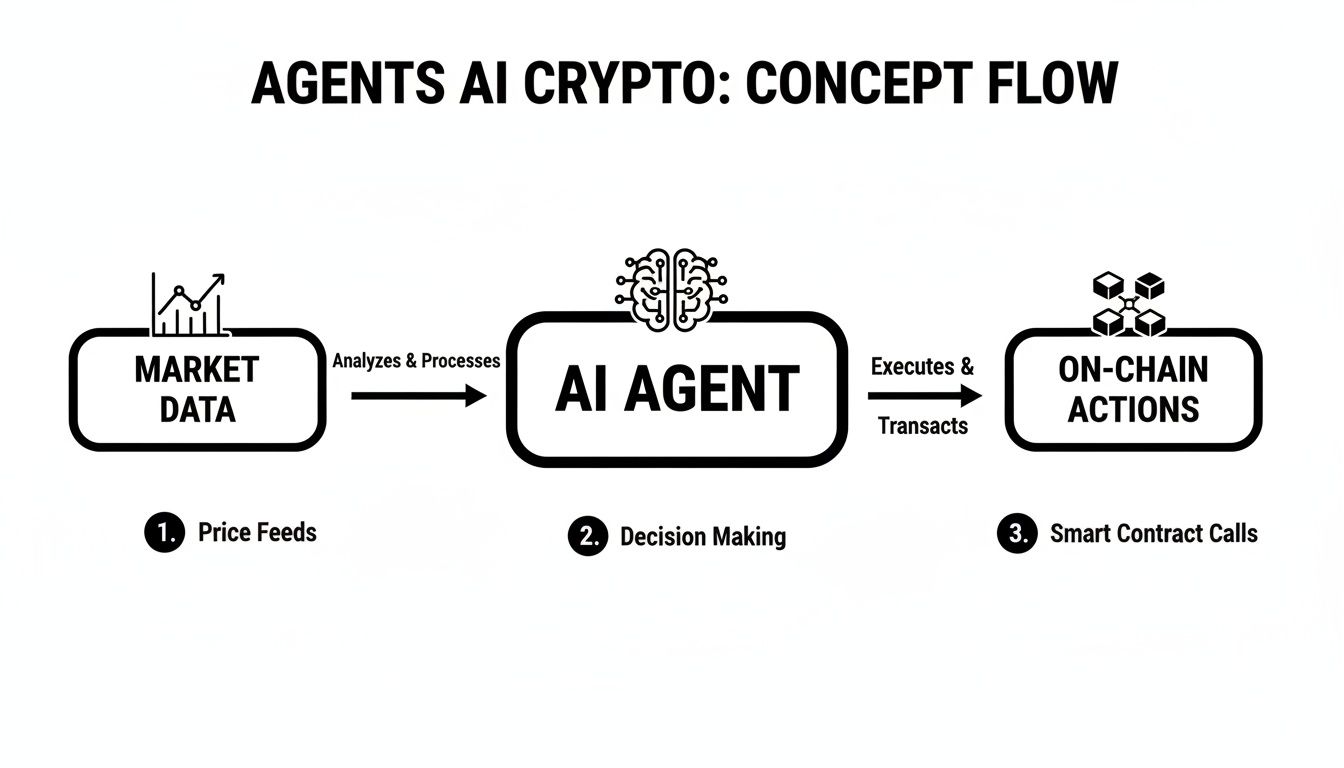
Flowchart detailing an AI agent's process from market data analysis to on-chain crypto transactions.

As the diagram shows, the agent acts as the "brain" between market data and the blockchain, turning information into automated, intelligent action.

Exploring Key AI Agent Toolchains

To actually build one of these agents, developers don’t start from scratch. They use specialized frameworks—or toolchains—that act as the foundational building blocks for creating autonomous systems. Think of them as construction kits for AI.

You’ll run into a few common approaches, each with its own strengths:

  • AutoGPT: This one is great for laser-focused tasks. You give it a single, clear objective, like "find the top three trending memecoins on the Base network," and it will work autonomously until the job is done.
  • LangChain: This is more like a set of programmable LEGO bricks. It excels at creating complex, multi-step workflows by letting you chain together language models, data sources, and on-chain tools to build sophisticated, reactive agents.
  • Reinforcement Learning (RL): This is where agents truly learn and evolve on their own. An RL agent is basically thrown into a simulated market to trade. It learns from its profits (rewards) and its losses (punishments), running through thousands of strategies until it discovers a highly optimized approach that a human might never find.

The real magic happens when you start combining these toolchains. For instance, you could build a LangChain agent that listens for signals from a platform like Wallet Finder.ai. When an interesting wallet makes a move, it could trigger an AutoGPT instance to do a deep dive on the token's fundamentals before deciding whether to execute a copy trade.

The right framework depends entirely on what you want the agent to do—from simple, one-off tasks to discovering entirely new ways to navigate the market.

Comparing Popular AI Agent Toolchains

To make things clearer, here’s a quick breakdown of how these toolchains stack up for crypto-specific tasks. Each offers a different path to building an autonomous agent, so choosing the right one is key to success.

ToolchainPrimary FunctionCommon Crypto Use CaseCore Strength
AutoGPTAutonomous Goal-Driven Task ExecutionAutomating research and market analysis tasksSimplicity and strong focus on achieving a single, defined goal
LangChainBuilding Complex Agentic WorkflowsCreating wallet-following agents that react to alertsFlexibility in chaining models, data, and actions
Reinforcement Learning (RL)Learning Optimal Strategies via Trial & ErrorDeveloping novel high-frequency trading modelsAbility to discover non-obvious strategies in complex environments

Ultimately, the choice of toolchain shapes the agent's capabilities. Whether you need a simple task-doer, a complex workflow manager, or a self-learning trading bot, there’s a framework designed for the job.

Powerful Use Cases for AI Agents in DeFi

An AI robot links to crypto liquidity pools, high-frequency trading, wallet following, and yield farming strategies.

Enough with the theory—let's get into what these agents ai crypto strategies actually do. We're seeing autonomous systems reshape decentralized finance (DeFi) in real-time, executing complex financial operations around the clock. This isn't just a futuristic concept; it's happening right now.

These agents thrive on tasks that require superhuman speed and data-crunching power. From high-octane trading to slow-and-steady portfolio management, their versatility blows simple, rule-based bots out of the water.

Here are the most impactful strategies being deployed today:

Automated Trading and Market Making

One of the clearest wins for AI agents is in high-frequency trading (HFT) and automated market making (AMM). In the world of HFT, an agent can scan thousands of data points a second, spotting tiny price differences across decentralized exchanges (DEXs) and executing profitable arbitrage trades before a human even blinks.

For market making, agents act as tireless liquidity providers. They constantly adjust their positions in trading pools based on real-time order flow and volatility. This creates tighter spreads and deeper liquidity, which is great for the overall health of DeFi, and it earns fees for the agent's owner. It's capital efficiency on a level that's simply impossible to achieve manually.

Wallet Following and Copy Trading

A hugely popular and surprisingly accessible strategy is creating agents that just copy the moves of proven, high-performing traders. You might know this as wallet-following or copy trading.

By tapping into a feed of real-time on-chain data, an agent can be programmed to automatically replicate the trades of a proven "smart money" wallet. This transforms the complex art of alpha generation into a systematic, automated process.

This is where platforms like Wallet Finder.ai become a game-changer. An agent can be set up to listen for alerts from a top-performing wallet you've identified. When that wallet makes a move, the agent instantly gets the signal and kicks into action.

It can be programmed to:

  • Analyze the transaction: Double-check things like gas fees, slippage, and the security of the token contract.
  • Determine trade size: Calculate the right position size based on its own portfolio's rules.
  • Execute the copy trade: Automatically place the same buy or sell order on a DEX.

This entire sequence can unfold in seconds. It allows everyday users to mirror the strategies of elite DeFi traders without being chained to a screen. Of course, this all hinges on rock-solid triggers and execution logic, a key component of smart contract automation for scalable DeFi strategies.

Dynamic Portfolio and Yield Optimization

Beyond the frenzy of active trading, AI agents are perfect for the patient work of continuous portfolio management. Imagine an agent tasked with keeping your portfolio balanced. It monitors your asset allocations 24/7. If a token skyrockets and throws your risk profile out of whack, the agent can automatically sell a portion to lock in profits and reallocate the funds.

It's the same story with yield farming. An agent can constantly scan different lending protocols and liquidity pools, hunting for the highest Annual Percentage Yield (APY). It will automatically shift capital between protocols to chase the best returns—a process often called "yield switching." This makes sure your capital is always deployed in the most efficient way possible, maximizing your gains while staying within the risk parameters you've set.

Your Blueprint for Building a Crypto AI Agent

Diagram showing an automated crypto trading workflow from Telegram alert to decision engine, smart contract execution, and on-chain trade.

Alright, let's move from theory to a practical game plan. Building your first AI crypto agent can sound like a huge undertaking, but it doesn’t have to be. A great starting point is a simple, yet incredibly powerful, wallet-following agent.

The idea is to create a bot that automatically copy-trades the moves of a proven trader. Your agent will simply watch for signals, process the information, and execute the same trade on your behalf. It’s systematic, disciplined, and removes emotion from the equation.

To pull this off, you only really need three core pieces. Think of them as the building blocks for your own automated trading operation.

The Three Core Building Blocks

Every solid wallet-following agent comes down to the same three layers: data, decision-making, and execution. Nail these, and you've got a reliable system.

  1. The Data Source (The Ears): This is how your agent listens for opportunities. It needs a real-time feed of trade alerts, which could be a Telegram channel from a service like Wallet Finder.ai, a custom API, or a webhook that pings you when a specific on-chain event happens. This layer’s only job is to get the signal, fast and reliably.

  2. The Decision Engine (The Brain): Once a signal comes in, the agent has to think. At its simplest, this could just be a script with a few hardcoded rules. A smarter engine might use a LangChain workflow to pull in more context—like current gas prices, potential slippage, or token contract safety—before giving a thumbs-up or thumbs-down on the trade.

  3. The Execution Layer (The Hands): After getting the green light, the agent has to act. This is the part that connects to the blockchain using libraries like web3.js or ethers.js. It builds the transaction, signs it securely with your private key, and sends it off to a DeFi protocol to get the trade done. This is where rubber meets the road.

The rising interest from big players is a huge reason why wallet-following works so well. Institutions are expected to hold around 4.2 million BTC by 2026. For us, that means AI agents can be trained on the highly disciplined strategies of these massive funds, letting us shadow moves that were once completely invisible to the average trader.

A Conceptual Workflow in Action

Let’s make this concrete. Imagine your agent gets a Telegram alert from Wallet Finder.ai: "Top Trader 'AlphaWhale' just swapped 10 ETH for 3M WIF on Raydium."

Here’s how your agent would spring into action:

  • Signal Ingestion: A script monitoring the Telegram channel immediately parses the message. It pulls out the key details: the token (WIF), the amount, and the exchange (Raydium).
  • Contextual Analysis: The decision engine kicks in. It might check Solana’s current gas fees, ping an API to double-check the WIF token's liquidity and contract address, and run it against your own risk parameters (e.g., "never allocate more than 2% of the portfolio to a single trade"). You can even teach your agent to better understand market chatter by learning how to preprocess sentiment data for AI models.
  • Trade Execution: If all the lights are green, the execution layer connects to Raydium’s smart contracts, builds a similar swap scaled to your portfolio size, and fires it off.

The entire sequence—from the moment the alert hits to your trade being confirmed on-chain—can happen in seconds. This is the real power of combining high-quality signals with automated execution to build your own trading system.

This blueprint gives you a clear and totally achievable starting point. By breaking the problem down into these three layers, you can start building your own on-chain agents and begin tapping into the same strategies used by the best in the market.

Essential Safety and Risk Management Practices

Building an AI agent that works is only half the battle. The real test is deploying it safely in the wild, unforgiving world of crypto markets. When you give an autonomous agent the keys to your funds, you absolutely need a rock-solid framework of safety checks and risk controls.

Without them, a tiny bug or an unexpected market swing can cause massive, irreversible losses. Think of it as your pre-flight checklist. Before your AI crypto agent ever touches a dime of real capital, it has to pass rigorous testing and be wrapped in multiple layers of protection. Skipping this step isn't just risky—it's a recipe for financial disaster.

The first, most critical step is backtesting. This is where you run your agent's strategy against historical market data to see how it would have performed in the past. It’s a simulation that lets you validate your logic and fine-tune parameters without risking a single dollar.

Implementing Non-Negotiable Risk Protocols

Once your strategy looks good on paper (or in backtesting), you must implement strict risk management protocols. These are the circuit breakers that will protect your capital when things inevitably go sideways.

Your agent needs hardcoded rules that it cannot break, no matter what its AI model is telling it to do. These rules are your ultimate safety net.

Here is an actionable checklist of protocols to build in:

  • Position Size Limits: A simple rule that stops the agent from putting more than a set percentage of the portfolio (e.g., 2-5%) into a single trade. This contains the damage from any one bad call.
  • Maximum Drawdown Rules: If the agent’s total portfolio value drops by a predetermined amount (say, 15%), it should automatically shut down all trading to prevent a complete wipeout.
  • Slippage Tolerance: Set a maximum acceptable slippage (e.g., 1-2%) for each trade. If the expected price impact is too high, the trade is cancelled.
  • A Manual Kill Switch: You must have a big red button—a "kill switch"—to instantly shut down all agent activity with a single command. This is your emergency brake for black swan events or bizarre agent behavior you didn't anticipate.

A well-designed agent isn't just smart about finding opportunities; it's engineered to be extremely cautious. The primary goal of risk management isn't to maximize every gain but to ensure the agent survives to trade another day.

The modern DeFi ecosystem provides a perfect playground for these agents. Prediction markets, stablecoins, and various DeFi rails are becoming a live training ground for AI agents that manage wallets, hedge risk, and execute copy-trading strategies. Deep stablecoin liquidity across chains like Ethereum, Solana, and Base reduces slippage, enabling complex routing and instant portfolio rebalancing.

Combine this environment with on-chain analytics layers like Wallet Finder.ai—which surfaces top-performing wallets and their trade histories—and you have a recipe for continuous learning. Agents can learn from every profitable strategy they copy, effectively turning global DeFi into an open, data-driven sandbox for smarter AI trading systems. You can read more about how the crypto landscape is evolving for AI on SVB.com.

Securing Your Agent's Foundation

Finally, you can't ignore the basics of security. Your agent's private keys are the literal keys to the kingdom, so protecting them is your top priority.

Stick to these security principles, no exceptions:

  • Use a Dedicated Hot Wallet: Never, ever give an agent access to your main savings or cold storage. Fund a completely separate wallet with only the capital you are fully prepared to lose.
  • Secure Key Management: Store private keys in a secure environment, like a dedicated hardware security module (HSM) or a trusted key management service. Never store them in plaintext files or commit them to public code repositories.
  • Smart Contract Audits: Before letting your agent interact with a new DeFi protocol, check if its smart contracts have been professionally audited. This helps you steer clear of common exploits that could put your funds at risk.

Frequently Asked Questions About AI Crypto Agents

As the world of AI crypto agents picks up steam, it's natural to have questions. This new frontier mashes together some pretty complex fields, but getting a handle on the basics is easier than you might think. Let's clear up some of the most common queries so you can navigate this space with a bit more confidence.

What's the Real Difference Between a Trading Bot and an AI Agent?

Think of a simple trading bot like a calculator. It follows a rigid set of "if-then" rules you feed it. For example, "buy when indicator X crosses line Y." It's purely mechanical and can't learn, adapt, or understand any context beyond those pre-programmed instructions.

An AI agent, on the other hand, is more like a junior financial analyst you've hired. You give it a high-level goal, like "maximize profit from Solana memecoins while keeping risk below 10%," and it uses learning models to figure out its own strategy. It makes complex, context-aware decisions that go way beyond simple rules.

Is It Safe to Give an AI Agent Control of My Crypto Wallet?

Handing over control of your funds to any automated system has risks, and you have to put safety first. The security of an AI crypto agent setup comes down to two things: the quality of the agent's code and the strict risk parameters you lock in.

Best practices are non-negotiable here. Always start with a dedicated "hot wallet" funded with a small amount of capital you are totally prepared to lose. Implement strict controls like maximum trade sizes, daily loss limits, and a manual "kill switch" to shut everything down instantly. Never, ever grant an agent access to your primary savings or cold storage wallet.

Do I Need to Be a Programmer to Use AI Crypto Agents?

Not anymore. While building an agent from the ground up still requires some serious coding chops, a new wave of no-code and low-code platforms is opening this tech up to everyone. These tools often use visual interfaces, letting you drag and drop components to build out agent workflows without writing code.

A really powerful approach is to connect AI-driven signal providers, like Wallet Finder.ai, to simpler automated execution platforms. This setup lets you act on sophisticated AI insights without having to program anything yourself.

This hybrid model gives you the brain of an AI-driven strategy without the steep learning curve, making advanced strategies accessible to a much wider audience.

Where Do I Find Good Data to Feed an AI Agent?

High-quality data is the fuel for any effective AI agent. Without it, even the smartest model is just guessing. For on-chain trading, you need real-time, accurate, and actionable data.

You can get raw data from node providers and blockchain APIs like Alchemy or Infura, but that usually requires a ton of processing to be useful. For more refined, ready-to-use signals, platforms designed to interpret on-chain activity are a game-changer.

A service like Wallet Finder.ai is a perfect example. It crunches massive amounts of raw on-chain data to pinpoint the trades and strategies of top-performing wallets. This gives you a powerful, pre-analyzed data source you can plug directly into your agent's decision-making process, saving you a ton of time and giving you a serious edge.


Ready to turn on-chain data into your competitive advantage? Wallet Finder.ai gives you the real-time signals and deep wallet analytics you need to build smarter, more effective trading strategies. Start your 7-day trial and see what the smart money is doing. Discover your edge today.