TradingView Crypto Screener: A Pro's Guide

Wallet Finder

Blank calendar icon with grid of squares representing days.

February 26, 2026

The TradingView crypto screener is a powerful tool for one simple reason: it cuts through the market noise. It’s designed to help you filter thousands of digital assets down to a small, manageable list of coins that actually fit your unique trading strategy.

Instead of getting overwhelmed by endless charts, you can scan the entire crypto market for specific, actionable criteria—like price action, volume spikes, and technical indicator setups. It’s all about turning market chaos into focused trade ideas.

Finding Trading Signals in a Noisy Market

With thousands of cryptocurrencies out there, finding a real opportunity can feel like searching for a needle in a haystack. Every day, countless assets jump up and down, creating a chaotic environment that makes clear-headed decisions almost impossible. How do you tell a random, temporary spike from a genuine trend? Or spot an undervalued gem before everyone else does?

This is exactly where the TradingView crypto screener becomes your best friend. Think of it as a highly sophisticated filter sitting between you and the raw, messy market data. Instead of manually clicking through hundreds of charts, you can tell the screener exactly what you're looking for, and it will bring the opportunities right to you.

From Chaos to Clarity

The screener's main job is to transform that market chaos into a clean, focused list of assets that are actually worth your time. It helps you pinpoint coins with very specific characteristics, such as:

  • Sudden Volume Surges: Identify coins seeing a massive, unusual increase in trading volume.
  • Bullish Technical Signals: Find assets flashing signals like a golden cross or an RSI breakout.
  • Sustained Momentum: Pinpoint tokens that have shown strong, consistent performance over the last week or month.

This gives you a huge advantage, shifting your approach from passively watching the market to actively hunting for setups. The TradingView Crypto Coins Screener covers over 4,021 individual cryptocurrencies. Just applying one simple filter—like a 24-hour trading volume over $1 billion—can instantly shrink that massive list down to just a handful of high-liquidity coins.

This dashboard is a great starting point, but the real magic happens when you start applying custom filters to hunt for specific trade setups. When you combine this kind of technical screening with a solid understanding of crypto market sentiment analysis, you start building a much more complete picture. The pros often take it a step further, pairing these signals with on-chain intelligence from tools like Wallet Finder.ai to create an even stronger trading edge.

Your Essential Toolkit for Building Custom Scans

Think of the TradingView crypto screener as your command center for sifting through the noise of the market. Instead of getting lost in a sea of thousands of coins, the platform neatly organizes its powerful filters into three distinct categories. Mastering these is the first step to building scans that actually find assets matching your strategy.

The whole point is to act like a funnel, turning the massive, chaotic crypto market into a small, manageable list of high-potential trade ideas.
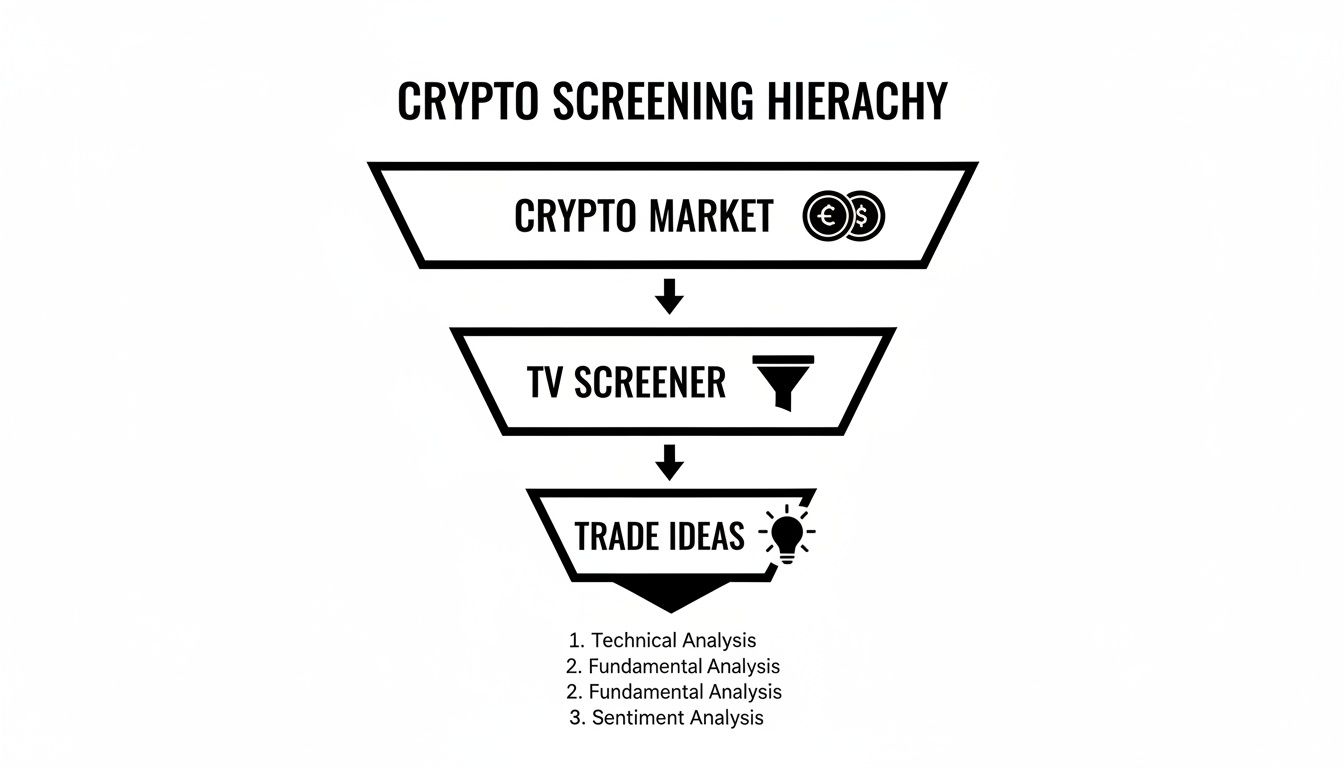
Flowchart illustrating crypto screening hierarchy: Crypto Market -> TV Screener -> Trade Ideas.

This process is all about efficiency. You apply your specific rules, and the screener does the heavy lifting, leaving you with a handful of charts worth your time. Let's break down the three core filter types you'll be using to build that funnel.

Descriptive Filters

Descriptive filters are your first, most basic cut. They help you define the universe of assets you want to look at before you even think about price action or indicators. Think of them as the high-level bouncers at the door.

You can use them to slice the market by:

  • Exchange: Want to see only what’s listed on Binance, Coinbase, or a specific DEX? This is the place.
  • Asset Type: You can focus strictly on spot markets or dive into derivatives like perpetual futures.
  • Category: TradingView has seriously stepped up its game here. You can now screen for niche sectors like Meme coins (MEME.C) or Real-World Assets (RWA.C).

Setting these first is just good practice. It ensures your more detailed filters are only applied to relevant coins, which saves a ton of time.

Fundamental Filters

Next up are fundamental filters, which help you size up a coin's overall market health and presence. These numbers give you crucial context that a price chart alone can't. This is where you find liquid assets and avoid illiquid traps.

It's a classic rookie mistake to obsess over technicals while ignoring fundamentals. Metrics like volume and market cap are your best friends for risk management—they help make sure you can actually get in and out of a trade without massive slippage.

Key fundamental filters include:

  • Market Capitalization: Hunt for large-cap "blue chips" (e.g., >$10B) or go digging for low-cap gems with explosive growth potential (e.g., <$50M).
  • Volume (24h): Make sure there are enough buyers and sellers by setting a minimum volume (e.g., >$1M). This is non-negotiable for active traders.
  • Total Coins Outstanding: Get a feel for the token's supply, which plays a big role in its long-term valuation potential.

Combining these helps you focus on projects that are less likely to be wildly manipulated and have a solid footing in the market.

Technical Filters

This is where the real magic happens for most traders. Technical filters scan the entire market for specific chart patterns and indicator signals, automatically flagging setups that meet your exact entry criteria.

The TradingView crypto screener is loaded with dozens of technical indicators. To give you an idea of what’s possible, let’s look at a few of the most powerful filters and how you can use them to find specific opportunities.

Essential TradingView Screener Filters and Their Purpose

Filter CategoryKey FilterWhat It Helps You Find
MomentumRelative Strength Index (RSI)Coins that are oversold (RSI < 30) and might be due for a bounce, or **overbought** (RSI > 70) and could be heading for a reversal.
TrendMoving Average (50/200)Assets in a strong uptrend (Price > 50MA > 200MA) or a confirmed downtrend, helping you trade with the market's flow.
VolatilityAverage True Range (ATR)Highly volatile coins perfect for short-term day trading, or low-volatility assets better suited for stable trend-following strategies.

When you start layering these technical filters on top of your descriptive and fundamental rules, you create an incredibly powerful, multi-faceted scan. It’s a systematic approach that guarantees you only spend time analyzing assets that check every single box on your trading plan.

Proven Screener Recipes for Any Market Condition

Knowing which filters to use is half the battle. The real magic happens when you combine them into a repeatable system that gives you an edge. A great screener setup is like a good recipe—you need the right ingredients in the right amounts to get the perfect result.

This section gives you three practical recipes you can plug into the TradingView crypto screener right now. Think of them as battle-tested starting points you can use immediately or tweak to match your own trading style.

Three cards illustrating crypto trading strategies: Breakout Hunter, Undervalued Gem, and DeFi Blue-Chip.

Let's break down the exact filters and the logic behind each one, so you can go from theory to an actionable trading playbook.

Recipe 1: The Breakout Hunter

This scan is built for momentum traders. The goal is to catch explosive moves by finding coins with heavy buying pressure that are smashing through key resistance levels. This strategy works best in a bullish or choppy, sideways market.

Actionable Steps:

  1. Filter for Liquidity: Set Volume (24h) to Above 1M. This weeds out illiquid coins and ensures there’s enough market participation to fuel a real move.
  2. Find Daily Strength: Set Change vs Open (Daily) to Above 3%. We’re looking for coins that are already showing serious strength on the day.
  3. Spot Unusual Activity: Set Relative Volume to Above 1.5. This is the secret sauce. It flags coins trading at 1.5x their average volume, signaling unusual interest.
  4. Confirm the Breakout: Set Price to New 1-Month High. This confirms the price is breaking out of its recent range.

This combination is powerful because it finds coins with both unusual interest (high relative volume) and proven price momentum (new monthly high). It's a classic way to get in on the ground floor of a new uptrend.

Recipe 2: The Undervalued Gem Finder

This recipe is for the treasure hunters looking for tomorrow's winners today. We're digging for low-cap coins that are just starting to show signs of life. It’s a higher-risk, higher-reward play focused on finding hidden gems before the rest of the market catches on.

The real edge in finding undervalued gems isn't just about spotting low market caps. It's about finding the ones that also exhibit strong recent performance, suggesting a fundamental shift or growing narrative that the broader market hasn't priced in yet.

Actionable Steps:

  • Target Small Caps: Set Market Capitalization to Below $50M. This immediately zooms in on the micro-cap and nano-cap world where explosive growth can happen.
  • Focus on Relevant Exchanges: Filter for major decentralized exchanges (DEXs) or exchanges known for listing new, smaller tokens.
  • Look for a Spark: Set Change (1W) to Above 20%. We don't want dead coins. We want to see a spark of life and strong recent momentum.
  • Check Tokenomics: Set Total Coins Outstanding to Below 1B. This filter helps screen out projects with hyper-inflationary tokenomics that could dilute your investment.

This scan won't give you a "buy" signal on its own. Instead, it builds a powerful watchlist of promising small-cap projects that deserve a much deeper dive into their fundamentals.

Recipe 3: The DeFi Blue-Chip Scan

If you prefer sticking with the big dogs, this scan is for you. It identifies large, established DeFi projects that are showing relative strength against the rest of the market. It's a perfect setup for swing trading or building a core portfolio position when the market is stable or trending up.

The mission here is simple: find liquid, well-known projects that are already in a solid uptrend.

Actionable Steps:

  • Narrow the Sector: Set Category to Decentralized Finance (DeFi). This instantly focuses your search.
  • Filter for Leaders: Set Market Capitalization to Above $500M. We’re only interested in the established leaders in the DeFi space.
  • Confirm the Trend: Set Price to Above SMA 50. This is a quick and easy way to confirm the asset is in a healthy medium-term uptrend.
  • Find a Good Entry: Set RSI (14, Daily) to Between 50 and 70. This helps find coins that are in a strong trend but aren't yet wildly overbought, giving you a better entry point.

This recipe helps you cut through the noise and concentrate your capital on the strongest players in one of crypto's most important sectors.

Adding On-Chain Intelligence to Your Market Scans

Market data from a tool like the TradingView crypto screener is fantastic at telling you what is happening. It shows you which assets are breaking out, where volume is pumping, and which indicators are flashing green.

But it’s missing a huge piece of the puzzle: the who.

That’s where on-chain intelligence comes in. While market screeners track price and volume, on-chain analysis tools track the actual wallets behind the trades. This gives you a massive edge by revealing whether the smartest, most profitable players are buying or selling the very assets your screener just flagged.

A candlestick chart with green and red bars validating 'Smart Money' represented by a blue wallet icon.

When you combine these two views of the market, you get a powerful, high-conviction trading workflow. You move from just spotting a good technical setup to confirming that smart money agrees with your thesis.

A Powerful Two-Step Workflow

The core idea here is simple: use each tool for what it does best. First, you cast a wide net with TradingView to find technically strong assets. Then, you use an on-chain tool like Wallet Finder.ai to zoom in and see if the pros are getting involved.

Here’s what this powerful workflow looks like in practice:

  1. Screen for Opportunity: Use one of the screener recipes we covered—like the "Breakout Hunter"—to build a small, focused watchlist of 3-5 coins that look ready to move. This is your list of candidates based purely on market data.
  2. Validate with On-Chain Data: Take that watchlist and plug the tickers into an on-chain intelligence platform. Look for signs of smart money piling into those specific tokens. Are top-performing wallets suddenly buying? Did a cluster of whale wallets start accumulating over the last 24 hours?

Discovering that a handful of highly profitable wallets have just started buying a coin that your TradingView screener flagged for a breakout is one of the strongest confirmation signals you can get in crypto trading. It bridges the gap between a chart pattern and real conviction.

This method transforms a good technical setup into a high-conviction trade idea. You’re no longer just trading a pattern; you're trading alongside some of the most successful players in the market. This dual-layered approach helps filter out fakeouts and dramatically boosts your confidence in a position.

Why This Method Works

The separation of data is what makes this so effective. TradingView gives you a broad, aggregated view of market activity, which is perfect for identifying macro trends and technical patterns across thousands of assets.

What it can't tell you is whether a volume spike is caused by thousands of retail traders FOMO-ing in or a few determined whales loading their bags.

On-chain tools provide that granular detail. They let you see the fingerprints of individual wallets, giving you a ground-truth perspective on who is driving the price action. You can learn much more about the fundamentals of this approach in our complete guide to on-chain analysis.

By layering these two datasets, you confirm that both the market (the what) and the smart money (the who) are aligned. That creates a much stronger foundation for any trade you take.

Advanced Screener Tactics for Derivatives Trading

While spot trading is a relatively straightforward game of buy-low-sell-high, derivatives trading is a different beast entirely. This is a fast-paced arena built on volatility, leverage, and market sentiment. In this game, the TradingView crypto screener can give you a serious edge, especially when you're hunting for extreme market positioning.

For derivatives traders, volatility isn't something to avoid—it's the fuel that creates opportunity. A core tactic is to screen for assets with high volatility, as these are the perfect battlegrounds for swing trading strategies. By layering volatility filters with technical indicators, you can start to pinpoint assets that are primed for big, explosive moves.

Hunting for High-Volatility Setups

First things first, you need to find the coins that are actually moving. A simple but incredibly effective scan for finding high-volatility candidates for perpetual futures trading only requires a few key filters.

Here’s a basic setup to get you started:

  • Average True Range (ATR): Set this to a high value relative to the asset's price. This immediately filters for coins with wide daily price swings.
  • Volume (24h, in USDT): You need liquidity to get in and out of large positions cleanly. Set a minimum like Above 10M to avoid getting stuck.
  • Performance (Change % 1D): Look for coins that are already making a statement, like those Above 5% or Below -5%.

This initial scan gives you a "hot list" of assets that are in play. They have the liquidity and the price action needed for active derivatives trading.

Identifying Squeeze Candidates

The real alpha in derivatives often comes from sniffing out potential short or long squeezes. These violent market events happen when too many traders get trapped on one side of a trade, forcing a chaotic unwinding when the price moves against them. The TradingView screener has the exact filters you need to hunt for these setups.

A squeeze is fueled by desperation. When a crowded trade goes wrong, traders are forced to buy back (to cover shorts) or sell (to liquidate longs) at any price, causing a cascade that sends the price flying. Finding these setups early is a high-level skill.

To find assets at risk of a short squeeze, you’d screen for a combination of:

  • High Open Interest: This tells you there's a large number of open futures contracts, a clear sign of a crowded trade.
  • Negative or Spiking Funding Rate: A deeply negative funding rate means short-sellers are paying a heavy premium to keep their positions open. It’s a massive signal of extreme bearish sentiment. For a deeper dive, check out our guide on how to interpret crypto funding rates.

On the flip side, you can find a long squeeze candidate by looking for high Open Interest paired with a sky-high positive funding rate.

Let's walk through an example. Imagine you run a screen and find a token with a 7-day performance of -30%, massive Open Interest, and a funding rate that’s deep in the red. This setup screams that the market is overwhelmingly short and paying a steep price for it. If a shred of good news hits or the price finds a strong technical floor, those shorts will be forced to buy back their positions, potentially kicking off an explosive rally.

This is how the screener stops being just a data tool and becomes a powerful strategic weapon for any derivatives trader.

Choosing the Right Tool for Your Trading Strategy

To build a complete trading system, you have to understand what your tools are actually designed for. A market screener and an on-chain intelligence platform serve completely different, yet highly complementary, purposes.

Think of it this way: one gives you a bird's-eye view of the entire market, while the other puts you on the ground, watching what individual players are doing.

The TradingView crypto screener is your go-to for that broad market analysis. It’s perfect for scanning thousands of assets to find technical patterns, momentum signals, and signs of fundamental health. This is how you generate a solid watchlist of potential opportunities.

On the flip side, a platform like Wallet Finder.ai is all about the "who" behind the trades. It tracks smart money movements and gives you predictive signals based on how the most profitable wallets are behaving.

When you see this distinction, it’s clear they aren't competitors. They are two essential parts of a powerful trading machine that, when used together, give you a far more complete picture of the market.

Comparing TradingView Screener vs Wallet Finder.ai

Understanding the unique capabilities of a market screener versus an on-chain intelligence tool is key. This table breaks down the core strengths of each platform, showing how they fit into different stages of your trading workflow.

FeatureTradingView Crypto ScreenerWallet Finder.ai
Primary GoalFinds assets meeting technical criteriaFinds top-performing wallets and their trades
Data SourceAggregated market data (price, volume)Raw on-chain blockchain data (transactions)
Best ForGenerating a broad watchlist of "what" to tradeValidating ideas by seeing "who" is trading

As you can see, TradingView helps you find interesting tokens based on market-wide signals, while Wallet Finder.ai lets you drill down to see if the smart money agrees with your thesis. It’s the difference between spotting a trend and confirming that the best traders are acting on it.

Frequently Asked Questions

Let's tackle a few common questions that pop up when traders first start digging into the TradingView crypto screener. Getting these points straight will help you use the tool correctly and avoid some common pitfalls.

Can I Find New Memecoins with The Screener?

This is a big one. While the screener is an absolute beast for analyzing established coins on major exchanges, it's not built for hunting down brand-new memecoins the second they launch.

Those "day-zero" coins almost always appear on decentralized exchanges (DEXs) first, and it can take a while for them to get listed on TradingView. For that kind of degen play, you really need an on-chain intelligence platform. Those tools watch the blockchain directly, letting you see when new liquidity pools are created and which top wallets are piling in during the first few minutes of a coin's life.

How Do I Save My Custom Screener Settings?

Once you've dialed in the perfect set of filters for your strategy, you absolutely want to save it. Rebuilding your scans every single time you log in is a massive waste of time and energy.

Look for a button or icon near the top of the screener panel, usually labeled something like "Save Screen As". Click that, give your preset a memorable name like "High Volume Breakouts" or "DeFi Blue-Chip Scan," and you're set. Next time, you can load your entire custom setup with a single click.

What Is The Best Time Frame for The Screener?

There's no single "best" time frame—it all comes down to your trading style. The right setting has to match your strategy's horizon.

  • Day Traders will likely live on the 5-minute or 15-minute charts. You're looking for short-term momentum and quick scalps, and these lower time frames are where that action happens.
  • Swing Traders, on the other hand, should be setting their filters to the 4-hour or Daily charts to spot trends that could play out over several days or weeks.

Remember, you can adjust the time frame for most technical indicators right inside the screener. Just make sure it aligns with the kind of trades you're actually looking to take.


Ready to combine market-wide screening with precision on-chain intelligence? Wallet Finder.ai gives you the "who" behind the "what," showing you which top wallets are buying the assets your screener flags. Start your free 7-day trial and see what smart money is trading today.